
CONJUGAISON Conjugating FRENCH VERBS in PRESENT Learning patterns
CONJUGAISON
Conjugating FRENCH VERBS in PRESENT Learning patterns is a key to mastering the conjugation of French verbs.
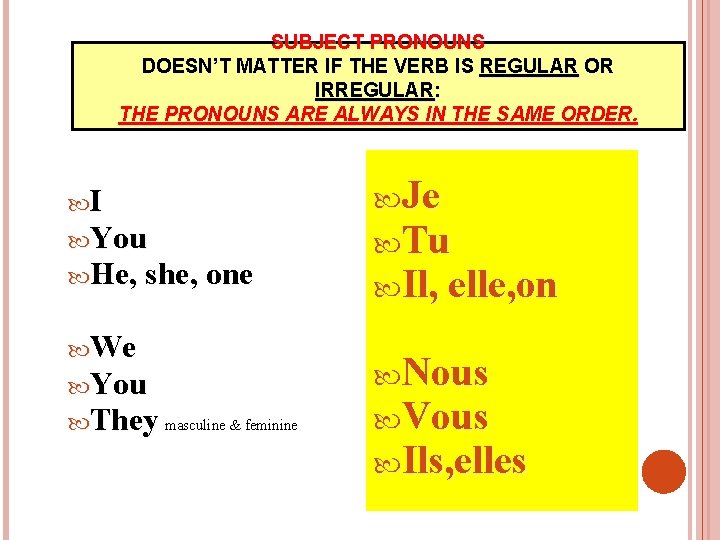
SUBJECT PRONOUNS DOESN’T MATTER IF THE VERB IS REGULAR OR IRREGULAR: THE PRONOUNS ARE ALWAYS IN THE SAME ORDER. I Je He, she, one Il, elle, on You We You They masculine & feminine Tu Nous Vous Ils, elles
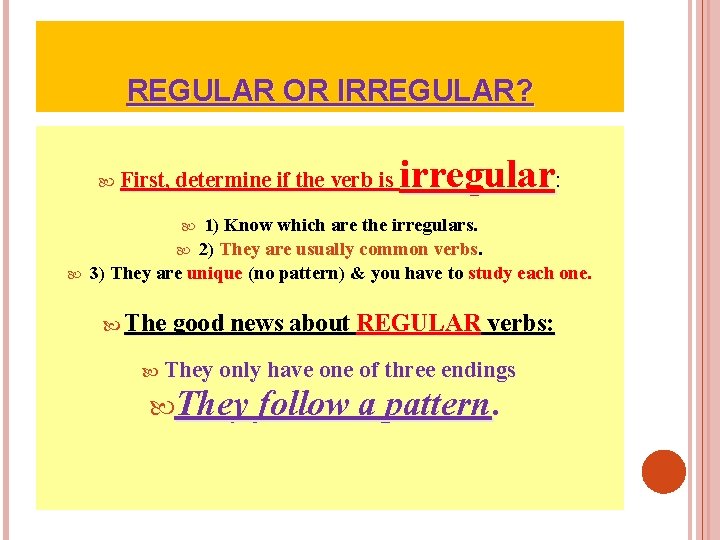
REGULAR OR IRREGULAR? First, determine if the verb is irregular: 1) Know which are the irregulars. 2) They are usually common verbs 3) They are unique (no pattern) & you have to study each one. The good news about REGULAR verbs: They only have one of three endings They follow a pattern.

REGULAR VERBS: THE PATTERN EXPLAINED The infinitive of most verbs in French end in the letters ER. Lesser numbers end in the letters IR and RE. Most follow a regular pattern for each “ending group” above. Exceptions to this pattern are called irregular verbs. So if you learn the regular patterns you will know the patterns for most verbs. To conjugate each verb in the present tense, the last two letters (ER, IR, RE) are dropped and a different ending is added for each pronoun (I, you, he, she, it, we, you all, they).
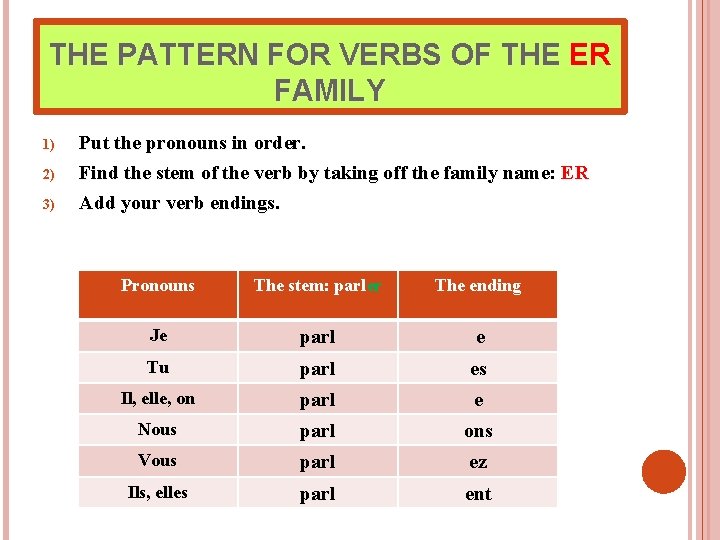
THE PATTERN FOR VERBS OF THE ER FAMILY 1) 2) 3) Put the pronouns in order. Find the stem of the verb by taking off the family name: ER Add your verb endings. Pronouns The stem: parler The ending Je parl e Tu parl es Il, elle, on parl e Nous parl ons Vous parl ez Ils, elles parl ent
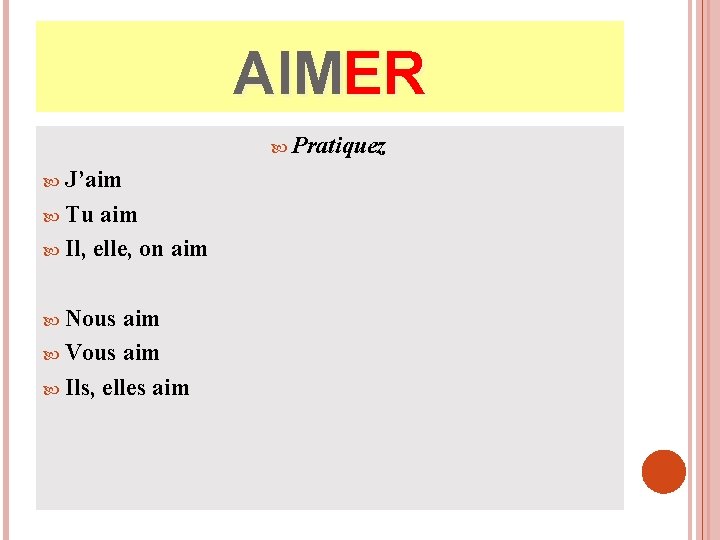
AIMER Pratiquez J’aim Tu aim Il, elle, on aim Nous aim Vous aim Ils, elles aim
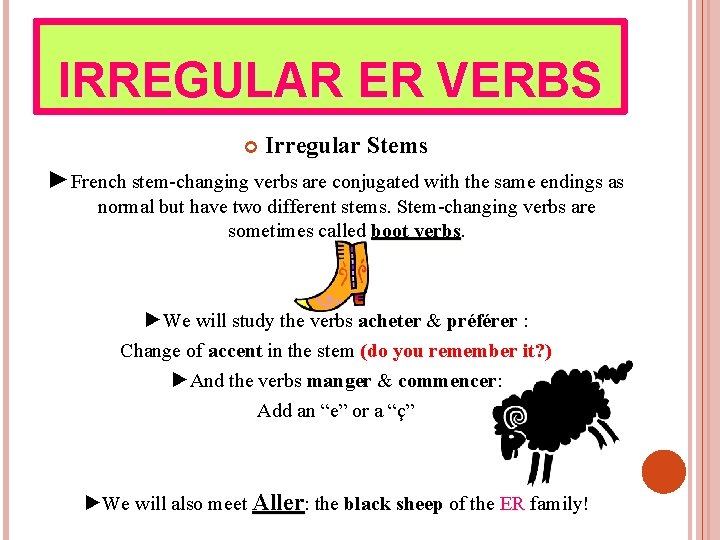
IRREGULAR ER VERBS Irregular Stems ►French stem-changing verbs are conjugated with the same endings as normal but have two different stems. Stem-changing verbs are sometimes called boot verbs ►We will study the verbs acheter & préférer : Change of accent in the stem (do you remember it? ) ►And the verbs manger & commencer: commencer Add an “e” or a “ç” ►We will also meet Aller: the black sheep of the ER family!
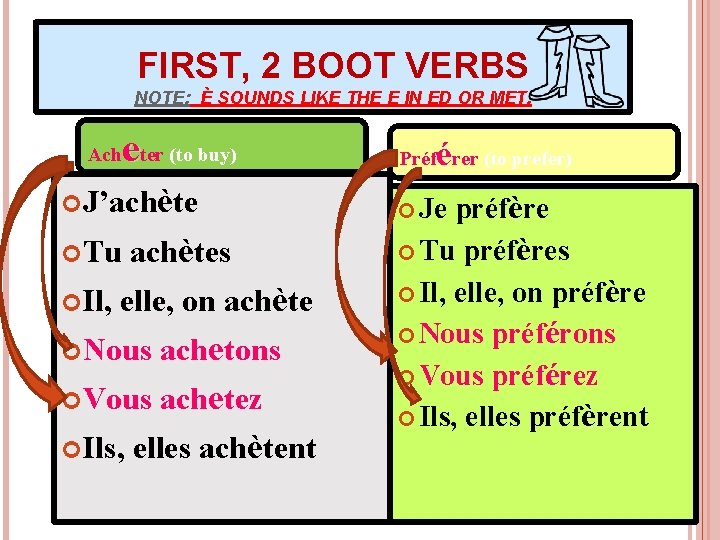
FIRST, 2 BOOT VERBS NOTE: È SOUNDS LIKE THE E IN ED OR MET. e Ach ter (to buy) J’achète Tu Il, achètes elle, on achète Nous achetons Vous achetez Ils, elles achètent é Préf rer (to prefer) préfère Tu préfères Il, elle, on préfère Nous préférons Vous préférez Ils, elles préfèrent Je
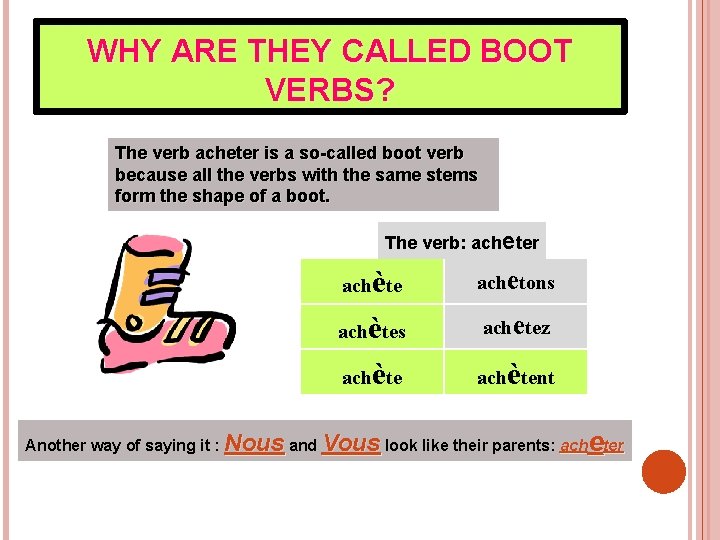
WHY ARE THEY CALLED BOOT VERBS? The verb acheter is a so-called boot verb because all the verbs with the same stems form the shape of a boot. The verb: acheter è achètes achète achetons achetez è ach tent e Another way of saying it : Nous and Vous look like their parents: ach ter
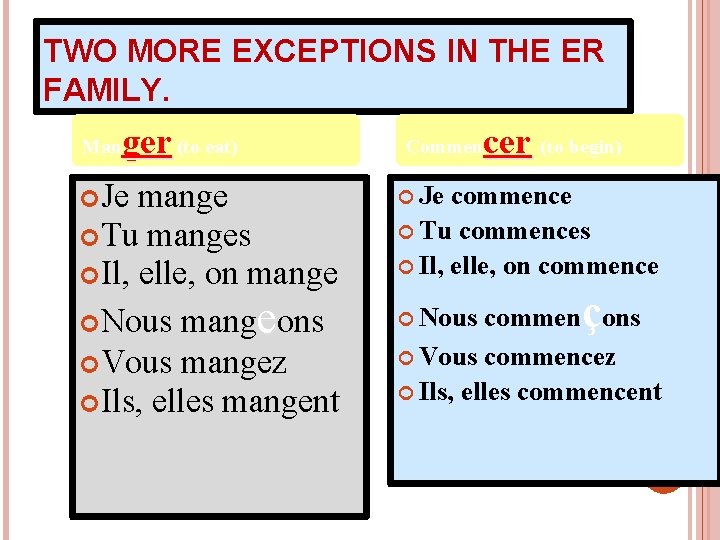
TWO MORE EXCEPTIONS IN THE ER FAMILY. Man ger (to eat) Je mange Tu manges Il, elle, on mange Nous mangeons Vous mangez Ils, elles mangent Commen cer (to begin) Je commence Tu commences Il, elle, on commence Nous ç commen ons Vous commencez Ils, elles commencent
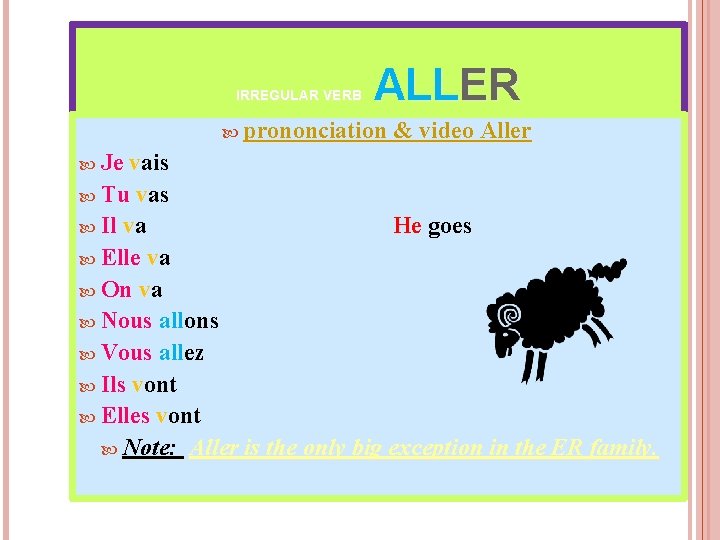
IRREGULAR VERB ALLER prononciation & video Aller Je vais Tu vas Il va He goes Elle va On va Nous allons Vous allez Ils vont Elles vont Note: Aller is the only big exception in the ER family.
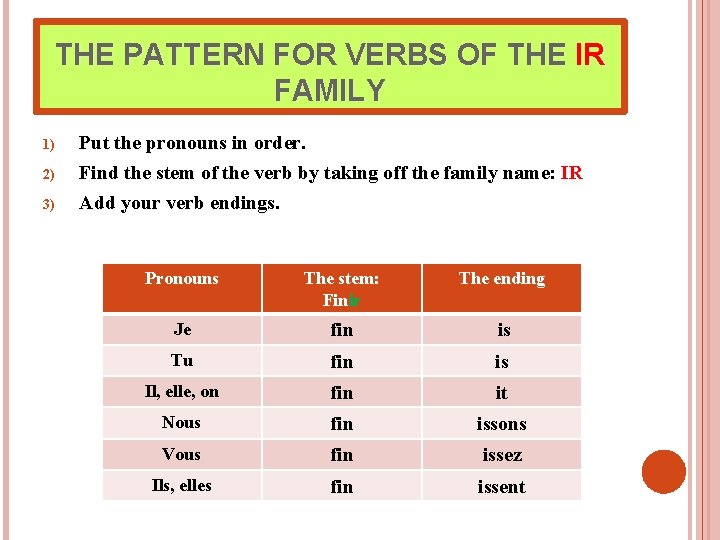
THE PATTERN FOR VERBS OF THE IR FAMILY 1) 2) 3) Put the pronouns in order. Find the stem of the verb by taking off the family name: IR Add your verb endings. Pronouns The stem: Finir The ending Je fin is Tu fin is Il, elle, on fin it Nous fin issons Vous fin issez Ils, elles fin issent
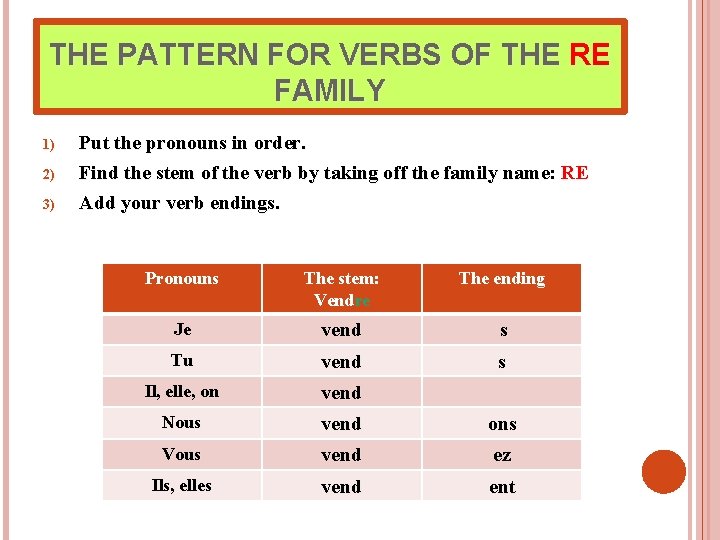
THE PATTERN FOR VERBS OF THE RE FAMILY 1) 2) 3) Put the pronouns in order. Find the stem of the verb by taking off the family name: RE Add your verb endings. Pronouns The stem: Vendre The ending Je vend s Tu vend s Il, elle, on vend Nous vend ons Vous vend ez Ils, elles vend ent
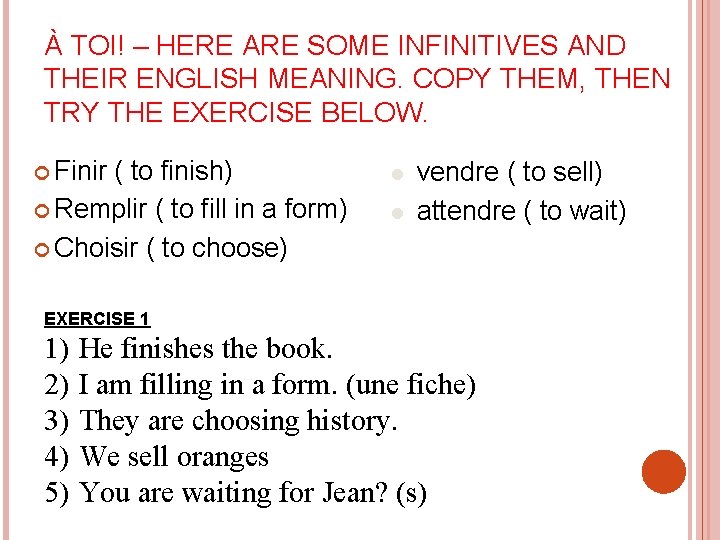
À TOI! – HERE ARE SOME INFINITIVES AND THEIR ENGLISH MEANING. COPY THEM, THEN TRY THE EXERCISE BELOW. Finir ( to finish) Remplir ( to fill in a form) Choisir ( to choose) l l vendre ( to sell) attendre ( to wait) EXERCISE 1 1) He finishes the book. 2) I am filling in a form. (une fiche) 3) They are choosing history. 4) We sell oranges 5) You are waiting for Jean? (s)
- Slides: 15