
Conjoint Behavioral Consultation The Effectiveness of a Partnership
Conjoint Behavioral Consultation: The Effectiveness of a Partnership Orientation S. Andrew Garbacz, M. A. Ashley M. Rohlk, M. A. Michelle S. Swanger, M. A. Kathryn E. Woods, B. S. Kathryn A. Black, B. A. Susan M. Sheridan, Ph. D. University of Nebraska at Lincoln Paper presented at the annual conference of the National Association of School Psychologists March, 2006 Anaheim, CA
Families and Schools p There are numerous settings in which children learn n Children spend an estimated 91% of their time between birth to the age of 18 outside of school (Usdan, 1990); once in school, they spend an estimated 70% of their time outside of school (Clark, 1990). p Families provide the single most important influence on a child’s development, where schools provide the second most important influence. p Families provide unique contributions to children’s academic, behavioral, and socioemotional outcomes. p The interface of families and schools provide children, families, and educators with favorable outcomes.
Family-Centered Perspective p Aimed at “enabling individuals and groups to become better able to solve problems, meet needs, or achieve aspirations by promoting the acquisition of competencies that support and strengthen functioning in a way that permits a greater sense of individual or group control over its developmental course” (Dunst, Trivette, Davis, & Cornwell, 1994, p. 162). p Characteristics: n Recognizes family as the constant within a child’s life n A positive and proactive approach emphasizes the need to support and strengthen family functioning n Services are delivered “with” families, not “to” or “for” families
Partnership-Oriented Perspective p Families and educators are unique, co-equal partners and contributors, to a child’s learning. p An extension of family-centered principles wherein educators or other support personnel contribute to the child’s learning and development. p Underlying principles: n n No fault approach (i. e. , shared ownership) Nondeficit approach (i. e. , strengths-based) Facilitates empowerment Facilitates an ecological approach (i. e. , emphasis on the mesosystem) (Christenson & Hirsch, 1998) p Conjoint Behavioral Consultation (CBC) is one model for promoting partnerships between families and schools.
Conjoint Behavioral Consultation p Conjoint Behavioral Consultation (CBC; Sheridan, Kratochwill, & Bergan, 1996) p Characteristics: n A structured, indirect model of service delivery. n Procedurally defined in 3 interviews: Conjoint Needs Identification Interview, Conjoint Needs Analysis Interview, and Conjoint Plan Evaluation Interview. n Families and teachers collaboratively address student needs with a consultant in problem-solving framework. n Aims to facilitate and promote partnerships through shared responsibility, a strengths-based orientation, relationship building, and skill building.
Conjoint Behavioral Consultation p CBC has been found to be: n An acceptable model of service delivery as reported by school psychologists, families and teachers (Freer & Watson, 1999; Sladeczek, Madden, Illsley, Finn, & August, 2006; Sheridan & Steck, 1995). n An evidence based consultation model effective in addressing students’ academic, behavioral, and social needs (Guli, 2005; Sheridan, Eagle, Cowan, & Mickelson, 2001).
Conjoint Behavioral Consultation: A Partnership Model p CBC engenders a family-centered positive psychology philosophy (Sheridan, Warnes, Cowan, Schemm, & Clarke, 2004) n Family-centered positive psychology principles: p p n Focuses on processes, rather than outcomes Builds on family strengths to access and mobilize resources Focuses on family-identified needs Promotes skill acquisition and competencies Family-centered positive psychology principles in CBC: p p p Addresses family and teacher identified needs Establishes partnerships between families and schools Develops and enhances the skills and competencies of families and teachers
Conjoint Behavioral Consultation: A Partnership Model p CBC is also related to effective helping (Sheridan et al. , 2004) n Helping characteristics embedded in CBC: Responsiveness to parent and teacher needs p Promotion of competency acquisition p Promotion of partnership and collaboration among systems (i. e. , family and school) p n Parents’ and teachers’ views of helpfulness are not always congruent.
Conjoint Behavioral Consultation: A Partnership Model p Dialogue between consultants and consultees reflect collaboration within CBC interviews (Sheridan, Meegan, & Eagle, 2002). p As measured by the Partnership Orientation Scale, CBC consultants are generally effective in conveying a partnership tone in relationship to: n Focusing on strengths, teaming and collaboration, encouraging, being sensitive and responsive, communicating effectively, developing skills, and being resourceful and sharing information (Sheridan et al. , 2005). p The degree to which a partnership orientation predicts CBC outcomes and relates to CBC service delivery (i. e. , implementation integrity) have not been investigated.
Current Study p Purpose n p Investigate the degree to which CBC as a partnership model predicts case outcomes Research Questions n Does partnership orientation predict CBC case outcomes? n What is the relationship between partnership orientation and integrity of the CBC problem-solving objectives?
Methods
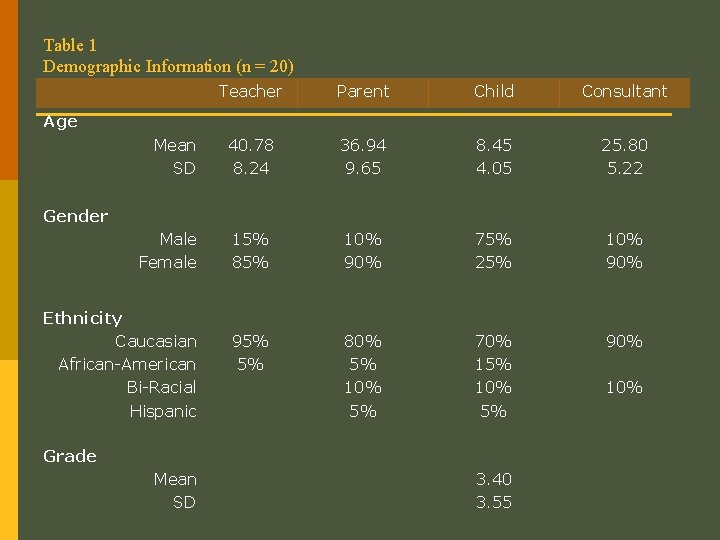
Table 1 Demographic Information (n = 20) Teacher Parent Child Consultant Mean SD 40. 78 8. 24 36. 94 9. 65 8. 45 4. 05 25. 80 5. 22 Male Female 15% 85% 10% 90% 75% 25% 10% 95% 5% 80% 5% 10% 5% 70% 15% 10% 5% 90% Age Gender Ethnicity Caucasian African-American Bi-Racial Hispanic Grade Mean SD 3. 40 3. 55 10%
Variables p Predictor Variable: n p Partnership Orientation Outcome Variables: n n n Satisfaction Acceptability Perceptions of Effectiveness Child Outcomes Process Integrity
Measures Predictor Variable: Effectiveness with which the consultant demonstrated a partnership orientation throughout the CBC process p Partnership Orientation Scale (POS) n Seven partnership oriented items rated on a 6 point Likert scale across 3 interviews. n Total partnership score for each case was derived by averaging the consultant’s scores on each partnership-centered item across CBC interviews. n Early research with the POS has yielded adequate internal consistency estimates (alpha =. 90).
Measures Outcome Variables: p Satisfaction n n p Parent and teacher satisfaction with the CBC process was assessed using the Consultant Evaluation Form (CEF; Erchul, 1987). Parents and teachers rated the degree to which they were satisfied with the CBC process and the consultant using a 12 item, 7 -point Likert scale. Acceptability n n Parents’ and teachers’ beliefs of treatment acceptability were examined using a revised version of the acceptability factor of the Behavior Intervention Rating Scale-Revised (BIRS-R; Elliott & Von Brock Treuting, 1991). Parents and teachers rated their acceptability of the CBC process using a 15 item, 6 -point Likert scale.
Measures Outcome Variables: p Perception of Effectiveness n n p Parents’ and teachers’ beliefs of treatment effectiveness were examined using the effectiveness factor of the BIRS-R (Elliott & Von Brock Treuting, 1991). Parents and teachers rated their perceived effectiveness of the CBC process using a 7 item, 6 -point Likert scale. Child Outcomes n n Effect sizes were computed for each case using a “no assumptions approach” (Busk & Serlin, 1992). Case effect sizes ranged from -1. 95 to 2. 79
Measures Outcome Variables: p Process Integrity n Process Integrity was measured by independent observers using the CBC Objectives Checklist. n The checklists were summaries of CBC objectives as listed on the CBC structured interview forms (Sheridan et al. , 1996). n Across all consultants and interviews, an average of 89% of the objectives were met.
Procedures p Interviews comprised 20 randomly selected cases from an existing database of CBC cases completed by school psychology graduate students between 1998 and 2005. p Using the POS, each of the CBC interviews were coded based on the degree to which consultants effectively demonstrated a partnership orientation in CBC. p Cases were randomly assigned to a team of 8 coders who had been trained to mastery in the CBC process and in the use of the POS. n n n p 33% of the interviews were coded by two coders. Ratings were considered reliable if they were within 1 effectiveness rating of each other. Inter-rater reliability = 100%. Data for all outcome variables were collected and calculated at the conclusion of CBC cases.
Analyses and Results
Analyses p Regression analyses were conducted to assess the degree to which partnership orientation predicted satisfaction, acceptability, perceived effectiveness, and effect sizes. p Pearson product-moment correlation coefficient analyses were conducted to assess the relationship between partnership orientation and CBC process integrity. p We hypothesized that high levels of partnership orientation would be associated with positive case outcomes. n p Due to the directional nature of the hypothesis, 1 -tailed hypothesis tests were used. We hypothesized that high levels of partnership orientation would be negatively correlated with integrity of the CBC process.

Results
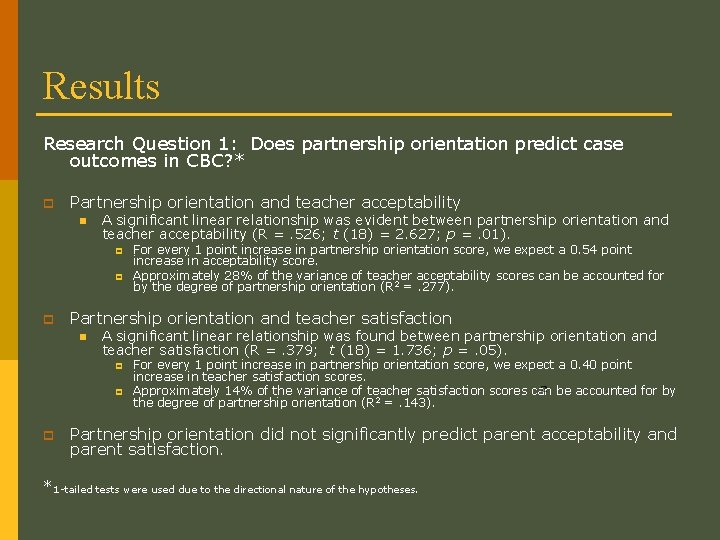
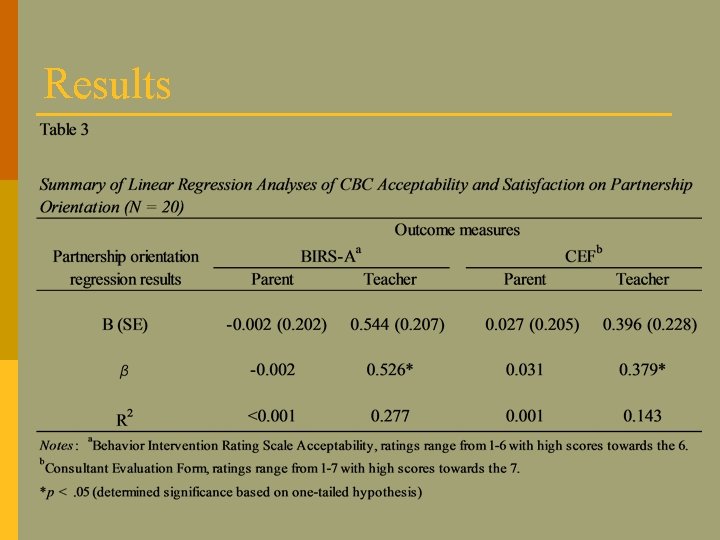
Results Research Question 1: Does partnership orientation predict case outcomes in CBC? * p Partnership orientation and teacher acceptability n A significant linear relationship was evident between partnership orientation and teacher acceptability (R =. 526; t (18) = 2. 627; p =. 01). p p p Partnership orientation and teacher satisfaction n A significant linear relationship was found between partnership orientation and teacher satisfaction (R =. 379; t (18) = 1. 736; p =. 05). p p p For every 1 point increase in partnership orientation score, we expect a 0. 54 point increase in acceptability score. Approximately 28% of the variance of teacher acceptability scores can be accounted for by the degree of partnership orientation (R 2 =. 277). For every 1 point increase in partnership orientation score, we expect a 0. 40 point increase in teacher satisfaction scores. Approximately 14% of the variance of teacher satisfaction scores can be accounted for by the degree of partnership orientation (R 2 =. 143). Partnership orientation did not significantly predict parent acceptability and parent satisfaction. *1 -tailed tests were used due to the directional nature of the hypotheses.
Results
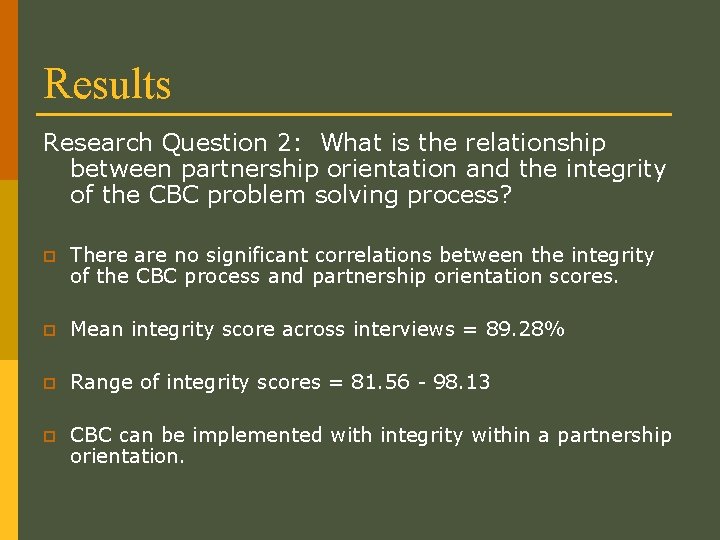
Results Research Question 2: What is the relationship between partnership orientation and the integrity of the CBC problem solving process? p There are no significant correlations between the integrity of the CBC process and partnership orientation scores. p Mean integrity score across interviews = 89. 28% p Range of integrity scores = 81. 56 - 98. 13 p CBC can be implemented with integrity within a partnership orientation.

Discussion
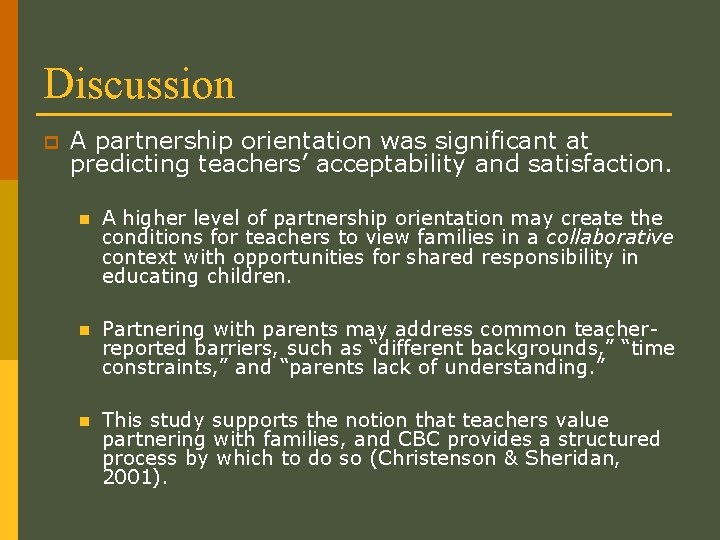
Discussion p A partnership orientation was significant at predicting teachers’ acceptability and satisfaction. n A higher level of partnership orientation may create the conditions for teachers to view families in a collaborative context with opportunities for shared responsibility in educating children. n Partnering with parents may address common teacherreported barriers, such as “different backgrounds, ” “time constraints, ” and “parents lack of understanding. ” n This study supports the notion that teachers value partnering with families, and CBC provides a structured process by which to do so (Christenson & Sheridan, 2001).
Discussion p Parents’ acceptability and satisfaction with the CBC process were not predicted by partnership orientation. n Parents routinely describe the CBC experience very favorably (e. g. , Sheridan et al. , 2001; Sheridan & Steck, 1995; Sladeczek et al, 2006). n The degree to which a partnership “tone” is projected may be less important than their sheer inclusion in problem-solving and decision-making. n CBC is experienced by parents in a manner that is distinct from other forms of traditional parent involvement (e. g. , parent teacher conferences).
Discussion p p Partnership orientation did not significantly predict child outcomes. n A partnership orientation, although important, is not sufficient to account for child outcomes. n CBC is a structured process within which evidence -based interventions can be developed and implemented (White & Kratochwill, in press). There were no significant relationships between the integrity of the CBC process and partnership orientation. n The integrity of the problem-solving objectives of CBC, which include an emphasis on data-based decision making, can be retained even within a partnership-oriented practice.
Implications for Practice p Results of this study revealed that teachers appear to value partnering with families, which provides further support for educators to continue findings ways to enhance partnerships in school settings. p The partnership “tone” conveyed to families does not seem as important as being included in the process; therefore, efforts with families should be focused on moving from basic levels of involvement to embodying a more active partnership role. p Partnership building should remain to be an integral part of pre-service education, especially considering increasing the level of partnership does not negatively affect the fidelity of the problem-solving model.
Limitations and Future Directions p Because of the small sample size (N = 20) the generalizability of these findings are limited. Future research should, among other things, include a larger sample. p Overall, parents and teachers reported high levels of acceptability, satisfaction, and perceived effectiveness, resulting in a lack of variability in some outcome data. p The manner in which effect sizes were calculated may be unreliable, resulting in potentially inflated effect sizes and a high degree of variability (SD = 1. 04).
Limitations and Future Directions p Direct outcome data are derived from information provided by parents and teachers and not independent observations. p The Partnership Orientation Scale is in need of further investigations to assess its psychometric properties; however, it appears to be an instrument that may be helpful in assessing the level of partnership orientation in existing models and aiding in the development of future partnership oriented models. p Consultants were involved in identical, rigorous, and systematic training procedures in CBC; thus, the external validity of the findings are questioned.
For More Information, contact: Dr. Susan M. Sheridan Nebraska Center for Research on Children, Youth, Families and Schools 216 Mabel Lee Hall University of Nebraska at Lincoln, NE 68588 -0235 (402) 472 -2448 ssheridan 2@unl. edu
References Busk, P. , & Serlin, R. (1992). Meta-analysis for single-case research. In T. R. Kratochwill & J. Levin (Eds. ), Single-case research design and analysis (pp. 187 -212). Hillside, NJ: Erlbaum. Christenson, S. L. , & Hirsch, J. A. (1998). Facilitating partnerships and conflict resolution between families and schools. In K. Stoiber & T. Kratochwill (Eds. ), Handbook of group intervention for children and families (pp. 307 -344). Boston, MA: Allyn & Bacon. Christenson, S. L. & Sheridan, S. M. (2001). Schools and families: Creating essential connections for learning. New York: Guilford Press. Clark, R. M. (1990). Why disadvantaged students succeed: What happens outside school is critical. Public Welfare, 17 -23. Dunst, C. J. , Trivette, C. M. , Davis, M. , & Cornwell, J. C. (1994). Characteristics of effective help-giving practices. In C. Dunst, C. Trivette, A. Deal (Eds. ), Supporting and strengthening families. Vol. 1: Methods, strategies and practices (pp. 171 -186). Cambridge, MA: Brookline.
References Elliott, S. N. , & Von Brock Treuting, M. B. (1991). The behavior intervention rating scale: The development and validation of a social validity measure. Journal of School Psychology, 29, 43 -52. Erchul, W. P. (1987). A relational communication analysis of control in school consultation. Professional School Psychology, 2, 113 -124. Freer, P. , & Watson, T. S. (1999). A comparison of parent and teacher acceptability ratings of behavioral and conjoint behavioral consultation. School Psychology Review, 28, 672 -684. Guli, L. A. (2005). Evidence-based parent consultation with school-related outcomes. School Psychology Quarterly, 20, 455 -472. Sheridan, S. M. , Eagle, J. W. , Cowan, R. J. , & Mickelson, W. (2001). The effects of conjoint behavioral consultation results of a four year investigation. Journal of School Psychology, 39, 361 -385.
References Sheridan, S. M. , Erchul, W. P. , Brown, M. S. , Dowd, S. E. , Warnes, E. D. , & Marti, D. C. , et al. , (2004). Perceptions of helpfulness in conjoint behavioral consultation: Congruence and agreement between teachers and parents. School Psychology Quarterly, 19, 121 -140. Sheridan, S. M. , Kratochwill, T. R. , & Bergan, J. R. (1996). Conjoint behavioral consultation: A procedural manual. New York: Plenum Press. Sheridan, S. M. , Marti, D. C. , Clarke, B. L. , Burt, J. D. , Black, K. A. , Rohlk, A. M. , Woods, K. E. , Garbacz, S. A. , Swanger, M. S. , Olson, S. C. , & Magee, K. (2005). Is conjoint behavioral consultation partnership centered? An exploratory analysis. Paper presented at the annual conference for the National Association of School Psychologists, Atlanta, GA. Sheridan, S. M. , Meegan, S. P. , & Eagle, J. W. (2002). Assessing the social context in initial conjoint behavioral consultation interviews: An exploratory analysis investigating processes and outcomes. School Psychology Quarterly, 17, 299 -324.
References Sheridan, S. M. , & Steck, M. C. (1995). Acceptability of conjoint behavioral consultation: A national survey of school psychologists. School Psychology Review, 24, 633 -647. Sheridan, S. M. , Warnes, E. D. , Cowan, R. J. , Schemm, A. , & Clarke, B. L. (2004). Family-centered positive psychology: Focusing on strengths to build student success. Psychology in the Schools, 41, 7 -17. Sladeczek, I. E. , Madden, L. , Illsley, S. D. , Finn, C. , & August, P. J. (2006). American and Canadian perceptions of the acceptability of conjoint behavioral consultation. School Psychology International, 27, 57 -77. Usdan, M. (1990). Restructuring American educational systems and programs to accommodate a new health agenda for youth. Journal of School Health, 60(4), 139 -141. White, J. L. , & Kratochwill, T. R. (in press). School-based problem-solving consultation: Plotting a new course for evidence-based research and practice in consultation. In W. P. Erchul & S. M. Sheridan (Eds. ), Handbook of research in school consultation: Empirical foundations for the field. New York: Erlbaum.
- Slides: 36