
Conifer adaptations for drier environments Vegetative 3 Seed
- Slides: 27
Conifer adaptations for drier environments Vegetative 3. Seed plants have wood producing tissue well developed for water conduction and support. This enables plants to grow tall and out-compete neighbors
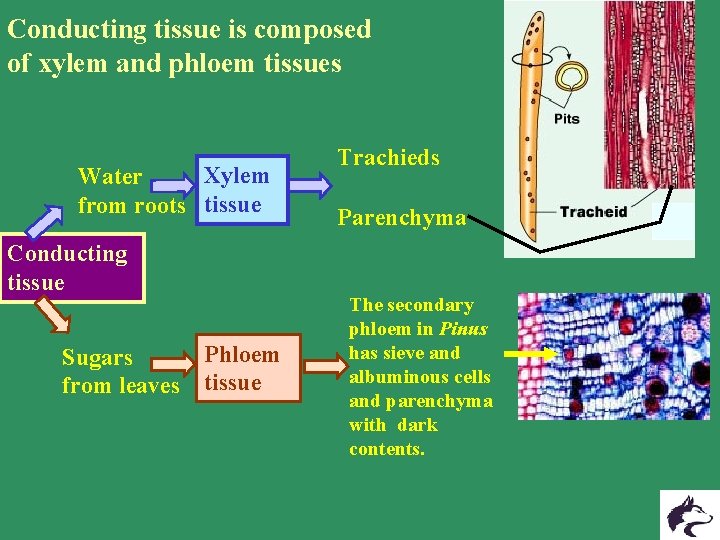
Conducting tissue is composed of xylem and phloem tissues Xylem Water from roots tissue Conducting tissue Phloem Sugars from leaves tissue Trachieds Parenchyma The secondary phloem in Pinus has sieve and albuminous cells and parenchyma with dark contents.
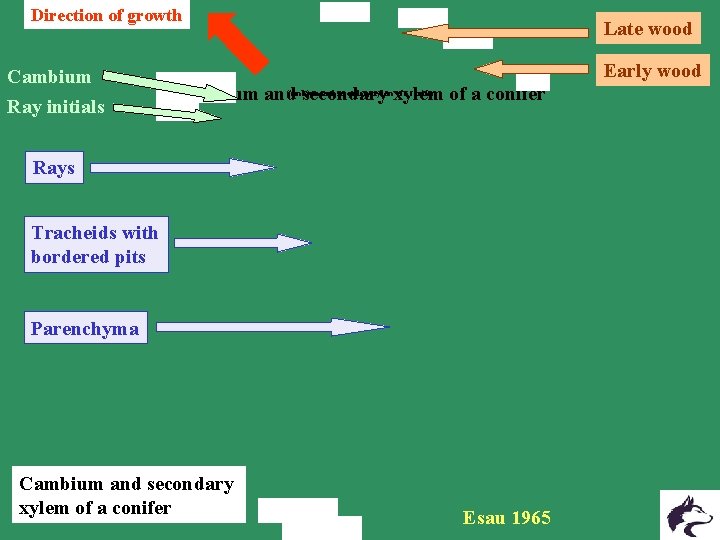
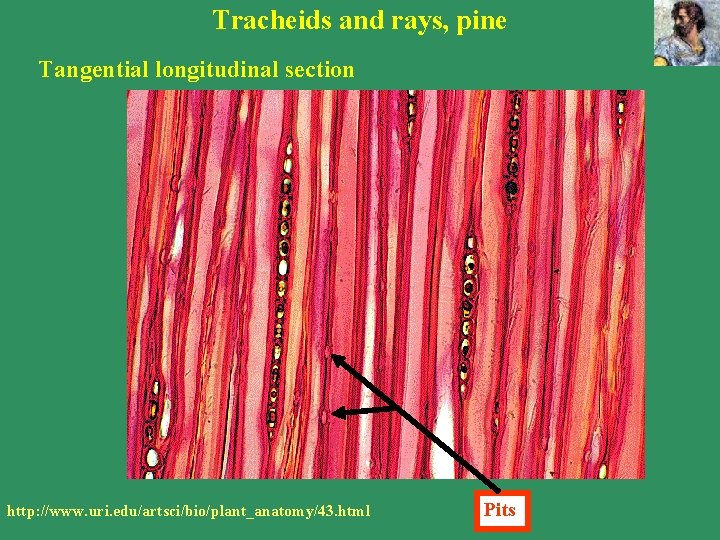
Secondary xylem is a complex tissue In conifers it consists of: tracheids that conduct water upwards, are long in the vertical direction, and have bordered pits parenchyma, thin walled cells ray cells running horizontally through the xylem and are composed mainly of parenchyma and some tracheids
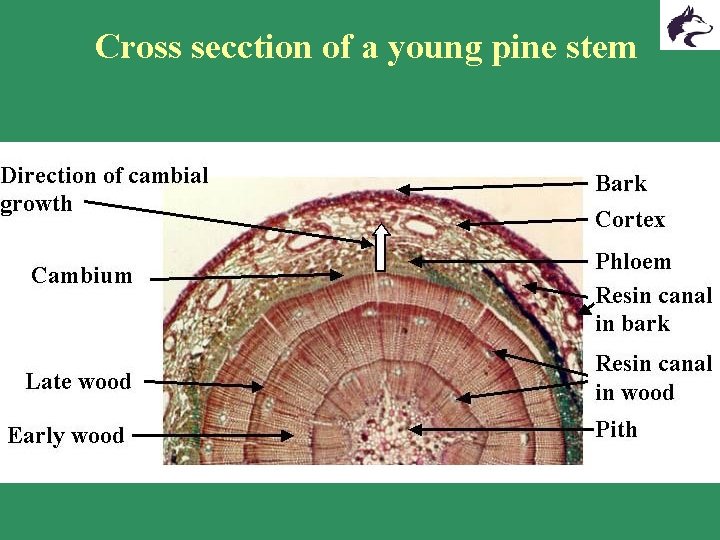
Cross secction of a young pine stem
Direction of growth Cambium Ray initials Late wood Early wood Cambium and secondary xylem of a conifer Rays Tracheids with bordered pits Parenchyma Cambium and secondary xylem of a conifer Esau 1965
Tracheids and rays, pine Tangential longitudinal section http: //www. uri. edu/artsci/bio/plant_anatomy/43. html Pits
Cavitation and Craig Aumann recovery from cavitation in Douglas-fir wood
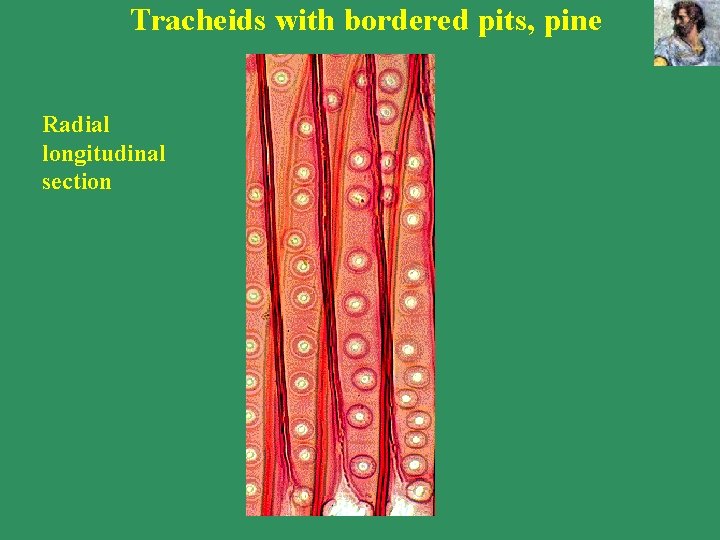
Tracheids with bordered pits, pine Radial longitudinal section
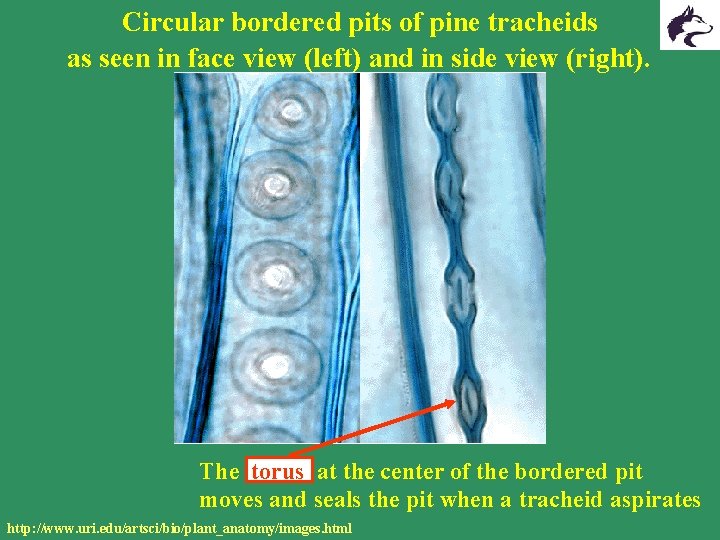
Circular bordered pits of pine tracheids as seen in face view (left) and in side view (right). Bordered pits The torus at the center of the bordered pit moves and seals the pit when a tracheid aspirates http: //www. uri. edu/artsci/bio/plant_anatomy/images. html
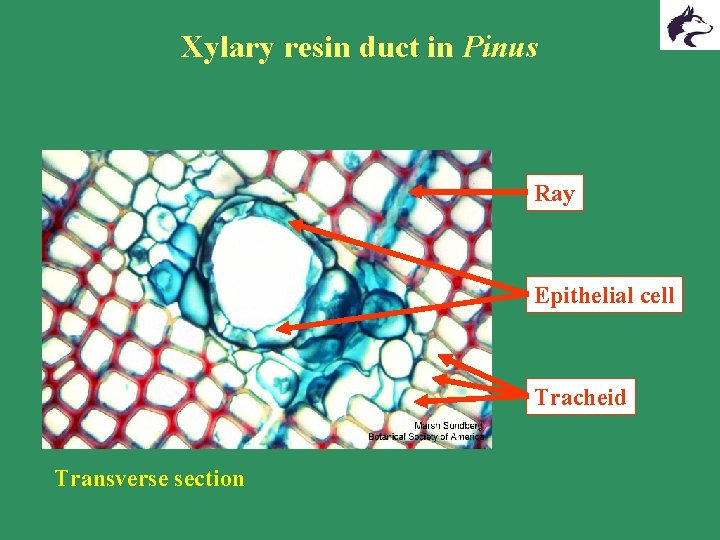
Xylary resin duct in Pinus Ray Epithelial cell Tracheid Transverse section
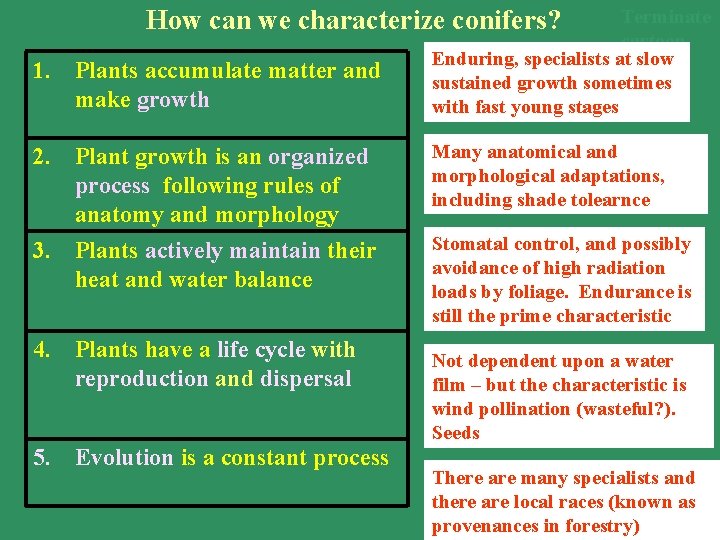
How can we characterize conifers? 1. Plants accumulate matter and make growth 2. Plant growth is an organized process following rules of anatomy and morphology 3. Plants actively maintain their heat and water balance 4. Plants have a life cycle with reproduction and dispersal 5. Evolution is a constant process Terminate cartoon Enduring, specialists at slow sustained growth sometimes with fast young stages Many anatomical and morphological adaptations, including shade tolearnce Stomatal control, and possibly avoidance of high radiation loads by foliage. Endurance is still the prime characteristic Not dependent upon a water film – but the characteristic is wind pollination (wasteful? ). Seeds There are many specialists and there are local races (known as provenances in forestry)
How the ecology of conifers determines an environmental issue
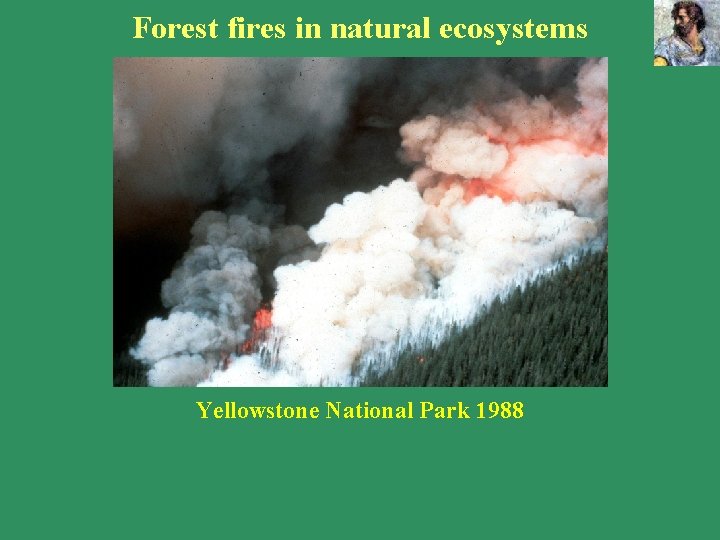
Forest fires in natural ecosystems Yellowstone National Park 1988
Forest fire can occur naturally Conifer species in the western USA form largely ‘dry’ land forests Many conifer species are adapted to withstand fire and/or regenerate following fire Examples?
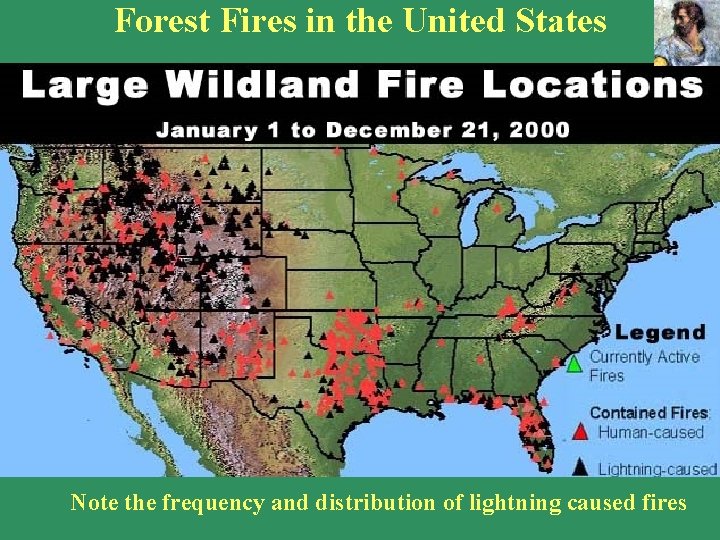
Forest Fires in the United States Note the frequency and distribution of lightning caused fires
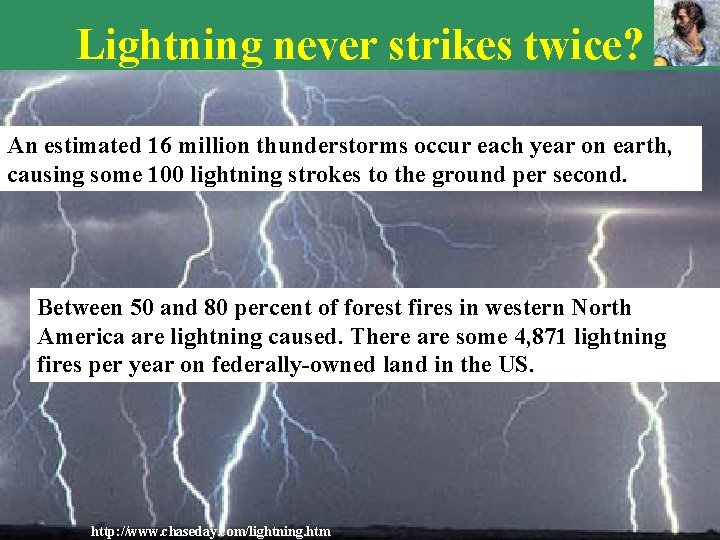
Lightning never strikes twice? An estimated 16 million thunderstorms occur each year on earth, causing some 100 lightning strokes to the ground per second. Between 50 and 80 percent of forest fires in western North America are lightning caused. There are some 4, 871 lightning fires per year on federally-owned land in the US. http: //www. chaseday. com/lightning. htm
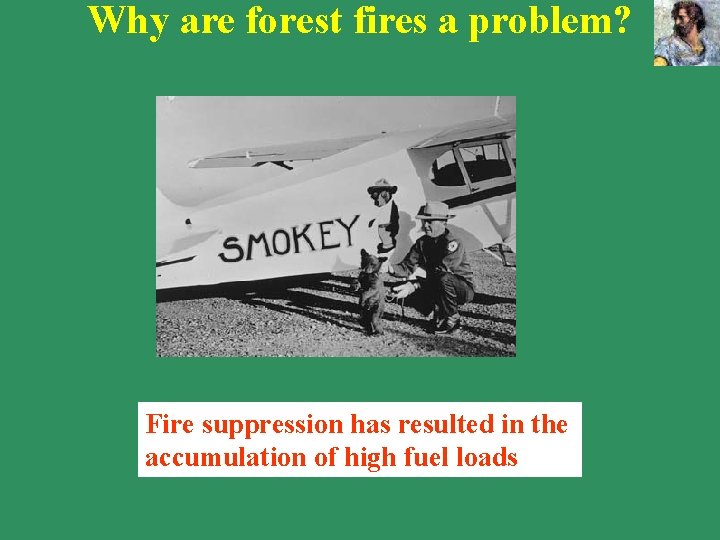
Why are forest fires a problem? Fire suppression has resulted in the accumulation of high fuel loads
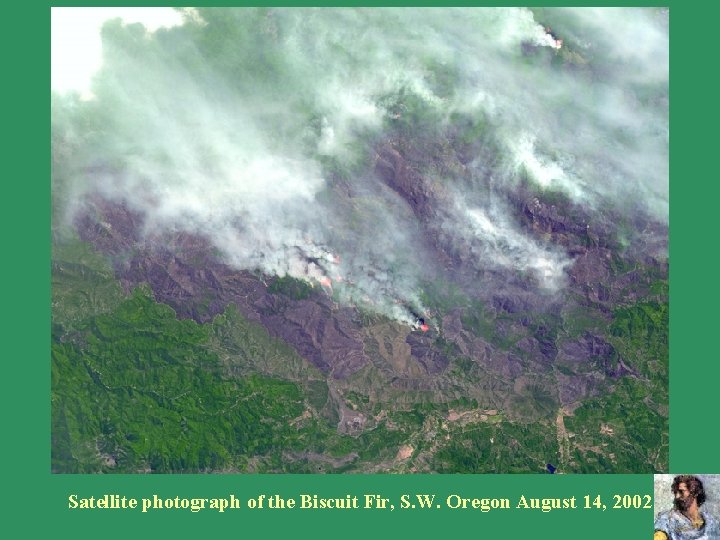
Satellite photograph of the Biscuit Fir, S. W. Oregon August 14, 2002
The Biscuit Fire started as a result of a series of lightning strikes on July 13, 2002 on the Siskiyou National Forest It cost an estimated $135 m to suppress at the date of containment. The fire grew to 499, 570 acres over two months On July 11, 2002, a Red Flag Warning was issued for dry lightning across southwestern Oregon beginning July 12. There were a number of lightening strikes from the same lightening cell and a number of fires were started on hill tops with no road access. Some fire staff had already been sent to New Mexico and Colorado fires. There was difficult, i. e. , not safe access, and initially the fire had low regional priority.
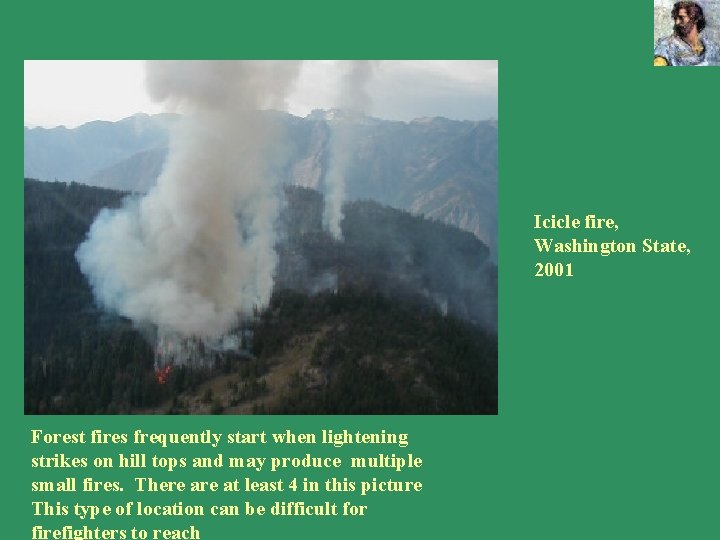
Icicle fire, Washington State, 2001 Forest fires frequently start when lightening strikes on hill tops and may produce multiple small fires. There at least 4 in this picture This type of location can be difficult for firefighters to reach
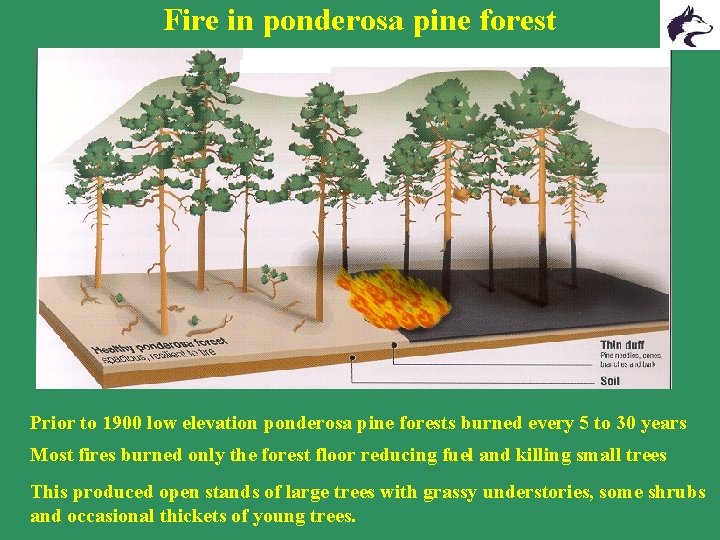
Fire in ponderosa pine forest Prior to 1900 low elevation ponderosa pine forests burned every 5 to 30 years Most fires burned only the forest floor reducing fuel and killing small trees This produced open stands of large trees with grassy understories, some shrubs and occasional thickets of young trees.
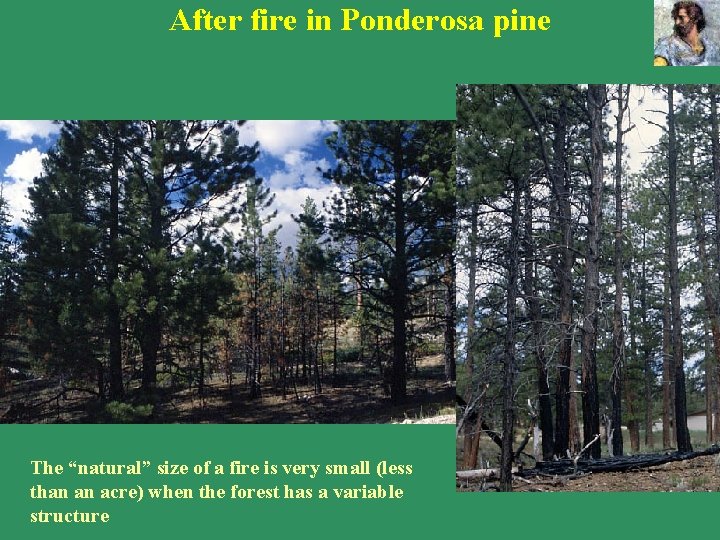
After fire in Ponderosa pine The “natural” size of a fire is very small (less than an acre) when the forest has a variable structure
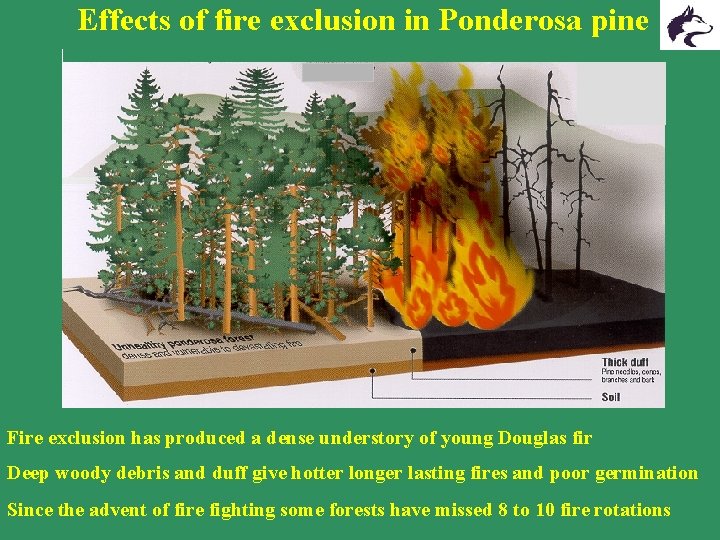
Effects of fire exclusion in Ponderosa pine Fire exclusion has produced a dense understory of young Douglas fir Deep woody debris and duff give hotter longer lasting fires and poor germination Since the advent of fire fighting some forests have missed 8 to 10 fire rotations
The consequences of fire protection in Ponderosa pine These photos were taken at Lick Creek in the Bitterroot Valley of Montana over an eighty-year period. Notice how the old growth ponderosa pine stand is replaced by dense Douglas-fir after fire suppression begins in the 1920 s. Exit Power. Point
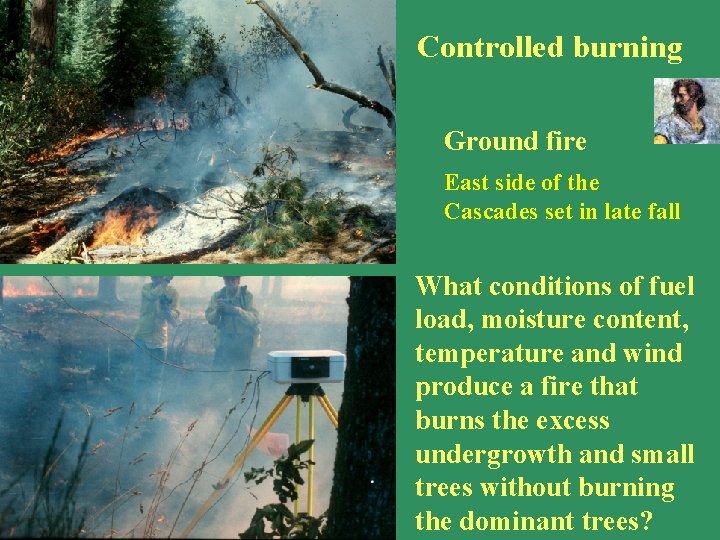
Controlled burning Ground fire East side of the Cascades set in late fall What conditions of fuel load, moisture content, temperature and wind produce a fire that burns the excess undergrowth and small trees without burning the dominant trees?
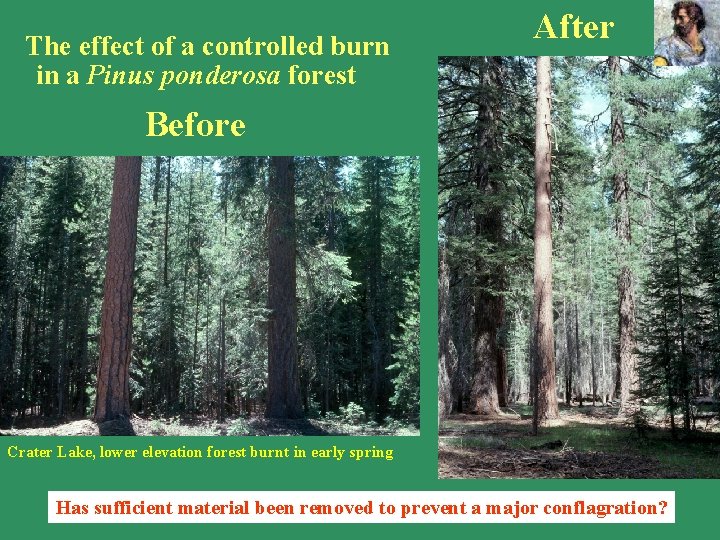
The effect of a controlled burn in a Pinus ponderosa forest After Before The effect of a controlled burn Crater Lake, lower elevation forest burnt in early spring Has sufficient material been removed to prevent a major conflagration?
Is there such a thing as a “natural” forest? If we define “natural” as not influenced by humans then wherever there has been an effective fire suppression policy is it reasonable to conclude that forests there are not natural?