
Congruent Figures Essential Question How can transformations be
Congruent Figures Essential Question? How can transformations be used to verify that two figures have the same shape and size? 8. G. 2
Common Core Standard: 8. G ─ Understand congruence and similarity using physical models, transparencies, or geometry software. 2. Understand that a two-dimensional figure is congruent to another if the second can be obtained from the first by a sequence of rotations, reflections, and translations; given two congruent figures, describe a sequence that exhibits the congruence between them.
Objectives: • To describe the effect of a translation, rotation, or reflections in relationship to the congruence of an image and its preimage.
Transformations The transformations we have studied so far do not change the size or shape of the original figure. Since the lengths of corresponding sides are equal and the measures of corresponding angles are equal, we can say that the image and preimage are CONGRUENT Two figures are CONGRUENT if there is a sequence of isometries of the plane onto itself that map one figure onto the other.
Transformations An ISOMETRY is a RIGID MOTION. Distances and angle measures are preserved. The ISOMETRIC transformations (preserve congruence) are: • TRANSLATIONS • REFLECTIONS • ROTATIONS The ONLY thing that could change when a figure undergoes a series (composition) of isometric transformations is the figure’s ORIENTATION
ORIENTATION The isometric transformations that preserve ORIENTATION are: • TRANSLATIONS The isometric transformations that change ORIENTATION are: • REFLECTIONS • ROTATIONS
Properties of ISOMETRIES • DISTANCE – Distance is preserved – Lines are taken to lines, line segments are taken to line segments of the same length • PARALLELISM – Parallelism is preserved – Parallel lines are taken to parallel lines • ANGLE MEASURE – Angle measure is preserved – Angles are taken to angles of the same measure
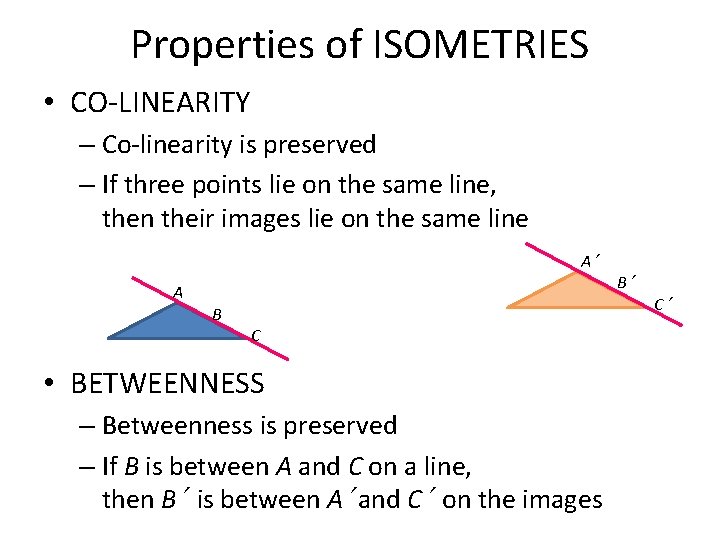
Properties of ISOMETRIES • CO-LINEARITY – Co-linearity is preserved – If three points lie on the same line, then their images lie on the same line A´ A B C • BETWEENNESS – Betweenness is preserved – If B is between A and C on a line, then B´ is between A´ and C´ on the images B´ C´
Transformations When you are told that two figures are congruent, there MUST be a sequence of translations, reflections, and/or rotations that transforms one into the other.
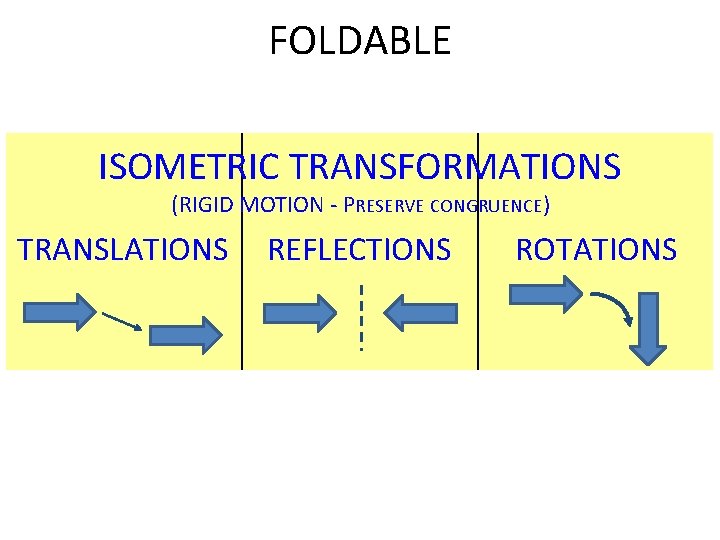
FOLDABLE ISOMETRIC TRANSFORMATIONS (RIGID MOTION - PRESERVE CONGRUENCE) TRANSLATIONS REFLECTIONS ROTATIONS
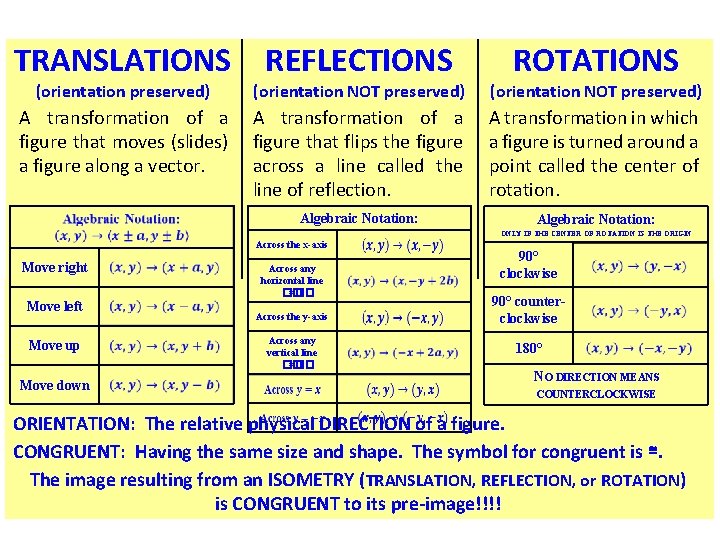
TRANSLATIONS REFLECTIONS ROTATIONS (orientation preserved) (orientation NOT preserved) A transformation of a figure that moves (slides) a figure along a vector. A transformation of a figure that flips the figure across a line called the line of reflection. A transformation in which a figure is turned around a point called the center of rotation. Algebraic Notation: ONLY IF THE CENTER OF ROTATION IS THE ORIGIN Across the x-axis Move right Move left Move up Move down Across any horizontal line �� =�� Across the y-axis Across any vertical line �� =�� 90° clockwise 90° counterclockwise 180° NO DIRECTION MEANS COUNTERCLOCKWISE ORIENTATION: The relative physical DIRECTION of a figure. CONGRUENT: Having the same size and shape. The symbol for congruent is ≅. The image resulting from an ISOMETRY (TRANSLATION, REFLECTION, or ROTATION) is CONGRUENT to its pre-image!!!!
- Slides: 11