
CONGRESS I Institutional Foundations II Key Functions III


- Slides: 33
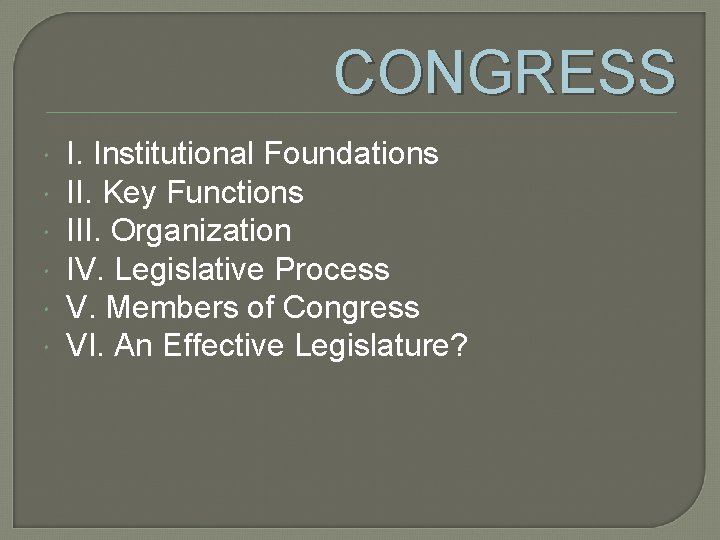
CONGRESS I. Institutional Foundations II. Key Functions III. Organization IV. Legislative Process V. Members of Congress VI. An Effective Legislature?
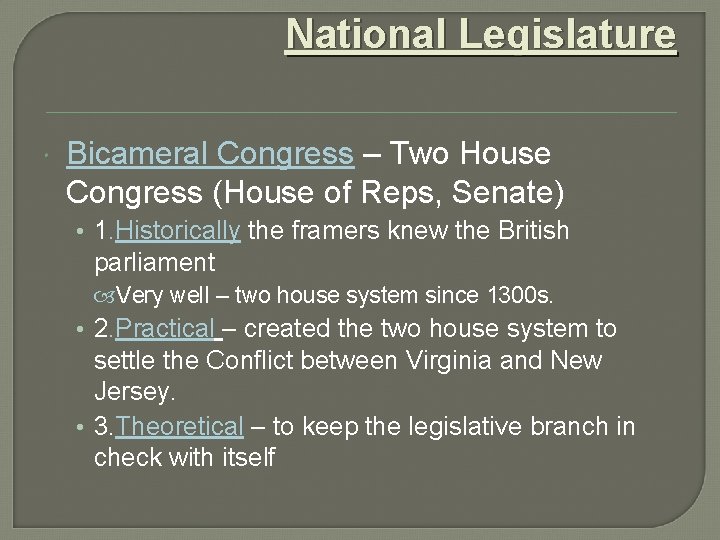
National Legislature Bicameral Congress – Two House Congress (House of Reps, Senate) • 1. Historically the framers knew the British parliament Very well – two house system since 1300 s. • 2. Practical – created the two house system to settle the Conflict between Virginia and New Jersey. • 3. Theoretical – to keep the legislative branch in check with itself
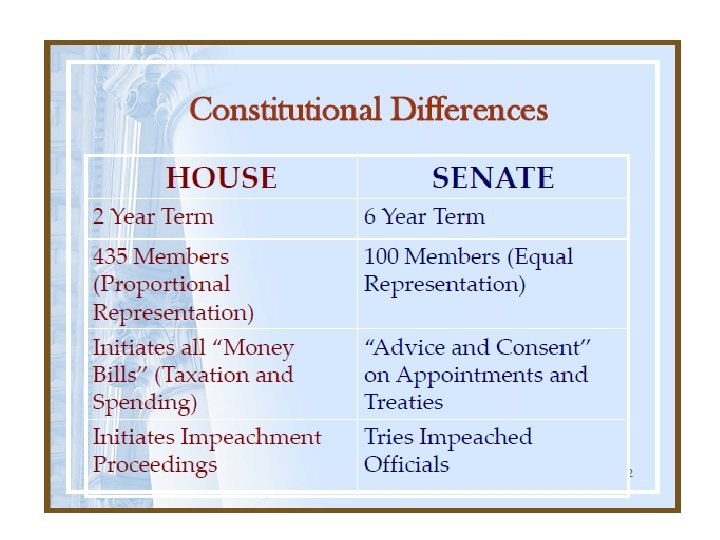
The Senate Size • 1. Two senators per state – (New Jersey Plan orgins) • 2. Equal Representation Term 1. Serve for Six years 2. No Term Limits
**Continuous Body** Qualifications • 1. Need to be 30 years old • 2. Be a citizen of the U. S. for Nine Years • 3. Must be an inhabitant of the state you are to be elected. Senate and House of Representatives • • • 1. Payment is around 160, 000 a year 2. Generous travel allowances 3. Special tax deductions 4. Covered by social security retirement and medicare 5. Free Postage
House of Representatives Size and Terms • 1. House of Representatives (435) and is apportioned. Apportioned – distributed to the states based on population • 2. Term of a Representative is 2 years • 3. There is no term limit on a representative
**Reapportioned – redistribute the seats on a decennial census Formal Qualifications. • 1. Must be 25 Years of age • 2. Must be a Citizen of the U. S. at least 7 years. • 3. Must be an inhabitant of the state he or she is elected
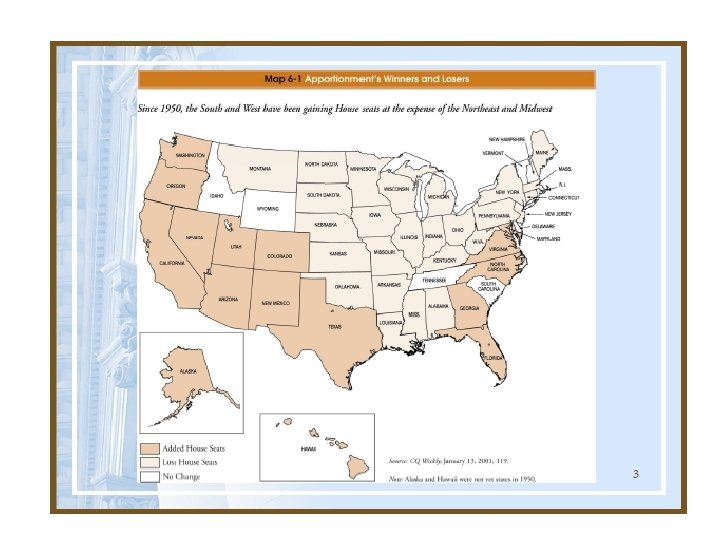
Reapportionment Act of 1929 1. Makes the House of Reps permanently 435 seats • **Unless Congress decides to change the number* 2. Census determines the number of seats each state should have. (The Bureau Plan) 3. When the Bureau Plan is ready the President must send it to Congress. 4. If neither house rejects the plan within 60 days of receiving it –It becomes effective. • **Gerrymandering – voting district lines that have been drawn up to the advantage to a political party advantage.
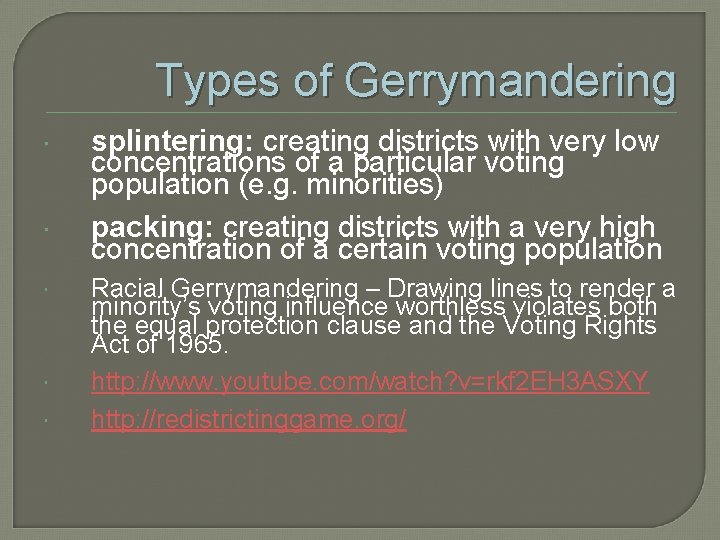
Types of Gerrymandering splintering: creating districts with very low concentrations of a particular voting population (e. g. minorities) packing: creating districts with a very high concentration of a certain voting population Racial Gerrymandering – Drawing lines to render a minority’s voting influence worthless violates both the equal protection clause and the Voting Rights Act of 1965. http: //www. youtube. com/watch? v=rkf 2 EH 3 ASXY http: //redistrictinggame. org/
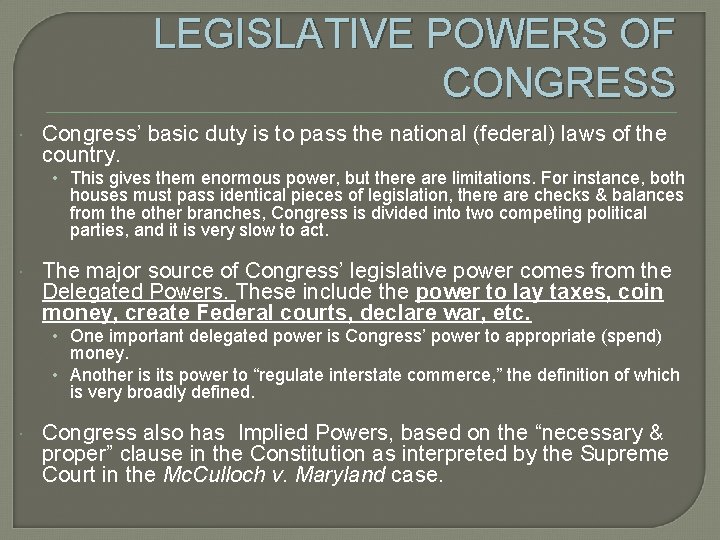
LEGISLATIVE POWERS OF CONGRESS Congress’ basic duty is to pass the national (federal) laws of the country. • This gives them enormous power, but there are limitations. For instance, both houses must pass identical pieces of legislation, there are checks & balances from the other branches, Congress is divided into two competing political parties, and it is very slow to act. The major source of Congress’ legislative power comes from the Delegated Powers. These include the power to lay taxes, coin money, create Federal courts, declare war, etc. • One important delegated power is Congress’ power to appropriate (spend) money. • Another is its power to “regulate interstate commerce, ” the definition of which is very broadly defined. Congress also has Implied Powers, based on the “necessary & proper” clause in the Constitution as interpreted by the Supreme Court in the Mc. Culloch v. Maryland case.
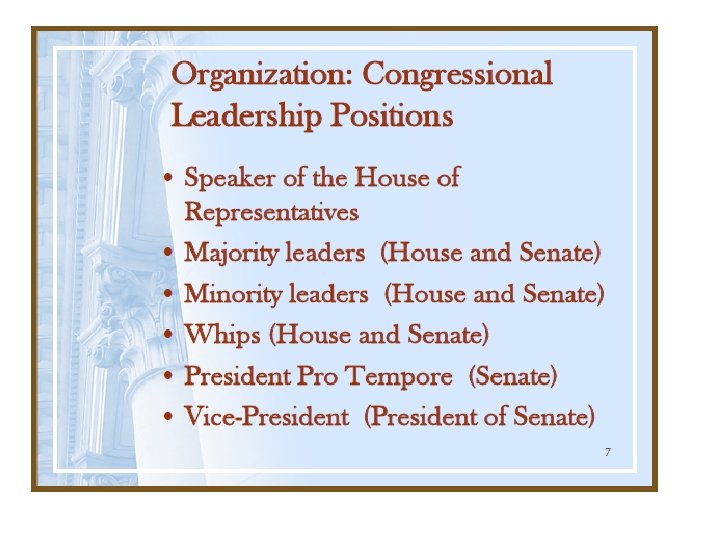
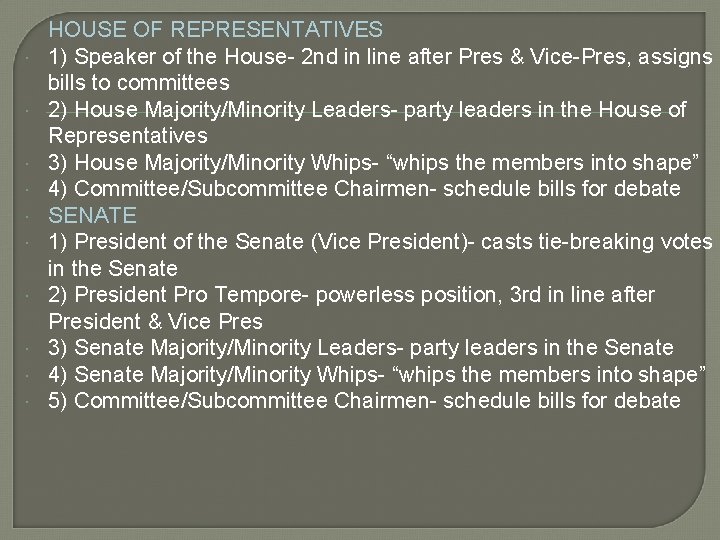
HOUSE OF REPRESENTATIVES 1) Speaker of the House- 2 nd in line after Pres & Vice-Pres, assigns bills to committees 2) House Majority/Minority Leaders- party leaders in the House of Representatives 3) House Majority/Minority Whips- “whips the members into shape” 4) Committee/Subcommittee Chairmen- schedule bills for debate SENATE 1) President of the Senate (Vice President)- casts tie-breaking votes in the Senate 2) President Pro Tempore- powerless position, 3 rd in line after President & Vice Pres 3) Senate Majority/Minority Leaders- party leaders in the Senate 4) Senate Majority/Minority Whips- “whips the members into shape” 5) Committee/Subcommittee Chairmen- schedule bills for debate
Special Session -A meeting to deal with emergency situations • 1. Can be called by the President • 2. The House or the Senate can be called in alone.
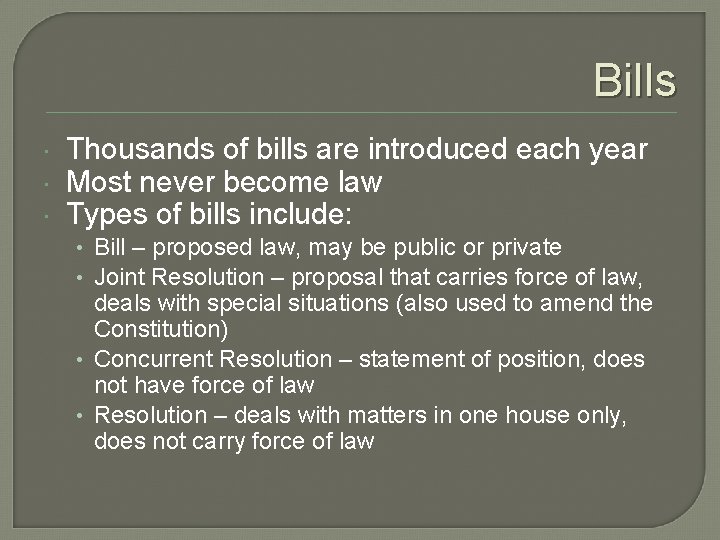
Bills Thousands of bills are introduced each year Most never become law Types of bills include: • Bill – proposed law, may be public or private • Joint Resolution – proposal that carries force of law, deals with special situations (also used to amend the Constitution) • Concurrent Resolution – statement of position, does not have force of law • Resolution – deals with matters in one house only, does not carry force of law
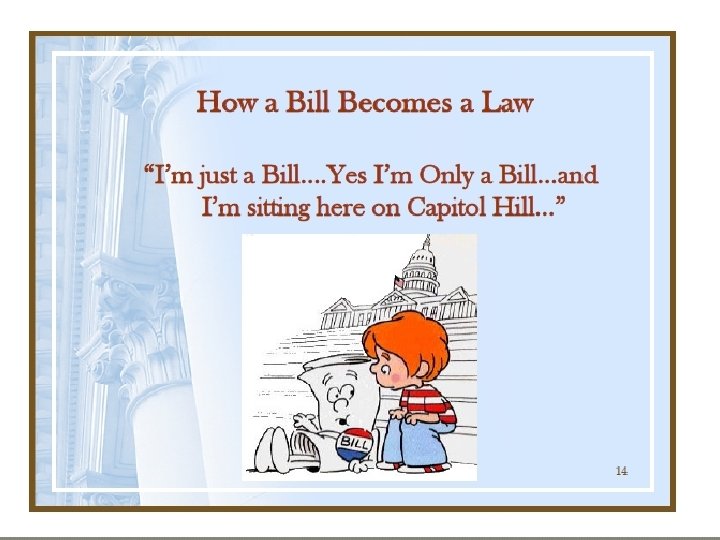
I’m Just a Bill… http: //www. youtube. com/watch? v=He. YBZFEzf 8
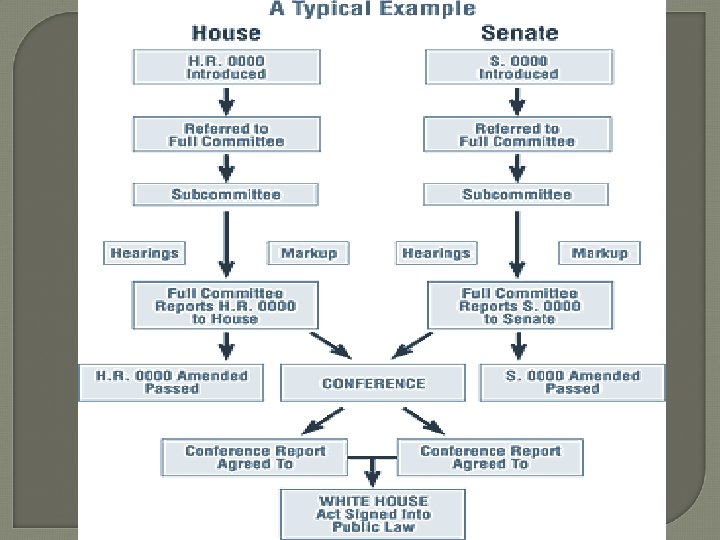
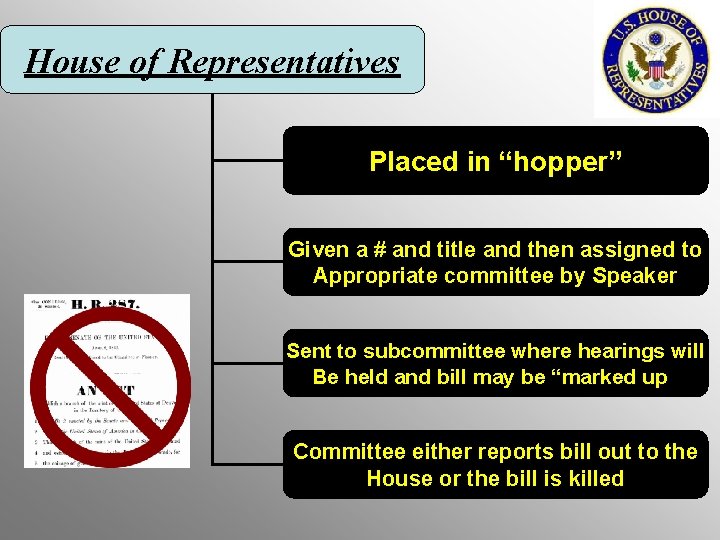
House of Representatives Placed in “hopper” Given a # and title and then assigned to Appropriate committee by Speaker Sent to subcommittee where hearings will Be held and bill may be “marked up” Committee either reports bill out to the House or the bill is killed
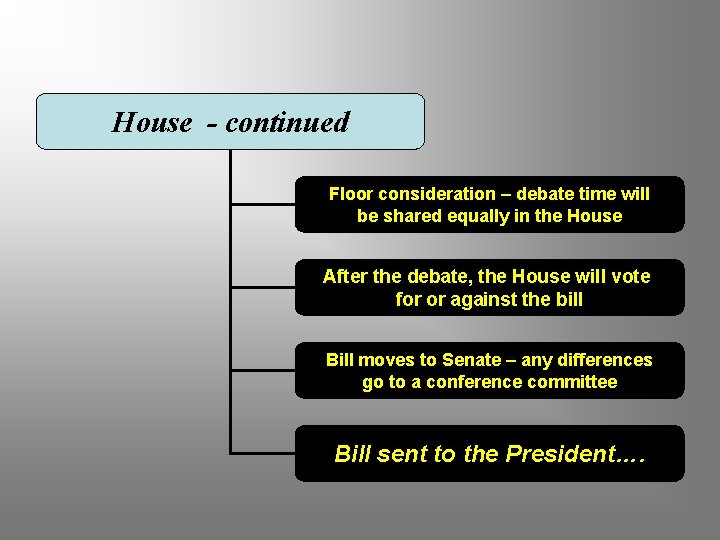
House - continued Floor consideration – debate time will be shared equally in the House After the debate, the House will vote for or against the bill Bill moves to Senate – any differences go to a conference committee Bill sent to the President….
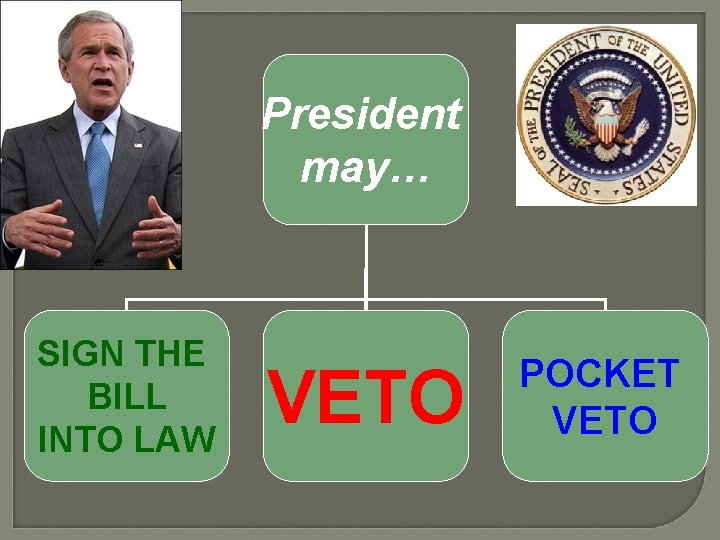
President may… SIGN THE BILL INTO LAW VETO POCKET VETO
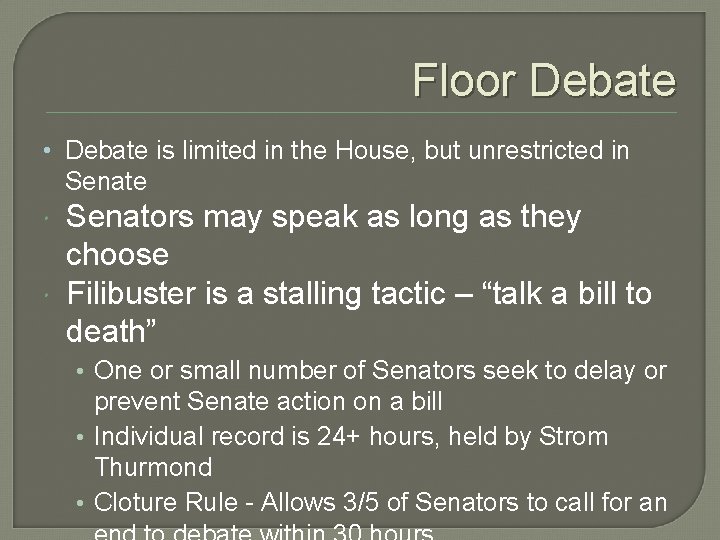
Floor Debate • Debate is limited in the House, but unrestricted in Senate Senators may speak as long as they choose Filibuster is a stalling tactic – “talk a bill to death” • One or small number of Senators seek to delay or prevent Senate action on a bill • Individual record is 24+ hours, held by Strom Thurmond • Cloture Rule - Allows 3/5 of Senators to call for an
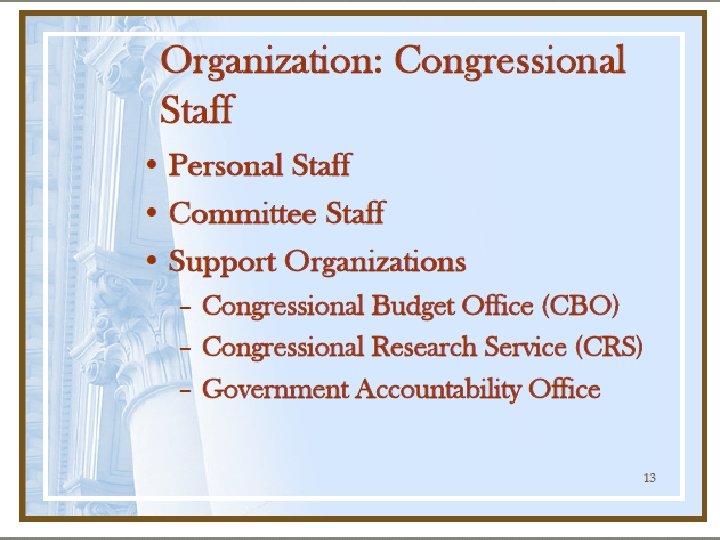
Congressional Staff (25, 000 people). Each rep has about 20. Each senator has between 30 -50 (depends on state size). Each Rep gets about $500, 000 a year in expense funds and Senators get $2, 000. Total expense spending for Congressmen = more than $2 BILLION. Workload (Day in the life of a Congressman) 12 -15 hour days (2 -3 in committee; 2 -3 on floor; 3 -4 meeting with people; 2 -3 attending meetings or events or conferences). May introduce 10 -50 bills in one session (convenes in January following a congressional election and extends for 2 years until after next one) Vote 900 -1, 000 times a session
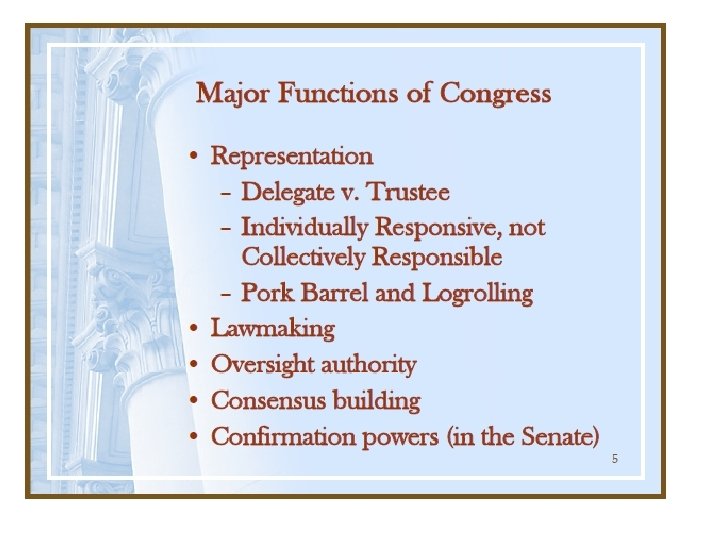
Learning the Lingo Pork Barrel – “bring home the bacon”: legislation or government programs, funds, or “goodies” flow to particular districts. Pressing the Flesh – be seen at home, often. Congress usually follows a Tuesday-to-Thursday schedule to help each other out. Puffing Images – Members use franking privileges to enhance their image through mail, newsletters, and other materials. They also use the Congressional television studios to send to local stations and all have webpages. Logrolling - the trading of favors, or quid pro quo, such as vote trading by legislative members to obtain passage of actions of interest to each legislative member. Turnover – Change in membership. Recently, it has been high. It usually results from retirement or resignation or reapportionment (loss of seat), not electoral defeat. FIlibustering
Rules of the Filibuster TO KEEP THE FLOOR: A senator must remain standing and must speak more or less continuously. WHAT THEY CAN SAY: Senators can basically say anything. Under Senate rules, speeches must be germane during the first three hours after routine business, but that is rarely enforced. Some popular filibuster material includes: law books, the Bible and local recipes. SPEECH LENGTH: Senate Rule 19 places no limit on the length of individual speeches or the number of senators who can speak on one question. INTERRUPTIONS: Senate rules say no senator shall interrupt another during debate without the speaker's consent. Senators can yield for a question and still keep the floor. CLOTURE: Starts when 16 senators present a motion to end debate. It then takes 60 senators to agree and invoke cloture.
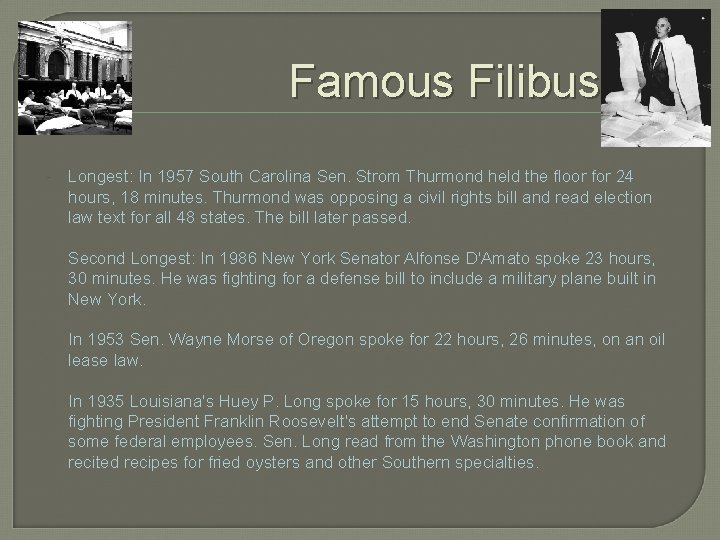
Famous Filibusters Longest: In 1957 South Carolina Sen. Strom Thurmond held the floor for 24 hours, 18 minutes. Thurmond was opposing a civil rights bill and read election law text for all 48 states. The bill later passed. Second Longest: In 1986 New York Senator Alfonse D'Amato spoke 23 hours, 30 minutes. He was fighting for a defense bill to include a military plane built in New York. In 1953 Sen. Wayne Morse of Oregon spoke for 22 hours, 26 minutes, on an oil lease law. In 1935 Louisiana's Huey P. Long spoke for 15 hours, 30 minutes. He was fighting President Franklin Roosevelt's attempt to end Senate confirmation of some federal employees. Sen. Long read from the Washington phone book and recited recipes for fried oysters and other Southern specialties.
Do you Know the Lingo ? Pork Barrel – Pressing the Flesh Puffing Images – Logrolling Turnover Filibustering In small groups of 4 -5 draw a cartoon illustrating your assigned political congressional lingo.
Presidential Veto Chart In Small groups look at the data provided. Determine among your group what this chart tell you about the legislative process and each president.