
Congress Congress US CAPITOL BUILDING Legislative Branch makes
Congress
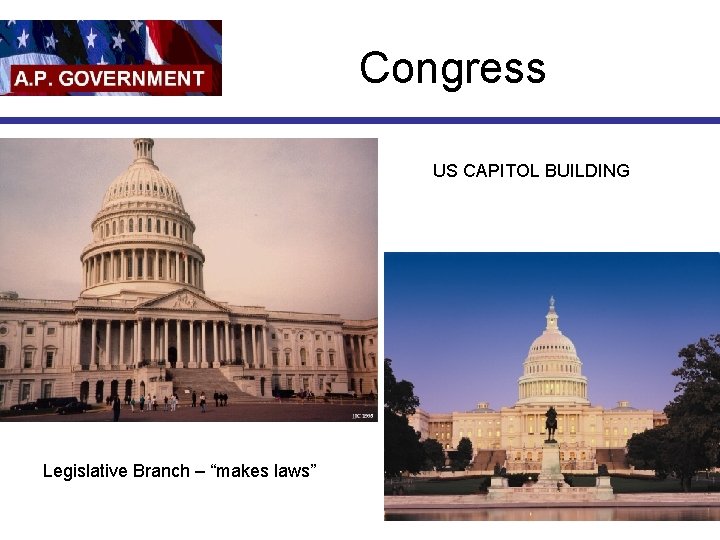
Congress US CAPITOL BUILDING Legislative Branch – “makes laws”
I. Founders’ Intentions 1. Strongest branch 2. Separation of lawmaking power from executive 3. Bicameralism balances large/small states • House – more connected to people (2 yr term) • Senate – allows for independent thinking (6 yr term)
Constitutional Powers Article I, Section 8 • To lay and collect taxes, duties, imports • To borrow money • To regulate commerce (states and foreign) • To establish rules for naturalization • To coin money • To create courts (except Supreme Court) • To declare war • To raise and support an army and navy
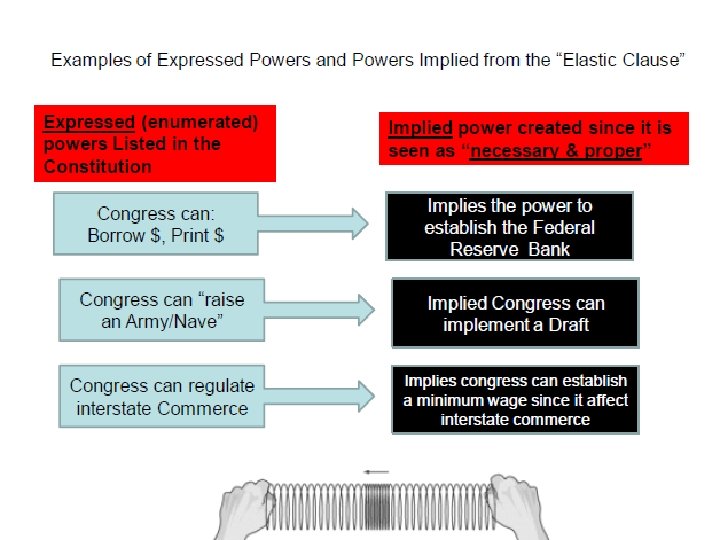
Evolution of Powers Elastic clause has extended Congress powers • Oversight of budget – can restrict the fed. budget prepared by executive branch • Appropriations – set amount of money made available for various activity in a fiscal year • Investigation – Congress can launch investigations (Watergate, Clinton-Lewinski hearings, Steroids in baseball)
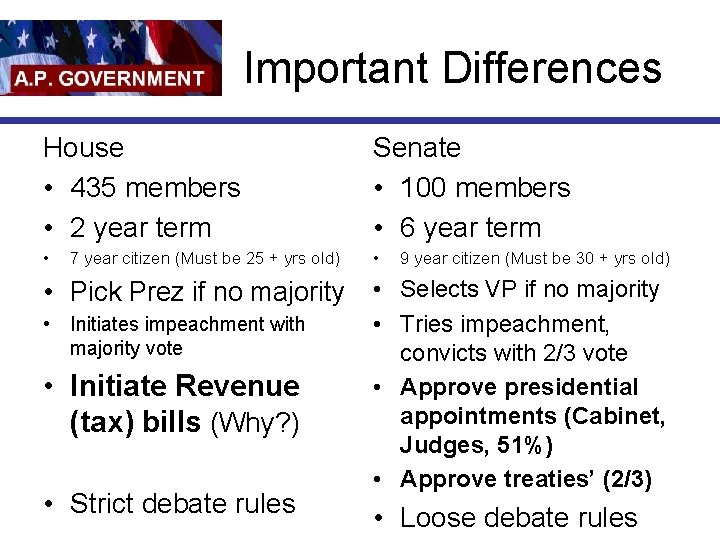
Important Differences House • 435 members • 2 year term Senate • 100 members • 6 year term • • 7 year citizen (Must be 25 + yrs old) • Pick Prez if no majority • Initiates impeachment with majority vote • Initiate Revenue (tax) bills (Why? ) • Strict debate rules 9 year citizen (Must be 30 + yrs old) • Selects VP if no majority • Tries impeachment, convicts with 2/3 vote • Approve presidential appointments (Cabinet, Judges, 51%) • Approve treaties’ (2/3) • Loose debate rules
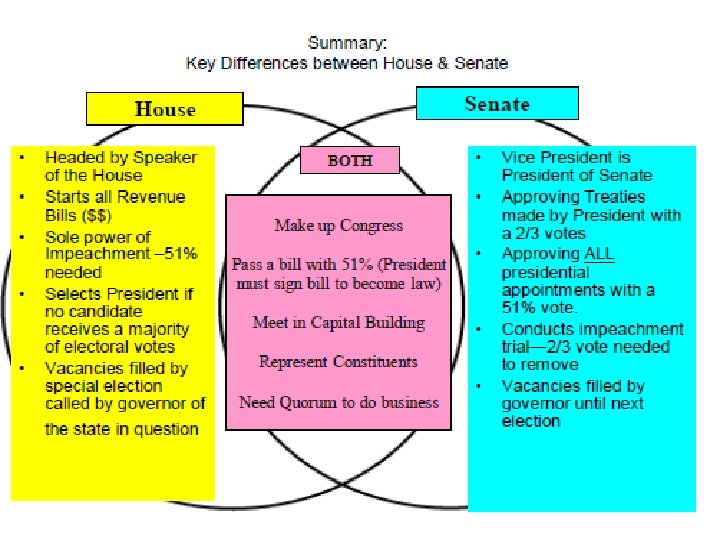
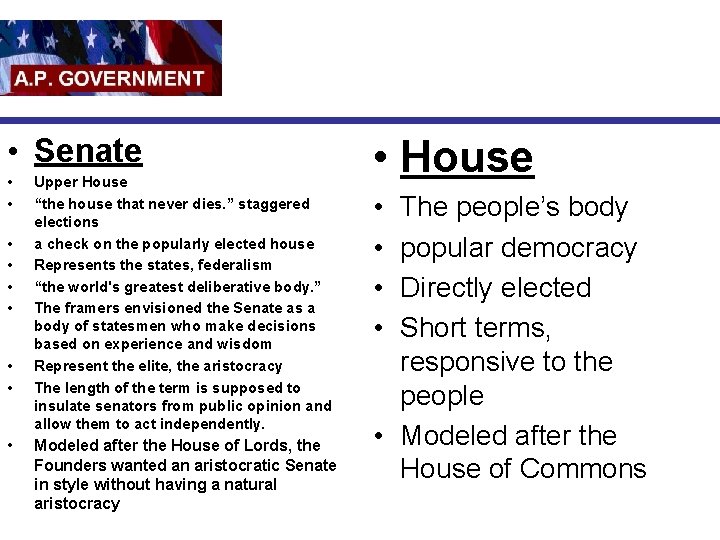
• Senate • • • Upper House “the house that never dies. ” staggered elections a check on the popularly elected house Represents the states, federalism “the world's greatest deliberative body. ” The framers envisioned the Senate as a body of statesmen who make decisions based on experience and wisdom Represent the elite, the aristocracy The length of the term is supposed to insulate senators from public opinion and allow them to act independently. Modeled after the House of Lords, the Founders wanted an aristocratic Senate in style without having a natural aristocracy • House • • The people’s body popular democracy Directly elected Short terms, responsive to the people • Modeled after the House of Commons
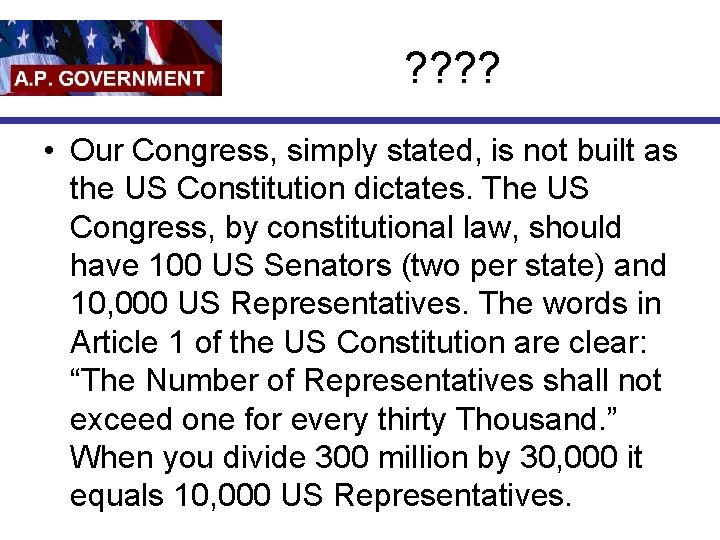
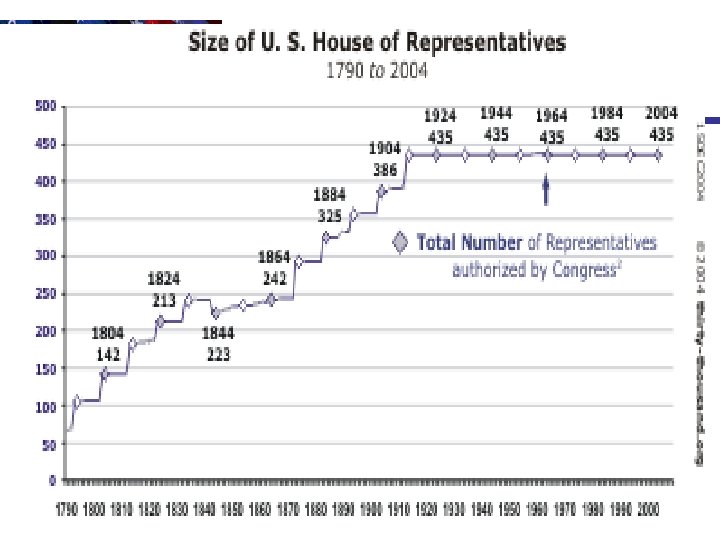
? ? • Our Congress, simply stated, is not built as the US Constitution dictates. The US Congress, by constitutional law, should have 100 US Senators (two per state) and 10, 000 US Representatives. The words in Article 1 of the US Constitution are clear: “The Number of Representatives shall not exceed one for every thirty Thousand. ” When you divide 300 million by 30, 000 it equals 10, 000 US Representatives.
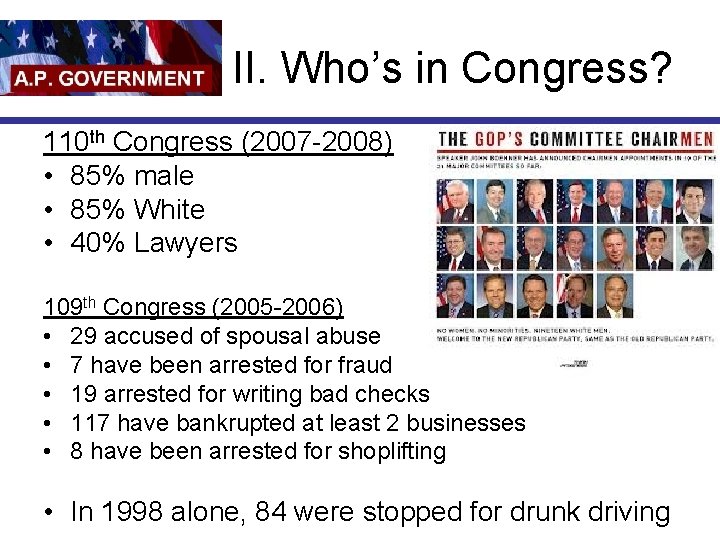
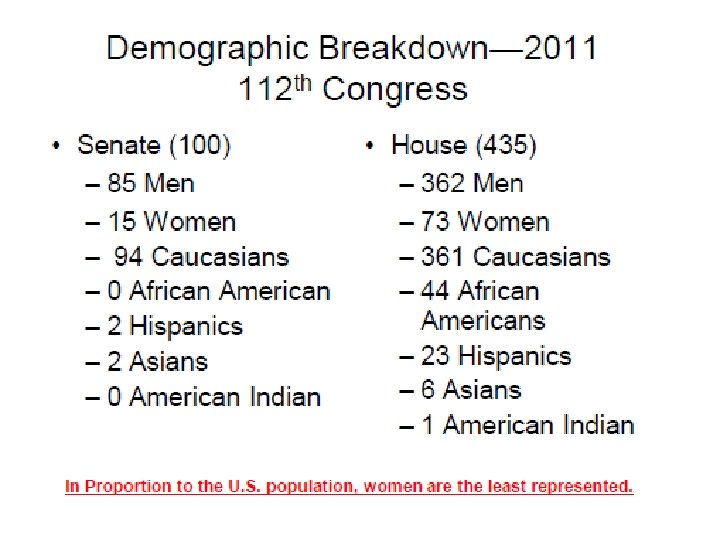
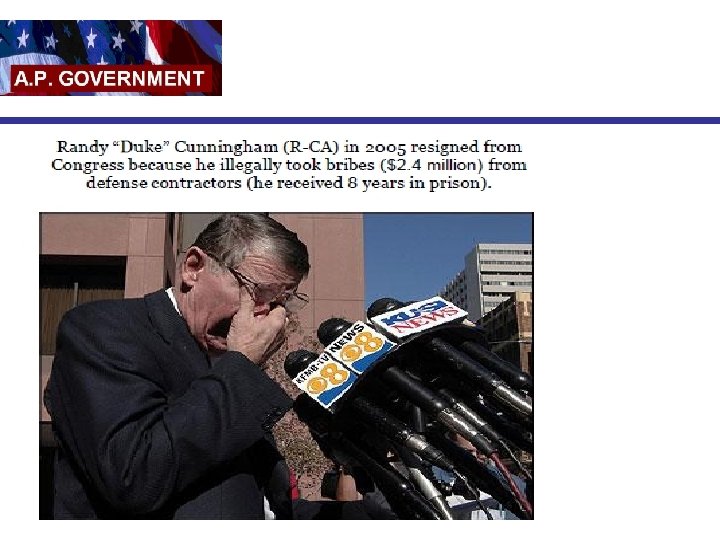
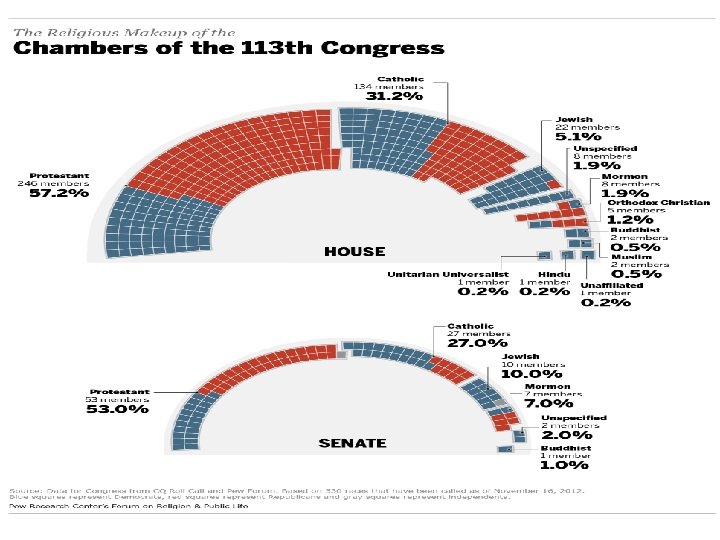
II. Who’s in Congress? 110 th Congress (2007 -2008) • 85% male • 85% White • 40% Lawyers 109 th Congress (2005 -2006) • 29 accused of spousal abuse • 7 have been arrested for fraud • 19 arrested for writing bad checks • 117 have bankrupted at least 2 businesses • 8 have been arrested for shoplifting • In 1998 alone, 84 were stopped for drunk driving
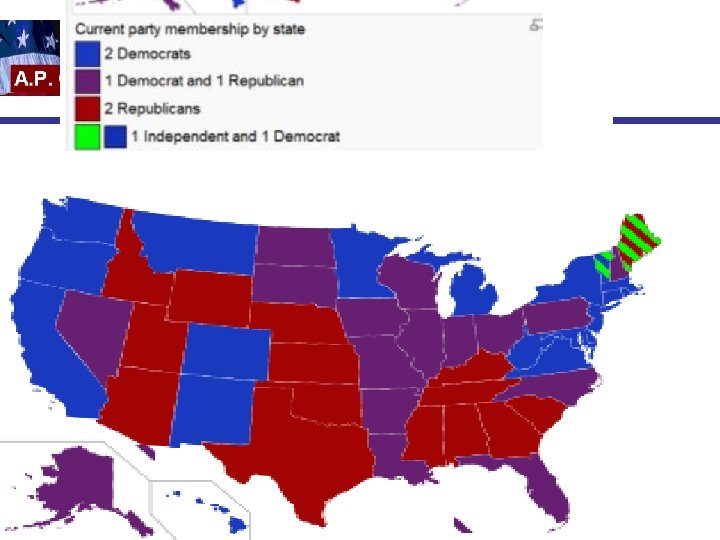
Who represents Florida?
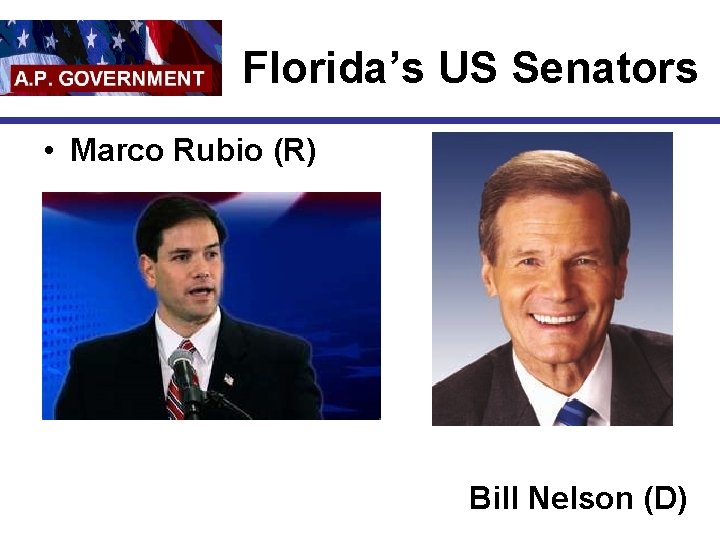
Florida’s US Senators • Marco Rubio (R) Bill Nelson (D)
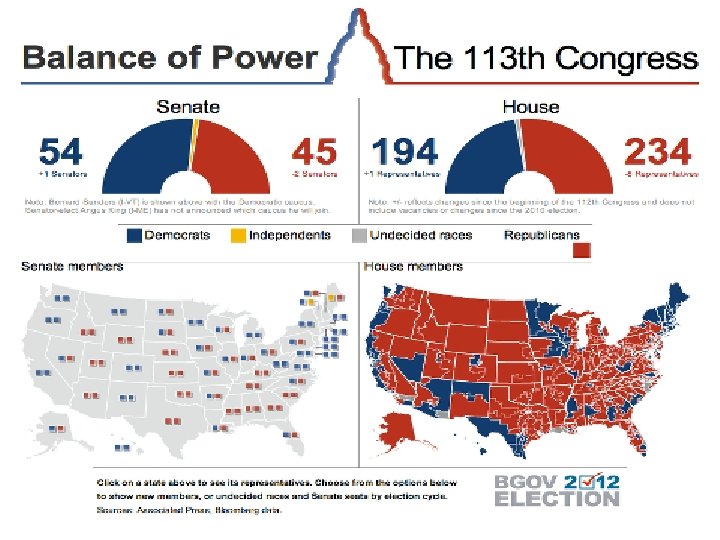
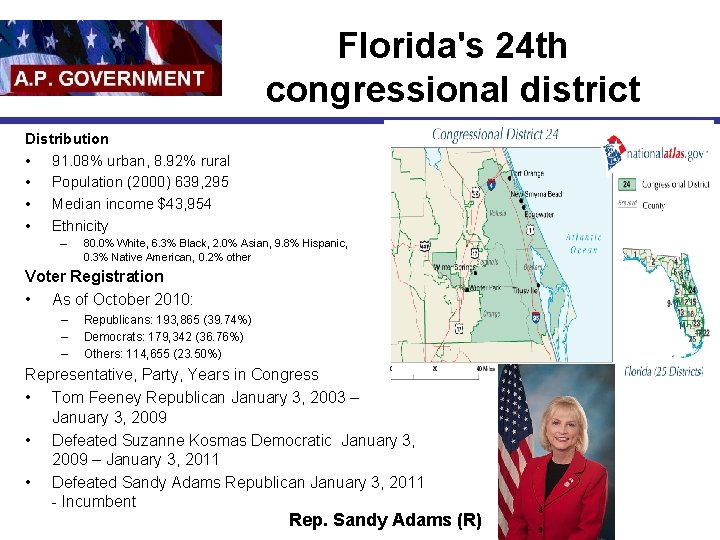
Florida's 24 th congressional district Distribution • 91. 08% urban, 8. 92% rural • Population (2000) 639, 295 • Median income $43, 954 • Ethnicity – 80. 0% White, 6. 3% Black, 2. 0% Asian, 9. 8% Hispanic, 0. 3% Native American, 0. 2% other Voter Registration • As of October 2010: – – – Republicans: 193, 865 (39. 74%) Democrats: 179, 342 (36. 76%) Others: 114, 655 (23. 50%) Representative, Party, Years in Congress • Tom Feeney Republican January 3, 2003 – January 3, 2009 • Defeated Suzanne Kosmas Democratic January 3, 2009 – January 3, 2011 • Defeated Sandy Adams Republican January 3, 2011 - Incumbent Rep. Sandy Adams (R)
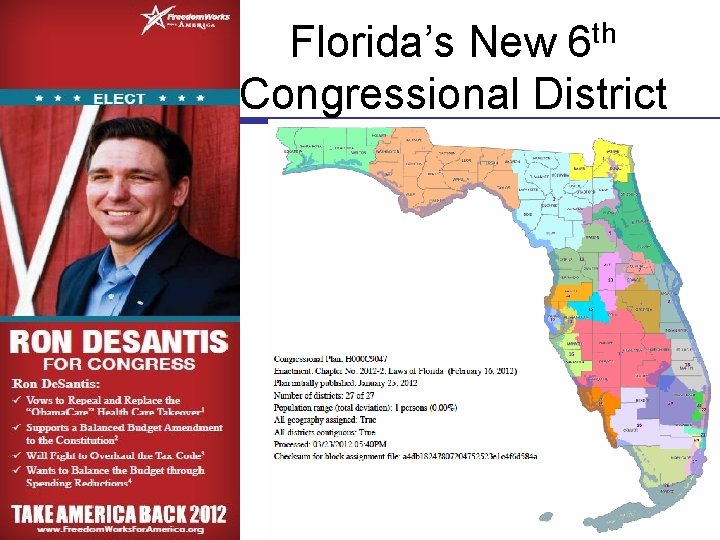
th 6 Florida’s New Congressional District
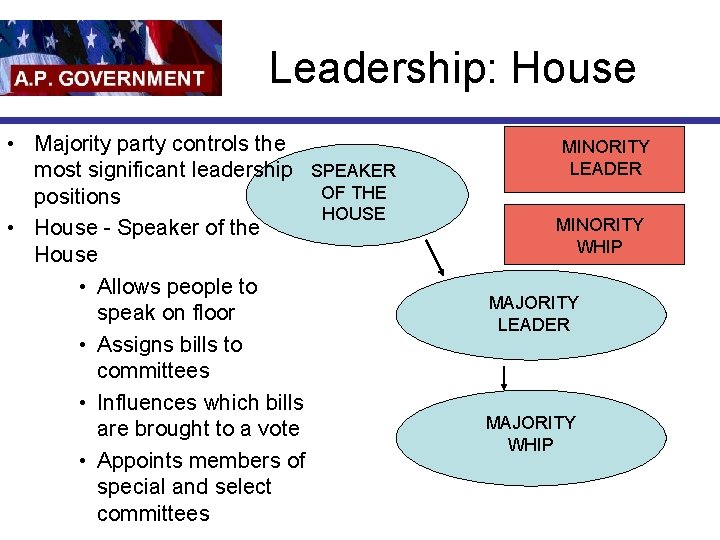
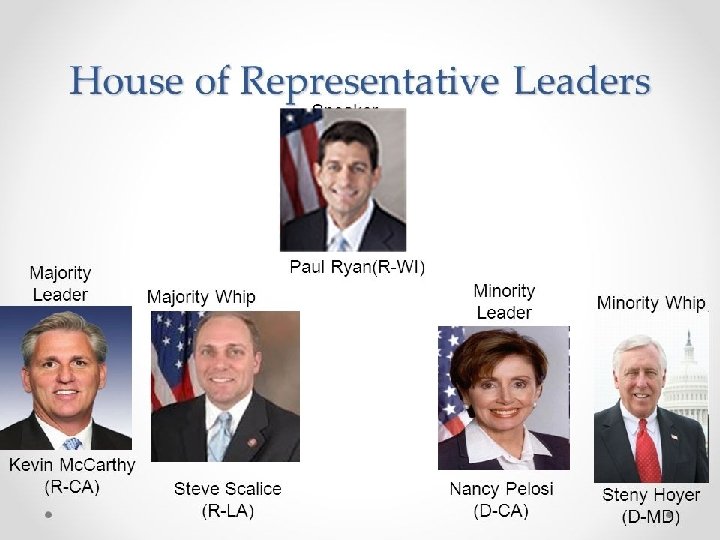
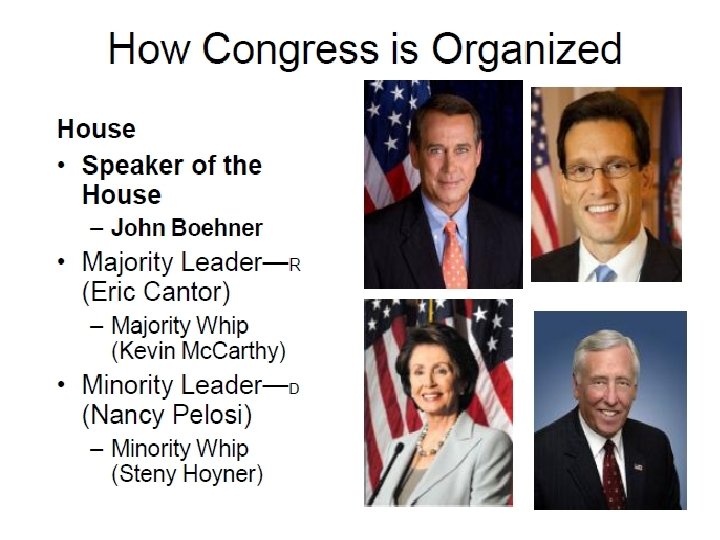
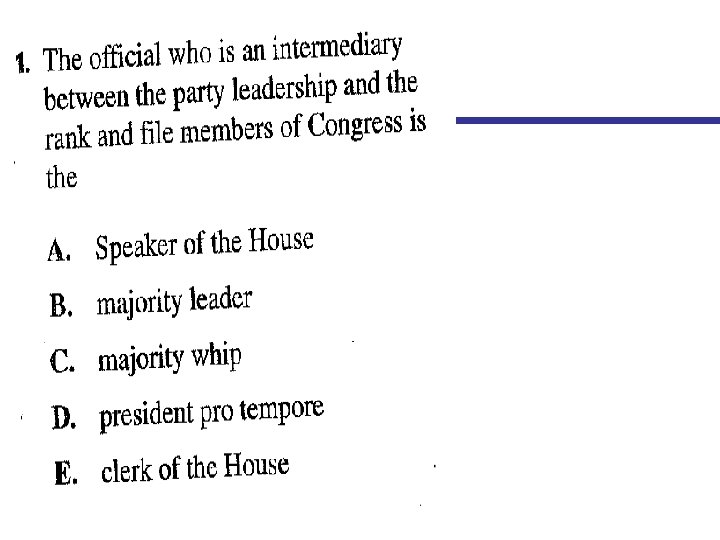
Leadership: House • Majority party controls the most significant leadership SPEAKER OF THE positions HOUSE • House - Speaker of the House • Allows people to speak on floor • Assigns bills to committees • Influences which bills are brought to a vote • Appoints members of special and select committees MINORITY LEADER MINORITY WHIP MAJORITY LEADER MAJORITY WHIP

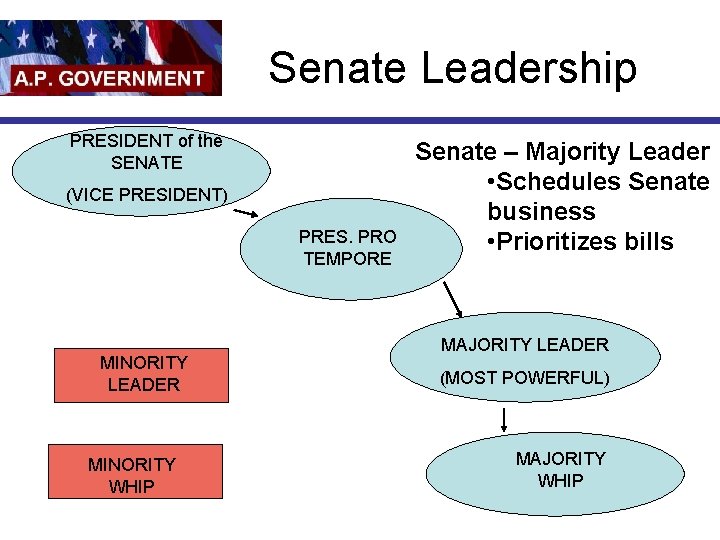
Senate Leadership PRESIDENT of the SENATE (VICE PRESIDENT) PRES. PRO TEMPORE MINORITY LEADER MINORITY WHIP Senate – Majority Leader • Schedules Senate business • Prioritizes bills MAJORITY LEADER (MOST POWERFUL) MAJORITY WHIP
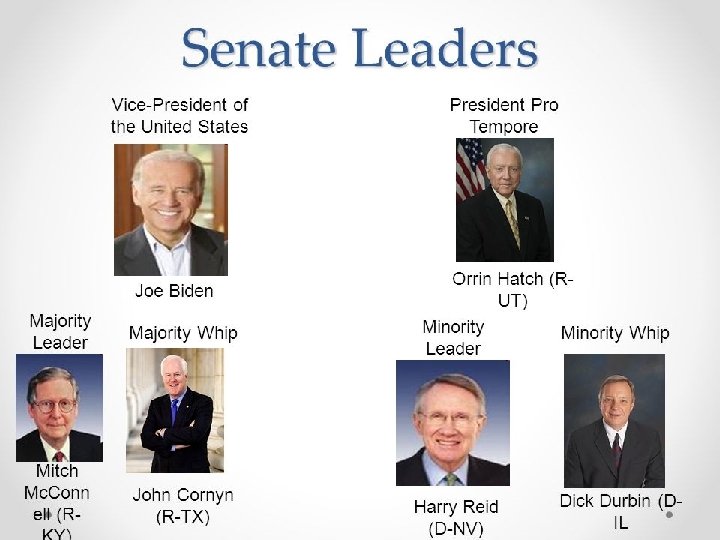
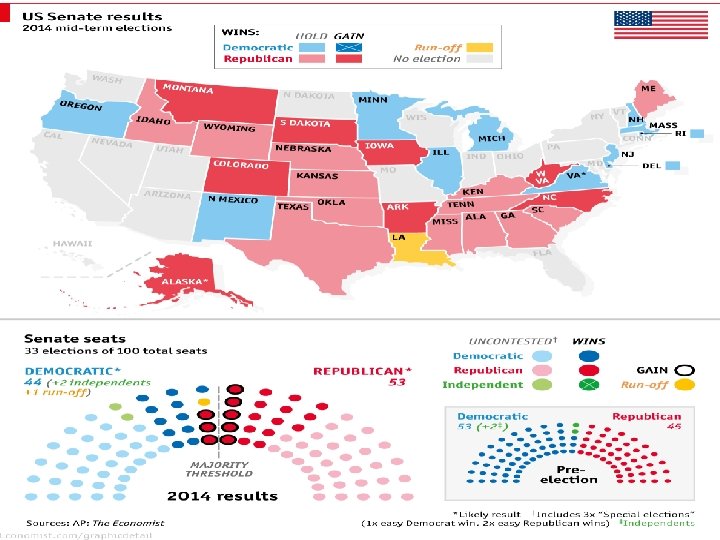
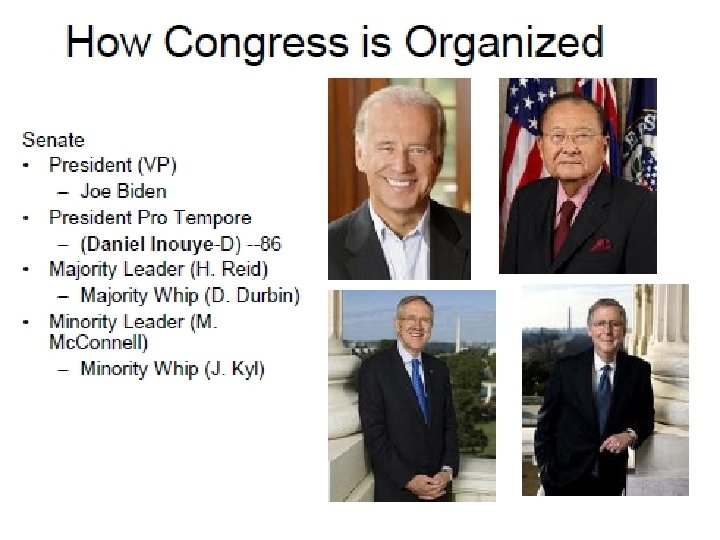
• With the conclusion of the 2014 mid-term elections the Republican party gained a majority in the Senate of the 114 th Congress. With this coming transition, Orrin Hatch, a Republican and senior senator from Utah, is expected to be elected the new president pro tempore by the Senate, in January 2015


Page 69
P 69 1. 2. 3. 4. 5. 6. 7. 8. 9. H S S H H B S H B 10. H 11. N 12. N 13. S 14. B
III. Elections • House members directly elected every 2 years • Senators directly elected after 17 th Amend – Elections every 6 years, staggered so 1/3 are up for election every 2 years
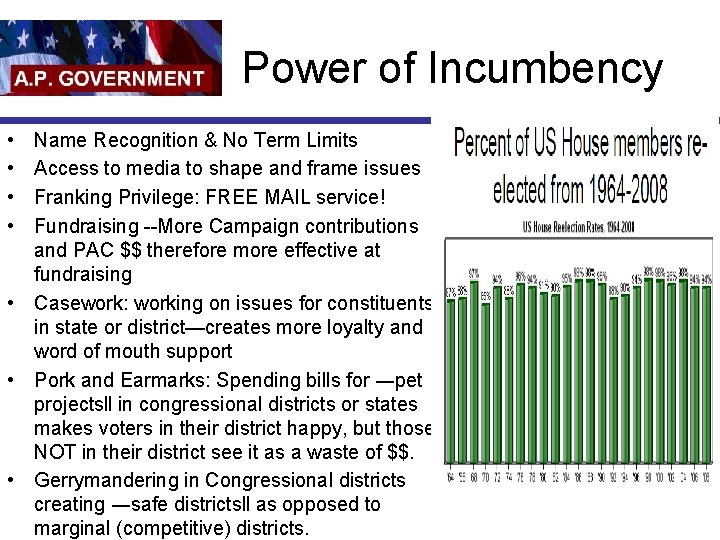
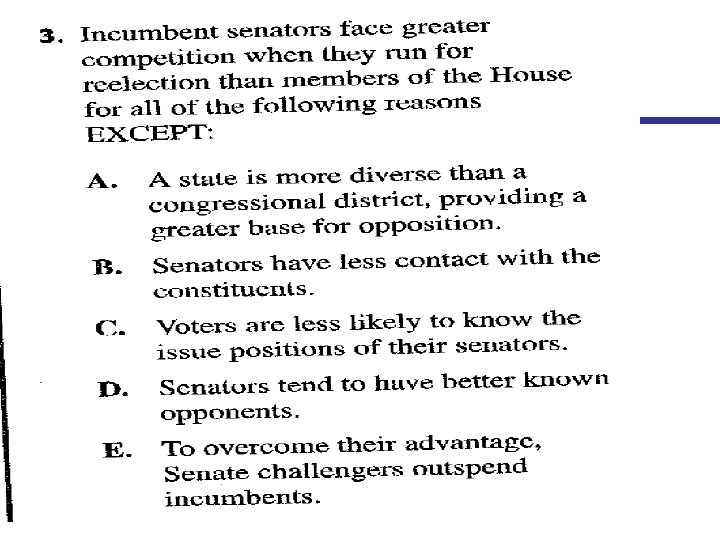
Power of Incumbency • • Name Recognition & No Term Limits Access to media to shape and frame issues Franking Privilege: FREE MAIL service! Fundraising --More Campaign contributions and PAC $$ therefore more effective at fundraising • Casework: working on issues for constituents in state or district—creates more loyalty and word of mouth support • Pork and Earmarks: Spending bills for ―pet projects‖ in congressional districts or states makes voters in their district happy, but those NOT in their district see it as a waste of $$. • Gerrymandering in Congressional districts creating ―safe districts‖ as opposed to marginal (competitive) districts.
Midterm Elections • http: //thedailyshow. cc. com/videos/yw 81 ah/ the-daily-show-rock-
Representation • The 435 members (fixed number since 1911) of the House are apportioned to each state based on population • Every 10 years, the CENSUS tells the government how many representatives each state gets - ---2010 censes – allotted 27 congressional seats to FL – 2 more than the previous census – 27+2 Senate = 29 electoral votes • Baker v. Carr (1962): Court decided that apportionment and redistricting was a justifiable issue. • Reynolds v. Sims (1964): Ordered state legislative districts to be as near equal as possible in population in order to preserve ―One man, one vote‖; • Wesberry v. Sanders (1964) : Congressional Districts must be relatively equal in population in order to preserve ―one man, one vote‖ —NO malapportionment – –DOES NOT apply to Senate since the Constitution forbids proportional representation in the SENATE. • Districts also must be contiguous and as compact as possible
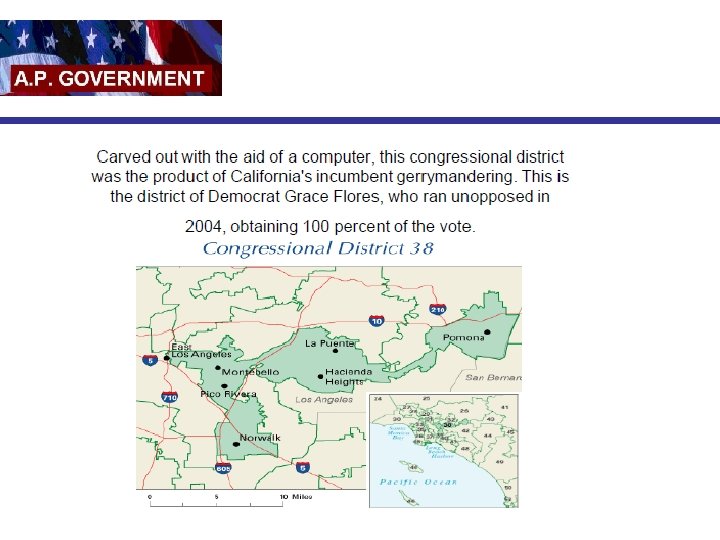
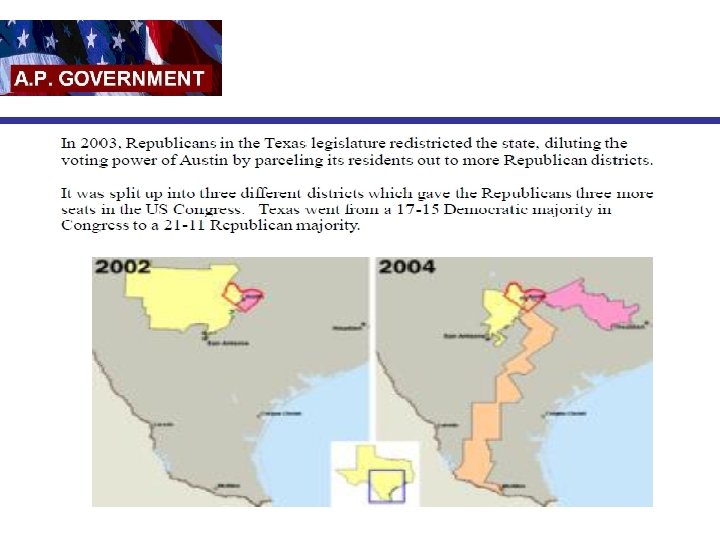
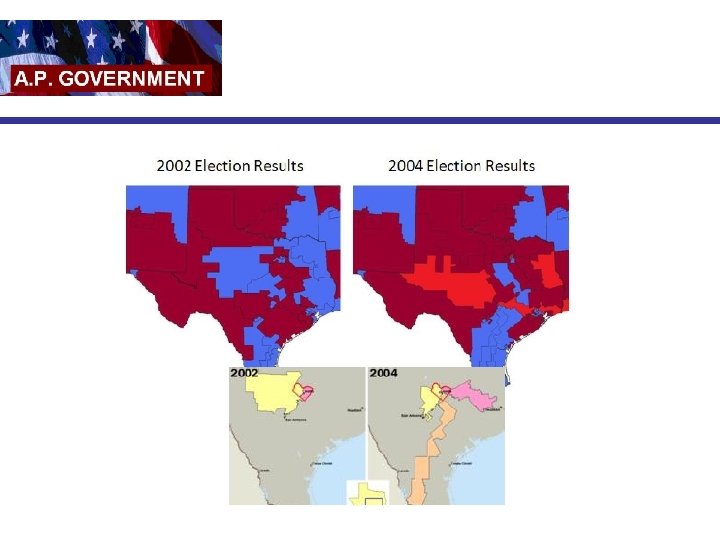
Redistricting and Gerrymandering • • • After States are told how many congressional district they have been apportioned, the State Legislature is in charge of drawing new districts that contain roughly the same number of people. • Gerrymandering occurs when the party in charge of the state government draws the congressional lines in a manner that favors individual members of their political party, and incumbent, or a specific group of people. Basically, gerrymandering allows politicians to chose their voters, rather than the voters choose their politicians, Gerrymandering can also be racial in that it can be used to the create majority-minority districts – Shaw v. Reno (1993), Miller v. Johnson (1995): Redistricting based on race as the predominant factor is illegal but can be done in some cases if it meets the standard of strict scrutiny (highest standard) In most cases, racial gerrymandering is illegal (especially if done to dilute voting power of minorities) but race can be a factor in the process if its done so in order to provide fair representation for minorities.
• What is the difference between redistricting and reapportionment?
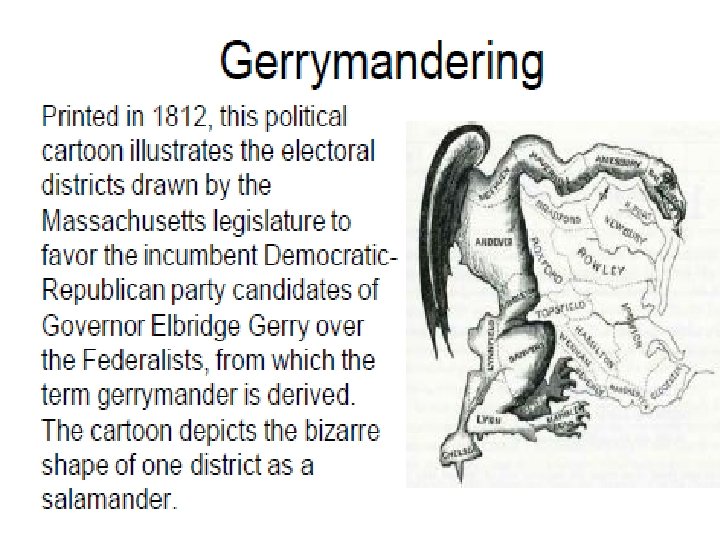
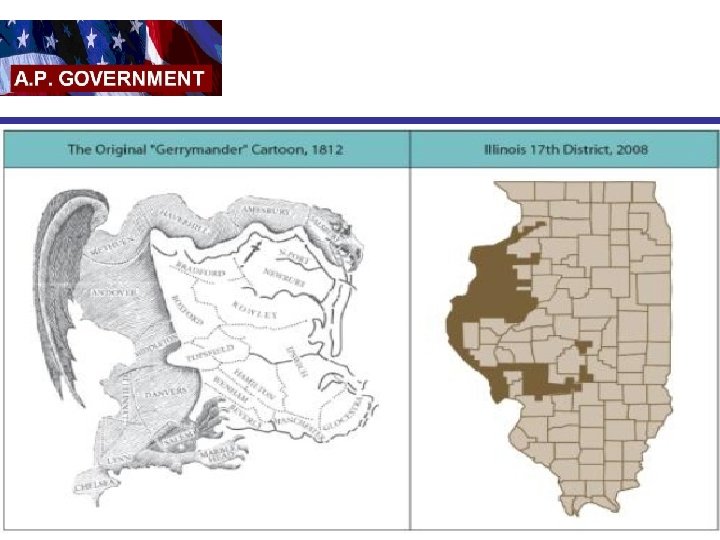
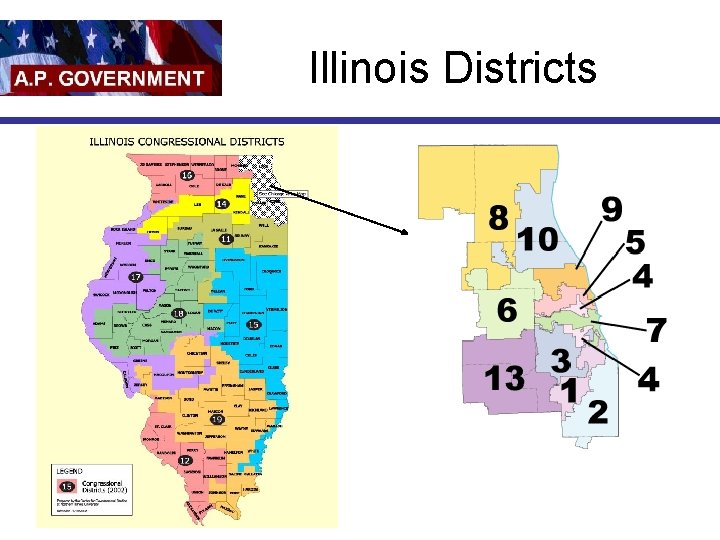
Illinois Districts
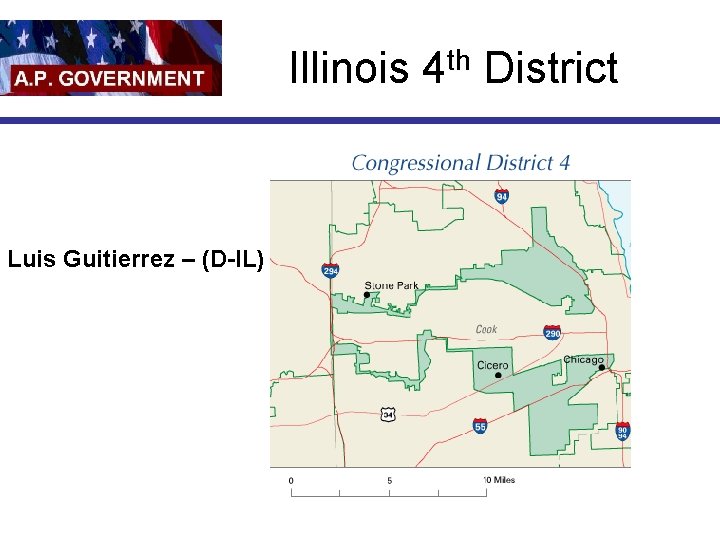
Illinois 4 th District Luis Guitierrez – (D-IL)
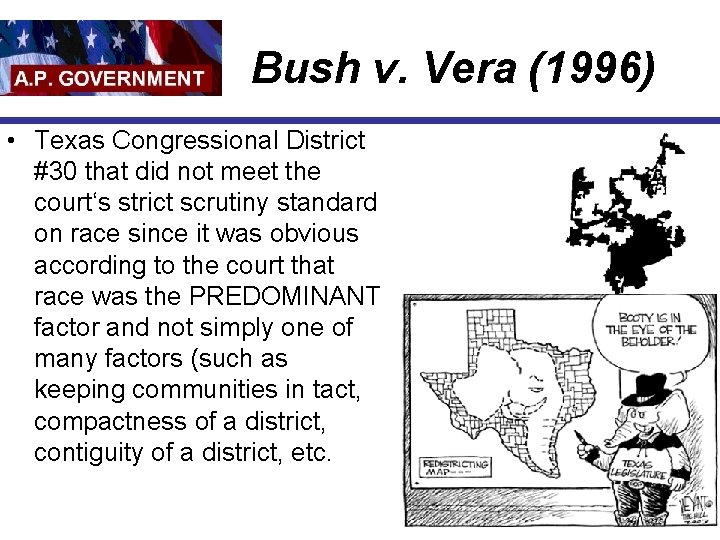
Bush v. Vera (1996) • Texas Congressional District #30 that did not meet the court‘s strict scrutiny standard on race since it was obvious according to the court that race was the PREDOMINANT factor and not simply one of many factors (such as keeping communities in tact, compactness of a district, contiguity of a district, etc.

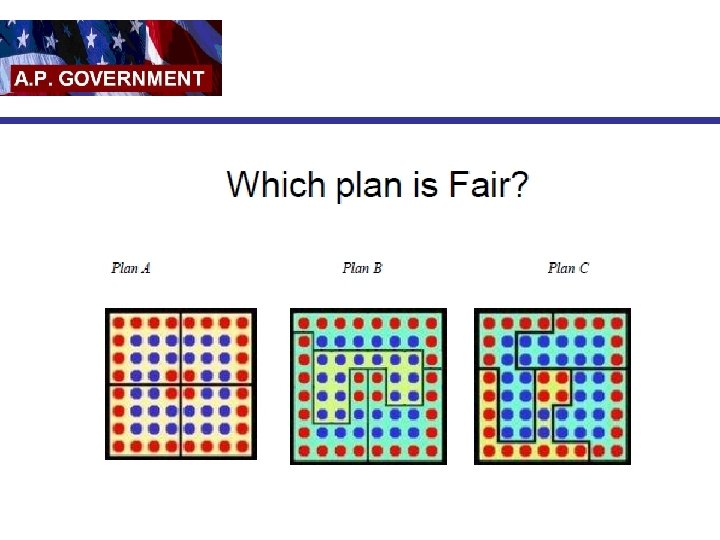
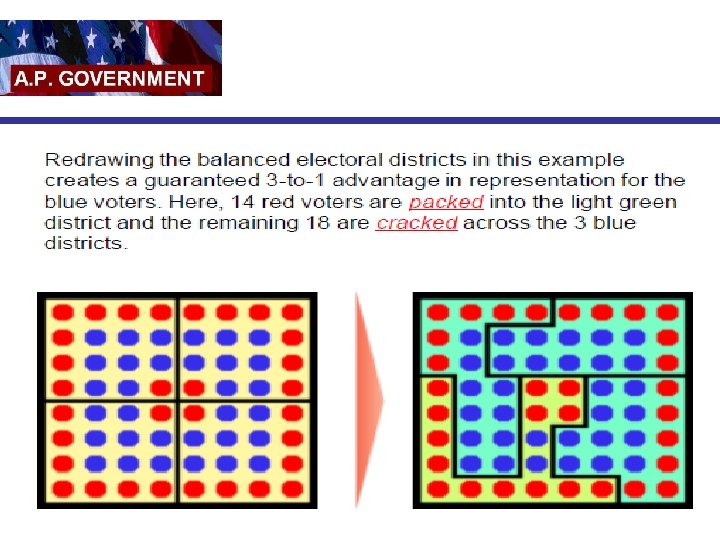
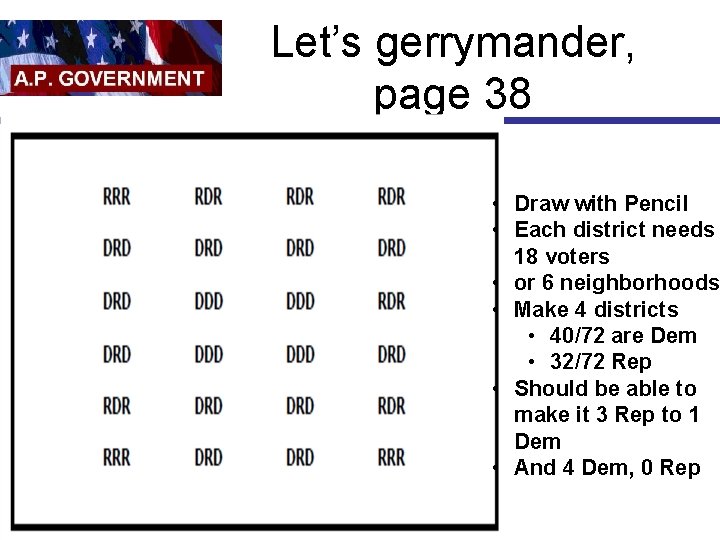
Let’s gerrymander, page 38 • Draw with Pencil • Each district needs 18 voters • or 6 neighborhoods • Make 4 districts • 40/72 are Dem • 32/72 Rep • Should be able to make it 3 Rep to 1 Dem • And 4 Dem, 0 Rep
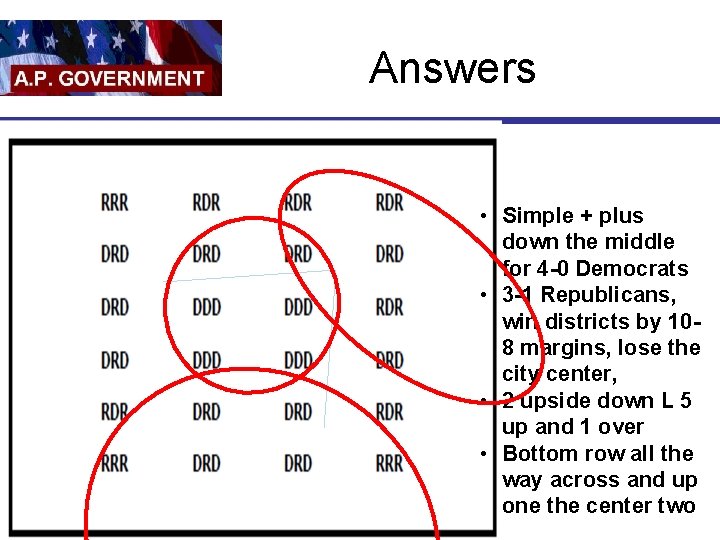
Answers • Simple + plus down the middle for 4 -0 Democrats • 3 -1 Republicans, win districts by 108 margins, lose the city center, • 2 upside down L 5 up and 1 over • Bottom row all the way across and up one the center two

Daily Show: Gerrymandering • http: //thedailyshow. cc. com/videos/0 adjfq/a merican-horrible-story---gerrymandering
GCP Grey • http: //www. youtube. com/watch? v=Mky 11 U Jb 9 AY&safe=active
IV. How A Bill Becomes a Law • Create legislation, make laws • Founders believed in a SLOW process • Founders believed efficiency was a trait of an oppressive government
Step 1 – Introduce Bill • Introduced in Senate or House (except tax) • Single or multiple reps can introduce bill
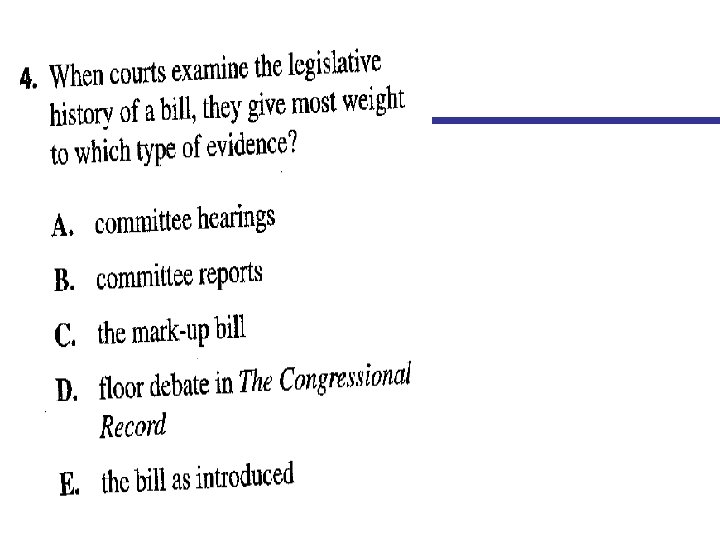
Step 2 - Committee 1. Bill is assigned to a particular committee in its category (Ex. Tax bill – Ways and Means Committee, Farm bill – Agriculture Committee) 2. Bill is then placed in sub-committee 3. Bills are debated and “marked up” 4. Most bills die in committee, committee can vote to “report out” a bill
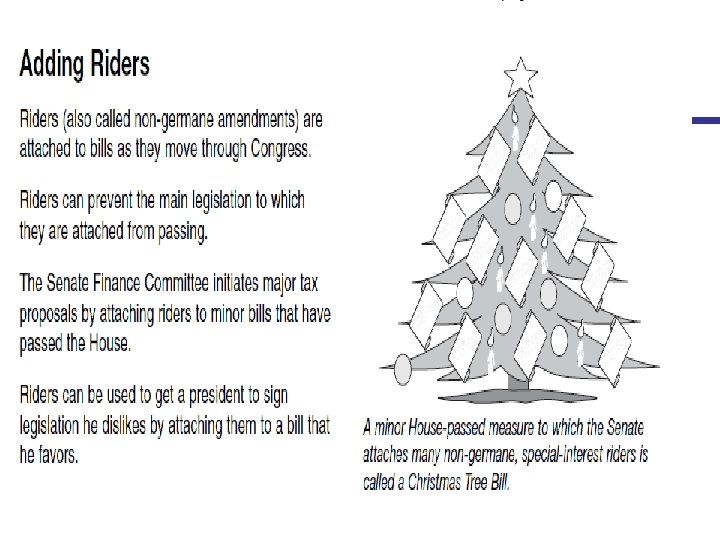
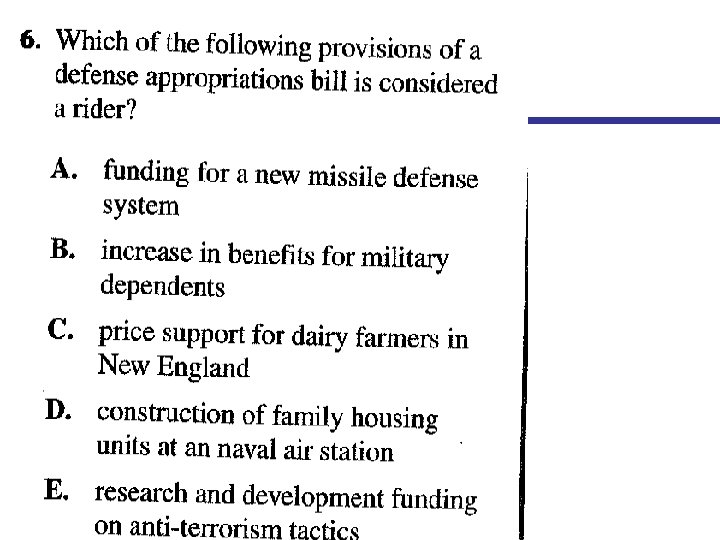
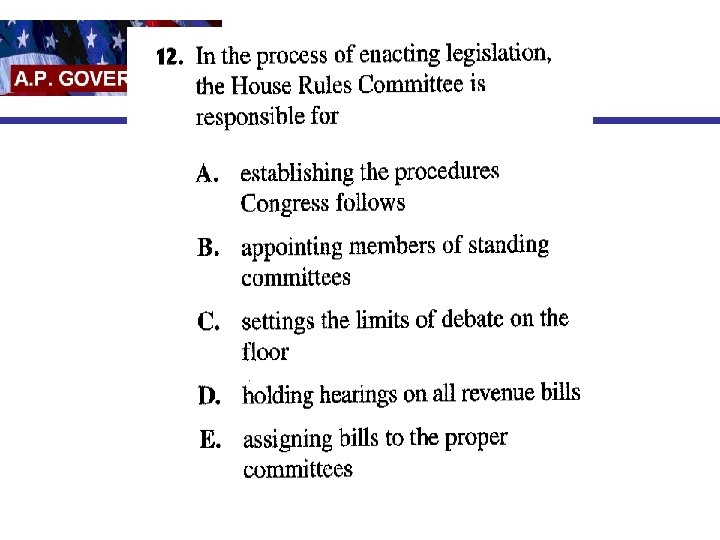
Step 3–Rules Committee • Before bill can go to floor in House, it must first set time limits and amendment regulations. – Closed rule – sets time limits, restricts amendments – Open rule – permits amendments – Restrictive rule – permits some amendments – (Rider, Amendment, Christmas Tree, Pork, )
Step 4 – Floor Debate Senate Debate • Less formal, no speaking limit • Filibuster – practice of stalling a bill w/ debate • Cloture – 3/5 of the Senate vote to stop debate House Debate • More formal, no filibuster, strict rules
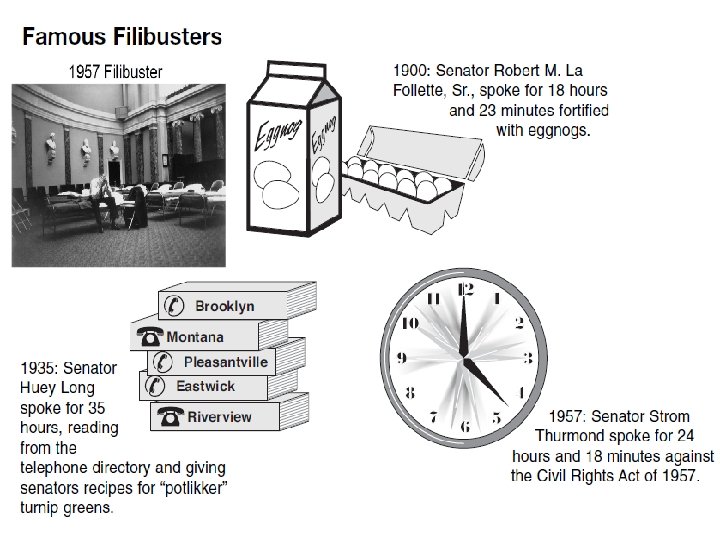
Holds & Filibusters • Holds – An informal practice by which a Senator informs the Majority leader that he does not wish a particular bill or other measure to reach the floor for consideration done prior to filibuster • • • Filibuster: endless debate to block a floor vote on a bill Neither Holds nor Filibusters are in the Constitution, but rather in the rules of the Senate that allows Extended Debate These can be used on legislation as well as any senatorial confirmation, such as a federal judge. Strom Thurmond (D/R-SC) set a record in 1957 by filibustering the Civil Rights Act of 1957 for 24 hours and 18 minutes. Procedural Filibuster: – Senate Rule 22 permits filibusters in which actual continuous floor speeches are not required, although the Senate Majority Leader may require an actual traditional filibuster if he or she so chooses. • • Filibuster can be ended by a cloture vote — 3/5 needed (60/100 votes) The Senate itself at the start of its session for a term must agree to amend its Parliamentary rules to get rid of the Filibuster
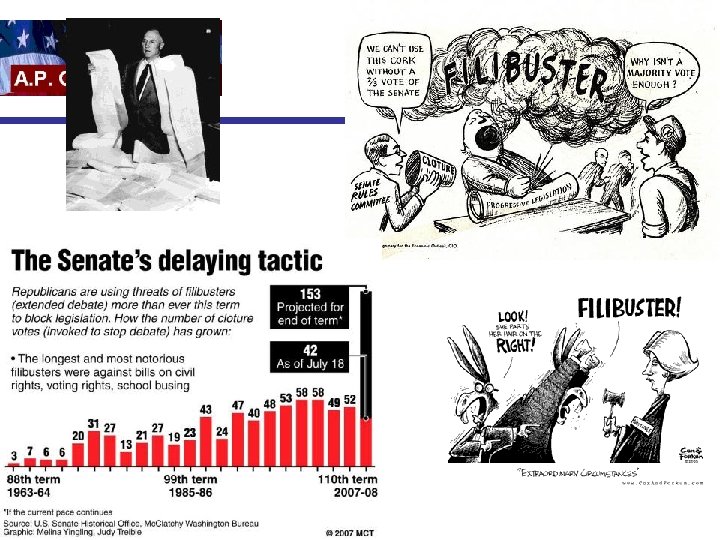
• • The word filibuster goes back to a Dutch word for "freebooter, " someone who took booty or loot. It came to mean a legislator who was "pirating" parliamentary proceedings. The word `filibuster' comes from piracy. The term first appeared in the English language in 1591, according to the Oxford English Dictionary. The word was then `flee-booters. ' Its origins are probably Dutch, with some Spanish and French influences. NORRIS: In the 17 th century, flee-booters raided the Spanish colonies in the Caribbean and earned a bad reputation. They were also called buccaneers and freebooters. The stuff these flee-booters stole was called booty. BLOCK: Eventually an extra syllable wormed its way into the word, and flee-booters became filibusters. It also took on political meaning in the 1850 s. Filibusters were people from the United States who traveled to Central America and the Spanish West Indies in order to illegally encourage revolutions. NORRIS: The Oxford English Dictionary says the first time a legislator was called a filibuster to accuse him of being an obstructionist was in 1889. BLOCK: And the next year, 1890, was the first usage of the word `filibuster' to mean the tactic of talking for a long time to obstruct Senate business. Filibustering senators were, by extension, pirates raiding the Congress for their own political gain.
• Mr. Smith goes to Washington • Explain Intro

Watch Mr. Smith Goes to Washington

Bill and Ted’s Excellent Adventure • thedailyshow. cc. com/videos/qd 0 f 9 i/healthc are-bill---ted-s-excellent-adventure • Compare filibusters
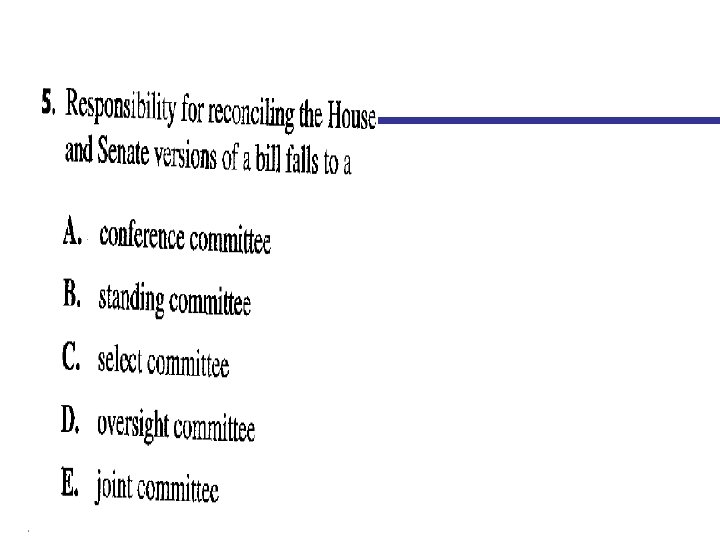
Step 5 - Voting • Majority passes • If the bill passes, it must go through the same process in the opposite chamber with a sponsor • If the bill passes one house and fails the other, it must start over • If the Senate and House cannot come to agreement over two versions, it goes to Conference Committee to fix it and resubmit the bill
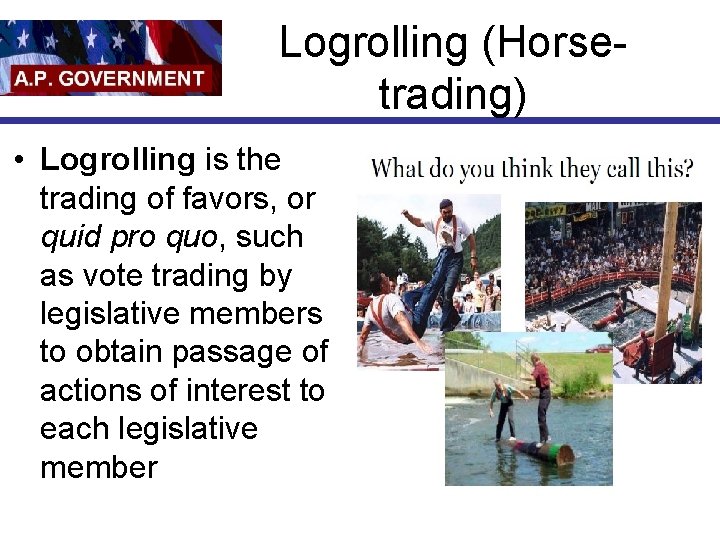
Logrolling (Horsetrading) • Logrolling is the trading of favors, or quid pro quo, such as vote trading by legislative members to obtain passage of actions of interest to each legislative member
Presidential Action • Sign – bill becomes law • Veto – bill returns to origin • Override – 2/3 vote in both houses can override veto • Pocket Veto – President has 10 days to act on a piece of legislation. If he receives the bill within 10 days of the end of the Congressional session, and doesn’t sign, it dies
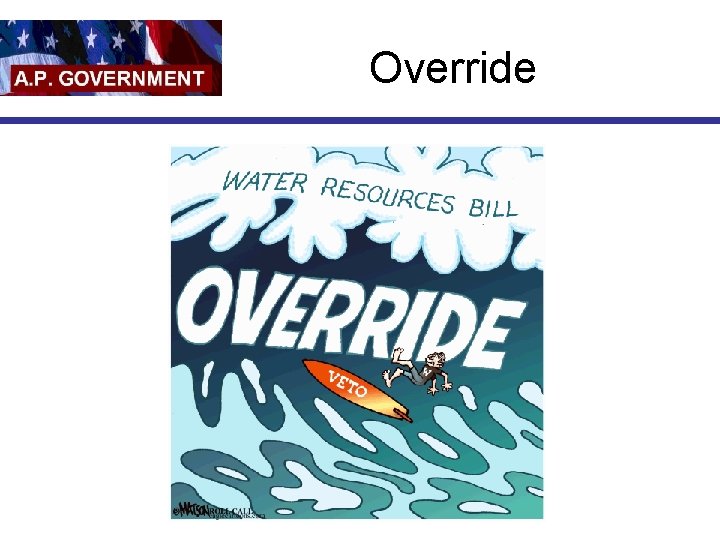
Override

Watch school house rocks

Daily Show: How a bill becomes an ad • http: //thedailyshow. cc. com/videos/38 vsni/h ow-a-bill-becomes-an-ad
V. Committees and Subcommittees • Most real work happens here • Bills are passed, changed, ignored, or killed
Types of Committees • Standing committee – handle bills in different policy areas • • Appropriations (Spending, budget) Committee House Ways and Means (Tax) Committee House Rules Committee Armed Services – most important and have been “standing” (existing) for a long time – Allows them to become policy experts • Select committee – formed for specific purposes and usually temporary – run investigations (ex. Aging, Intelligence)
Types of Committees • Joint committee – consist of both House and Senate members – similar in purpose to Select committee – Meant to draw attention to issues • Conference committee – consist of both House reps and Senators – formed to hammer out differences between House and Senate versions of similar bills • http: //www. govtrack. us/congress/committe es/
Committee Membership • Controlled by majority party, committee membership divided proportionally • Committee Chairman – Senior member of committee – Controls membership and debate
Work of Committees • 11, 000 bills introduced yearly, most die • Committees can… – Report out favorably/unfavorably – Pigeonholed/table (do not discuss) – Amend / “mark up” (change or rewrite)
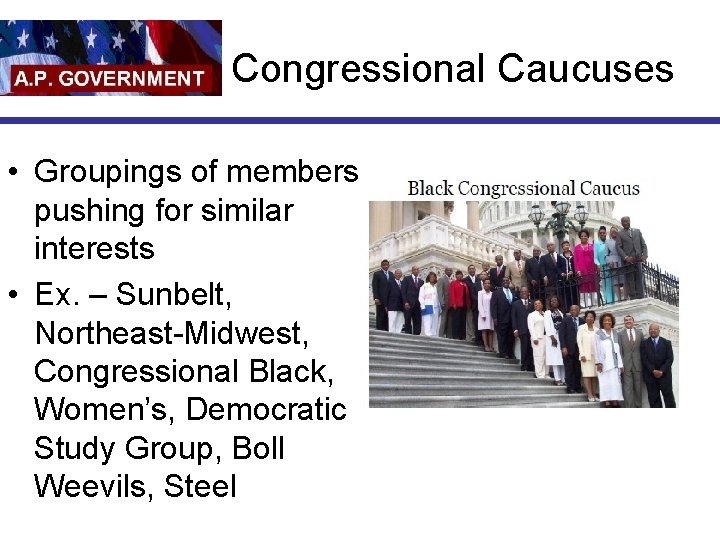
Congressional Caucuses • Groupings of members pushing for similar interests • Ex. – Sunbelt, Northeast-Midwest, Congressional Black, Women’s, Democratic Study Group, Boll Weevils, Steel
LEADERSHIP IN CONGRESS P 55
LEADERSHIP IN CONGRESS p 55 1. 2. 3. 4. 5. K A J M L
LEADERSHIP IN CONGRESS p 55 1. 2. 3. 4. 5. 6. 7. 8. 9. K A J M L N F B C 10. G
LEADERSHIP IN CONGRESS p 55 1. 2. 3. 4. 5. 6. 7. 8. 9. K A J M L N F B C 10. G 11. D 12. E 13. H 14. I 15. O 16. P 17. Q 18. R
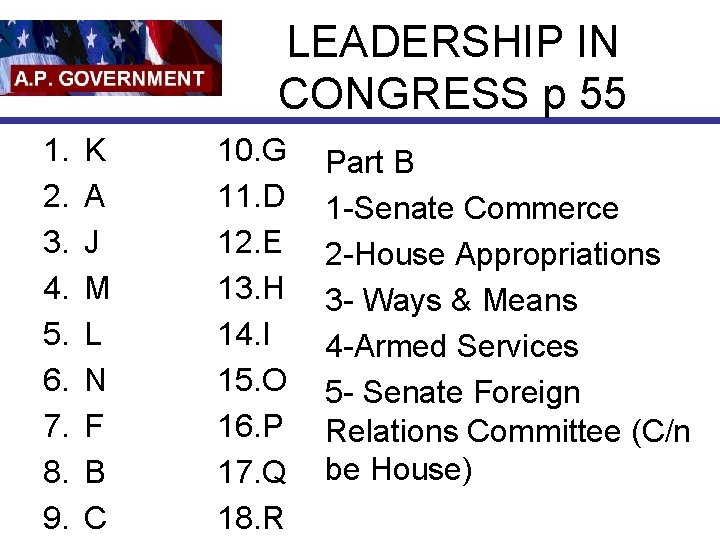
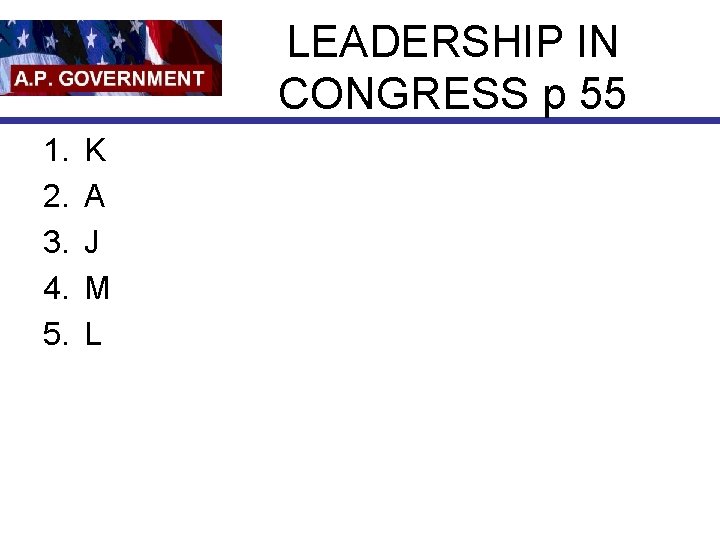
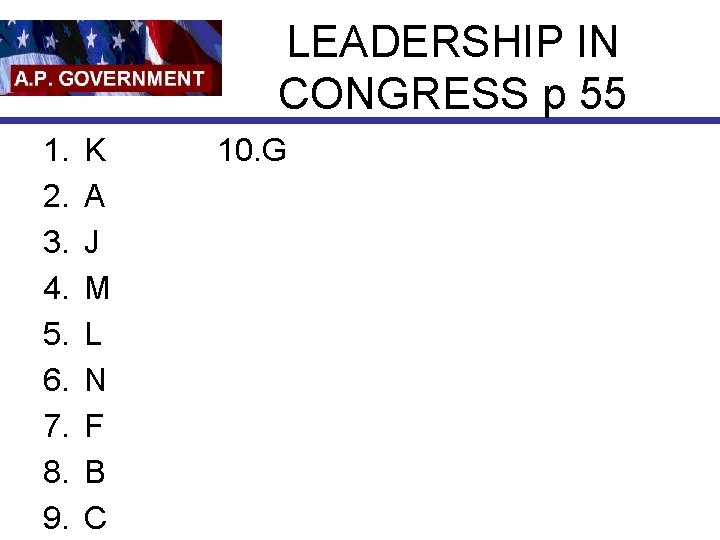
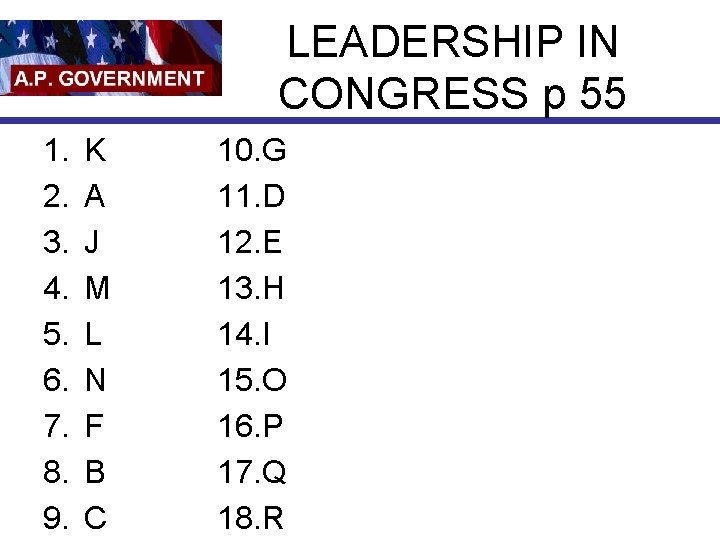
LEADERSHIP IN CONGRESS p 55 1. 2. 3. 4. 5. 6. 7. 8. 9. K A J M L N F B C 10. G 11. D 12. E 13. H 14. I 15. O 16. P 17. Q 18. R Part B 1 -Senate Commerce 2 -House Appropriations 3 - Ways & Means 4 -Armed Services 5 - Senate Foreign Relations Committee (C/n be House)
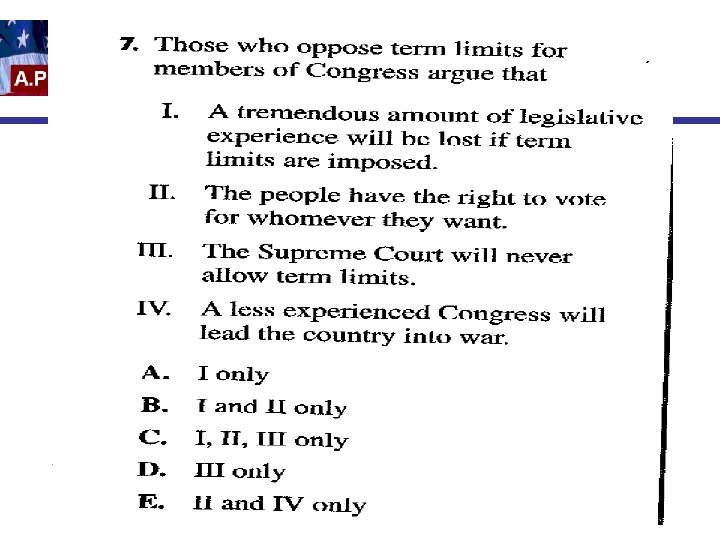
VI. Reforming Congress • Impose term limits (but Supreme Court ruled states cannot constitutionally impose term limits on Congress Constitutional Amendment? ) • Eliminate filibuster? Or reduce cloture vote? • Reducing power and perks (Gifts, Reduce Franking –the ability to mail for free) • Get ride of tradition of riders and amendments (porkbarreling) • Reduce the number of committees and assignments to slow pace and allow reasoned consideration of bills • Downsize staff sizes (might force congressmen to be a greater part of legislation or may have the staff rely more on executive agencies? )
Term-limits Debate • No current limit on how many terms members of Congress can serve 1. Some argue this has weakened popular control of Congress, reps might be unresponsive to their constituents 2. Some argue most experienced reps have the expertise to bring home more benefits (pork, riders, etc. )
Line-Item-Veto • Idea that the president should be able to veto parts of a bill (earmarks) rather than the whole bill • Many governors possess this power • 1996 Republican Congress passed law allowing Clinton the Line-Item veto
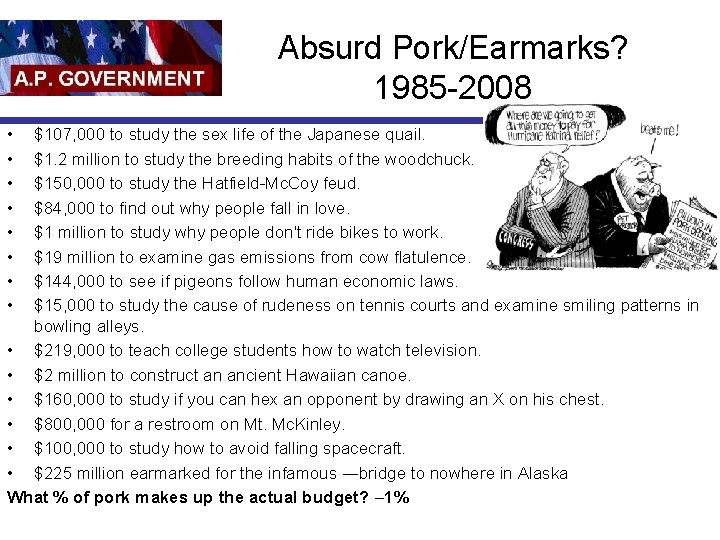
Absurd Pork/Earmarks? 1985 -2008 • • $107, 000 to study the sex life of the Japanese quail. $1. 2 million to study the breeding habits of the woodchuck. $150, 000 to study the Hatfield-Mc. Coy feud. $84, 000 to find out why people fall in love. $1 million to study why people don't ride bikes to work. $19 million to examine gas emissions from cow flatulence. $144, 000 to see if pigeons follow human economic laws. $15, 000 to study the cause of rudeness on tennis courts and examine smiling patterns in bowling alleys. • $219, 000 to teach college students how to watch television. • $2 million to construct an ancient Hawaiian canoe. • $160, 000 to study if you can hex an opponent by drawing an X on his chest. • $800, 000 for a restroom on Mt. Mc. Kinley. • $100, 000 to study how to avoid falling spacecraft. • $225 million earmarked for the infamous ―bridge to nowhere in Alaska What % of pork makes up the actual budget? – 1%
• 1998 the Supreme Court ruled it UNCONSTITUTIONAL in Clinton v. City of New York in a suit brought by Mayor Rudy Giuliani • This power is not expressly written in the Constitution so Congress cannot delegate their responsibilities to the President • A Constitutional Amendment must be passed to add the power • This power would greatly expand the powers of the Presidency
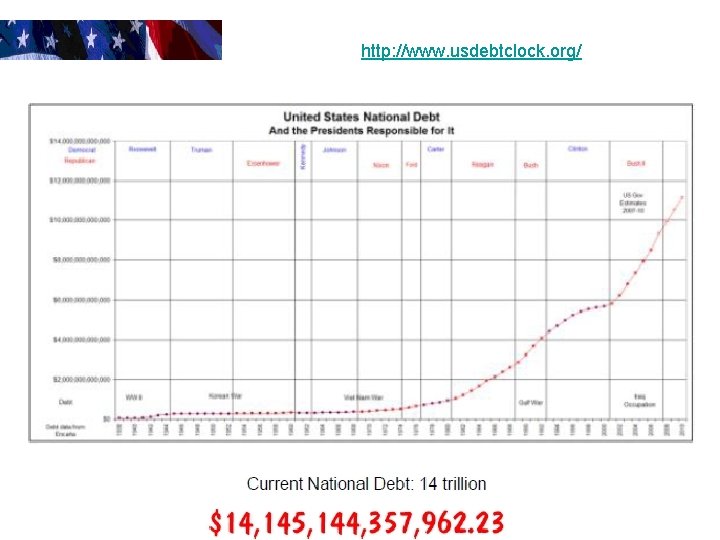
http: //www. usdebtclock. org/
2006 • The Framers of the U. S. Constitution created a legislative system that is bicameral. However, it is not just bicameral; the framers also established two houses of distinctly different character and authority. A. Discuss two reasons why the framers created a bicameral legislature. B. Identify one power unique to the House of Representatives and explain why the framers gave the House that power. C. Identify one power unique to the Senate and explain why the framers gave the Senate that power.

Part (a): 2 points Discuss two reasons why the framers created a bicameral legislature. • One point is earned for each of two reasons discussed. • Acceptable reasons for discussion may include: – Compromise at Constitutional Convention (representation of large vs. small population states). – Compromise among competing interests/protect minority interests. – Slow the process. – Different types of representation/federalism. – An intrabranch check/prevent majority tyranny.
Part (b): 2 points Identify one power unique to the House of Representatives and explain why the framers gave the House that power. • One point is earned for a correct identification of a power unique to the House of Representatives, and 1 point is earned for a correct explanation that is linked to the character of the House of Representatives. • Acceptable identifications may include. – Initiate revenue bills. – Choose the President when the Electoral College is deadlocked or no candidate receives a majority of electoral votes. – Impeachment. • Acceptable identifications may include. – Closer to the people – More representative of and responsive to the public/direct election to two-year terms.
Part (c): 2 points Identify one power unique to the Senate and explain why the framers gave the Senate that power. • One point is earned for a correct identification of a power unique to the senate, and 1 point is earned for a correct explanation that is linked to the character of the Senate. • Acceptable identifications may include: – Treaty ratification – Confirmation of judicial and executive appointments. – Try impeachments/conviction/removal from office. • Acceptable identifications may include: – – More mature/”august” body. More insulated from public opinion/indirectly elected (originally). Longer and/or staggered terms. Reflects state interests. • Note: The unique power must be one that is included in the Constitution (e. g. , “filibuster” does not get credit because it is a Senate rule, not a constitutional power).
2003 • Both party leadership and committees in Congress play key roles in the legislative process. • A. Define the following elements of the congressional committee system and explain how each influences the legislative process; – Specialization – Reciprocity/logrolling – Party representation on committees • B. Identify 3 ways party leadership in Congress can influence the legislative process, and explain how each way influences the process.
Part A Define two of the following element of the congressional committee system and explain how each influences the legislative process; • Committees: Explanations must go beyond merely linking to definition. All explanations must be clearly in context of defined element to get credit. • Specialization – [members of Congress develop policy expertise]- development of expertise; independence from executive branch; more attention paid to legislation; division of labor; better legislation accepted only if fully explain HOW. • Reciprocity/ logrolling [vote trading/ exchanges, bargaining] – – speeds process, government more expansive (do more). Explanations related to electoral success NOT accepted. More pork barrel ok only if clearly in context of reciprocity. • Party representation on committees [representation is reflective of the chamber as a whole] – – party pushes own agenda, determines leadership on committees.
Part B Party leadership: Identify two ways party leadership in Congress can influence the legislative process, and explain how each way influences the process. • Acceptable identification may include: – – – – assignment of members to committees assignment of committee chairs scheduling agenda-setting (rules committee) party discipline leadership use of media recognition on floor leadership control of electoral support • Explanation must specifically indicate HOW the party leadership influences the legislative process.
2008 • Congressional reappointment and redistricting are conducted every ten years. When redistricting is conducted, politicians often engage in gerrymandering. A. Define congressional reappointment and explain one reason why it is important to states. B. Define congressional redistricting. C. Explain two goals of politicians when they gerrymander during redistricting. D. Describe two limits that the United States Supreme Court placed on congressional redistricting.
Define congressional reappointment and explain one reason why it is important to states. • • • One point is earned for a correct definition of congressional reapportionment. One point is earned for a correct explanation of why reapportionment is important to states. An acceptable definition of congressional reapportionment is: – The reallocation of the number of representatives each state has in the House of Representatives Acceptable explanations of why congressional reapportionment is important to states are: – Reapportionment increases or decreases the number of seats a state has in the House/Congress (not the Senate). – More representatives mean that a state has more influence. – Reapportionment increases or decreases a state’s number of electoral votes.
Define congressional redistricting. • One point is earned for a correct definition of congressional redistricting. An acceptable definition is: • The drawing/redrawing of House/congressional (not Senate) district lines.
Explain two goals of politicians when they gerrymander during redistricting. • One point is earned for each of two explanations of the goals of politicians when they gerrymander during redistricting. Acceptable explanations may include – To enhance political party strength/to minimize the strength of the opposition party. – To protect incumbents/to discourage challengers. – To increase minority representation/to decrease minority representation. – To punish foes/to reward friends.
Describe two limits that the United States Supreme Court placed on congressional redistricting. • One point is earned for each of two descriptions of limits that the U. S. Supreme Court has placed n congressional redistricting. • Acceptable explanations include: – Districts must be equally populated. – Lines must be contiguous or connected. – Redistricting cannot dilute minority voting strength. – District lines cannot be drawn solely based upon race. – Districts must be compact. – Communities of interest must be protected.
2009 • In the United States Congress, the majority party exerts a substantial influence over lawmaking. However, even when one party has a numerical majority in each chamber of the United States Congress, there is no guarantee that legislation supported by that majority party will be passed by both chambers. Rules of each chamber independently influence the likelihood that legislation in that chamber; legislation passed by one chamber is not always passed by the other. – Describe two advantages the majority party in the United States House of Representative has in lawmaking, above and beyond the numerical advantage that majority party enjoys in floor voting. – Describe two differences between House and Senate rules that may make it likely that legislation may pass in one chamber but not in the other. – Explain how the differences identified in (b) can lead to the passage of a bill in one chamber but not in the other.
Describe two advantages the majority party in the United States House of Representative has in lawmaking, above and beyond the numerical advantage that majority party enjoys in floor voting. • Part (a): 2 points: One point is earned for each of two descriptions of majority party advantage in the House of Representatives. The description must include three components: – Majority party – Advantage – Factual statement about the advantage • Acceptable answers may include: – Holds committee chairs – Controls Rules Committee – Sets the agenda – Controls debate – Chooses Speaker of the House – Holds majority on each committee – Assigns bills to committees
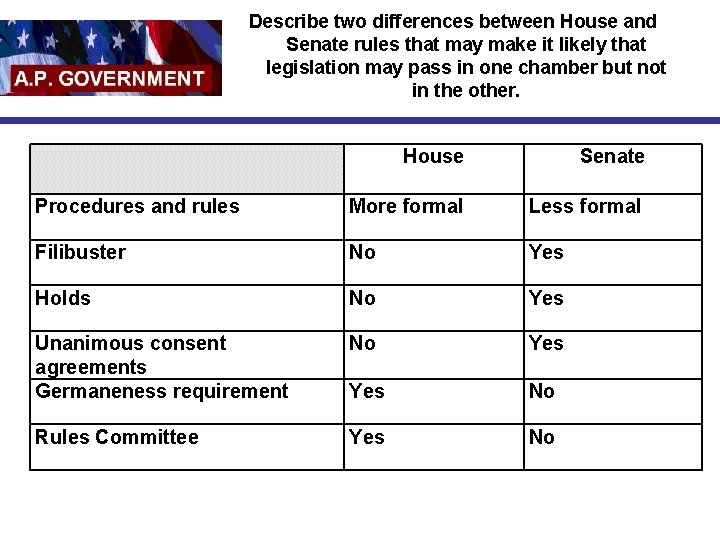
Describe two differences between House and Senate rules that may make it likely that legislation may pass in one chamber but not in the other. House Senate Procedures and rules More formal Less formal Filibuster No Yes Holds No Yes Unanimous consent agreements Germaneness requirement No Yes No Rules Committee Yes No
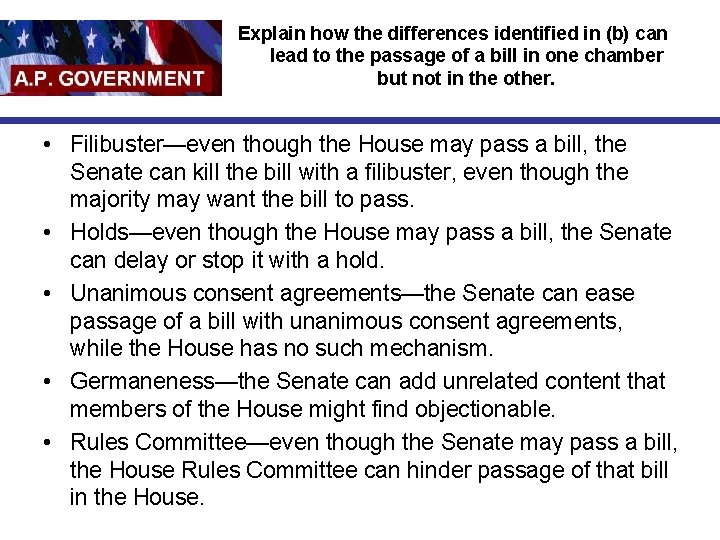
Explain how the differences identified in (b) can lead to the passage of a bill in one chamber but not in the other. • Filibuster—even though the House may pass a bill, the Senate can kill the bill with a filibuster, even though the majority may want the bill to pass. • Holds—even though the House may pass a bill, the Senate can delay or stop it with a hold. • Unanimous consent agreements—the Senate can ease passage of a bill with unanimous consent agreements, while the House has no such mechanism. • Germaneness—the Senate can add unrelated content that members of the House might find objectionable. • Rules Committee—even though the Senate may pass a bill, the House Rules Committee can hinder passage of that bill in the House.
• Public opinion polls are a way to link the public with elected officials. Members of Congress often use polls to understand the views of their constituents, but they must also pay attention to other political considerations. • Identify two characteristics of a valid, scientific, public opinion poll. • Explain why each of the following enhances the influence of public opinion on the voting decisions of members of Congress. – Strong public opinion as expressed in polling results – Competitive re-elections • Explain why each of the following limits the influence of public opinion on the voting decisions of members of Congress. – Legislators’ voting records – Party leadership
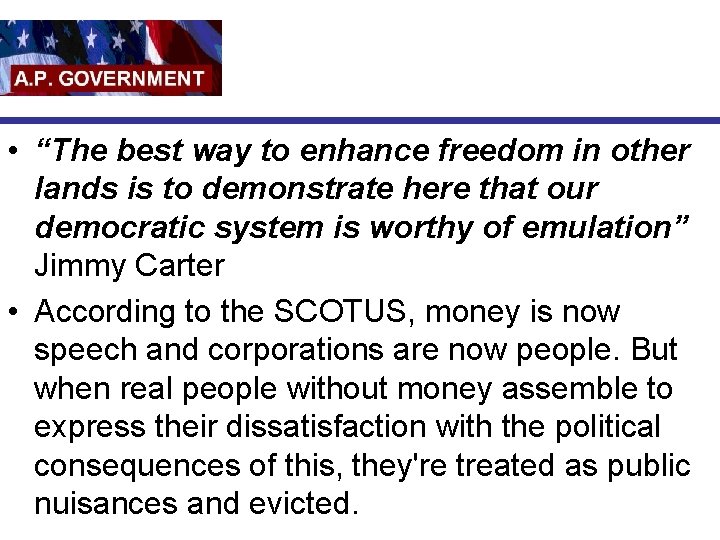
• “The best way to enhance freedom in other lands is to demonstrate here that our democratic system is worthy of emulation” Jimmy Carter • According to the SCOTUS, money is now speech and corporations are now people. But when real people without money assemble to express their dissatisfaction with the political consequences of this, they're treated as public nuisances and evicted.
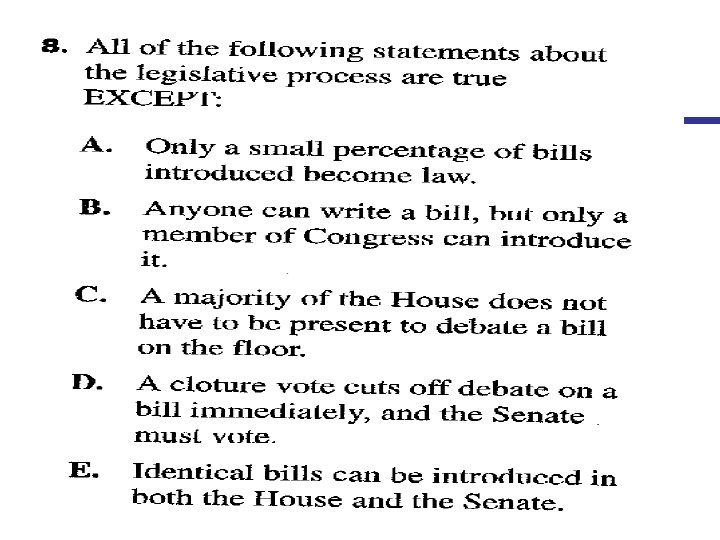
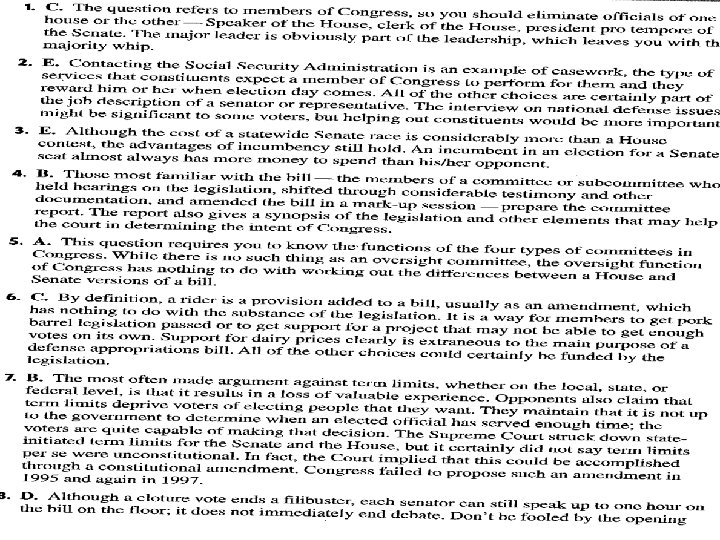
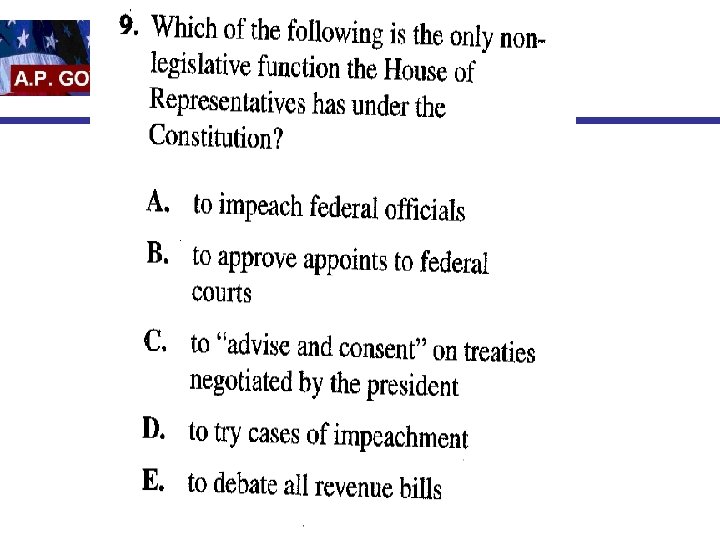
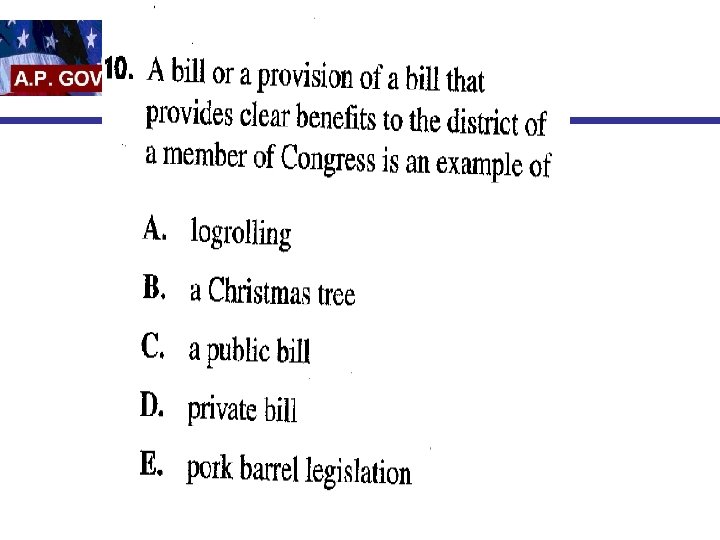
- Slides: 132