
Congress Chapter 10 The National Legislature Section One





































- Slides: 65
Congress Chapter 10
The National Legislature Section One
Congress is the branch of the National Government that makes laws.
The Constitution says that Congress will be bicameral— that is, made up of two houses, which are the Senate and the House of Representatives.
Congress is bicameral in order to give fair representation to both large and small States.
In the Senate, each State is represented equally and has equal power.
In the House of Representatives, States with larger populations get more representation.
The term of Congress is the length of time its officials serve after their election.
Each term begins on January 3 of every odd numbered year and lasts for two years.
Congress holds one session, or meeting period, every year.
Each term has two sessions. Congress can adjourn, or end, a session when it finishes its business.
Today, Congress meets almost year round, with several recesses, or breaks.
The President has an as yet unused power to prorogue, or adjourn, a session if the two houses cannot agree on an adjournment date.
In case of an emergency, the President may call Congress into special session.
Because Congress spends so much of the year in session, the President has not called a special session in over 50 years.
End Section One
The House of Representatives Section Two
Today the House of Representatives has 435 members.
Congress apportions, or distributes, the House's seats among the States according to their populations.
Each State sends at least one representative to the House.
Every ten years the House's seats are reapportioned— redistributed—when the United States counts its population.
This count is called a census.
After each census has been conducted, the number of representatives of any State may change based on changes in its population.
Once Congress tells each State how many House seats it has, the State draws the boundaries of its electoral districts.
States must follow guidelines and avoid gerrymandering, or drawing districts in a way that is advantageous to the State legislature's controlling party.
Since 1842, the use of the single member district arrangement has allowed the voters of each congressional district to choose one representative from a pool of candidates associated with that district.
Before 1842, voters in some States chose their representatives at large, or from the State as a whole.
To become a representative, a person must be at least 25 years of age, have been a citizen of the United States for seven years, and live in the State that he or she wishes to represent.
Representatives serve two year terms and may be elected an unlimited number of times. Congressional elections are held in November of even numbered years.
An off year election (or mid term election) is a congressional election that is held between presidential elections.
End Section Two
The Senate Section Three
The Senate has 100 members, two from each State—a number established by the Constitution.
The Senate is therefore a much smaller body than the House of Representatives.
Originally, the Constitution established that Senators were chosen by the State Legislatures.
The passage of the 17 th Amendment in 1913 gave direct election of Senators to the citizens.
The voters of each State elect one senator in any given election, unless the other seat has been vacated by death, resignation, or expulsion and so also needs to be filled.
The Senate is called the "upper house" of Congress because senators meet stricter qualifications and serve longer terms than representatives do.
Senators serve six year terms whose start dates are staggered so that only one third of the senators' terms end at the same time.
This means that every two years about 33 senators come up for reelection.
The Senate is, therefore, a continuous body: it never contains only new members, so a majority of its membership always has experience.
The longer terms for senators and the larger size and geographic diversity of their constituencies those people who elect them are designed to remove senators, at least somewhat, from day to day politics.
In contrast to their colleagues, or coworkers, in the House, senators have more power and prestige and are more likely to be seen as national political leaders.
To become a senator, a person must be at least 30 years of age, have been a citizen of the United States for at least nine years, and live in the State that he or she wishes to represent.
End Section Three
The Members of Congress Section Four
Historically, most members of Congress are white, upper middle class, and male, although more women and minorities have been elected in recent years.
Most also have previous political experience, such as being a State governor or legislator.
Typically, the members of Congress take on one of the following roles as they vote on bills.
As trustees, they consider each bill's merits, regardless of the views of constituents.
As delegates, they base their votes on the wishes of the "folks back home, " their constituents.
As partisans, they vote in line with their political party.
As politicos, they consider all of these factors when they vote.
On committees, members of Congress screen proposed bills and decide which should be acted on.
Committees also exercise the oversight function, checking that the executive branch is working effectively and in line with the policies that Congress has set.
Members of Congress also act as servants of their constituents.
Through this duty they help those they represent solve problems with the National Government.
In performing the above roles, members of Congress carry out five key duties: they act as legislators, representatives of their constituents, committee members, servants of their constituents, and politicians.
For their work, they receive a salary and benefits such as the franking privilege, the right to send mail postage free.
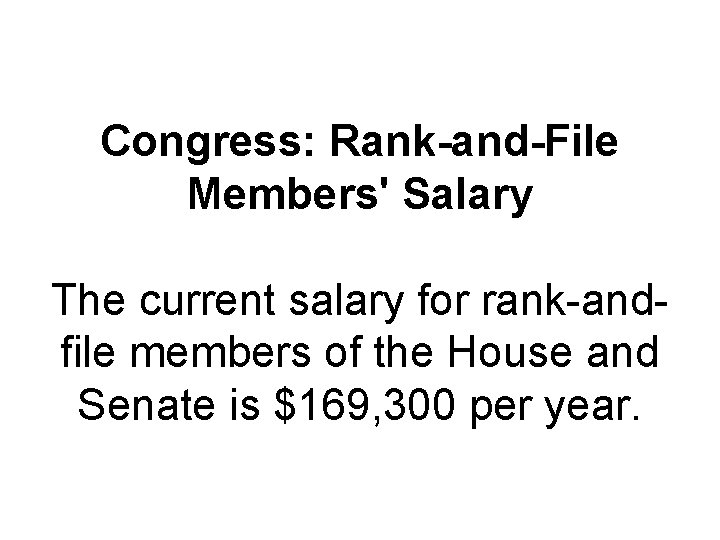
Congress: Rank-and-File Members' Salary The current salary for rank and file members of the House and Senate is $169, 300 per year.
Congress: Leadership Members' Salary (110 th Congress) Leaders of the House and Senate are paid a higher salary than rank and file members.
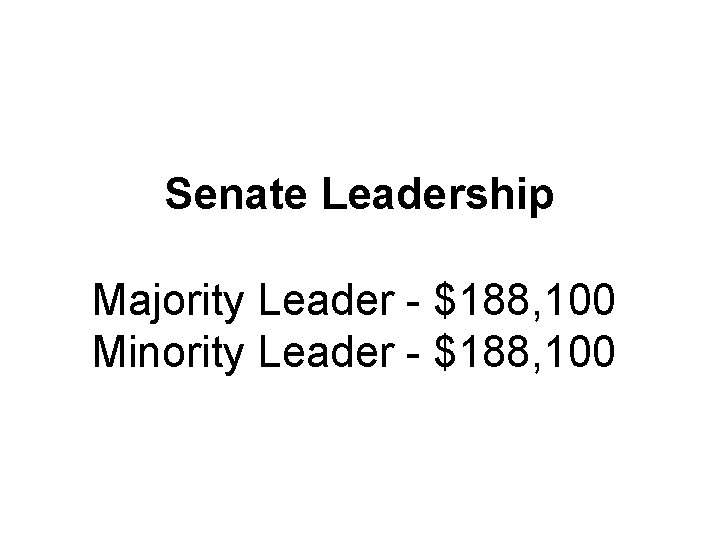
Senate Leadership Majority Leader $188, 100 Minority Leader $188, 100
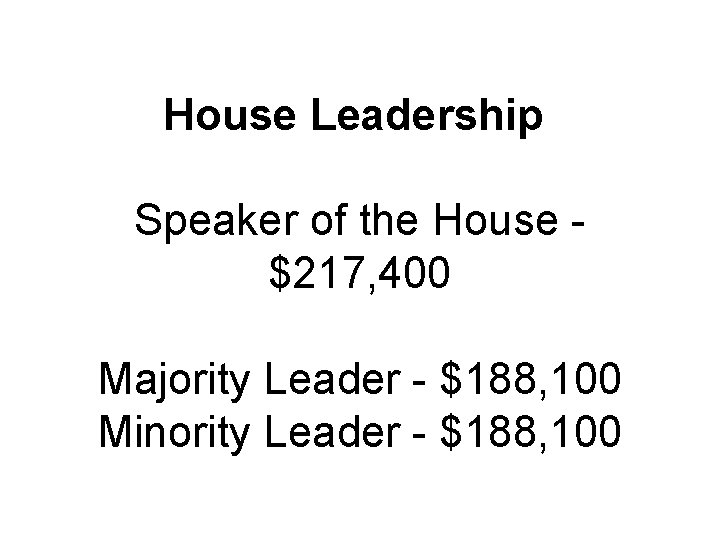
House Leadership Speaker of the House $217, 400 Majority Leader $188, 100 Minority Leader $188, 100
End Section Four
End Chapter Ten