
Congregational Life Cycles Average Lifespan of a Church

- Slides: 11
Congregational Life Cycles
Average Lifespan of a Church – 75 years Texas State Baptist Convention Bill Hoyt, Nex. Step Consulting, 2006
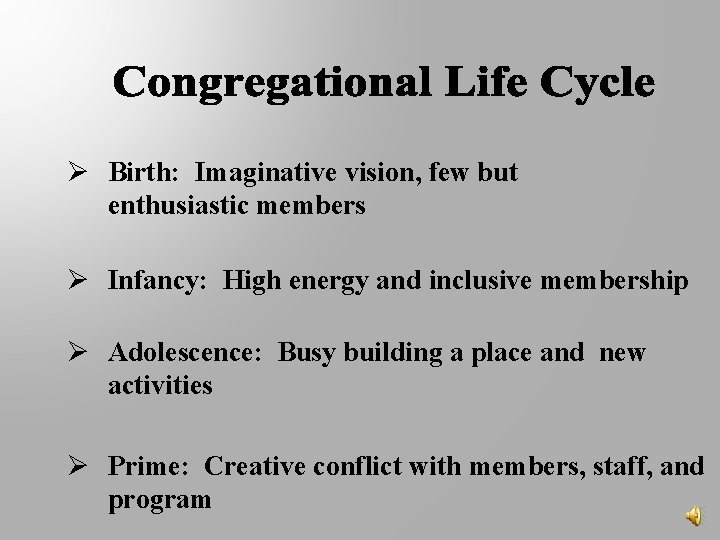
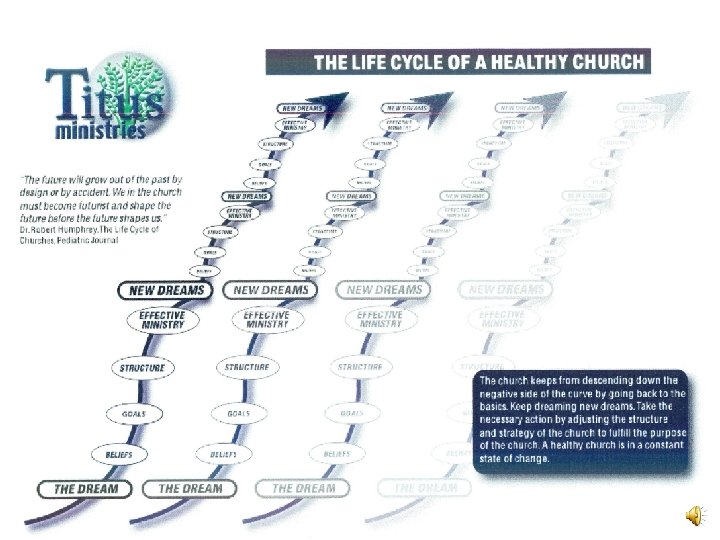
Ø Birth: Imaginative vision, few but enthusiastic members Ø Infancy: High energy and inclusive membership Ø Adolescence: Busy building a place and new activities Ø Prime: Creative conflict with members, staff, and program
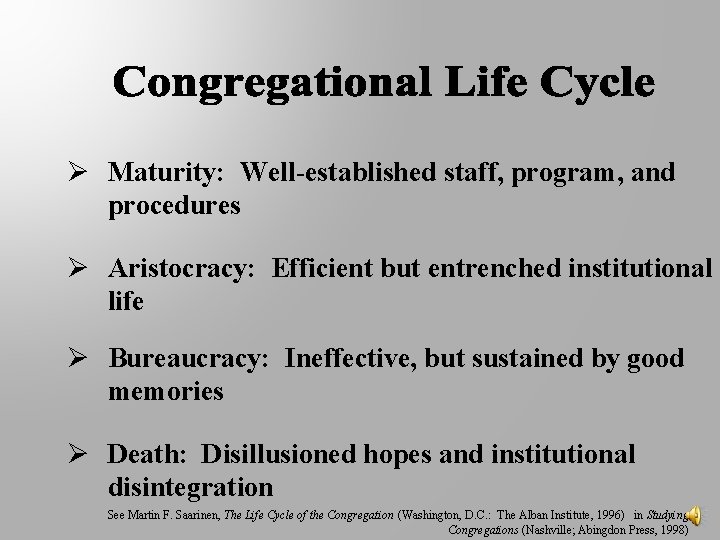
Ø Maturity: Well-established staff, program, and procedures Ø Aristocracy: Efficient but entrenched institutional life Ø Bureaucracy: Ineffective, but sustained by good memories Ø Death: Disillusioned hopes and institutional disintegration See Martin F. Saarinen, The Life Cycle of the Congregation (Washington, D. C. : The Alban Institute, 1996) in Studying Congregations (Nashville; Abingdon Press, 1998)
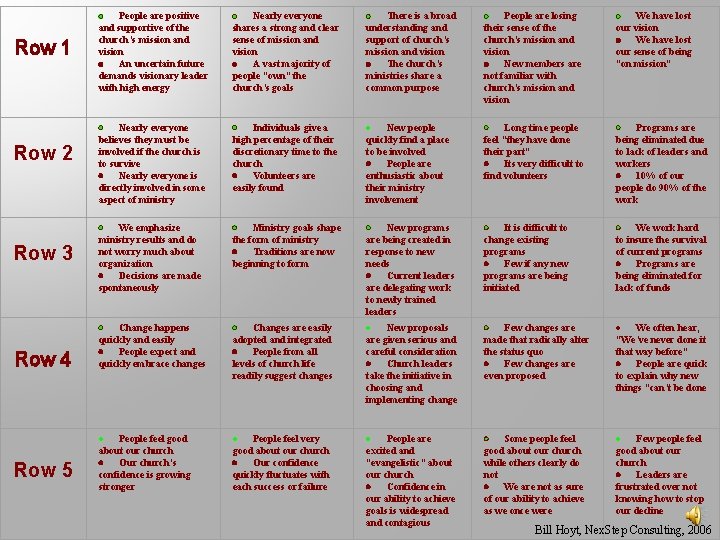
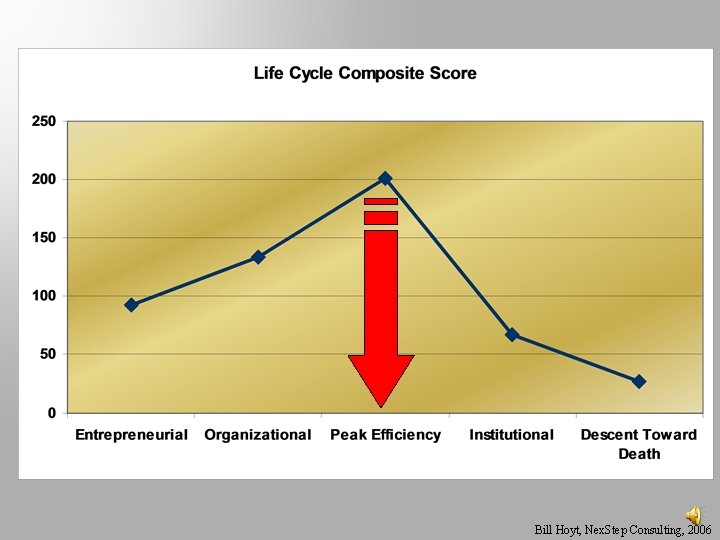
Row 1 Row 2 Row 3 Row 4 Row 5 · People are positive and supportive of the church’s mission and vision · An uncertain future demands visionary leader with high energy · Nearly everyone shares a strong and clear sense of mission and vision · A vast majority of people “own” the church’s goals · There is a broad understanding and support of church’s mission and vision · The church’s ministries share a common purpose · People are losing their sense of the church’s mission and vision · New members are not familiar with church’s mission and vision · We have lost our sense of being “on mission” · Nearly everyone believes they must be involved if the church is to survive · Nearly everyone is directly involved in some aspect of ministry · Individuals give a high percentage of their discretionary time to the church · Volunteers are easily found · New people quickly find a place to be involved · People are enthusiastic about their ministry involvement · Long time people feel “they have done their part” · Its very difficult to find volunteers · Programs are being eliminated due to lack of leaders and workers · 10% of our people do 90% of the work · We emphasize ministry results and do not worry much about organization · Decisions are made spontaneously · Ministry goals shape the form of ministry · Traditions are now beginning to form · New programs are being created in response to new needs · Current leaders are delegating work to newly trained leaders · It is difficult to change existing programs · Few if any new programs are being initiated · We work hard to insure the survival of current programs · Programs are being eliminated for lack of funds · Change happens quickly and easily · People expect and quickly embrace changes · Changes are easily adopted and integrated · People from all levels of church life readily suggest changes · New proposals are given serious and careful consideration · Church leaders take the initiative in choosing and implementing change · Few changes are made that radically alter the status quo · Few changes are even proposed · We often hear, “We’ve never done it that way before” · People are quick to explain why new things “can’t be done · People feel good about our church · Our church’s confidence is growing stronger · People feel very good about our church · Our confidence quickly fluctuates with each success or failure · People are excited and “evangelistic” about our church · Confidence in our ability to achieve goals is widespread and contagious · Some people feel good about our church while others clearly do not · We are not as sure of our ability to achieve as we once were · Few people feel good about our church · Leaders are frustrated over not knowing how to stop our decline Bill Hoyt, Nex. Step Consulting, 2006
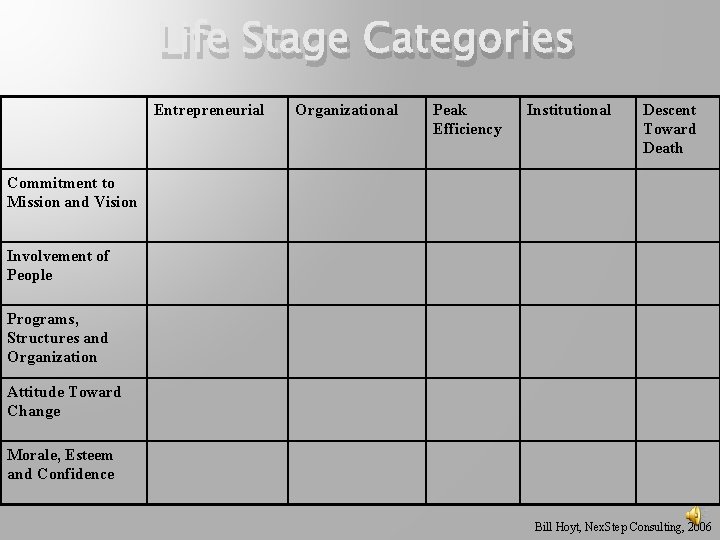
Life Stage Categories Entrepreneurial Organizational Peak Efficiency Institutional Descent Toward Death Commitment to Mission and Vision Involvement of People Programs, Structures and Organization Attitude Toward Change Morale, Esteem and Confidence Bill Hoyt, Nex. Step Consulting, 2006
Bill Hoyt, Nex. Step Consulting, 2006
In which life stage is your Congregation? Bill Hoyt, Nex. Step Consulting, 2006