
Congestion Control in Data Centers Lecture 16 Computer

- Slides: 28
Congestion Control in Data Centers Lecture 16, Computer Networks (198: 552)
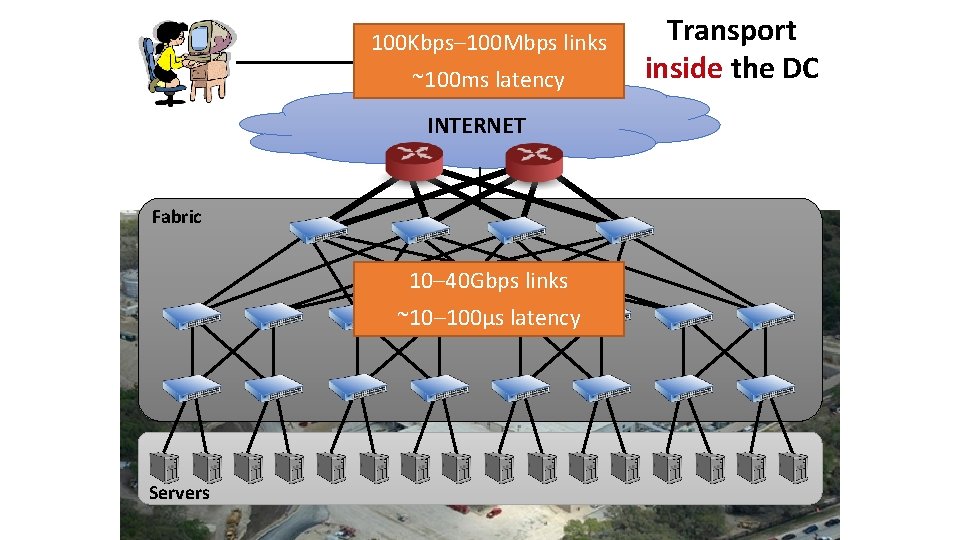
100 Kbps– 100 Mbps links ~100 ms latency INTERNET Fabric 10– 40 Gbps links ~10– 100μs latency Servers Transport inside the DC
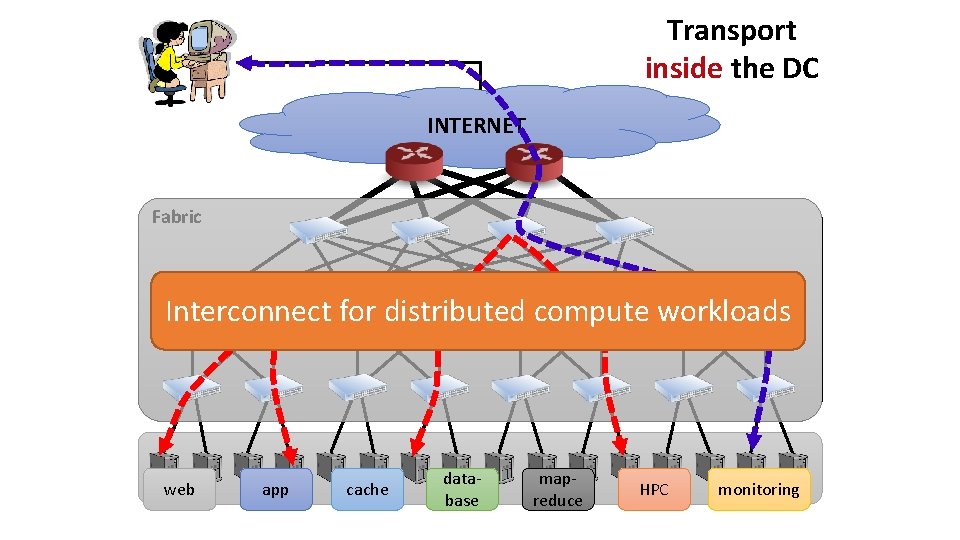
Transport inside the DC INTERNET Fabric Interconnect for distributed compute workloads web Servers app cache database mapreduce HPC monitoring
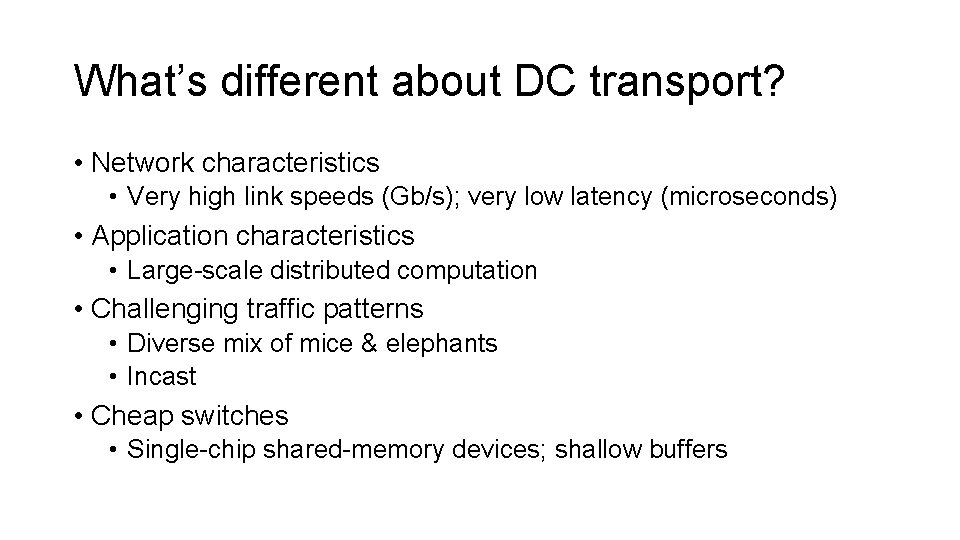
What’s different about DC transport? • Network characteristics • Very high link speeds (Gb/s); very low latency (microseconds) • Application characteristics • Large-scale distributed computation • Challenging traffic patterns • Diverse mix of mice & elephants • Incast • Cheap switches • Single-chip shared-memory devices; shallow buffers
Additional degrees of flexibility • Flow priorities and deadlines • Preemption and termination of flows • Coordination with switches • Packet header changes to propagate information
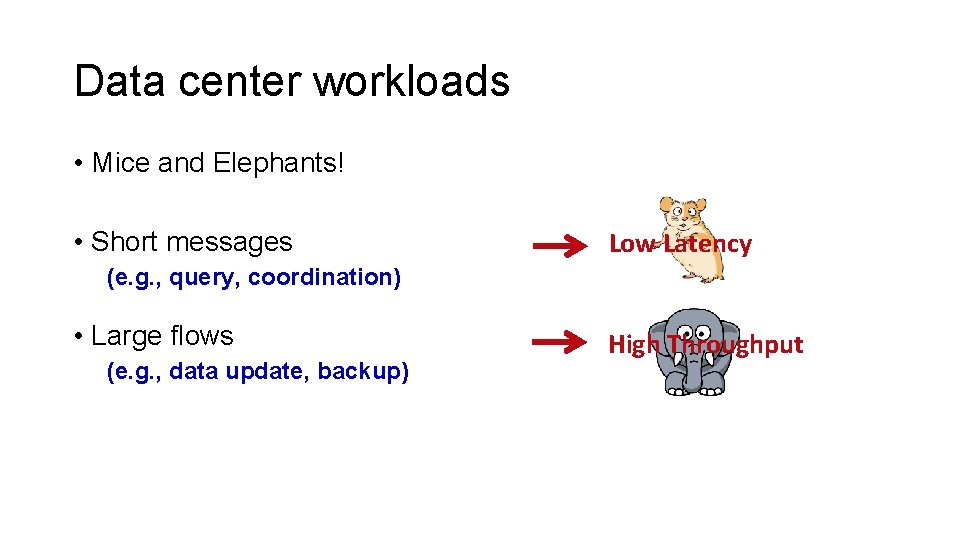
Data center workloads • Mice and Elephants! • Short messages Low Latency (e. g. , query, coordination) • Large flows (e. g. , data update, backup) High Throughput
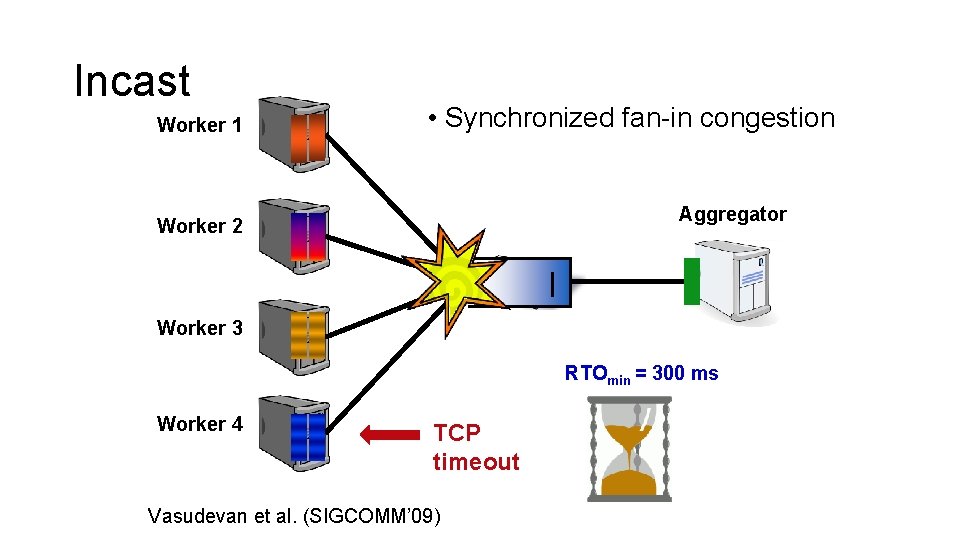
Incast Worker 1 • Synchronized fan-in congestion Aggregator Worker 2 Worker 3 RTOmin = 300 ms Worker 4 TCP timeout Vasudevan et al. (SIGCOMM’ 09)
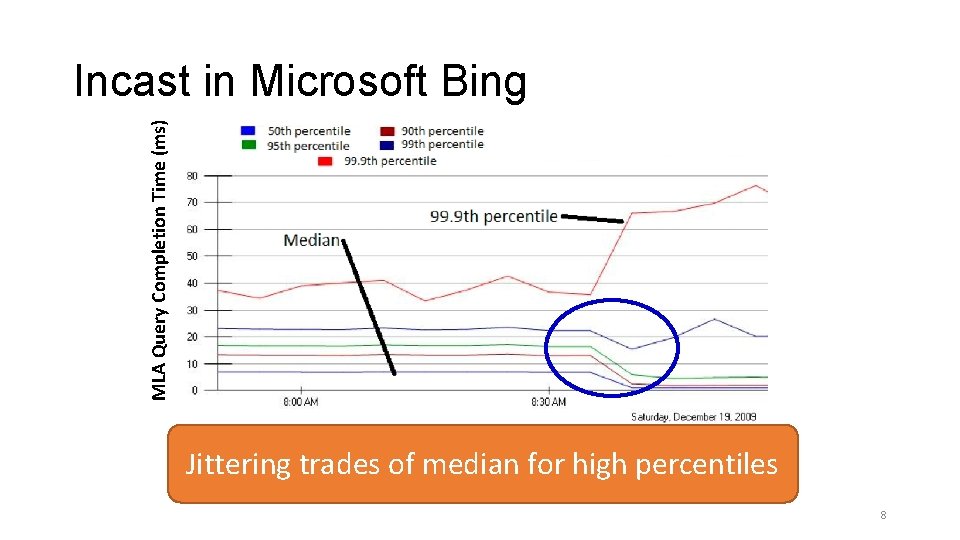
MLA Query Completion Time (ms) Incast in Microsoft Bing • Requests are jittered over 10 ms window. Jittering trades of median for high percentiles • Jittering switched off around 8: 30 am. 8
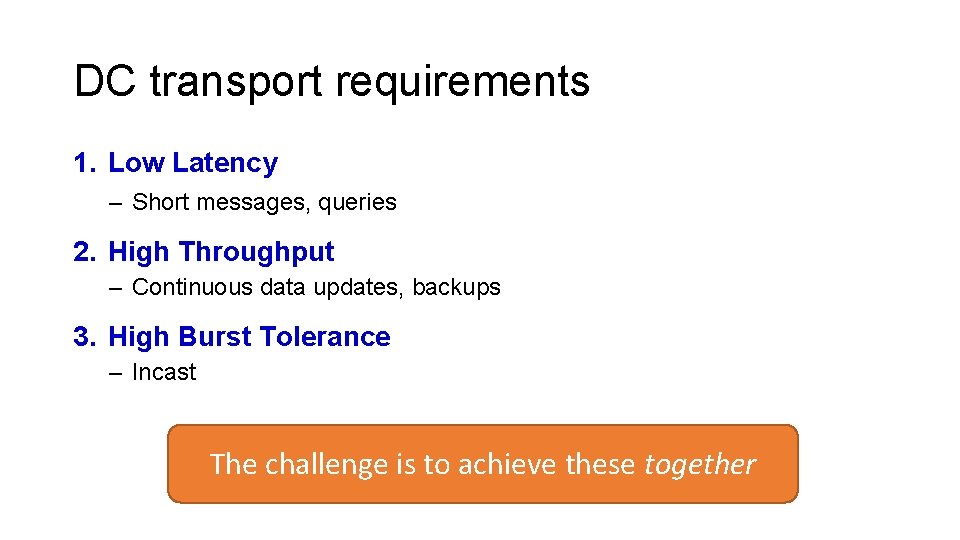
DC transport requirements 1. Low Latency – Short messages, queries 2. High Throughput – Continuous data updates, backups 3. High Burst Tolerance – Incast The challenge is to achieve these together
Data Center TCP Mohammad Alizadeh et al. , SIGCOMM’ 10
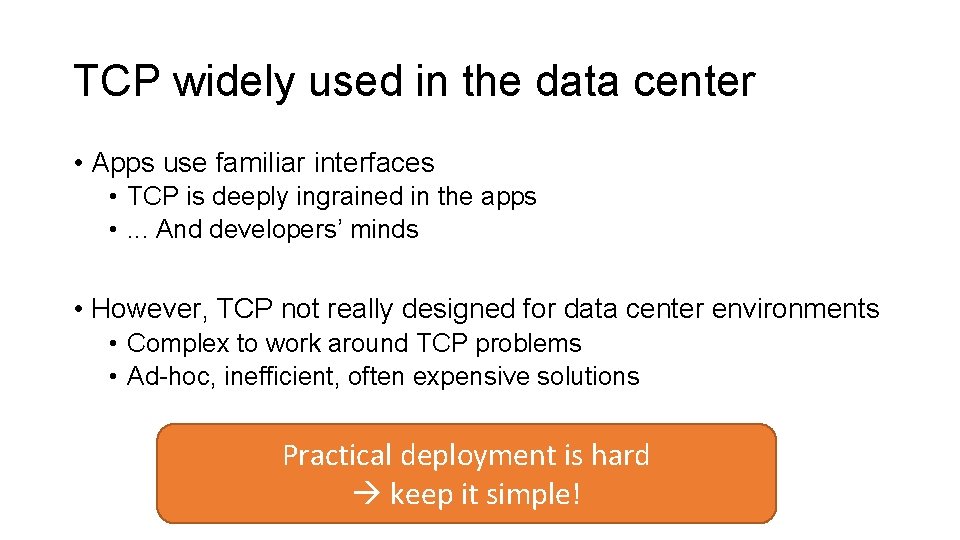
TCP widely used in the data center • Apps use familiar interfaces • TCP is deeply ingrained in the apps • . . . And developers’ minds • However, TCP not really designed for data center environments • Complex to work around TCP problems • Ad-hoc, inefficient, often expensive solutions Practical deployment is hard keep it simple!
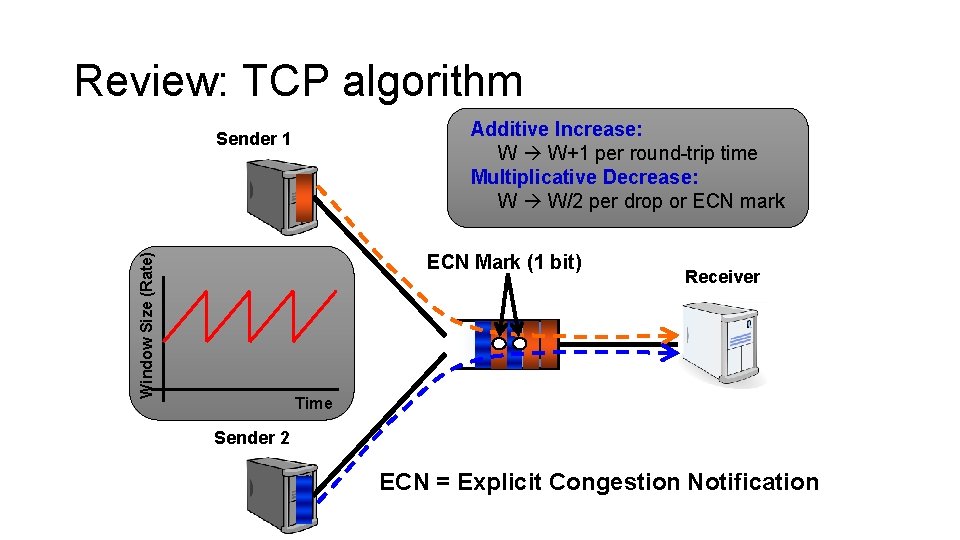
Review: TCP algorithm Additive Increase: W W+1 per round-trip time Multiplicative Decrease: W W/2 per drop or ECN mark Sender 1 Window Size (Rate) ECN Mark (1 bit) Receiver Time Sender 2 ECN = Explicit Congestion Notification
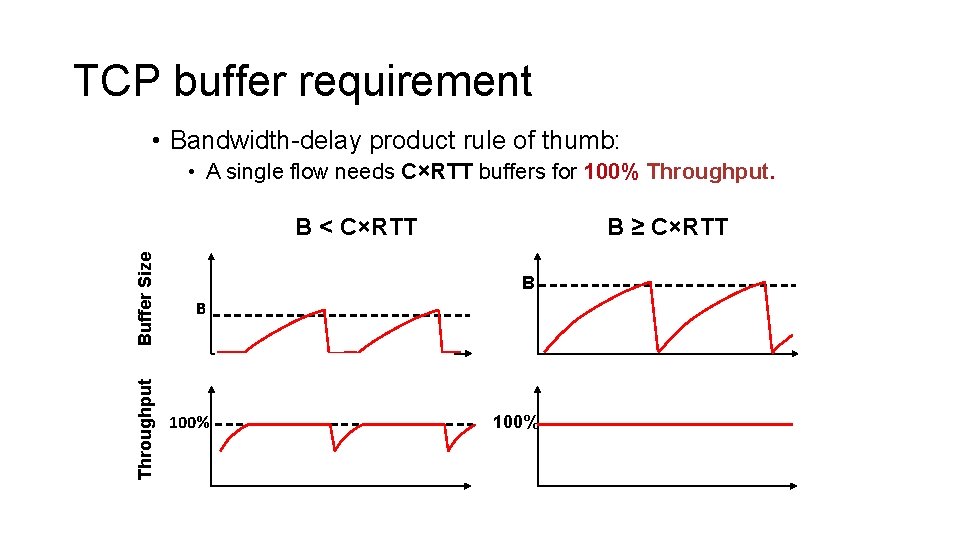
TCP buffer requirement • Bandwidth-delay product rule of thumb: • A single flow needs C×RTT buffers for 100% Throughput. Buffer Size B Throughput B < C×RTT 100% B ≥ C×RTT B 100%
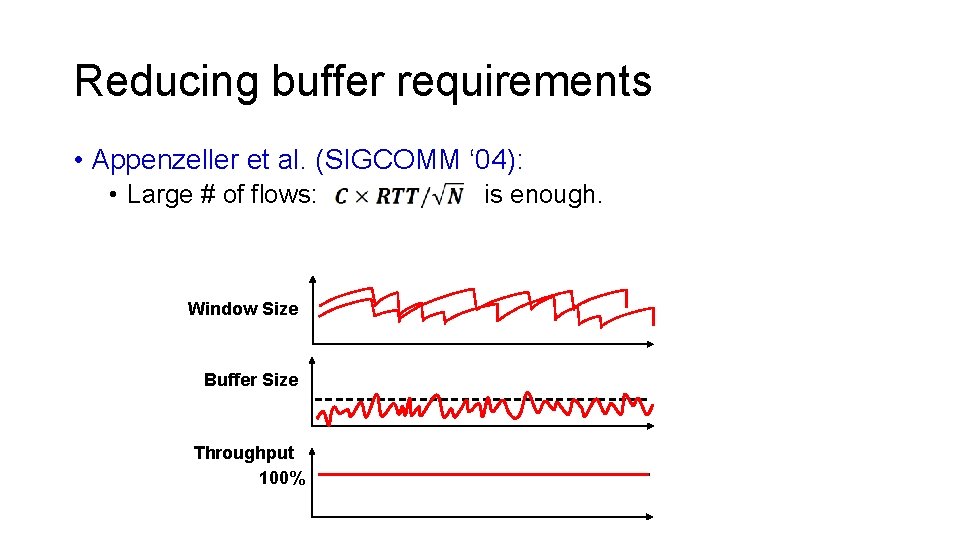
Reducing buffer requirements • Appenzeller et al. (SIGCOMM ‘ 04): • Large # of flows: Window Size Buffer Size Throughput 100% is enough.
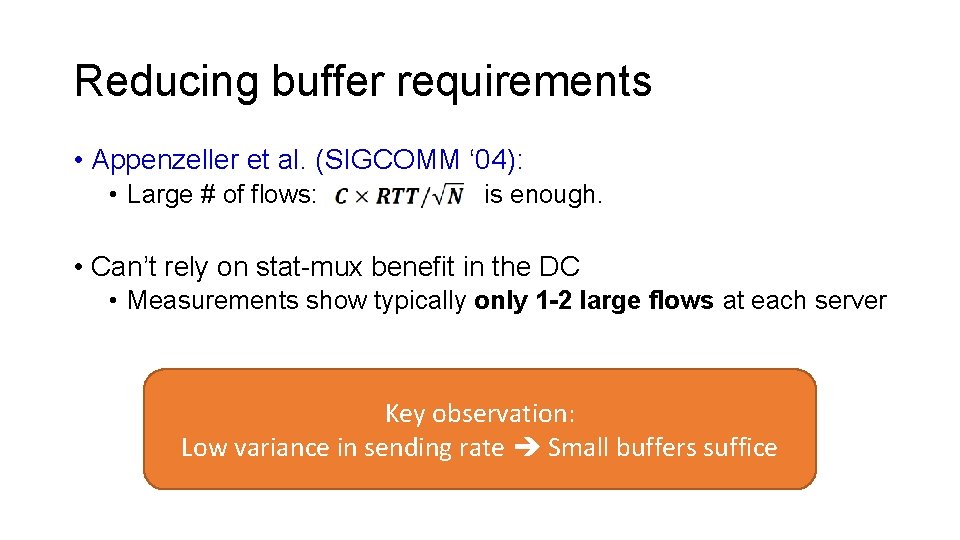
Reducing buffer requirements • Appenzeller et al. (SIGCOMM ‘ 04): • Large # of flows: is enough. • Can’t rely on stat-mux benefit in the DC • Measurements show typically only 1 -2 large flows at each server Key observation: Low variance in sending rate Small buffers suffice
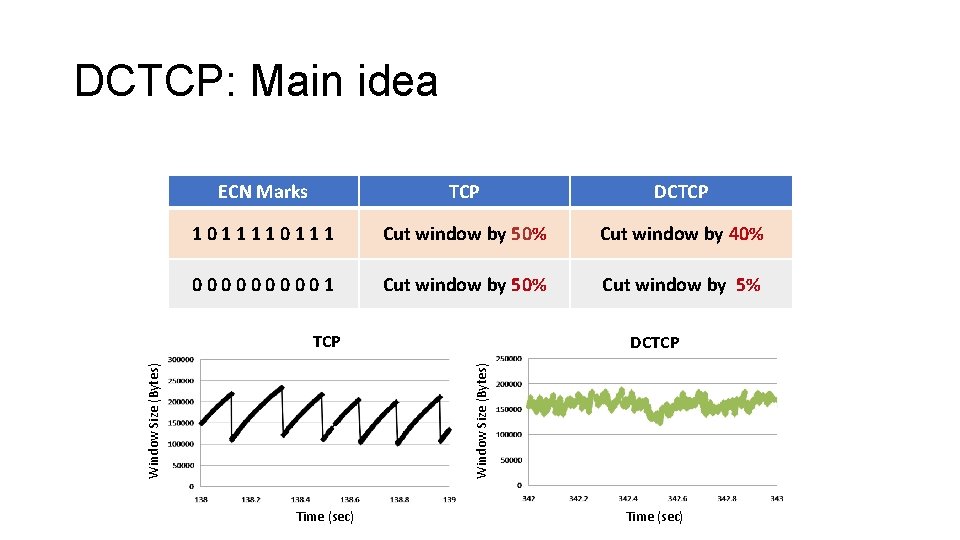
DCTCP: Main idea • Extract multi-bit feedback from single-bit stream of ECN marks • Reduce window size based on fraction of marked packets
DCTCP: Main idea ECN Marks TCP DCTCP 10111 Cut window by 50% Cut window by 40% 000001 Cut window by 50% Cut window by 5% TCP Window Size (Bytes) DCTCP Time (sec)
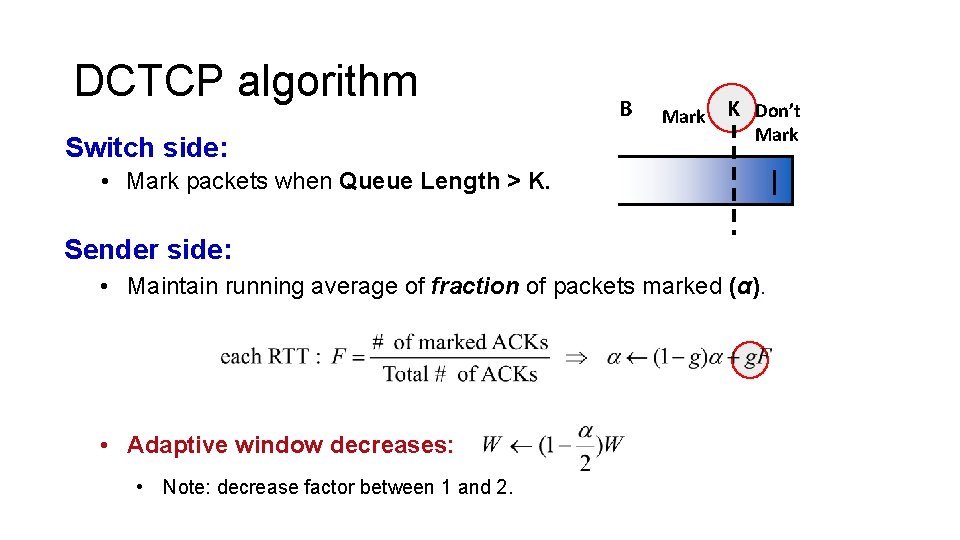
DCTCP algorithm Switch side: B Mark K Don’t Mark • Mark packets when Queue Length > K. Sender side: • Maintain running average of fraction of packets marked (α). • Adaptive window decreases: • Note: decrease factor between 1 and 2.
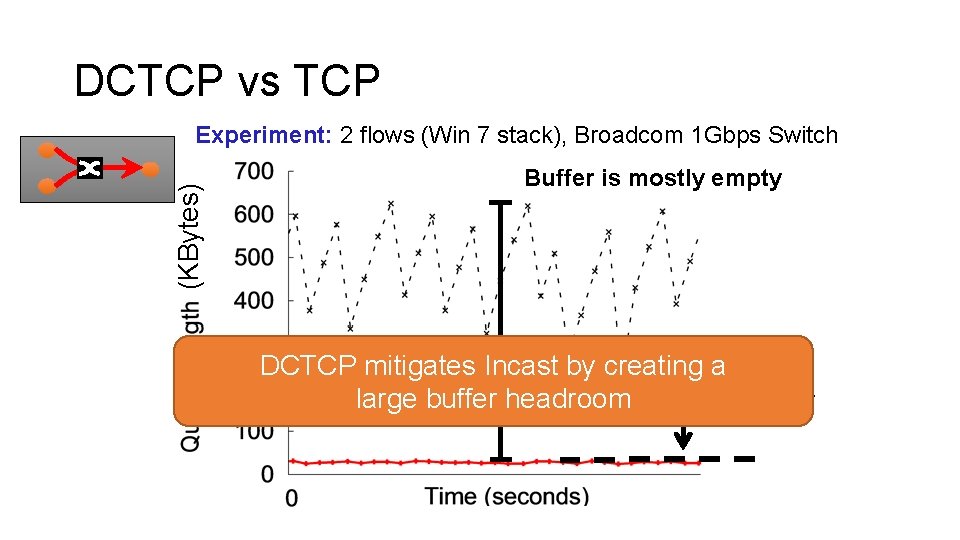
DCTCP vs TCP (KBytes) Experiment: 2 flows (Win 7 stack), Broadcom 1 Gbps Switch Buffer is mostly empty DCTCP mitigates Incast by creating a ECN Marking Thresh = 30 KB large buffer headroom
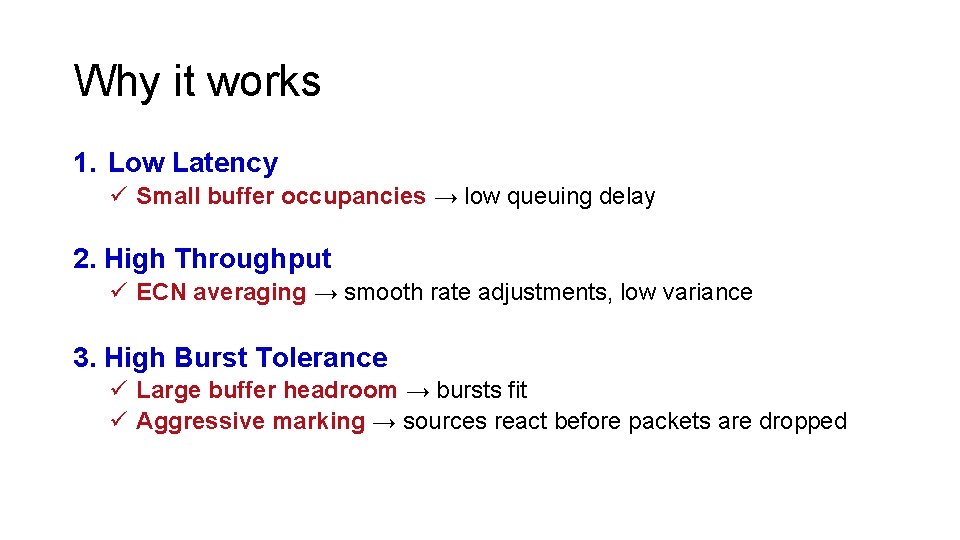
Why it works 1. Low Latency ü Small buffer occupancies → low queuing delay 2. High Throughput ü ECN averaging → smooth rate adjustments, low variance 3. High Burst Tolerance ü Large buffer headroom → bursts fit ü Aggressive marking → sources react before packets are dropped
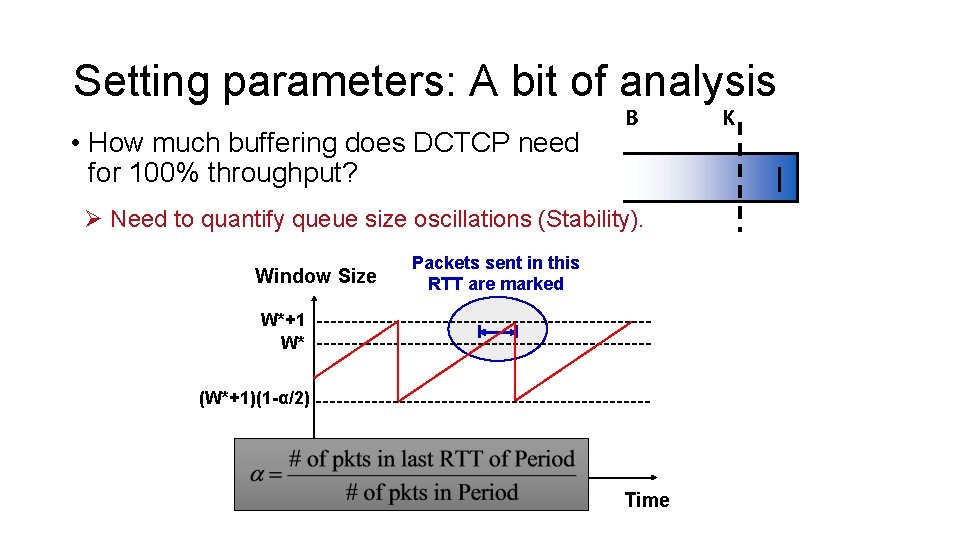
Setting parameters: A bit of analysis • How much buffering does DCTCP need for 100% throughput? B Ø Need to quantify queue size oscillations (Stability). Window Size Packets sent in this RTT are marked W*+1 W* (W*+1)(1 -α/2) Time K
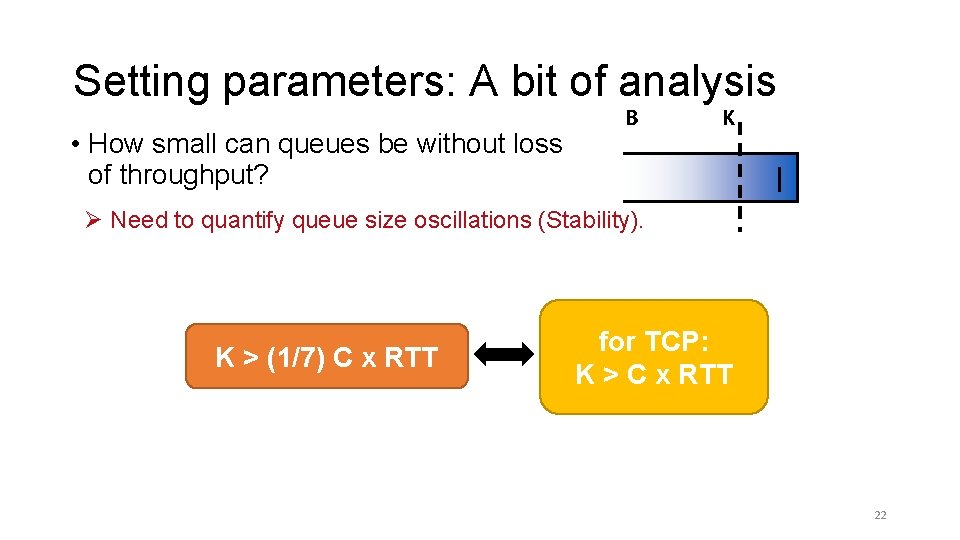
Setting parameters: A bit of analysis • How small can queues be without loss of throughput? B K Ø Need to quantify queue size oscillations (Stability). K > (1/7) C x RTT for TCP: K > C x RTT 22
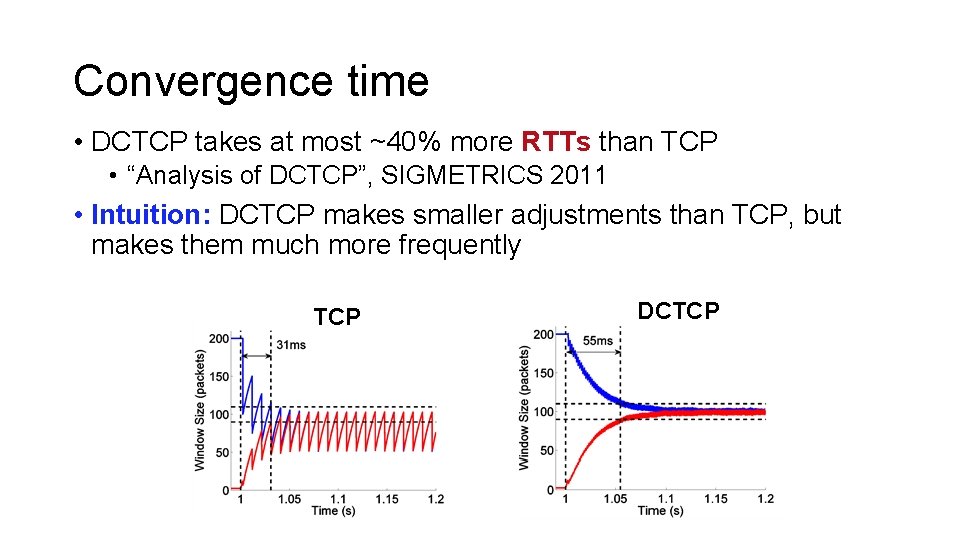
Convergence time • DCTCP takes at most ~40% more RTTs than TCP • “Analysis of DCTCP”, SIGMETRICS 2011 • Intuition: DCTCP makes smaller adjustments than TCP, but makes them much more frequently TCP DCTCP
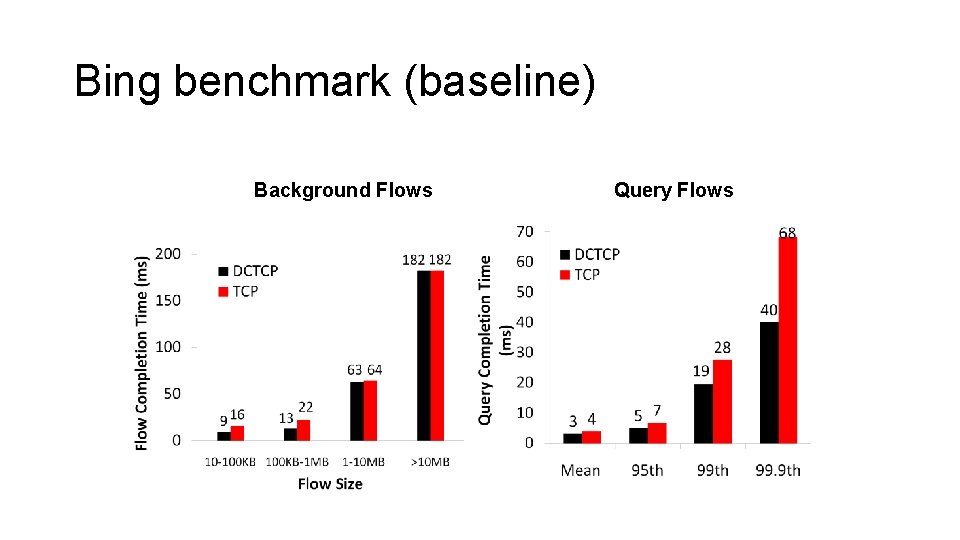
Bing benchmark (baseline) Background Flows Query Flows
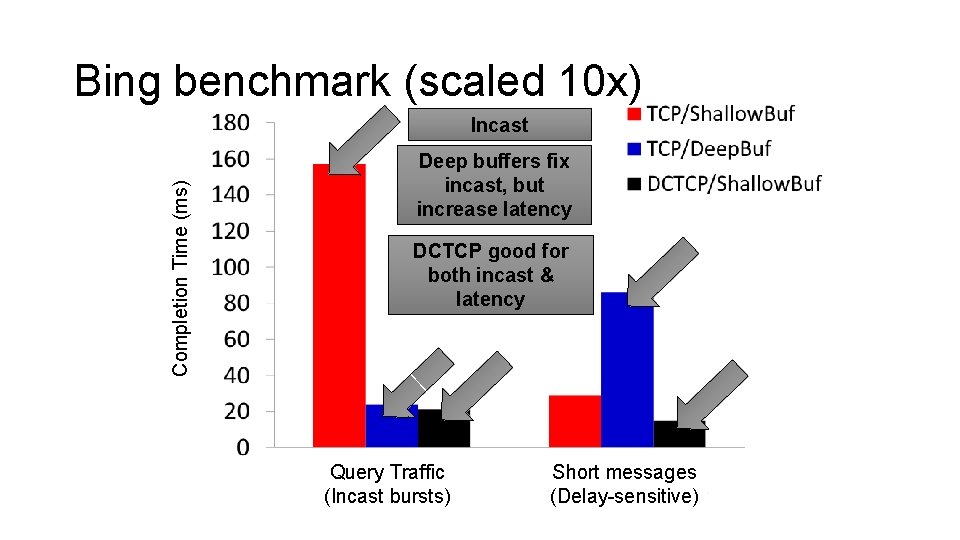
Bing benchmark (scaled 10 x) Completion Time (ms) Incast Deep buffers fix incast, but increase latency DCTCP good for both incast & latency Query Traffic (Incast bursts) Short messages (Delay-sensitive)
Discussion • Between throughput, delay, and convergence time, what metrics are you willing to give up? Why? • Are there other factors that may determine choice of K and B besides loss of throughput and max queue size? • How would you improve on DCTCP? • How could you add on flow prioritization over DCTCP?
Acknowledgment • Slides heavily adapted from material by Mohammad Alizadeh