
Congenital Malformation Scope of the Problem Charles J
Congenital Malformation - Scope of the Problem Charles J. Macri MD Head, Division of Reproductive and Medical Genetics National Naval Medical Center
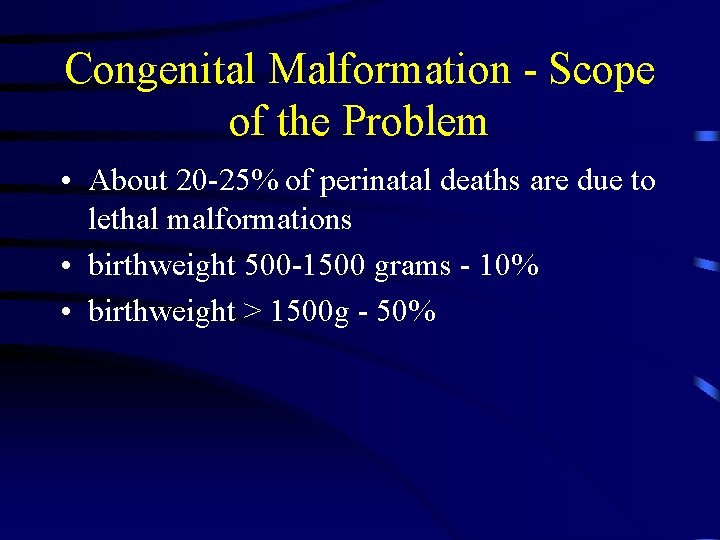
Congenital Malformation - Scope of the Problem • About 20 -25% of perinatal deaths are due to lethal malformations • birthweight 500 -1500 grams - 10% • birthweight > 1500 g - 50%
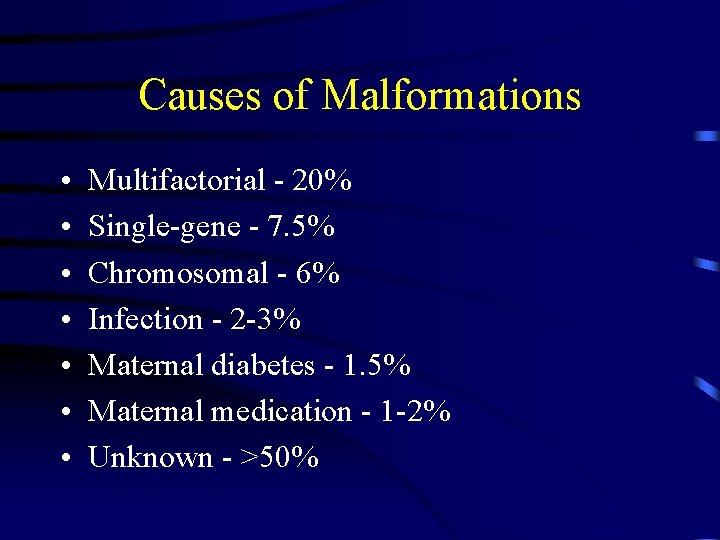
Causes of Malformations • • Multifactorial - 20% Single-gene - 7. 5% Chromosomal - 6% Infection - 2 -3% Maternal diabetes - 1. 5% Maternal medication - 1 -2% Unknown - >50%
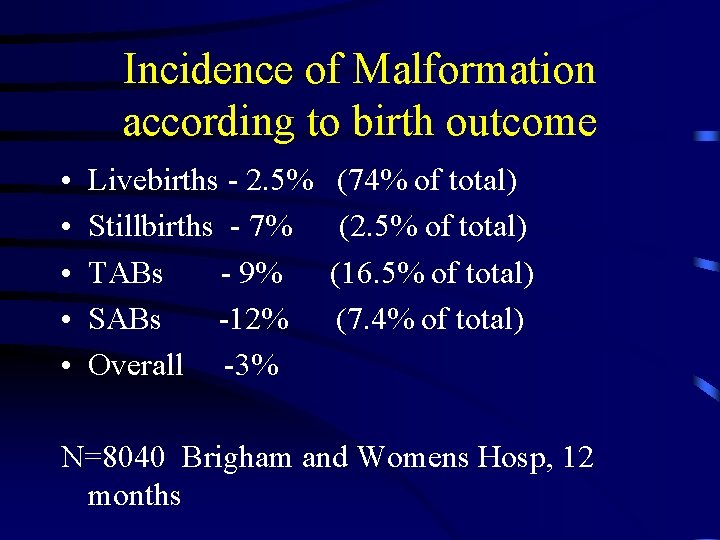
Incidence of Malformation according to birth outcome • • • Livebirths - 2. 5% Stillbirths - 7% TABs - 9% SABs -12% Overall -3% (74% of total) (2. 5% of total) (16. 5% of total) (7. 4% of total) N=8040 Brigham and Womens Hosp, 12 months

Definitions • • • Malformation sequence Deformation Disruption Deformation sequence
Definitions • • • Major malformation Minor malformation Syndrome Association Non-specificity of malformations
Malformation • Morphologic defect of an organ or region due to an intrinsically abnormal developmental process (e. g. hypoplasia, incomplete closure, incomplete separation)
Malformation Sequence • Multiple defects derived from a single known or presumed structural defect • Examples: – meningomyeocele • club foot, hip dislocation, hydrocephalus – mandibular hypoplasia • cleft palate (Robin sequence)
Deformation • Abnormal form or position of a body region caused by non-disruptive mechanical forces • Examples: – clubfoot, congenital hip dislocation

Deformation Sequence • Examples: – Intrauterine constraint – Robin sequence secondary to mandibular constraint
Disruption • Morphologic defect of an organ or region resulting from a breakdown of, or interference with an originally normal developmental process • example: Amniotic Band Disruption
Major Malformation • Malformation of medical, surgical or cosmetic significance
Minor Malformation • Minor morphologic features of little or no known medical significance • found in less than 4% of population
Minor Variation • “Normal” morphologic features representing variations of morphology, of no medical significance • found in more than 4% of population
Association • Non-random occurrence of several morphologic defects not identified as a sequence or syndrome
Syndrome • From the Greek - “Running together” • Multiple anomalies thought to be pathogenetically related, not representing a sequence
Non-Specificity of Malformations • The same morphologic abnormality or pattern of anomalies may occur as – an isolated anomaly – a feature in a sequence, syndrome, or association – a feature in a chromosomal disorder, singlegene disorder or multifactorial disorder • A feature in a teratogenic disorder
Goals of a rational clinical approach to a fetal & congenital malformation • • Accurate diagnosis Accurate prognosis Appropriate management of pregnancy Recognition of associated malformations and medical problems • Prevention of complications • Appropriate counseling for parents • Prevention of recurrence by preventive measures and prenatal diagnosis
Management of newborn with malformation • • • Avoid delivery room diagnosis Prompt, expert clinical evaluation Search for associated malformations Chromosomal studies Photographs Appropriate diagnostic studies
Management of newborn with malformation • • Explain concerns openly Emphasize the normal Humanize the abnormal Use precise diagnostic terms only when certain • Don’t offer extensive differential diagnosis • Careful prognostication
Suggestions for pregnancy management • Assess every pregnancy for risk of malformation • Previous child or family history of malformation or chromosomal disorder • History of recurrent pregnancy loss • Intrauterine growth restriction • Olighydramnios or polyhydramnios
• Suggestions for pregnancy management Appropriate diagnostic studies and clinical genetics consultation • Evaluate for associated malformation – Think chromosomes!! • Careful presentation of diagnostic and prognostic issues to the parents • Consider referral to pediatric sub-specialist for provision of detailed diagnostic and prognostic information • Utilize routine ultrasound study to screen for fetal malformation
Suggestions for management of fatal malformation in the fetus or newborn • • • Careful and expert clinical examination Photographs Chromosomes (blood, viscera, skin) X-rays Pathologic examination Allow parents to see the child (naming, photographing, memorializing) • refer for genetic counseling soon
- Slides: 23