
Confucianism Harper Davis Lily Stephens Sarah Womack Abby
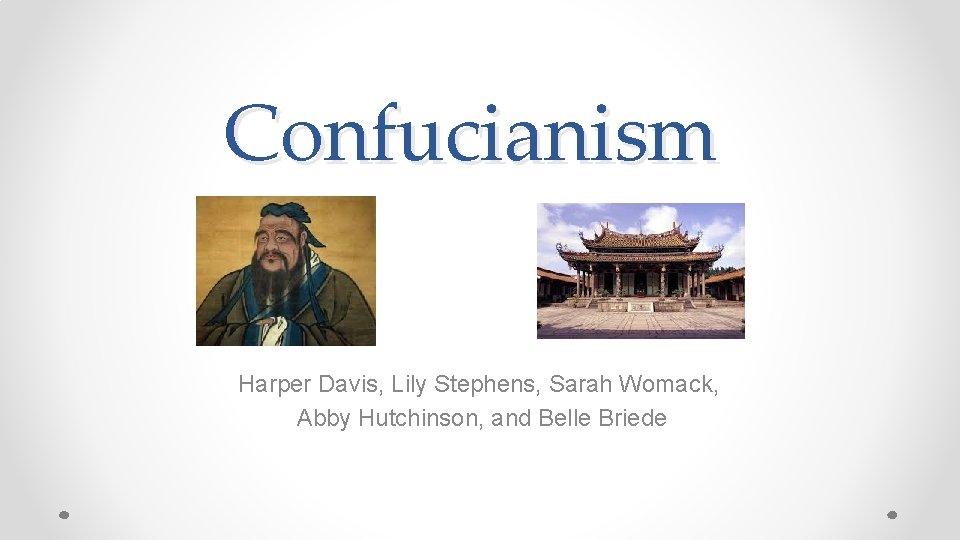
Confucianism Harper Davis, Lily Stephens, Sarah Womack, Abby Hutchinson, and Belle Briede
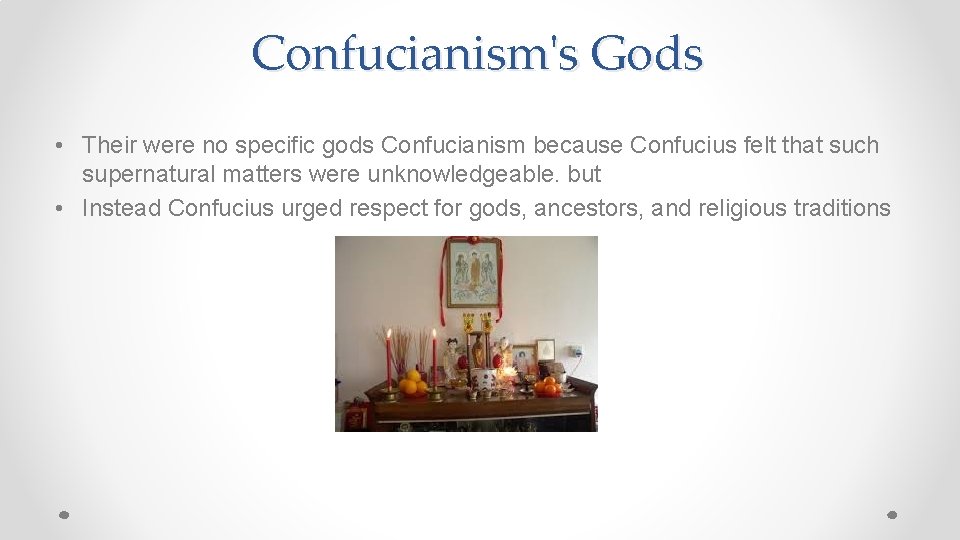
Confucianism's Gods • Their were no specific gods Confucianism because Confucius felt that such supernatural matters were unknowledgeable. but • Instead Confucius urged respect for gods, ancestors, and religious traditions
Basic Beliefs • Confucius drew upon traditional institutions and values but gave them new shape and meaning. • Their was a great importance on the “rituals”, or forms of behavior, that guide people in their daily interactions with one another. • Promotion in harmony in human relations. • Family was the fundamental component of society • Each person has his or her place and duties in a hierarchical order that was determined by age and gender. • Ren, humanness, which meant the feelings between family members was expanded into a universal ideal of benevolence and compassion that would, ideally, pervade every activity, wanted society to function smoothly at a very little level. • Provided a philosophical and ethical framework for conducting one’s life and understanding one’s place in the world
How the Followers Practice the Religion Followers of Confucianism incorporate aspects of Confucius thinking into their daily lives: -Family hierarchy should be very structured; everyone has a specific job to do and a specific role to fulfill. -Living with an honor code of loyalty and truth -Ancestor worship Confucianism is, frankly, a culmination of ethical philosophies in which rituals at important times throughout a person’s life have been added. Ancestor worship is the ritualized commemoration of, communication with, and sacrifice to one's deceased relatives. Its origin lies deep within the Confucian tradition.
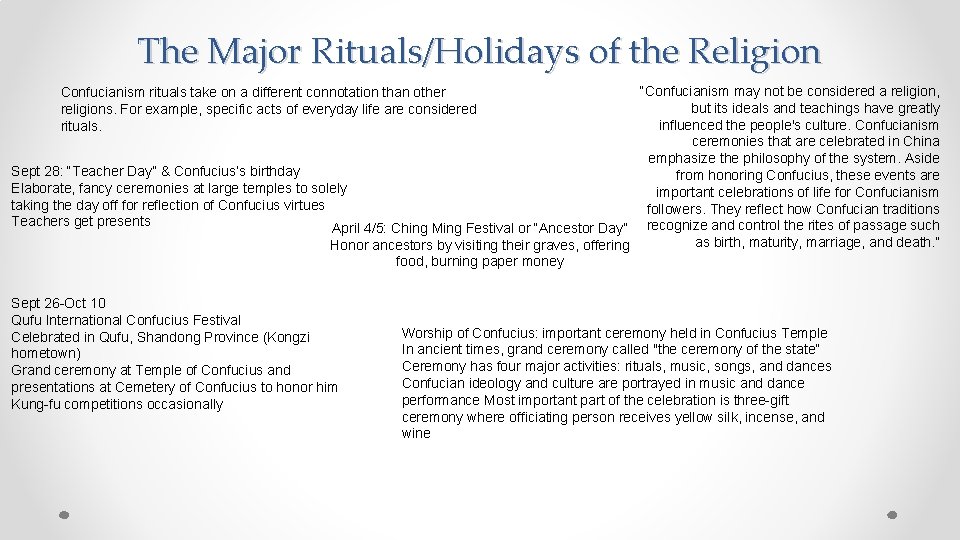
The Major Rituals/Holidays of the Religion “Confucianism may not be considered a religion, but its ideals and teachings have greatly influenced the people's culture. Confucianism ceremonies that are celebrated in China emphasize the philosophy of the system. Aside Sept 28: “Teacher Day” & Confucius’s birthday from honoring Confucius, these events are Elaborate, fancy ceremonies at large temples to solely important celebrations of life for Confucianism taking the day off for reflection of Confucius virtues followers. They reflect how Confucian traditions Teachers get presents April 4/5: Ching Ming Festival or “Ancestor Day” recognize and control the rites of passage such as birth, maturity, marriage, and death. ” Honor ancestors by visiting their graves, offering food, burning paper money Confucianism rituals take on a different connotation than other religions. For example, specific acts of everyday life are considered rituals. Sept 26 -Oct 10 Qufu International Confucius Festival Celebrated in Qufu, Shandong Province (Kongzi hometown) Grand ceremony at Temple of Confucius and presentations at Cemetery of Confucius to honor him Kung-fu competitions occasionally Worship of Confucius: important ceremony held in Confucius Temple In ancient times, grand ceremony called "the ceremony of the state“ Ceremony has four major activities: rituals, music, songs, and dances Confucian ideology and culture are portrayed in music and dance performance Most important part of the celebration is three-gift ceremony where officiating person receives yellow silk, incense, and wine
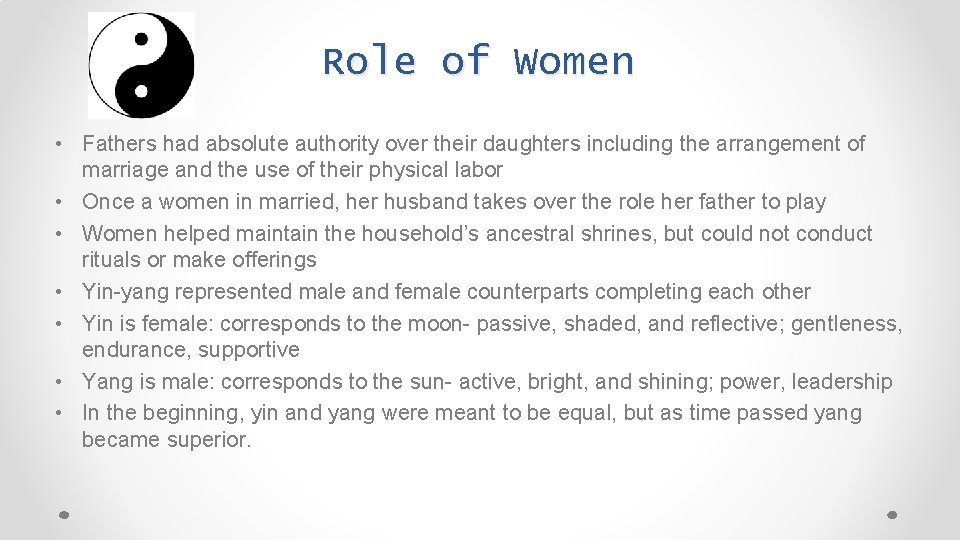
Role of Women • Fathers had absolute authority over their daughters including the arrangement of marriage and the use of their physical labor • Once a women in married, her husband takes over the role her father to play • Women helped maintain the household’s ancestral shrines, but could not conduct rituals or make offerings • Yin-yang represented male and female counterparts completing each other • Yin is female: corresponds to the moon- passive, shaded, and reflective; gentleness, endurance, supportive • Yang is male: corresponds to the sun- active, bright, and shining; power, leadership • In the beginning, yin and yang were meant to be equal, but as time passed yang became superior.
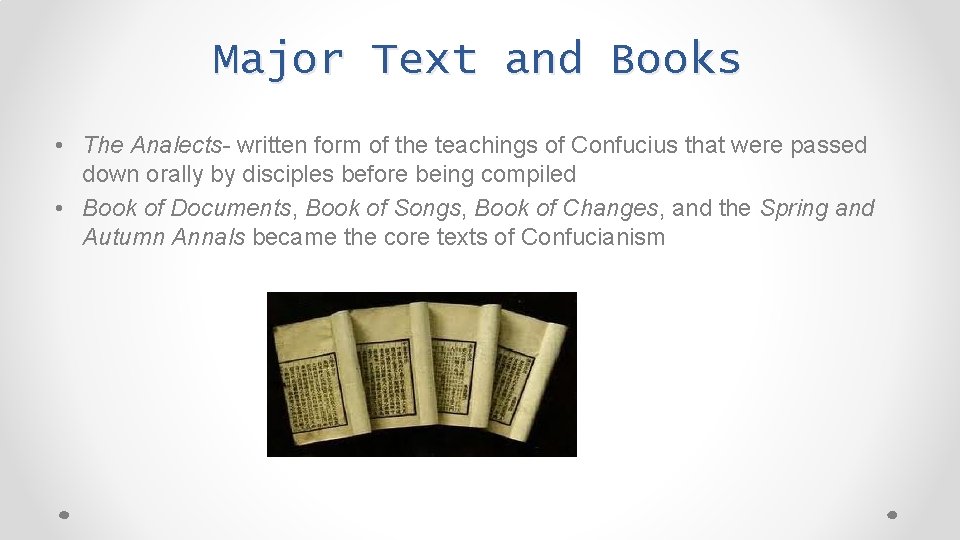
Major Text and Books • The Analects- written form of the teachings of Confucius that were passed down orally by disciples before being compiled • Book of Documents, Book of Songs, Book of Changes, and the Spring and Autumn Annals became the core texts of Confucianism
Missionary/ Outreach Work • China’s empire had a lot of political, social, and religious influence on it’s neighboring countries • Spread all over: China, Vietnam, Korea, and Japan • Confucius traveled from region to region with a small group of disciples, becoming more popular and gradually gaining a larger crowd every time he spoke. • Passed on from stories of others from generation to generation • Antalects- his deciples created after Confucius died • Had a school- Great Academy(people learned about his beliefs)
Origin/Diffusion • • • Started in Zhou era (China) 500 B. C. E. After Confucius died, Mencius, philosopher of the Confucian school, continued to teach the ethics of Confucianism by stressing the innate goodness of human nature. Han dynasty revived Confucianism. During the previous period the works of Confucianism were destroyed, but were restored by the scholars in national academy. The work formed the basis of civil service, who's government positions acknowledged appointments on their understanding of classic literature. As a result, Confucianism had impacted Chinese intellectual and political life. Buddhism became well known during the Tang dynasty, but the Sung dynasty gave rebirth of the Confucianism tradition. They reshaped the intellectual and spirituality of the religion. Created “neo” Confucian; equals the compass and scope of Buddhism. It was effected by a construction of the traditional Confucian structure that provided new mental and spiritual ideas. Activities of the Sung dynasty gave rise to a new system of Confucian based on a mixture of Buddhist and Taoist elements; known as Neo-Confucianism: New school of Confucianism
Major Conflicts Daoism Both Daoism and Confucianism developed during the Eastern Zhou Era. These two philosophical systems are polar opposites. Confucianism strived for old china and created strict, hierarchical family units as the base of the society. Daoism on the other hand felt that such a structure was over bearing, Daoist focused on being one with nature and attempted to lead a life free from stress and obligations of a chaotic society. Legalism Legalist believed that it was a mistake to go back to old china’s society and they described the kindness of Confucius leaders to be naïve. In legalism, Lord Shang held the majority of power and Legalist felt it was their duty to protect the state. Around 221 -206 BCE, legalists attempted to end Confucianism. They befriended Shi Huangdi, the new leader of the Qin Dynasty, and convinced him of the Confucius wrongdoings. The books of Confucius were then burned and the Confucius scholars were executed. Buddhism was introduced in China in the first century CE and it fit nicely in Chinese culture because it was a mix between Daoism and Confucianism. Buddhist believe in looking back to traditional features but they emphasis the importance of the natural world.
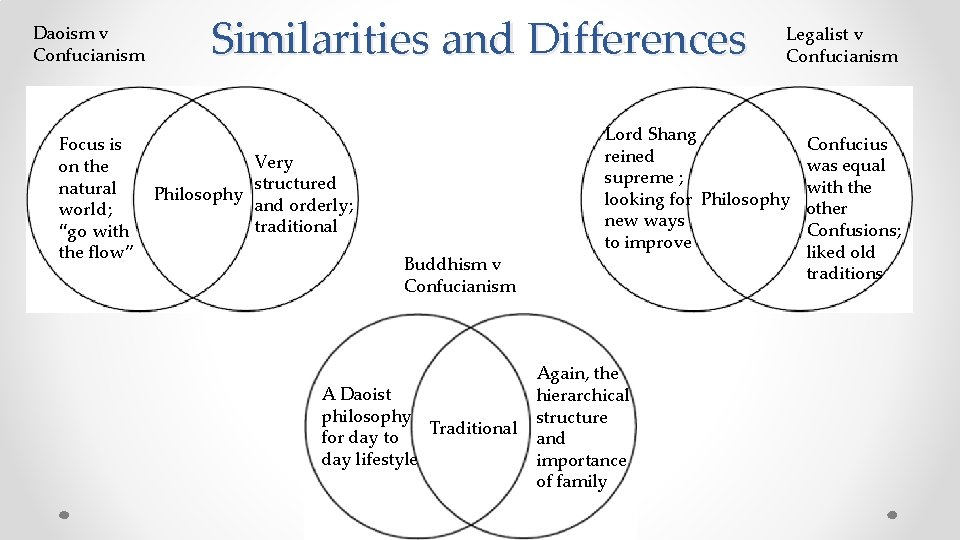
Daoism v Confucianism Focus is on the natural world; “go with the flow” Similarities and Differences Very structured Philosophy and orderly; traditional Buddhism v Confucianism A Daoist philosophy Traditional for day to day lifestyle Legalist v Confucianism Lord Shang reined supreme ; looking for Philosophy new ways to improve Again, the hierarchical structure and importance of family Confucius was equal with the other Confusions; liked old traditions
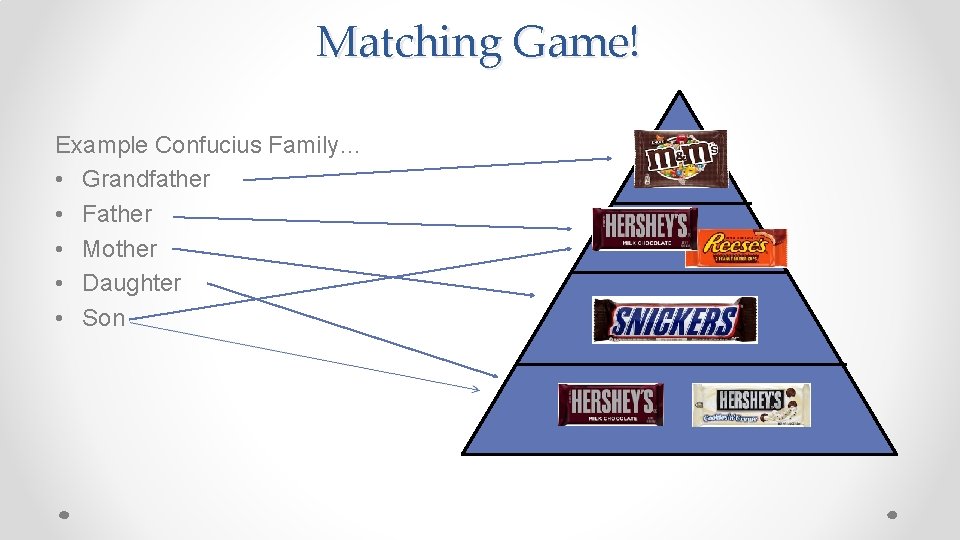
Matching Game! Example Confucius Family… • Grandfather • Father • Mother • Daughter • Son
Bibliography Bulliet, Richard W. , Pamela K. Crossley, and Daniel R. Headrick. The Earth and It's Peoples A Global History Ap Edition. 5 th ed. N. p. : Wadsworth Pub, 2010. Print. Confucianism. " New Page 1. N. p. , n. d. Web. 15 Sept. 2014. <http: //confucianism. freehostingguru. com/>.
- Slides: 13