
Confronting the Climate Challenge Lessons for Future US
- Slides: 30
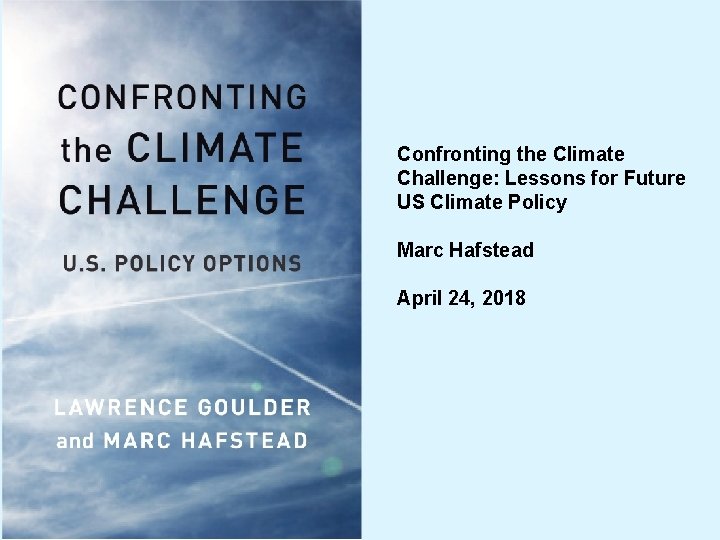
Confronting the Climate Challenge: Lessons for Future US Climate Policy Marc Hafstead April 24, 2018
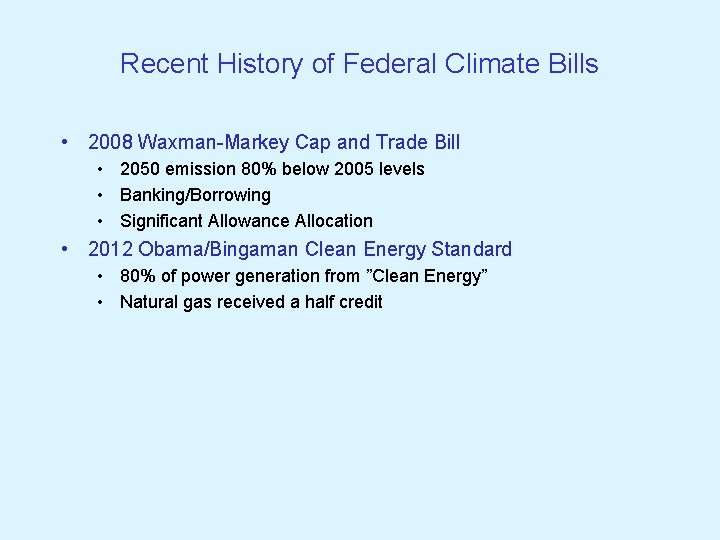
Recent History of Federal Climate Bills • 2008 Waxman-Markey Cap and Trade Bill • 2050 emission 80% below 2005 levels • Banking/Borrowing • Significant Allowance Allocation • 2012 Obama/Bingaman Clean Energy Standard • 80% of power generation from ”Clean Energy” • Natural gas received a half credit
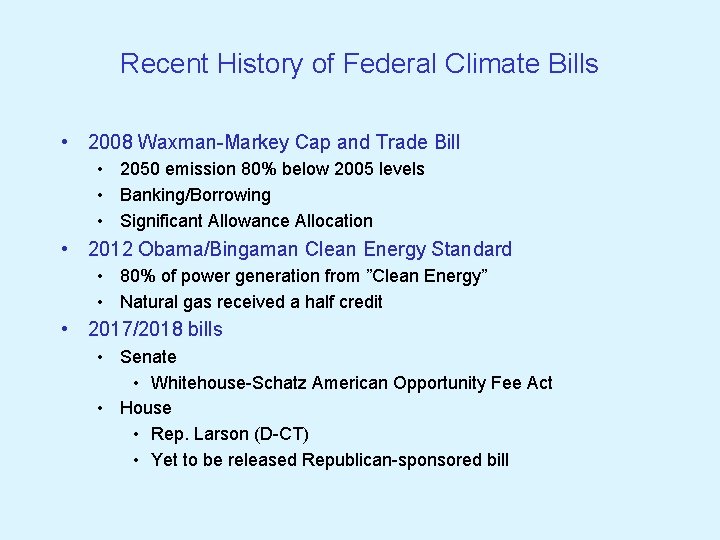
Recent History of Federal Climate Bills • 2008 Waxman-Markey Cap and Trade Bill • 2050 emission 80% below 2005 levels • Banking/Borrowing • Significant Allowance Allocation • 2012 Obama/Bingaman Clean Energy Standard • 80% of power generation from ”Clean Energy” • Natural gas received a half credit • 2017/2018 bills • Senate • Whitehouse-Schatz American Opportunity Fee Act • House • Rep. Larson (D-CT) • Yet to be released Republican-sponsored bill
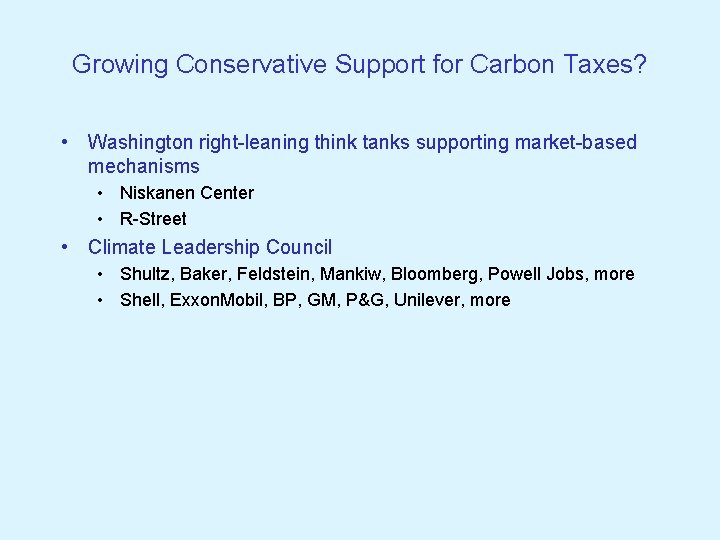
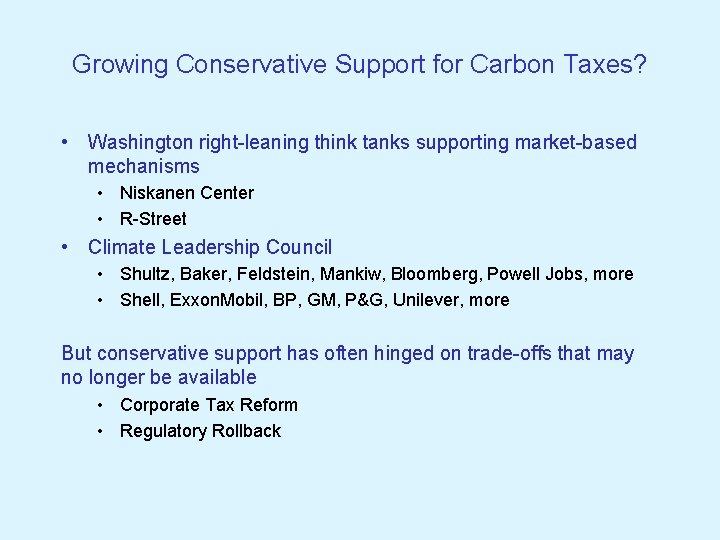
Growing Conservative Support for Carbon Taxes? • Washington right-leaning think tanks supporting market-based mechanisms • Niskanen Center • R-Street • Climate Leadership Council • Shultz, Baker, Feldstein, Mankiw, Bloomberg, Powell Jobs, more • Shell, Exxon. Mobil, BP, GM, P&G, Unilever, more
Growing Conservative Support for Carbon Taxes? • Washington right-leaning think tanks supporting market-based mechanisms • Niskanen Center • R-Street • Climate Leadership Council • Shultz, Baker, Feldstein, Mankiw, Bloomberg, Powell Jobs, more • Shell, Exxon. Mobil, BP, GM, P&G, Unilever, more But conservative support has often hinged on trade-offs that may no longer be available • Corporate Tax Reform • Regulatory Rollback
Sub-National Climate Policies? • 9 US states, 227 US cities, and a number of universities and businesses have signaled support for Paris Agreement • #wearestillin • Multiple states have contacted RFF about policy analysis and/or policy design questions
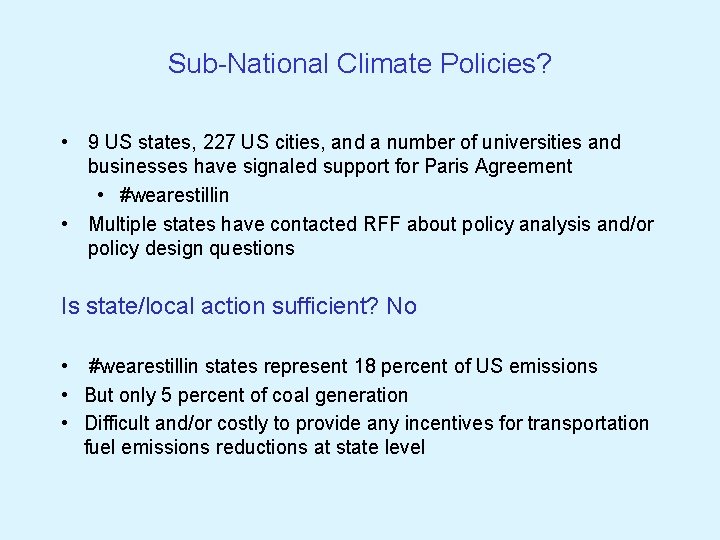
Sub-National Climate Policies? • 9 US states, 227 US cities, and a number of universities and businesses have signaled support for Paris Agreement • #wearestillin • Multiple states have contacted RFF about policy analysis and/or policy design questions Is state/local action sufficient? No • #wearestillin states represent 18 percent of US emissions • But only 5 percent of coal generation • Difficult and/or costly to provide any incentives for transportation fuel emissions reductions at state level
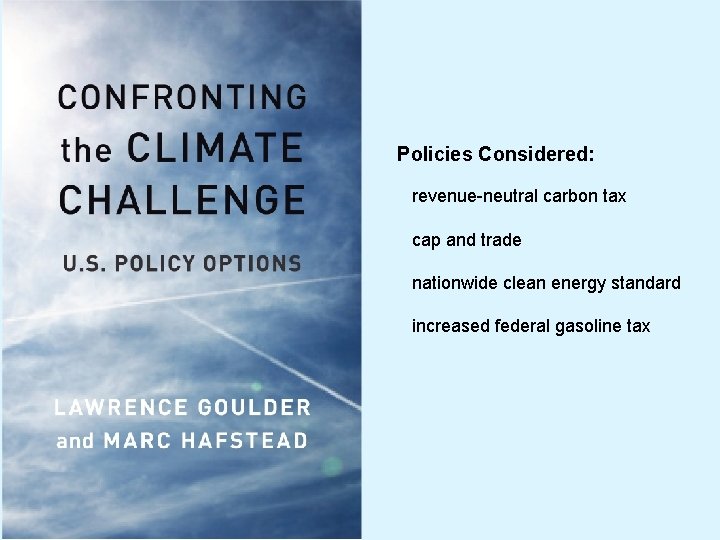
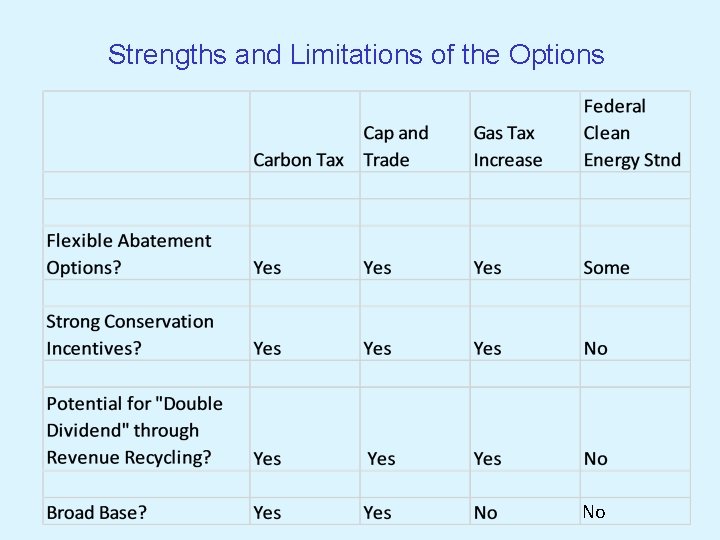
Policies Considered: revenue-neutral carbon tax cap and trade nationwide clean energy standard increased federal gasoline tax
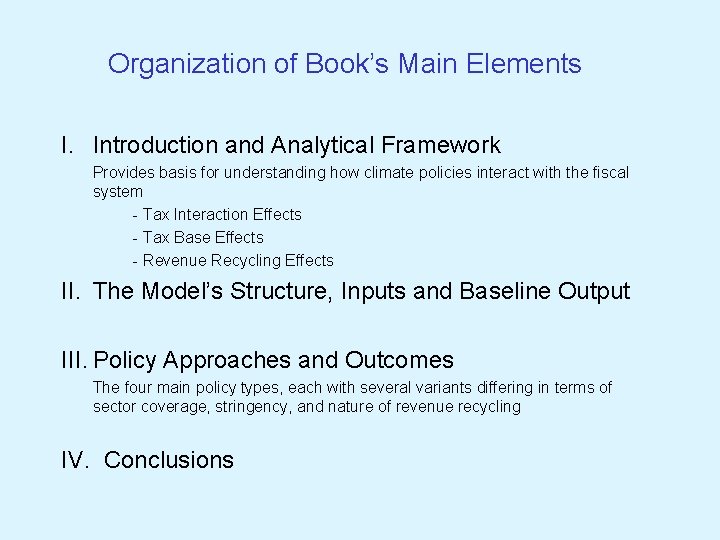
Organization of Book’s Main Elements I. Introduction and Analytical Framework Provides basis for understanding how climate policies interact with the fiscal system - Tax Interaction Effects - Tax Base Effects - Revenue Recycling Effects II. The Model’s Structure, Inputs and Baseline Output III. Policy Approaches and Outcomes The four main policy types, each with several variants differing in terms of sector coverage, stringency, and nature of revenue recycling IV. Conclusions
Strengths and Limitations of the Options No
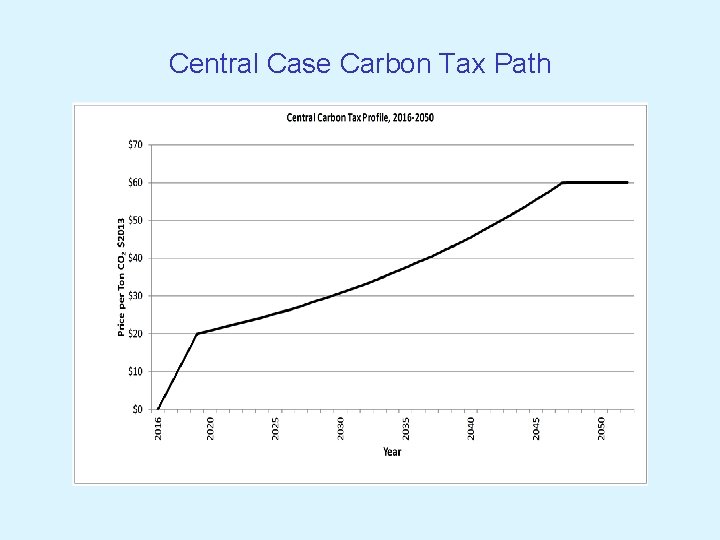
Central Case Carbon Tax Path
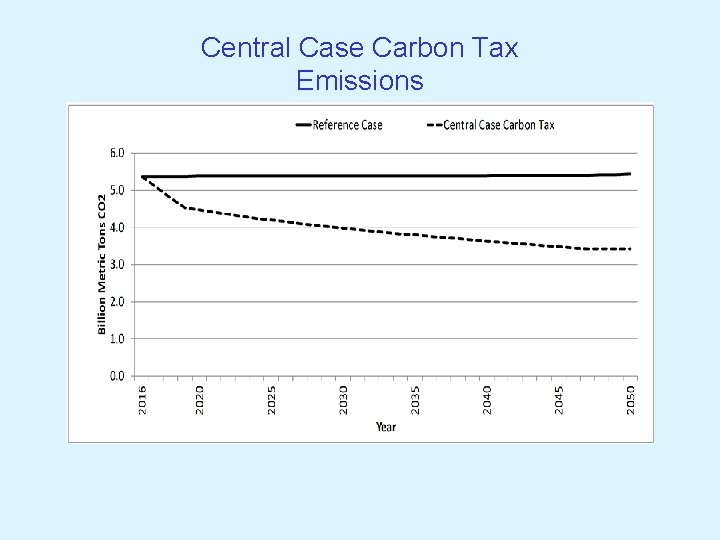
Central Case Carbon Tax Emissions
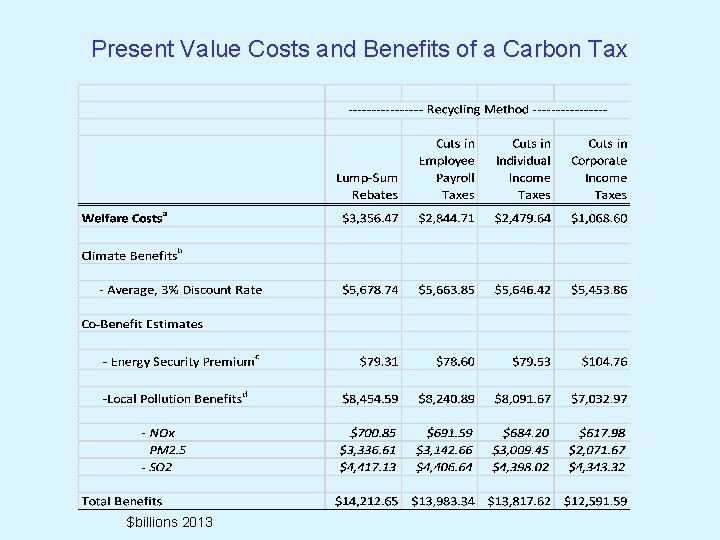
Present Value Costs and Benefits of a Carbon Tax $billions 2013
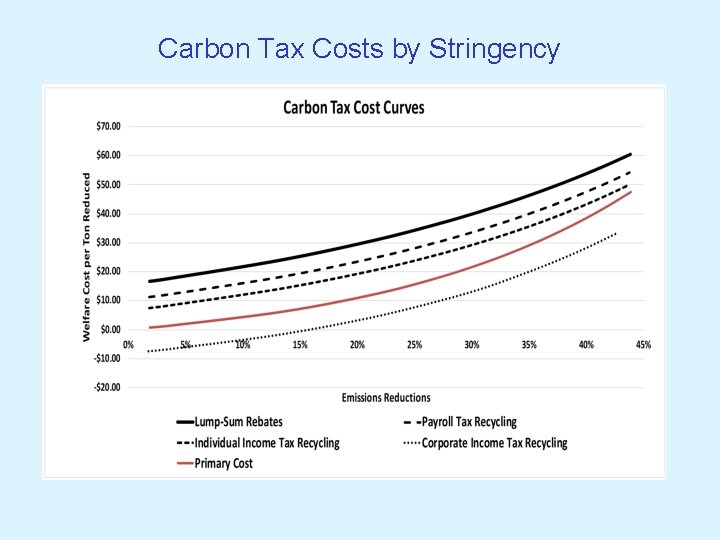
Carbon Tax Costs by Stringency
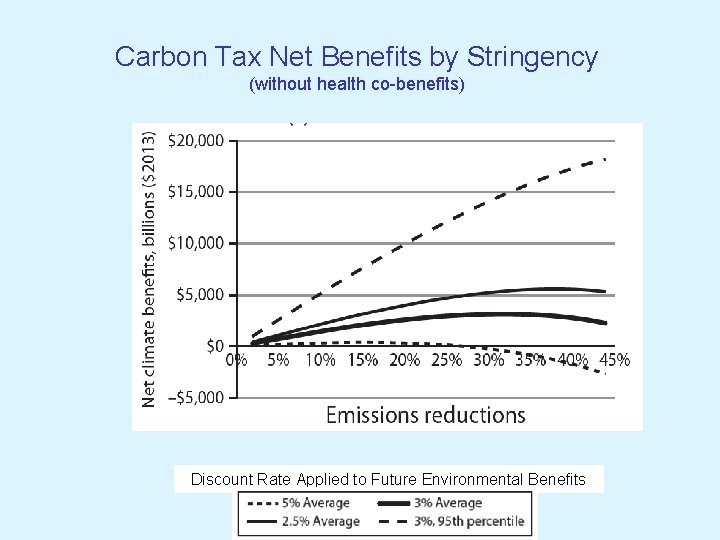
Carbon Tax Net Benefits by Stringency (without health co-benefits) Discount Rate Applied to Future Environmental Benefits
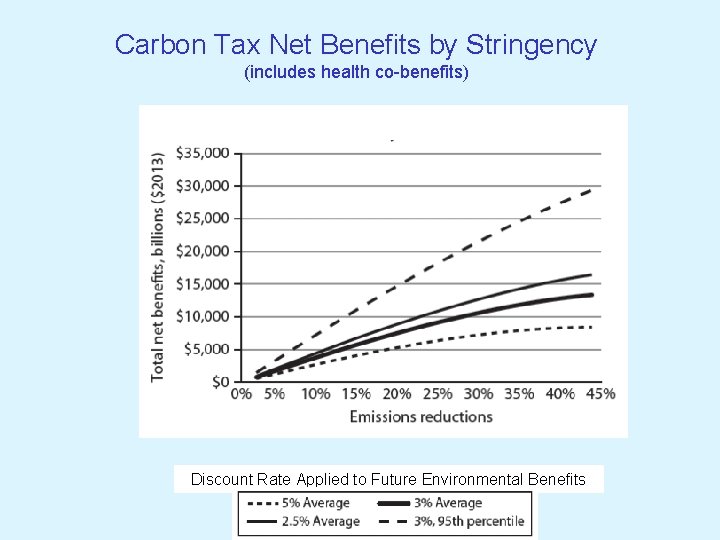
Carbon Tax Net Benefits by Stringency (includes health co-benefits) Discount Rate Applied to Future Environmental Benefits
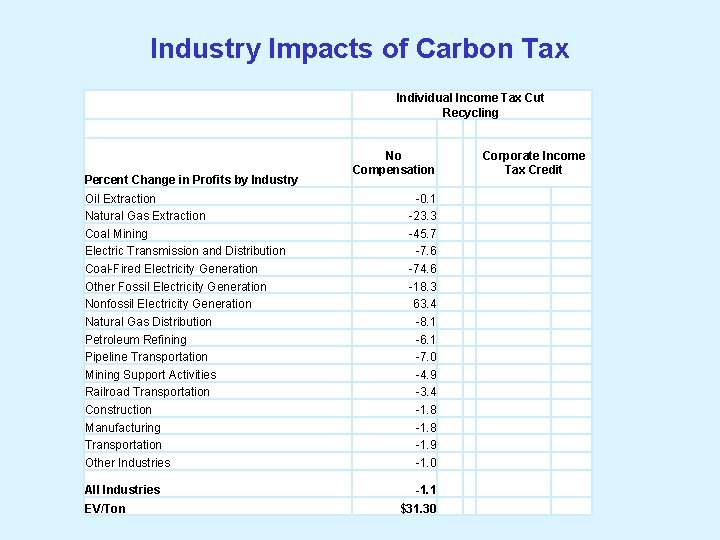
Industry Impacts of Carbon Tax Individual Income Tax Cut Recycling Percent Change in Profits by Industry Oil Extraction Natural Gas Extraction Coal Mining Electric Transmission and Distribution Coal-Fired Electricity Generation Other Fossil Electricity Generation Nonfossil Electricity Generation Natural Gas Distribution Petroleum Refining Pipeline Transportation Mining Support Activities Railroad Transportation Construction Manufacturing Transportation Other Industries All Industries EV/Ton No Compensation -0. 1 -23. 3 -45. 7 -7. 6 -74. 6 -18. 3 63. 4 -8. 1 -6. 1 -7. 0 -4. 9 -3. 4 -1. 8 -1. 9 -1. 0 -1. 1 $31. 30 Corporate Income Tax Credit
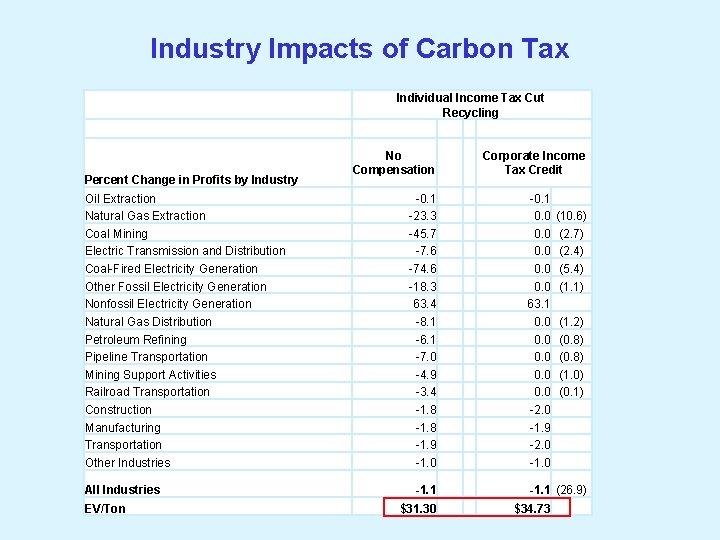
Industry Impacts of Carbon Tax Individual Income Tax Cut Recycling Percent Change in Profits by Industry Oil Extraction Natural Gas Extraction Coal Mining Electric Transmission and Distribution Coal-Fired Electricity Generation Other Fossil Electricity Generation Nonfossil Electricity Generation Natural Gas Distribution Petroleum Refining Pipeline Transportation Mining Support Activities Railroad Transportation Construction Manufacturing Transportation Other Industries All Industries EV/Ton No Compensation -0. 1 -23. 3 -45. 7 -7. 6 -74. 6 -18. 3 63. 4 -8. 1 -6. 1 -7. 0 -4. 9 -3. 4 -1. 8 -1. 9 -1. 0 -1. 1 $31. 30 Corporate Income Tax Credit -0. 1 0. 0 0. 0 63. 1 0. 0 0. 0 -2. 0 -1. 9 -2. 0 -1. 0 (10. 6) (2. 7) (2. 4) (5. 4) (1. 1) (1. 2) (0. 8) (1. 0) (0. 1) -1. 1 (26. 9) $34. 73
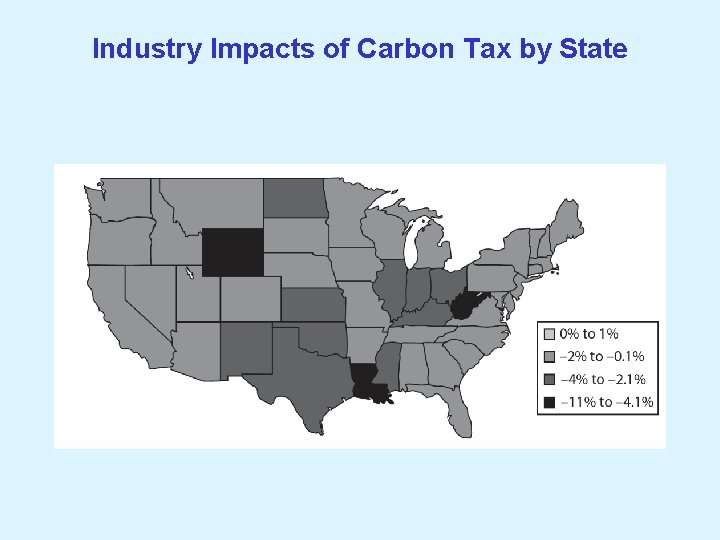
Industry Impacts of Carbon Tax by State
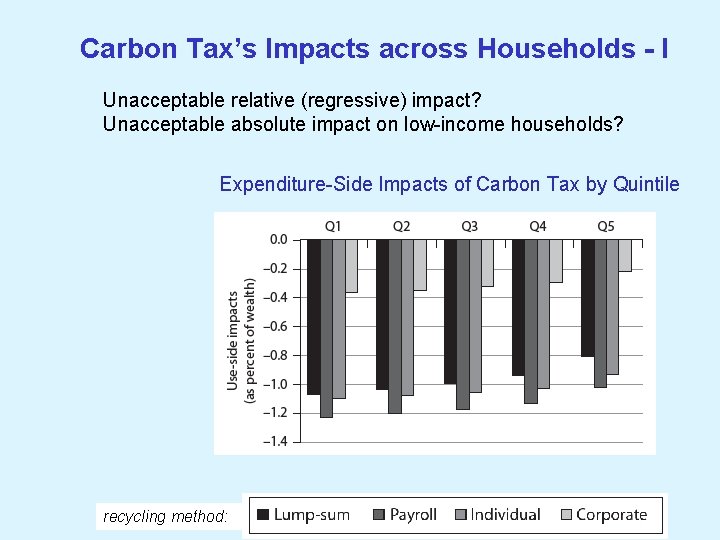
Carbon Tax’s Impacts across Households - I Unacceptable relative (regressive) impact? Unacceptable absolute impact on low-income households? Expenditure-Side Impacts of Carbon Tax by Quintile recycling method:
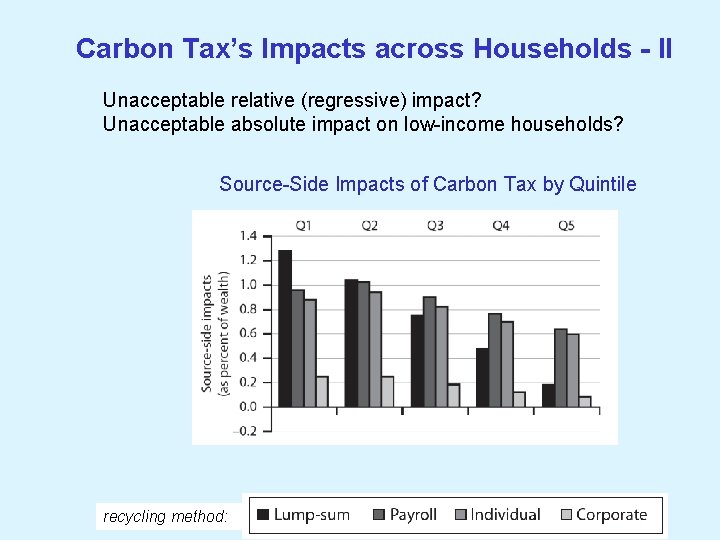
Carbon Tax’s Impacts across Households - II Unacceptable relative (regressive) impact? Unacceptable absolute impact on low-income households? Source-Side Impacts of Carbon Tax by Quintile recycling method:
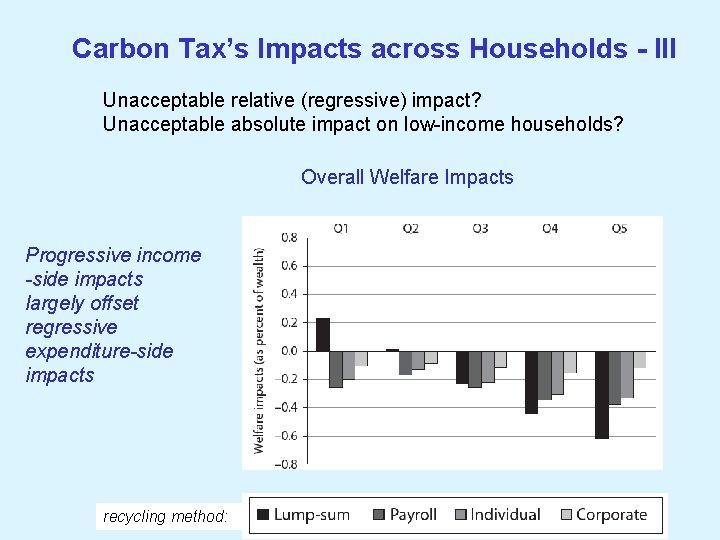
Carbon Tax’s Impacts across Households - III Unacceptable relative (regressive) impact? Unacceptable absolute impact on low-income households? Overall Welfare Impacts Progressive income -side impacts largely offset regressive expenditure-side impacts recycling method:
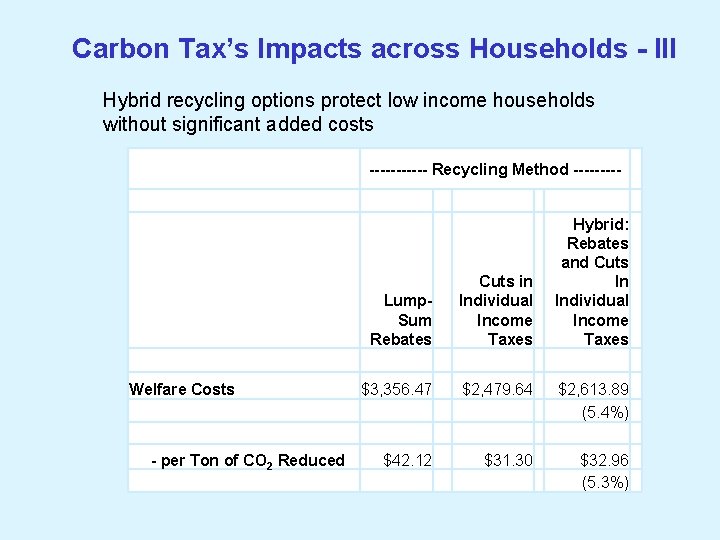
Carbon Tax’s Impacts across Households - III Hybrid recycling options protect low income households without significant added costs ------ Recycling Method ----- Welfare Costs - per Ton of CO 2 Reduced Hybrid: Rebates and Cuts In Individual Income Taxes Lump. Sum Rebates Cuts in Individual Income Taxes $3, 356. 47 $2, 479. 64 $2, 613. 89 (5. 4%) $42. 12 $31. 30 $32. 96 (5. 3%)
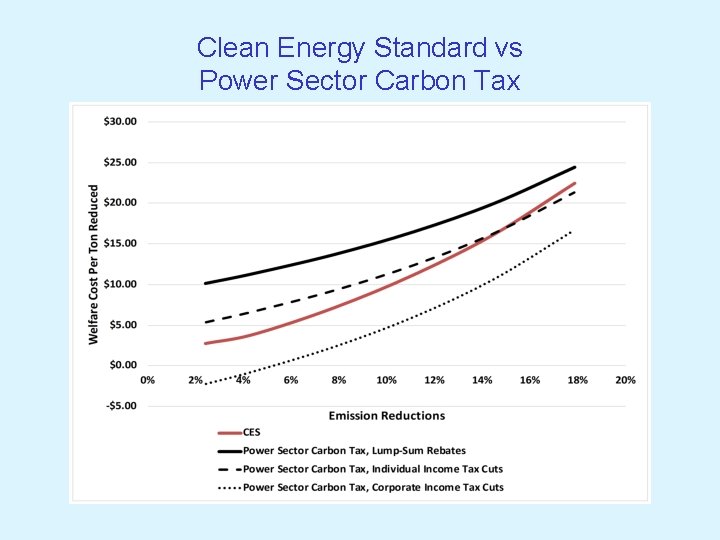
Clean Energy Standard vs Power Sector Carbon Tax
Summary of Key Findings Aggregate Impacts • • • Appropriately designed federal-level climate policies produce significant net benefits. • Costs depend on nature of revenue-recycling • Non-climate benefits exceed climate benefits Among the four general policy types considered, carbon tax and cap & trade tend to be the most cost-effective • But much depends on stringency and nature of revenue-recycling • Large-scale emissions reductions will require economy-wide emissions pricing Carbon pricing provides most incentive to decarbonize power sector – transportation emissions are less responsive
Summary of Key Findings Aggregate Impacts • • • Appropriately designed federal-level climate policies produce significant net benefits. • Costs depend on nature of revenue-recycling • Non-climate benefits exceed climate benefits Among the four general policy types considered, carbon tax and cap & trade tend to be the most cost-effective • But much depends on stringency and nature of revenue-recycling • Large-scale emissions reductions will require economy-wide emissions pricing Carbon pricing provides most incentive to decarbonize power sector – transportation emissions are less responsive Heterogeneous Impacts • • Costs are not evenly distributed across industries, household, and states Adverse impacts on industry and households can be addressed through revenue use, with little additional aggregate economic costs.
Research beyond Confronting the Climate Challenge Employment Impacts • Hafstead and Williams (2018): Climate policies induce reallocation across firms/industries with relatively small net impacts • Hafstead, Williams, and Chen (2018): Full-employment models overestimate changes in jobs by a factor of more than 2. 5
Research beyond Confronting the Climate Challenge Employment Impacts • Hafstead and Williams (2018): Climate policies induce reallocation across firms/industries with relatively small net impacts • Hafstead, Williams, and Chen (2018): Full-employment models overestimate changes in jobs by a factor of more than 2. 5 Emissions Uncertainty • Qualitative ideas from Harvard Environmental Law Review Symposium (Spring 2017) • Hafstead, Metcalf, and Williams • Murray, Pizer, and Reichart • Aldy • Quantitative Modeling • Harris and Pizer (2018) • Hafstead and Williams (2018)
What will it take for federal US Climate Policy? • Credible and robust objective analysis • • • Economists (and others) need to stop selling the double dividend • • • Policymakers know that interest groups bring biased advice Goulder-Hafstead E 3 and similar models (like in EMF 32) are needed Double-dividend is an efficiency argument -- equity issues may be more important politically Confronting the Climate Challenge shows significant net benefits even if costs are positive Revenue use to offset disadvantaged industries/households/states • Confronting the Climate Challenge shows this is possible without sacrificing cost-effectiveness
What will it take for federal US Climate Policy? • Credible and robust objective analysis • • • Economists (and others) need to stop selling the double dividend • • • Confronting the Climate Challenge shows this is possible without sacrificing cost-effectiveness Republican support • • • Double-dividend is an efficiency argument -- equity issues may be more important politically Confronting the Climate Challenge shows significant net benefits even if costs are positive Revenue use to offset disadvantaged industries/households/states • • Policymakers know that interest groups bring biased advice Goulder-Hafstead E 3 and similar models (like in EMF 32) are needed Can Republicans admit Al Gore was right? And what will bring more Republicans to the table? Progressive support? • Are emissions certainty mechanisms enough?