
Confocal Twophoton Microscopy Contents 1 TwoPhoton Microscopy 2
- Slides: 27
Confocal & Two-photon Microscopy
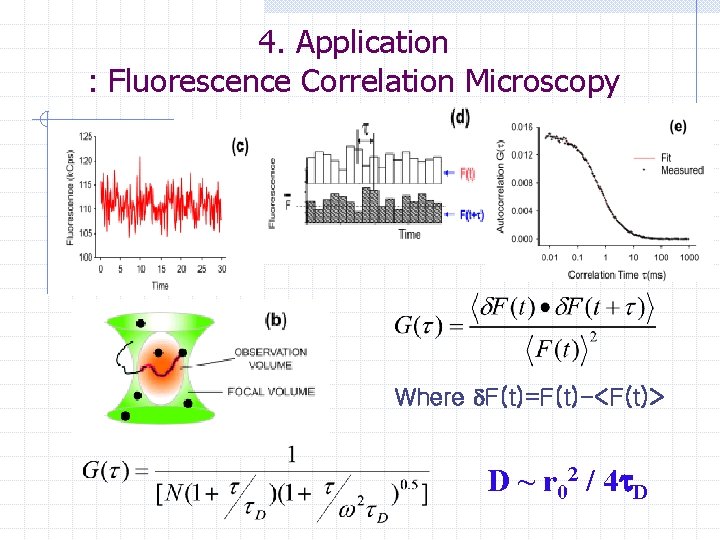
Contents 1. Two-Photon Microscopy 2. : Basic principles and Architectures 2. Resolution and Contrast in Confocal and Two-Photon microscopy 3. Example of two-photon images 4. Extensive application : Fluorescence Correlation Microscopy, Life-time imaging
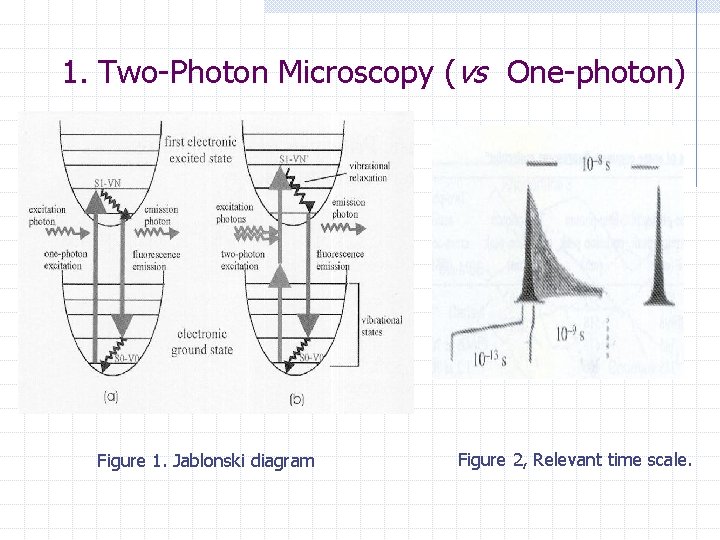
1. Two-Photon Microscopy (vs One-photon) Figure 1. Jablonski diagram Figure 2, Relevant time scale.
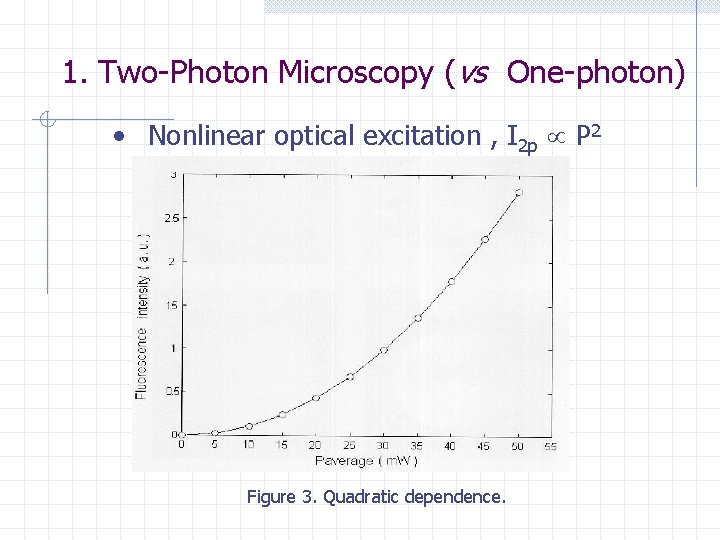
1. Two-Photon Microscopy (vs One-photon) • Nonlinear optical excitation , I 2 p P 2 Figure 3. Quadratic dependence.
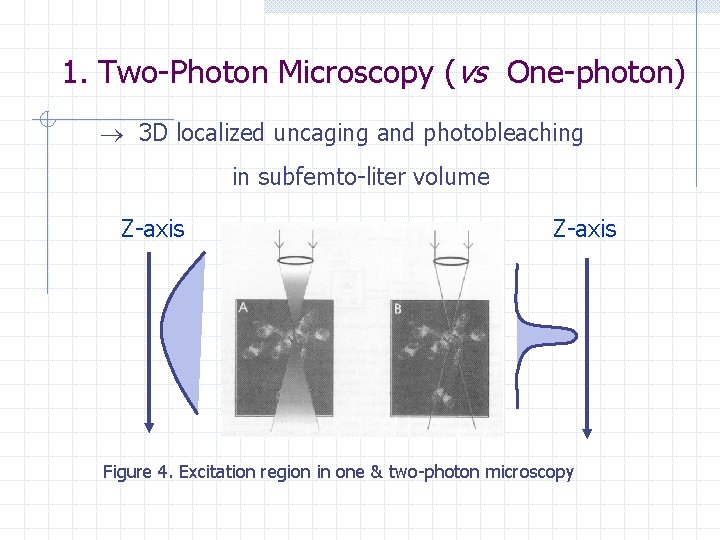
1. Two-Photon Microscopy (vs One-photon) 3 D localized uncaging and photobleaching in subfemto-liter volume Z-axis Figure 4. Excitation region in one & two-photon microscopy
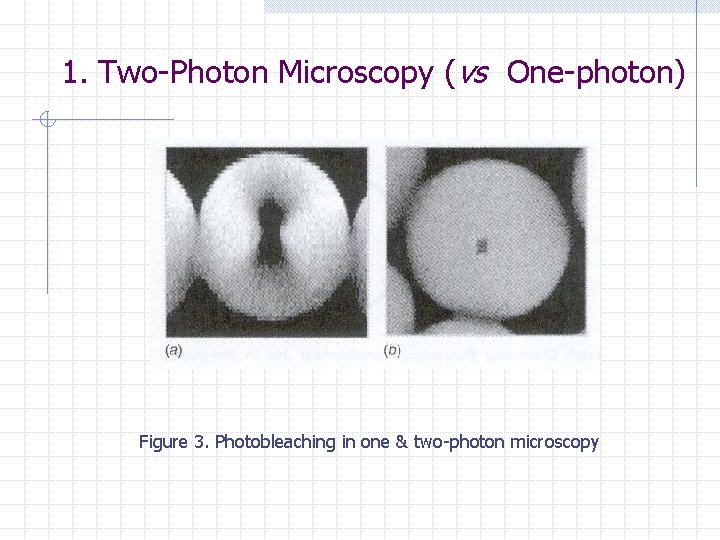
1. Two-Photon Microscopy (vs One-photon) Figure 3. Photobleaching in one & two-photon microscopy
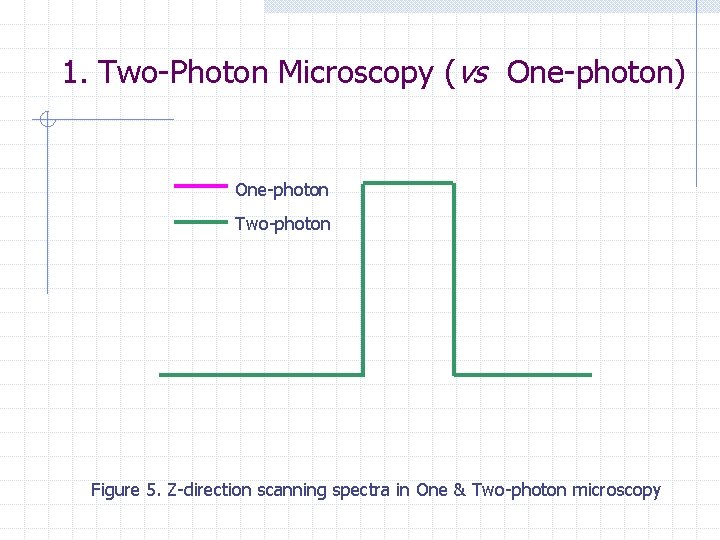
1. Two-Photon Microscopy (vs One-photon) One-photon Two-photon Figure 5. Z-direction scanning spectra in One & Two-photon microscopy
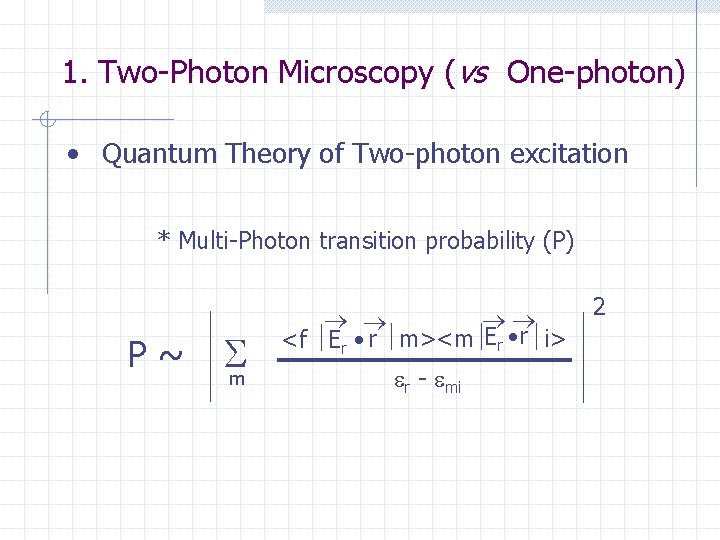
1. Two-Photon Microscopy (vs One-photon) • Quantum Theory of Two-photon excitation * Multi-Photon transition probability (P) P~ m <f Er • r m><m Er • r i> r - mi 2
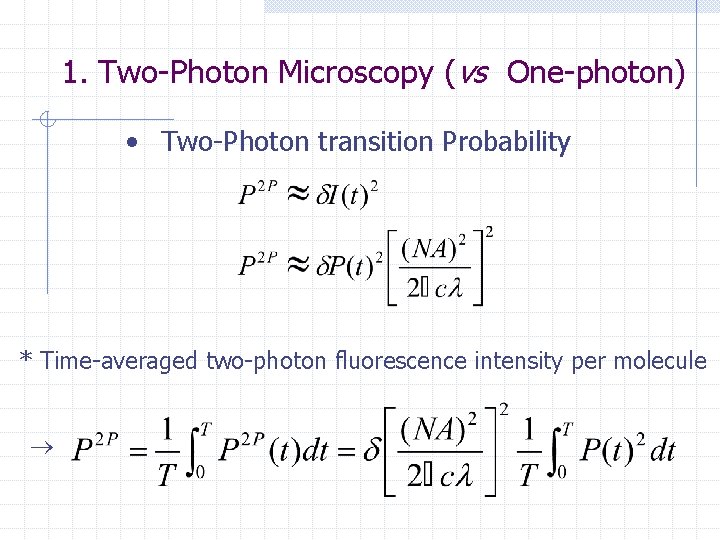
1. Two-Photon Microscopy (vs One-photon) • Two-Photon transition Probability * Time-averaged two-photon fluorescence intensity per molecule
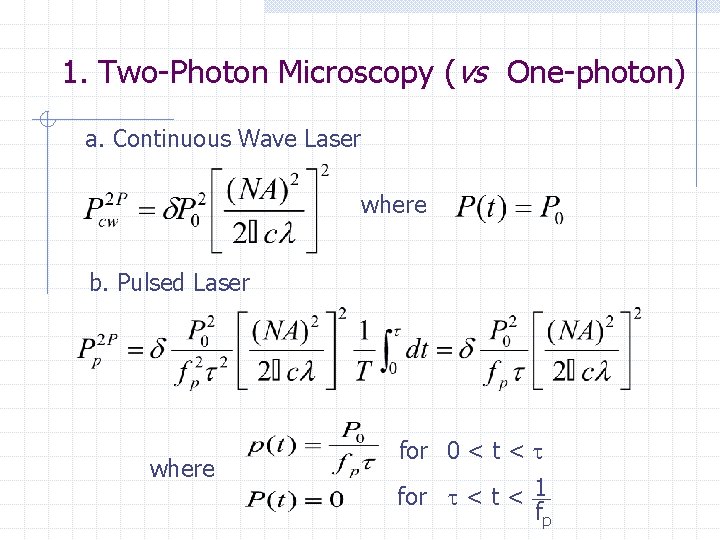
1. Two-Photon Microscopy (vs One-photon) a. Continuous Wave Laser where b. Pulsed Laser where for 0 < t < for < t < 1 fp
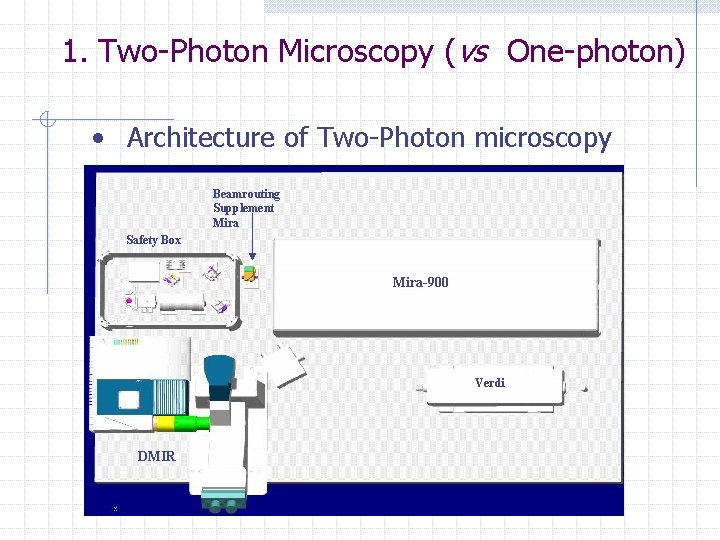
1. Two-Photon Microscopy (vs One-photon) • Architecture of Two-Photon microscopy Beamrouting Supplement Mira Safety Box Mira-900 Verdi DMIR
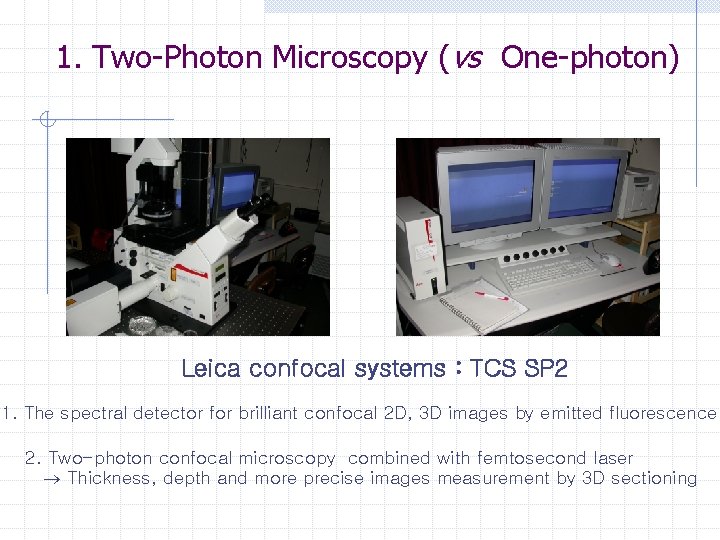
1. Two-Photon Microscopy (vs One-photon) Leica confocal systems : TCS SP 2 1. The spectral detector for brilliant confocal 2 D, 3 D images by emitted fluorescence 2. Two-photon confocal microscopy combined with femtosecond laser Thickness, depth and more precise images measurement by 3 D sectioning
1. Two-Photon Microscopy (vs One-photon) • Light source : Femtosecond Ti-Sapphire system with 80 MHz, 100 fs delivering peak powers of over 100 k. W !! wide tuning range , 700~1000 nm !! At the entrance of scanning head, ~20 m. W Before the objective lens, 9~13 m. W At the sample, 3~5 m. W Picosecond, CW (required higher average power !!) Mira 900 : 76 MHz, 180 fs, 400~500 m. W,
1. Two-Photon Microscopy (vs One-photon) • Advantages of Two-photon Deep-specimen imaging a. Lower absorption & scattering coefficient due to IR b. : Deeper penetration effect ! c. b. Excitation only in a subfemtoliter-sized focal volum d. : It reduce photodamage !
2. Resolution and Contrast (confocal vs two-photon) The resolution, defined as the minimum separation of two Point objects that provides a certain contrast between them, depends on The wavelength of the light ! Numerical Aperture of the optical arrangement ! Specimen !
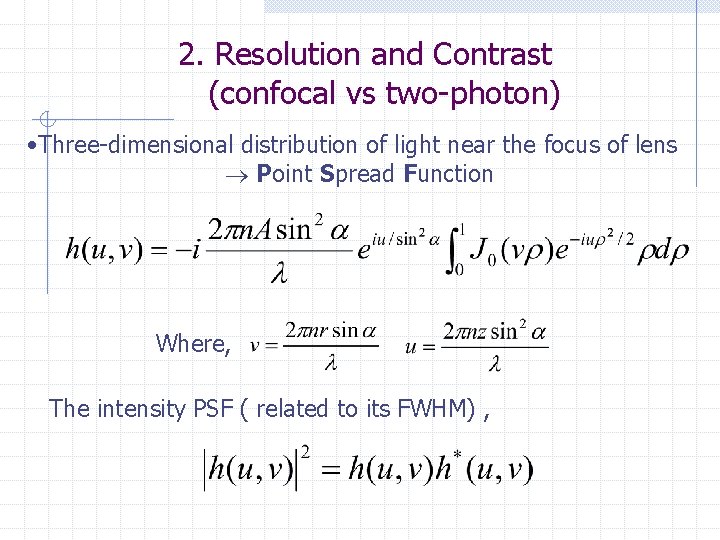
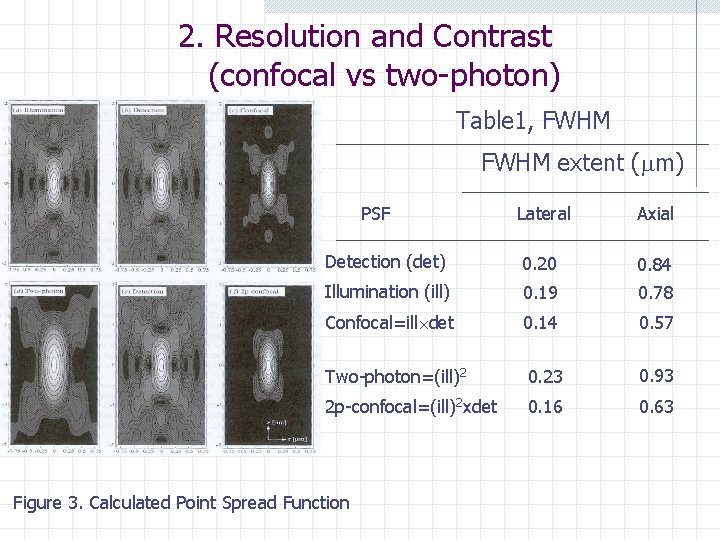
2. Resolution and Contrast (confocal vs two-photon) • Three-dimensional distribution of light near the focus of lens Point Spread Function Where, The intensity PSF ( related to its FWHM) ,
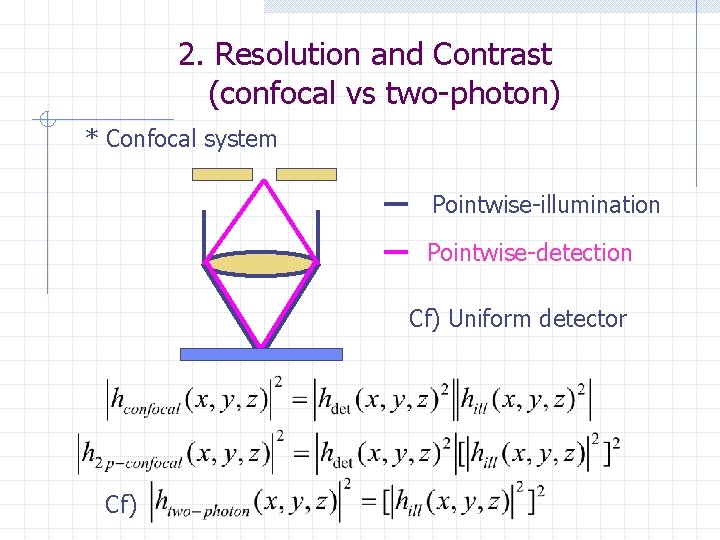
2. Resolution and Contrast (confocal vs two-photon) * Confocal system Pointwise-illumination Pointwise-detection Cf) Uniform detector Cf)
2. Resolution and Contrast (confocal vs two-photon) Table 1, FWHM extent ( m) PSF Lateral Axial Detection (det) 0. 20 0. 84 Illumination (ill) 0. 19 0. 78 Confocal=ill det 0. 14 0. 57 Two-photon=(ill)2 0. 23 0. 93 2 p-confocal=(ill)2 xdet 0. 16 0. 63 Figure 3. Calculated Point Spread Function
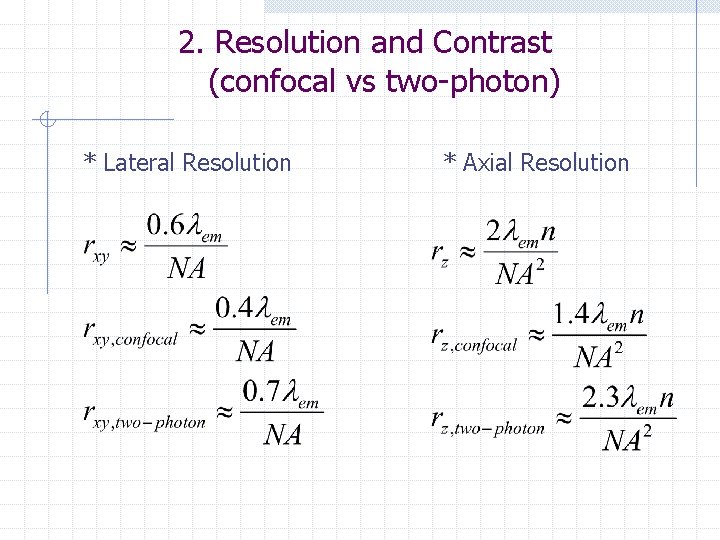
2. Resolution and Contrast (confocal vs two-photon) * Lateral Resolution * Axial Resolution
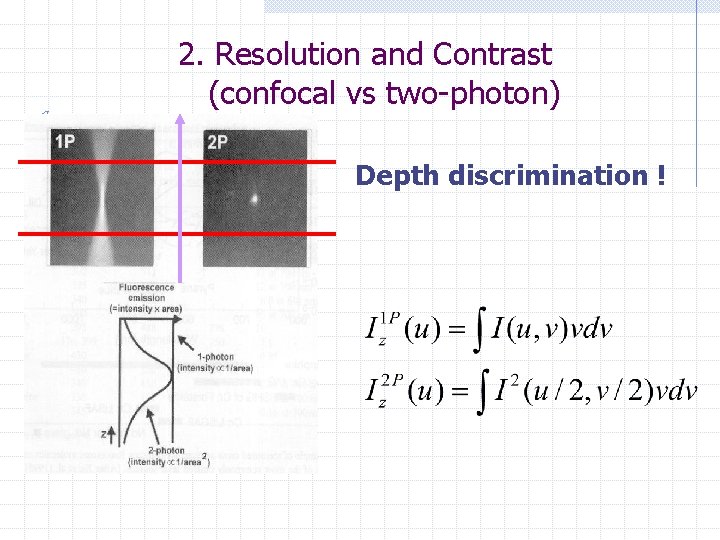
2. Resolution and Contrast (confocal vs two-photon) Depth discrimination !
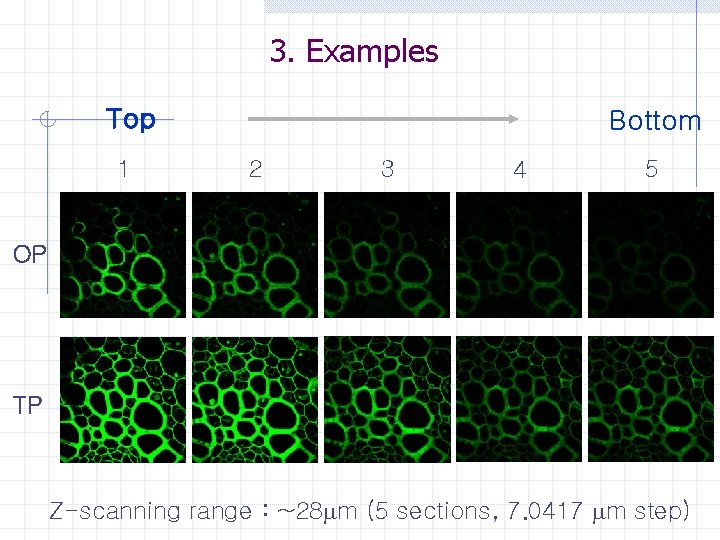
3. Examples Top 1 Bottom 2 3 4 5 OP TP Z-scanning range : ~28 m (5 sections, 7. 0417 m step)
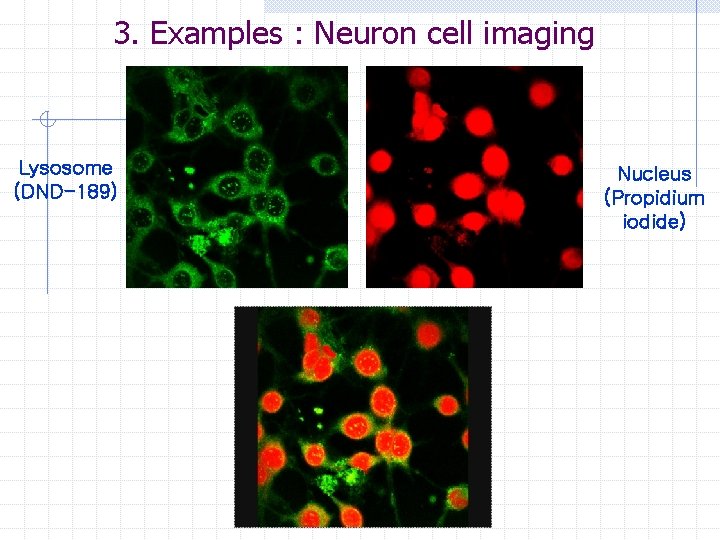
3. Examples : Neuron cell imaging Lysosome (DND-189) Nucleus (Propidium iodide)
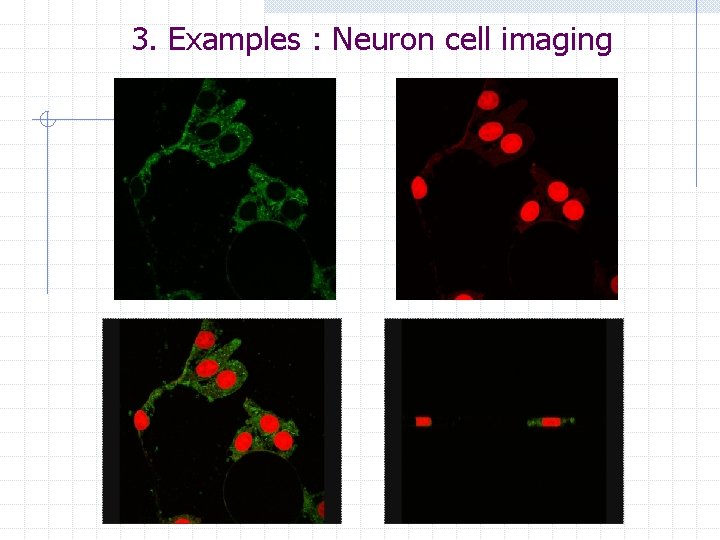
3. Examples : Neuron cell imaging
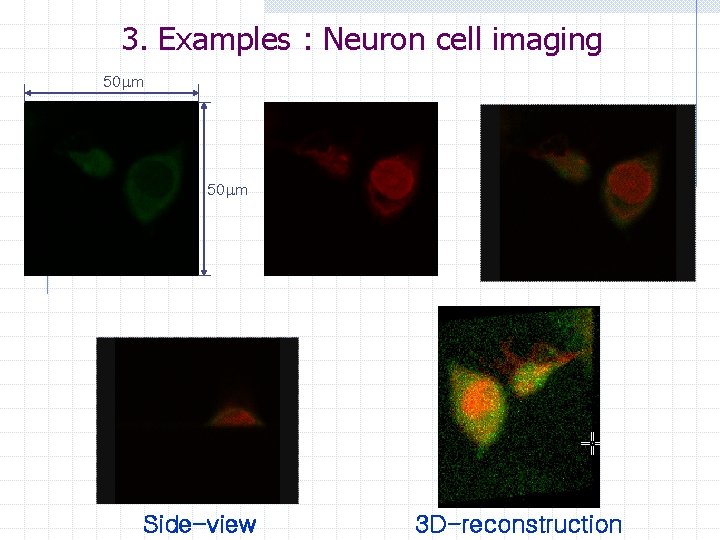
3. Examples : Neuron cell imaging 50 m Side-view 3 D-reconstruction
4. Application : Fluorescence Correlation Microscopy Where F(t)=F(t)-<F(t)> D ~ r 02 / 4 D
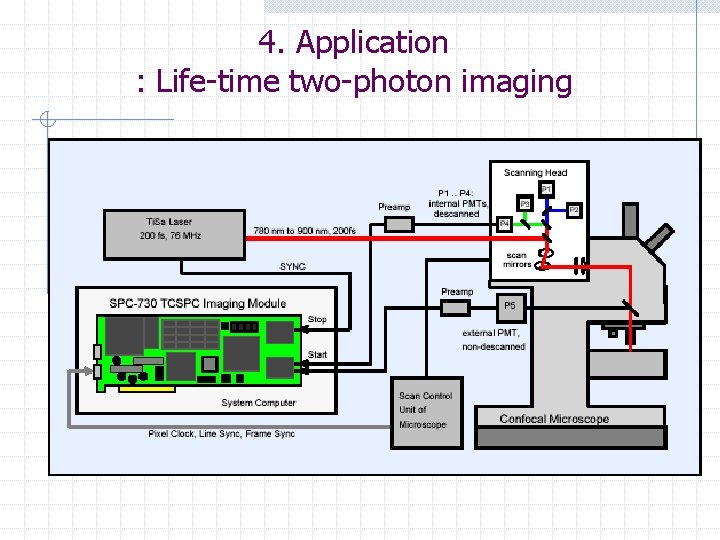
4. Application : Life-time two-photon imaging
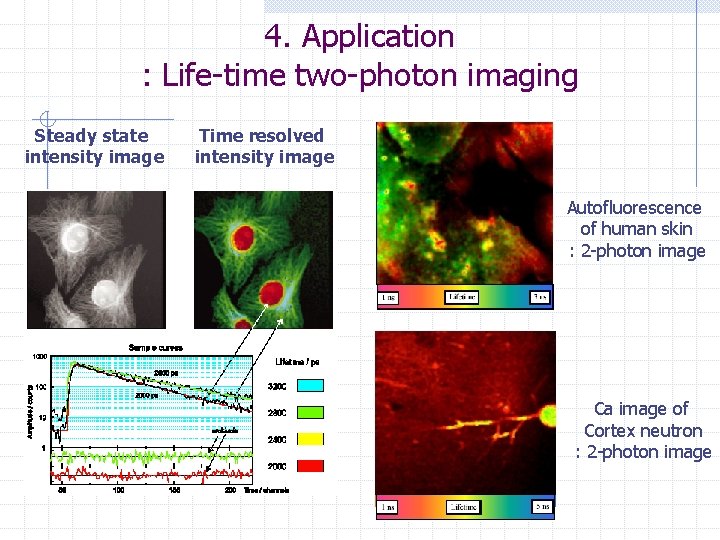
4. Application : Life-time two-photon imaging Steady state intensity image Time resolved intensity image Autofluorescence of human skin : 2 -photon image Ca image of Cortex neutron : 2 -photon image