
Conflict Resolution Meeting the Challenge Biblically B L
Conflict Resolution Meeting the Challenge Biblically B L Kendall 2018 Part 1 Some Basics
• A Hazard that Threatens and Needs to Be Avoided • An Obstacle that Must Be Overcome Regardless of Consequences • An Opportunity to Solve Common Problems to the Glory of God
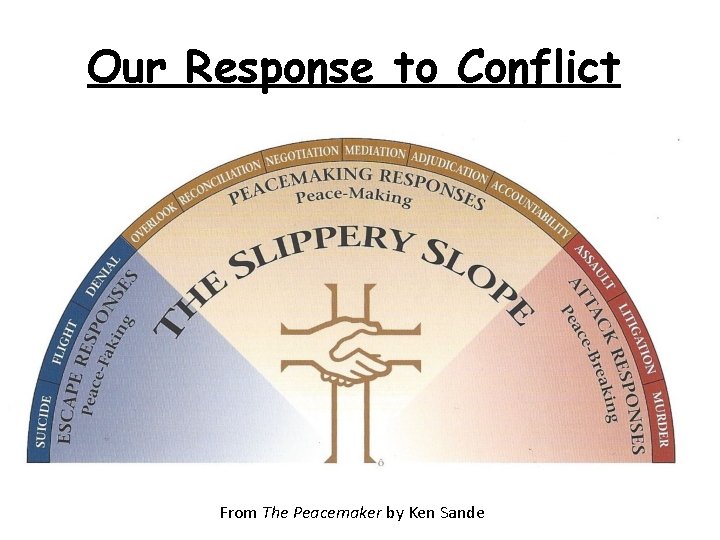
Our Response to Conflict From The Peacemaker by Ken Sande
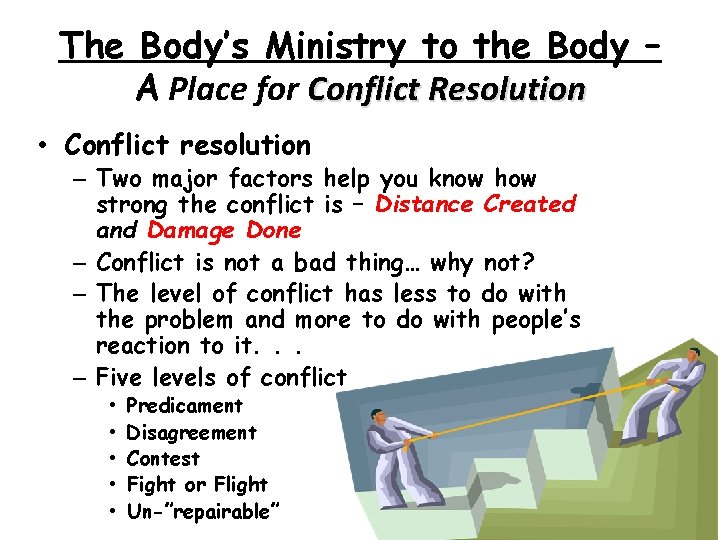
The Body’s Ministry to the Body – A Place for Conflict Resolution • Conflict resolution – Two major factors help you know how strong the conflict is – Distance Created and Damage Done – Conflict is not a bad thing… why not? – The level of conflict has less to do with the problem and more to do with people’s reaction to it. . . – Five levels of conflict • • • Predicament Disagreement Contest Fight or Flight Un-”repairable”
The Body’s Ministry to the Body – Living in a No Fault- No Flight Zone – If your brother has aught against you. . . You have aught with your brother Matt. 5. 21 -26; 18. 15 ff. • • Love Unity Meekness Oneness Example Witness Millstones, Temptations Roots of bitterness – Phil. 2 – yielded rights – Stronger/ weaker brother – 1 Cor. 1 -3/ 4. 6 Knowing when and upon what to take a stand – Caring enough to confront. . . Properly, with Father, Son, Spirit, church, kingdom, lost, and self in mind – When is the Wrong time/ right time to walk away? – Are we called to church discipline or church punishment?
Iron on Iron • Conflict is not necessarily bad or destructive. Even when conflict is caused by sin and causes a great deal of stress, God can use it for good (see Rom. 8: 28 -29). • As the Apostle Paul wrote in 1 Corinthians 10: 31 -11: 1, conflict actually provides three significant opportunities; By God's grace, you can use conflict to: – Glorify God (by trusting, obeying, and imitating him) – Serve other people (by helping to bear their burdens or by confronting them in love; Gal. 6. 1 ff. ) – Grow to be like Christ (by confessing sin and turning from attitudes that promote conflict; James 5). – CP. Matt. 5. 3 -12; Rom. 5. 3 -5; 2 Cor. 4. 7 -12; 12. 7 -10
Glorify God • When the Apostle Paul urged the Corinthians to live "to the glory of God, " he was not talking about one hour on Sunday morning. He wanted them to show God honor and bring him praise in day-to-day life, especially by the way that they resolved personal conflicts (see 1 Cor. 10: 31). • As mentioned above, you can glorify God in the midst of conflict by trusting him, obeying him, and imitating him (see Prov. 3: 1 -6; John 14: 15; Eph. 5: 1). • One of the best ways to keep these concerns uppermost in your mind is to regularly ask yourself this focusing question: "How can I please and honor the Lord in this situation? "
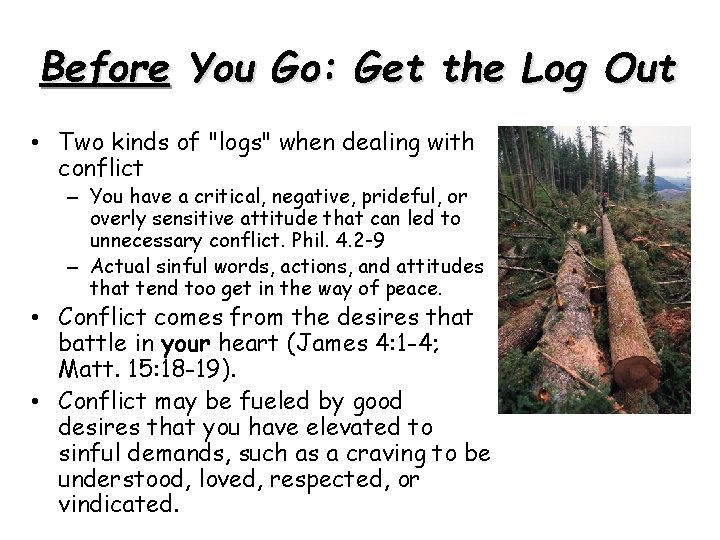
Before You Go: Get the Log Out • Two kinds of "logs" when dealing with conflict – You have a critical, negative, prideful, or overly sensitive attitude that can led to unnecessary conflict. Phil. 4. 2 -9 – Actual sinful words, actions, and attitudes that tend too get in the way of peace. • Conflict comes from the desires that battle in your heart (James 4: 1 -4; Matt. 15: 18 -19). • Conflict may be fueled by good desires that you have elevated to sinful demands, such as a craving to be understood, loved, respected, or vindicated.
Goal; To Gently Restore • Help others understand how they have contributed to a conflict. – – Matt. 18. 15 CP Matt. 18. 12 -14 Cp. Matt 18. 21 -35 Gal. 6. 1 ff. • Remember Pv. 19. 11: “Good sense makes one slow to anger, and it is his glory to overlook an offense. ”
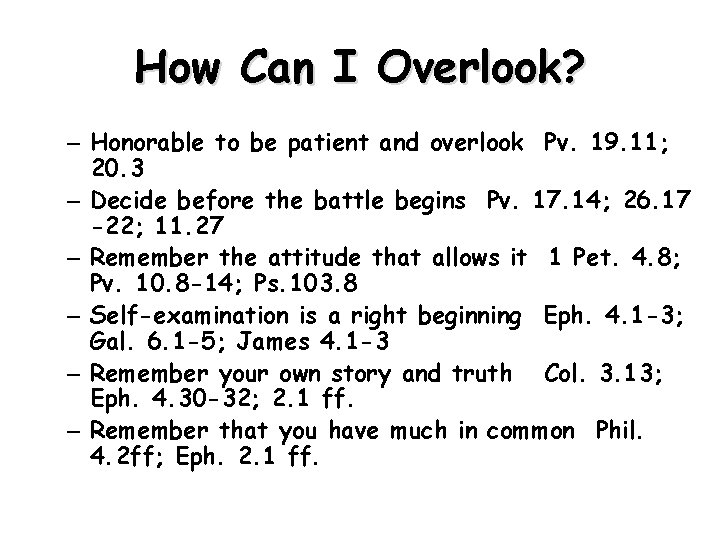
How Can I Overlook? – Honorable to be patient and overlook Pv. 19. 11; 20. 3 – Decide before the battle begins Pv. 17. 14; 26. 17 -22; 11. 27 – Remember the attitude that allows it 1 Pet. 4. 8; Pv. 10. 8 -14; Ps. 103. 8 – Self-examination is a right beginning Eph. 4. 1 -3; Gal. 6. 1 -5; James 4. 1 -3 – Remember your own story and truth Col. 3. 13; Eph. 4. 30 -32; 2. 1 ff. – Remember that you have much in common Phil. 4. 2 ff; Eph. 2. 1 ff.
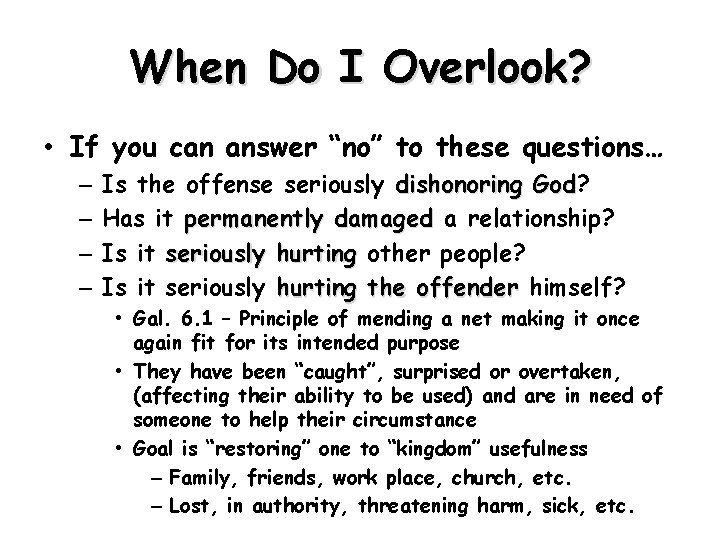
When Do I Overlook? • If you can answer “no” to these questions… – – Is the offense seriously dishonoring God? God Has it permanently damaged a relationship? Is it seriously hurting other people? Is it seriously hurting the offender himself? • Gal. 6. 1 – Principle of mending a net making it once again fit for its intended purpose • They have been “caught”, surprised or overtaken, (affecting their ability to be used) and are in need of someone to help their circumstance • Goal is “restoring” one to “kingdom” usefulness – Family, friends, work place, church, etc. – Lost, in authority, threatening harm, sick, etc.
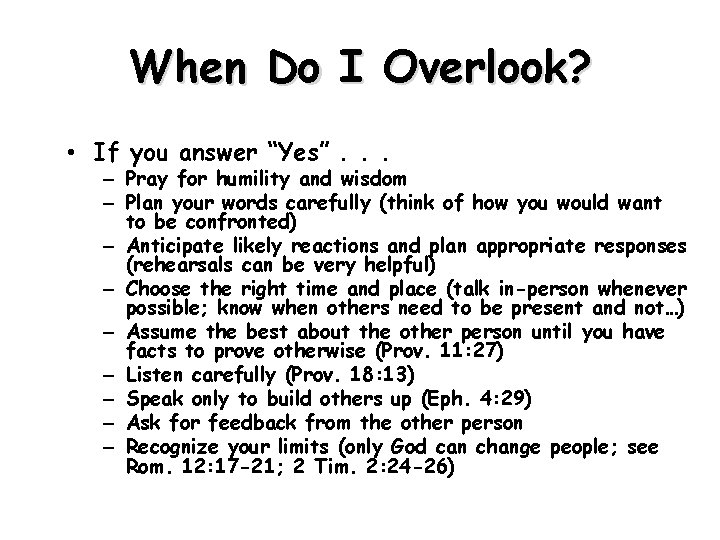
When Do I Overlook? • If you answer “Yes”. . . – Pray for humility and wisdom – Plan your words carefully (think of how you would want to be confronted) – Anticipate likely reactions and plan appropriate responses (rehearsals can be very helpful) – Choose the right time and place (talk in-person whenever possible; know when others need to be present and not…) – Assume the best about the other person until you have facts to prove otherwise (Prov. 11: 27) – Listen carefully (Prov. 18: 13) – Speak only to build others up (Eph. 4: 29) – Ask for feedback from the other person – Recognize your limits (only God can change people; see Rom. 12: 17 -21; 2 Tim. 2: 24 -26)
Go and Be Reconciled • The Pursuit of Genuine Forgiveness and Reconciliation – Col. 3: 12 -17; – 1 Cor. 13: 4 -7; – Psalm 103: 8 -14 • Reconciliation (a result of forgiveness) may be described as a decision to make four promises: – "I will not dwell on this incident. " – "I will not choose to bring up this incident again and use it against you. " – "I will not make this incident an issue for others. " – “I will continue to choose to respond to you as much like Christ as I am able. ”
Forgiveness. . . • Remember that forgiveness is a spiritual process that you cannot fully accomplish on your own. • Therefore, as you seek to forgive others, continually ask God for the grace to enable you to imitate His wonderful forgiveness toward you. (Matt. 6. 7 -15)
Conflict Resolution Meeting the Challenge Biblically B L Kendall 2018 Part 2 Unreasonable People
Be Prepared for Unreasonable People • Remember that God does not measure success in terms of results but in terms of faithful obedience. He knows that you cannot force other people to act in a certain way. Therefore he will not hold you responsible for their actions or for the ultimate outcome of a conflict. (Cp. Ez. 3. 18 ff. ) • All God expects of you is to obey his revealed will as faithfully as possible (see Rom. 12: 18). If you do that, no matter how the conflict turns out, you can walk away with a clear conscience before God, knowing that his appraisal is, "Well done, good and faithful servant. "
Be Prepared for Unreasonable People • Resolve that you will not give up on finding a biblical solution. If a dispute is not easily resolved, you may be tempted to say, "Well, I tried all the biblical principles I know, and they just didn't work. It looks like I'll have to handle this another way (meaning, 'the world's way'). " • A Christian should never close the Bible. When you try to resolve a conflict but do not see the results you desire, you should seek God even more earnestly through prayer, the study of his Word, and the counsel of his church. As you do so, it is essential to keep your focus on Christ and all that he has already done for you (see Col. 3: 1 -4).
Be Prepared for Unreasonable People • Follow the principles for overcoming evil, which are described in Romans 12: 9 -21: • 9 Let love be genuine. Abhor what is evil; hold fast to what is good. 10 Love one another with brotherly affection. Outdo one another in showing honor. 11 Do not be slothful in zeal, be fervent in spirit, serve the Lord. 12 Rejoice in hope, be patient in tribulation, be constant in prayer. 13 Contribute to the needs of the saints and seek to show hospitality. 14 Bless those who persecute you; bless and do not curse them. 15 Rejoice with those who rejoice, weep with those who weep. 16 Live in harmony with one another. Do not be haughty, but associate with the lowly. Never be wise in your own sight. 17 Repay no one evil for evil, but give thought to do what is honorable in the sight of all. 18 If possible, so far as it depends on you, live peaceably with all. 19 Beloved, never avenge yourselves, but leave it to the wrath of God, for it is written, “Vengeance is mine, I will repay, says the Lord. ” 20 To the contrary, “if your enemy is hungry, feed him; if he is thirsty, give him something to drink; for by so doing you will heap burning coals on his head. ” 21 Do not be overcome by evil, but overcome evil with good.
Be Prepared for Unreasonable People • The good news is that "God so loved the world that he gave his one and only Son, that whoever believes in him shall not perish but have eternal life" (John 3: 16). • Believing in Jesus means more than being baptized, going to church, or trying to be a good person. None of these activities alone can erase the sins you have already committed and will continue to commit throughout your life. • Believing in Jesus means, first of all, admitting that you are a sinner and acknowledging that there is no way you can earn God's approval by your own works (Gal. 3. 10 -14; Eph. 2: 8– 9).
Be Prepared for Unreasonable People • Second, it means believing that Jesus paid the full penalty for your sins when he died on the cross (Isa. 53: 1– 12; 1 Peter 2: 24– 25). In other words, believing in Jesus means trusting that he exchanged records with you at Calvary—that is, he took your sinful record on himself and paid for it in full, giving you his perfect record. • When you believe in Jesus and receive his perfect record of righteousness, you can really have true peace with God. As you receive this peace, God will give you an increasing ability to make peace with others by following the peacemaking principles he gives us in Scripture, many of which are described above (see Phil. 4: 4 -9; Matt. 5: 2 -12)
Be Wise When Conflict Comes: Looking at Nehemiah • In spite of the fact that he was doing God’s work, Nehemiah still met with many people determined to resist his work. . . Like him we may expect pockets of envy, dishonesty, apathy, fury, mockery, and hostility. • Nehemiah shows us how to weather even the most perfect storm. . .
Be Wise When Conflict Comes: Looking at Nehemiah Anticipate Pockets of Envy: Respond with Unity in Mind Nehemiah 2. 10 Nehemiah 2. 11 -20
Be Wise When Conflict Comes: Looking at Nehemiah Anticipate Pockets of Dishonesty: Respond with Humility & Integrity Nehemiah 2. 19 Nehemiah 2. 20
Be Wise When Conflict Comes: Looking at Nehemiah Anticipate Pockets of Apathy: Respond with Tenacity Nehemiah 3. 1 -5 Nehemiah 3. 5 ff.
Be Wise When Conflict Comes: Looking at Nehemiah Anticipate Pockets of Anger and Fury: Respond with Vulnerability Nehemiah 4. 3 Nehemiah 4. 4
Be Wise When Conflict Comes: Looking at Nehemiah Anticipate Pockets of Mockery: Respond with God-Reality Nehemiah 4. 2 -4 Nehemiah 4. 14
Be Wise When Conflict Comes: Looking at Nehemiah Anticipate Pockets of Hostility: Respond with Creativity Nehemiah 4. 7 -12 Nehemiah 4. 14 -23.
Be Wise When Conflict Comes: Looking at Paul 1 Cor. 1. 1 -9 Affirmation Everyone Stands on Holy Ground • Sanctified and holy • Grace given in Christ • Christ is the soul-keeper
Be Wise When Conflict Comes: Looking at Paul 1 Cor. 1. 10 -3. 23 He focused on the Body of Christ 1. 10 -17 He focused on Christ 1. 18 -2. 16 He focused on Christlikeness 3. 1 -23
Be Wise When Conflict Comes: Looking at Paul 1 Cor. 4. 1 -5; Identity: Real, Transparent Humility Phil. 2. 1 -5 Romans 12. 1 -5 • Focus on His evaluation ( 1 Cor. 4. 1 -5) • Getting off the merry-go-round (Eph. 5. 21 -6. 9)
Be Wise When Conflict Comes: Looking at Paul 1 Cor. 11. 1 Poured out Like Him Intentional focus all around (cp. Phil. 2. 1 ff) Remember how quickly we can get unfocused (1 Cor. 3. 1 ff; 11. 1) The needed exchange (2 Cor. 6. 1115; 2. Cor. 1. 8 -11)
Be Wise When Conflict Comes: Acts 15 • Give both sides a chance to present. Paul and Barnabas presented their position, then the Pharisees presented theirs. • Give time for adequate discussion. This was a crucial issue (salvation) so there was "much discussion. " • Be quiet. Note that "the whole assembly became silent" as they listened to the discussion. Too often in such situations there is an undercurrent of whispering in the crowd. • Listen. "They listened. " There is a big difference between being quiet and really listening. Put yourself in the other’s place and really try to hear and understand what the other side is saying. Too often we "turn them off, " let our minds wander, think about what we are going to say in reply, or just doze off in a long discussion. • Allow others to finish. "When they finished, James spoke up. " Do not interrupt until others have finished.
Be Wise When Conflict Comes: Acts 15 • Keep to the issue. The issue here was whether or not circumcision was necessary for salvation. Imagine all the other issues that could have been proposed from the books of the law! Also discuss the issue, not personalities. • Express feelings appropriately. There is no report of verbal attacks or counterattacks during the discussion. • Apply scripture. There may be differing interpretations, but certainly at least look at what the Bible has to say. James quoted from Amos 9. • Propose a solution. James said, "It is my judgement, therefore, that…" • Settle on essentials. They all agreed on several items and wrote a letter. • Accept the decision. When the delegation delivered the letter back to the church at Antioch, "The people read it and were glad for its encouraging message. " • Reaffirm your friendship. "After spending some time there" for fellowship, they were sent off "with the blessing of peace. "
Conflict Resolution Meeting the Challenge Biblically B L Kendall 2018 Part 3 Dealing with Discipline
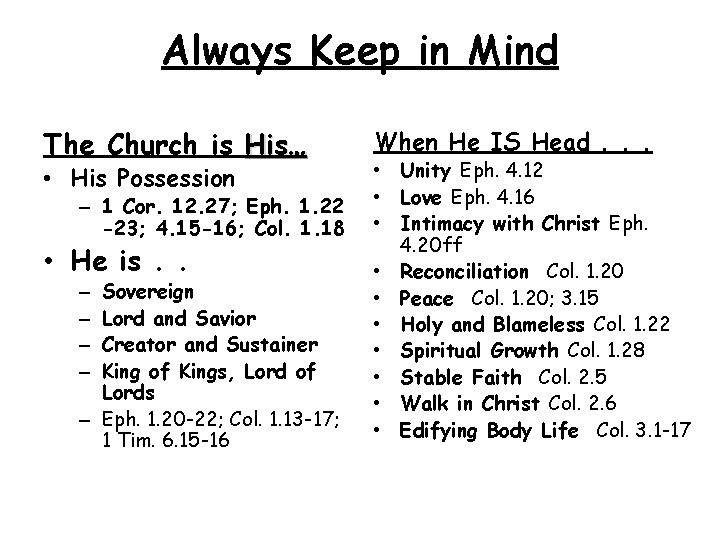
Always Keep in Mind The Church is His… • His Possession – 1 Cor. 12. 27; Eph. 1. 22 -23; 4. 15 -16; Col. 1. 18 • He is. . Sovereign Lord and Savior Creator and Sustainer King of Kings, Lord of Lords – Eph. 1. 20 -22; Col. 1. 13 -17; 1 Tim. 6. 15 -16 – – When He IS Head. . . • Unity Eph. 4. 12 • Love Eph. 4. 16 • Intimacy with Christ Eph. 4. 20 ff • Reconciliation Col. 1. 20 • Peace Col. 1. 20; 3. 15 • Holy and Blameless Col. 1. 22 • Spiritual Growth Col. 1. 28 • Stable Faith Col. 2. 5 • Walk in Christ Col. 2. 6 • Edifying Body Life Col. 3. 1 -17
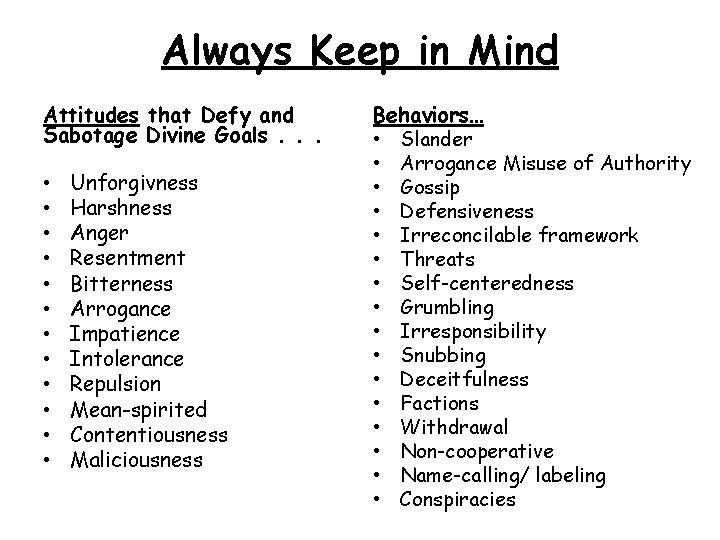
Always Keep in Mind Attitudes that Defy and Sabotage Divine Goals. . . • • • Unforgivness Harshness Anger Resentment Bitterness Arrogance Impatience Intolerance Repulsion Mean-spirited Contentiousness Maliciousness Behaviors… • Slander • Arrogance Misuse of Authority • Gossip • Defensiveness • Irreconcilable framework • Threats • Self-centeredness • Grumbling • Irresponsibility • Snubbing • Deceitfulness • Factions • Withdrawal • Non-cooperative • Name-calling/ labeling • Conspiracies
When Conflict Happens- The Damage Done • • • • Blasphemes the name of Christ Dishonors God Wounds Church Members Invalidates the Church’s witness Turns people away from God and church Destroys the Joy of Christian walk Damages Relationships Confuses Young Christians Spreads Guilt, Shame, and Discouragement Discourages Loyalty Sin is ignored and tolerated Defies Headship of Christ Offers Satan a victory
Spiritual Preparation and Protection • Go to God in Prayer, Submit to Him, Placing Everything in His Hands • Affirm That God IS Sovereign • Remember from Whence Comes Any Authority That you May Have • Put on The FULL Armor of God • Continue Before God in Prayer
The Body’s Ministry to the Body – Is There Any Place for Discipline? – Hebrews 12: 1 -13; – The disciple is disciplined… if not the effects on the church can be terrible – There are two kinds of discipline » Preventative » Surgical – Three ways discipline must be handled » Urgently » Biblically » Consistently
Purpose of Church Discipline: – To bring glory to God and enhance the testimony of the flock. – To restore, heal, and build up sinning believers (Matt. 18: 15; 2 Thess. 3: 14 -15; Heb. 12: 1013; Gal. 6: 1 -2; Jam. 5: 20). – To produce a healthy faith, one sound in doctrine (Tit. 1: 13; 1 Tim. 1: 19 -20). – To win a soul to Christ, if the sinning person is only a professing Christian (2 Tim. 2: 24 -26). – To silence false teachers and their influence in the church (Tit. 1: 10 -11). – To set an example for the rest of the body and promote godly fear (1 Tim. 5: 20). – To protect the church against the destructive consequences that occur when churches fail to carry out church discipline.
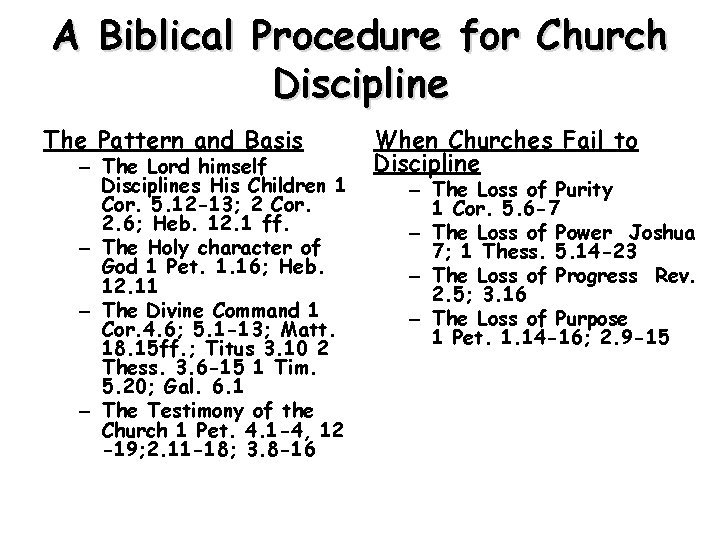
A Biblical Procedure for Church Discipline The Pattern and Basis – The Lord himself Disciplines His Children 1 Cor. 5. 12 -13; 2 Cor. 2. 6; Heb. 12. 1 ff. – The Holy character of God 1 Pet. 1. 16; Heb. 12. 11 – The Divine Command 1 Cor. 4. 6; 5. 1 -13; Matt. 18. 15 ff. ; Titus 3. 10 2 Thess. 3. 6 -15 1 Tim. 5. 20; Gal. 6. 1 – The Testimony of the Church 1 Pet. 4. 1 -4, 12 -19; 2. 11 -18; 3. 8 -16 When Churches Fail to Discipline – The Loss of Purity 1 Cor. 5. 6 -7 – The Loss of Power Joshua 7; 1 Thess. 5. 14 -23 – The Loss of Progress Rev. 2. 5; 3. 16 – The Loss of Purpose 1 Pet. 1. 14 -16; 2. 9 -15
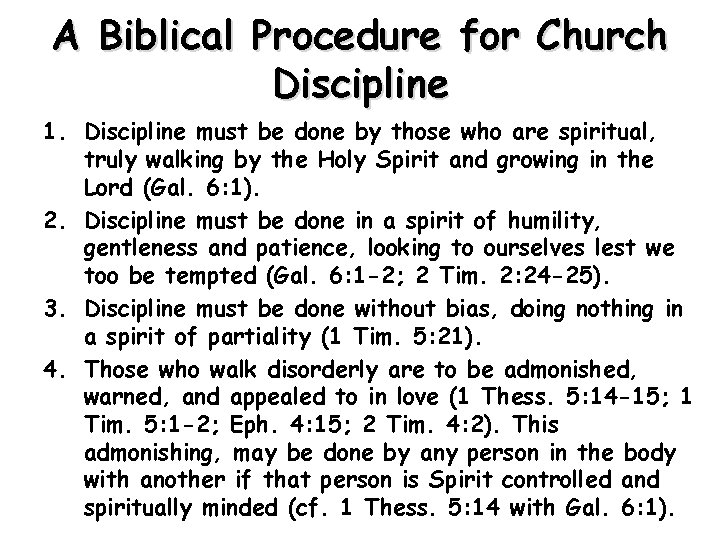
A Biblical Procedure for Church Discipline 1. Discipline must be done by those who are spiritual, truly walking by the Holy Spirit and growing in the Lord (Gal. 6: 1). 2. Discipline must be done in a spirit of humility, gentleness and patience, looking to ourselves lest we too be tempted (Gal. 6: 1 -2; 2 Tim. 2: 24 -25). 3. Discipline must be done without bias, doing nothing in a spirit of partiality (1 Tim. 5: 21). 4. Those who walk disorderly are to be admonished, warned, and appealed to in love (1 Thess. 5: 14 -15; 1 Tim. 5: 1 -2; Eph. 4: 15; 2 Tim. 4: 2). This admonishing, may be done by any person in the body with another if that person is Spirit controlled and spiritually minded (cf. 1 Thess. 5: 14 with Gal. 6: 1).
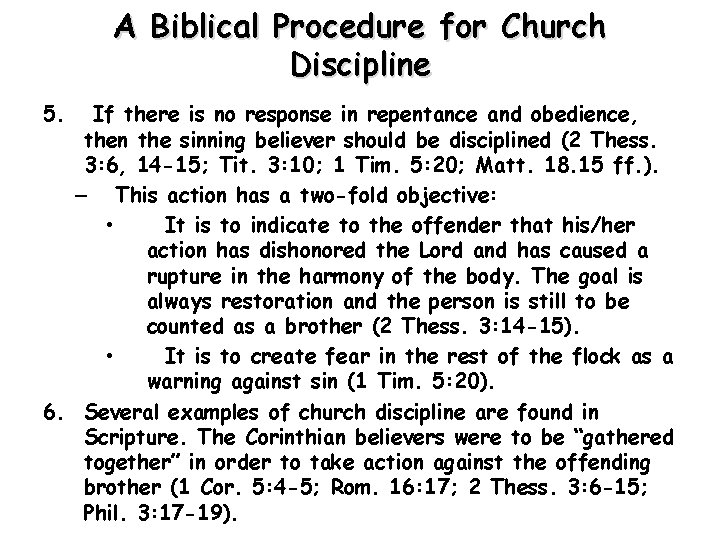
A Biblical Procedure for Church Discipline 5. If there is no response in repentance and obedience, then the sinning believer should be disciplined (2 Thess. 3: 6, 14 -15; Tit. 3: 10; 1 Tim. 5: 20; Matt. 18. 15 ff. ). – This action has a two-fold objective: • It is to indicate to the offender that his/her action has dishonored the Lord and has caused a rupture in the harmony of the body. The goal is always restoration and the person is still to be counted as a brother (2 Thess. 3: 14 -15). • It is to create fear in the rest of the flock as a warning against sin (1 Tim. 5: 20). 6. Several examples of church discipline are found in Scripture. The Corinthian believers were to be “gathered together” in order to take action against the offending brother (1 Cor. 5: 4 -5; Rom. 16: 17; 2 Thess. 3: 6 -15; Phil. 3: 17 -19).
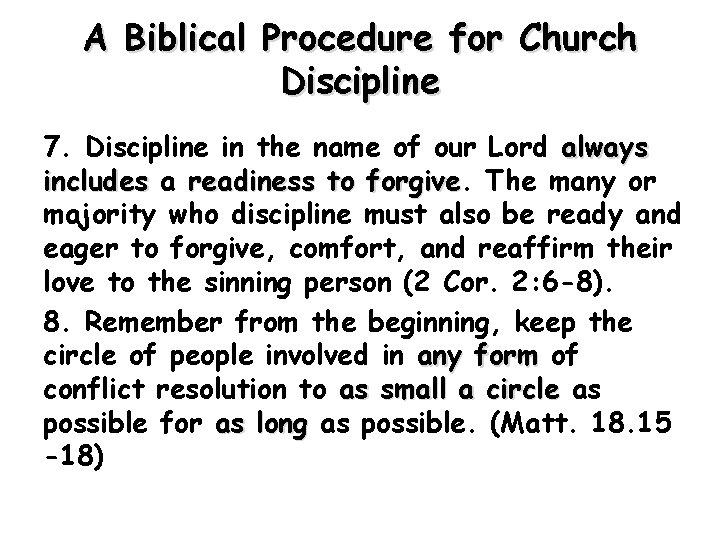
A Biblical Procedure for Church Discipline 7. Discipline in the name of our Lord always includes a readiness to forgive The many or majority who discipline must also be ready and eager to forgive, comfort, and reaffirm their love to the sinning person (2 Cor. 2: 6 -8). 8. Remember from the beginning, keep the circle of people involved in any form of conflict resolution to as small a circle as possible for as long as possible. (Matt. 18. 15 -18)
A Biblical Procedure for Church Discipline; Specific Causes (1) General Causes: Disorderly conduct, conduct clearly out of line with the prescribed commands of Scripture and which negatively impacts the testimony and unity of the church (2 Thess. 3: 6 -15). (2) Specific Causes: • Difficulties between members (Matt. 18: 15 -17). • Divisive or factious people causing divisions in the church (Rom. 16: 17 -18; Titus 3: 9 -11). • Immoral conduct; sins of the type mentioned in 1 Corinthians 5 such as incest, immorality, covetousness, idolatry, abusive speech, drunkenness, swindling, or idle busybodies who refuse to work and run around spreading dissension (1 Cor. 5: 1, 11; 2 Thess. 3: 10 -15). • False teaching; erroneous teaching and views which concern the fundamentals of the faith and not lesser differences of interpretation (1 Tim. 1: 20; 2 Tim. 2: 17 -18; also implied in Rev. 2: 14 -16; Phil. 3: 2 -3, 15 -19; Rom. 16: 17 -18). The key concerns that guide us in this are: (a) the holy character of God, (b) the testimony of the flock, (c) the effect upon the unity and purity of the flock, and (d) the edification and restoration of the individual.
A Biblical Procedure for Church Discipline: Cautions If you see the offense or you have accurate knowledge of the sin(s), please note these cautions: • Be sure it is an offense which calls for discipline and not merely one of our pet peeves. Again, the Word must be our criterion. • Remember how we too have sinned in the past and heed the warnings of Galatians 6: 1. • Bring the matter before the Lord in prayer before the confrontation takes place (1 Sam. 8: 6). • Don’t procrastinate. The longer the delay, the more difficult the condition can become. Remember the consequences listed above. • Don’t gossip or even talk to others about it in the sense of Matthew 18: 16 until you have talked to the sin-ning believer privately. We must guard and protect the person and the flock from rumors and a slanderous tongue (Prov. 6: 19 b; 10: 19; 11: 13; 18: 8, 21; 20: 19).
A Biblical Procedure for Church Discipline: Step 1 First, seek private correction and/or reconciliation with the offender (Matt. 18: 15). – When the problem involves one believer sinning against another, there are two problems that need to be taken care of: reconciliation and restoration (Matt. 5: 23 -24). – When the problem involves a believer overcome in or by some sin, as was the case in Galatians 6: 1, the need is restoration.
A Biblical Procedure for Church Discipline: Step 1 Some Personal Guidelines – Begin by expressing your genuine appreciation for the person and their good qualities to show you are genuinely concerned about their welfare. Then and only then bring up the matter which is of concern. – In some situations the sin is apparent and there is no question, but we must allow for the possibility that we have misjudged or have wrong information. We must listen to the other person’s side of the story and seek the facts in the interest of truth and fairness. – If the person fails to respond, first seek council for further wisdom and insights, re-checking your heart and attitude, then gently warn them that you may need to get others as concerned witnesses and return with them to further address or discuss the issues. (Matt. 18. 16)
A Biblical Procedure for Church Discipline: Step 2 • If the first step fails, take witnesses to strengthen the influence of the shared concern, preferably spiritual leaders, so that if it has to be brought before the whole church it can be firmly proven and established (Matt. 18: 16 -17; 1 Tim. 5: 19). • The aid of church leadership should be sought if the problem involves an offense that is against the whole body or if it is a threat to the unity of the body. • These initial contacts, private and with witnesses, provide opportunity for loving admonition, correction, and forgiveness. • On the other hand, if these first steps do not produce results, it constitutes a warning that further action will be taken and provides occasion for serious rebuke (2 Tim. 4: 2; 1 Thess. 5: 12 -13; Titus 2: 15; 3: 10).
A Biblical Procedure for Church Discipline: Step 3 If the second step fails, seek reconciliation and restoration through the whole body. If further action is necessary, it is to be taken before the whole church (2 Thess. 3: 6, 14 -15; Matt. 18: 17; 1 Tim. 5: 20). • This action appears to fall into two stages when we combine 2 Thessalonians 3: 14 and 1 Corinthians 5: 9 -13 with Matthew 18: 17. – If the offender refuses to listen to the gentle encouragement offered to this point, acting as unbelievers in attitude and practice, then they are to be treated as they are acting. – If this doesn’t work, the local body of believers is to exercise further discipline: removal from church membership, loss of some privileges, and continuation of the loss of intimate fellowship. This must be explained and shared with the entire congregation (2 Cor. 2: 6). • This is, in essence, the Lord carrying out discipline through the action of the entire body under the leadership of the elders or the spiritually mature (1 Cor. 5: 4). Similar heavenly authority is seen in the ratification of this disciplinary action as spelled out in Matthew 18: 18 -19.
A Biblical Procedure for Church Discipline: Restoration • Forgiveness • In keeping with the goal of restoration, the role of the church must respond after there is repentance. This means accepting the person and forgetting (choosing to respond differently to) the past (2 Cor. 2: 7 a). • But how do we know when repentance is genuine? What is our respon sibility when the sinning party acknowledges their wrong and claims repentance? The following two passages answer this for us. – Luke 3: 8, when they “. . . bring forth fruits in keeping with repentance. ” – Acts 26: 20, “. . . that they should repent and turn to God, performing deeds appropriate to repentance. ”
A Biblical Procedure for Church Discipline: Restoration • Genuine repentance will make itself evident by its deeds and attitudes. The repentant person will: – Freely acknowledge his sin (1 Jn. 1: 9; Prov. 28: 13 a). – Cease the activity for which he was disciplined or at least seeking help if it’s a case of life dominating patterns (Prov. 28: 13 b; Gal. 6: 1 f; Jam. 5: 19 -20). – Make restitution and/or ask forgiveness from those hurt as it is applicable (Phil. 18 -19; Matt. 5: 23 -24). – He/she will demonstrate a genuine change of heart, a real concern and godly sorrow over his actions, not in order to be forgiven, but because of the harm caused to the glory of God and the hurt caused others (2 Cor. 7: 811; Ps. 51: 17). – He/she will begin to manifest the fruit of the Spirit and a concern for the things of Christ (Gal. 5: 22 f).
A Biblical Procedure for Church Discipline: Restoration • Comfort • This means reaching out to them, assuring them of your support, and encouraging, exhorting, and challenging them to move on (John 8. 1 ff. ; 2 Cor. 2: 7 b). “Go and sin No More • Remember roles are returning to “normal” (Eph. 4. 11 ff. ; James 5. 1 ff. )
A Biblical Procedure for Church Discipline: Restoration • Love • This means including them, drawing them close, doing for them that which will aid their growth and complete recovery (2 Cor. 2: 8). • This would include encouraging them to get involved in ministry (Luke 22: 31 -32). • For positions of leadership, there should be a time of testing to demonstrate their qualifications after the analogy of 1 Timothy 3: 10.
THE CAUSES OF UNRESOLVED CONFLICT • • Biblical Ignorance Bad Experiences Cultural Influences Aversion to Paying the Price
Conflict Resolution Meeting the Challenge Biblically B L Kendall 2018 Part 4 Other Forms of Discipline
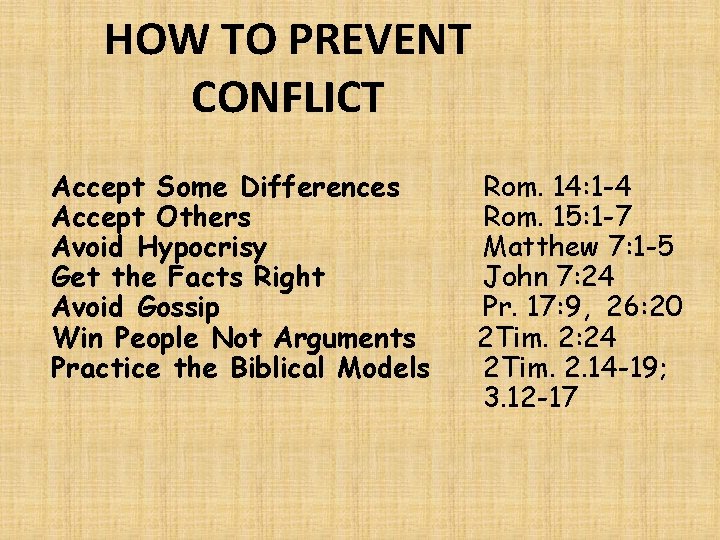
HOW TO PREVENT CONFLICT Accept Some Differences Accept Others Avoid Hypocrisy Get the Facts Right Avoid Gossip Win People Not Arguments Practice the Biblical Models Rom. 14: 1 -4 Rom. 15: 1 -7 Matthew 7: 1 -5 John 7: 24 Pr. 17: 9, 26: 20 2 Tim. 2: 24 2 Tim. 2. 14 -19; 3. 12 -17
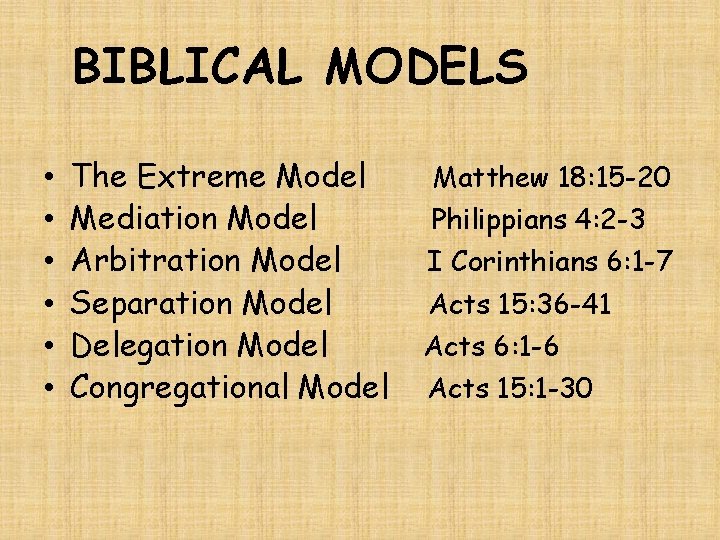
BIBLICAL MODELS • • • The Extreme Model Mediation Model Arbitration Model Separation Model Delegation Model Congregational Model Matthew 18: 15 -20 Philippians 4: 2 -3 I Corinthians 6: 1 -7 Acts 15: 36 -41 Acts 6: 1 -6 Acts 15: 1 -30
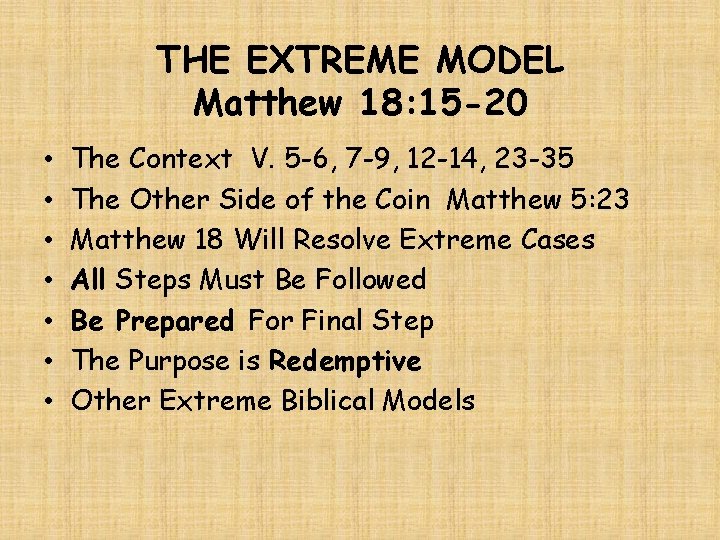
THE EXTREME MODEL Matthew 18: 15 -20 • • The Context V. 5 -6, 7 -9, 12 -14, 23 -35 The Other Side of the Coin Matthew 5: 23 Matthew 18 Will Resolve Extreme Cases All Steps Must Be Followed Be Prepared For Final Step The Purpose is Redemptive Other Extreme Biblical Models
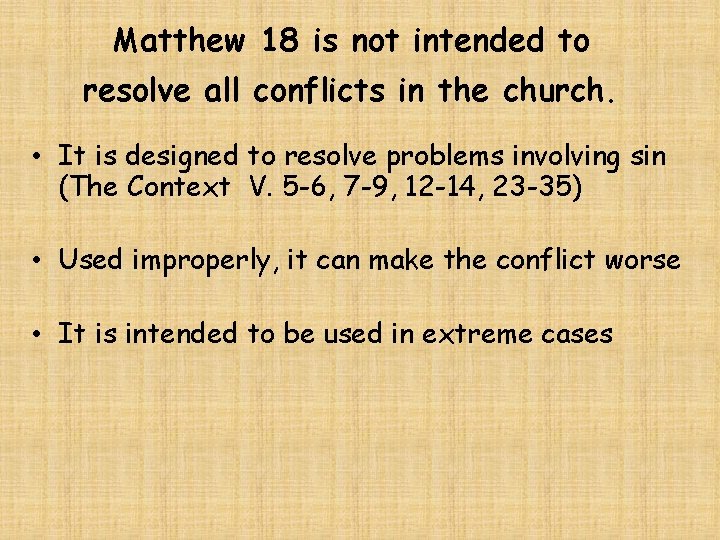
Matthew 18 is not intended to resolve all conflicts in the church. • It is designed to resolve problems involving sin (The Context V. 5 -6, 7 -9, 12 -14, 23 -35) • Used improperly, it can make the conflict worse • It is intended to be used in extreme cases
OTHER EXAMPLES • Immorality I Corinthians 5: 1 -13 • Divisive Doctrine Romans 16: 17, Titus 3: 10 • Disorderly Conduct II Thessalonians 3: 6 • Leaders Who Sin I Timothy 5: 19 -21
BIBLICAL MODELS • Mediation Model Philippians 4: 2 -3 I plead with Euodia and I plead with Syntyche to agree with each other in the Lord. Yes, and I ask you, loyal yokefellow, help these women who have contended at my side in the cause of the gospel, along with Clement and the rest of my fellow workers, whose names are in the book of life.
BIBLICAL MODELS • Arbitration Model I Cor. 6: 1 -7 If any of you has a dispute with another, dare he take it before the ungodly for judgment instead of before the saints? Do you not know that the saints will judge the world? And if you are to judge the world, are you not competent to judge trivial cases? Do you not know that we will judge angels? How much more things of this life! Therefore, if you have disputes about such matters, appoint as judges even men of little account in the church! I say this to shame you. Is it possible that there is nobody among you wise enough to judge a dispute between believers? But instead, one brother goes to law against another-and this in front of unbelievers!
BIBLICAL MODELS • Separation Model Acts 15: 36 -41 Some time later Paul said to Barnabas, "Let us go back and visit the brothers in all the towns where we preached the word of the Lord and see how they are doing. “ Barnabas wanted to take John, also called Mark, with them, but Paul did not think it wise to take him, because he had deserted them in Pamphylia and had not continued with them in the work. They had such a sharp disagreement that they parted company. Barnabas took Mark and sailed for Cyprus, but Paul chose Silas and left, commended by the brothers to the grace of the Lord.
BIBLICAL MODELS • Delegation Model Acts 6: 1 -7 In those days when the number of disciples was increasing, the Grecian Jews among them complained against the Hebraic Jews because their widows were being overlooked in the daily distribution of food. So the Twelve gathered all the disciples together and said, "It would not be right for us to neglect the ministry of the word of God in order to wait on tables. Brothers, choose seven men from among you who are known to be full of the Spirit and wisdom. We will turn this responsibility over to them and will give our attention to prayer and the ministry of the word. " This proposal pleased the whole group. They chose Stephen, a man full of faith and of the Holy Spirit; also Philip, Procorus, Nicanor, Timon, Parmenas, and Nicolas from Antioch, a convert to Judaism. They presented these men to the apostles, who prayed and laid their hands on them. So the word of God spread. The number of disciples in Jerusalem increased rapidly, and a large number of priests became obedient to the faith.
BIBLICAL MODELS • Congregational Model Acts 15: 1 -30 Then the apostles and elders, with the whole church, decided to choose some of their own men and send them to Antioch with Paul and Barnabas. They chose Judas (called Barsabbas) and Silas, two men who were leaders among the brothers.
- Slides: 66