
CONFLICT RESOLUTION FOR CONSTRUCTION STORMWATER REGULATORY COMPLIANCE PRESENTER
- Slides: 27
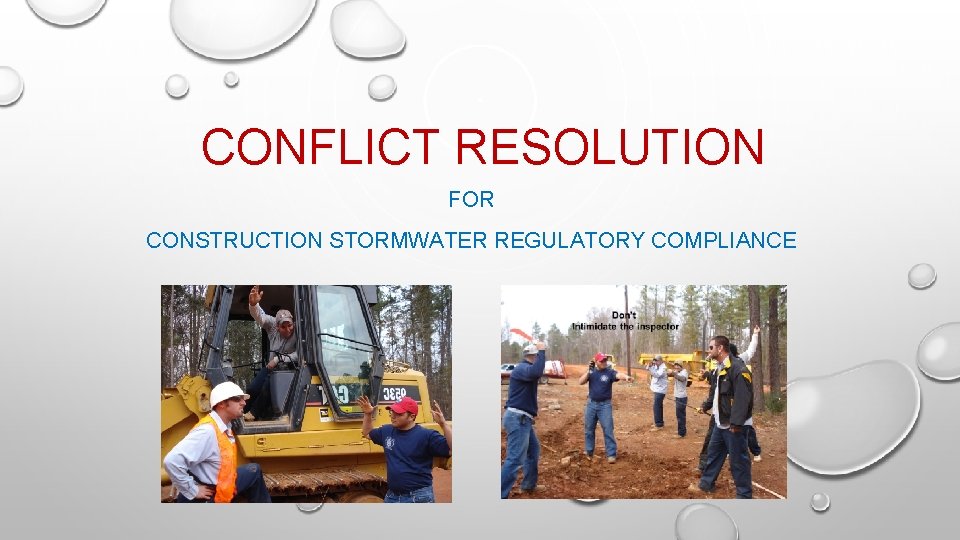
CONFLICT RESOLUTION FOR CONSTRUCTION STORMWATER REGULATORY COMPLIANCE
PRESENTER Phil Handley, CPESC BACKGROUND: 38 Years in the construction Industry • 4 Years with City of San Antonio-Public Works Engineering Department • 14 Years with 2 local private engineering consultants (construction management & environmental) • 18 Years with MS 4 Agency (San Antonio Water System) managing the Const. Stormwater regulatory program • Last 2 years, with Stormcon, LLC, a stormwater consultant EDUCATION: • Associates Degree in Applied Science (Political Science/Public Administration) • Leadership/Management Certification from Rice University
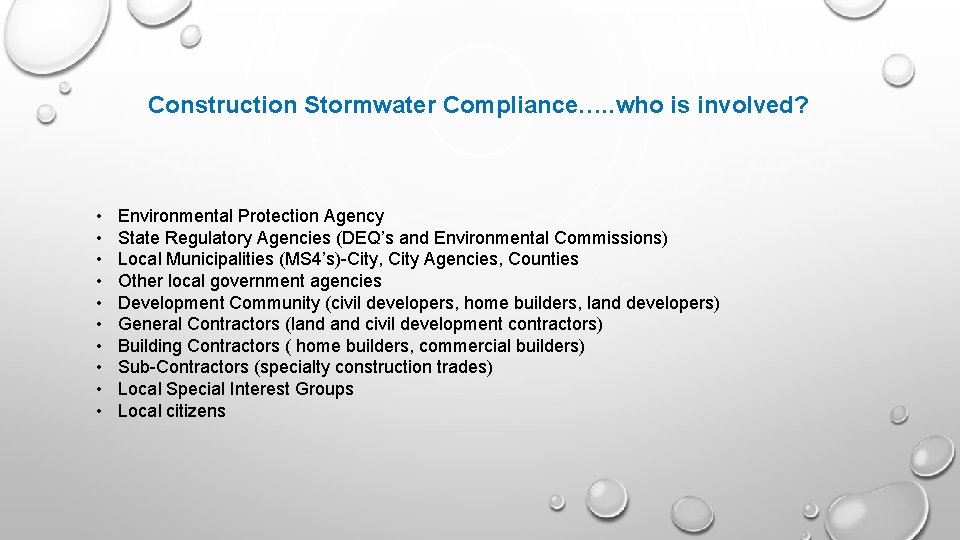
Construction Stormwater Compliance…. . who is involved? • • • Environmental Protection Agency State Regulatory Agencies (DEQ’s and Environmental Commissions) Local Municipalities (MS 4’s)-City, City Agencies, Counties Other local government agencies Development Community (civil developers, home builders, land developers) General Contractors (land civil development contractors) Building Contractors ( home builders, commercial builders) Sub-Contractors (specialty construction trades) Local Special Interest Groups Local citizens
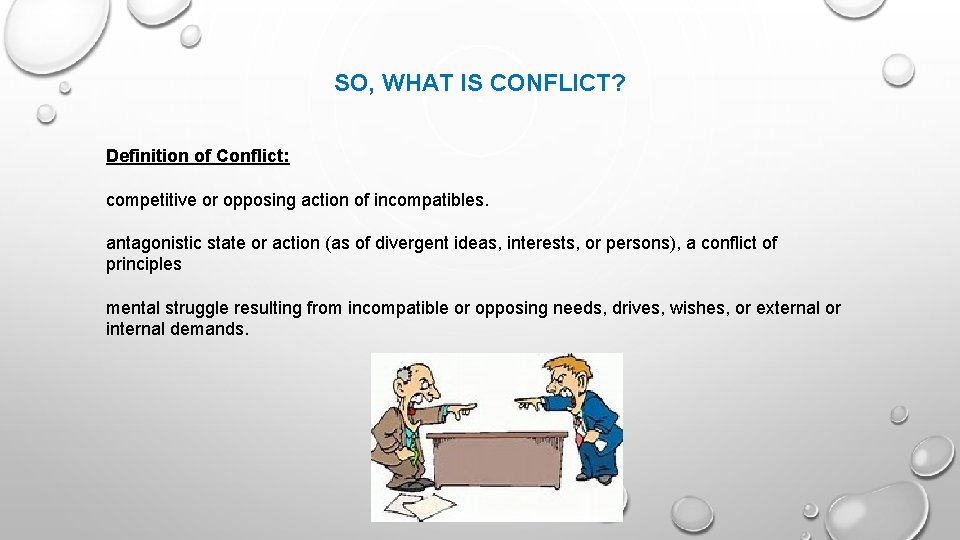
SO, WHAT IS CONFLICT? Definition of Conflict: competitive or opposing action of incompatibles. antagonistic state or action (as of divergent ideas, interests, or persons), a conflict of principles mental struggle resulting from incompatible or opposing needs, drives, wishes, or external or internal demands.
WHAT IS RESOLUTION? Definition of Resolution: a formal expression of opinion or intention made, usually after debate conclusion, by a formal organization, or other group. the act of resolving or determining upon an action, course of action, method, procedure, etc. a resolve; a decision or determination: to make a firm resolution to do something.
WHAT IS CONFLICT RESOLUTION? Definition of Conflict Resolution: A firm, collaborative decision to do something. A course of action determined or decided on. The act of solving or explaining a problem or conflict. The resolving or concluding of a dispute or disagreement. A formal statement of a decision or expression of opinion put before or adopted by a group or assembly.
WHAT/WHO GENERATES CONFLICT IN CONSTRUCTION? What or “Who” generates conflict: • • • EPA State Environmental Agency State or EPA Construction General Permit Local Municipality/MS 4 Construction Stormwater Ordinance Developers Contactors (General and Building) Sub-Contractors (Specialty Trades) The Stormwater Pollution Prevention Plan (SWP 3)-Non-compliance The “unexpected” issues of construction Local Action Groups or Citizens
STORMWATER CONSTRUCTION GENERAL PERMIT The Stormwater “PERMIT”…is the primary focus of much of the conflict between the regulated and the regulatory Hierarchy of the Permit…. . Environmental Protection Agency (EPA) creates the Federal Construction General Permit. The EPA permit establishes the holistic expectation of the construction industry to protect the waters of the U. S. State Environmental Agency (DEQ or Commission) has delegated authority from the EPA to create a “State Construction General Permit” to meet the specific needs and expectations of the State.
STORMWATER CONSTRUCTION GENERAL PERMIT Hierarchy of the Permit: Local Municipality/MS 4 Ordinance. The local Ordinance is the legal, local law outlining specific needs of the MS 4. The needs of the MS 4 are generally specified in the MS 4’s “State stormwater Permit”. However, local stormwater and water quality needs can also be addressed in the local Ordinance. A local Ordinance is regulatorily enforced by the MS 4. Additionally, in many instances, the MS 4 can leverage State environmental law for enforcement as well. It is likely that the primary regulatory agency to be seen by the local development and construction community with frequency will be the MS 4 regulatory agents (inspectors).
COMMON CONFLICTS IN STORMWATER? Stormwater Pollution Prevention Plan (SWP 3) is required by all EPA, State Permits and local MS 4 Ordinances. The SWP 3 is a dynamic “living” document which defines BMP’s, operator responsibilities, reporting documentation and all aspects of stormwater management for a construction site. Unexpected issues of construction sometimes create the most interesting conflicts. Be it unknown utilities or underground obstacles, construction practice challenges, conflicts between the SWP 3 and Permit or conflicts with local action groups or citizens…. these various obstacles and difficulties can create conflict on the construction site and with stormwater rules and permits.
DEVELOPER/CONTRACTOR ROLE Development and Construction Industry Groups: Developers are typically the primary generator of development and construction in the localized area. Developers are typically the economic source of the development. Additionally, Developers activities include design responsibilities, seeking of approval from City authorities to develop specific developments, hire general and building contractors and build the development in a timely, and economically successful outcome. As owners, Developers are responsible to secure a State or EPA Construction General Permit for each development.
DEVELOPER/CONTRACTOR ROLE Contractors: Contractors (general and building) are the constructors of development. Contractors secure Permits, initiate construction, soil disturbing activities, usually manage the Stormwater Pollution Prevention Plan (SWP 3) required by the Permit and install Best Management Practices (BMP’s) outlined in the SWP 3 and complete documentation/reporting to protect water quality. Sub-Contractors (Specialty Trades) are typically hired by the general or building contractor. Some specialty contractors are hired by local utility companies (wet and dry utilities). These utilities and their contracted utility contractors are required to secure State or EPA permits as well.
DEVELOPER/CONTRACTOR RESPONSIBILITIES Common Developer and Contractor Responsibilities: • Acquire land for development, verify City Zoning, plan, design and approve planned development with City, County and other authorizing agencies. • Design project/development to assure all local and state codes, rules and policies for construction are achieved. • Obtain all appropriate local, state and federal permits required to construct the development • Secure all environment obligations and permits to meet local, state and federal environmental laws. • Coordinate construction activities with all local authorities/regulatory and inspection groups • Build a quality product • Meet local residence requirements during construction of development • Build development in a timely manner • Complete development to meet economic and physical expectations of the project. • Make everyone happy during the process
MS 4 RESPONSIBILITIES In a Large MS 4 (and small MS 4) there are more tasks to accomplish to meet their Permit expectations than just inspecting and enforcing on construction sites and aggravating operators Examples of Responsibilities are: • Create/maintain structural controls and stormwater collection system operations • Identify areas of new development and significant re-development • Roadways-street sweeping and cleaning (including inlets) • Develop flood control projects • Manage pesticide, herbicide and fertilizer applications • Monitor and respond to illicit discharges and improper disposal • Spill prevention and response • Monitor and manage industrial high risk runoff • Public education and public participation • Monitoring Program (dry and wet weather and high risk runoff sampling/analysis) • Last but not least…… • Monitor, manage and enforce construction site runoff
CONFLICT RESOLUTION STRATEGIES STRATEGY 1: When angry, separate yourself from the situation and take time to cool off. A unplanned conflict on a construction project can make an inspector or superintendent frustrated and a angry. The angry individual(s) needs to avoid discussion and collaboration on the item until cooler heads prevail. STRATEGY 2: Attack the problem, not the person. Starting a conversation with a compliment is a good start. A conflict or issue occurring on the project is a “problem”. The person(s) meeting to collaborate on a solution to the “problem” are usually…. ”NOT” the problem. If one person in the issue is the problem…seek another “person” to discuss the issue that is not directly associated with the problem.
CONFLICT RESOLUTION STRATEGIES STRATEGY 3: Communicate your feelings assertively, NOT aggressively. Express them without blaming. When discussions begin between parties in order to develop solutions to the problem/conflict, assertively make your points (sticking to facts and reality). Aggression triggers anger and no positive solution will be obtained. Also, do not blame the opposing person or group for the problem/conflict. STRATEGY 4: Focus on the Issue, NOT your position about the issue. The issue is the “conflict” and the problem. Opening resolution discussion needs to start with the “issue” and facts related to the problem. Your opening statement on your “position” only establishes your unwillingness to listen to others solutions. Once facts are on the table, your position and “concerns” can enter the conversation on the way to a solution.
CONFLICT RESOLUTION STRATEGIES STRATEGY 5: Accept and respect that individual opinions may differ, don’t try to force your solution, work to develop common agreement and acceptance. More times than not, most individuals come to the table to offer facts and potential solutions to the issue/conflict. However two opposition parties will likely come to the table with different facts and solutions. Respect and listening to all solution options usually will develop into a common agreement on a solution. STRATEGY 6: Do not review the situation concerning a conflict as a competition, where one has to win and one has to lose. Work toward a solution in which both parties compromise on a common accepted solution. Most conflicts can find solutions to meet resolution in a common acceptance and agreement that is beneficial and successful to all parties.
CONFLICT RESOLUTION STRATEGIES STRATEGY 7: Focus on areas of common interest and agreement, instead of areas of disagreement and opposition. Open discussion on common interest where there is agreement. Many times the solution can be achieved on common facts of agreement. If there are disagreement items, then approach them in a positive, assertive manner, one at a time, seek solution agreement, then move to the next disagreement item. At the end, compromise may not provide solution to all of your disagreement. Enter the discussion with knowledge of what disagreements your are willing to “let go”. STRATEGY 8: NEVER jump to conclusions or make assumptions about what another is feeling or thinking. In early discussion, ask your opponent in an assertive and respectful way “what are you thinking? ” “How do you feel about this issue? ” “ I would appreciate your thoughts and opinion on this matter. ”
CONFLICT RESOLUTION STRATEGIES STRATEGY 9: Listen without interrupting; ask for feedback if needed to assure clear understanding of the issue. While in discussion on a conflict or issue, let the other person speak without interruption. Interrupting breaks a persons thought process and also incites frustration, and potential anger from the person speaking. Causing this situation disrupts progress in seeking a solution and in some cases can be the “game breaker” in the resolution discussion as it is assumed you have no interest in resolving the conflict, you just want your way. Once a conflict solution is achieved, revisit for feedback and clarification on understanding all the points of resolution. STRATEGY 10: Remember, when only one person or groups needs are satisfied in a conflict, it is not really “resolved” and the conflict/problem will continue. It ain’t over…till it’s over!” If a collaborative solution to a conflict is not jointly agreed upon, the conflict or issue will continue or rise again.
CONFLICT RESOLUTIONS STRATEGY 11: Forget the past and stay in the present. Past examples of solutions to historic conflict and problems usually do not share the same “facts” as the present conflict/problem. Open discussion with facts concerning the new and present problem. Sometimes, review of past solutions may provide opportunity to be a current solution…. but not always. Arguments on past issues can usually sour positive discussion on the “new” issue. STRATEGY 12: Build “power with” and NOT “power over” others. Building consensus with creation of solutions with opponents on issues and conflicts leaves a positive track for future issues and conflict resolution. Building “power with” your opponent creates a positive environment building trust and a comfort level in discussing matters of conflict. “Power over” others, just creates an Us vs. Them atmosphere and leads to a “I’ll get you back on the next conflict issue”.
CONFLICT RESOLUTIONS FINAL STRATEGY: Thank the other person for listening! When a conflict/issue arises on your project and the ultimate solution decision is not necessarily in your hands…. it is good to have the person on the “other side of the table” come to the table with an open mind and willingness to “hear” the problem. It is also a good thing to have built a good communication process with the other person(s) on other conflict issues based on mutual respect and acceptance of differing opinions and solutions. It should always be the intent of both conflict resolution parties to enter a conflict resolution with intent of a WIN-WIN solution and outcome.
FINAL POINTS! Both the City/County and the Developer community want to see progress and improvement in their communities. Cities/Counties and Developer community understands there are local, state and federal codes, rules, permits and policies involved in development within communities. Everyone involved in development and construction understands there is a requirement for a Stormwater Construction General Permit, involving Permits, SWPPP’s and BMP’s to protect waters of the U. S. , waters of the State and local waters for water quality purposes. Construction/development works with economy and time restraints. This fact is understood by the regulatory community. Construction/development community needs to understand that Regulatory Programs have many water quality responsibilities to their community.
FINAL POINTS! Regulatory Programs are not inspecting sites to “get you”, they have a responsibility to protect the water quality of all water sources in their jurisdiction. Secret…. enforcement is very time consuming. EDUCATION on stormwater processes, inspection protocol, BMP installation and other stormwater related education courses, workshops and lunch-n-learns are valuable tools. When the construction community and regulatory community can come into an education opportunity to share information, it is an opportunity for a team building experience (not an “I’m going to tell you how it is!” sermon. ) All construction community needs to GET INVOLVED in discussion when new permits or ordinances are proposed by the regulatory entities. All EPA, and State rules and permits require a “comment period”. Additionally, local Ordinances (or similar documents) go through “comment periods” as well. If you don’t agree with the language or policy, go voice your opinion and offer positive feedback and solutions. Agencies usually won’t take seriously comments like “I don’t like this policy because it is bad for me” or “I don’t like Agencies with rules telling me what to do”.
EXAMPLE CONFLICT (WATER QUALITY BASIN VS. MIGRATORY BIRDS) SITUATION • A 100 unit residential housing development is being constructed near a river that is considered a “water of the state”. • The development was designed with a post construction device, a Storm Water Quality Basin (SWQB) which is to remain in place after construction is completed. • Prior to completion of the project, the basin is receiving “nuisance water” runoff from the existing residents over-watering their lawns. • There is also some sediment build up in the SWQB from construction activity and prior rain events. • There is now standing water that does not drain from the basin.
EXAMPLE CONFLICT (WATER QUALITY BASIN VS. MIGRATORY BIRDS) WHO IS INVOLVED? There are two groups involved with this SWQB issue: • One group represents the Regulatory Representatives (local Storm Water MS 4, State DEQ, State Fish and Wildlife, local Health Departmentenvironmental). • One group represents the Developer/Builder for the project.
EXAMPLE CONFLICT (WATER QUALITY BASIN VS. MIGRATORY BIRDS) PROBLEM! • With water now standing in the SWQB and not draining, water is now becoming stagnant. • Birds have now found the SWQB and have begun migrating to the SWQB (Birds are an endangered species) and now consider the basin “HOME”. • Due to sediment and other materials in the SWQB it will not drain. • Water cannot be pumped into the adjacent river as it has been listed on the States 303 d list of impaired water bodies. SOLUTION?
QUESTIONS?