
CONFLICT RESOLUTION AND STRESS MANAGEMENT BY PROF H
CONFLICT RESOLUTION AND STRESS MANAGEMENT BY PROF. H. E. EMBEYWA. MOUNT KENYA UNIVERSITY
DEFINITION OF CONFLICT A CONDITION THAT DEMANDS A CHOICE BETWEEN COMPITING OPTIONS. (+Ve AND –Ve) Attitude, Thought, Interest, Ideology, value. Conflict refers to some form of friction, disagreement, or discord arising within a group when the beliefs or actions of one of more members of the group are either resisted by or unacceptable to one or more members of another group. Conflict can arise between members of the same group, known as intragroup conflict, or it can occur between members of two or more groups, and involve violence, interpersonal discord, and psychological tension, known as intergroup conflict. Conflict in groups often follows a specific course. Routine group interaction is first disrupted by an initial conflict, often caused by differences of opinion, disagreements between members, or scarcity of resources. At this point, the group is no longer united, and may split into coalitions.

THE ROOTS OF CONFLICT VARIATION IN LACK OF FAIRENESS -PRIORITIES SOCIAL / CULTURAL -INTERESTS -NEEDS POLITICAL CLASH OF NEEDS CLASH OF INTERESTS CLASH OF IMAGES PERCEPTION OF STATUS OPEN TERRORISM MISCOMMUNICTION SCARCITY OF RESOURCES CULTURAL DIVERSITY ECONOMIC LEGAL SPIRITUAL EMOTIONAL § LOSS OF IDENTITY § THIRST FOR POWER OR CONTROL § SABBOTAGE § UNGODLINESS
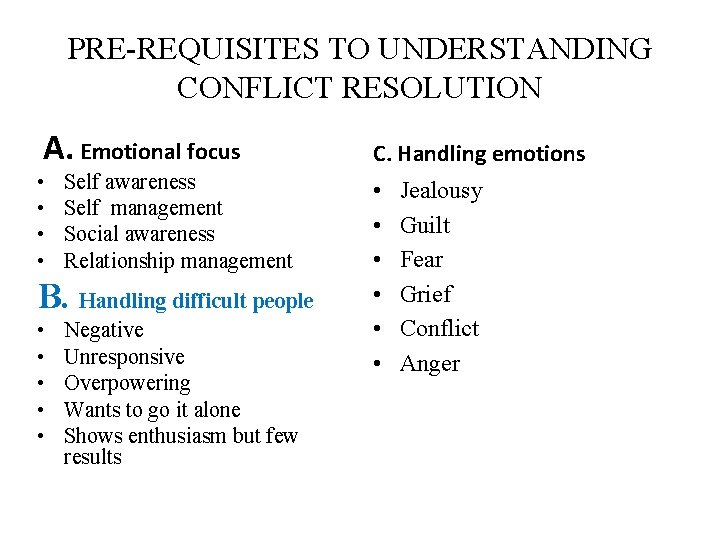
PRE-REQUISITES TO UNDERSTANDING CONFLICT RESOLUTION A. Emotional focus • • Self awareness Self management Social awareness Relationship management B. Handling difficult people • • • Negative Unresponsive Overpowering Wants to go it alone Shows enthusiasm but few results C. Handling emotions • • • Jealousy Guilt Fear Grief Conflict Anger
CONFLICT RESOLUTION Conflict resolution is conceptualized as the methods and processes involved in facilitating the peaceful ending of conflict. Often, committed group members attempt to resolve group conflicts by actively communicating information about their conflicting motives or ideologies to the rest of the group (e. g. , intentions; reasons for holding certain beliefs), and by engaging in collective negotiation. Ultimately, a wide range of methods and procedures for addressing conflict exist, including but not limited to, negotiation, mediation, diplomacy, and creative peace building.
NEGOTIATION. Negotiation is a dialogue between two or more people or parties, intended to reach an understanding, resolve point of difference, or gain advantage in outcome of dialogue, to produce an agreement upon courses of action, to bargain for individual or collective advantage, to craft outcomes to satisfy various interests of two people/parties involved in negotiation process. Negotiation is a process where each party involved in negotiating tries to gain an advantage for themselves by the end of the process. Negotiation is intended to aim at compromise. Negotiation occurs in business, non-profit organizations, government branches, legal proceedings, among nations and in personal situations such as marriage, divorce, parenting, and everyday life. The study of the subject is called negotiation theory. Professional negotiators are often specialized, such as union negotiators, leverage buyout negotiators, peace negotiators, hostage negotiators, or may work under other titles, such as diplomats, legislators or brokers.
MEDIATION Mediation, as used in law, is a form of alternative dispute resolution (ADR), a way of resolving disputes between two or more parties with concrete effects. Typically, a third party, the mediator, assists the parties to negotiate a settlement. Disputants may mediate disputes in a variety of domains, such as commercial, legal, diplomatic, workplace, community and family matters. The term "mediation" broadly refers to any instance in which a third party helps others reach agreement. More specifically, mediation has a structure, timetable and dynamics that "ordinary" negotiation lacks. The process is private and confidential, possibly enforced by law. Participation is typically voluntary. The mediator acts as a neutral third party and facilitates rather than directs the process. Mediators use various techniques to open, or improve, dialogue between disputants, aiming to help the parties reach an agreement. Much depends on the mediator's skill and training. As the practice gained popularity, training programs, certifications and licensing followed, producing trained, professional mediators committed to the discipline.
DIPLOMACY Diplomacy is the art and practice of conducting negotiations between representatives of groups or states. It usually refers to international diplomacy, the conduct of international relations[2] through the intercession of professional diplomats with regard to issues of peace-making, trade, war, economics, culture, environment, and human rights. International treaties are usually negotiated by diplomats prior to endorsement by national politicians. In an informal or social sense, diplomacy is the employment of tact to gain strategic advantage or to find mutually acceptable solutions to a common challenge, one set of tools being the phrasing of statements in a non-confrontational, or polite manner.
PEACE BUILDING • • Peacebuilding is a term describing interventions that are designed to prevent the start or resumption of violent conflict by creating a sustainable peace. Peacebuilding activities address the root causes or potential causes of violence, create a societal expectation for peaceful conflict resolution and stabilize society politically and socioeconomically. Common to all definitions is the agreement that improving human security is the central task of peacebuilding. Peacebuilding includes a wide range of efforts by diverse actors in government and civil society at the community, national and international levels to address the root causes of violence and ensure civilians have freedom from fear, freedom from wantand freedom from humiliation before, during, and after violent conflict. There are two broad approaches to peacebuilding. First, peacebuilding can refer to direct work that intentionally focuses on addressing the factors driving or mitigating conflict. When applying the term "peacebuilding" to this work, there is an explicit attempt by those designing and planning a peacebuilding effort to reduce structural or direct violence. Second, the term peacebuilding can also refer to efforts to coordinate a multi-leveled, multisectoral strategy, including ensuring that there is funding and proper communication and coordination mechanisms between humanitarian assistance, development, governance, security, justice and other sectors that may not use the term "peacebuilding" to describe themselves. Peacemaking involves stopping an ongoing conflict, whereas peacebuilding happens before a conflict starts or once it ends. Peacekeeping prevents the resumption of fighting following a conflict; it does not address the underlying causes of violence or work to create societal change, as peacebuiding does. It also differs from peacebuilding in that it only occurs after conflict ends, not before it begins.
CONFLICT MANAGEMENT Conflict management refers to the long-term management of intractable conflicts. It is the label for the variety of ways by which people handle grievances —standing up for what they consider to be right and against what they consider to be wrong. Those ways include such diverse phenomena as gossip, ridicule, lynching, terrorism, warfare, feuding, genocide, law, mediation, and avoidance. Which forms of conflict management will be used in any given situation can be somewhat predicted and explained by the social structure—or social geometry—of the case.
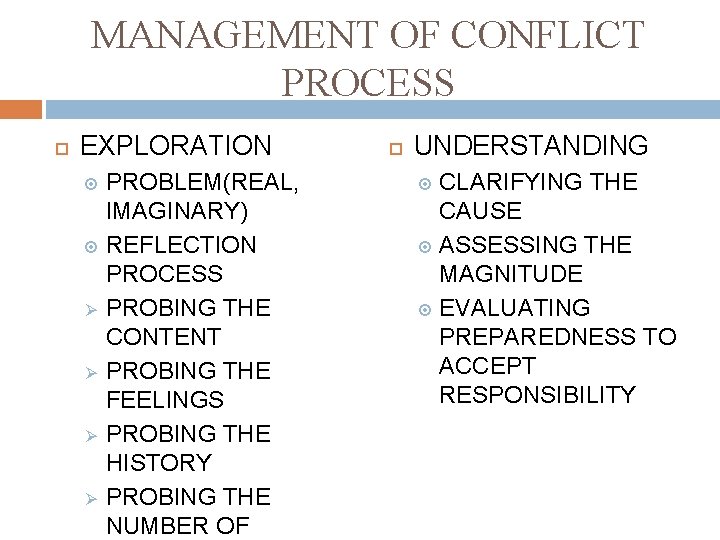
MANAGEMENT OF CONFLICT PROCESS EXPLORATION PROBLEM(REAL, IMAGINARY) REFLECTION PROCESS Ø PROBING THE CONTENT Ø PROBING THE FEELINGS Ø PROBING THE HISTORY Ø PROBING THE NUMBER OF UNDERSTANDING CLARIFYING THE CAUSE ASSESSING THE MAGNITUDE EVALUATING PREPAREDNESS TO ACCEPT RESPONSIBILITY
RESPONDING AN OPEN MIND TRUST A FORGIVING HEART WILLINGNESS TO NEGOTIATE FOCUSSING ON ISSUE RATHER THAN PERSONALITY A WIN –WIN MIND SET
STRESS MANAGEMENT MEANING OF STRESS A state of severe psychological or physiological tension A preparation for fight or flight A body’s chemical, physical or emotional response when demands exceed capacity The onset of a number of diseases
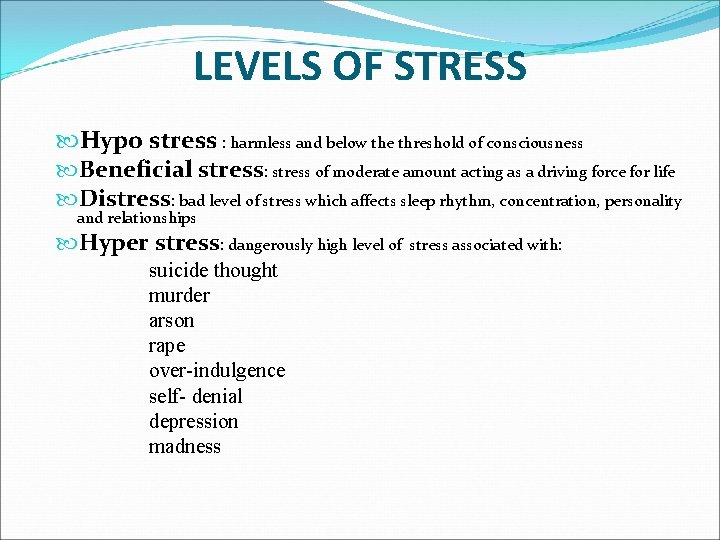
LEVELS OF STRESS Hypo stress : harmless and below the threshold of consciousness Beneficial stress: stress of moderate amount acting as a driving force for life Distress: bad level of stress which affects sleep rhythm, concentration, personality and relationships Hyper stress: dangerously high level of suicide thought murder arson rape over-indulgence self- denial depression madness stress associated with:
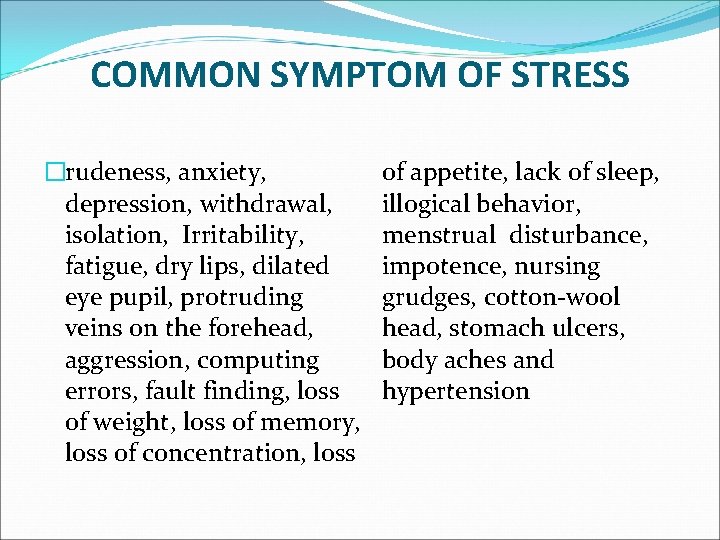
COMMON SYMPTOM OF STRESS �rudeness, anxiety, depression, withdrawal, isolation, Irritability, fatigue, dry lips, dilated eye pupil, protruding veins on the forehead, aggression, computing errors, fault finding, loss of weight, loss of memory, loss of concentration, loss of appetite, lack of sleep, illogical behavior, menstrual disturbance, impotence, nursing grudges, cotton-wool head, stomach ulcers, body aches and hypertension
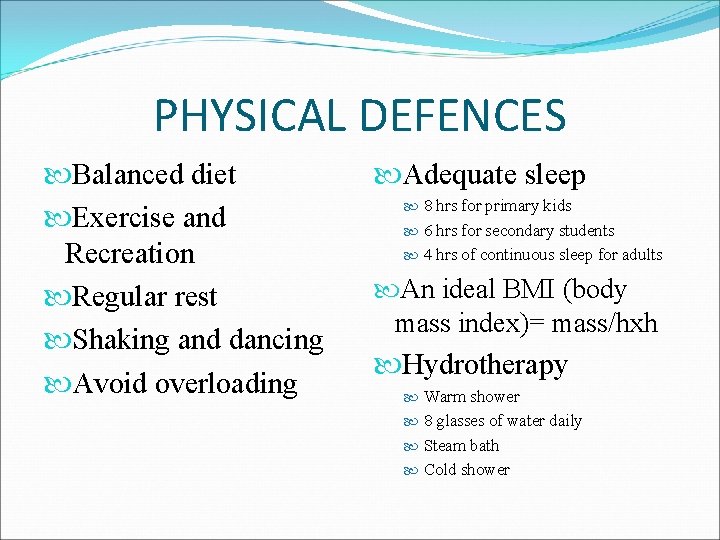
PHYSICAL DEFENCES Balanced diet Exercise and Recreation Regular rest Shaking and dancing Avoid overloading Adequate sleep 8 hrs for primary kids 6 hrs for secondary students 4 hrs of continuous sleep for adults An ideal BMI (body mass index)= mass/hxh Hydrotherapy Warm shower 8 glasses of water daily Steam bath Cold shower
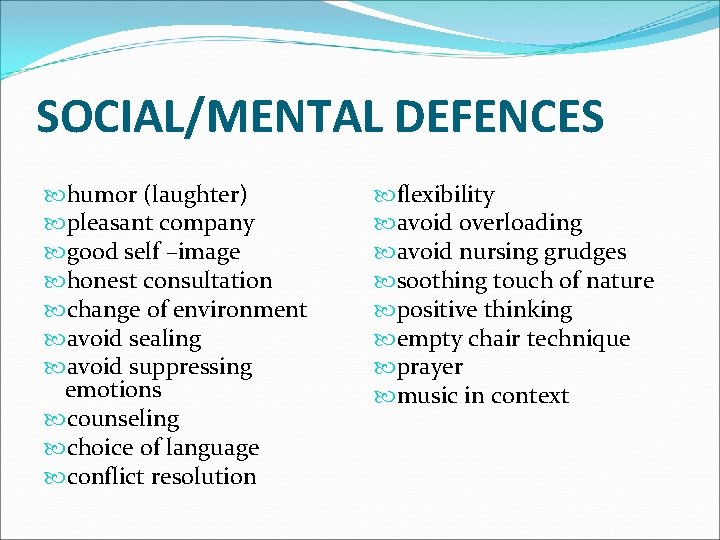
SOCIAL/MENTAL DEFENCES humor (laughter) pleasant company good self –image honest consultation change of environment avoid sealing avoid suppressing emotions counseling choice of language conflict resolution flexibility avoid overloading avoid nursing grudges soothing touch of nature positive thinking empty chair technique prayer music in context
MEDICAL DEFENCES �Clinical counseling �Therapeutic training �Prescription of specific drugs �Psychiatric management and advice
THE END THANK YOU ALL
- Slides: 19