
Conflict Resolution and Negotiation in Engineering Project Teams
- Slides: 29
Conflict Resolution and Negotiation in Engineering Project Teams 1
“Conflict is a form of interaction among parties that differ in interest, perceptions, and preferences. ” Kolb, David A. , Osland, Joyce S. , and Rubin, Irwin M. , Organizational Behavior, Prentice Hall, Englewood Cliffs, NJ, 6 th Edition. 2
Audience Participation (Already!) Why are we addressing conflict management? What examples of conflict in teams do you remember? 3
Why Conflict Management? Teams in engineering involve both interpersonal and technical competencies People’s skills in both technical tasks and interpersonal relationship management differ These differences can result in conflict that impacts the successful completion of the project Many a project has been endangered because of feuding team members! 4
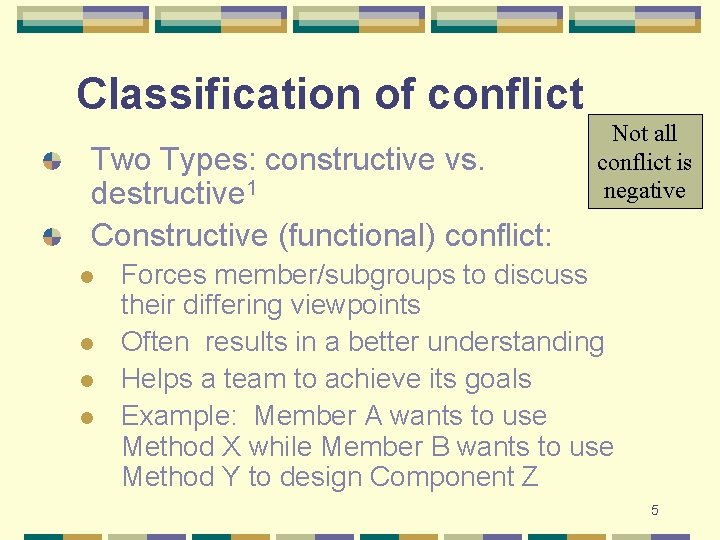
Classification of conflict Two Types: constructive vs. destructive 1 Constructive (functional) conflict: l l Not all conflict is negative Forces member/subgroups to discuss their differing viewpoints Often results in a better understanding Helps a team to achieve its goals Example: Member A wants to use Method X while Member B wants to use Method Y to design Component Z 5
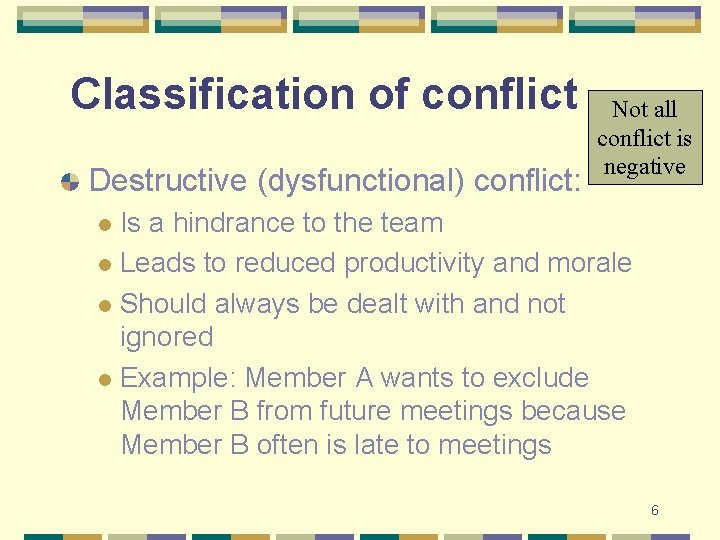
Classification of conflict Destructive (dysfunctional) conflict: Not all conflict is negative Is a hindrance to the team l Leads to reduced productivity and morale l Should always be dealt with and not ignored l Example: Member A wants to exclude Member B from future meetings because Member B often is late to meetings l 6
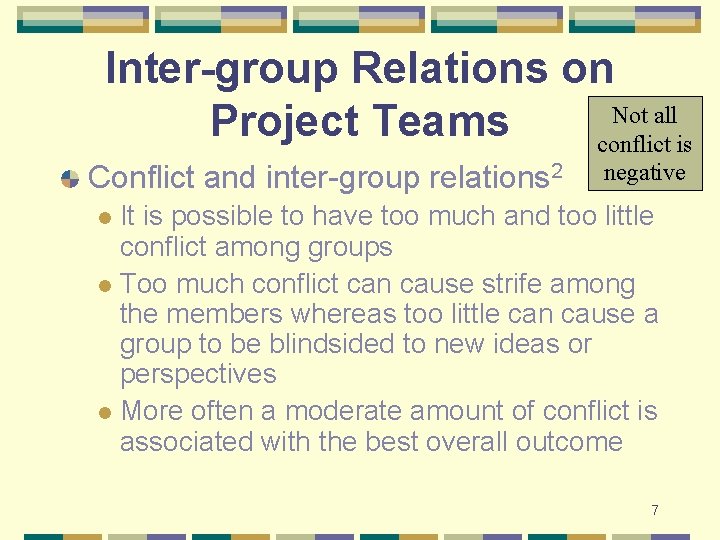
Inter-group Relations on Not all Project Teams conflict is Conflict and inter-group relations 2 negative It is possible to have too much and too little conflict among groups l Too much conflict can cause strife among the members whereas too little can cause a group to be blindsided to new ideas or perspectives l More often a moderate amount of conflict is associated with the best overall outcome l 7
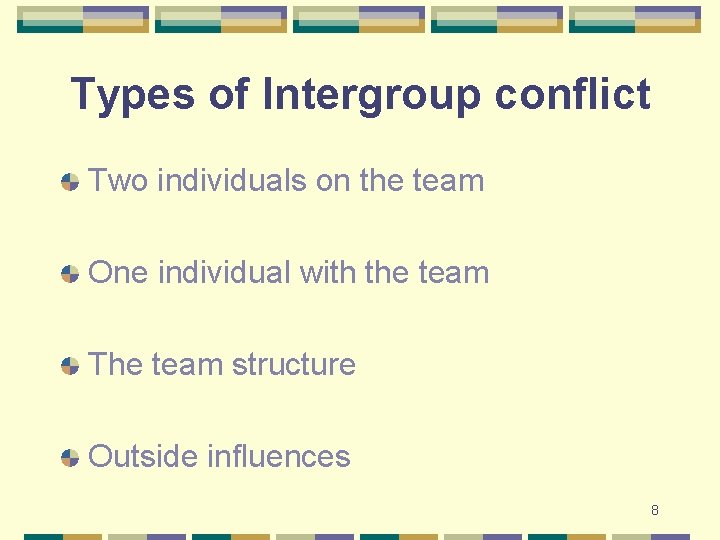
Types of Intergroup conflict Two individuals on the team One individual with the team The team structure Outside influences 8
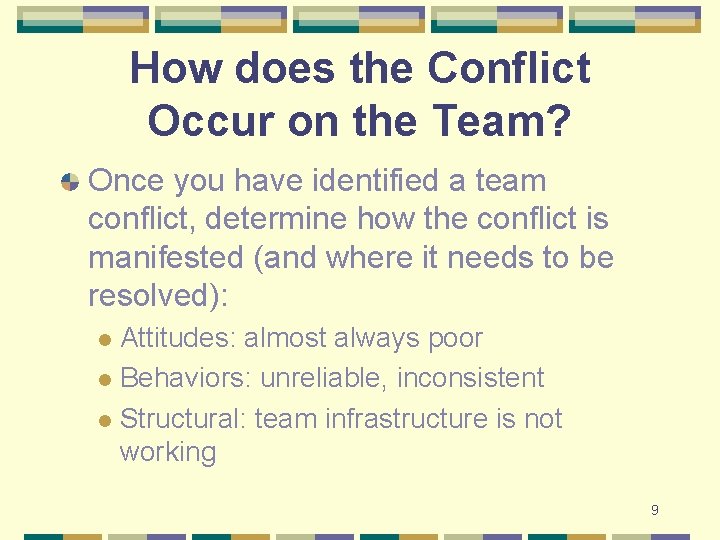
How does the Conflict Occur on the Team? Once you have identified a team conflict, determine how the conflict is manifested (and where it needs to be resolved): Attitudes: almost always poor l Behaviors: unreliable, inconsistent l Structural: team infrastructure is not working l 9
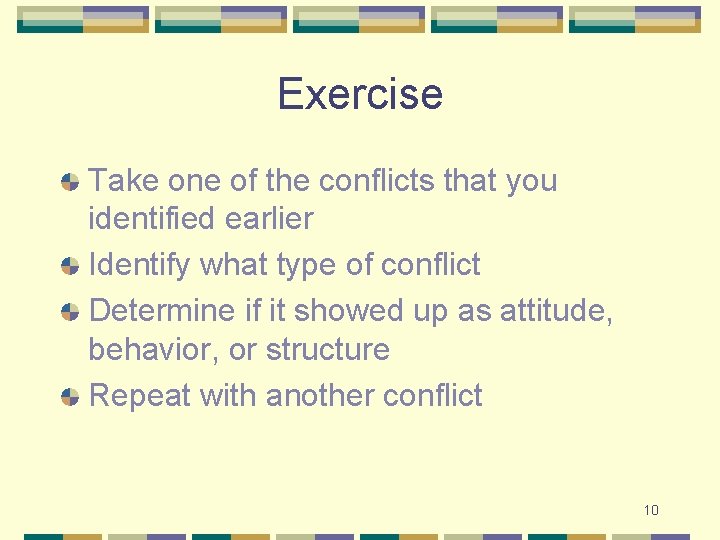
Exercise Take one of the conflicts that you identified earlier Identify what type of conflict Determine if it showed up as attitude, behavior, or structure Repeat with another conflict 10
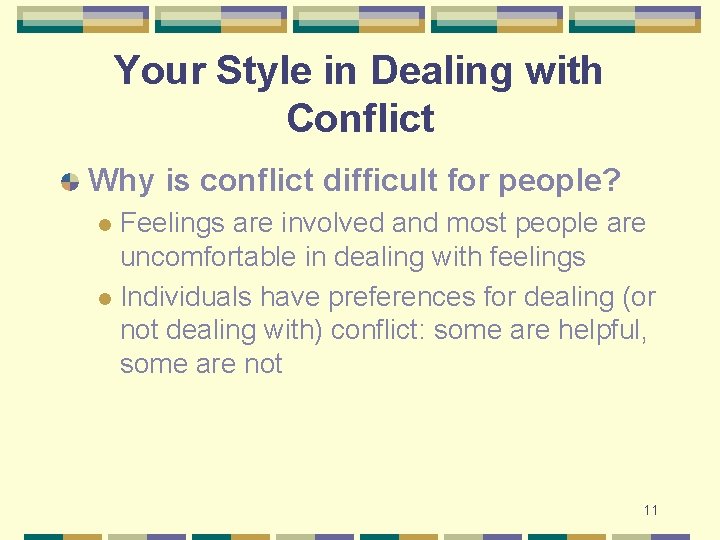
Your Style in Dealing with Conflict Why is conflict difficult for people? Feelings are involved and most people are uncomfortable in dealing with feelings l Individuals have preferences for dealing (or not dealing with) conflict: some are helpful, some are not l 11
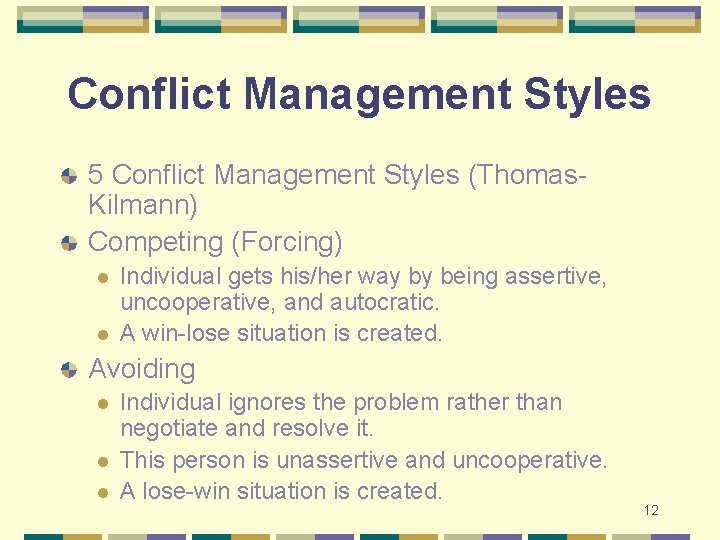
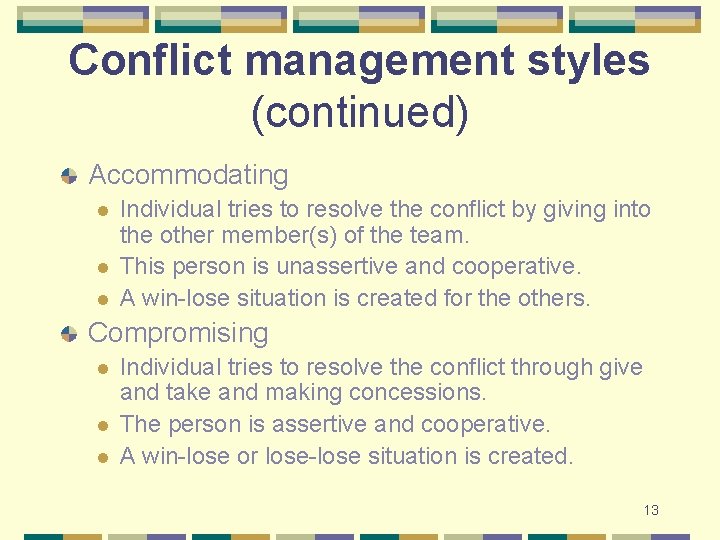
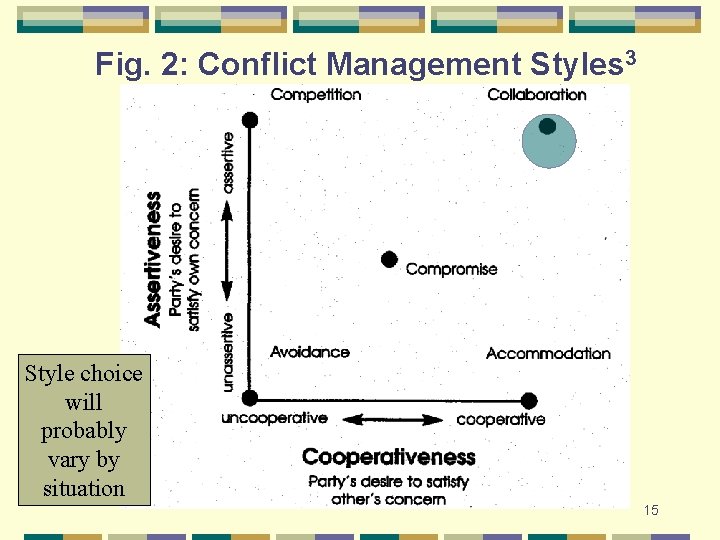
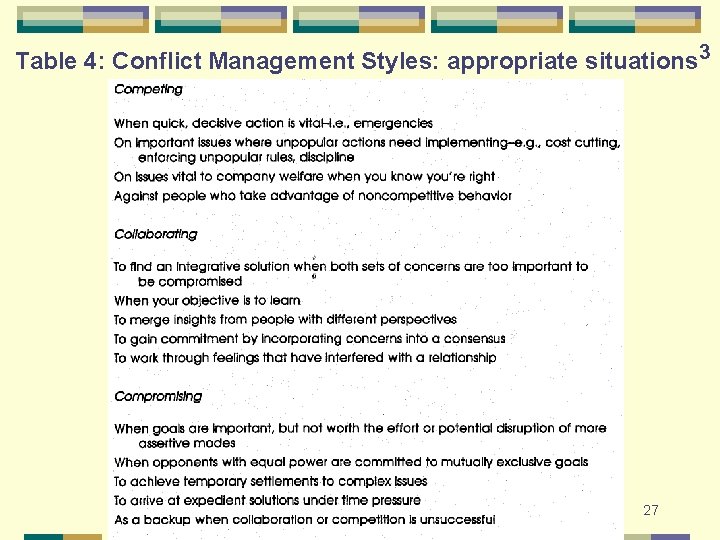
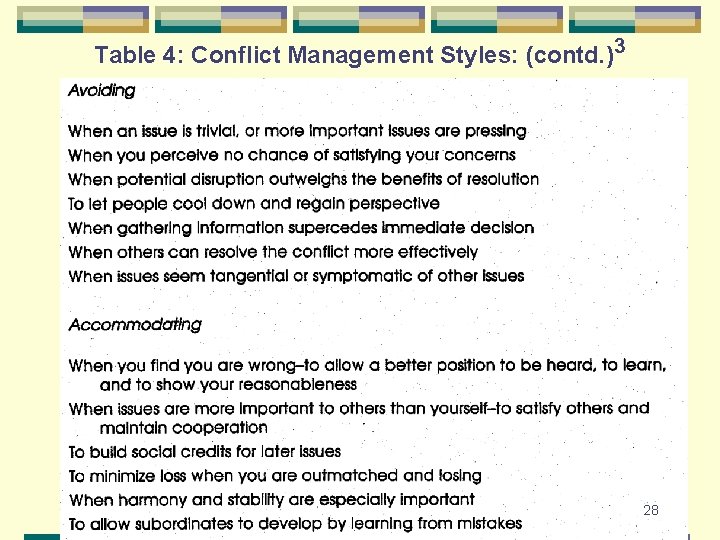
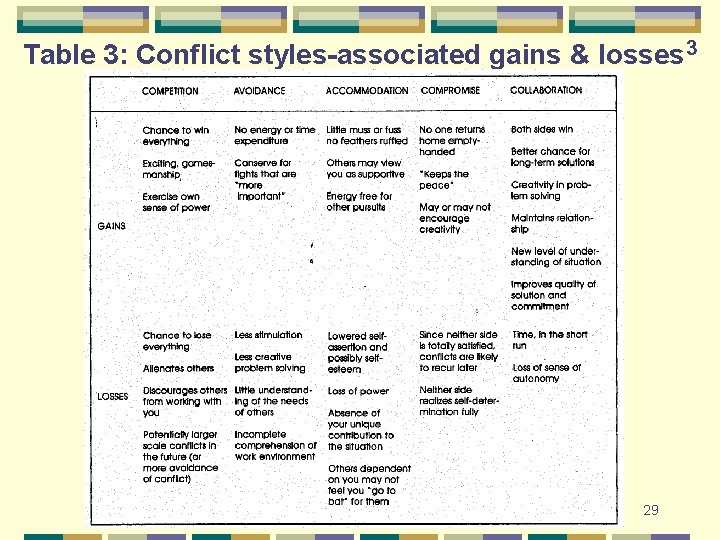
Conflict Management Styles 5 Conflict Management Styles (Thomas. Kilmann) Competing (Forcing) l l Individual gets his/her way by being assertive, uncooperative, and autocratic. A win-lose situation is created. Avoiding l l l Individual ignores the problem rather than negotiate and resolve it. This person is unassertive and uncooperative. A lose-win situation is created. 12
Conflict management styles (continued) Accommodating l l l Individual tries to resolve the conflict by giving into the other member(s) of the team. This person is unassertive and cooperative. A win-lose situation is created for the others. Compromising l l l Individual tries to resolve the conflict through give and take and making concessions. The person is assertive and cooperative. A win-lose or lose-lose situation is created. 13
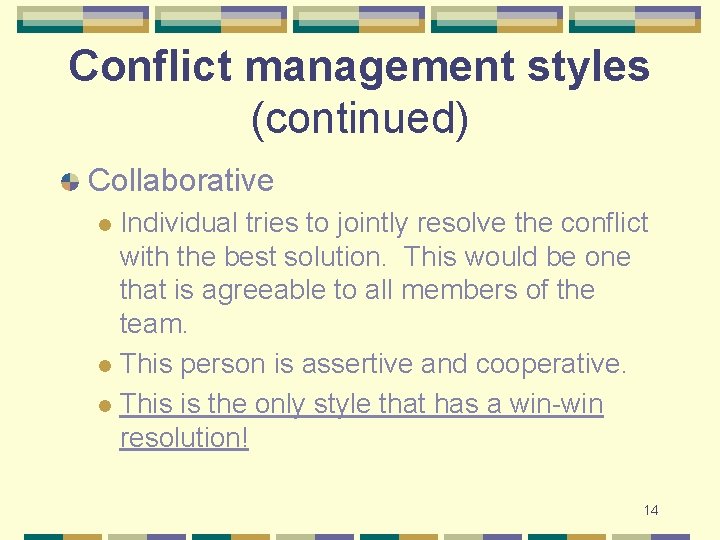
Conflict management styles (continued) Collaborative Individual tries to jointly resolve the conflict with the best solution. This would be one that is agreeable to all members of the team. l This person is assertive and cooperative. l This is the only style that has a win-win resolution! l 14
Fig. 2: Conflict Management Styles 3 Style choice will probably vary by situation 15
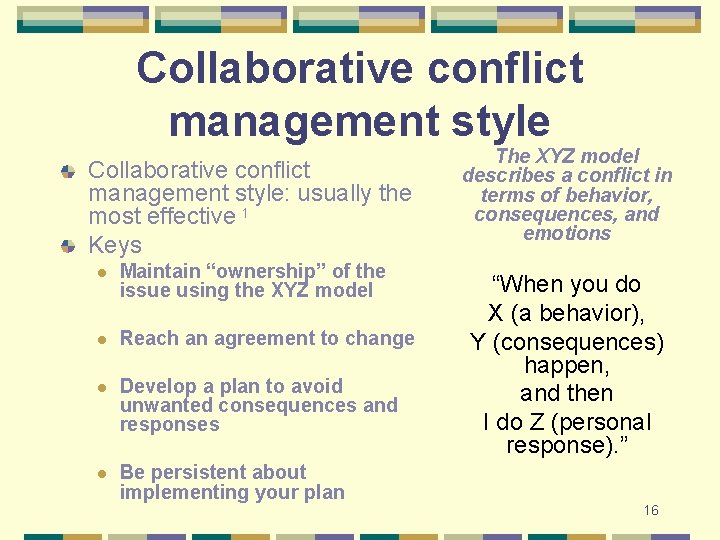
Collaborative conflict management style: usually the most effective 1 Keys l Maintain “ownership” of the issue using the XYZ model l Reach an agreement to change l Develop a plan to avoid unwanted consequences and responses l Be persistent about implementing your plan The XYZ model describes a conflict in terms of behavior, consequences, and emotions “When you do X (a behavior), Y (consequences) happen, and then I do Z (personal response). ” 16
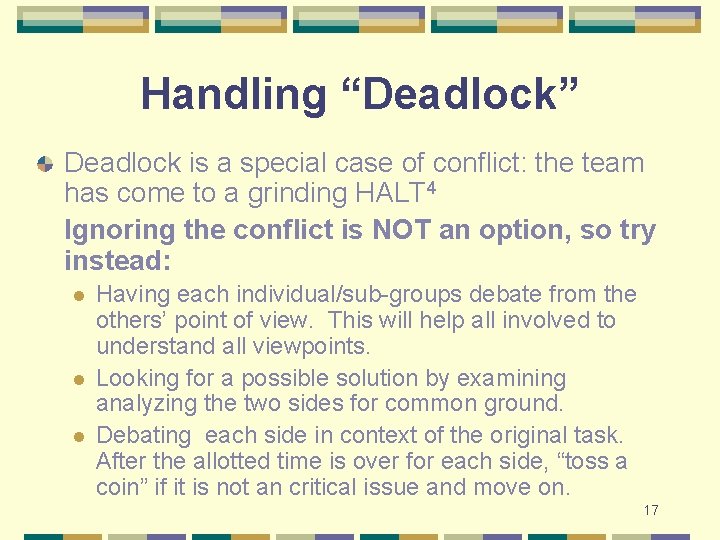
Handling “Deadlock” Deadlock is a special case of conflict: the team has come to a grinding HALT 4 Ignoring the conflict is NOT an option, so try instead: l l l Having each individual/sub-groups debate from the others’ point of view. This will help all involved to understand all viewpoints. Looking for a possible solution by examining analyzing the two sides for common ground. Debating each side in context of the original task. After the allotted time is over for each side, “toss a coin” if it is not an critical issue and move on. 17
Role Play Conflict Resolution Take one of the conflicts that has been mentioned (especially one that is difficult for you) Using the structure that has been presented as the starting point, use the collaborative approach as a way to resolve the conflict. Provide feedback (what worked, what did not, what influenced the process? ) 18
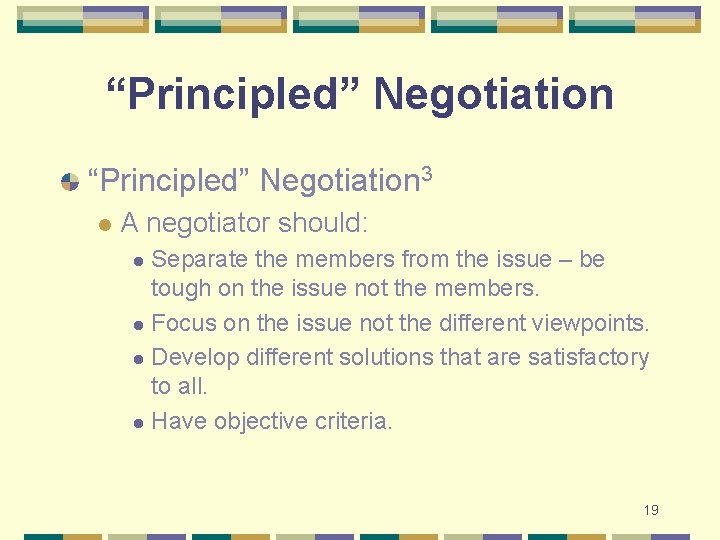
“Principled” Negotiation 3 l A negotiator should: Separate the members from the issue – be tough on the issue not the members. l Focus on the issue not the different viewpoints. l Develop different solutions that are satisfactory to all. l Have objective criteria. l 19
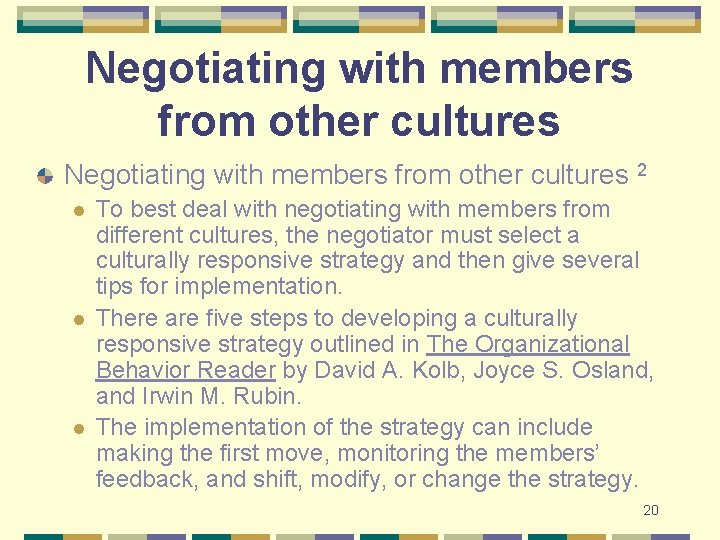
Negotiating with members from other cultures 2 l l l To best deal with negotiating with members from different cultures, the negotiator must select a culturally responsive strategy and then give several tips for implementation. There are five steps to developing a culturally responsive strategy outlined in The Organizational Behavior Reader by David A. Kolb, Joyce S. Osland, and Irwin M. Rubin. The implementation of the strategy can include making the first move, monitoring the members’ feedback, and shift, modify, or change the strategy. 20
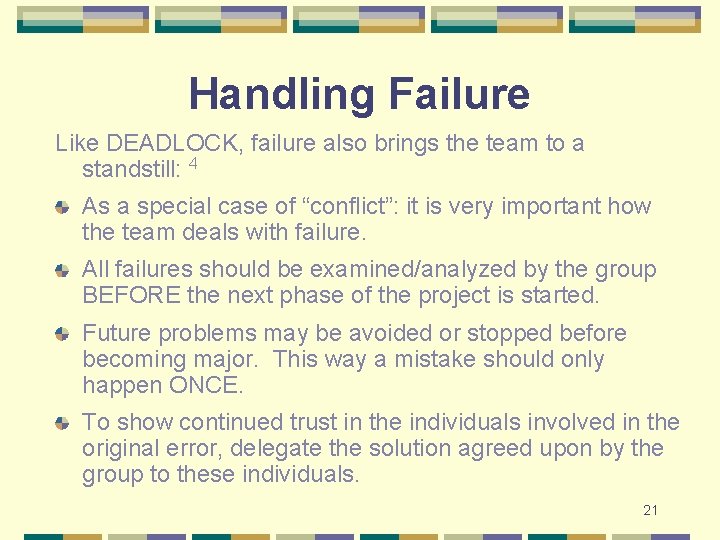
Handling Failure Like DEADLOCK, failure also brings the team to a standstill: 4 As a special case of “conflict”: it is very important how the team deals with failure. All failures should be examined/analyzed by the group BEFORE the next phase of the project is started. Future problems may be avoided or stopped before becoming major. This way a mistake should only happen ONCE. To show continued trust in the individuals involved in the original error, delegate the solution agreed upon by the group to these individuals. 21
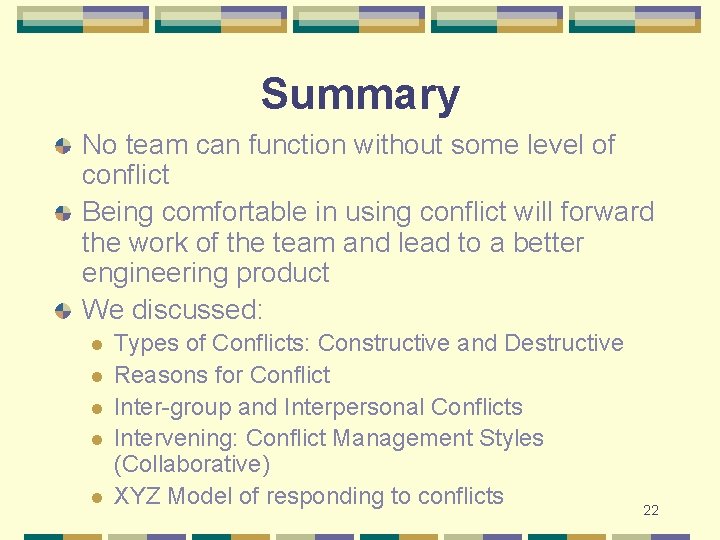
Summary No team can function without some level of conflict Being comfortable in using conflict will forward the work of the team and lead to a better engineering product We discussed: l l l Types of Conflicts: Constructive and Destructive Reasons for Conflict Inter-group and Interpersonal Conflicts Intervening: Conflict Management Styles (Collaborative) XYZ Model of responding to conflicts 22
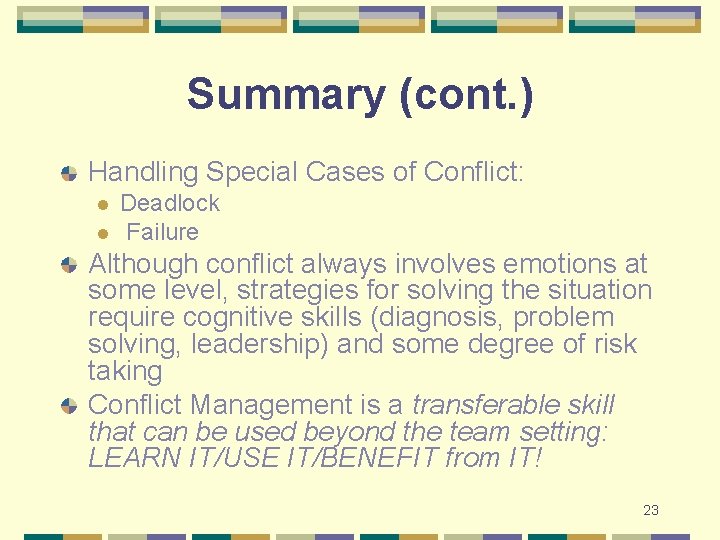
Summary (cont. ) Handling Special Cases of Conflict: l l Deadlock Failure Although conflict always involves emotions at some level, strategies for solving the situation require cognitive skills (diagnosis, problem solving, leadership) and some degree of risk taking Conflict Management is a transferable skill that can be used beyond the team setting: LEARN IT/USE IT/BENEFIT from IT! 23
Conflict Resolution and Negotiation: References 1 http: //www. cooper. edu/classes/eng/esc 000/Conflict/not es. html 2 Kolb, David A. , Osland, Joyce S. , and Rubin, Irwin M. , The Organizational Behavior Reader, Prentice Hall, Englewood Cliffs, NJ, 6 th Edition. 3 Kolb, David A. , Osland, Joyce S. , and Rubin, Irwin M. , Organizational Behavior, Prentice Hall, Englewood Cliffs, NJ, 6 th Edition. 4 http: //www. ee. ed. ac. uk/~gerald/Management/ 24
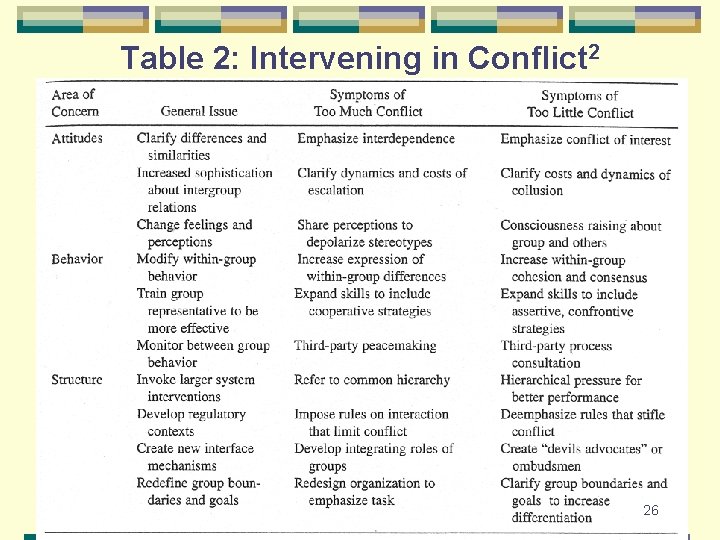
Intervention among groups 2 l l l To promote constructive conflict, intervention may be needed to reduce conflict in groups with too much conflict or induce conflict in groups with too little. Intervention among groups involves efforts to disrupt the cyclic behavior caused by the interaction of attitudes, behavior, and structure These strategies for intervening among groups are given in Table 2. 25
Table 2: Intervening in Conflict 2 26
Table 4: Conflict Management Styles: appropriate situations 3 27
Table 4: Conflict Management Styles: (contd. )3 28
Table 3: Conflict styles-associated gains & losses 3 29