
Conflict Management KSF Communication Level 3 or 4

![Thomas Kilmann Conflict Mode Instrument [TKI] Increasingly assertive Competing (win – lose) Collaboration (win](https://slidetodoc.com/presentation_image/2aa7c9e3875284fe4f35ed9f6f2c1a61/image-22.jpg "Thomas Kilmann Conflict Mode Instrument [TKI] Increasingly assertive Competing (win – lose) Collaboration (win")
![Teddy Bear “Smoothing” 1= [1] 5 Owl “Confronting” Fox “Compromising” Turtle “Withdrawing” [4] Shark](https://slidetodoc.com/presentation_image/2aa7c9e3875284fe4f35ed9f6f2c1a61/image-28.jpg "Teddy Bear “Smoothing” 1= [1] 5 Owl “Confronting” Fox “Compromising” Turtle “Withdrawing” [4] Shark")
![Thomas Kilmann Conflict Mode Instrument [TKI] Increasingly assertive Competing (win – lose) Collaboration (win](https://slidetodoc.com/presentation_image/2aa7c9e3875284fe4f35ed9f6f2c1a61/image-29.jpg "Thomas Kilmann Conflict Mode Instrument [TKI] Increasingly assertive Competing (win – lose) Collaboration (win")


- Slides: 50
Conflict Management KSF Communication - Level 3 or 4 accomplice. uk. com br 1. 4. 1 -conflict management 1
Welcome br 1. 4. 1 -conflict management 2
Aim To increase our ability to recognise and positively deal with conflict situations br 1. 4. 1 -conflict management 3
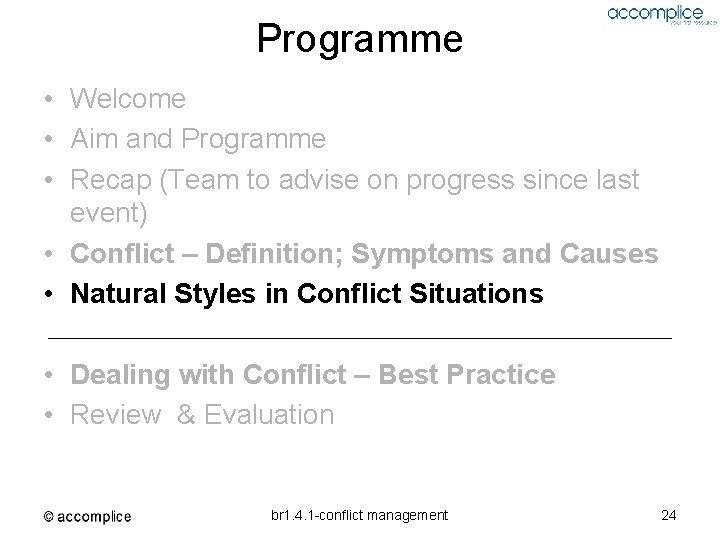
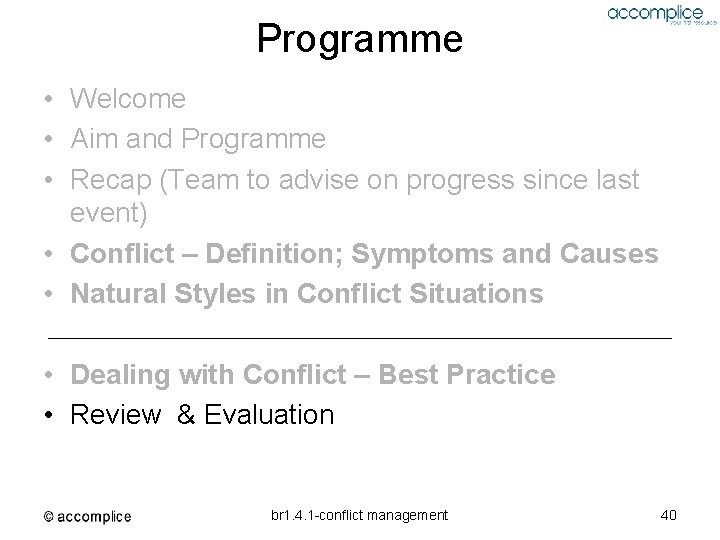
Programme • Welcome • Aim and Programme • Recap (Team to advise on progress since last event) • Conflict – Definition; Symptoms and Causes • Natural Styles in Conflict Situations • Dealing with Conflict – Best Practice • Review & Evaluation br 1. 4. 1 -conflict management 4
Your Personal Objective br 1. 4. 1 -conflict management 5
Recap Feedback on Team Actions Since the Team Time Out br 1. 4. 1 -conflict management 6
What is conflict? br 1. 4. 1 -conflict management 7
Programme • Welcome • Aim and Programme • Recap (Team to advise on progress since last event) • Conflict – Definition; Symptoms and Causes • Natural Styles in Conflict Situations • Dealing with Conflict – Best Practice • Review & Evaluation br 1. 4. 1 -conflict management 8
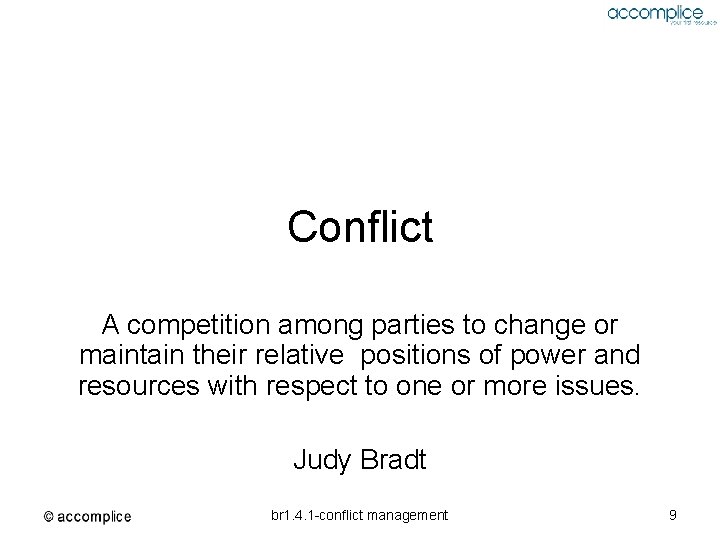
Conflict A competition among parties to change or maintain their relative positions of power and resources with respect to one or more issues. Judy Bradt br 1. 4. 1 -conflict management 9
Being able to work with others is one of the most sought after skills Being able to relate to colleagues is essential for everyone KSF Communication - Level 3 or 4 br 1. 4. 1 -conflict management 10
Symptoms of Conflict How would you recognise conflict? br 1. 4. 1 -conflict management 11
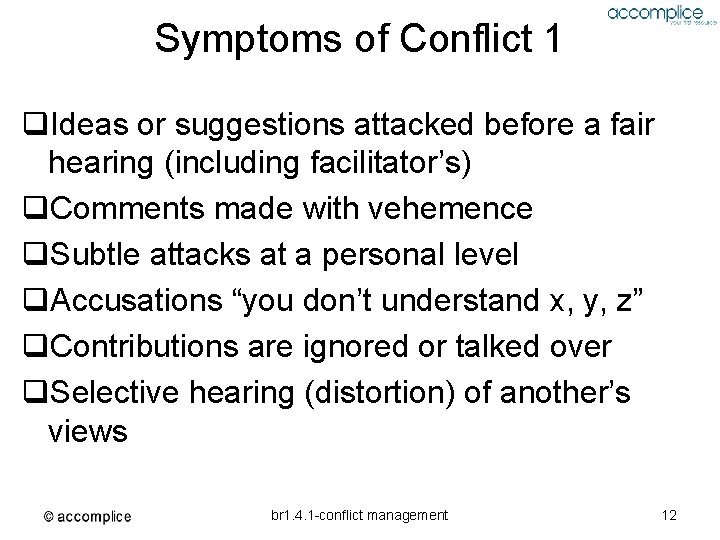
Symptoms of Conflict 1 q. Ideas or suggestions attacked before a fair hearing (including facilitator’s) q. Comments made with vehemence q. Subtle attacks at a personal level q. Accusations “you don’t understand x, y, z” q. Contributions are ignored or talked over q. Selective hearing (distortion) of another’s views br 1. 4. 1 -conflict management 12
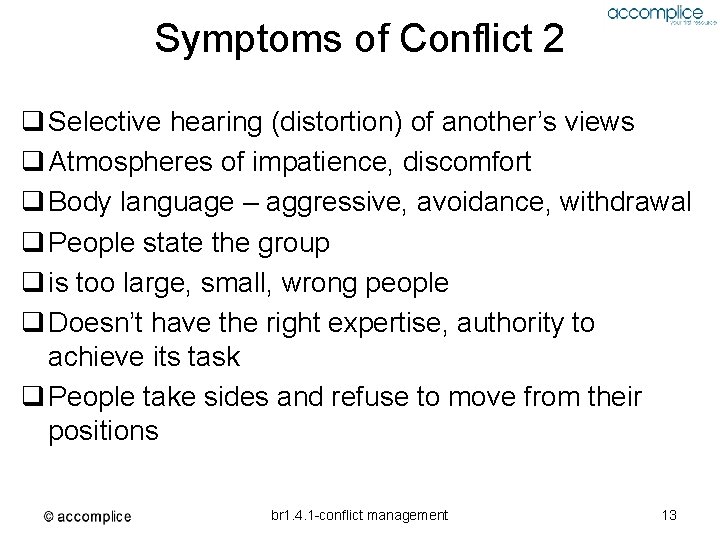
Symptoms of Conflict 2 q Selective hearing (distortion) of another’s views q Atmospheres of impatience, discomfort q Body language – aggressive, avoidance, withdrawal q People state the group q is too large, small, wrong people q Doesn’t have the right expertise, authority to achieve its task q People take sides and refuse to move from their positions br 1. 4. 1 -conflict management 13
Causes of Conflict br 1. 4. 1 -conflict management 14
Case Study Reflect on scenario (s) in which there has been or is conflict Who is in conflict – and why? What is causing the conflict? br 1. 4. 1 -conflict management 15
Sources of Conflict In the conflict scenario you describe, what caused the conflict to happen? What other things cause conflict? br 1. 4. 1 -conflict management 16
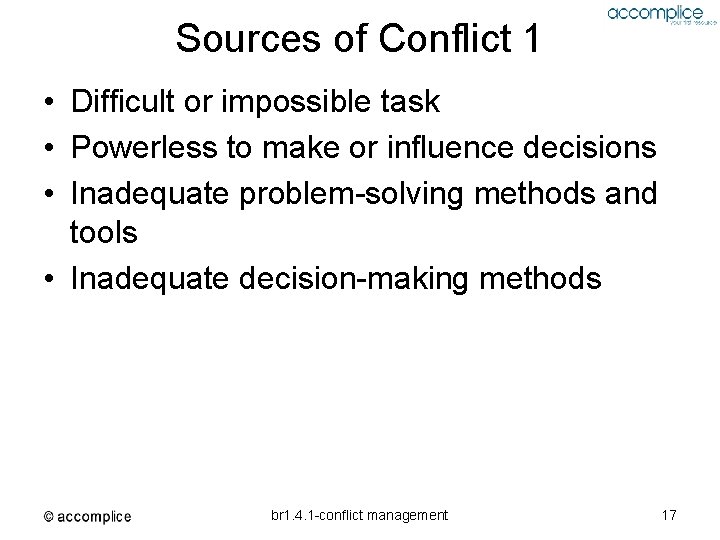
Sources of Conflict 1 • Difficult or impossible task • Powerless to make or influence decisions • Inadequate problem-solving methods and tools • Inadequate decision-making methods br 1. 4. 1 -conflict management 17
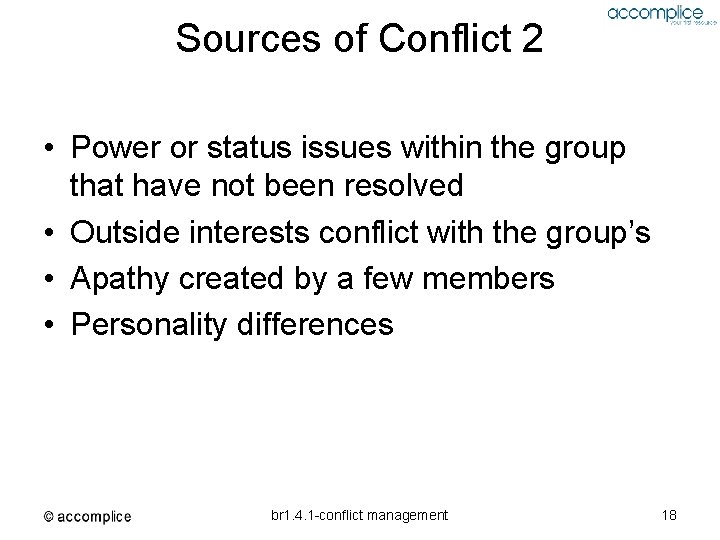
Sources of Conflict 2 • Power or status issues within the group that have not been resolved • Outside interests conflict with the group’s • Apathy created by a few members • Personality differences br 1. 4. 1 -conflict management 18
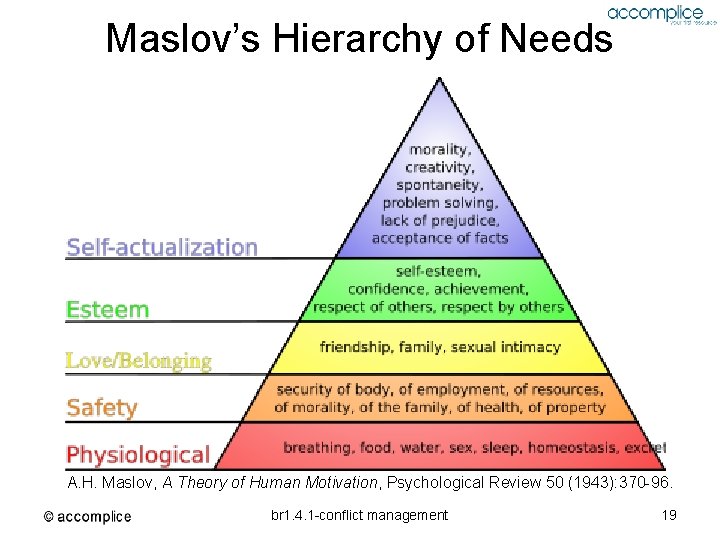
Maslov’s Hierarchy of Needs A. H. Maslov, A Theory of Human Motivation, Psychological Review 50 (1943): 370 -96. br 1. 4. 1 -conflict management 19
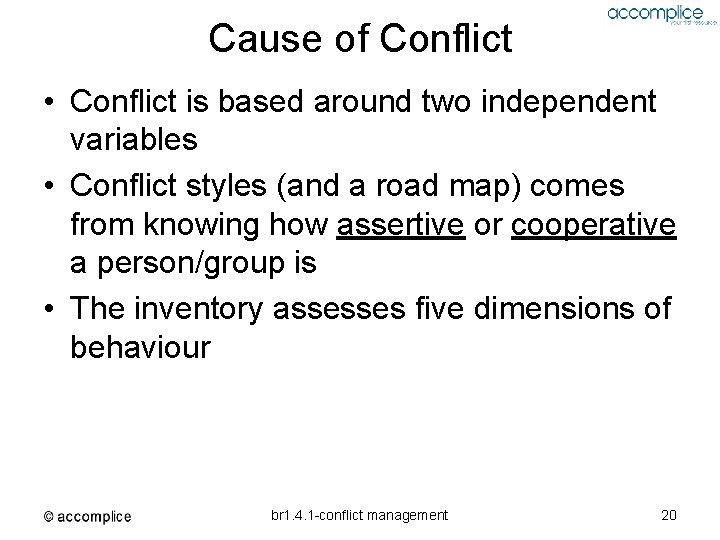
Cause of Conflict • Conflict is based around two independent variables • Conflict styles (and a road map) comes from knowing how assertive or cooperative a person/group is • The inventory assesses five dimensions of behaviour br 1. 4. 1 -conflict management 20
"Don't just focus on what you want to say. “Most misunderstandings arise because of how you say it. " br 1. 4. 1 -conflict management 21
Thomas Kilmann Conflict Mode Instrument [TKI] Increasingly assertive Competing (win – lose) Collaboration (win – win) Compromising (partial winpartial lose) Avoiding (lose – lose) Accommodating (lose - win) Increasingly cooperative br 1. 4. 1 -conflict management 22
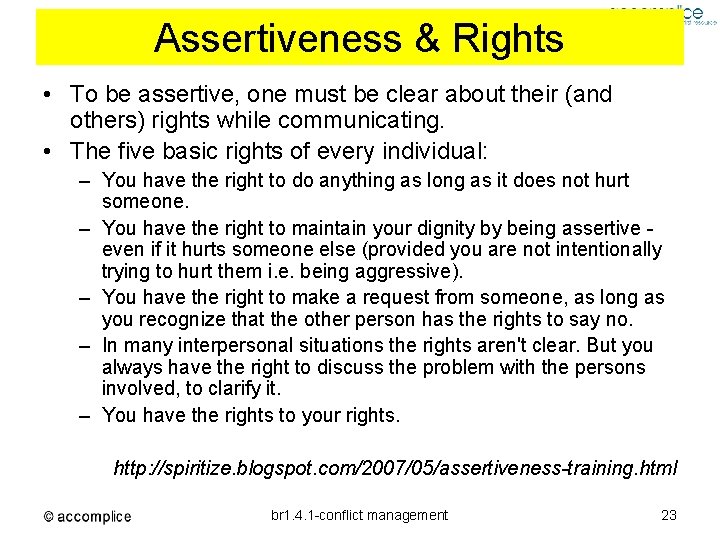
Assertiveness & Rights • To be assertive, one must be clear about their (and others) rights while communicating. • The five basic rights of every individual: – You have the right to do anything as long as it does not hurt someone. – You have the right to maintain your dignity by being assertive even if it hurts someone else (provided you are not intentionally trying to hurt them i. e. being aggressive). – You have the right to make a request from someone, as long as you recognize that the other person has the rights to say no. – In many interpersonal situations the rights aren't clear. But you always have the right to discuss the problem with the persons involved, to clarify it. – You have the rights to your rights. http: //spiritize. blogspot. com/2007/05/assertiveness-training. html br 1. 4. 1 -conflict management 23
Programme • Welcome • Aim and Programme • Recap (Team to advise on progress since last event) • Conflict – Definition; Symptoms and Causes • Natural Styles in Conflict Situations • Dealing with Conflict – Best Practice • Review & Evaluation br 1. 4. 1 -conflict management 24
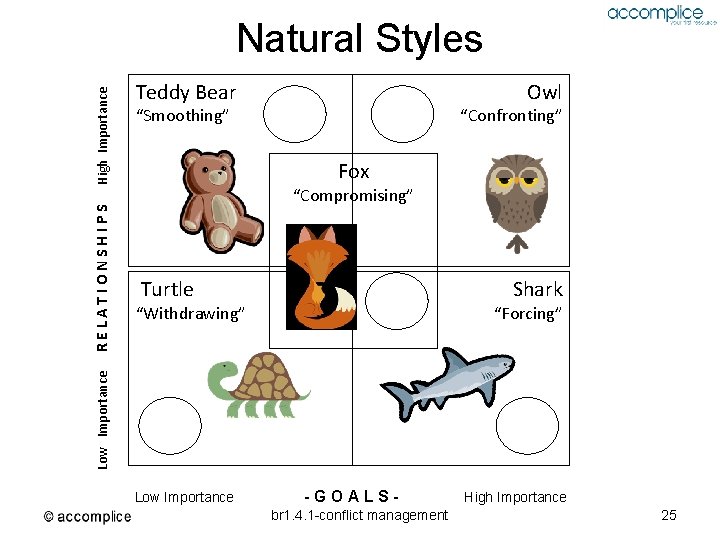
Teddy Bear Owl “Smoothing” “Confronting” Fox “Compromising” Turtle Shark “Withdrawing” “Forcing” Low Importance RELATIONSHIPS High Importance Natural Styles Low Importance -GOALSbr 1. 4. 1 -conflict management High Importance 25
br 1. 4. 1 -conflict management 26
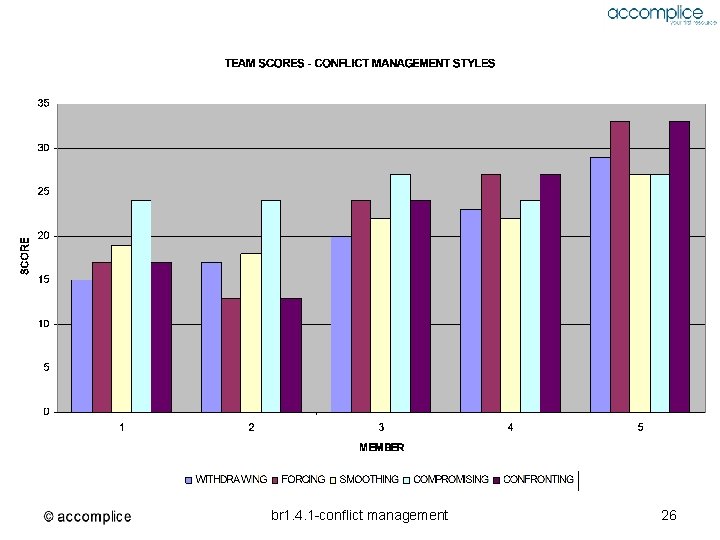
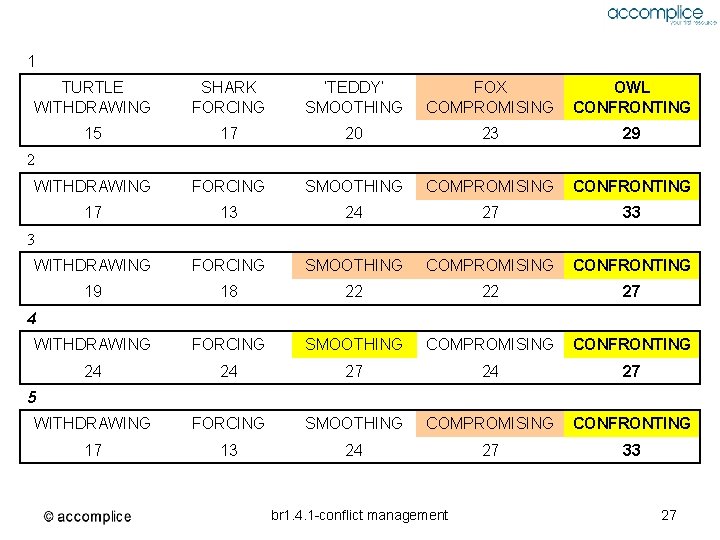
1 TURTLE WITHDRAWING SHARK FORCING ‘TEDDY’ SMOOTHING FOX COMPROMISING OWL CONFRONTING 15 17 20 23 29 WITHDRAWING FORCING SMOOTHING COMPROMISING CONFRONTING 17 13 24 27 33 WITHDRAWING FORCING SMOOTHING COMPROMISING CONFRONTING 19 18 22 22 27 WITHDRAWING FORCING SMOOTHING COMPROMISING CONFRONTING 24 24 27 WITHDRAWING FORCING SMOOTHING COMPROMISING CONFRONTING 17 13 24 27 33 2 3 4 5 br 1. 4. 1 -conflict management 27
Teddy Bear “Smoothing” 1= [1] 5 Owl “Confronting” Fox “Compromising” Turtle “Withdrawing” [4] Shark “Forcing” Low Importance RELATIONSHIPS High Importance Natural Styles Low Importance -GOALSbr 1. 4. 1 -conflict management High Importance 28
Thomas Kilmann Conflict Mode Instrument [TKI] Increasingly assertive Competing (win – lose) Collaboration (win – win) Compromising (partial winpartial lose) Avoiding (lose – lose) Accommodating (lose - win) Increasingly cooperative br 1. 4. 1 -conflict management 29
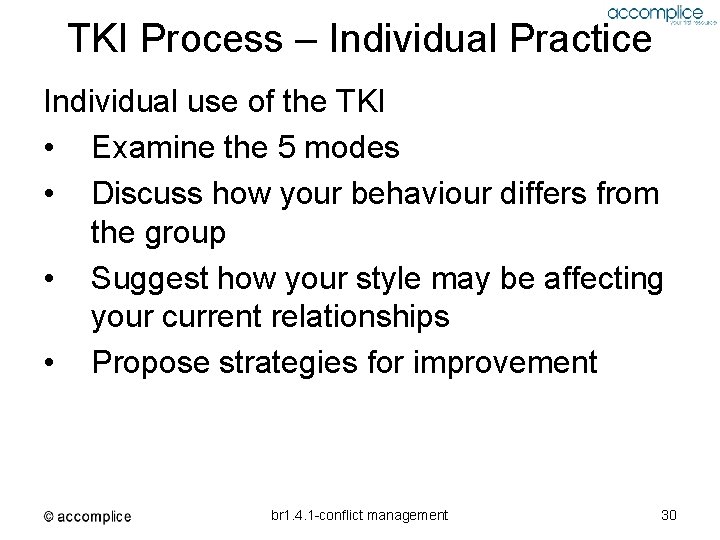
TKI Process – Individual Practice Individual use of the TKI • Examine the 5 modes • Discuss how your behaviour differs from the group • Suggest how your style may be affecting your current relationships • Propose strategies for improvement br 1. 4. 1 -conflict management 30
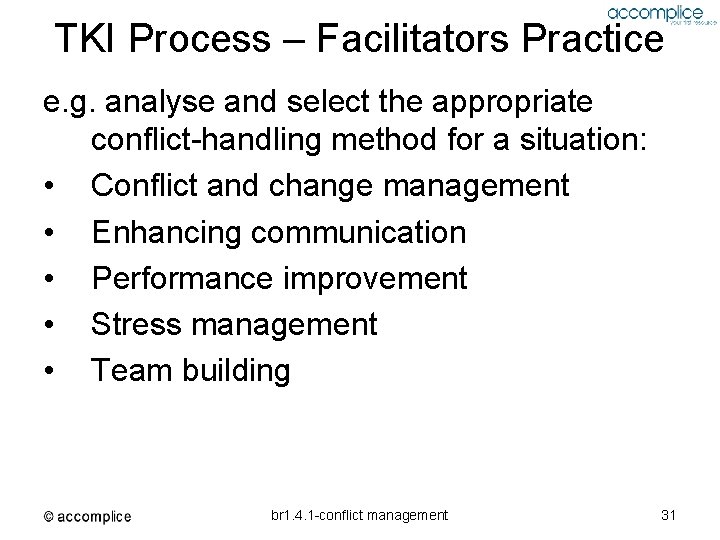
TKI Process – Facilitators Practice e. g. analyse and select the appropriate conflict-handling method for a situation: • Conflict and change management • Enhancing communication • Performance improvement • Stress management • Team building br 1. 4. 1 -conflict management 31
Programme • Welcome • Aim and Programme • Recap (Team to advise on progress since last event) • Conflict – Definition; Symptoms and Causes • Natural Styles in Conflict Situations • Dealing with Conflict – Best Practice • Review & Evaluation br 1. 4. 1 -conflict management 32
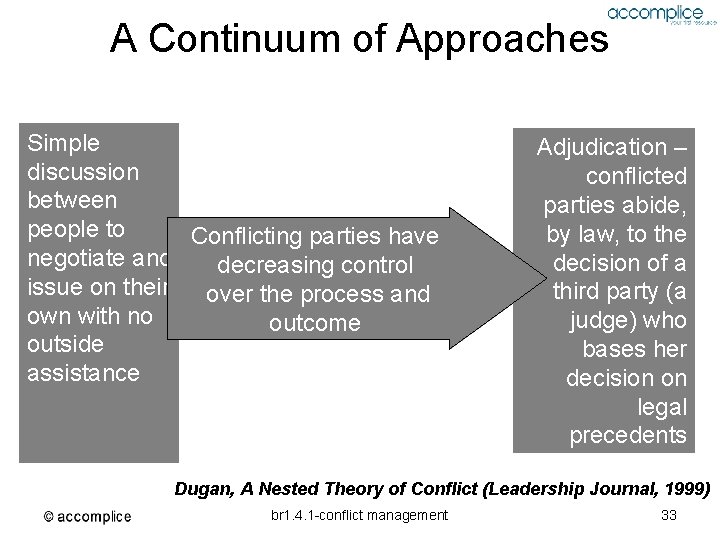
A Continuum of Approaches Simple discussion between people to Conflicting parties have negotiate and decreasing control issue on their over the process and own with no outcome outside assistance Adjudication – conflicted parties abide, by law, to the decision of a third party (a judge) who bases her decision on legal precedents Dugan, A Nested Theory of Conflict (Leadership Journal, 1999) br 1. 4. 1 -conflict management 33
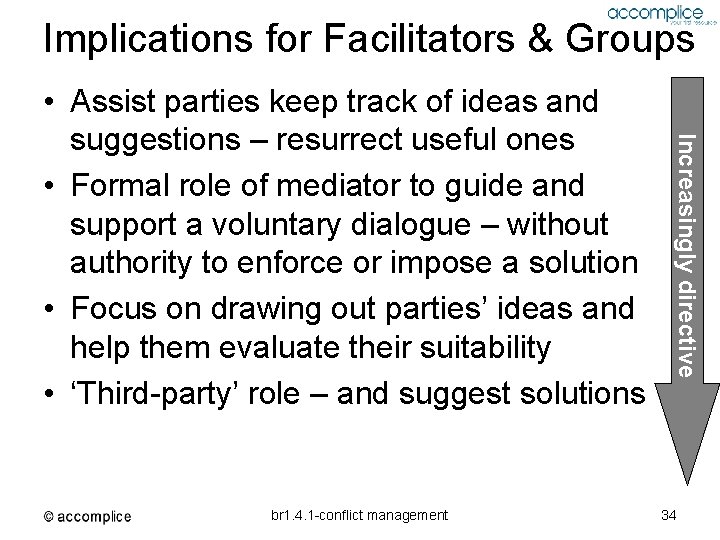
Implications for Facilitators & Groups br 1. 4. 1 -conflict management Increasingly directive • Assist parties keep track of ideas and suggestions – resurrect useful ones • Formal role of mediator to guide and support a voluntary dialogue – without authority to enforce or impose a solution • Focus on drawing out parties’ ideas and help them evaluate their suitability • ‘Third-party’ role – and suggest solutions 34
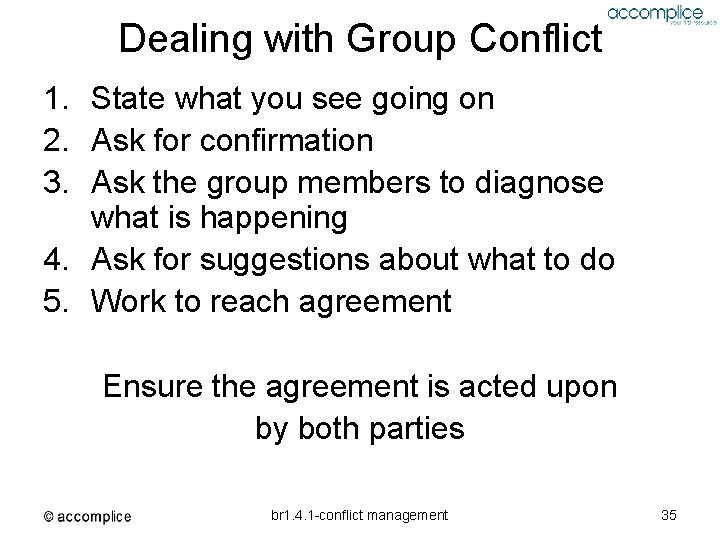
Dealing with Group Conflict 1. State what you see going on 2. Ask for confirmation 3. Ask the group members to diagnose what is happening 4. Ask for suggestions about what to do 5. Work to reach agreement Ensure the agreement is acted upon by both parties br 1. 4. 1 -conflict management 35
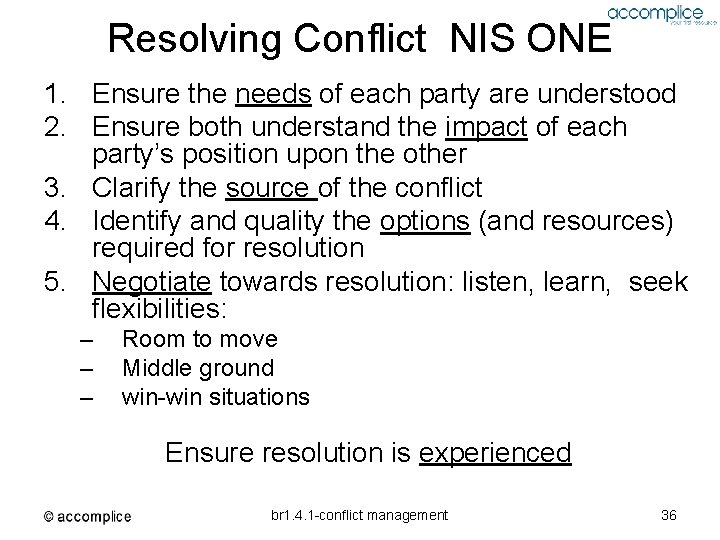
Resolving Conflict NIS ONE 1. Ensure the needs of each party are understood 2. Ensure both understand the impact of each party’s position upon the other 3. Clarify the source of the conflict 4. Identify and quality the options (and resources) required for resolution 5. Negotiate towards resolution: listen, learn, seek flexibilities: – – – Room to move Middle ground win-win situations Ensure resolution is experienced br 1. 4. 1 -conflict management 36
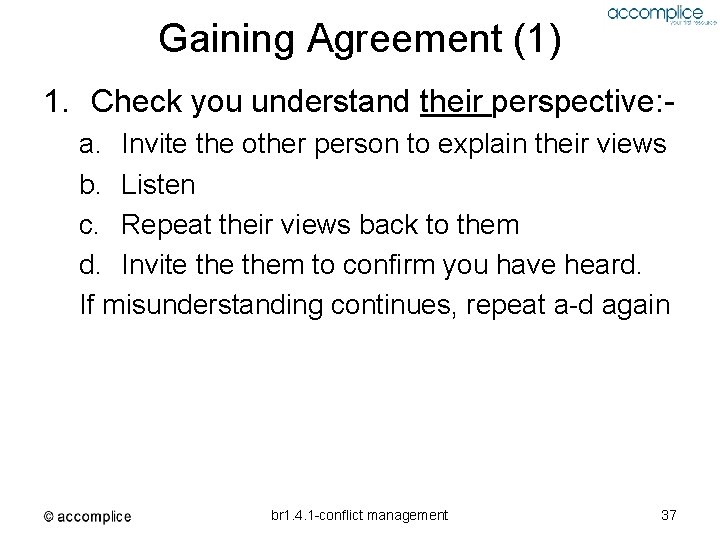
Gaining Agreement (1) 1. Check you understand their perspective: a. Invite the other person to explain their views b. Listen c. Repeat their views back to them d. Invite them to confirm you have heard. If misunderstanding continues, repeat a-d again br 1. 4. 1 -conflict management 37
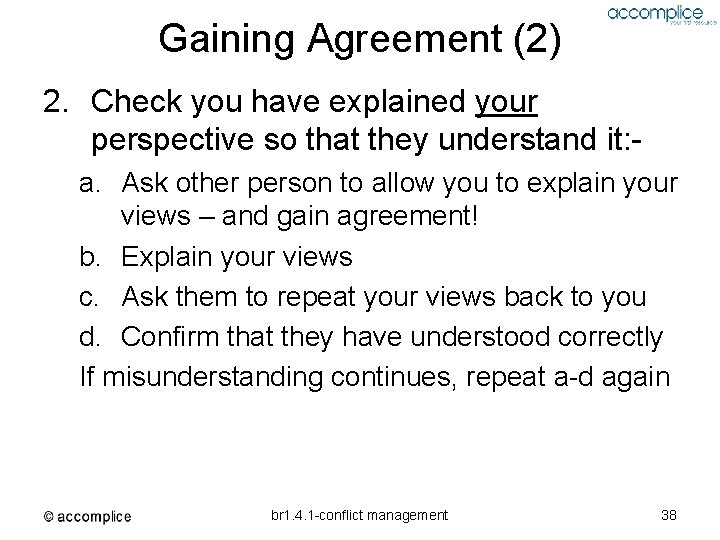
Gaining Agreement (2) 2. Check you have explained your perspective so that they understand it: a. Ask other person to allow you to explain your views – and gain agreement! b. Explain your views c. Ask them to repeat your views back to you d. Confirm that they have understood correctly If misunderstanding continues, repeat a-d again br 1. 4. 1 -conflict management 38
Conflict Resolution Role Play br 1. 4. 1 -conflict management 39
Programme • Welcome • Aim and Programme • Recap (Team to advise on progress since last event) • Conflict – Definition; Symptoms and Causes • Natural Styles in Conflict Situations • Dealing with Conflict – Best Practice • Review & Evaluation br 1. 4. 1 -conflict management 40
Review br 1. 4. 1 -conflict management 41
Evaluation CPD br 1. 4. 1 -conflict management 42
Close br 1. 4. 1 -conflict management 43
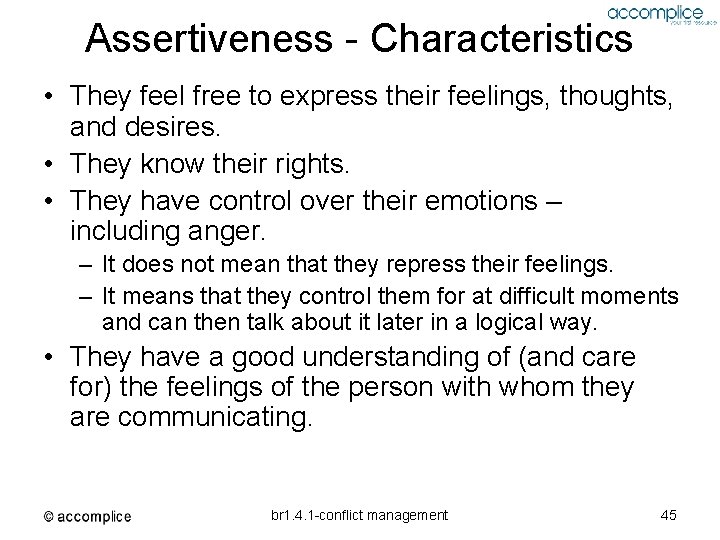
Assertiveness - Definition • To be able to interact with people while standing up for your rights. – Being assertive is to one's benefit most of the time but it does not mean that you always gets what you want. – The result of being assertive is that • you feel good about yourself • other people know how to deal with you and there is nothing vague about dealing with you. • Adapted from Winkipedia br 1. 4. 1 -conflict management 44
Assertiveness - Characteristics • They feel free to express their feelings, thoughts, and desires. • They know their rights. • They have control over their emotions – including anger. – It does not mean that they repress their feelings. – It means that they control them for at difficult moments and can then talk about it later in a logical way. • They have a good understanding of (and care for) the feelings of the person with whom they are communicating. br 1. 4. 1 -conflict management 45
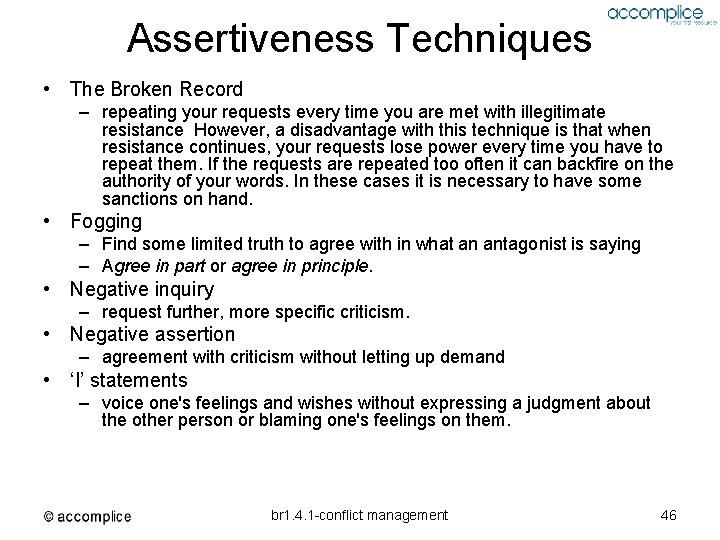
Assertiveness Techniques • The Broken Record – repeating your requests every time you are met with illegitimate resistance However, a disadvantage with this technique is that when resistance continues, your requests lose power every time you have to repeat them. If the requests are repeated too often it can backfire on the authority of your words. In these cases it is necessary to have some sanctions on hand. • Fogging – Find some limited truth to agree with in what an antagonist is saying – Agree in part or agree in principle. • Negative inquiry – request further, more specific criticism. • Negative assertion – agreement with criticism without letting up demand • ‘I’ statements – voice one's feelings and wishes without expressing a judgment about the other person or blaming one's feelings on them. br 1. 4. 1 -conflict management 46
• • A person is aggressive when they impose their will onto another person and tries to force them to submit. Examples of aggressive behaviour are fighting, accusing, threatening, and a general disregard for the other persons feeling. Aggression is about dominance. People behave passively when they let others push them around, when they do not stand up for themselves, and when they do what they are told regardless of how they feel about it. Passivity is about submission. Nobody likes being dominated, but it might seem like the smart thing to do at the time (perhaps to avoid disagreement or confrontation). Assertiveness is about finding the middle path. We behave assertively when we stand up for ourselves (when required), express our true feelings, and do not let others take advantage of us while, at the same time, being considerate of others' feelings. Assertivness is not about simply choosing between an aggressive or passive style of communication. It's about respecting the rights (personal boundaries) and feelings of others and expecting others to respect your rights and feelings too. If someone doesn't respect your rights and feelings, you communicate it to them. It isn't about scoring points or getting even by lashing out at them (aggressive) or feeling hurt and not talking about it so as to not embarrass the other person (passive). - for self and others. br 1. 4. 1 -conflict management 47
• Assertiveness training emphasizes that to be assertive, one must be clear about their (and others) rights while communicating. The five basic rights of every individual: – You have the right to do anything as long as it does not hurt someone. – You have the right to maintain your dignity by being assertive even if it hurts someone else (provided you are not intentionally trying to hurt them i. e. being aggressive). – You have the right to make a request from someone, as long as you recognize that the other person has the rights to say no. – In many interpersonal situations the rights aren't clear. But you always have the right to discuss the problem with the persons involved, to clarify it. – You have the rights to your rights. br 1. 4. 1 -conflict management 48
Assertive Behaviour - Characteristics • • Openess implies being clear and specific about what you want, think and feel. A lack of openness often leads to misunderstanding. "I didn't like that movie", "I feel irritated when you show up late", "I want to eat Chinese. Can we get Chinese? " are statements that are clear and unlikely to be misinterpreted. Directness means addressing the person / situation directly. For example, if you are in a group and want to say something to someone, communicate directly with that person instead of addressing the whole group and hoping that the person gets the message. Or, if you want your husband to get you vegetables from the supermarket, address it directly, "Will you please get a packet of frozen peas from the supermarket? " instead of asking, "Will you, by any chance, be going out today? ". Honesty in communication implies that you be truthful and not mislead the other person. Example: your friend says, "I don't like your hairstyle" and you reply, "Yes, I don't too" when in fact you actually do. When we aren't honest, we deprive the other person a chance to get to understand know us better. Appropriateness implies taking the social and cultural context into consideration before communicating. Asking out a girl in a bar might be appropriate, but trying to get a date with a widow on her husbands funeral can certainly get you into trouble. In other words, don't forget your manners! br 1. 4. 1 -conflict management 49
Becoming Assertive 1. Understand the basic concepts 2. Practice non-verbal cues: – Stand straight ; Make eye contact; Speak loud enough 3. Practice Verbal Responses: – saying yes or no, when we want to – ask favours and make requests – communicate our feelings and thoughts in an open and direct way – handle put downs 4. Learn – adaptive behaviours in job situations – the ability to form and maintain a social network – develop close, personal relationships br 1. 4. 1 -conflict management 50