
CONFLICT MANAGEMENT FEATURES OF CONFLICT 1 Conflict occurs


- Slides: 46
CONFLICT MANAGEMENT
FEATURES OF CONFLICT 1. Conflict occurs when individuals are not able to choose among the available alternative courses of action. 2. Conflict between two individuals implies that they have conflicting perspectives, values and goals. 3. Conflict is a dynamic process as it indicates a series of events. Each conflict is made up of a series of interlocking conflict episodes. 4. Conflict must be perceived by the parties. If no one is aware of a conflict, then it is generally agreed that no conflict exists.
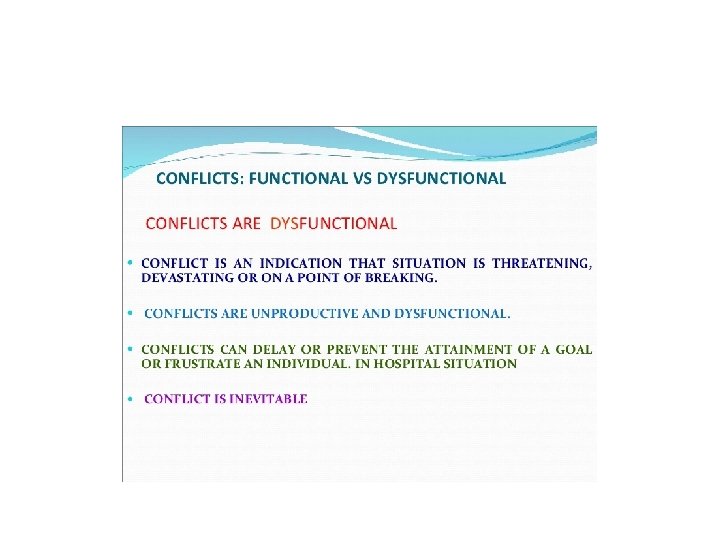
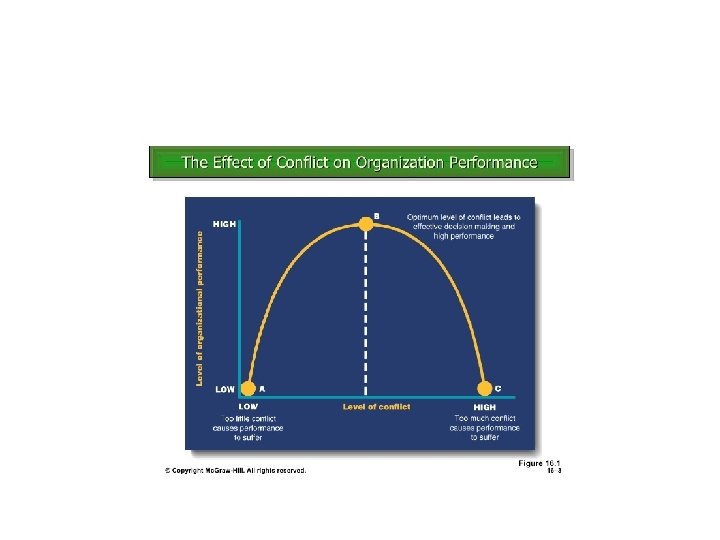
SCHOOLS OF THOUGHT ON CONFLICT 1. Traditional view- Conflict is harmful and must be avoided, must be suppressed, ignored, pushed under the rug. 2. Human Relations View- Conflict is a natural occurrence, should be accepted and resolved at the earliest. 3. The interactionist View- Encourage conflict, necessary for a group to perform effectively.
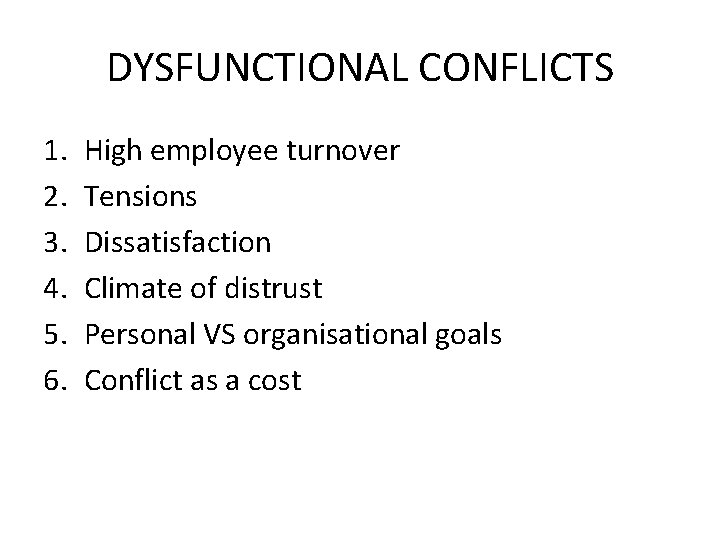
DYSFUNCTIONAL CONFLICTS 1. 2. 3. 4. 5. 6. High employee turnover Tensions Dissatisfaction Climate of distrust Personal VS organisational goals Conflict as a cost
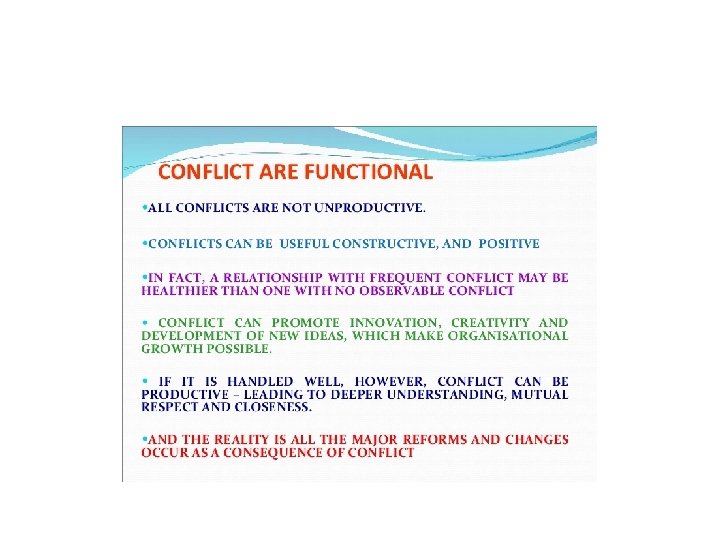
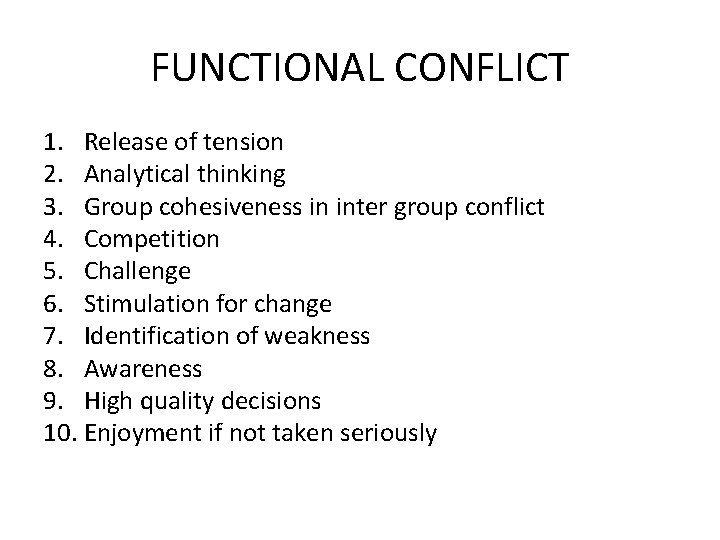
FUNCTIONAL CONFLICT 1. Release of tension 2. Analytical thinking 3. Group cohesiveness in inter group conflict 4. Competition 5. Challenge 6. Stimulation for change 7. Identification of weakness 8. Awareness 9. High quality decisions 10. Enjoyment if not taken seriously
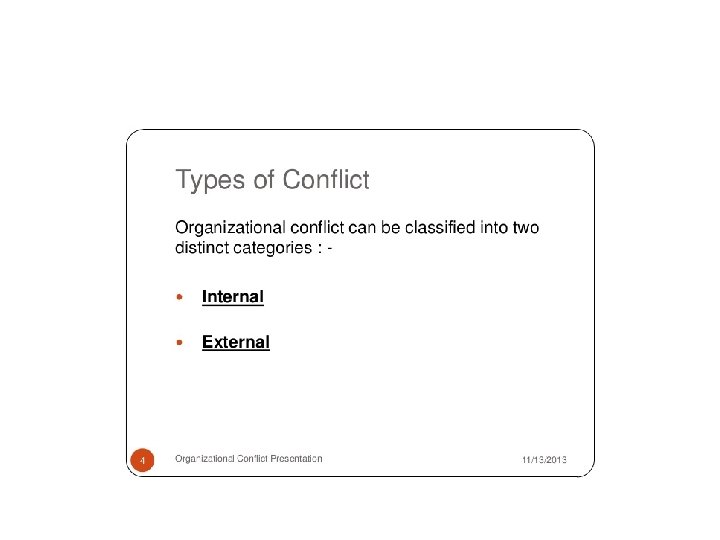
TYPES OF CONFLICTS 1. 2. 3. 4. 5. Intrapersonal level conflict Interpersonal level conflict Intragroup level conflict Intergroup level conflict Organisational level conflict
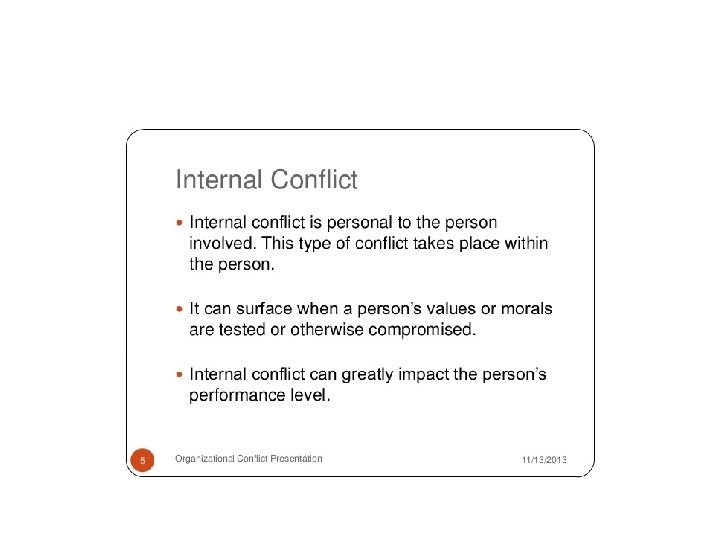
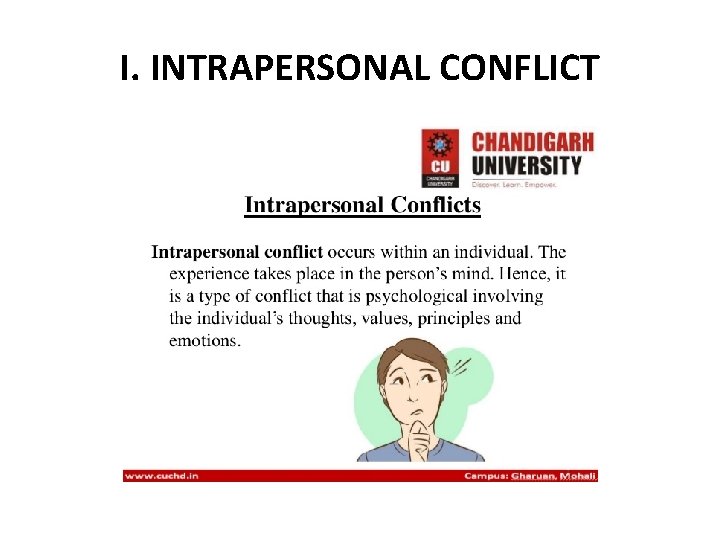
I. INTRAPERSONAL CONFLICT
FACTORS LEADING TO INTRAINDIVIDUAL CONFLICT 1. Unacceptability of goal/ method of doing 2. Incomparability of outcomes 3. Uncertainty
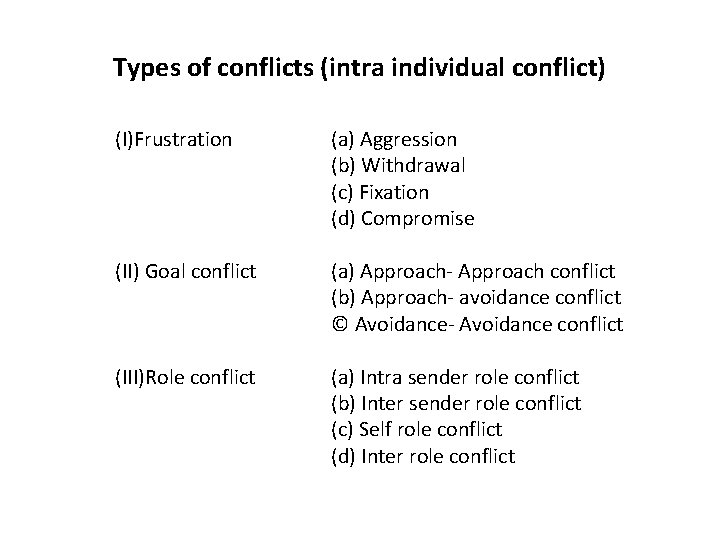
Types of conflicts (intra individual conflict) (I)Frustration (a) Aggression (b) Withdrawal (c) Fixation (d) Compromise (II) Goal conflict (a) Approach- Approach conflict (b) Approach- avoidance conflict © Avoidance- Avoidance conflict (III)Role conflict (a) Intra sender role conflict (b) Inter sender role conflict (c) Self role conflict (d) Inter role conflict
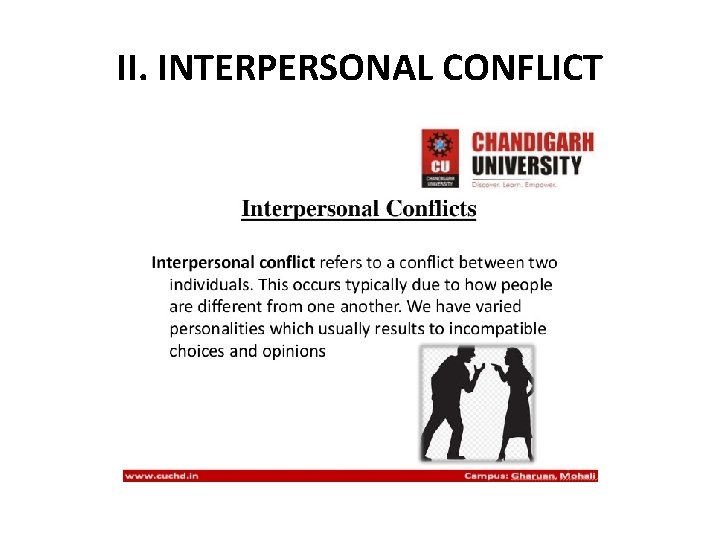
II. INTERPERSONAL CONFLICT
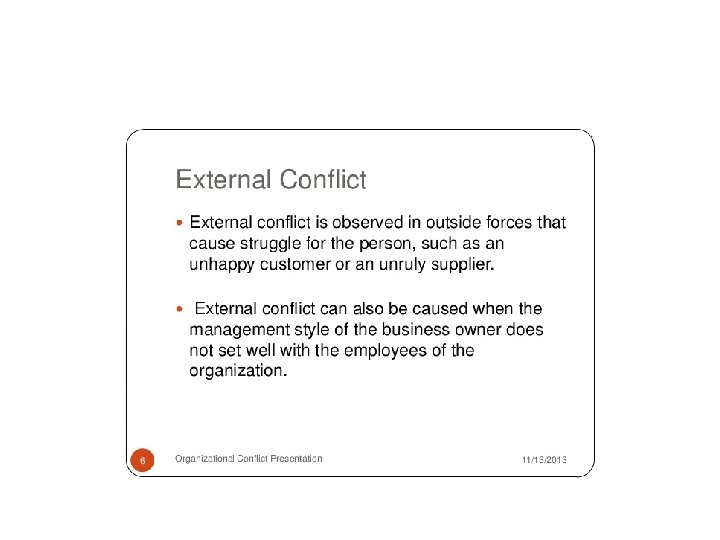
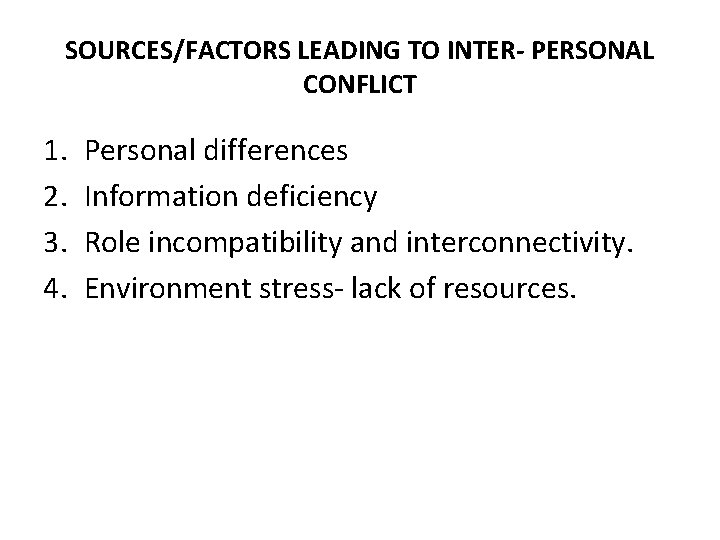
SOURCES/FACTORS LEADING TO INTER- PERSONAL CONFLICT 1. 2. 3. 4. Personal differences Information deficiency Role incompatibility and interconnectivity. Environment stress- lack of resources.
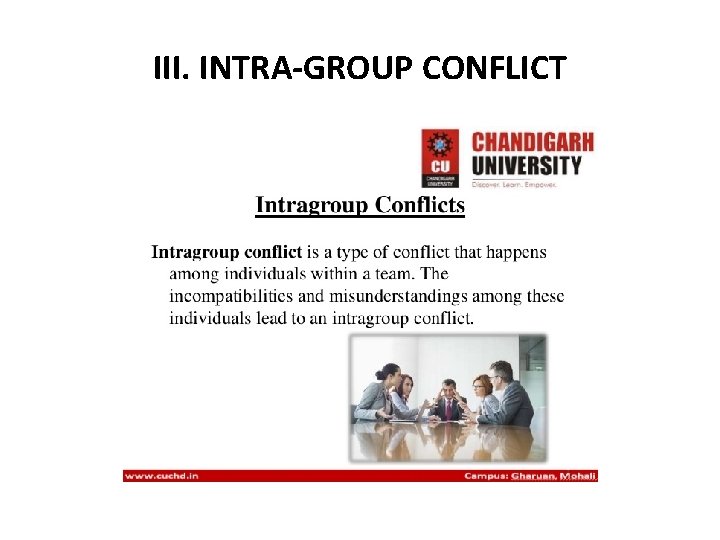
III. INTRA-GROUP CONFLICT
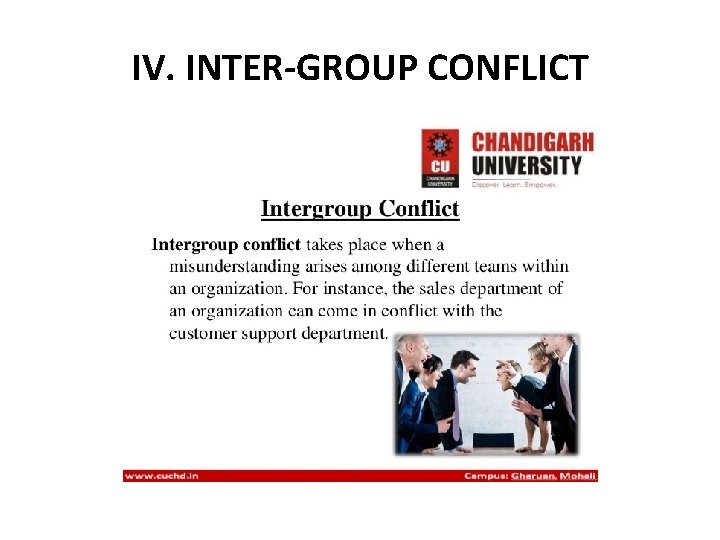
IV. INTER-GROUP CONFLICT
CAUSES/ FACTORS OF INTER-GROUP CONFLICT 1. 2. 3. 4. 5. Absence of joint decision making Difference in goals Difference in perception Difference in goals as well as perception Lack of Resources
V. ORGANISATION LEVEL CONFLICT It occurs between organisations which are in some way or the other dependent upon each other. It can be between (a) buyer and seller, (b) union and organisation, (c) government agencies and the organisation
CAUSES OF CONFLICT 1. Communicational aspect of conflict 2. Behavioural aspect of conflict 3. Structural aspect of conflict
Communicational aspect: Conflicts that arise due to lack of proper or partial communication or miscommunication. 1. Too much or too little communication 2. Filtering of communication 3. Semantic problems 4. Problem of noise
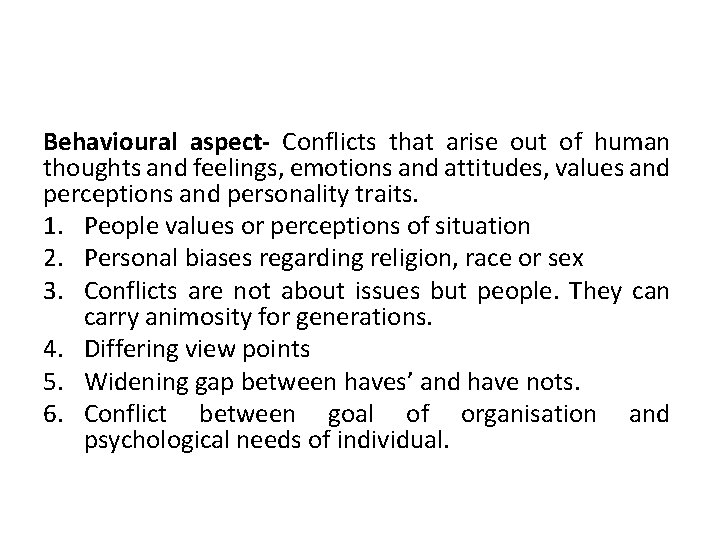
Behavioural aspect- Conflicts that arise out of human thoughts and feelings, emotions and attitudes, values and perceptions and personality traits. 1. People values or perceptions of situation 2. Personal biases regarding religion, race or sex 3. Conflicts are not about issues but people. They can carry animosity for generations. 4. Differing view points 5. Widening gap between haves’ and have nots. 6. Conflict between goal of organisation and psychological needs of individual.
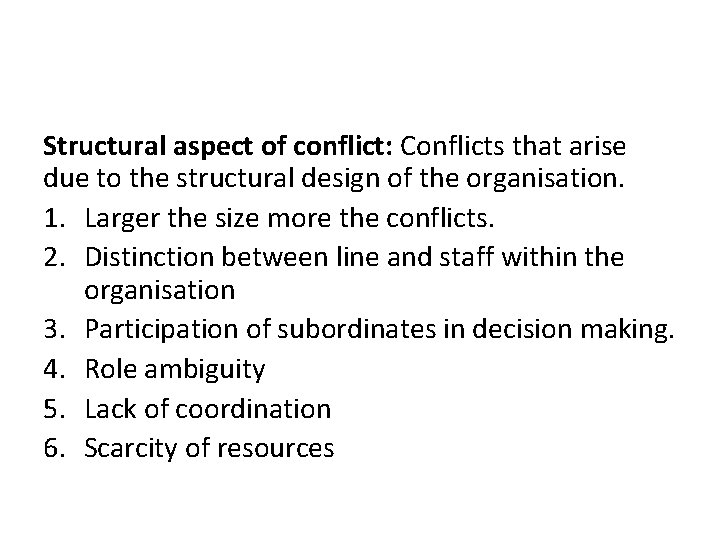
Structural aspect of conflict: Conflicts that arise due to the structural design of the organisation. 1. Larger the size more the conflicts. 2. Distinction between line and staff within the organisation 3. Participation of subordinates in decision making. 4. Role ambiguity 5. Lack of coordination 6. Scarcity of resources
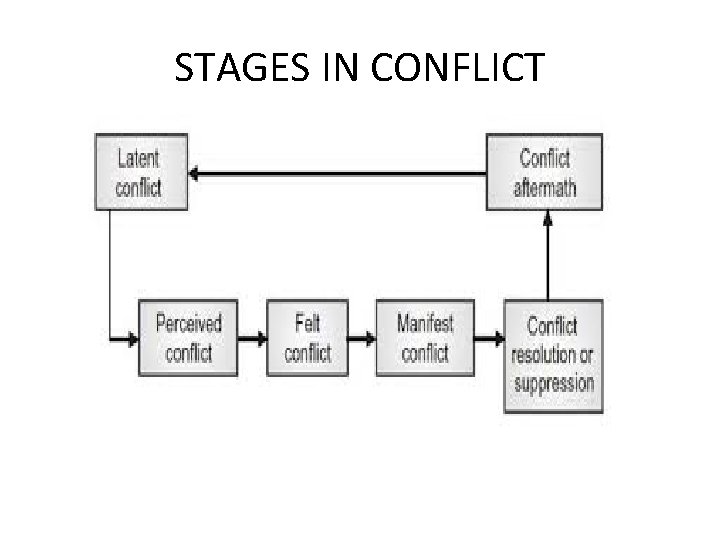
STAGES IN CONFLICT
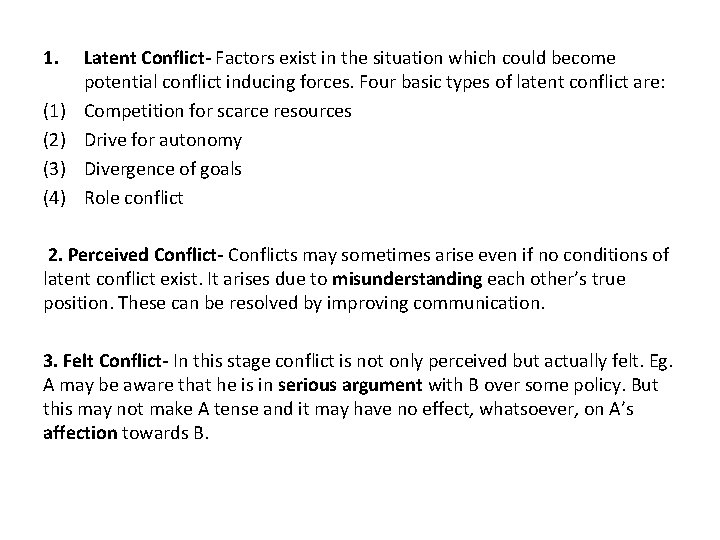
1. (1) (2) (3) (4) Latent Conflict- Factors exist in the situation which could become potential conflict inducing forces. Four basic types of latent conflict are: Competition for scarce resources Drive for autonomy Divergence of goals Role conflict 2. Perceived Conflict- Conflicts may sometimes arise even if no conditions of latent conflict exist. It arises due to misunderstanding each other’s true position. These can be resolved by improving communication. 3. Felt Conflict- In this stage conflict is not only perceived but actually felt. Eg. A may be aware that he is in serious argument with B over some policy. But this may not make A tense and it may have no effect, whatsoever, on A’s affection towards B.
4. Manifest Conflict- When two parties engage in behaviours which evoke responses from each other in form of open aggression, apathy, sabotage, withdrawal and perfect obedience to rules. (Violence is rare) 5. Conflict aftermath- aftermath of conflict may have positive or negative repercussions depending upon how the conflict is resolved. If conflict is resolved to the satisfaction of all participants-basis for cooperative relationship may be laid. If conflict is merely suppressed- the latent conditions may be aggravated and explode in a more serious form until they are rectified.
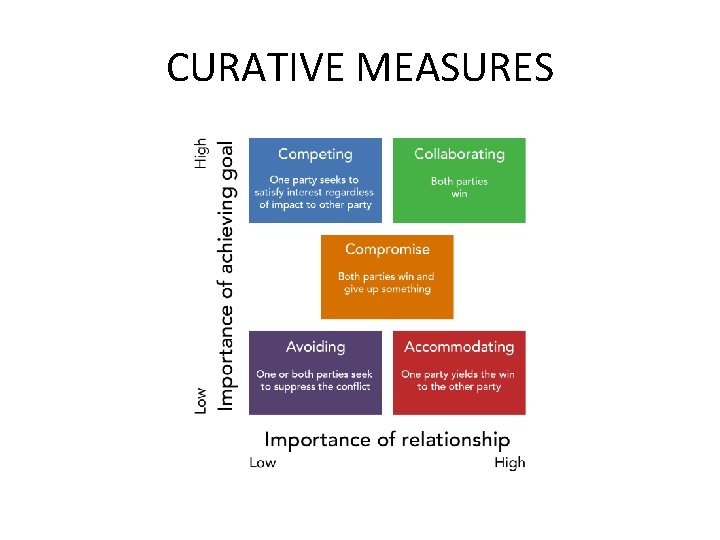
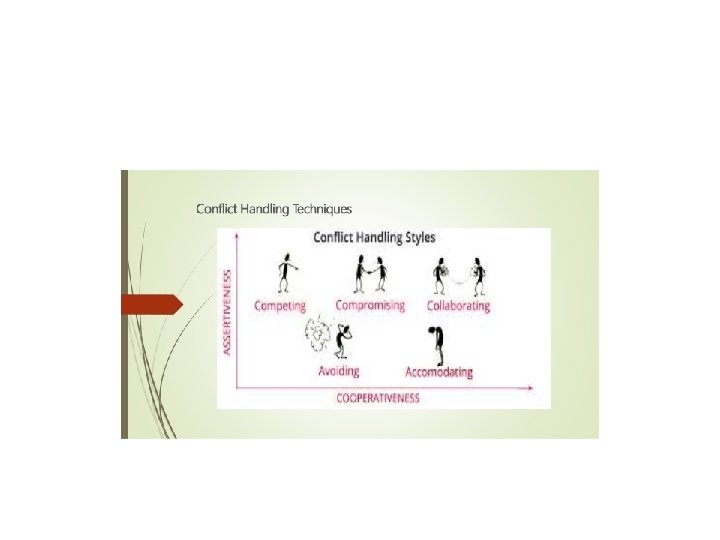
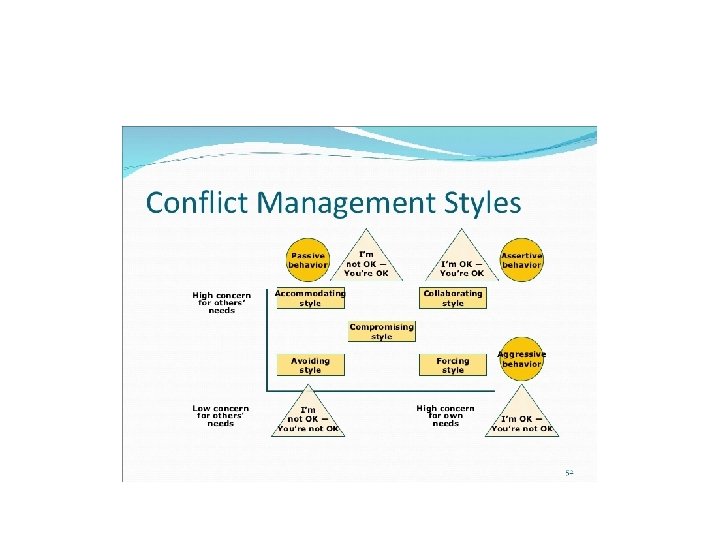
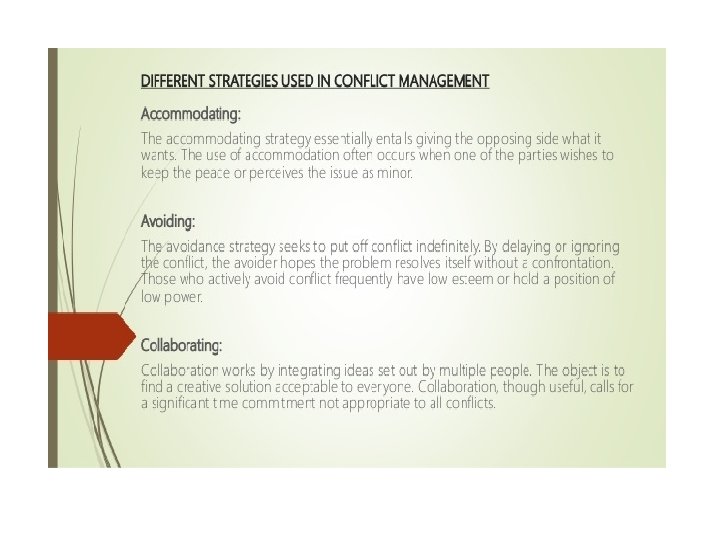
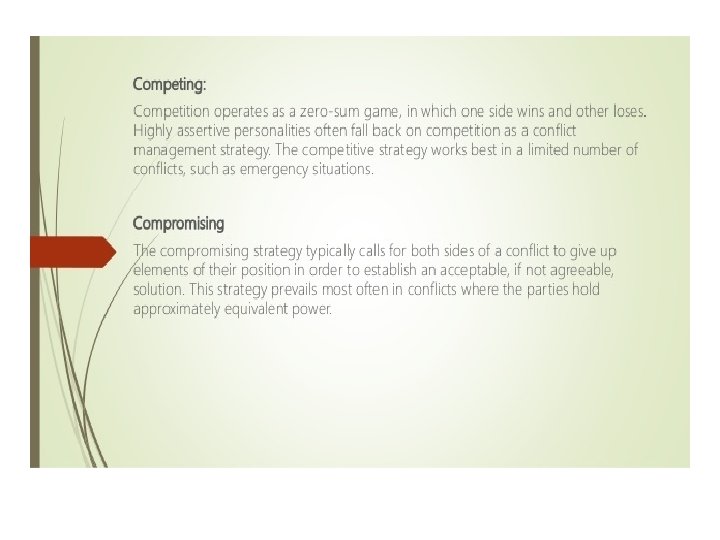
CONFLICT MANAGEMENT 1. Preventive Measures- To prevent conflicts from developing. 2. Curative Measures- Resolution of conflicts when they take place.
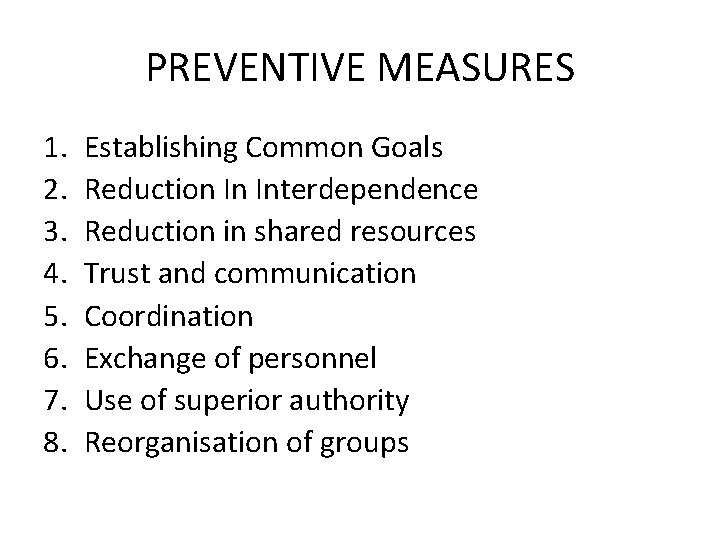
PREVENTIVE MEASURES 1. 2. 3. 4. 5. 6. 7. 8. Establishing Common Goals Reduction In Interdependence Reduction in shared resources Trust and communication Coordination Exchange of personnel Use of superior authority Reorganisation of groups
CURATIVE MEASURES
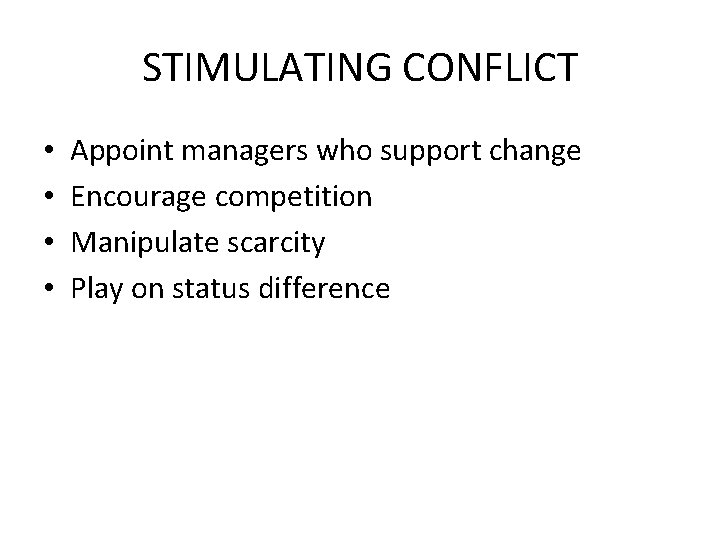
STIMULATING CONFLICT • • Appoint managers who support change Encourage competition Manipulate scarcity Play on status difference
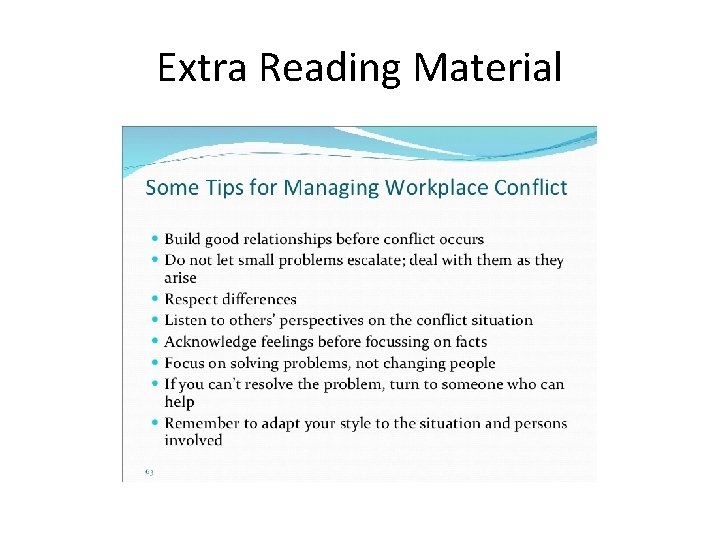
Extra Reading Material