
Conflict Escalation and the Management of Workplace Bullying
Conflict Escalation and the Management of Workplace Bullying Dieter Zapf Universidad del Pais Vasco Cursos de Verano San Sebastian 27 -28 June 2013 Dieter Zapf Hier wird Wissen Wirklichkeit
Content 1. The Problem of Early Intervention 2. Trust and the Importance of Success Stories 3. Formal and Informal Procedures 2 Dieter Zapf Hier wird Wissen Wirklichkeit
1. The Problem of Early Intervention Early intervention is complicated because there is no unique definition of bullying 3 Dieter Zapf Hier wird Wissen Wirklichkeit
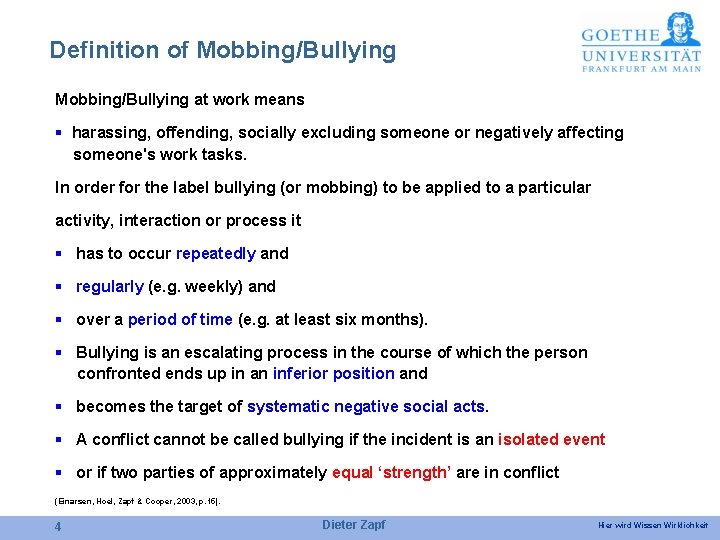
Definition of Mobbing/Bullying at work means § harassing, offending, socially excluding someone or negatively affecting someone's work tasks. In order for the label bullying (or mobbing) to be applied to a particular activity, interaction or process it § has to occur repeatedly and § regularly (e. g. weekly) and § over a period of time (e. g. at least six months). § Bullying is an escalating process in the course of which the person confronted ends up in an inferior position and § becomes the target of systematic negative social acts. § A conflict cannot be called bullying if the incident is an isolated event § or if two parties of approximately equal ‘strength’ are in conflict (Einarsen, Hoel, Zapf & Cooper, 2003, p. 15). 4 Dieter Zapf Hier wird Wissen Wirklichkeit
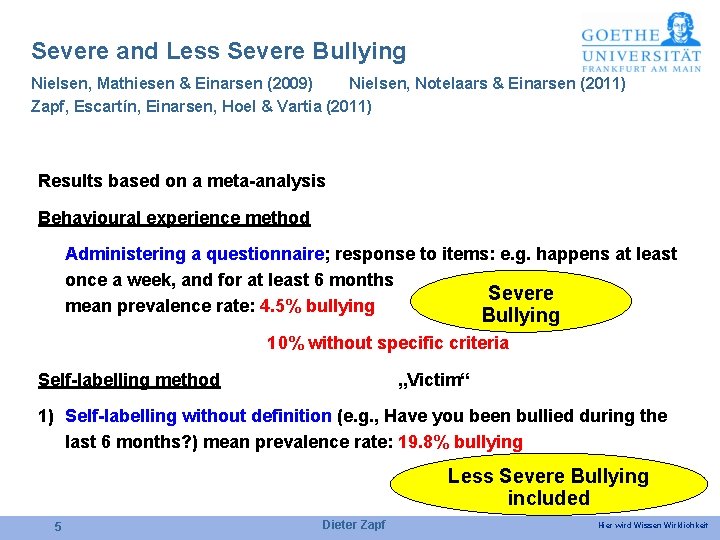
Severe and Less Severe Bullying Nielsen, Mathiesen & Einarsen (2009) Nielsen, Notelaars & Einarsen (2011) Zapf, Escartín, Einarsen, Hoel & Vartia (2011) Results based on a meta-analysis Behavioural experience method Administering a questionnaire; response to items: e. g. happens at least once a week, and for at least 6 months Severe mean prevalence rate: 4. 5% bullying Bullying 10% without specific criteria Self-labelling method „Victim“ 1) Self-labelling without definition (e. g. , Have you been bullied during the last 6 months? ) mean prevalence rate: 19. 8% bullying Less Severe Bullying included 5 Dieter Zapf Hier wird Wissen Wirklichkeit
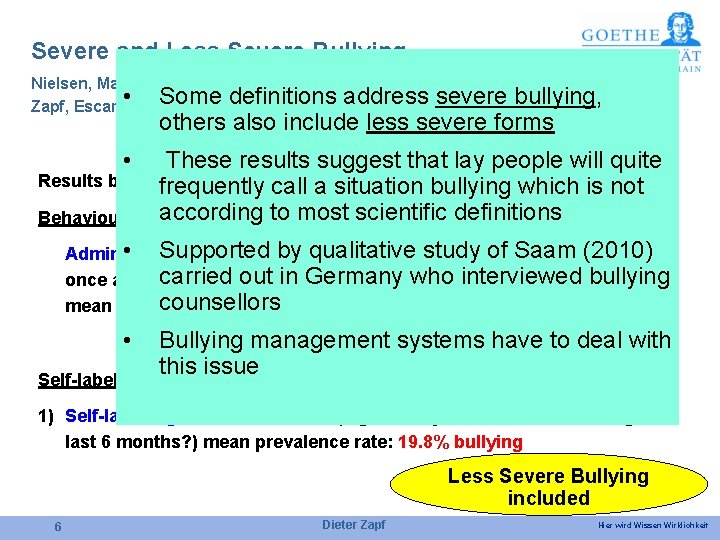
Severe and Less Severe Bullying Nielsen, Mathiesen & Einarsen (2009) Nielsen, Notelaars & Einarsen (2011) • Einarsen, Some definitions address severe bullying, Zapf, Escartín, Hoel & Vartia (2011) others also include less severe forms • These results suggest that lay people will quite Results basedfrequently call a situation bullying which is not on a meta-analysis according to most scientific definitions Behavioural experience method • Supported by qualitative study of Saam (2010) Administering a questionnaire; response to items: e. g. happens at least carried out in Germany who interviewed bullying once a week, and for at least 6 months Severe counsellors mean prevalence rate: 4. 5% bullying Bullying • Bullying management systems have to deal with this issue Self-labelling method „Victim“ 1) Self-labelling without definition (e. g. , Have you been bullied during the last 6 months? ) mean prevalence rate: 19. 8% bullying Less Severe Bullying included 6 Dieter Zapf Hier wird Wissen Wirklichkeit
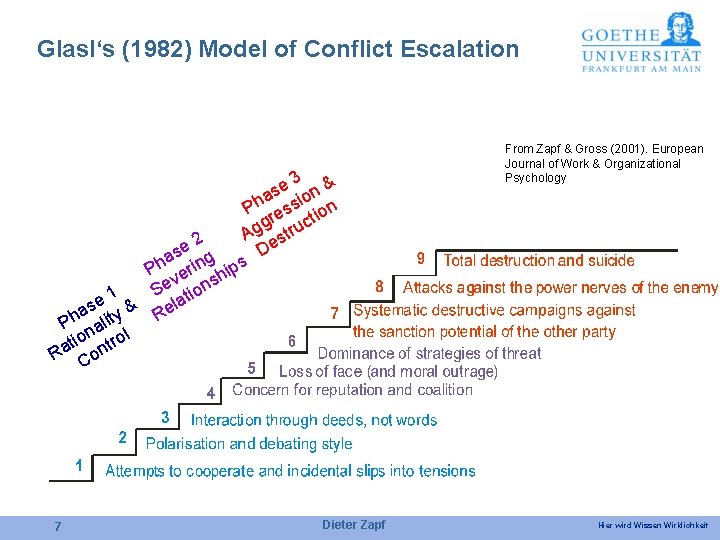
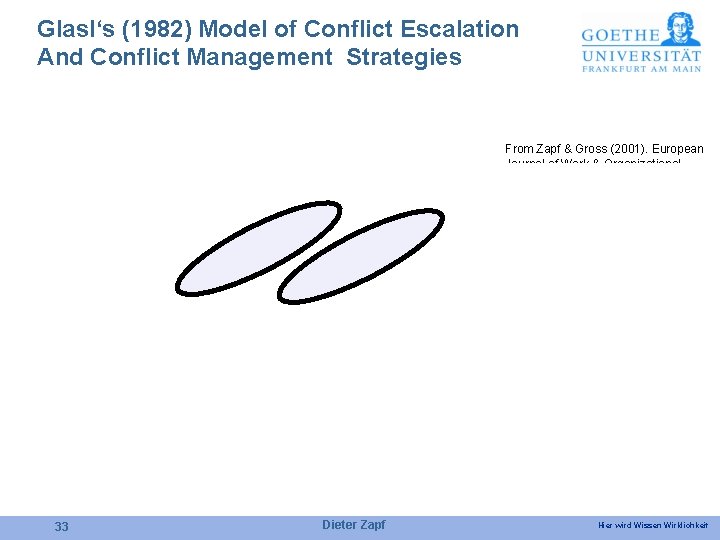
Glasl‘s (1982) Model of Conflict Escalation e 3 n & s ha ssio n P gre ctio Ag stru 2 e De s ha ring ips P Seve onsh 1 lati e as ity & Re h P al on trol i t Ra Con 7 Dieter Zapf From Zapf & Gross (2001). European Journal of Work & Organizational Psychology Hier wird Wissen Wirklichkeit
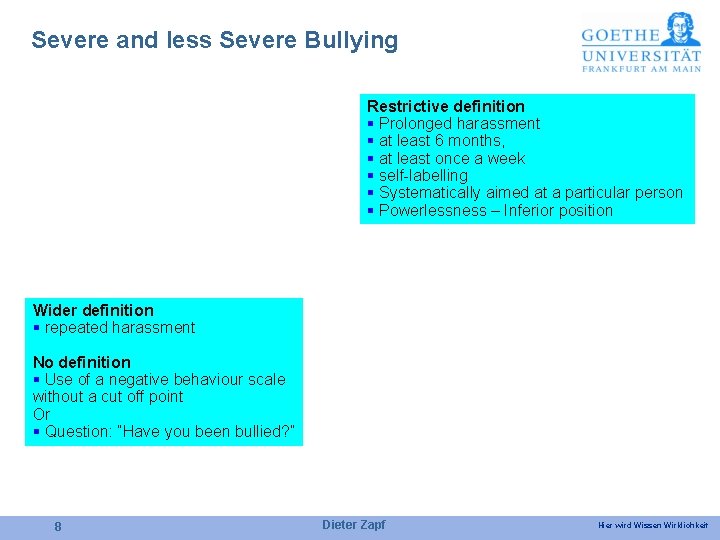
Severe and less Severe Bullying Restrictive definition § Prolonged harassment § at least 6 months, § at least once a week § self-labelling § Systematically aimed at a particular person § Powerlessness – Inferior position Wider definition § repeated harassment No definition § Use of a negative behaviour scale without a cut off point Or § Question: “Have you been bullied? ” 8 Dieter Zapf Hier wird Wissen Wirklichkeit
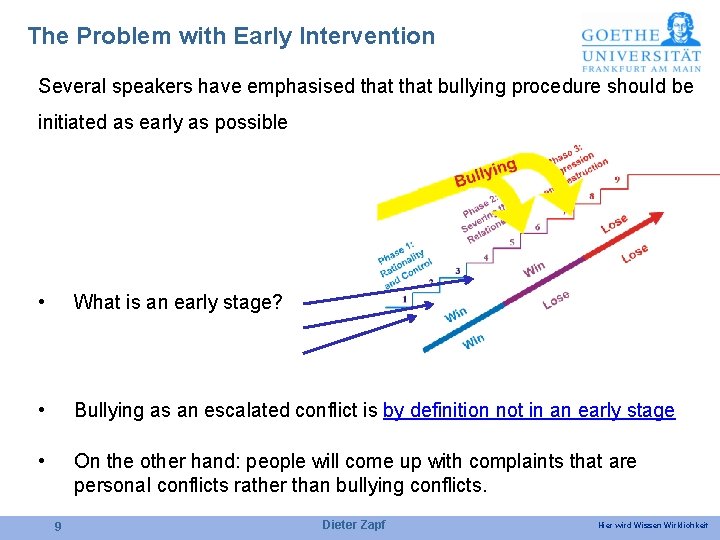
The Problem with Early Intervention Several speakers have emphasised that bullying procedure should be initiated as early as possible • What is an early stage? • Bullying as an escalated conflict is by definition not in an early stage • On the other hand: people will come up with complaints that are personal conflicts rather than bullying conflicts. 9 Dieter Zapf Hier wird Wissen Wirklichkeit
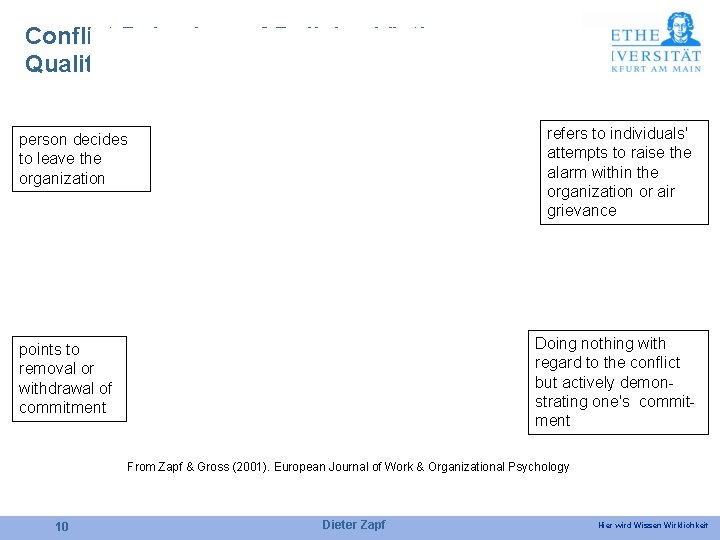
Conflict Behaviour of Bullying Victims Qualitative Study refers to individuals' attempts to raise the alarm within the organization or air grievance person decides to leave the organization Doing nothing with regard to the conflict but actively demonstrating one's commitment points to removal or withdrawal of commitment From Zapf & Gross (2001). European Journal of Work & Organizational Psychology 10 Dieter Zapf Hier wird Wissen Wirklichkeit
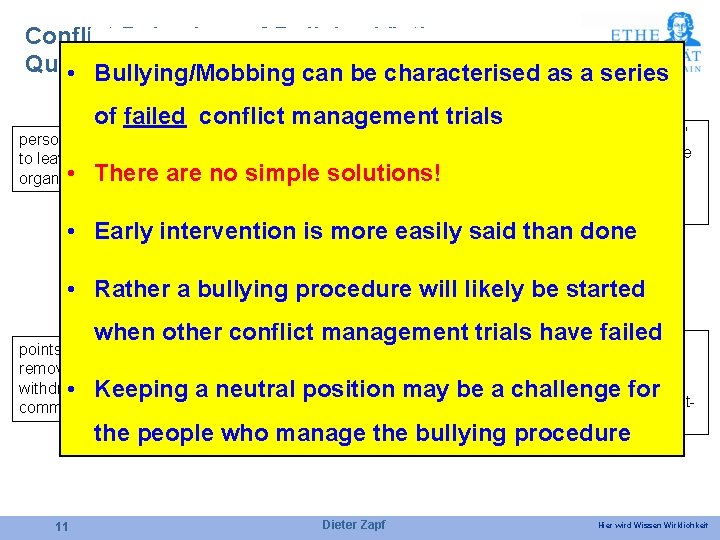
Conflict Behaviour of Bullying Victims Qualitative Study • Bullying/Mobbing can be characterised as a series of failed conflict management trials person decides to leave the • There organization are no simple solutions! refers to individuals' attempts to raise the alarm within the organization or air grievance • Early intervention is more easily said than done • Rather a bullying procedure will likely be started when other conflict management trials Doing nothing with have failed points to removal or withdrawal of • Keeping commitment a neutral position may be a regard to the conflict but actively demonchallenge for strating one's commitment the people who manage the bullying procedure From Zapf & Gross (2001). European Journal of Work & Organizational Psychology 11 Dieter Zapf Hier wird Wissen Wirklichkeit
2. Trust and the Importance of Success Stories What we know from research on organizational change and development 12 Dieter Zapf Hier wird Wissen Wirklichkeit
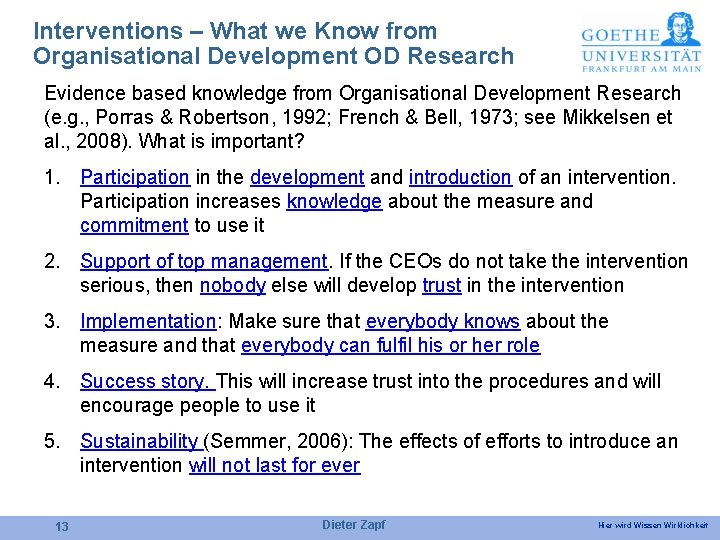
Interventions – What we Know from Organisational Development OD Research Evidence based knowledge from Organisational Development Research (e. g. , Porras & Robertson, 1992; French & Bell, 1973; see Mikkelsen et al. , 2008). What is important? 1. Participation in the development and introduction of an intervention. Participation increases knowledge about the measure and commitment to use it 2. Support of top management. If the CEOs do not take the intervention serious, then nobody else will develop trust in the intervention 3. Implementation: Make sure that everybody knows about the measure and that everybody can fulfil his or her role 4. Success story. This will increase trust into the procedures and will encourage people to use it 5. Sustainability (Semmer, 2006): The effects of efforts to introduce an intervention will not last for ever 13 Dieter Zapf Hier wird Wissen Wirklichkeit
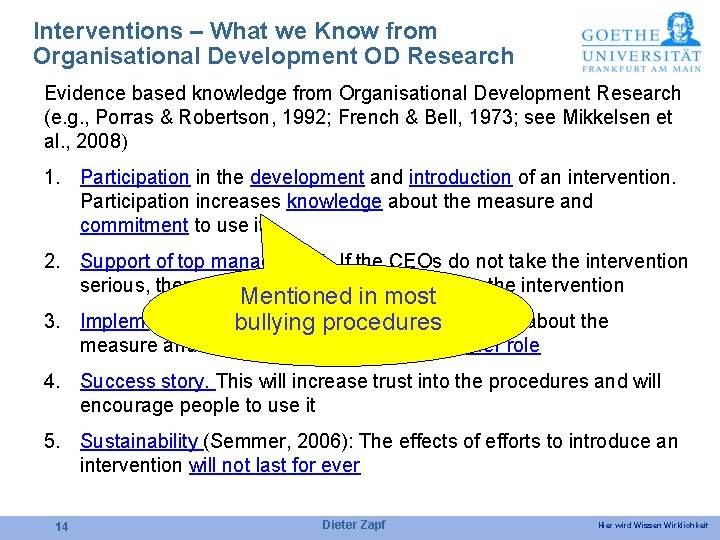
Interventions – What we Know from Organisational Development OD Research Evidence based knowledge from Organisational Development Research (e. g. , Porras & Robertson, 1992; French & Bell, 1973; see Mikkelsen et al. , 2008) 1. Participation in the development and introduction of an intervention. Participation increases knowledge about the measure and commitment to use it 2. Support of top management. If the CEOs do not take the intervention serious, then nobody else will develop trust in the intervention Mentioned in most 3. Implementation: Make sure that everybody knows about the bullying procedures measure and that everybody can fulfil his or her role 4. Success story. This will increase trust into the procedures and will encourage people to use it 5. Sustainability (Semmer, 2006): The effects of efforts to introduce an intervention will not last for ever 14 Dieter Zapf Hier wird Wissen Wirklichkeit
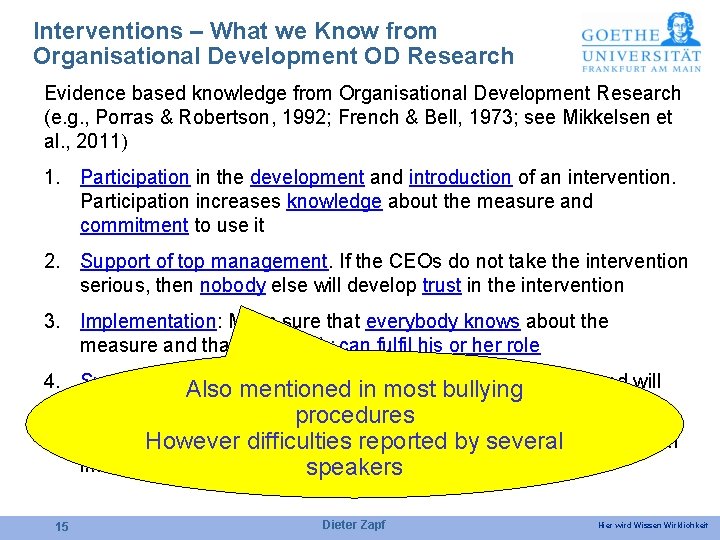
Interventions – What we Know from Organisational Development OD Research Evidence based knowledge from Organisational Development Research (e. g. , Porras & Robertson, 1992; French & Bell, 1973; see Mikkelsen et al. , 2011) 1. Participation in the development and introduction of an intervention. Participation increases knowledge about the measure and commitment to use it 2. Support of top management. If the CEOs do not take the intervention serious, then nobody else will develop trust in the intervention 3. Implementation: Make sure that everybody knows about the measure and that everybody can fulfil his or her role 4. Success story. This will increase trust into the procedures and will Also mentioned in most bullying encourage people to use it procedures 5. Sustainability (Semmer, 2006): The effects of efforts to introduce an However difficulties reported by several intervention will not last for ever speakers 15 Dieter Zapf Hier wird Wissen Wirklichkeit
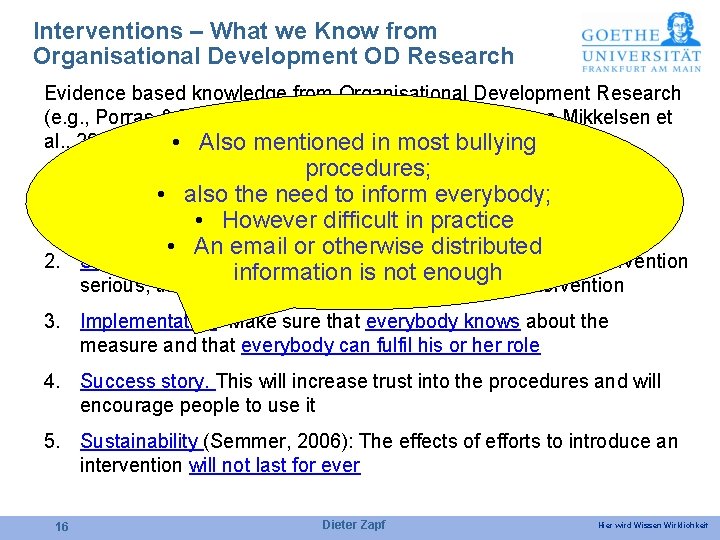
Interventions – What we Know from Organisational Development OD Research Evidence based knowledge from Organisational Development Research (e. g. , Porras & Robertson, 1992; French & Bell, 1973; see Mikkelsen et al. , 2008) • Also mentioned in most bullying procedures; 1. Participation in the development and introduction of an intervention. • also the need to inform everybody; Participation increases knowledge about the measure and • However difficult in practice commitment to use it • An email or otherwise distributed 2. Support of top management. If the CEOs do not take the intervention information is not enough serious, then nobody else will develop trust in the intervention 3. Implementation: Make sure that everybody knows about the measure and that everybody can fulfil his or her role 4. Success story. This will increase trust into the procedures and will encourage people to use it 5. Sustainability (Semmer, 2006): The effects of efforts to introduce an intervention will not last for ever 16 Dieter Zapf Hier wird Wissen Wirklichkeit
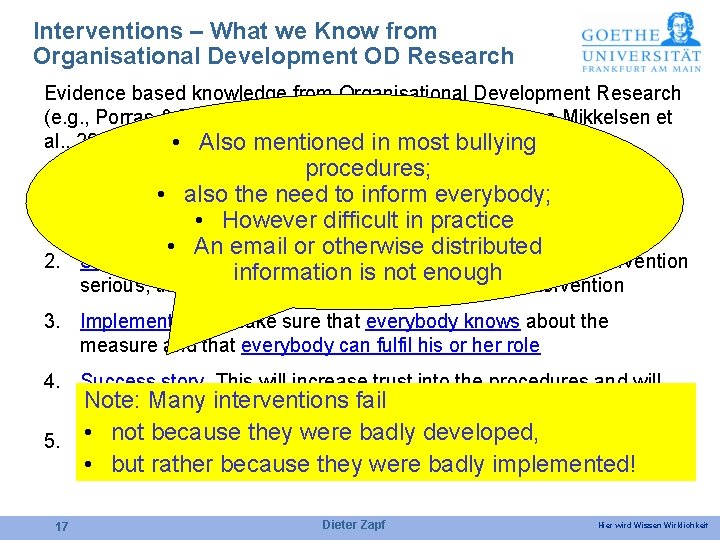
Interventions – What we Know from Organisational Development OD Research Evidence based knowledge from Organisational Development Research (e. g. , Porras & Robertson, 1992; French & Bell, 1973; see Mikkelsen et al. , 2008) • Also mentioned in most bullying procedures; 1. Participation in the development and introduction of an intervention. • also the need to inform everybody; Participation increases knowledge about the measure and • However difficult in practice commitment to use it • An email or otherwise distributed 2. Support of top management. If the CEOs do not take the intervention information is not enough serious, then nobody else will develop trust in the intervention 3. Implementation: Make sure that everybody knows about the measure and that everybody can fulfil his or her role 4. Success story. This will increase trust into the procedures and will Note: Many interventions fail encourage people to use it • not because they were badly developed, 5. Sustainability (Semmer, 2006): The effects of efforts to introduce an • but rather because they were badly implemented! intervention will not last for ever 17 Dieter Zapf Hier wird Wissen Wirklichkeit
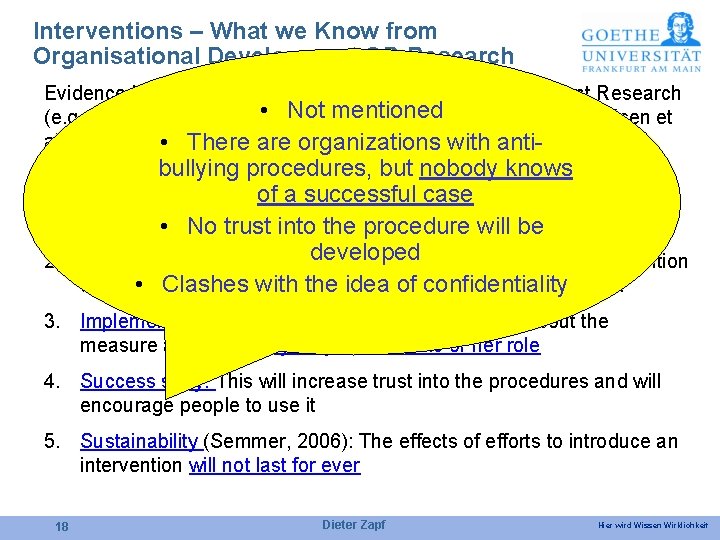
Interventions – What we Know from Organisational Development OD Research Evidence based knowledge from Organisational Development Research • Not mentioned (e. g. , Porras & Robertson, 1992; French & Bell, 1973; see Mikkelsen et al. , 2008) • There are organizations with anti- bullying procedures, but nobody knows 1. Participation in the development and introduction of an intervention. of a successful case Participation increases knowledge about the measure and commitment to use it • No trust into the procedure will be developed 2. Support of top management. If the CEOs do not take the intervention • Clashes with the idea of confidentiality serious, then nobody else will develop trust in the intervention 3. Implementation: Make sure that everybody knows about the measure and that everybody can fulfil his or her role 4. Success story. This will increase trust into the procedures and will encourage people to use it 5. Sustainability (Semmer, 2006): The effects of efforts to introduce an intervention will not last for ever 18 Dieter Zapf Hier wird Wissen Wirklichkeit
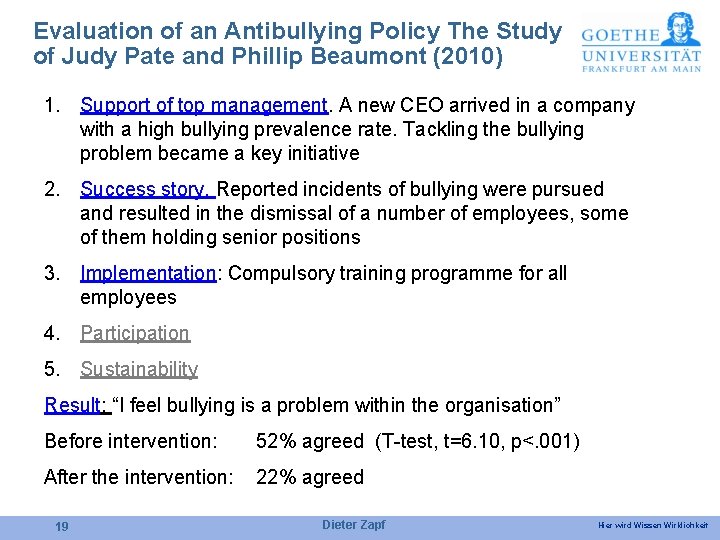
Evaluation of an Antibullying Policy The Study of Judy Pate and Phillip Beaumont (2010) 1. Support of top management. A new CEO arrived in a company with a high bullying prevalence rate. Tackling the bullying problem became a key initiative 2. Success story. Reported incidents of bullying were pursued and resulted in the dismissal of a number of employees, some of them holding senior positions 3. Implementation: Compulsory training programme for all employees 4. Participation 5. Sustainability Result: “I feel bullying is a problem within the organisation” Before intervention: 52% agreed (T-test, t=6. 10, p<. 001) After the intervention: 22% agreed 19 Dieter Zapf Hier wird Wissen Wirklichkeit
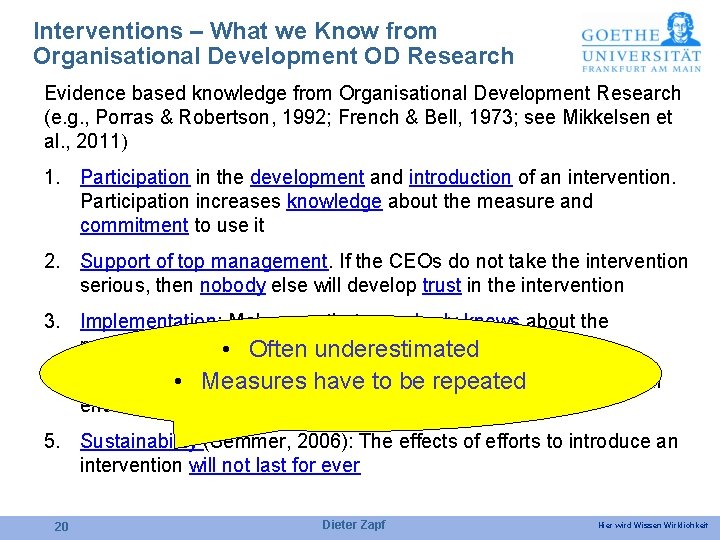
Interventions – What we Know from Organisational Development OD Research Evidence based knowledge from Organisational Development Research (e. g. , Porras & Robertson, 1992; French & Bell, 1973; see Mikkelsen et al. , 2011) 1. Participation in the development and introduction of an intervention. Participation increases knowledge about the measure and commitment to use it 2. Support of top management. If the CEOs do not take the intervention serious, then nobody else will develop trust in the intervention 3. Implementation: Make sure that everybody knows about the measure and that everybody can fulfil his or her role • Often underestimated 4. Success story. This will increase trust into the procedures and will • Measures have to be repeated encourage people to use it 5. Sustainability (Semmer, 2006): The effects of efforts to introduce an intervention will not last for ever 20 Dieter Zapf Hier wird Wissen Wirklichkeit
3. Formal and Informal Procedures 21 Dieter Zapf Hier wird Wissen Wirklichkeit

Formal and Informal Procedures • The procedures suggested to address bullying in the workplace are formal procedures. • Results are suggested to be binding for the parties involved • Therefore: Disciplinary acts may follow as a result of a case • This is a serious thing! • Informal procedures are mentioned. I found it only elaborated in the Irish Code of Practice • I will contrast the formal bullying procedure with a bullying psychotherapy program 22 Dieter Zapf Hier wird Wissen Wirklichkeit
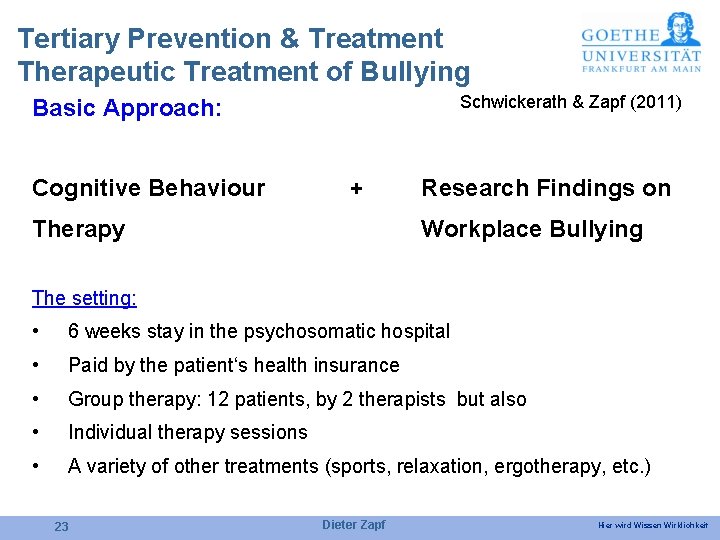
Tertiary Prevention & Treatment Therapeutic Treatment of Bullying Schwickerath & Zapf (2011) Basic Approach: Cognitive Behaviour + Therapy Research Findings on Workplace Bullying The setting: • 6 weeks stay in the psychosomatic hospital • Paid by the patient‘s health insurance • Group therapy: 12 patients, by 2 therapists but also • Individual therapy sessions • A variety of other treatments (sports, relaxation, ergotherapy, etc. ) 23 Dieter Zapf Hier wird Wissen Wirklichkeit
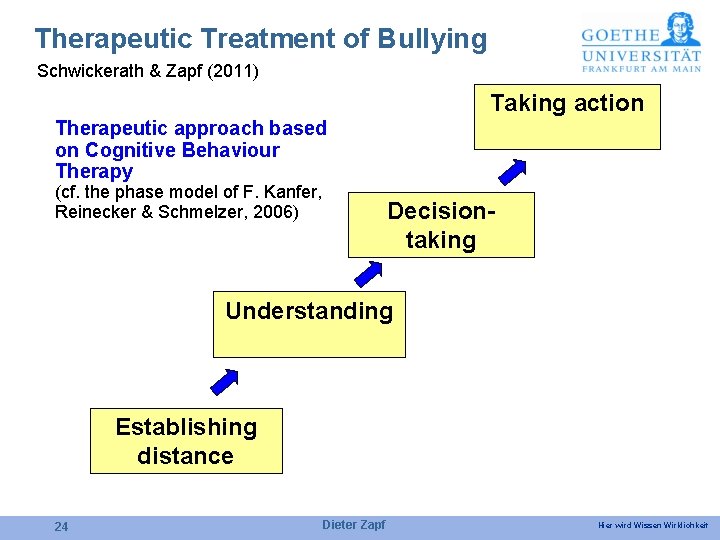
Therapeutic Treatment of Bullying Schwickerath & Zapf (2011) Taking action Therapeutic approach based on Cognitive Behaviour Therapy (cf. the phase model of F. Kanfer, Reinecker & Schmelzer, 2006) Decisiontaking Understanding Establishing distance 24 Dieter Zapf Hier wird Wissen Wirklichkeit
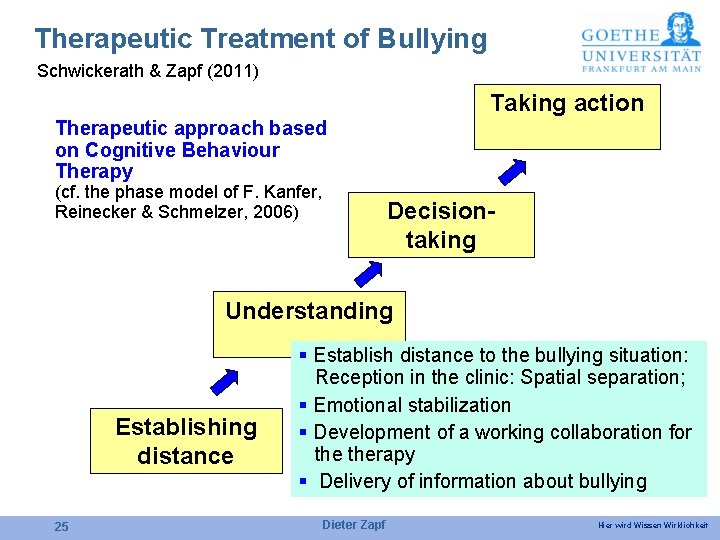
Therapeutic Treatment of Bullying Schwickerath & Zapf (2011) Taking action Therapeutic approach based on Cognitive Behaviour Therapy (cf. the phase model of F. Kanfer, Reinecker & Schmelzer, 2006) Decisiontaking Understanding Establishing distance 25 § Establish distance to the bullying situation: Reception in the clinic: Spatial separation; § Emotional stabilization § Development of a working collaboration for therapy § Delivery of information about bullying Dieter Zapf Hier wird Wissen Wirklichkeit
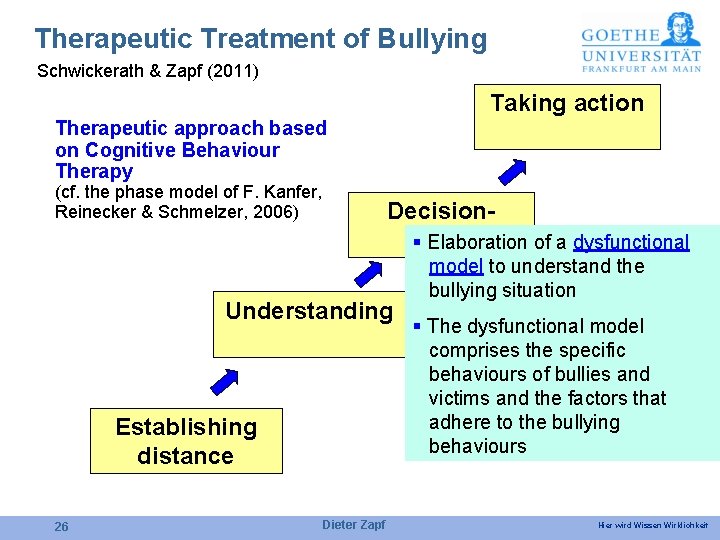
Therapeutic Treatment of Bullying Schwickerath & Zapf (2011) Taking action Therapeutic approach based on Cognitive Behaviour Therapy (cf. the phase model of F. Kanfer, Reinecker & Schmelzer, 2006) Decisiontaking § Elaboration of a dysfunctional Understanding Establishing distance 26 Dieter Zapf model to understand the bullying situation § The dysfunctional model comprises the specific behaviours of bullies and victims and the factors that adhere to the bullying behaviours Hier wird Wissen Wirklichkeit
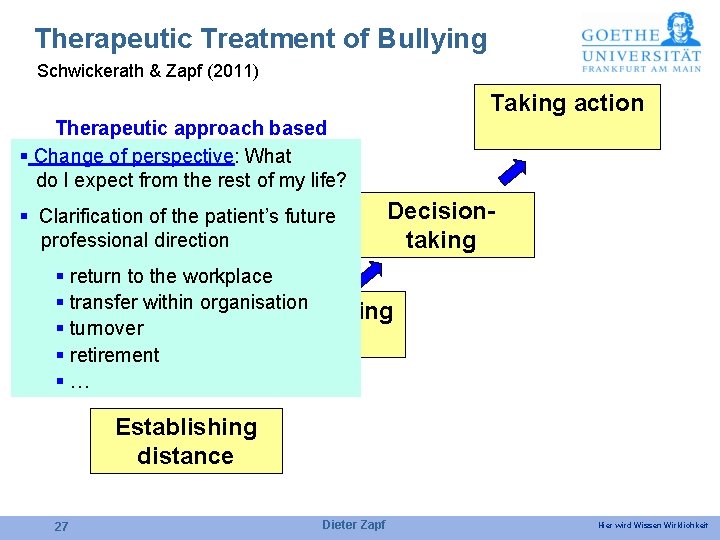
Therapeutic Treatment of Bullying Schwickerath & Zapf (2011) Taking action Therapeutic approach based on Cognitive Behaviour § Change of perspective: What Therapy do I expect from the rest of my life? (cf. the phase model of F. Kanfer, Reinecker & Schmelzer, 2006) § Clarification of the patient’s future professional direction Decisiontaking § return to the workplace § transfer within organisation Understanding § turnover § retirement § … Establishing distance 27 Dieter Zapf Hier wird Wissen Wirklichkeit
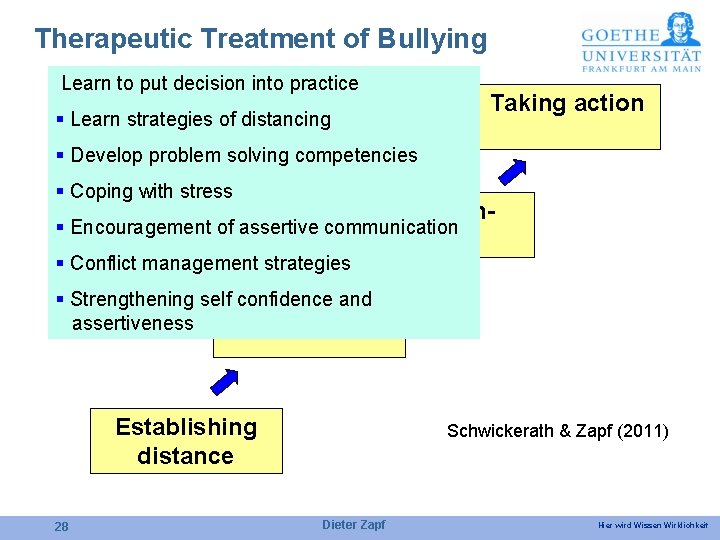
Therapeutic Treatment of Bullying Learn to put decision into practice §Therapeutic Learn strategies of distancing approach based on Cognitive Behaviour § Develop problem solving competencies Therapy § Coping with stress (cf. the phase model of F. Kanfer, Taking action Decision§ Encouragement of assertive communication taking Reinecker & Schmelzer, 2006) § Conflict management strategies § Strengthening self confidence and Understanding assertiveness Establishing distance 28 Schwickerath & Zapf (2011) Dieter Zapf Hier wird Wissen Wirklichkeit
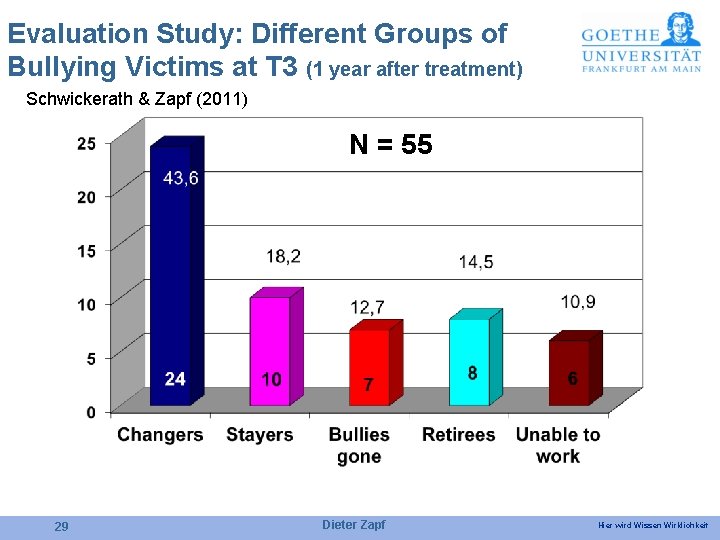
Evaluation Study: Different Groups of Bullying Victims at T 3 (1 year after treatment) Schwickerath & Zapf (2011) N = 55 29 Dieter Zapf Hier wird Wissen Wirklichkeit
Conclusion • Targets are often psychologically in a bad shape. They may feel they cannot stand a confrontation with the perpetrator (in therapy one goal is to regain resources) • Even if a formal bullying procedure is intended to be fair with regard to both sides and even if it intends to support the target if necessary, the target cannot be sure whether this will be so. Therefore, submitting a bullying complaint is a risky endeavour from the victim’s perspective 30 Dieter Zapf Hier wird Wissen Wirklichkeit
Conclusion • Because of these reasons, only later in therapy process a decision is made what the target wants to do: • Should I stay in the same organisation or should I leave? • Will there be a way of living with the perpetrator or will it be impossible to repair the psychological harm done? • Should I use formal or legal means and act against the perpetrator? • Will I be able to live with the outcome of these procedures? • Can I be sure that I will not be bullied even more afterwards? • In practice the difficulty of this decision is often not taken seriously enough • Instead, victims are pressured to use formal or legal means 31 Dieter Zapf Hier wird Wissen Wirklichkeit
Conclusion • In every organisation there is a strong need for informal procedures • Trained counsellor who • Is independent. That is, he or she is not obliged to report to the management, HR, workers representatives etc. • Listens to the victim • will do nothing if the victim wishes so • Tries to help the victim to come up with a decision what to do • • • 32 start a mediation process Submit a bullying complaint Seek therapeutic help Talk to perpetrator (again), supervisor, workers representatives Leave the bullying situation Dieter Zapf Hier wird Wissen Wirklichkeit
Glasl‘s (1982) Model of Conflict Escalation And Conflict Management Strategies From Zapf & Gross (2001). European Journal of Work & Organizational Psychology 33 Dieter Zapf Hier wird Wissen Wirklichkeit
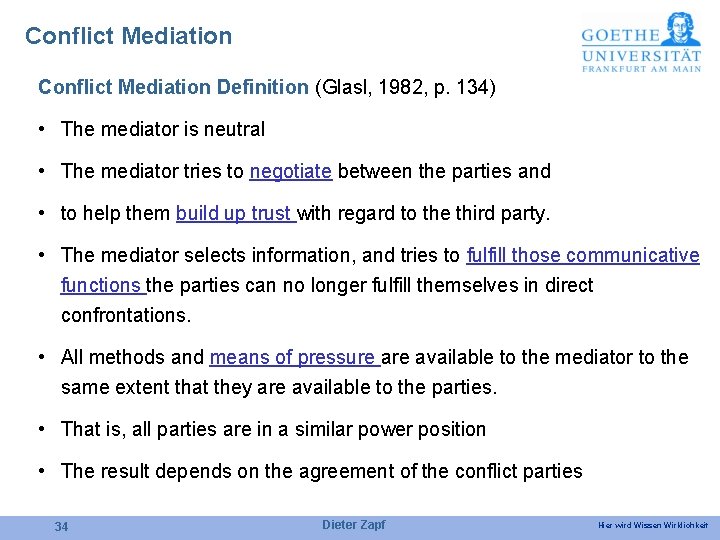
Conflict Mediation Definition (Glasl, 1982, p. 134) • The mediator is neutral • The mediator tries to negotiate between the parties and • to help them build up trust with regard to the third party. • The mediator selects information, and tries to fulfill those communicative functions the parties can no longer fulfill themselves in direct confrontations. • All methods and means of pressure available to the mediator to the same extent that they are available to the parties. • That is, all parties are in a similar power position • The result depends on the agreement of the conflict parties 34 Dieter Zapf Hier wird Wissen Wirklichkeit
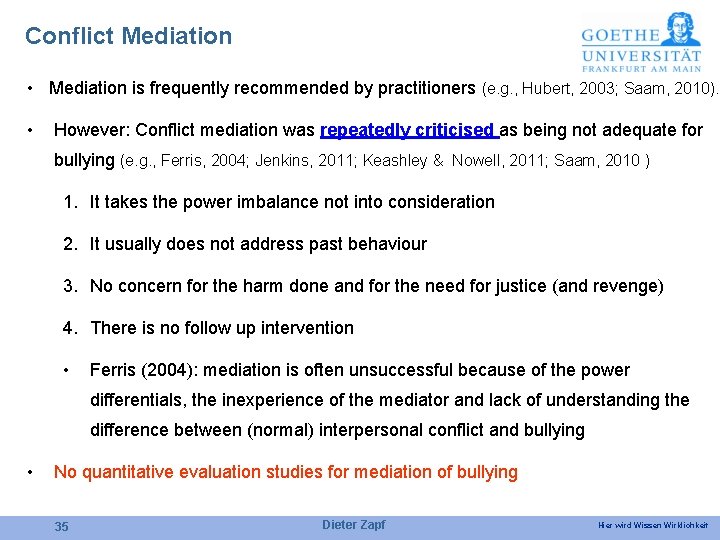
Conflict Mediation • Mediation is frequently recommended by practitioners (e. g. , Hubert, 2003; Saam, 2010). • However: Conflict mediation was repeatedly criticised as being not adequate for bullying (e. g. , Ferris, 2004; Jenkins, 2011; Keashley & Nowell, 2011; Saam, 2010 ) 1. It takes the power imbalance not into consideration 2. It usually does not address past behaviour 3. No concern for the harm done and for the need for justice (and revenge) 4. There is no follow up intervention • Ferris (2004): mediation is often unsuccessful because of the power differentials, the inexperience of the mediator and lack of understanding the difference between (normal) interpersonal conflict and bullying • No quantitative evaluation studies for mediation of bullying 35 Dieter Zapf Hier wird Wissen Wirklichkeit
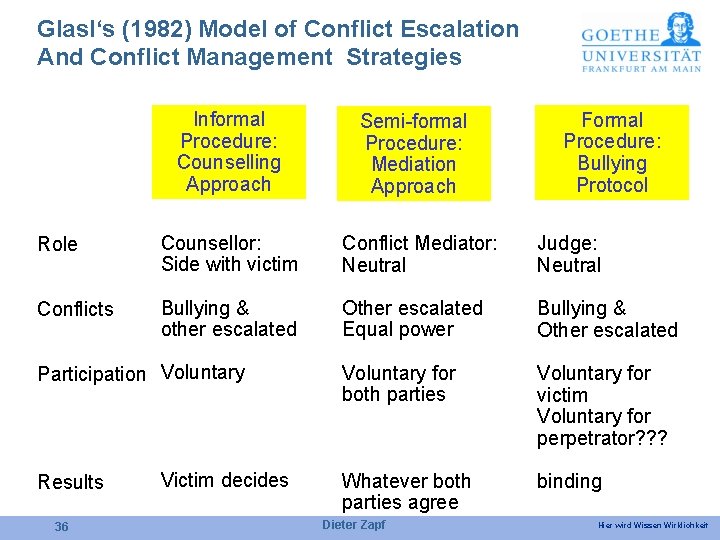
Glasl‘s (1982) Model of Conflict Escalation And Conflict Management Strategies Informal Procedure: Counselling Approach Semi-formal Procedure: Mediation Approach Role Counsellor: Side with victim Conflict Mediator: Neutral Judge: Neutral Conflicts Bullying & other escalated Other escalated Equal power Bullying & Other escalated Voluntary for both parties Voluntary for victim Voluntary for perpetrator? ? ? Whatever both parties agree binding Participation Voluntary Results 36 Victim decides Dieter Zapf Formal Procedure: Bullying Protocol Hier wird Wissen Wirklichkeit
! Gracias por su atención Thank you for Your Attention! Vielen Dank für Ihre Aufmerksamkeit 37 Dieter Zapf Hier wird Wissen Wirklichkeit
- Slides: 37