
CONFINEMENT EFFECT IN A THICK LAYER OF NEMATIC
- Slides: 1
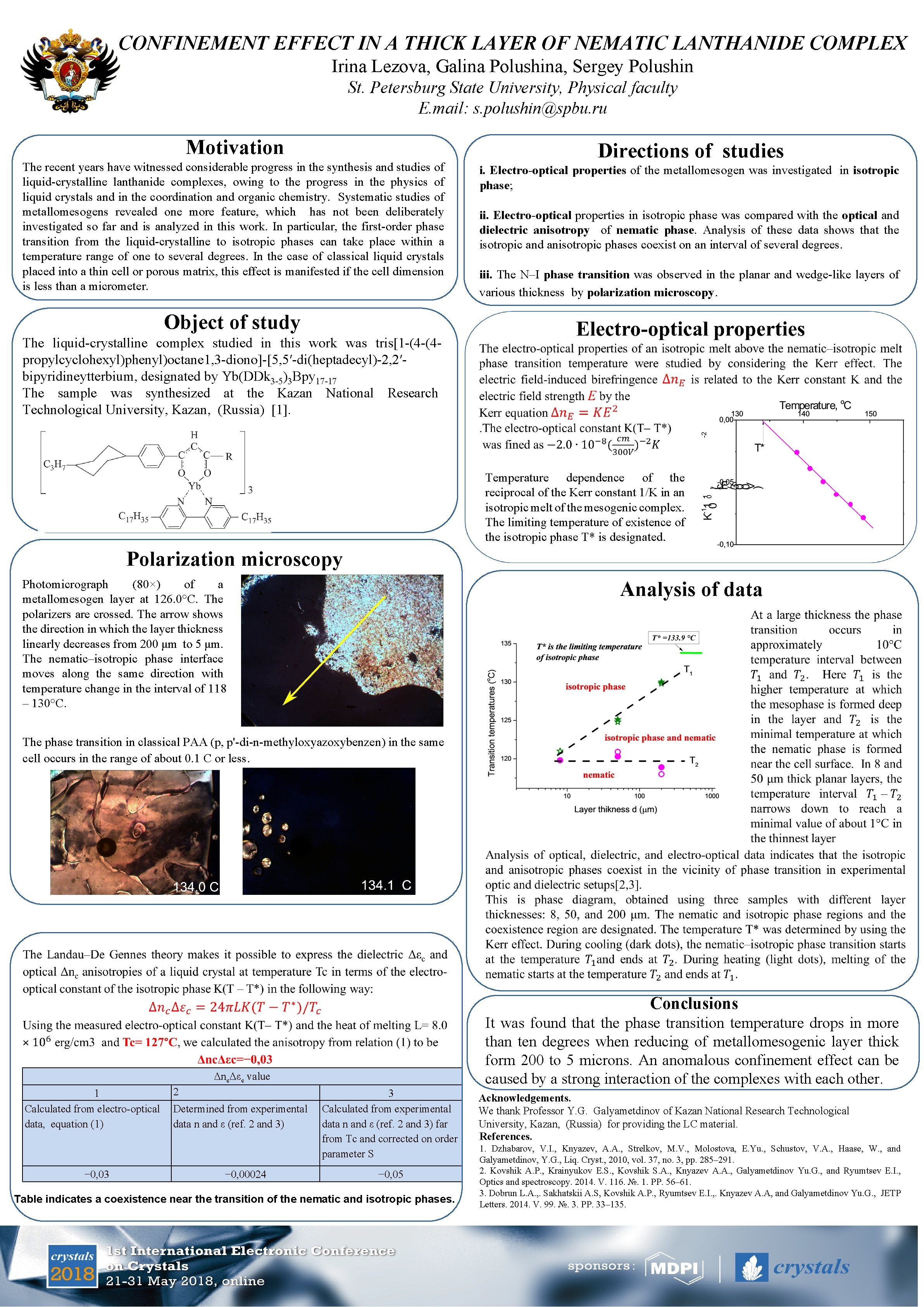
CONFINEMENT EFFECT IN A THICK LAYER OF NEMATIC LANTHANIDE COMPLEX Irina Lezova, Galina Polushina, Sergey Polushin St. Petersburg State University, Physical faculty E. mail: s. polushin@spbu. ru Motivation The recent years have witnessed considerable progress in the synthesis and studies of liquid-crystalline lanthanide complexes, owing to the progress in the physics of liquid crystals and in the coordination and organic chemistry. Systematic studies of metallomesogens revealed one more feature, which has not been deliberately investigated so far and is analyzed in this work. In particular, the first-order phase transition from the liquid-crystalline to isotropic phases can take place within a temperature range of one to several degrees. In the case of classical liquid crystals placed into a thin cell or porous matrix, this effect is manifested if the cell dimension is less than a micrometer. Directions of studies i. Electro-optical properties of the metallomesogen was investigated in isotropic phase; ii. Electro-optical properties in isotropic phase was compared with the optical and dielectric anisotropy of nematic phase. Analysis of these data shows that the isotropic and anisotropic phases coexist on an interval of several degrees. iii. The N–I phase transition was observed in the planar and wedge-like layers of various thickness by polarization microscopy. Object of study The liquid-crystalline complex studied in this work was tris[1 -(4 -(4 propylcyclohexyl)phenyl)octane 1, 3 -diono]-[5, 5′-di(heptadecyl)-2, 2′bipyridineytterbium, designated by Yb(DDk 3 -5)3 Bpy 17 -17 The sample was synthesized at the Kazan National Research Technological University, Kazan, (Russia) [1]. where R=CH 3–C 8 H 17. Temperature dependence of the reciprocal of the Kerr constant 1/K in an isotropic melt of the mesogenic complex. The limiting temperature of existence of the isotropic phase T* is designated. Polarization microscopy Photomicrograph (80×) of a metallomesogen layer at 126. 0°С. The polarizers are crossed. The arrow shows the direction in which the layer thickness linearly decreases from 200 μm to 5 μm. The nematic–isotropic phase interface moves along the same direction with temperature change in the interval of 118 – 130°C. Analysis of data The phase transition in classical PAA (p, p'-di-n-methyloxyazoxybenzen) in the same cell occurs in the range of about 0. 1 C or less. Conclusions It was found that the phase transition temperature drops in more than ten degrees when reducing of metallomesogenic layer thick form 200 to 5 microns. An anomalous confinement effect can be caused by a strong interaction of the complexes with each other. ΔnсΔεс value 1 Calculated from electro-optical data, equation (1) − 0, 03 2 Determined from experimental data n and ε (ref. 2 and 3) − 0, 00024 3 Calculated from experimental data n and ε (ref. 2 and 3) far from Tc and corrected on order parameter S − 0, 05 Table indicates a coexistence near the transition of the nematic and isotropic phases. Acknowledgements. We thank Professor Y. G. Galyametdinov of Kazan National Research Technological University, Kazan, (Russia) for providing the LC material. References. 1. Dzhabarov, V. I. , Knyazev, A. A. , Strelkov, M. V. , Molostova, E. Yu. , Schustov, V. A. , Haase, W. , and Galyametdinov, Y. G. , Liq. Cryst. , 2010, vol. 37, no. 3, pp. 285– 291. 2. Kovshik A. P. , Krainyukov E. S. , Kovshik S. A. , Knyazev A. A. , Galyametdinov Yu. G. , and Ryumtsev E. I. , Optics and spectroscopy. 2014. V. 116. №. 1. PP. 56– 61. 3. Dobrun L. A. , . Sakhatskii A. S, Kovshik A. P. , Ryumtsev E. I. , . Knyazev A. A, and Galyametdinov Yu. G. , JETP Letters. 2014. V. 99. №. 3. PP. 33– 135.