
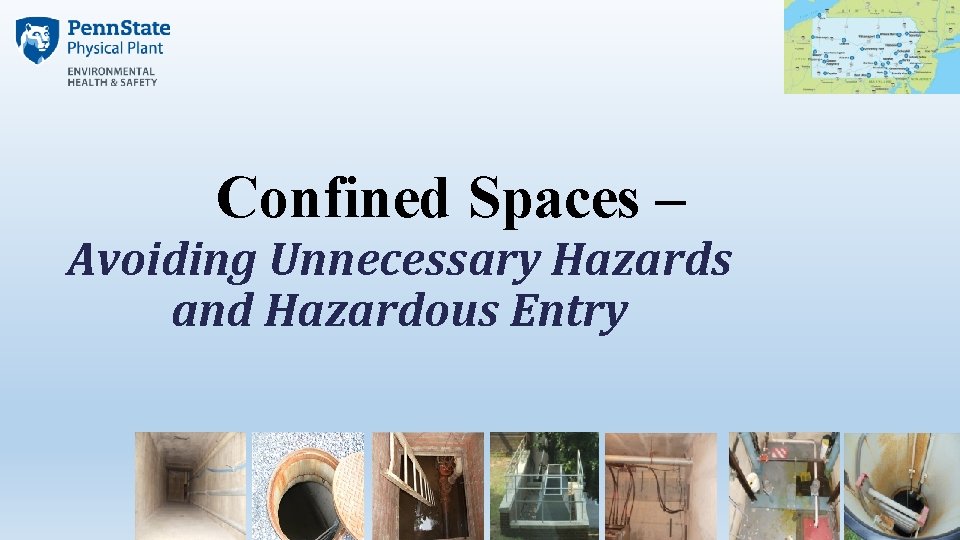
Confined Spaces Avoiding Unnecessary Hazards and Hazardous Entry

- Slides: 55
Confined Spaces – Avoiding Unnecessary Hazards and Hazardous Entry
Agenda • Objectives • Confined Spaces - Dangerous workplaces • What is a “Confined Space” according to OSHA? • Permit-Required Confined Space (PRCS) • Confined Space Hazards 101 • Penn State Examples • Confined Spaces at Penn State – A Real Concern? • Penn State Confined Spaces (by Organization) • Penn State Confined Space Program • OSHA Requirements for Employers and Contractors • Questions/ Comments
Objectives • Recognize varied types of Penn State confined spaces. • Recognize Penn State organizations that “own” or work with confined spaces. • Understand OSHA definition for “confined space”, and “permit-required confined space. ” • Recognize life-threatening hazards related to confined space work. • Recognize proper work requirements for “permit-required” confined spaces. • Understand OSHA requirements for employers, employees, and Contractors. • Understand access Penn State’s confined space program, and contacts for answers and assistance regarding Penn State confined spaces.
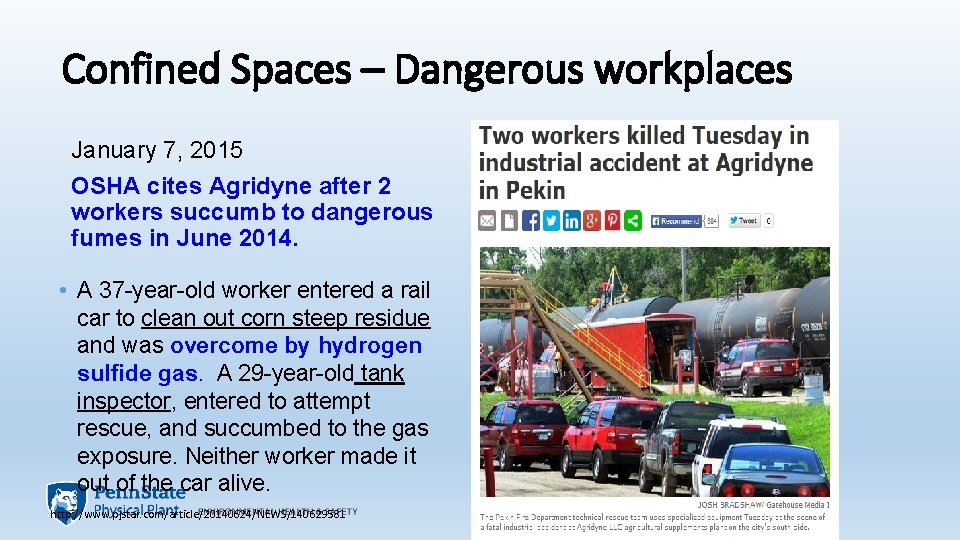
Confined Spaces – Dangerous workplaces January 7, 2015 OSHA cites Agridyne after 2 workers succumb to dangerous fumes in June 2014. • A 37 -year-old worker entered a rail car to clean out corn steep residue and was overcome by hydrogen sulfide gas. A 29 -year-old tank inspector, entered to attempt rescue, and succumbed to the gas exposure. Neither worker made it out of the car alive. http: //www. pjstar. com/article/20140624/NEWS/140629581
Confined Spaces – Dangerous workplaces Dec. 9, 2014 Latino worker dies following exposure to nitrogen in tanker truck at Michael Foods' Big Red Farms facility in Wakefield, Nebraska. • The 23 -year-old Latino worker was found unresponsive in a tanker truck at the company's Big Red Farms facility. He was conducting sampling of the tank, which contained egg products and nitrogen. . .
Confined Spaces – Dangerous workplaces Feb. 12, 2014 Serious workplace safety violations were found in connection with the September 2013 explosion at the Canastota Wastewater Treatment Plant that killed one worker and injured another. • Joy Process Mechanical Inc. of East Syracuse and M. Hubbard Construction Inc. of Mottville were hired by the plant to replace piping inside a methane gas dome, a confined space. The Joy Process Mechanical worker was welding inside the dome when the explosion occurred, burning him and a Hubbard Construction worker who was standing atop a stepladder opening to the confined space.
Confined Spaces – Dangerous workplaces What were possible causes for these tragedies?
Confined Spaces – Dangerous workplaces What were possible causes for these tragedies? • Lack of awareness
Confined Spaces – Dangerous workplaces What were possible causes for these tragedies? • Lack of awareness • Lack of effective education and training
Confined Spaces – Dangerous workplaces What were possible causes for these tragedies? • Lack of awareness • Lack of effective education and training • Lack of preparation
Confined Spaces – Dangerous workplaces What were possible causes for these tragedies? • Lack of awareness • Lack of effective education and training • Lack of preparation • Unknown or changing conditions
Confined Spaces – Dangerous workplaces What were possible causes for these tragedies? • Lack of awareness • Lack of effective education and training • Lack of preparation • Unknown or changing conditions These tragedies were not anticipated!
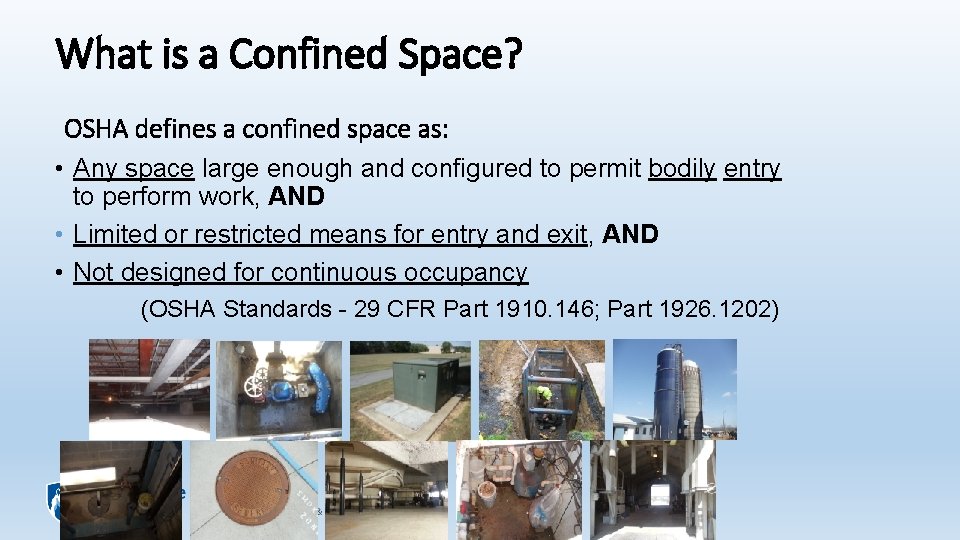
What is a Confined Space? OSHA defines a confined space as: • Any space large enough and configured to permit bodily entry to perform work, AND • Limited or restricted means for entry and exit, AND • Not designed for continuous occupancy (OSHA Standards - 29 CFR Part 1910. 146; Part 1926. 1202)
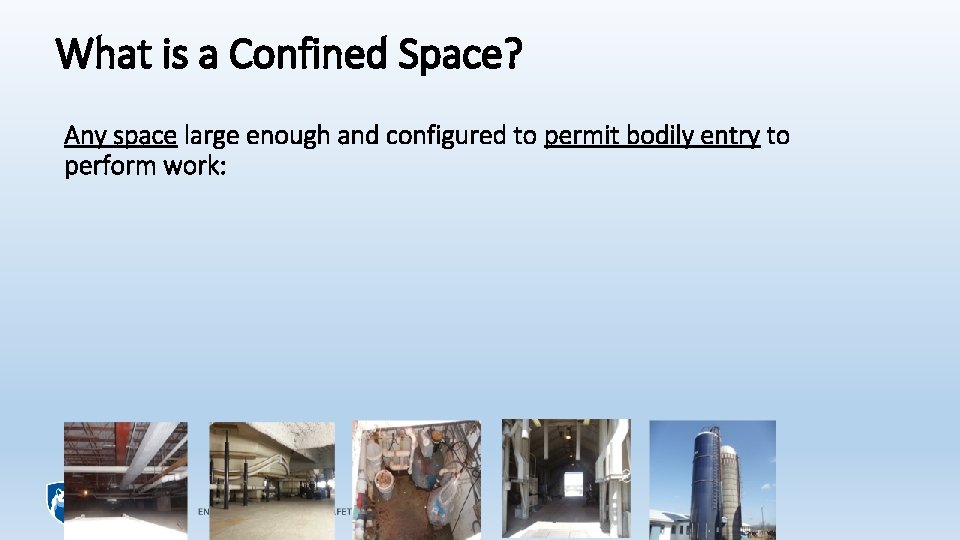
What is a Confined Space? Any space large enough and configured to permit bodily entry to perform work:
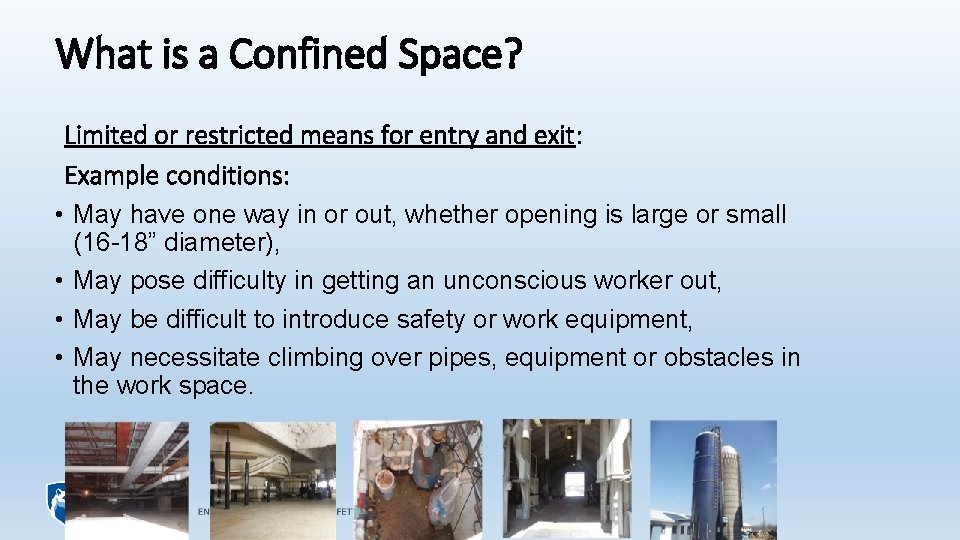
What is a Confined Space? Limited or restricted means for entry and exit: Example conditions: • May have one way in or out, whether opening is large or small (16 -18” diameter), • May pose difficulty in getting an unconscious worker out, • May be difficult to introduce safety or work equipment, • May necessitate climbing over pipes, equipment or obstacles in the work space.
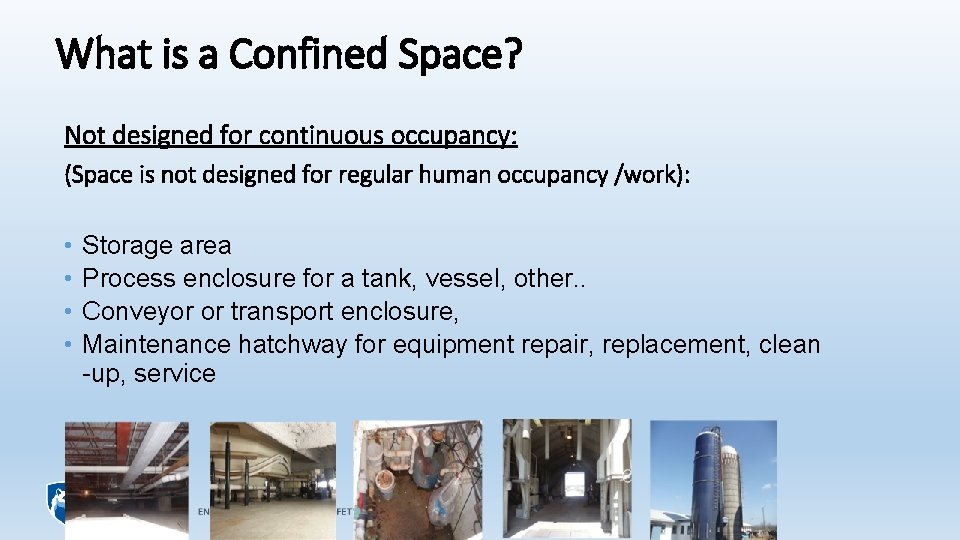
What is a Confined Space? Not designed for continuous occupancy: (Space is not designed for regular human occupancy /work): • • Storage area Process enclosure for a tank, vessel, other. . Conveyor or transport enclosure, Maintenance hatchway for equipment repair, replacement, clean -up, service
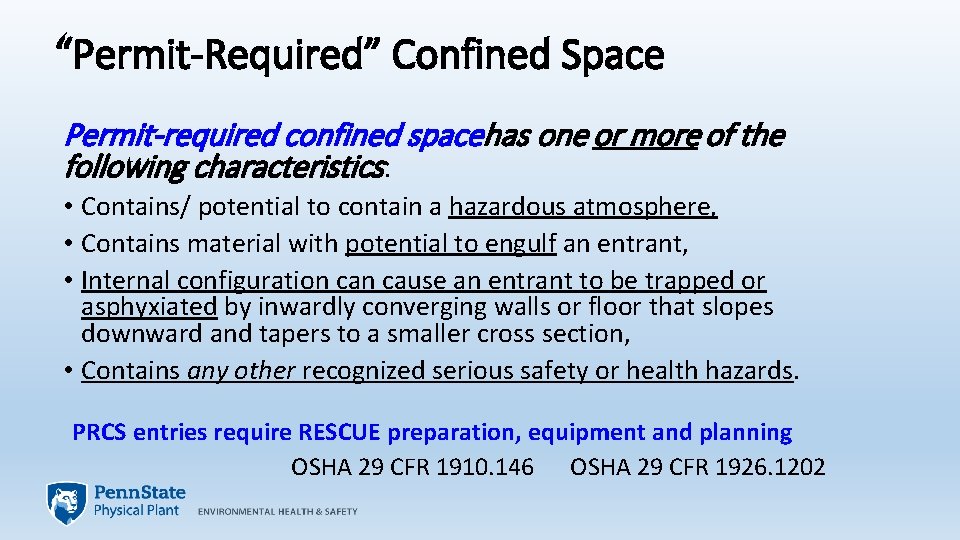
“Permit-Required” Confined Space Permit-required confined spacehas one or more of the following characteristics: • Contains/ potential to contain a hazardous atmosphere, • Contains material with potential to engulf an entrant, • Internal configuration cause an entrant to be trapped or asphyxiated by inwardly converging walls or floor that slopes downward and tapers to a smaller cross section, • Contains any other recognized serious safety or health hazards. PRCS entries require RESCUE preparation, equipment and planning OSHA 29 CFR 1910. 146 OSHA 29 CFR 1926. 1202
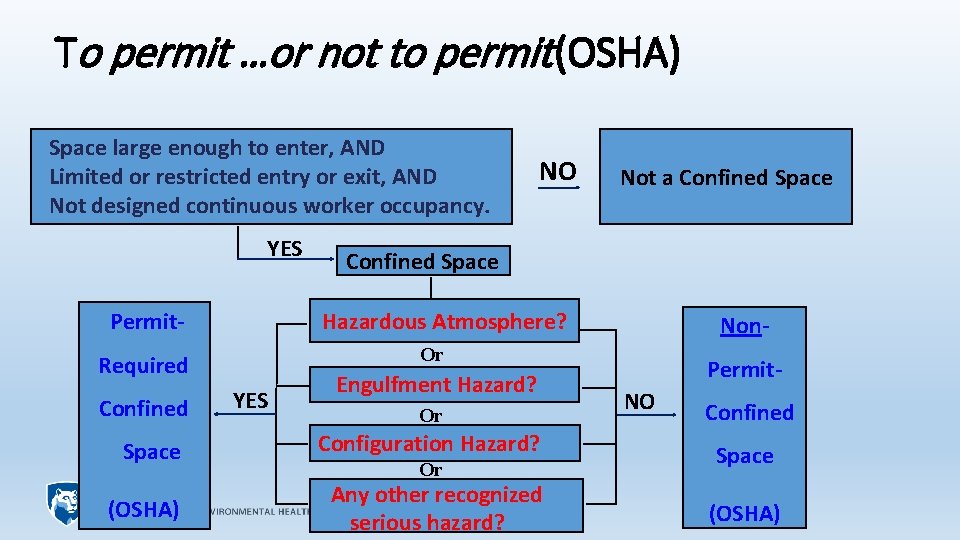
To permit …or not to permit (OSHA) Space large enough to enter, AND Limited or restricted entry or exit, AND Not designed continuous worker occupancy. YES Not a Confined Space Hazardous Atmosphere? Permit- Non- Or Required Confined NO YES Engulfment Hazard? Or Space Configuration Hazard? (OSHA) Any other recognized serious hazard? Or Permit. NO Confined Space (OSHA)
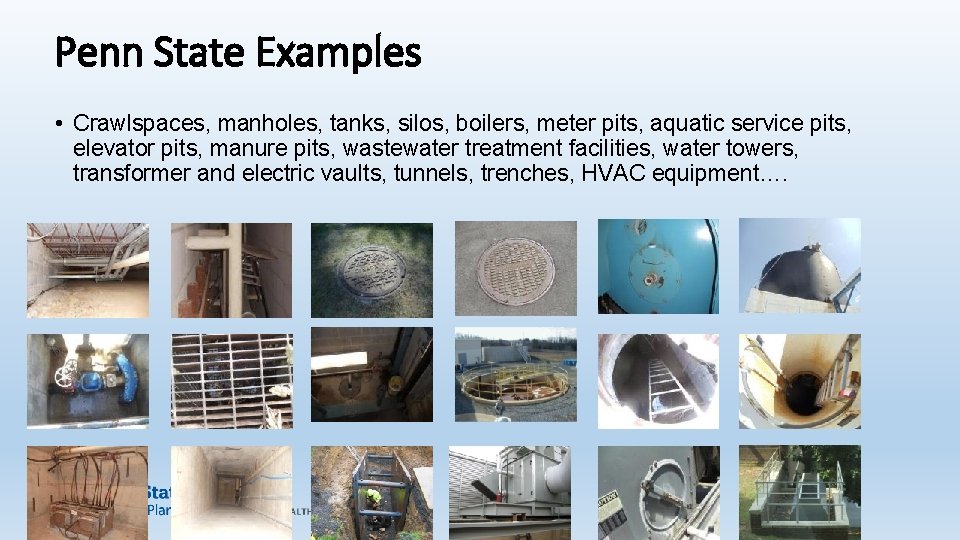
Penn State Examples • Crawlspaces, manholes, tanks, silos, boilers, meter pits, aquatic service pits, elevator pits, manure pits, wastewater treatment facilities, water towers, transformer and electric vaults, tunnels, trenches, HVAC equipment….
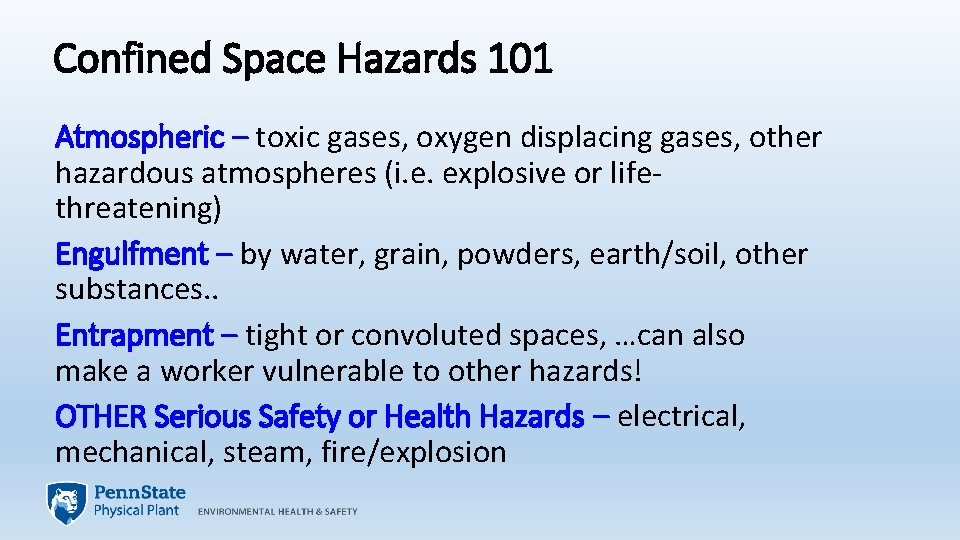
Confined Space Hazards 101 Atmospheric – toxic gases, oxygen displacing gases, other hazardous atmospheres (i. e. explosive or lifethreatening) Engulfment – by water, grain, powders, earth/soil, other substances. . Entrapment – tight or convoluted spaces, …can also make a worker vulnerable to other hazards! OTHER Serious Safety or Health Hazards – electrical, mechanical, steam, fire/explosion
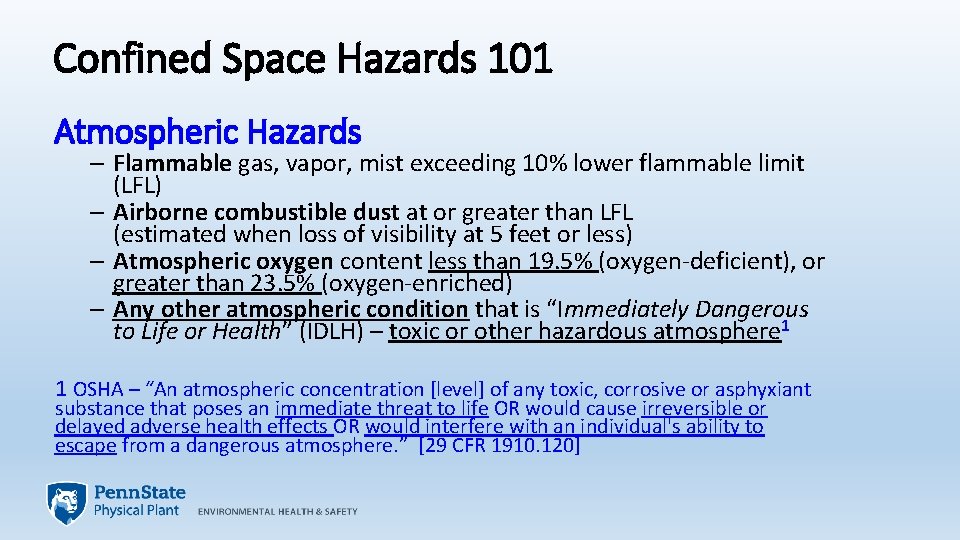
Confined Space Hazards 101 Atmospheric Hazards – Flammable gas, vapor, mist exceeding 10% lower flammable limit (LFL) – Airborne combustible dust at or greater than LFL (estimated when loss of visibility at 5 feet or less) – Atmospheric oxygen content less than 19. 5% (oxygen-deficient), or greater than 23. 5% (oxygen-enriched) – Any other atmospheric condition that is “Immediately Dangerous to Life or Health” (IDLH) – toxic or other hazardous atmosphere 1 1 OSHA – “An atmospheric concentration [level] of any toxic, corrosive or asphyxiant substance that poses an immediate threat to life OR would cause irreversible or delayed adverse health effects OR would interfere with an individual's ability to escape from a dangerous atmosphere. ” [29 CFR 1910. 120]
Confined Space Hazards 101 Atmospheric Hazards Created by: • Lack of air movement into and through the space – gases or vapors can build up. • Toxic or deadly gases can have a different density than air – forming a toxic layer, or displacing air in the space. • Organic materials can decompose to create toxic gases – using up oxygen from the air in the space. • Gases, vapors, or fine dusts can become explosive in the right concentration – become easily ignited. • Nearby vehicles, emergency generators produce carbon monoxide – can infiltrate a nearby space.
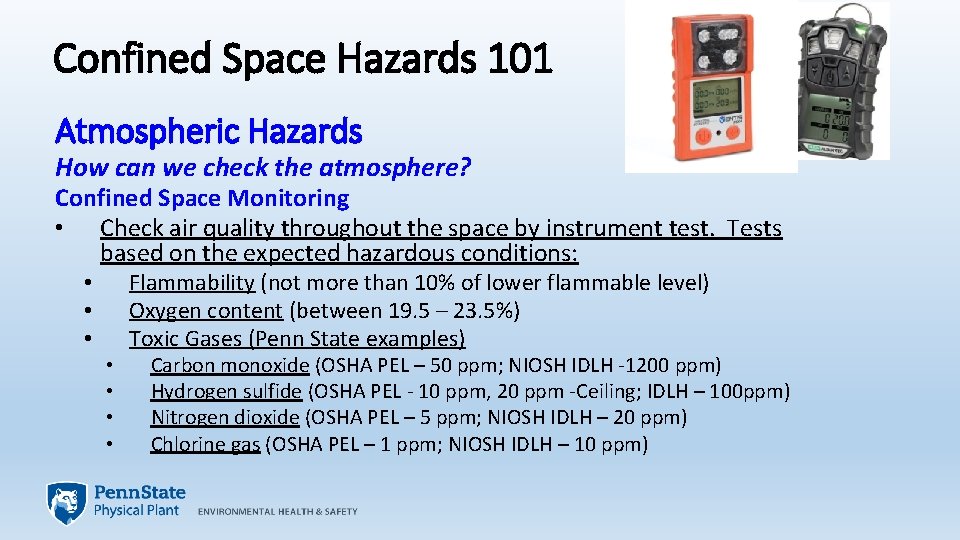
Confined Space Hazards 101 Atmospheric Hazards How can we check the atmosphere? Confined Space Monitoring • Check air quality throughout the space by instrument test. Tests based on the expected hazardous conditions: • • Flammability (not more than 10% of lower flammable level) Oxygen content (between 19. 5 – 23. 5%) Toxic Gases (Penn State examples) Carbon monoxide (OSHA PEL – 50 ppm; NIOSH IDLH -1200 ppm) Hydrogen sulfide (OSHA PEL - 10 ppm, 20 ppm -Ceiling; IDLH – 100 ppm) Nitrogen dioxide (OSHA PEL – 5 ppm; NIOSH IDLH – 20 ppm) Chlorine gas (OSHA PEL – 1 ppm; NIOSH IDLH – 10 ppm)
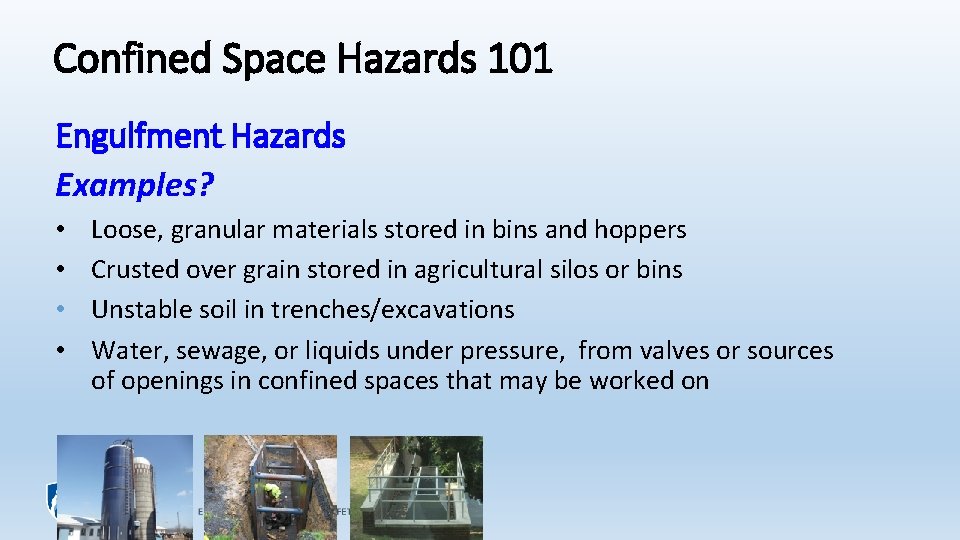
Confined Space Hazards 101 Engulfment Hazards Examples? • • Loose, granular materials stored in bins and hoppers Crusted over grain stored in agricultural silos or bins Unstable soil in trenches/excavations Water, sewage, or liquids under pressure, from valves or sources of openings in confined spaces that may be worked on
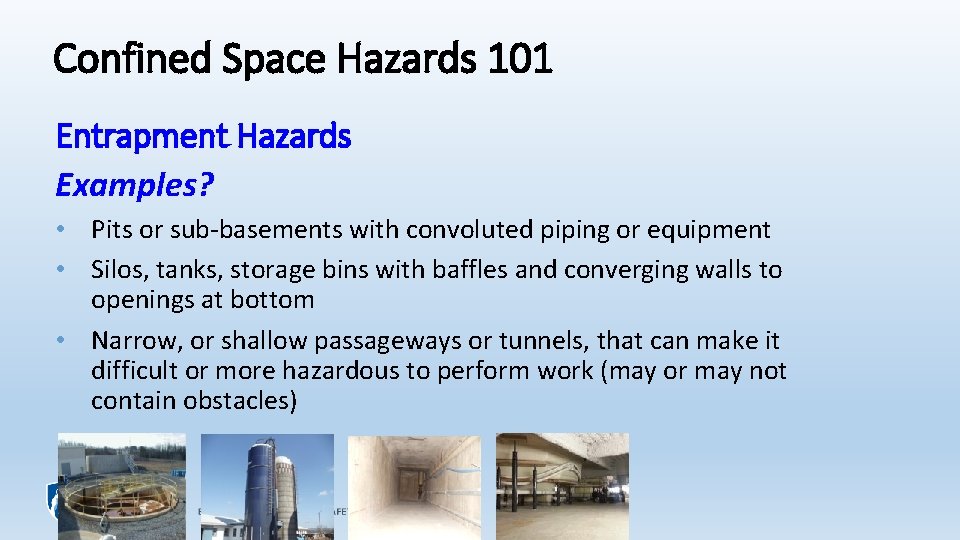
Confined Space Hazards 101 Entrapment Hazards Examples? • Pits or sub-basements with convoluted piping or equipment • Silos, tanks, storage bins with baffles and converging walls to openings at bottom • Narrow, or shallow passageways or tunnels, that can make it difficult or more hazardous to perform work (may or may not contain obstacles)
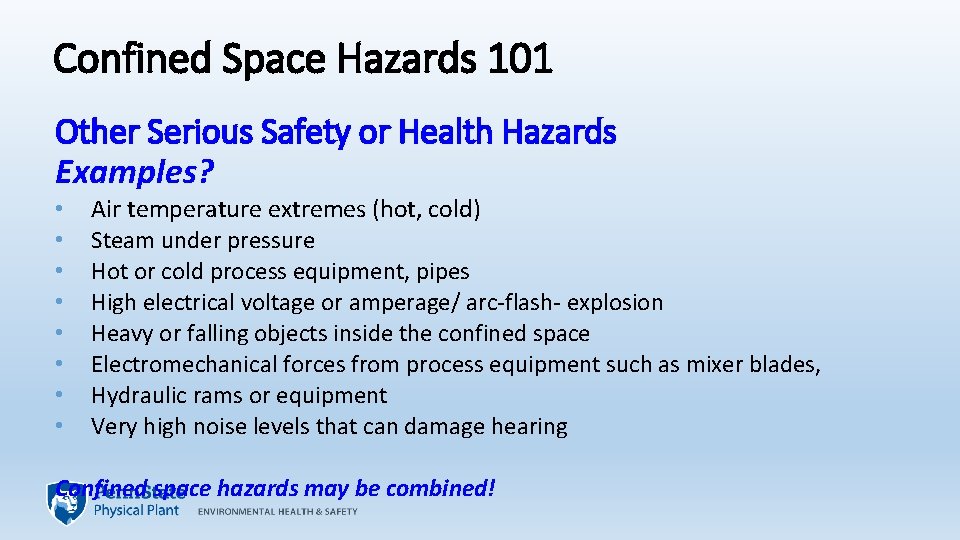
Confined Space Hazards 101 Other Serious Safety or Health Hazards Examples? • • Air temperature extremes (hot, cold) Steam under pressure Hot or cold process equipment, pipes High electrical voltage or amperage/ arc-flash- explosion Heavy or falling objects inside the confined space Electromechanical forces from process equipment such as mixer blades, Hydraulic rams or equipment Very high noise levels that can damage hearing Confined space hazards may be combined!
Confined Spaces at Penn State – A real concern?
Confined Spaces at Penn State – A real concern? • Frequent new construction/ renovation
Confined Spaces at Penn State – A real concern? • Frequent new construction/ renovation • Different groups: OPP Tech Services, Housing & Foods, Campus Housing, Campus Maintenance, Contractors
Confined Spaces at Penn State – A real concern? • Frequent new construction/ renovation • Different groups: OPP Tech Services, Housing & Foods, Campus Housing, Campus Maintenance, Contractors • Different types of confined spaces
Confined Spaces at Penn State – A real concern? • Frequent new construction/ renovation • Different groups: OPP Tech Services, Housing & Foods, Campus Housing, Campus Maintenance, Contractors • Different types of confined spaces • Life-threatening hazards • Electrical, mechanical, engulfment, entrapment, hazardous gases, . . asphyxiation (lack of oxygen)
Confined Spaces at Penn State – A real concern? Other potential impacts to Penn State if persons are hurt, . . . lives are lost?
Confined Spaces at Penn State – A real concern? Other potential impacts to Penn State if persons are hurt, . . . lives are lost? • Regulatory fines (OSHA) • Increased insurance cost • Increased inspections • Reduced employee morale • Penn State credibility
Confined Spaces at Penn State – Primary Organizations • • • Office of Physical Plant Campuses College of Agriculture Transmission & Network Services Auxiliary & Business Services Applied Research Laboratory Contact Facility Coordinators/Safety Officers at U/Park, or Contact Campus Directors of Business Services, Maint. Supervisors Contact EHS (5 -6391) for information or support.
Confined Spaces at Penn State – A real concern? What should we do to keep ourselves safe?
Confined Spaces at Penn State – A real concern? What should we do to keep ourselves safe? • Be aware of potential hazards • Training • Preparation (for the job, for rescue. . ) • Use correct equipment • Monitor potential dangerous atmospheres • Do not enter confined spaces without proper training, preparation, equipment, authorization and supervision.
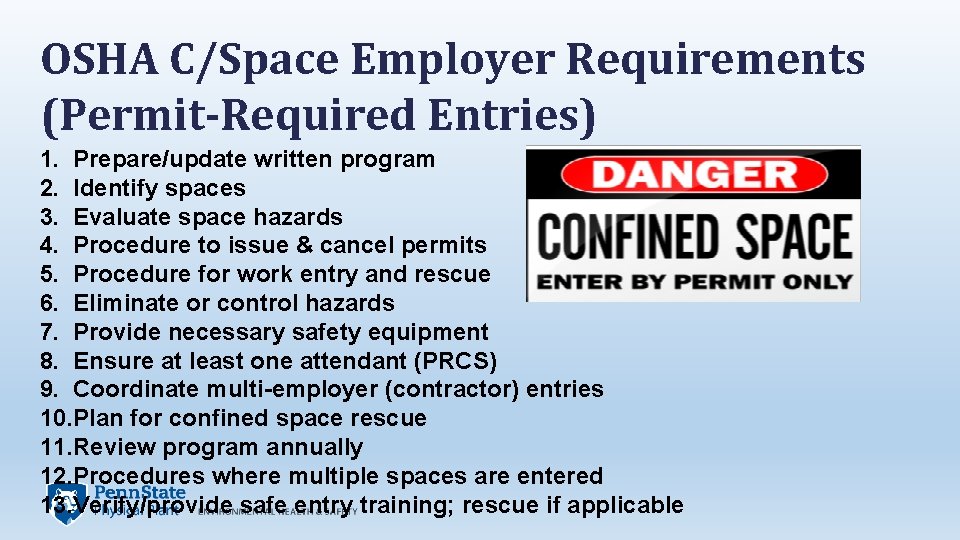
OSHA C/Space Employer Requirements (Permit-Required Entries) 1. Prepare/update written program 2. Identify spaces 3. Evaluate space hazards 4. Procedure to issue & cancel permits 5. Procedure for work entry and rescue 6. Eliminate or control hazards 7. Provide necessary safety equipment 8. Ensure at least one attendant (PRCS) 9. Coordinate multi-employer (contractor) entries 10. Plan for confined space rescue 11. Review program annually 12. Procedures where multiple spaces are entered 13. Verify/provide safe entry training; rescue if applicable
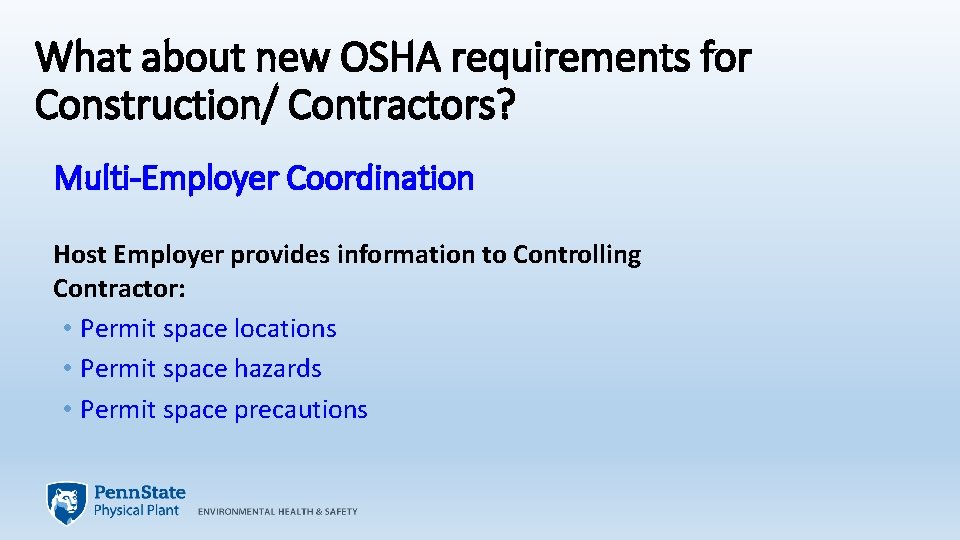
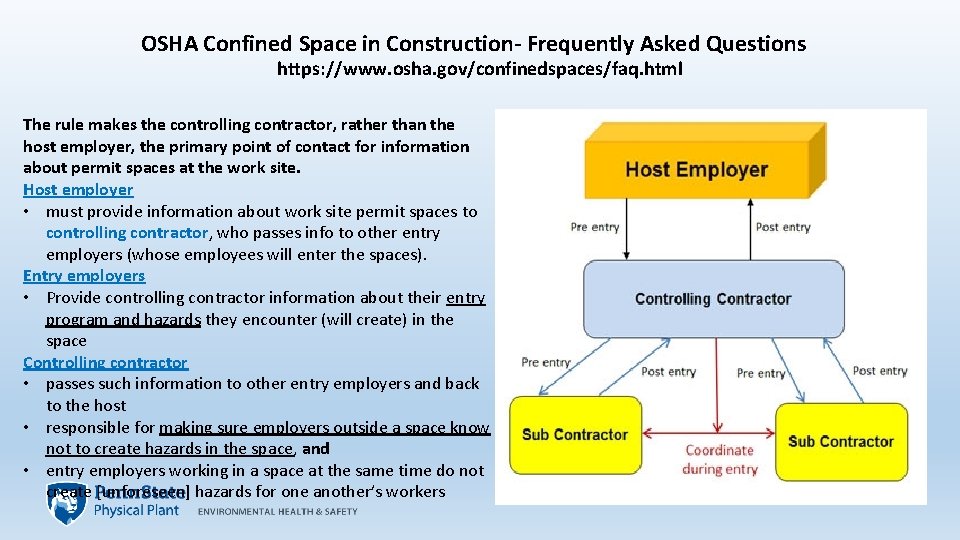
What about new OSHA requirements for Construction/ Contractors? Multi-Employer Coordination Host Employer provides information to Controlling Contractor: • Permit space locations • Permit space hazards • Permit space precautions
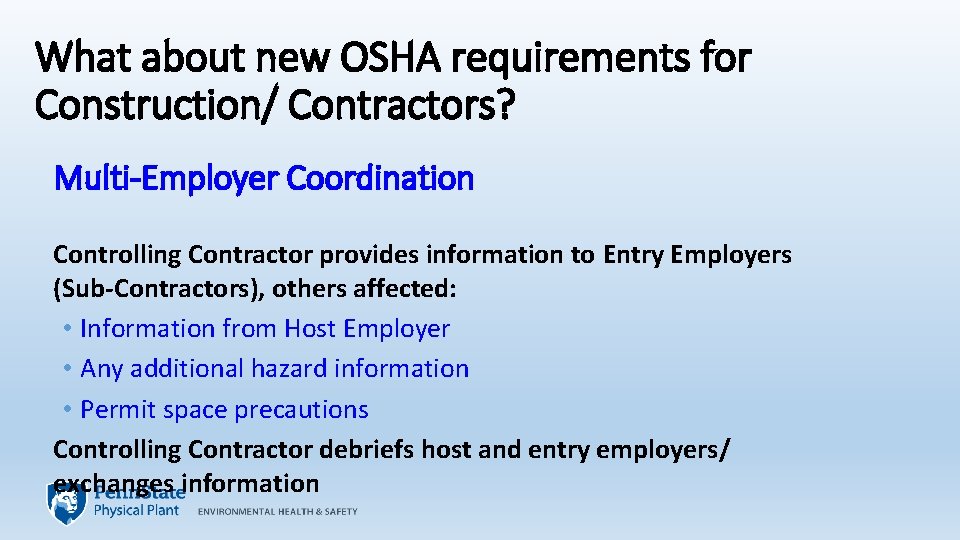
What about new OSHA requirements for Construction/ Contractors? Multi-Employer Coordination Controlling Contractor provides information to Entry Employers (Sub-Contractors), others affected: • Information from Host Employer • Any additional hazard information • Permit space precautions Controlling Contractor debriefs host and entry employers/ exchanges information
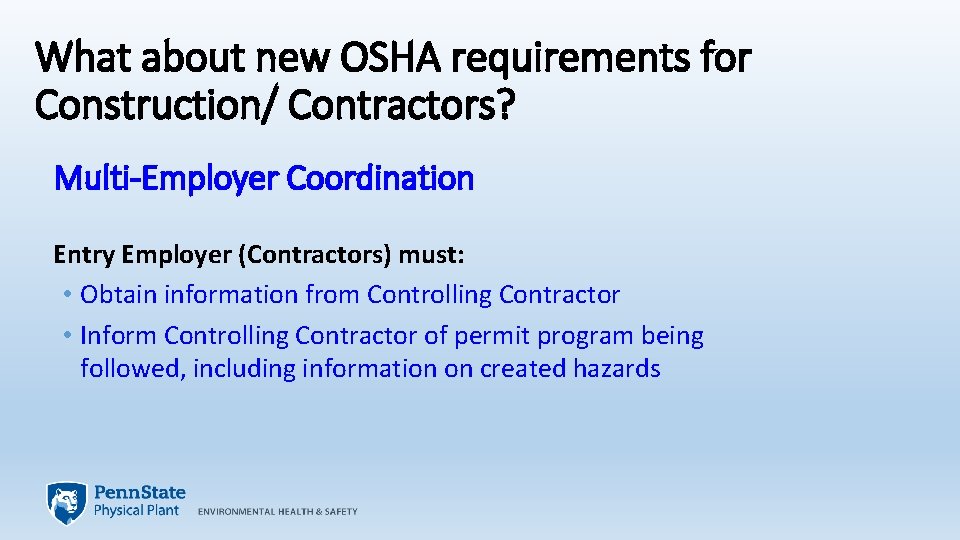
What about new OSHA requirements for Construction/ Contractors? Multi-Employer Coordination Entry Employer (Contractors) must: • Obtain information from Controlling Contractor • Inform Controlling Contractor of permit program being followed, including information on created hazards
OSHA Confined Space in Construction- Frequently Asked Questions https: //www. osha. gov/confinedspaces/faq. html The rule makes the controlling contractor, rather than the host employer, the primary point of contact for information about permit spaces at the work site. Host employer • must provide information about work site permit spaces to controlling contractor, who passes info to other entry employers (whose employees will enter the spaces). Entry employers • Provide controlling contractor information about their entry program and hazards they encounter (will create) in the space Controlling contractor • passes such information to other entry employers and back to the host • responsible for making sure employers outside a space know not to create hazards in the space, and • entry employers working in a space at the same time do not create [unforeseen] hazards for one another’s workers
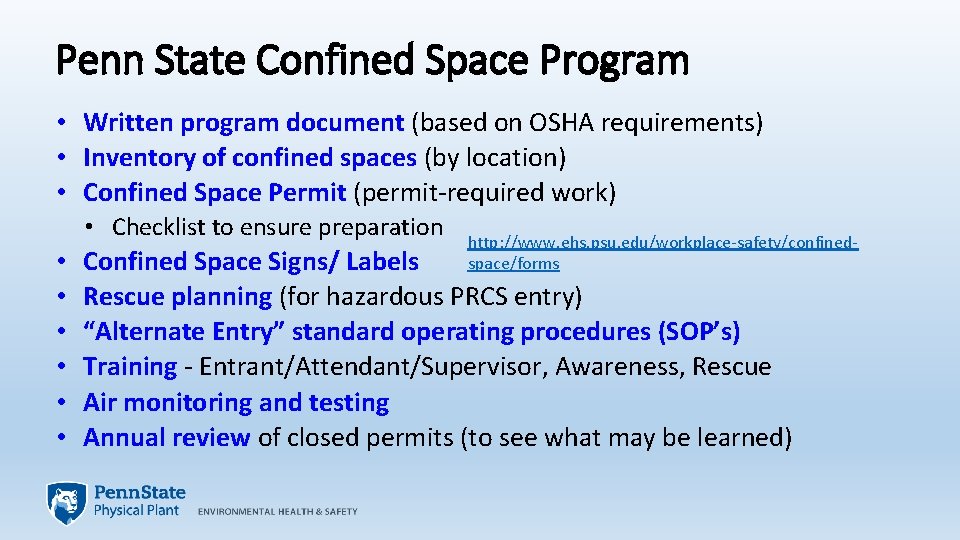
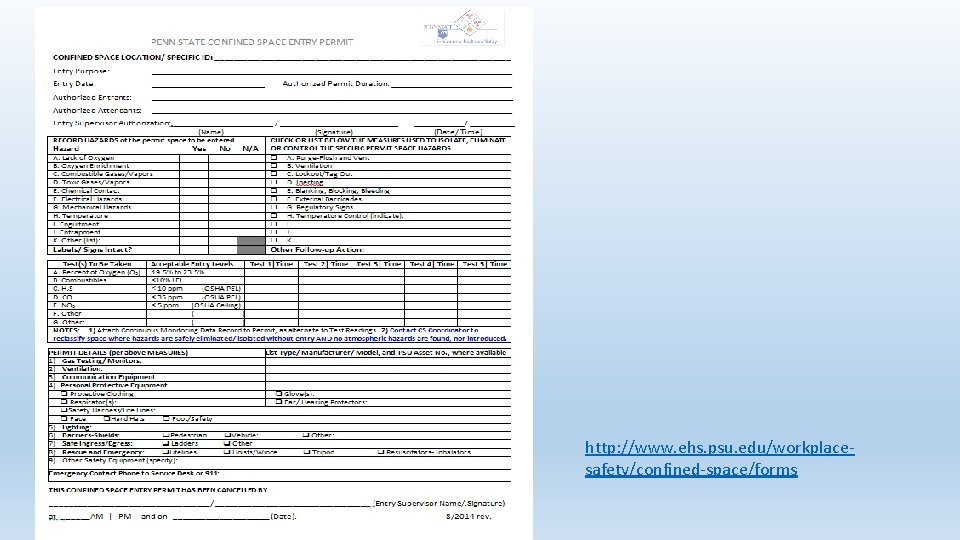
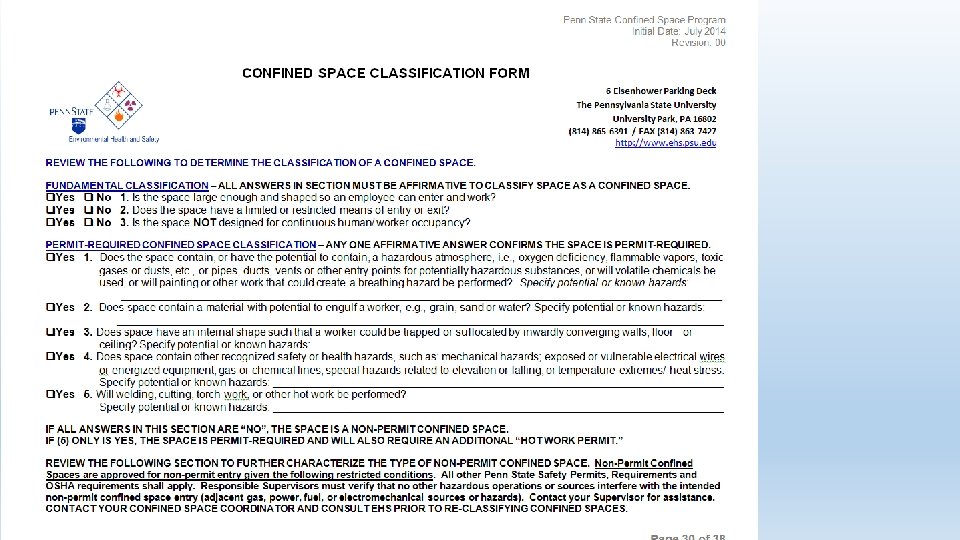
Penn State Confined Space Program • Written program document (based on OSHA requirements) • Inventory of confined spaces (by location) • Confined Space Permit (permit-required work) • Checklist to ensure preparation • • • http: //www. ehs. psu. edu/workplace-safety/confinedspace/forms Confined Space Signs/ Labels Rescue planning (for hazardous PRCS entry) “Alternate Entry” standard operating procedures (SOP’s) Training - Entrant/Attendant/Supervisor, Awareness, Rescue Air monitoring and testing Annual review of closed permits (to see what may be learned)
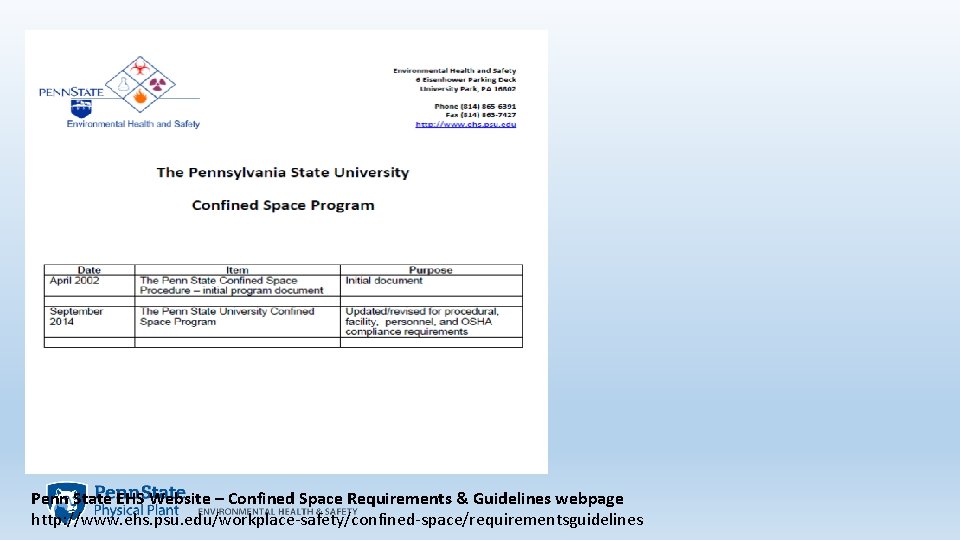
Penn State EHS Website – Confined Space Requirements & Guidelines webpage http: //www. ehs. psu. edu/workplace-safety/confined-space/requirementsguidelines
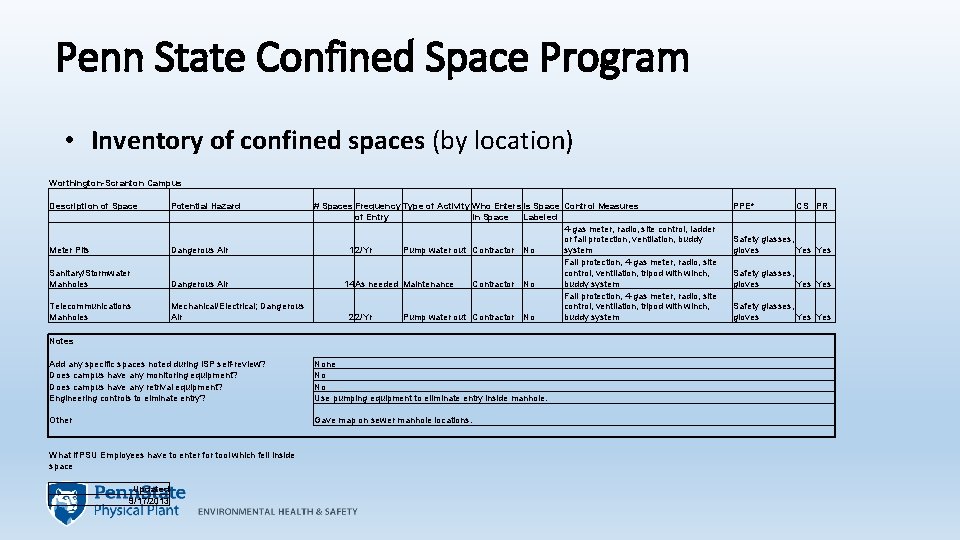
Penn State Confined Space Program • Inventory of confined spaces (by location) Worthington-Scranton Campus Description of Space Meter Pits Sanitary/Stormwater Manholes Telecommunications Manholes Potential Hazard # Spaces Frequency Type of Activity Who Enters Is Space Control Measures of Entry In Space Labeled 4 -gas meter, radio, site control, ladder or fall protection, ventilation, buddy system Dangerous Air 1 2/Yr Pump water out Contractor No Fall protection, 4 -gas meter, radio, site control, ventilation, tripod with winch, buddy system Dangerous Air 14 As needed Maintenance Contractor No Fall protection, 4 -gas meter, radio, site Mechanical/Electrical; Dangerous control, ventilation, tripod with winch, buddy system Air 2 2/Yr Pump water out Contractor No Notes Add any specific spaces noted during ISP self-review? Does campus have any monitoring equipment? Does campus have any retrival equipment? Engineering controls to elminate entry? Other What if PSU Employees have to enter for tool which fell inside space Updated 9/17/2013 PPE* CS PR Safety glasses, gloves Yes Yes Safety glasses, gloves Yes None No Use pumping equipment to eliminate entry inside manhole. Gave map on sewer manhole locations.
http: //www. ehs. psu. edu/workplacesafety/confined-space/forms
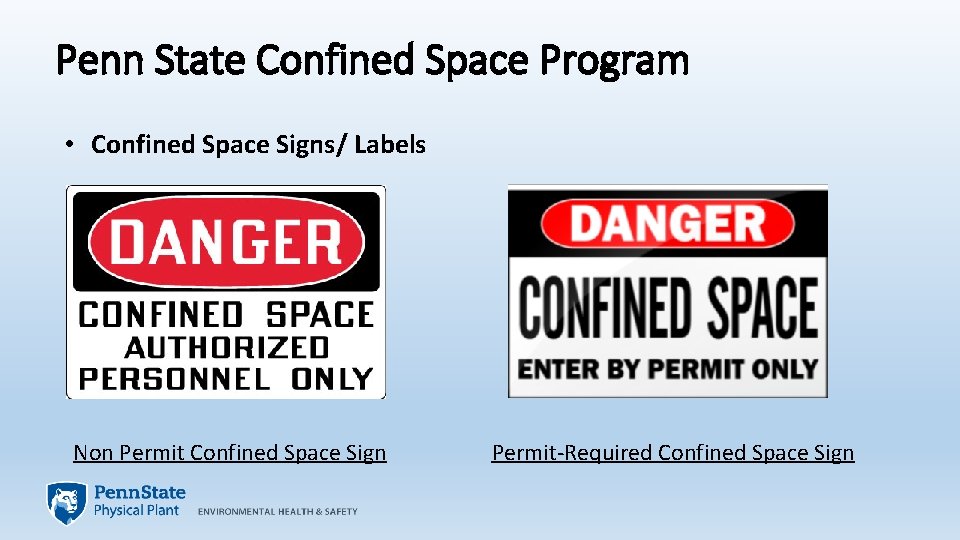
Penn State Confined Space Program • Confined Space Signs/ Labels Non Permit Confined Space Sign Permit-Required Confined Space Sign
Questions / Comments? Please direct questions or comments to the Penn State or your organizational contact regarding confined spaces.
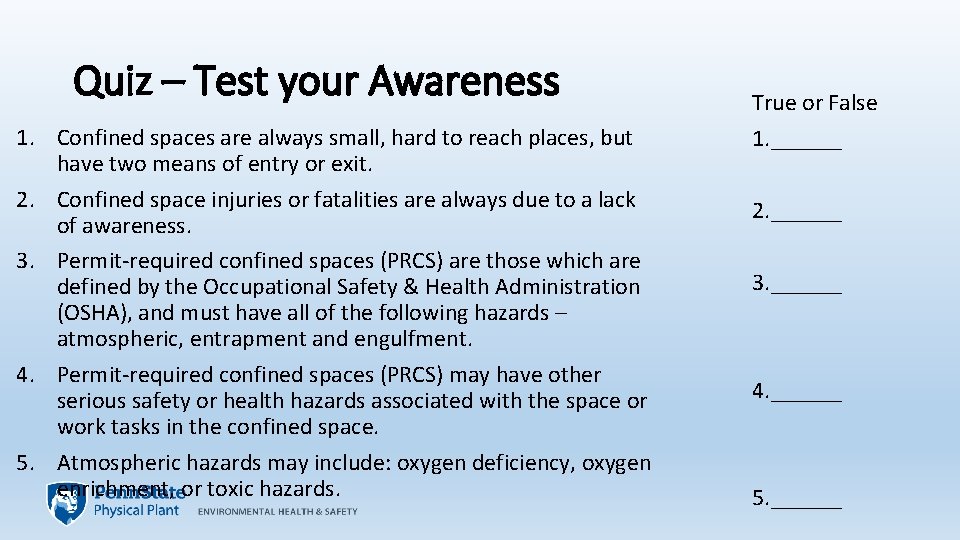
Quiz – Test your Awareness 1. Confined spaces are always small, hard to reach places, but have two means of entry or exit. 2. Confined space injuries or fatalities are always due to a lack of awareness. 3. Permit-required confined spaces (PRCS) are those which are defined by the Occupational Safety & Health Administration (OSHA), and must have all of the following hazards – atmospheric, entrapment and engulfment. 4. Permit-required confined spaces (PRCS) may have other serious safety or health hazards associated with the space or work tasks in the confined space. 5. Atmospheric hazards may include: oxygen deficiency, oxygen enrichment, or toxic hazards. True or False 1. ______ 2. ______ 3. ______ 4. ______ 5. ______
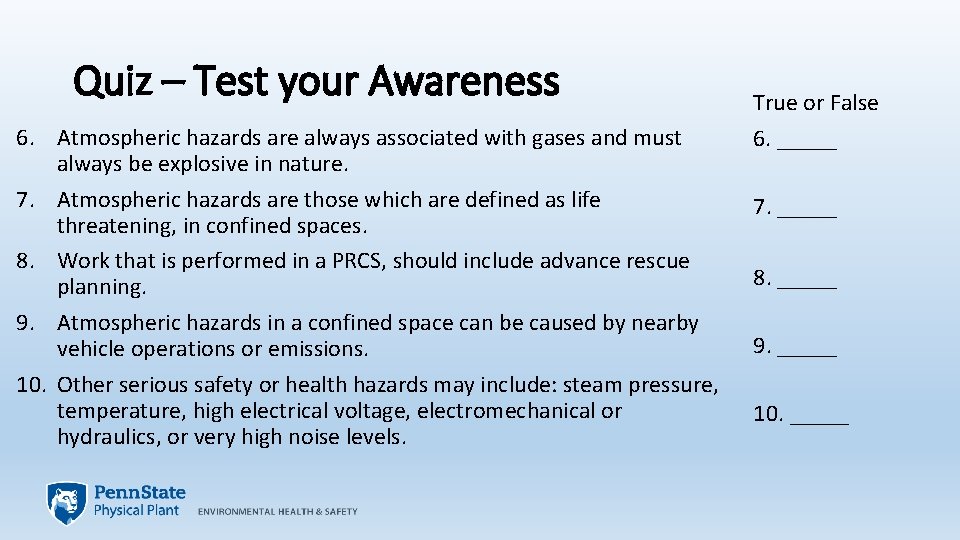
Quiz – Test your Awareness 6. Atmospheric hazards are always associated with gases and must always be explosive in nature. 7. Atmospheric hazards are those which are defined as life threatening, in confined spaces. 8. Work that is performed in a PRCS, should include advance rescue planning. 9. Atmospheric hazards in a confined space can be caused by nearby vehicle operations or emissions. 10. Other serious safety or health hazards may include: steam pressure, temperature, high electrical voltage, electromechanical or hydraulics, or very high noise levels. True or False 6. _____ 7. _____ 8. _____ 9. _____ 10. _____
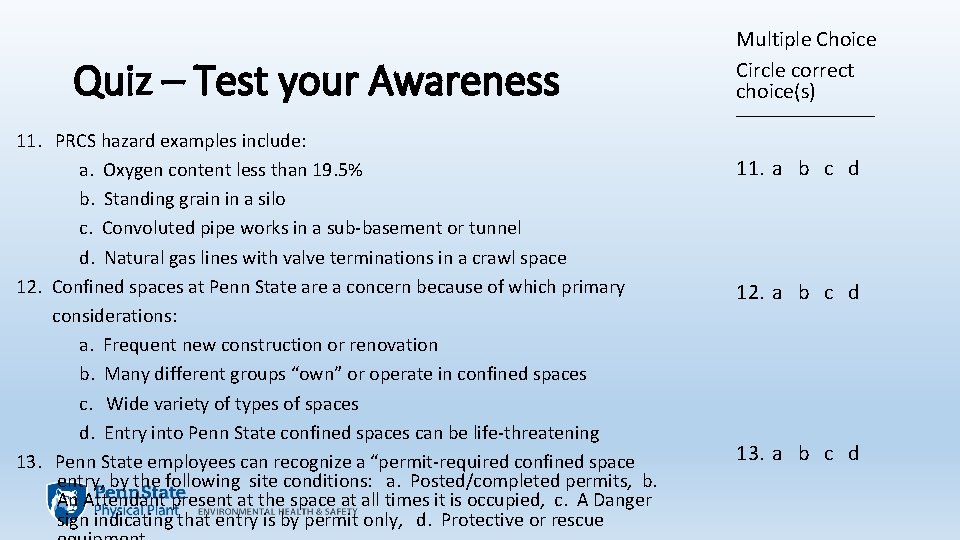
Quiz – Test your Awareness Multiple Choice Circle correct choice(s) ___________________________________ 11. PRCS hazard examples include: a. Oxygen content less than 19. 5% b. Standing grain in a silo c. Convoluted pipe works in a sub-basement or tunnel d. Natural gas lines with valve terminations in a crawl space 12. Confined spaces at Penn State are a concern because of which primary considerations: a. Frequent new construction or renovation b. Many different groups “own” or operate in confined spaces c. Wide variety of types of spaces d. Entry into Penn State confined spaces can be life-threatening 13. Penn State employees can recognize a “permit-required confined space entry, by the following site conditions: a. Posted/completed permits, b. An Attendant present at the space at all times it is occupied, c. A Danger sign indicating that entry is by permit only, d. Protective or rescue 11. a b c d 12. a b c d 13. a b c d
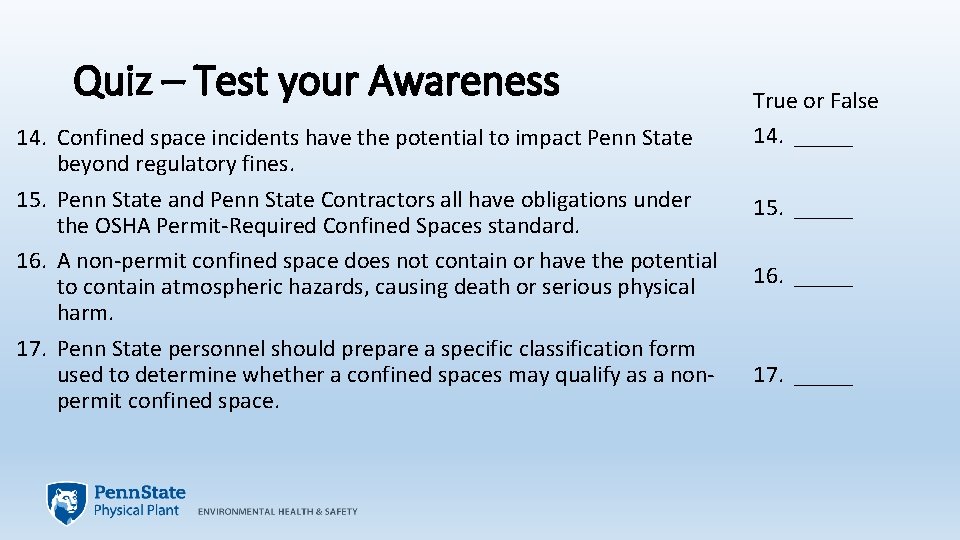
Quiz – Test your Awareness 14. Confined space incidents have the potential to impact Penn State beyond regulatory fines. 15. Penn State and Penn State Contractors all have obligations under the OSHA Permit-Required Confined Spaces standard. 16. A non-permit confined space does not contain or have the potential to contain atmospheric hazards, causing death or serious physical harm. 17. Penn State personnel should prepare a specific classification form used to determine whether a confined spaces may qualify as a nonpermit confined space. True or False 14. _____ 15. _____ 16. _____ 17. _____
Multiple Choice Quiz – Test your Awareness Circle correct choice(s) ________________________________ 18. Penn State’s written confined space program addresses : a. rescue planning, b. alternate entry standard operating procedures (SOP’s), c. specialized Entrant/Attendant/Supervisor and Rescuer training, d. Required review of closed permits every 3 years. 18. a b c d 19. Confined space work preparation, must include: a. Hazard awareness and proper classification of the confined space 19. a b c d b. Necessary equipment, signs, procedures, and training for PRCS work c. Designated sharing of information about hazards for contracted work d. Specific host, controlling contractor , entry contractor responsibilities 18. PRCS entries by contractors at Penn State facilities, require: a. PS supply information regarding CS locations, hazards, precautions b. General/ Controlling contractor coordinate Host and Entry Employer information exchange c. Entry employers supply permit program used and hazards introduced 20. a b c
Penn State Confined Space Program Contacts • T. Hans Derr, CIH Pete Muldoon – Commonwealth Campuses Penn State EHS (CS Program Lead) George Conklin – Central Region 814 -865 -6391 Joe Mazzoni – Eastern Region thd 12@psu. edu Brandi Baros – Western Region http: //www. ehs. psu. edu/workplace-safety/confined-space • Don Fronk, CSP George Benko - Utilities Office of Physical Plant Jonathon Risley - Construction 814 -865 -1661 Liz Fisher – Buildings and Grounds dlf 21@psu. edu http: //www. opp. psu. edu/intranet/hr/safety-and-workers-compentsation-information/safety-information • Contact EHS, Campus Maintenance Supervisors, or Campus Confined Space Coordinators for assistance.