
Confined Space 29 CFR 1910 146 PPT004 04
- Slides: 51
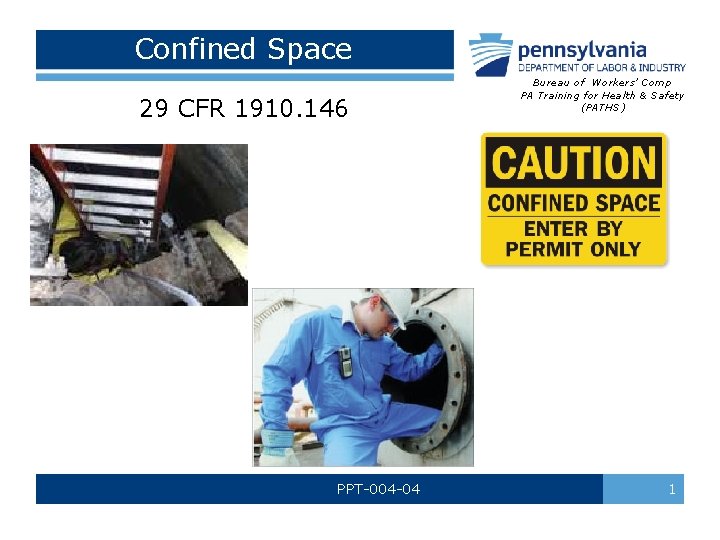
Confined Space 29 CFR 1910. 146 PPT-004 -04 Bureau of Workers’ Comp PA Training for Health & Safety (PATHS) 1
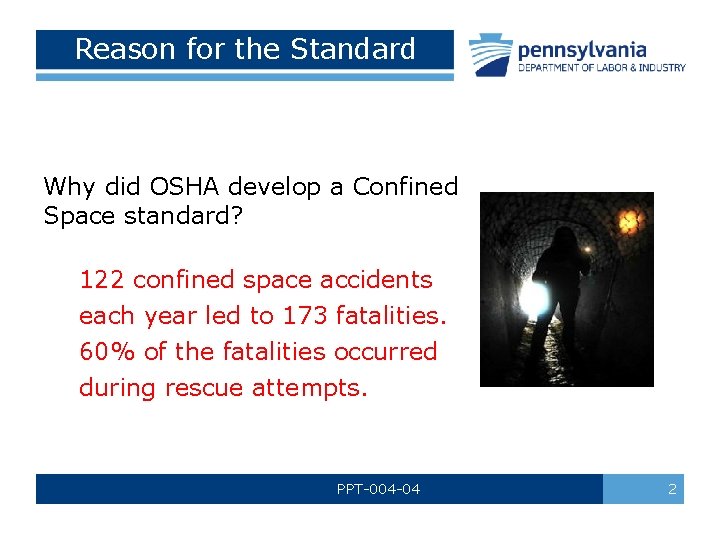
Reason for the Standard Why did OSHA develop a Confined Space standard? 122 confined space accidents each year led to 173 fatalities. 60% of the fatalities occurred during rescue attempts. PPT-004 -04 2
The Standard Intended to protect workers from Toxic, flammable, explosive, or asphyxiating atmospheres. Possible engulfment. Any other recognized serious hazard (example: hazardous energy). The standard focuses on areas with immediate health or safety risks, denoting them as “Permit Required Confined Space. ” PPT-004 -04 3
Industry Standard All employees required to enter into confined or enclosed spaces shall be instructed as to: - Nature of the hazards involved. - Necessary precautions to be taken. - Use of protective emergency equipment. The employer shall comply with any specific regulations that apply to work in dangerous or potentially dangerous areas. PPT-004 -04 4
Typical Confined Spaces • Boiler, Degreaser, Furnace • Pipeline, Pit, Pumping Station • Reaction or Process Vessel, Mills • Septic Tank, Sewage Digester • Silo, Storage Tank, Barges • Sewer, Utility Vault, Manhole • Trenches, Shafts, Caissons PPT-004 -04 5
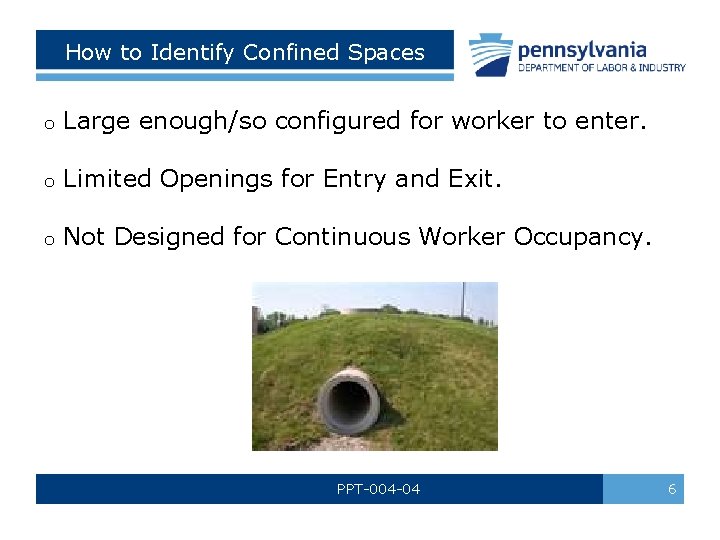
How to Identify Confined Spaces o Large enough/so configured for worker to enter. o Limited Openings for Entry and Exit. o Not Designed for Continuous Worker Occupancy. PPT-004 -04 6
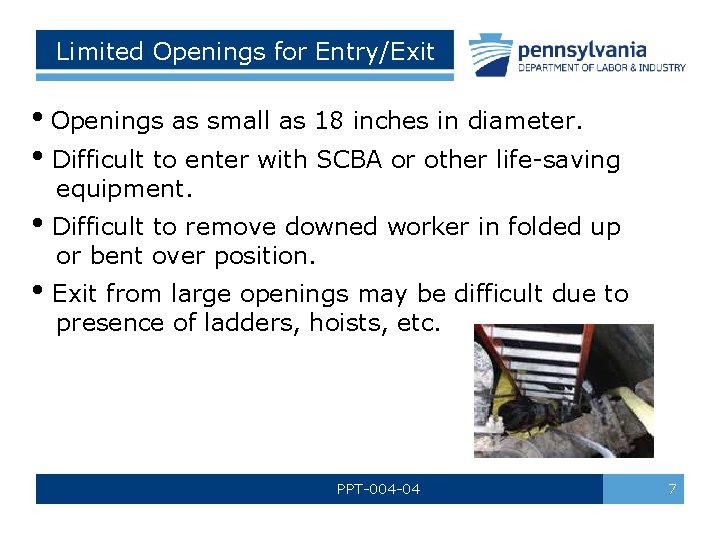
Limited Openings for Entry/Exit • Openings as small as 18 inches in diameter. • Difficult to enter with SCBA or other life-saving equipment. • Difficult to remove downed worker in folded up or bent over position. • Exit from large openings may be difficult due to presence of ladders, hoists, etc. PPT-004 -04 7
Unfavorable Natural Ventilation § Lack of air movement in and out of the space can create an atmosphere much different than the outside atmosphere. § Deadly gases can be trapped inside. § Organic materials can decompose. § May not be enough oxygen due to presence of other gases or chemical reactions such as rusting. PPT-004 -04 8
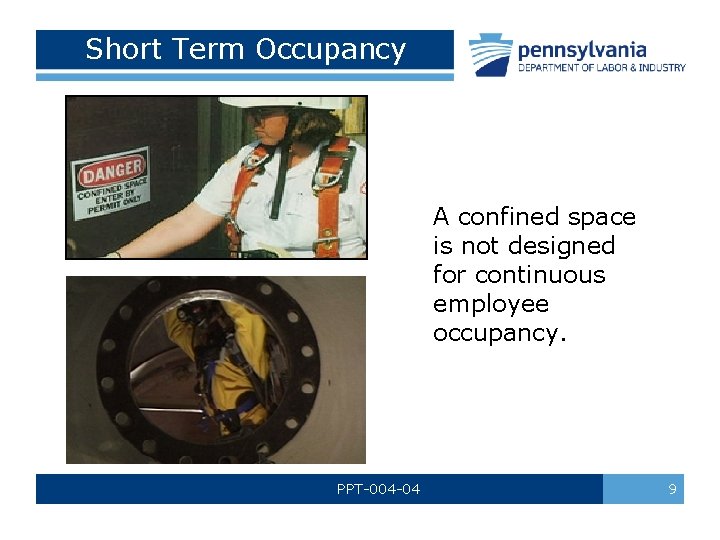
Short Term Occupancy A confined space is not designed for continuous employee occupancy. PPT-004 -04 9
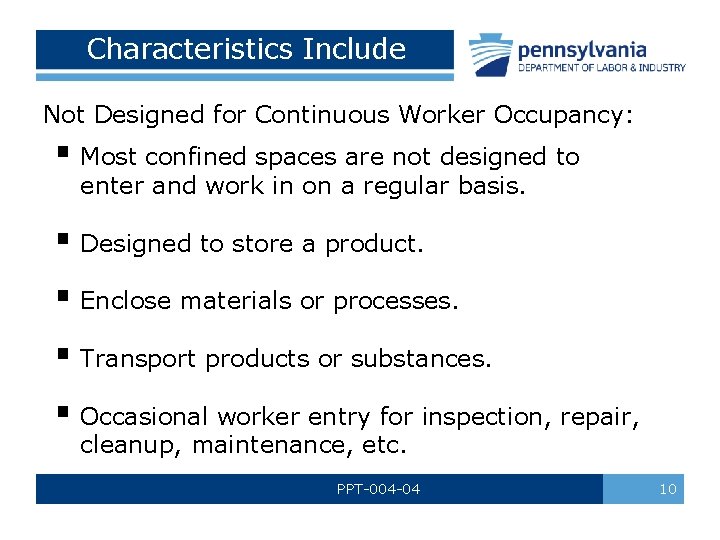
Characteristics Include Not Designed for Continuous Worker Occupancy: § Most confined spaces are not designed to enter and work in on a regular basis. § Designed to store a product. § Enclose materials or processes. § Transport products or substances. § Occasional worker entry for inspection, repair, cleanup, maintenance, etc. PPT-004 -04 10
Dangerous Combinations • Presence of all three confined space characteristics can complicate the situation. • Working in and around the space. • Rescue operations during emergencies. • Worsened conditions due to work activities: o Welding and cutting, use of bonding agents. o Cleaning with solvents, use of other chemicals. o Use of gas-powered equipment. PPT-004 -04 11
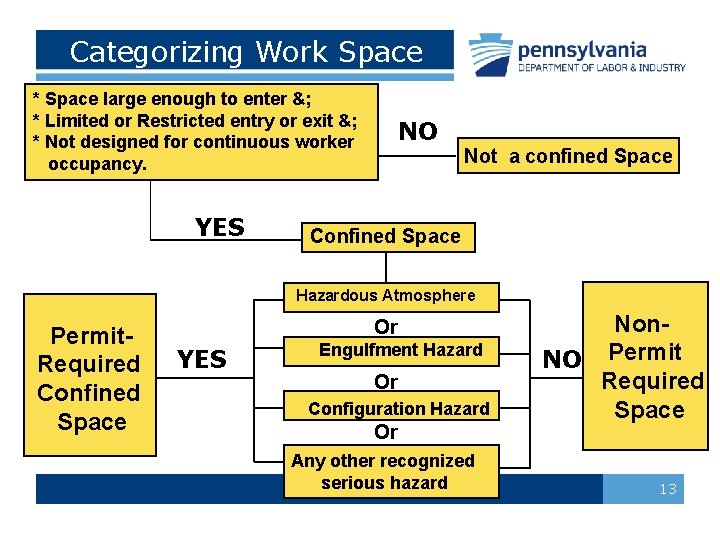
PRCS Permit-Required Confined Space 1. Contains or has a potential to contain a hazardous atmosphere. 2. Contains a material that has the potential for engulfing an entrant. 3. Has an internal configuration such that an entrant could be trapped or asphyxiated by inwardly converging walls or by a floor which slopes downward and tapers to a smaller crosssection. 4. Contains any other recognized serious safety or health hazard. PPT-004 -04 12
Categorizing Work Space * Space large enough to enter &; * Limited or Restricted entry or exit &; * Not designed for continuous worker occupancy. YES NO Not a confined Space Confined Space Hazardous Atmosphere Permit. Required Confined Space Or YES Engulfment Hazard Or Configuration Hazard Or Any other recognized serious PPT- hazard Non. NO Permit Required Space 13
Evaluation Employers are required to evaluate workplaces for permit required confined spaces. Employees must be informed of the existence of confined spaces through the use of signs, etc. UNAUTHORIZED ENTRY MUST BE PREVENTED PPT-004 -04 14
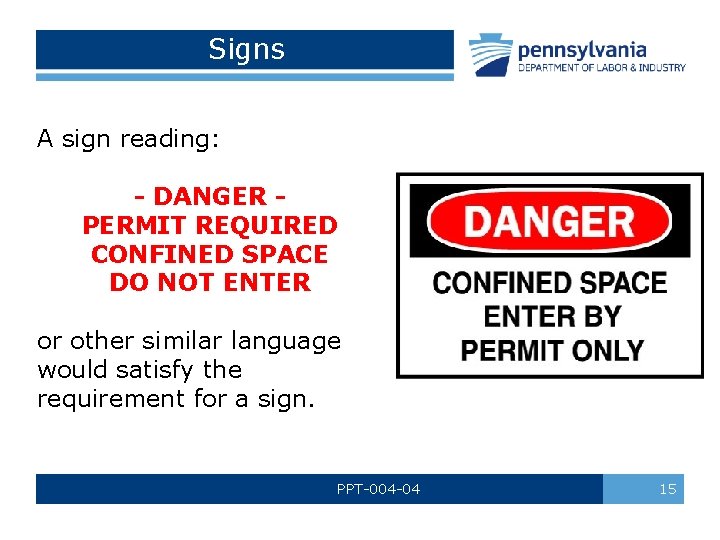
Signs A sign reading: - DANGER PERMIT REQUIRED CONFINED SPACE DO NOT ENTER or other similar language would satisfy the requirement for a sign. PPT-004 -04 15
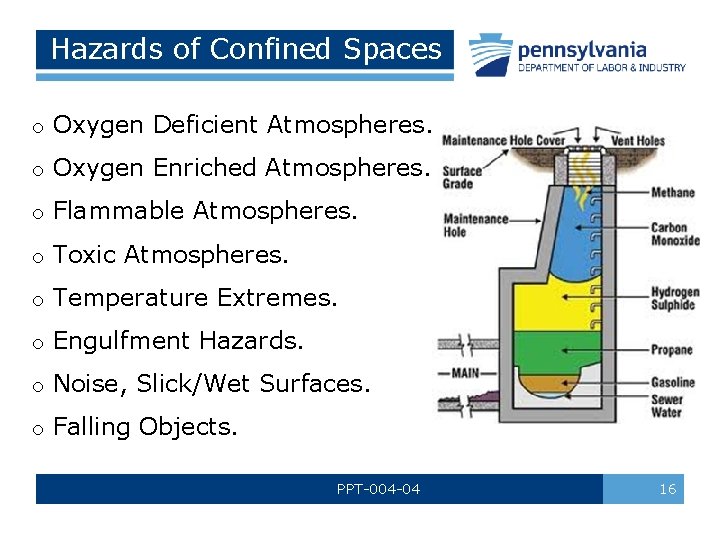
Hazards of Confined Spaces o Oxygen Deficient Atmospheres. o Oxygen Enriched Atmospheres. o Flammable Atmospheres. o Toxic Atmospheres. o Temperature Extremes. o Engulfment Hazards. o Noise, Slick/Wet Surfaces. o Falling Objects. PPT-004 -04 16
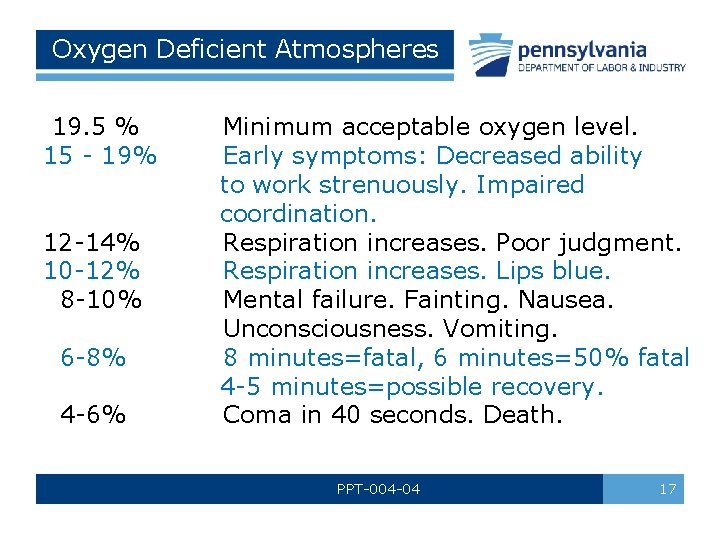
Oxygen Deficient Atmospheres 19. 5 % 15 - 19% 12 -14% 10 -12% 8 -10% 6 -8% 4 -6% Minimum acceptable oxygen level. Early symptoms: Decreased ability to work strenuously. Impaired coordination. Respiration increases. Poor judgment. Respiration increases. Lips blue. Mental failure. Fainting. Nausea. Unconsciousness. Vomiting. 8 minutes=fatal, 6 minutes=50% fatal 4 -5 minutes=possible recovery. Coma in 40 seconds. Death. PPT-004 -04 17
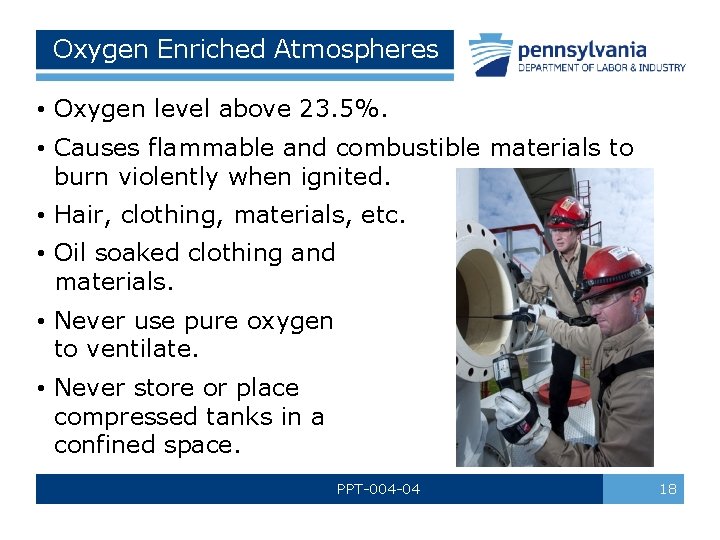
Oxygen Enriched Atmospheres • Oxygen level above 23. 5%. • Causes flammable and combustible materials to burn violently when ignited. • Hair, clothing, materials, etc. • Oil soaked clothing and materials. • Never use pure oxygen to ventilate. • Never store or place compressed tanks in a confined space. PPT-004 -04 18
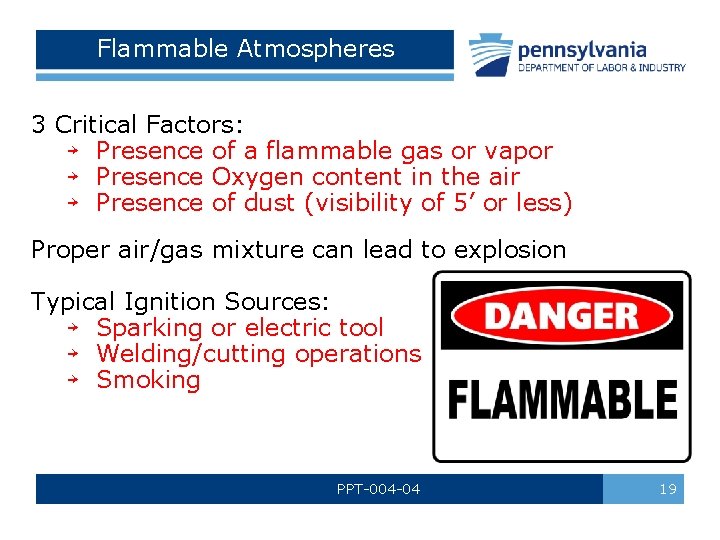
Flammable Atmospheres 3 Critical Factors: → Presence of a flammable gas or vapor → Presence Oxygen content in the air → Presence of dust (visibility of 5’ or less) Proper air/gas mixture can lead to explosion Typical Ignition Sources: → Sparking or electric tool → Welding/cutting operations → Smoking PPT-004 -04 19
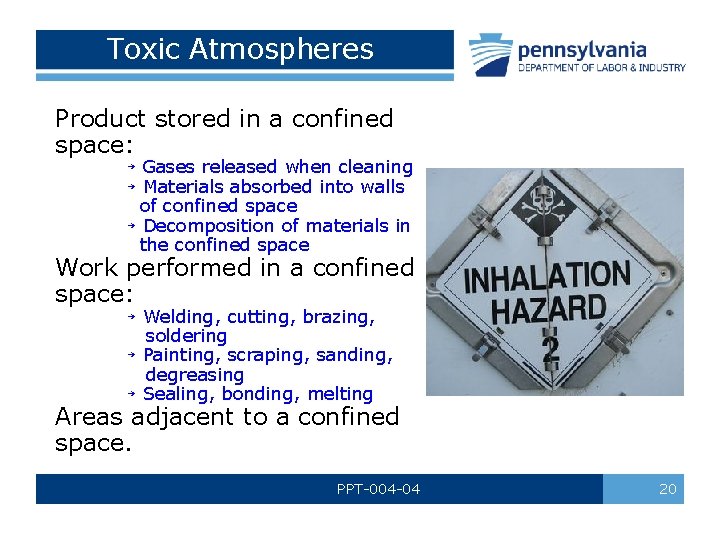
Toxic Atmospheres Product stored in a confined space: → Gases released when cleaning → Materials absorbed into walls of confined space → Decomposition of materials in the confined space Work performed in a confined space: → Welding, cutting, brazing, soldering → Painting, scraping, sanding, degreasing → Sealing, bonding, melting Areas adjacent to a confined space. PPT-004 -04 20
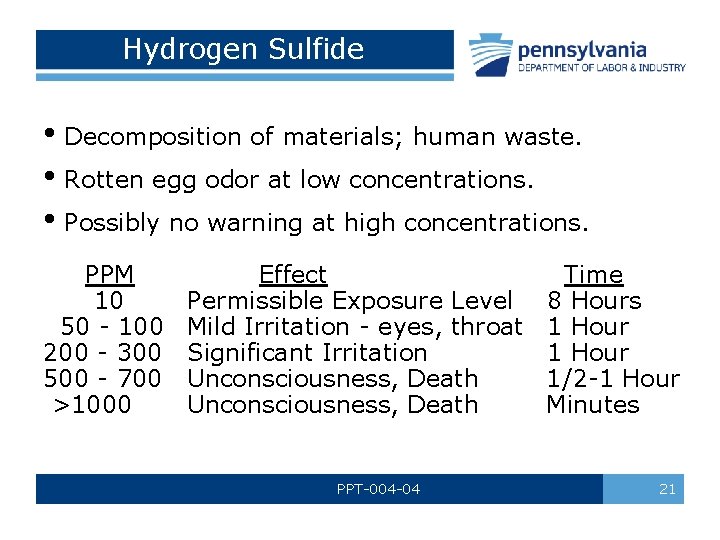
Hydrogen Sulfide • Decomposition of materials; human waste. • Rotten egg odor at low concentrations. • Possibly no warning at high concentrations. PPM 10 50 - 100 200 - 300 500 - 700 >1000 Effect Permissible Exposure Level Mild Irritation - eyes, throat Significant Irritation Unconsciousness, Death PPT-004 -04 Time 8 Hours 1 Hour 1/2 -1 Hour Minutes 21
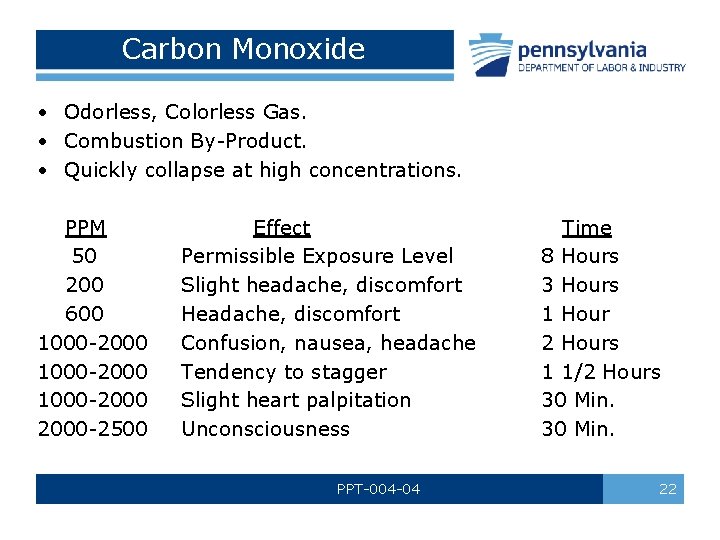
Carbon Monoxide • Odorless, Colorless Gas. • Combustion By-Product. • Quickly collapse at high concentrations. PPM 50 200 600 1000 -2000 2000 -2500 Effect Permissible Exposure Level Slight headache, discomfort Headache, discomfort Confusion, nausea, headache Tendency to stagger Slight heart palpitation Unconsciousness PPT-004 -04 Time 8 Hours 3 Hours 1 Hour 2 Hours 1 1/2 Hours 30 Min. 22
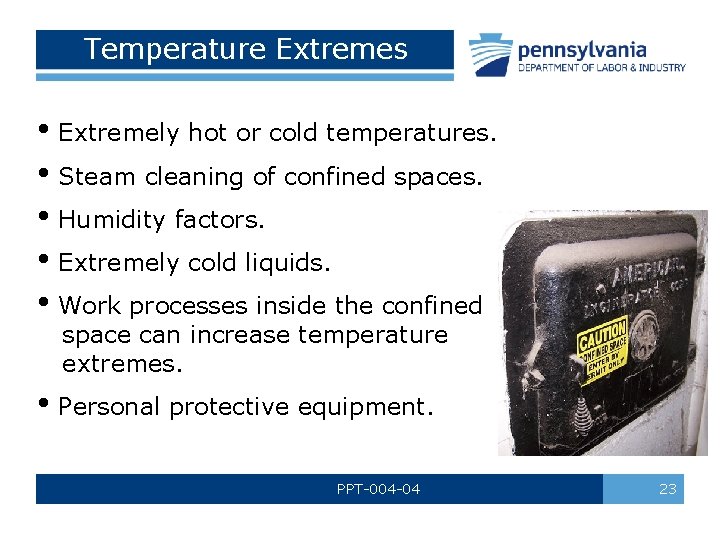
Temperature Extremes • Extremely hot or cold temperatures. • Steam cleaning of confined spaces. • Humidity factors. • Extremely cold liquids. • Work processes inside the confined space can increase temperature extremes. • Personal protective equipment. PPT-004 -04 23
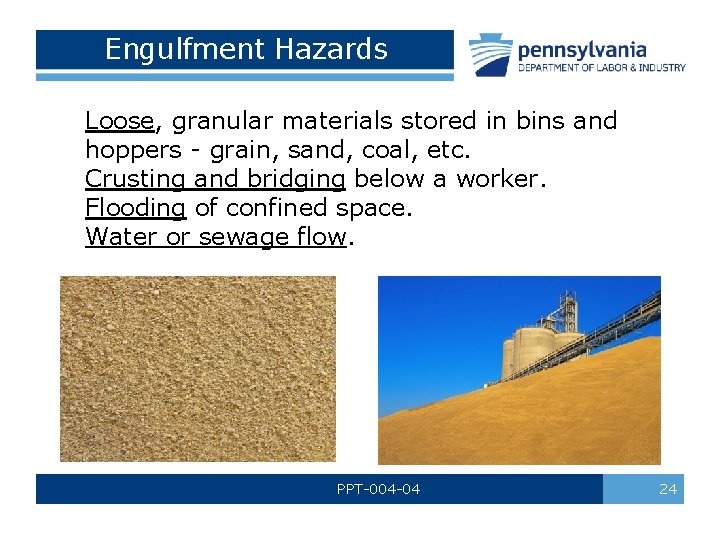
Engulfment Hazards Loose, granular materials stored in bins and hoppers - grain, sand, coal, etc. Crusting and bridging below a worker. Flooding of confined space. Water or sewage flow. PPT-004 -04 24
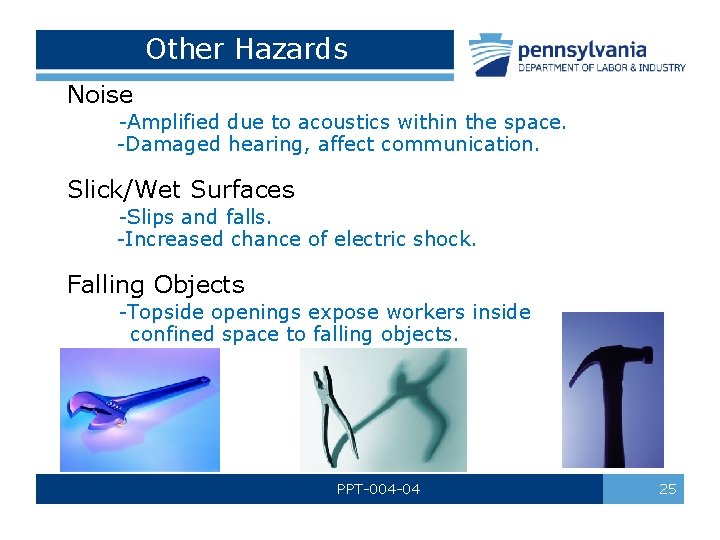
Other Hazards Noise -Amplified due to acoustics within the space. -Damaged hearing, affect communication. Slick/Wet Surfaces -Slips and falls. -Increased chance of electric shock. Falling Objects -Topside openings expose workers inside confined space to falling objects. PPT-004 -04 25
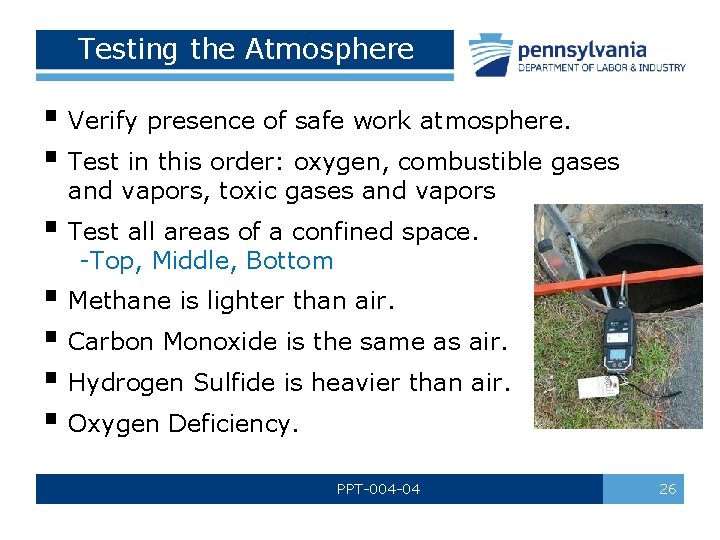
Testing the Atmosphere § Verify presence of safe work atmosphere. § Test in this order: oxygen, combustible gases and vapors, toxic gases and vapors § Test all areas of a confined space. -Top, Middle, Bottom § Methane is lighter than air. § Carbon Monoxide is the same as air. § Hydrogen Sulfide is heavier than air. § Oxygen Deficiency. PPT-004 -04 26
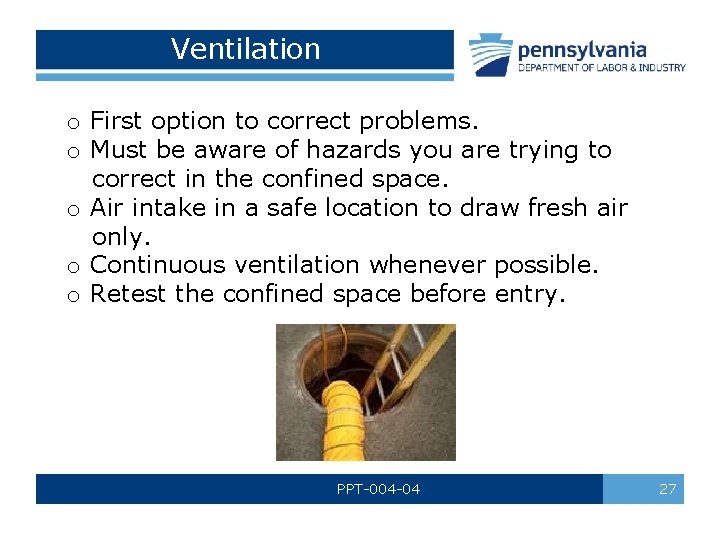
Ventilation o First option to correct problems. o Must be aware of hazards you are trying to correct in the confined space. o Air intake in a safe location to draw fresh air only. o Continuous ventilation whenever possible. o Retest the confined space before entry. PPT-004 -04 27
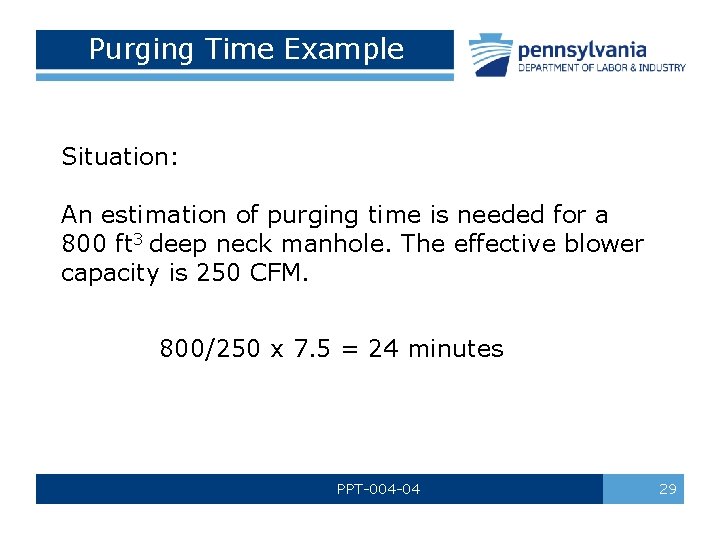
Determination of Purge Time Purge times can be estimated by the following: T = 7. 5 V/C T = purge time in minutes V = the volume of the space in ft 3 C = effective blower capacity CFM PPT-004 -04 28
Purging Time Example Situation: An estimation of purging time is needed for a 800 ft 3 deep neck manhole. The effective blower capacity is 250 CFM. 800/250 x 7. 5 = 24 minutes PPT-004 -04 29
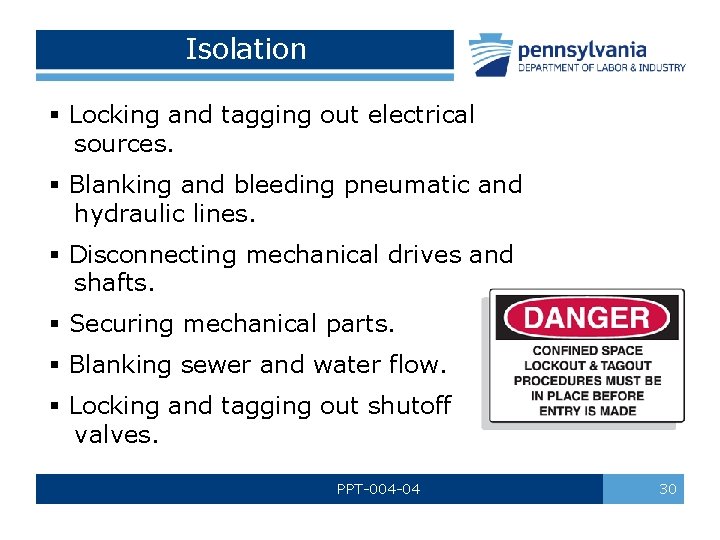
Isolation § Locking and tagging out electrical sources. § Blanking and bleeding pneumatic and hydraulic lines. § Disconnecting mechanical drives and shafts. § Securing mechanical parts. § Blanking sewer and water flow. § Locking and tagging out shutoff valves. PPT-004 -04 30
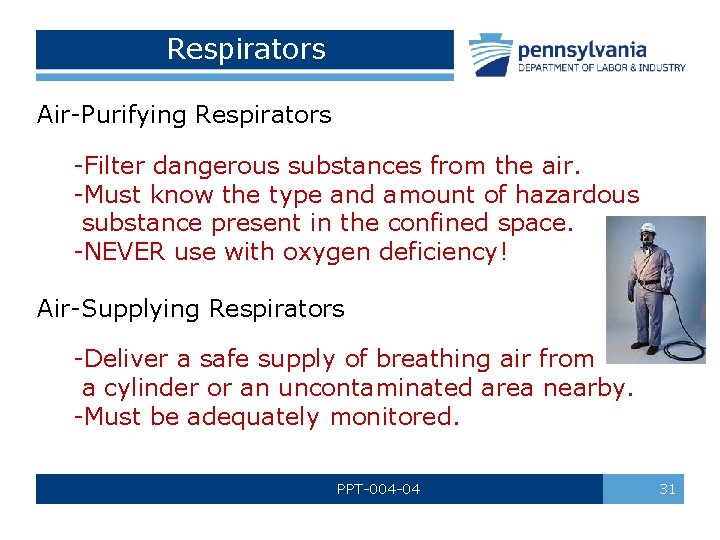
Respirators Air-Purifying Respirators -Filter dangerous substances from the air. -Must know the type and amount of hazardous substance present in the confined space. -NEVER use with oxygen deficiency! Air-Supplying Respirators -Deliver a safe supply of breathing air from a cylinder or an uncontaminated area nearby. -Must be adequately monitored. PPT-004 -04 31
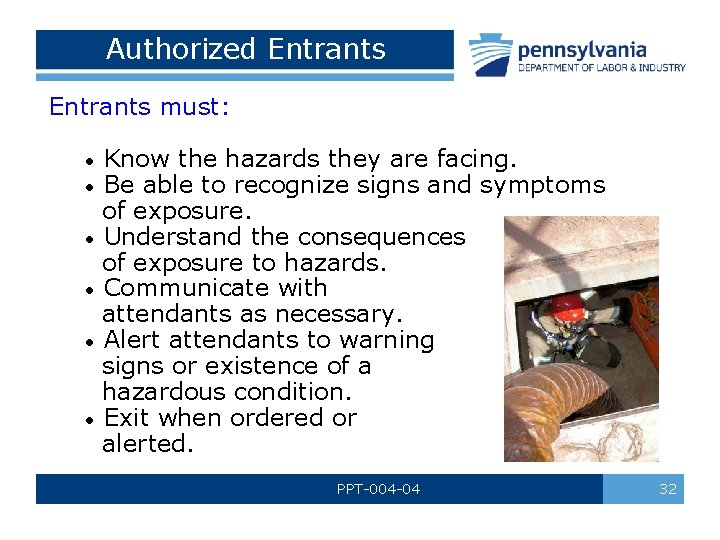
Authorized Entrants must: Know the hazards they are facing. Be able to recognize signs and symptoms of exposure. • Understand the consequences of exposure to hazards. • Communicate with attendants as necessary. • Alert attendants to warning signs or existence of a hazardous condition. • Exit when ordered or alerted. • • PPT-004 -04 32
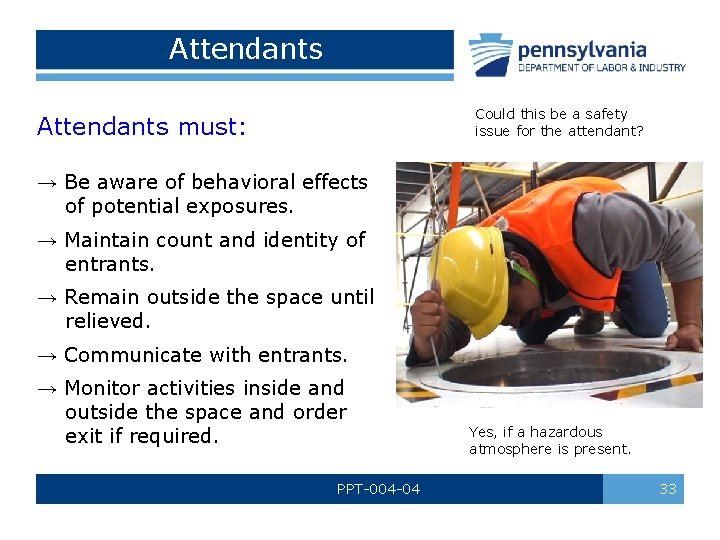
Attendants Could this be a safety issue for the attendant? Attendants must: → Be aware of behavioral effects of potential exposures. → Maintain count and identity of entrants. → Remain outside the space until relieved. → Communicate with entrants. → Monitor activities inside and outside the space and order exit if required. PPT-004 -04 Yes, if a hazardous atmosphere is present. 33
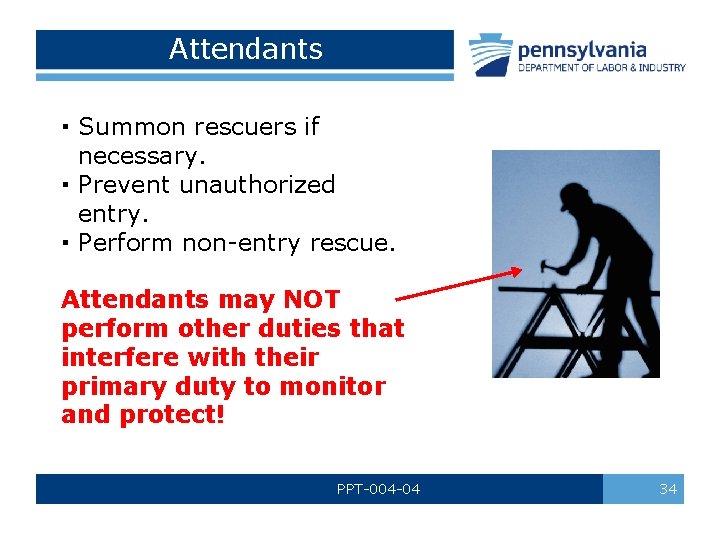
Attendants ▪ Summon rescuers if necessary. ▪ Prevent unauthorized entry. ▪ Perform non-entry rescue. Attendants may NOT perform other duties that interfere with their primary duty to monitor and protect! PPT-004 -04 34
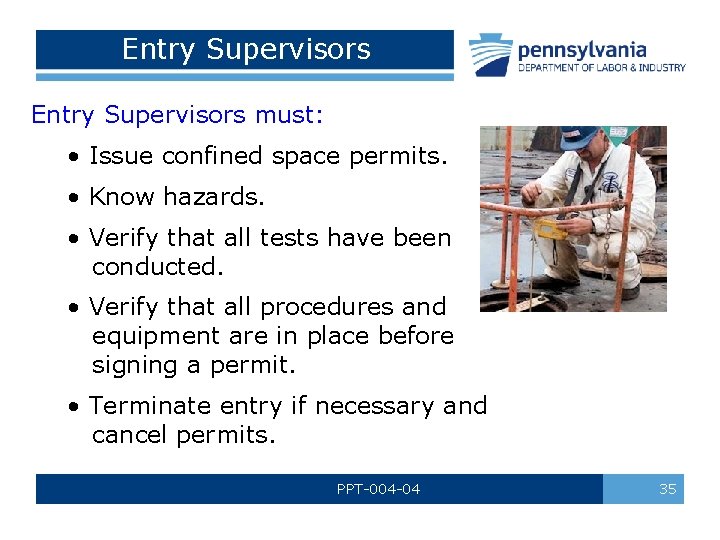
Entry Supervisors must: • Issue confined space permits. • Know hazards. • Verify that all tests have been conducted. • Verify that all procedures and equipment are in place before signing a permit. • Terminate entry if necessary and cancel permits. PPT-004 -04 35
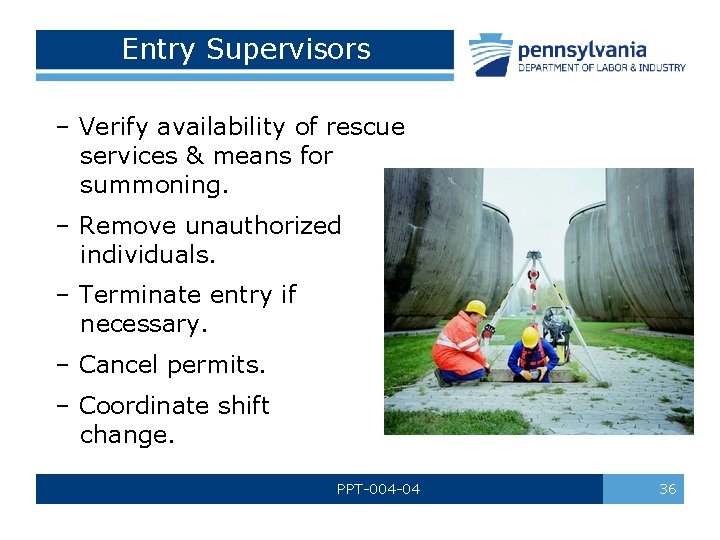
Entry Supervisors – Verify availability of rescue services & means for summoning. – Remove unauthorized individuals. – Terminate entry if necessary. – Cancel permits. – Coordinate shift change. PPT-004 -04 36
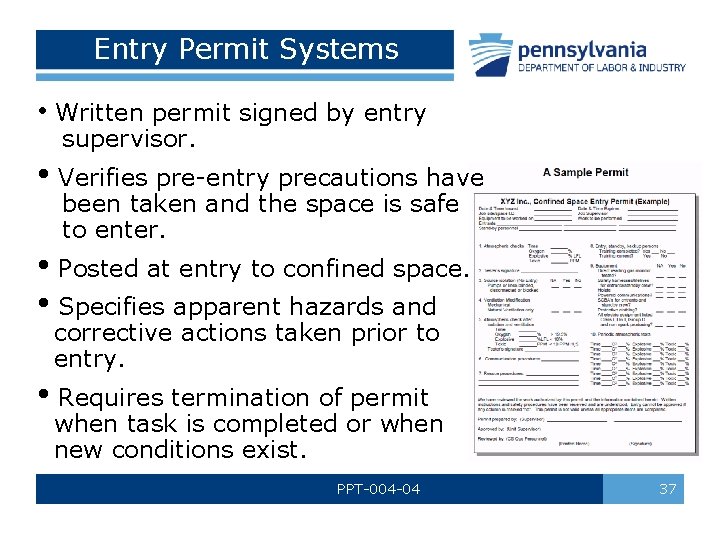
Entry Permit Systems • Written permit signed by entry supervisor. • Verifies pre-entry precautions have been taken and the space is safe to enter. • Posted at entry to confined space. • Specifies apparent hazards and corrective actions taken prior to entry. • Requires termination of permit when task is completed or when new conditions exist. PPT-004 -04 37
Entry Permit Requirements o Date, location, and name of confined space. o Purpose of entry and known hazards. o Duration of entry permit time. o Authorized entrants, attendants, supervisors. o Air testing results - signature of tester. o Protective measures to be taken. –Ventilation, Isolation, Flushing –Lockout/Tagout, Purging PPT-004 -04 38
More Entry Permit Requirements • Name and phone numbers of rescue and emergency services. • Communication procedures. • Special equipment and procedures. –Personal protective equipment (PPE) –Alarm procedures –Rescue equipment –Respirators PPT-004 -04 39
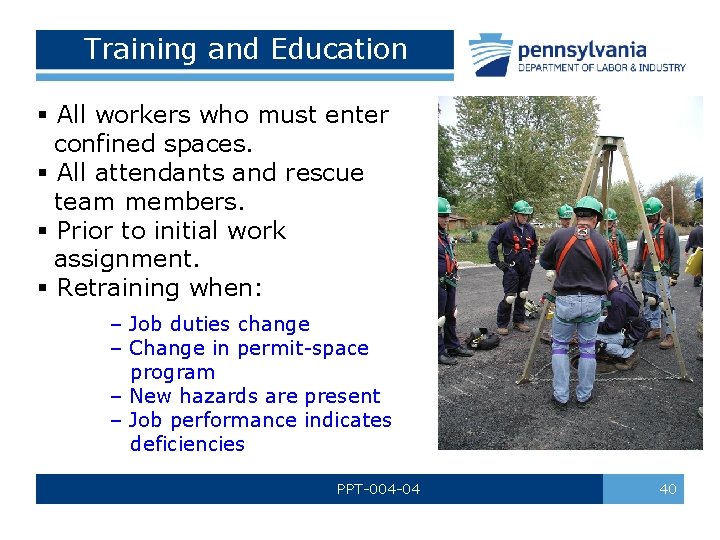
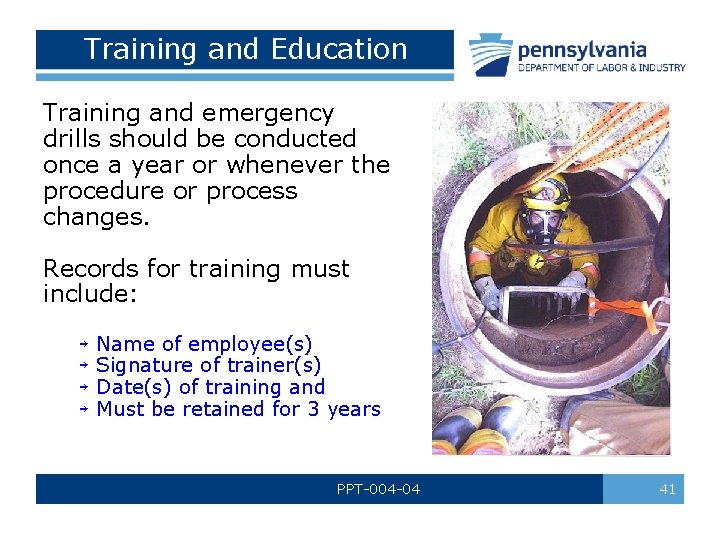
Training and Education § All workers who must enter confined spaces. § All attendants and rescue team members. § Prior to initial work assignment. § Retraining when: – Job duties change – Change in permit-space program – New hazards are present – Job performance indicates deficiencies PPT-004 -04 40
Training and Education Training and emergency drills should be conducted once a year or whenever the procedure or process changes. Records for training must include: → → Name of employee(s) Signature of trainer(s) Date(s) of training and Must be retained for 3 years PPT-004 -04 41
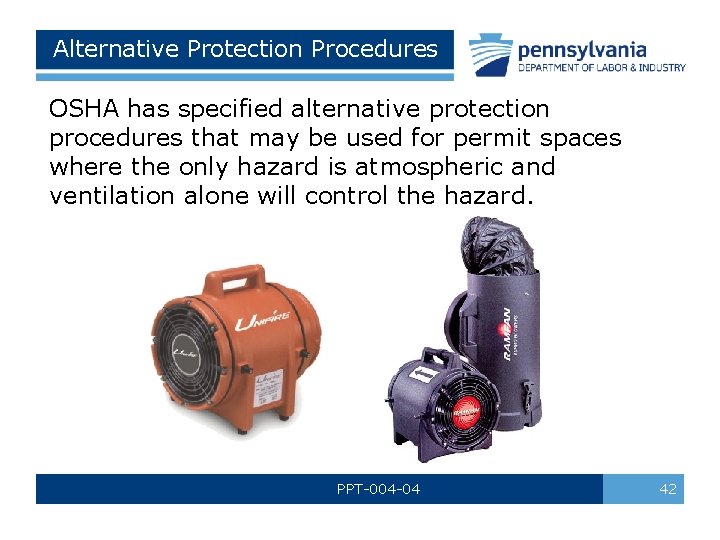
Alternative Protection Procedures OSHA has specified alternative protection procedures that may be used for permit spaces where the only hazard is atmospheric and ventilation alone will control the hazard. PPT-004 -04 42
Entry without Permit When a confined space is opened: –The opening must be promptly guarded by a rail or temporary cover. –The atmosphere must be tested before entering using only direct reading instruments. –The atmosphere must be tested (in this order) for oxygen content, flammable gases/vapors, and toxic air contaminants. –Continuous forced air ventilation must be used. PPT-004 -04 43
Entry without Permit When a confined space is opened: –The atmosphere must be tested periodically during work. –The employer must verify alternative procedure applicability and safe entry conditions by a written certification (not a permit) with the following information: ● Date ● Location ● Signature NOTE: The above certificate must be made available to entrant to review PPT-004 -04 44
Entry without Permit If you meet the conditions stated in Section (C)(5)(i) of the OSHA standard: → Employer can prove only hazard is actual or potential hazardous atmosphere → Continuous forced air or ventilation alone sufficient for entry → Employer develops monitoring and inspection data You may use the procedures specified in Section (C)(5)(ii) of the standard. This allows you to OMIT Paragraphs (d) through (f) and (h) through (k) of the standard. NOTE: Paragraph (g) Training still applies to all confined space activities PPT-004 -04 45
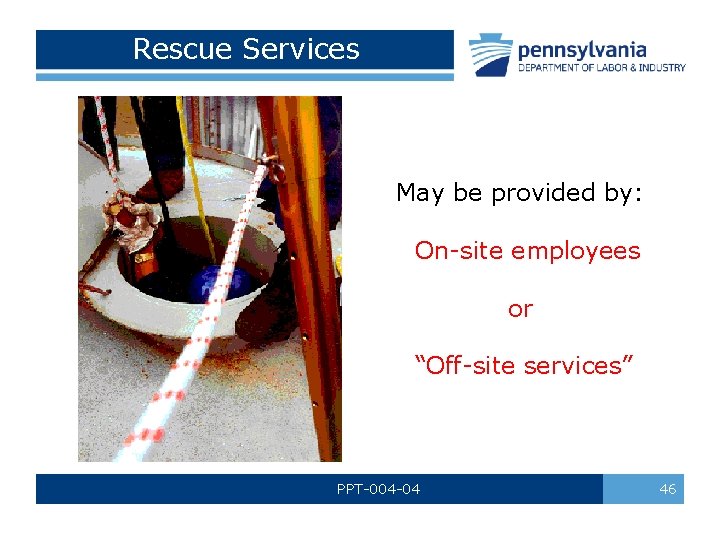
Rescue Services May be provided by: On-site employees or “Off-site services” PPT-004 -04 46
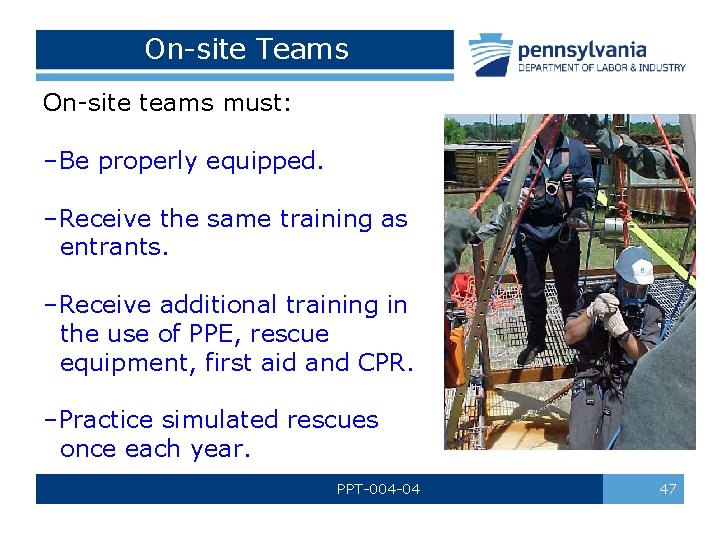
On-site Teams On-site teams must: –Be properly equipped. –Receive the same training as entrants. –Receive additional training in the use of PPE, rescue equipment, first aid and CPR. –Practice simulated rescues once each year. PPT-004 -04 47
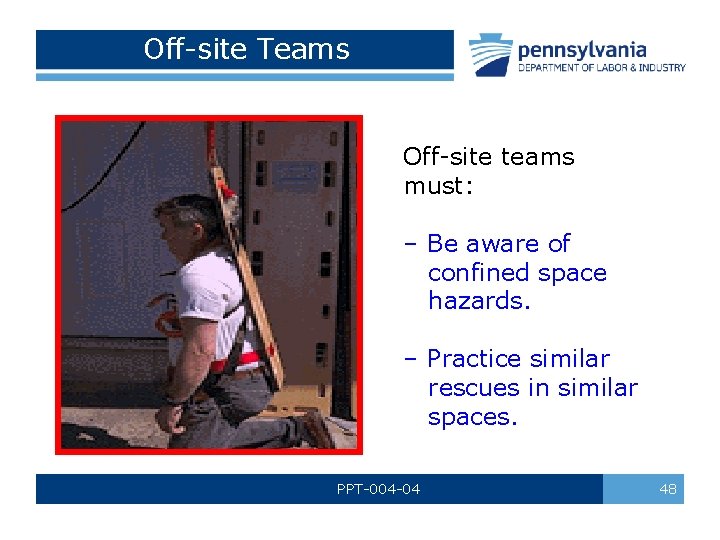
Off-site Teams Off-site teams must: – Be aware of confined space hazards. – Practice similar rescues in similar spaces. PPT-004 -04 48
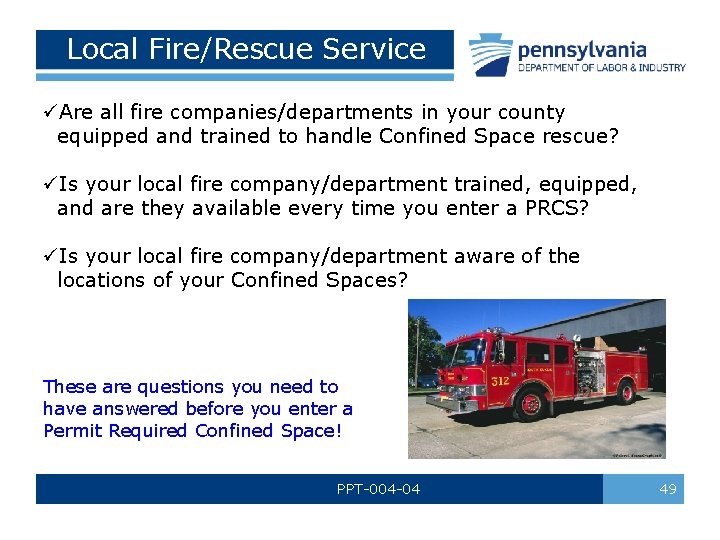
Local Fire/Rescue Service üAre all fire companies/departments in your county equipped and trained to handle Confined Space rescue? üIs your local fire company/department trained, equipped, and are they available every time you enter a PRCS? üIs your local fire company/department aware of the locations of your Confined Spaces? These are questions you need to have answered before you enter a Permit Required Confined Space! PPT-004 -04 49
Bottom Line § Be aware of the location of all Confined Spaces in your facility. § Ensure you’re familiar with the hazards of these Confined Spaces. § Don’t enter a Permit Required Confined Space until all the safety conditions have been met and you’re wearing the proper PPE. § Before entering a PRCS, ensure reliable and trained personnel are available to perform rescue if the need arises. PPT-004 -04 50
Contact Information Health & Safety Training Specialists 1171 South Cameron Street, Room 324 Harrisburg, PA 17104 -2501 (717) 772 -1635 RA-LI-BWC-PATHS@pa. gov Like us on Facebook! https: //www. facebook. com/BWCPATHS PPT-004 -04 51