
Configuration Management What does configuration management really manage
- Slides: 14
Configuration Management • What does configuration management really manage? – – – Software artifacts Change control activities System build activities
Software Configuration Management The management of all the artifacts produced as a part of the software development and software support activities e. g. - requirements specifications - design documentation - source code - test scenarios - executable code - data base tables - initialization data - customer problem calls - problem fixes - user documentation
Managing the Software Artifacts Interested in : - Inter-Relating the artifacts (e. g. ) - by “usage” relationship - by packaging into a “release” relationship - by promoting into different test bucket level - Intra-Relating Multi-versioning of each artifact - Access and protection of each artifact
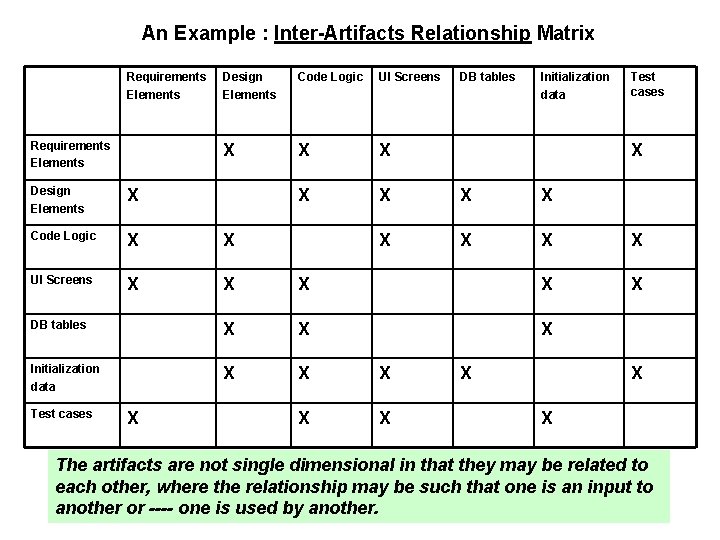
An Example : Inter-Artifacts Relationship Matrix Requirements Elements Design Elements Code Logic UI Screens DB tables Initialization data X X X X Design Elements X Code Logic X X UI Screens X X DB tables X X X Initialization data X X X Test cases X X X The artifacts are not single dimensional in that they may be related to each other, where the relationship may be such that one is an input to another or ---- one is used by another.
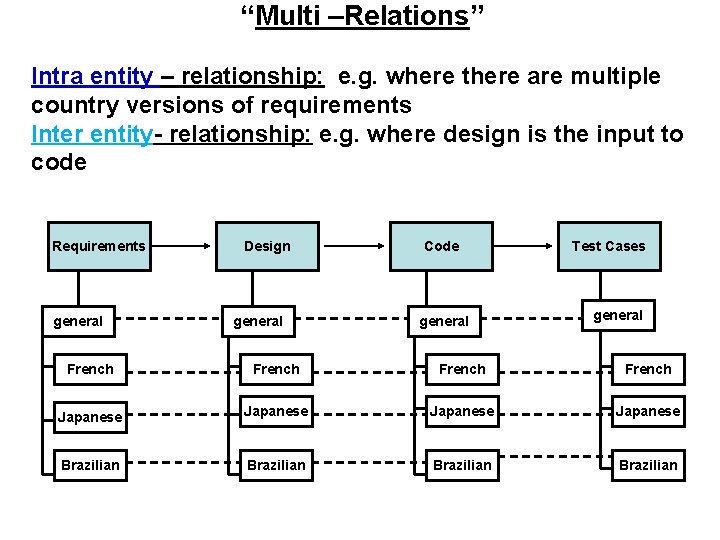
“Multi –Relations” Intra entity – relationship: e. g. where there are multiple country versions of requirements Inter entity- relationship: e. g. where design is the input to code Requirements general Design general Code general Test Cases general French Japanese Brazilian
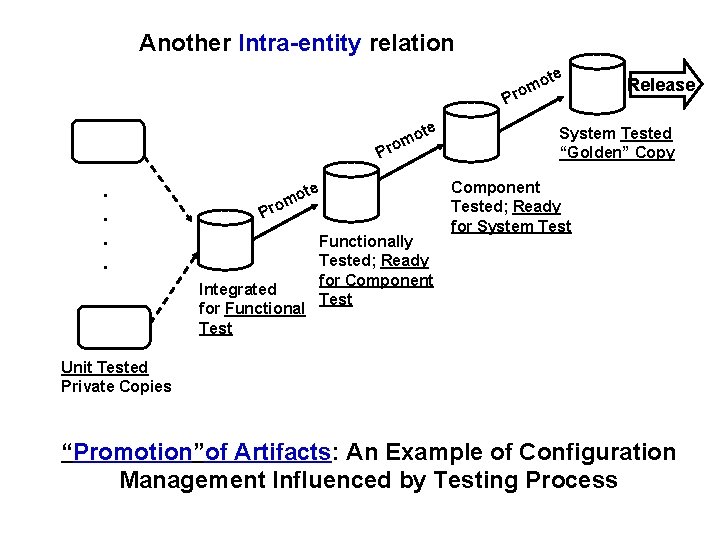
Another Intra-entity relation te P te o rom P . . te o rom P Integrated for Functional Test Functionally Tested; Ready for Component Test o m o r Release System Tested “Golden” Copy Component Tested; Ready for System Test Unit Tested Private Copies “Promotion”of Artifacts: An Example of Configuration Management Influenced by Testing Process
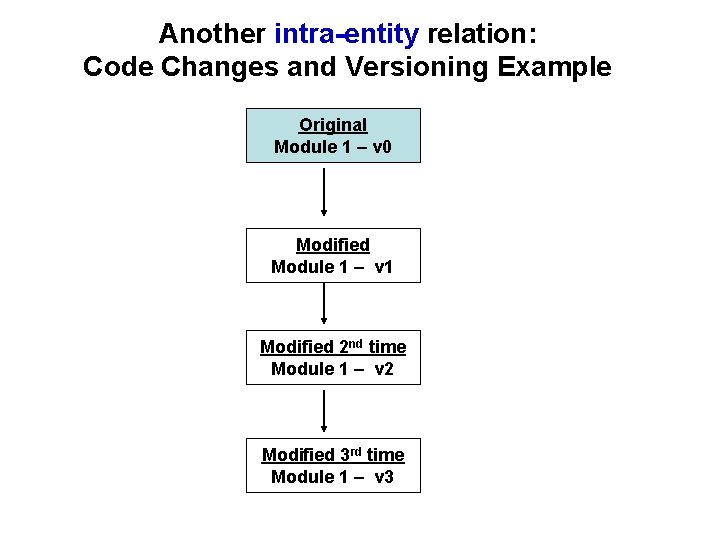
Another intra-entity relation: Code Changes and Versioning Example Original Module 1 – v 0 Modified Module 1 – v 1 Modified 2 nd time Module 1 – v 2 Modified 3 rd time Module 1 – v 3
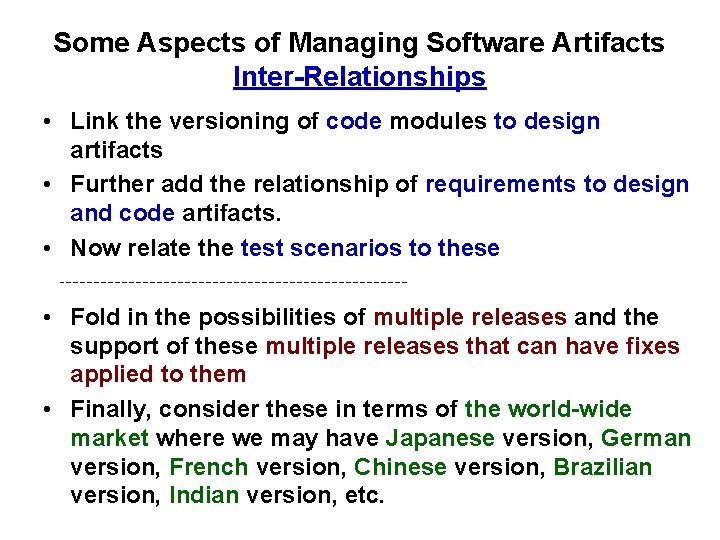
Some Aspects of Managing Software Artifacts Inter-Relationships • Link the versioning of code modules to design artifacts • Further add the relationship of requirements to design and code artifacts. • Now relate the test scenarios to these • Fold in the possibilities of multiple releases and the support of these multiple releases that can have fixes applied to them • Finally, consider these in terms of the world-wide market where we may have Japanese version, German version, French version, Chinese version, Brazilian version, Indian version, etc.
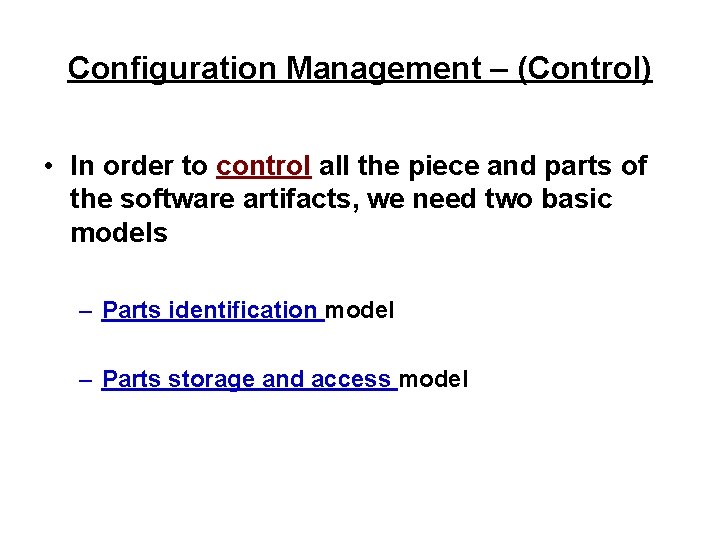
Configuration Management – (Control) • In order to control all the piece and parts of the software artifacts, we need two basic models – Parts identification model – Parts storage and access model
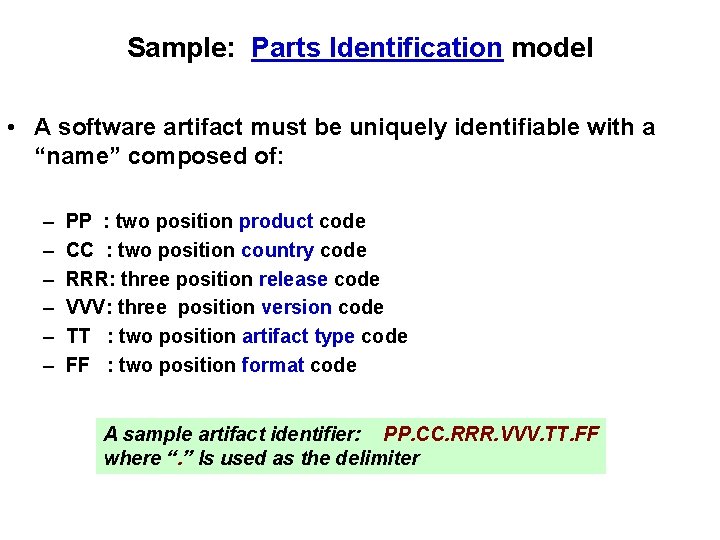
Sample: Parts Identification model • A software artifact must be uniquely identifiable with a “name” composed of: – – – PP : two position product code CC : two position country code RRR: three position release code VVV: three position version code TT : two position artifact type code FF : two position format code A sample artifact identifier: PP. CC. RRR. VVV. TT. FF where “. ” Is used as the delimiter
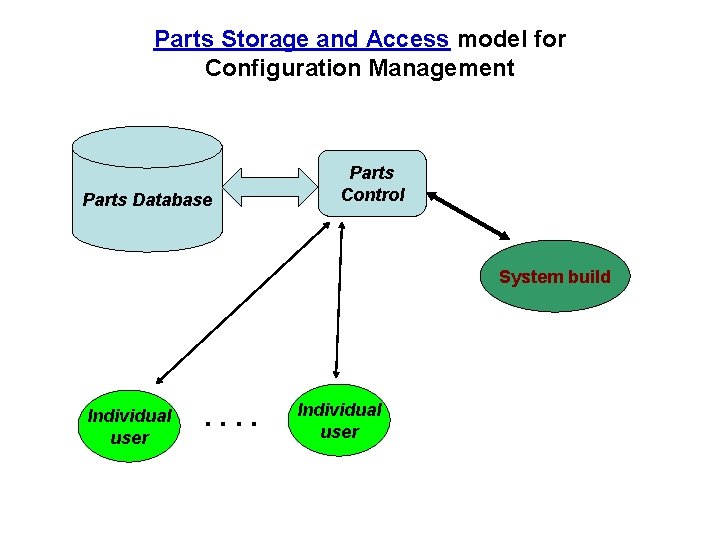
Parts Storage and Access model for Configuration Management Parts Database Parts Control System build Individual user . . Individual user
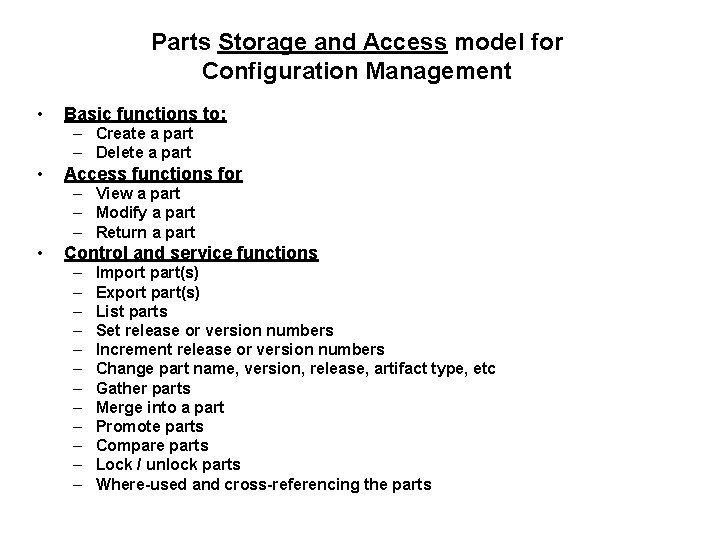
Parts Storage and Access model for Configuration Management • Basic functions to: – Create a part – Delete a part • Access functions for – View a part – Modify a part – Return a part • Control and service functions – – – Import part(s) Export part(s) List parts Set release or version numbers Increment release or version numbers Change part name, version, release, artifact type, etc Gather parts Merge into a part Promote parts Compare parts Lock / unlock parts Where-used and cross-referencing the parts
(System Build) with Configuration Manager • • Construct a build (dependency) list Compile Link Generating the required executables that are ready to run
Some Configuration Mgmt Tools • Tier 1 : Version control and change control: – Revision control system (RCS) – Source code control system (RCCS) – Concurrent version system (CVS) • Tier 2: Builds – – Make utility Odin Cons Scons • Tier 3: Configuration Management for large systems – – PVCS : Change. Man (Serena Software) Rational Clear Case (IBM) Visual Source. Safe (Microsoft) Perforce (Perforce Software) - we just got this into SPSU(2011)