
Confidentiality and Privacy Controls Chapter 9 Copyright 2015
- Slides: 9
Confidentiality and Privacy Controls Chapter 9 Copyright © 2015 Pearson Education, Inc. 9 -1
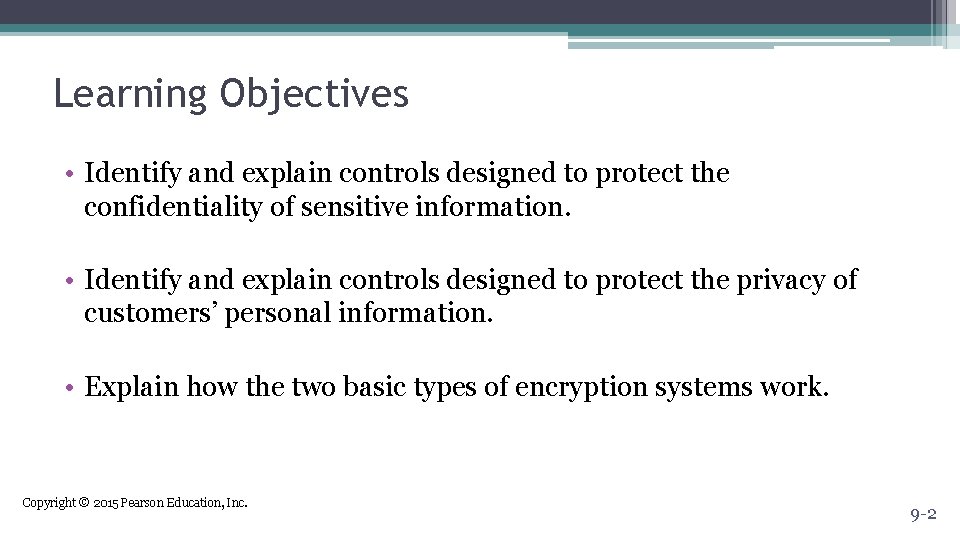
Learning Objectives • Identify and explain controls designed to protect the confidentiality of sensitive information. • Identify and explain controls designed to protect the privacy of customers’ personal information. • Explain how the two basic types of encryption systems work. Copyright © 2015 Pearson Education, Inc. 9 -2
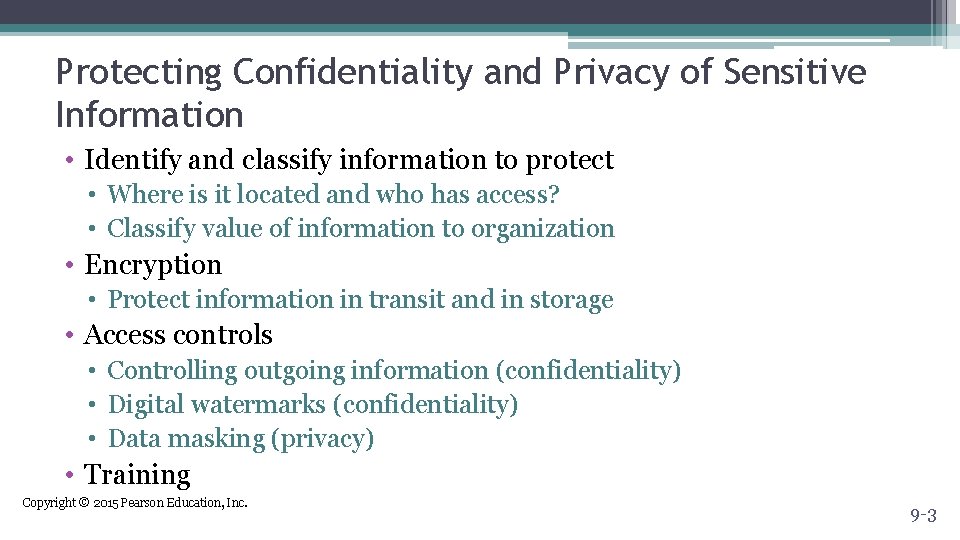
Protecting Confidentiality and Privacy of Sensitive Information • Identify and classify information to protect • Where is it located and who has access? • Classify value of information to organization • Encryption • Protect information in transit and in storage • Access controls • Controlling outgoing information (confidentiality) • Digital watermarks (confidentiality) • Data masking (privacy) • Training Copyright © 2015 Pearson Education, Inc. 9 -3
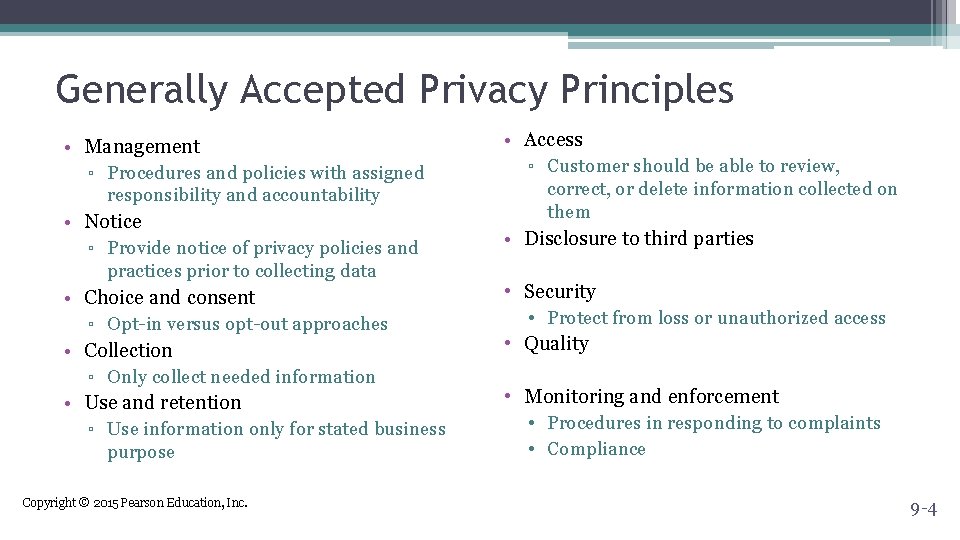
Generally Accepted Privacy Principles • Management ▫ Procedures and policies with assigned responsibility and accountability • Notice ▫ Provide notice of privacy policies and practices prior to collecting data • Choice and consent ▫ Opt-in versus opt-out approaches • Collection ▫ Only collect needed information • Use and retention ▫ Use information only for stated business purpose Copyright © 2015 Pearson Education, Inc. • Access ▫ Customer should be able to review, correct, or delete information collected on them • Disclosure to third parties • Security • Protect from loss or unauthorized access • Quality • Monitoring and enforcement • Procedures in responding to complaints • Compliance 9 -4
Encryption • Preventative control • Factors that influence encryption strength: ▫ Key length (longer = stronger) ▫ Algorithm ▫ Management policies Stored securely Copyright © 2015 Pearson Education, Inc. 9 -5
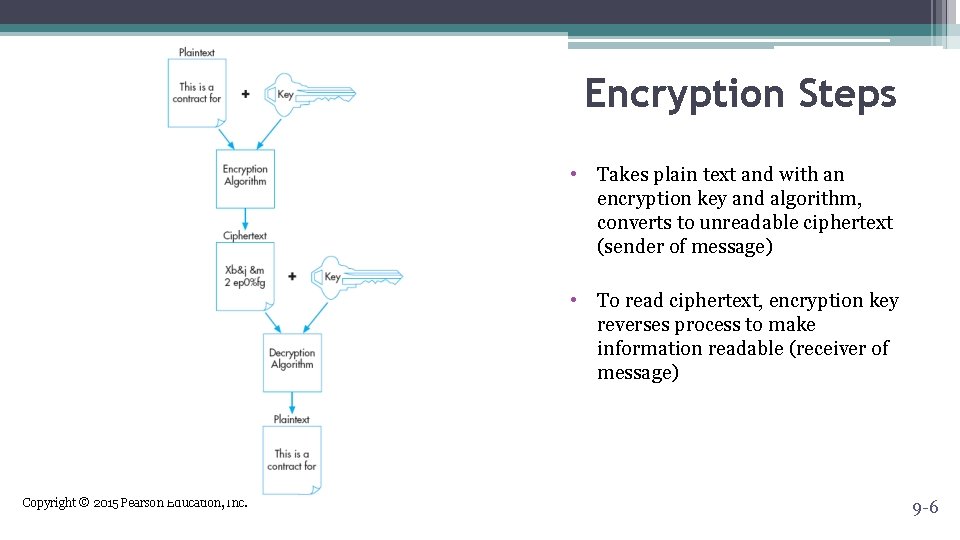
Encryption Steps • Takes plain text and with an encryption key and algorithm, converts to unreadable ciphertext (sender of message) • To read ciphertext, encryption key reverses process to make information readable (receiver of message) Copyright © 2015 Pearson Education, Inc. 9 -6
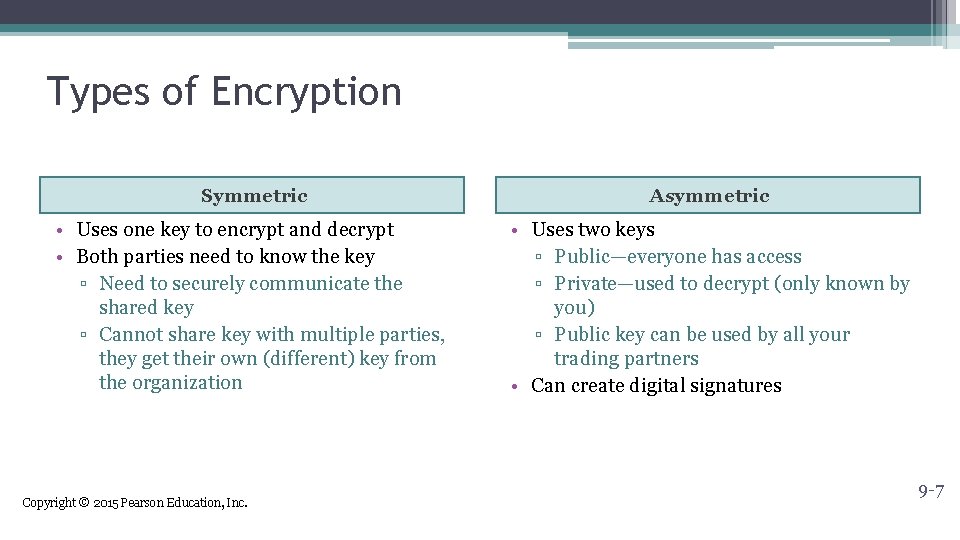
Types of Encryption Symmetric Asymmetric • Uses one key to encrypt and decrypt • Both parties need to know the key ▫ Need to securely communicate the shared key ▫ Cannot share key with multiple parties, they get their own (different) key from the organization • Uses two keys ▫ Public—everyone has access ▫ Private—used to decrypt (only known by you) ▫ Public key can be used by all your trading partners • Can create digital signatures Copyright © 2015 Pearson Education, Inc. 9 -7
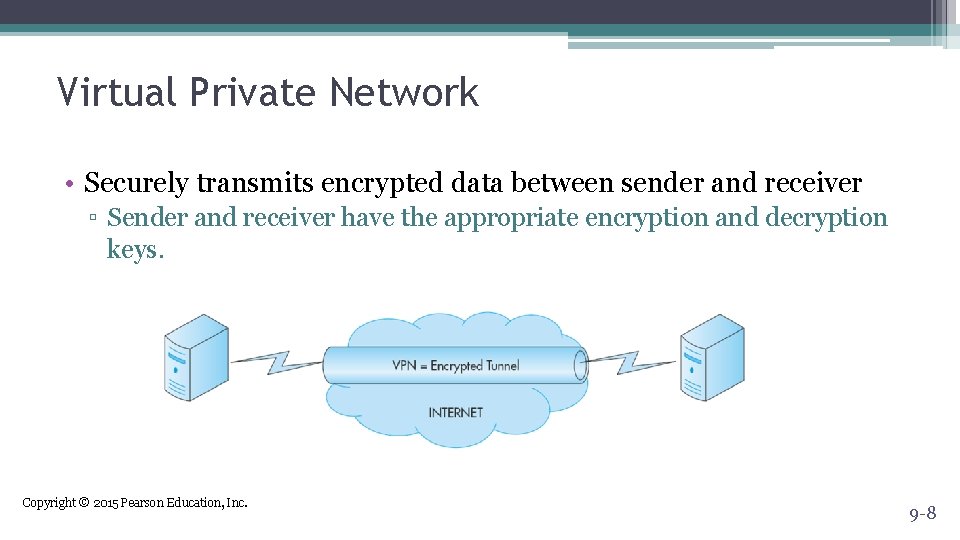
Virtual Private Network • Securely transmits encrypted data between sender and receiver ▫ Sender and receiver have the appropriate encryption and decryption keys. Copyright © 2015 Pearson Education, Inc. 9 -8
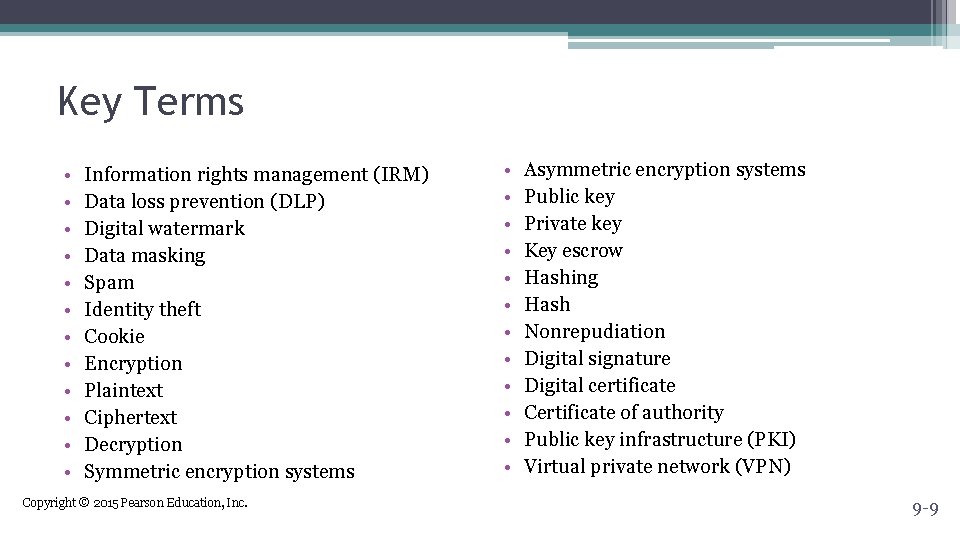
Key Terms • • • Information rights management (IRM) Data loss prevention (DLP) Digital watermark Data masking Spam Identity theft Cookie Encryption Plaintext Ciphertext Decryption Symmetric encryption systems Copyright © 2015 Pearson Education, Inc. • • • Asymmetric encryption systems Public key Private key Key escrow Hashing Hash Nonrepudiation Digital signature Digital certificate Certificate of authority Public key infrastructure (PKI) Virtual private network (VPN) 9 -9