
CONFIDENTIAL TRANSNET PRESENTATION ON THE INDUSTRIAL POLICY ACTION
- Slides: 33
CONFIDENTIAL TRANSNET PRESENTATION ON THE INDUSTRIAL POLICY ACTION PLAN TO THE PORTFOLIO COMMITTEE ON TRADE AND INDUSTRY Chris Wells: Acting Group Chief Executive 16 April 2010
Contents Topics 1. Transnet Performance and targets 2. Cost of doing business regarding rail and freight 3. Utilising public procurement spend to reduce supply chain costs challenges and implications 4. Opportunities and challenges presented by IPAP 2 1
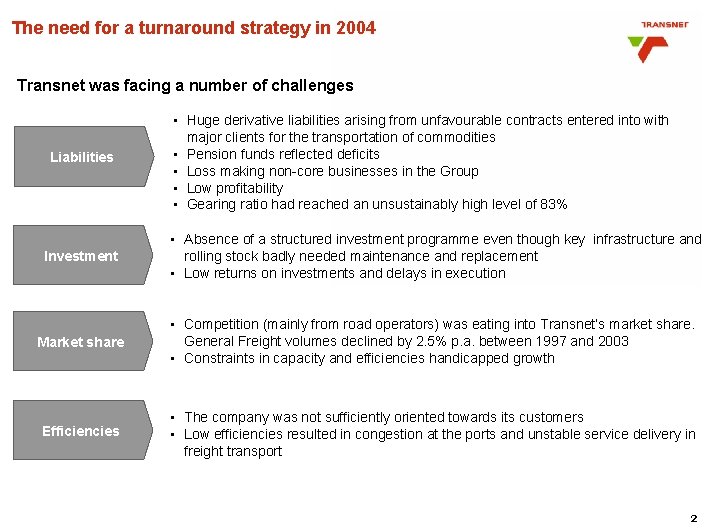
The need for a turnaround strategy in 2004 Transnet was facing a number of challenges Liabilities • Huge derivative liabilities arising from unfavourable contracts entered into with major clients for the transportation of commodities • Pension funds reflected deficits • Loss making non core businesses in the Group • Low profitability • Gearing ratio had reached an unsustainably high level of 83% Investment • Absence of a structured investment programme even though key infrastructure and rolling stock badly needed maintenance and replacement • Low returns on investments and delays in execution Market share • Competition (mainly from road operators) was eating into Transnet’s market share. General Freight volumes declined by 2. 5% p. a. between 1997 and 2003 • Constraints in capacity and efficiencies handicapped growth Efficiencies • The company was not sufficiently oriented towards its customers • Low efficiencies resulted in congestion at the ports and unstable service delivery in freight transport 2
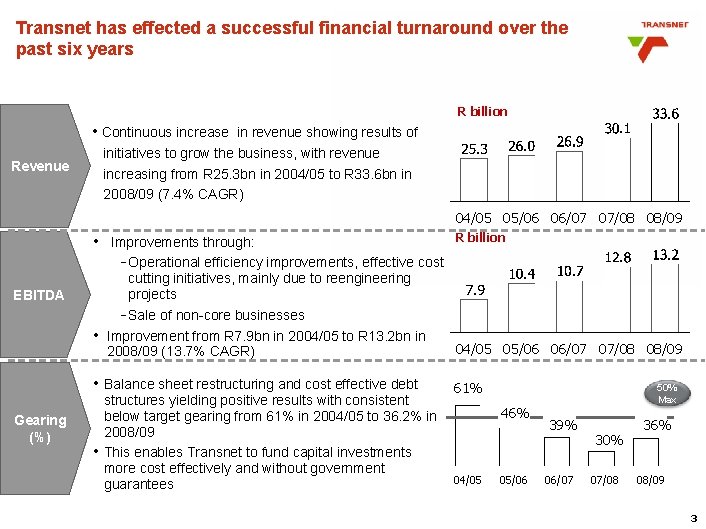
Transnet has effected a successful financial turnaround over the past six years R billion • Continuous increase in revenue showing results of initiatives to grow the business, with revenue increasing from R 25. 3 bn in 2004/05 to R 33. 6 bn in 2008/09 (7. 4% CAGR) Revenue 04/05 05/06 06/07 07/08 08/09 • Improvements through: Operational efficiency improvements, effective cost EBITDA • cutting initiatives, mainly due to reengineering projects Sale of non core businesses Improvement from R 7. 9 bn in 2004/05 to R 13. 2 bn in 2008/09 (13. 7% CAGR) • Balance sheet restructuring and cost effective debt Gearing (%) • structures yielding positive results with consistent below target gearing from 61% in 2004/05 to 36. 2% in 2008/09 This enables Transnet to fund capital investments more cost effectively and without government guarantees R billion 04/05 05/06 06/07 07/08 08/09 61% 46% 04/05 05/06 50% Max 39% 06/07 30% 07/08 36% 08/09 3
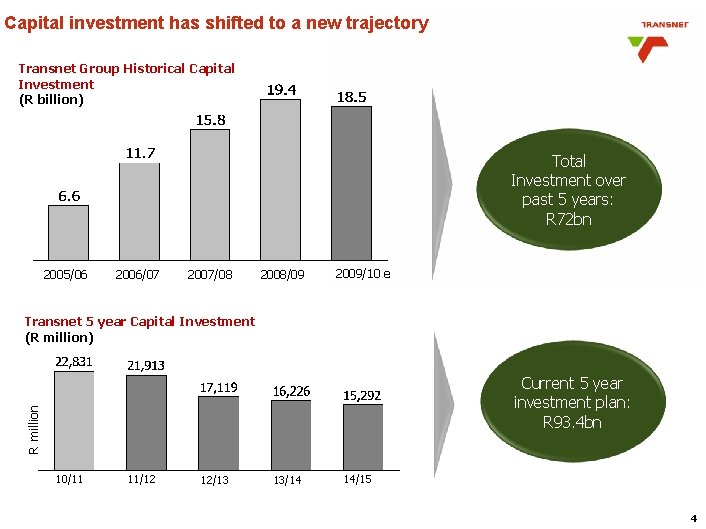
Capital investment has shifted to a new trajectory Transnet Group Historical Capital Investment (R billion) Total Investment over past 5 years: R 72 bn 2005/06 2006/07 2007/08 2008/09 2009/10 e Transnet 5 year Capital Investment (R million) R million Current 5 year investment plan: R 93. 4 bn 10/11 11/12 12/13 13/14 14/15 4
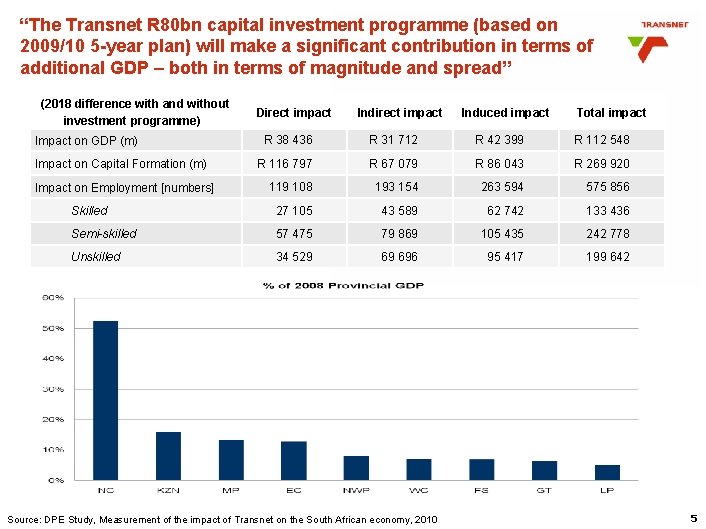
“The Transnet R 80 bn capital investment programme (based on 2009/10 5 -year plan) will make a significant contribution in terms of additional GDP – both in terms of magnitude and spread” (2018 difference with and without investment programme) Direct impact Induced impact Total impact R 38 436 R 31 712 R 42 399 R 112 548 R 116 797 R 67 079 R 86 043 R 269 920 119 108 193 154 263 594 575 856 Skilled 27 105 43 589 62 742 133 436 Semi-skilled 57 475 79 869 105 435 242 778 Unskilled 34 529 69 696 95 417 199 642 Impact on GDP (m) Impact on Capital Formation (m) Impact on Employment [numbers] Source: DPE Study, Measurement of the impact of Transnet on the South African economy, 2010 5
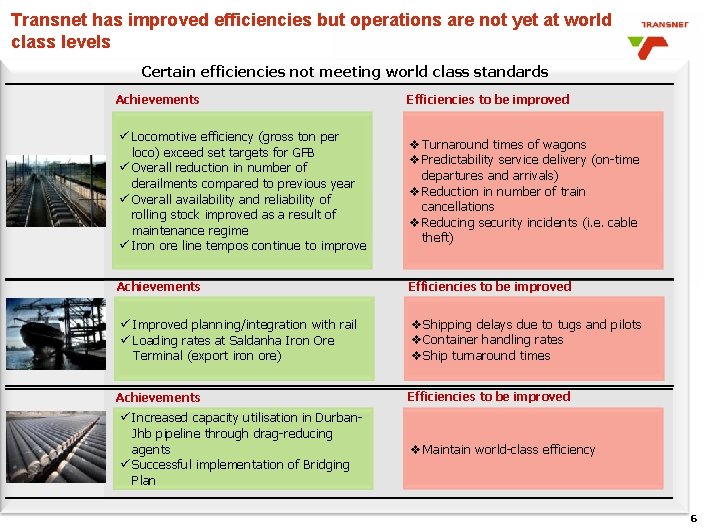
Transnet has improved efficiencies but operations are not yet at world class levels Certain efficiencies not meeting world class standards Rail Ports Pipelines Achievements Efficiencies to be improved ü Locomotive efficiency (gross ton per loco) exceed set targets for GFB ü Overall reduction in number of derailments compared to previous year ü Overall availability and reliability of rolling stock improved as a result of maintenance regime ü Iron ore line tempos continue to improve v Turnaround times of wagons v Predictability service delivery (on-time departures and arrivals) v Reduction in number of train cancellations v Reducing security incidents (i. e. cable theft) Achievements Efficiencies to be improved ü Improved planning/integration with rail ü Loading rates at Saldanha Iron Ore Terminal (export iron ore) v Shipping delays due to tugs and pilots v Container handling rates v Ship turnaround times Achievements Efficiencies to be improved ü Increased capacity utilisation in Durban. Jhb pipeline through drag-reducing agents ü Successful implementation of Bridging Plan v Maintain world-class efficiency 6
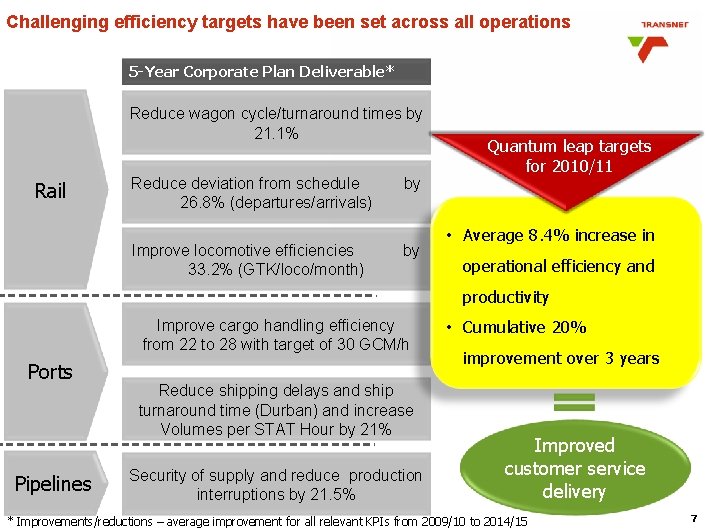
Challenging efficiency targets have been set across all operations 5 -Year Corporate Plan Deliverable* Reduce wagon cycle/turnaround times by 21. 1% Rail Reduce deviation from schedule 26. 8% (departures/arrivals) Improve locomotive efficiencies 33. 2% (GTK/loco/month) by by Quantum leap targets for 2010/11 • Average 8. 4% increase in operational efficiency and productivity Improve cargo handling efficiency from 22 to 28 with target of 30 GCM/h Ports Pipelines Reduce shipping delays and ship turnaround time (Durban) and increase Volumes per STAT Hour by 21% Security of supply and reduce production interruptions by 21. 5% • Cumulative 20% improvement over 3 years Improved customer service delivery * Improvements/reductions – average improvement for all relevant KPIs from 2009/10 to 2014/15 7
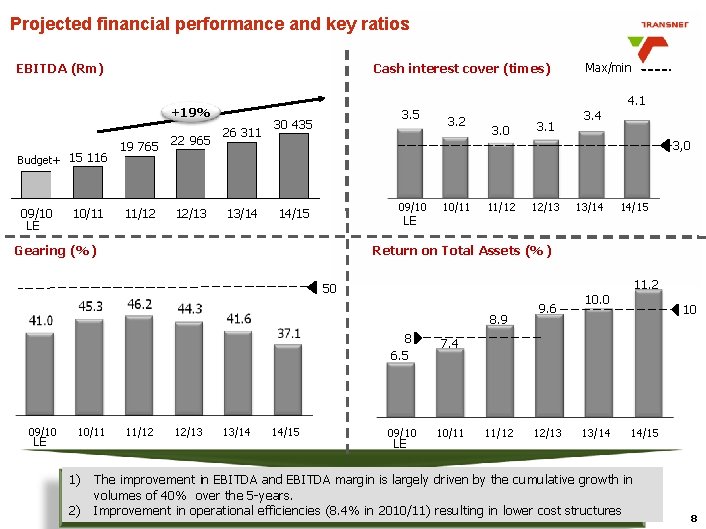
Projected financial performance and key ratios EBITDA (Rm) Cash interest cover (times) +19% Budget+ 12 759 15 116 09/10 LE 10/11 19 765 11/12 22 965 12/13 26 311 13/14 3. 5 30 435 09/10 14/15 LE Gearing (%) 3. 2 10/11 3. 0 3. 1 11/12 12/13 10/11 13/14 14/15 Return on Total Assets (%) 8. 9 LE 3. 4 4. 1 3, 0 50 09/10 Max/min 11/12 12/13 13/14 14/15 8 6. 5 7. 4 09/10 10/11 LE 11/12 9. 6 12/13 11. 2 10. 0 13/14 10 14/15 1) The improvement in EBITDA and EBITDA margin is largely driven by the cumulative growth in volumes of 40% over the 5 -years. 2) Improvement in operational efficiencies (8. 4% in 2010/11) resulting in lower cost structures 8
Contents Topics 1. Transnet Performance and targets 2. Cost of doing business regarding rail and freight 3. Utilising public procurement spend to reduce supply chain costs challenges and implications 4. Opportunities and challenges presented by IPAP 2 9
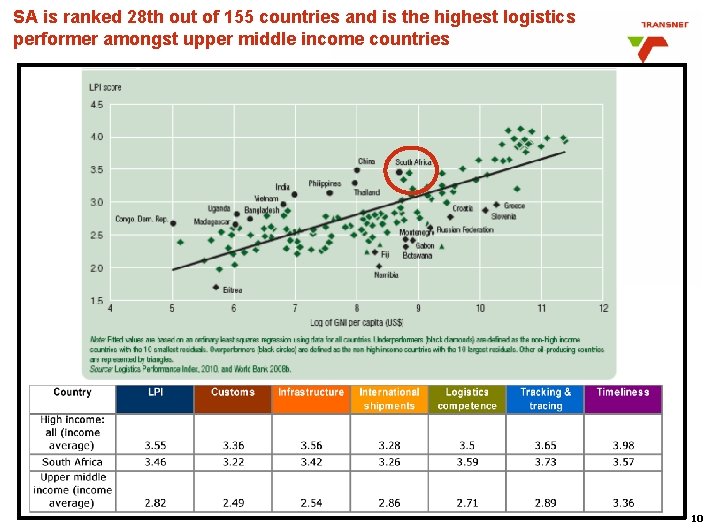
SA is ranked 28 th out of 155 countries and is the highest logistics performer amongst upper middle income countries 10
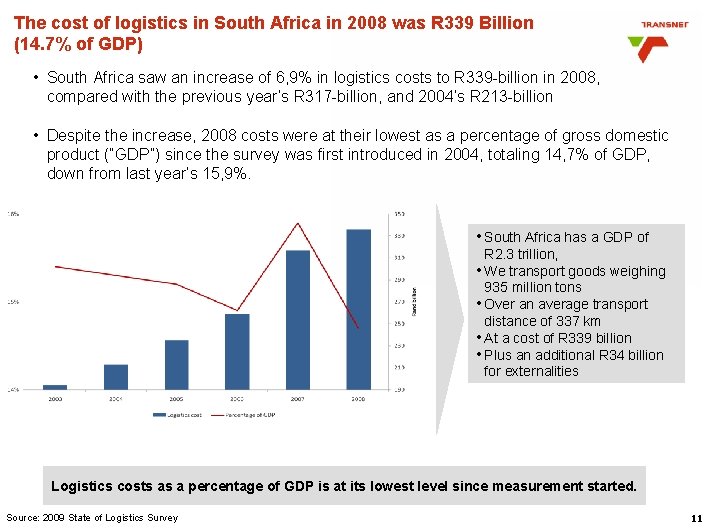
The cost of logistics in South Africa in 2008 was R 339 Billion (14. 7% of GDP) • South Africa saw an increase of 6, 9% in logistics costs to R 339 billion in 2008, compared with the previous year’s R 317 billion, and 2004’s R 213 billion • Despite the increase, 2008 costs were at their lowest as a percentage of gross domestic product (“GDP”) since the survey was first introduced in 2004, totaling 14, 7% of GDP, down from last year’s 15, 9%. • South Africa has a GDP of R 2. 3 trillion, • We transport goods weighing 935 million tons • Over an average transport distance of 337 km • At a cost of R 339 billion • Plus an additional R 34 billion for externalities Logistics costs as a percentage of GDP is at its lowest level since measurement started. Source: 2009 State of Logistics Survey 11
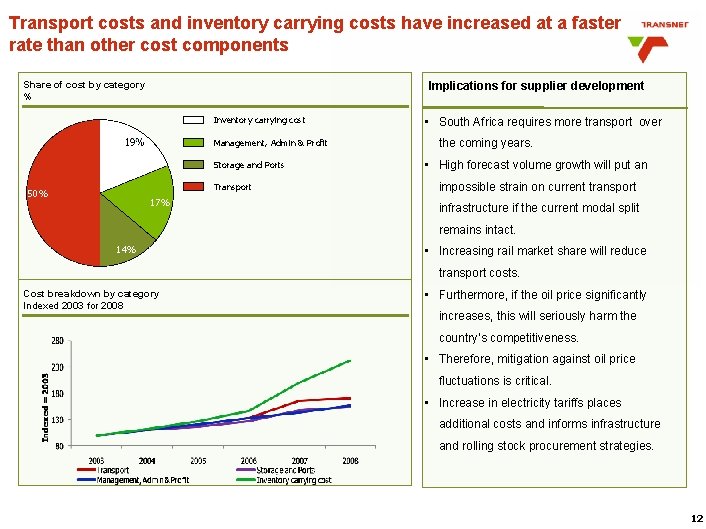
Transport costs and inventory carrying costs have increased at a faster rate than other cost components Share of cost by category % Implications for supplier development Inventory carrying cost Management, Admin & Profit Storage and Ports Transport 50% 17% • South Africa requires more transport over the coming years. • High forecast volume growth will put an impossible strain on current transport infrastructure if the current modal split remains intact. 14% • Increasing rail market share will reduce transport costs. Cost breakdown by category Indexed 2003 for 2008 • Furthermore, if the oil price significantly increases, this will seriously harm the country’s competitiveness. • Therefore, mitigation against oil price fluctuations is critical. • Increase in electricity tariffs places additional costs and informs infrastructure and rolling stock procurement strategies. 12
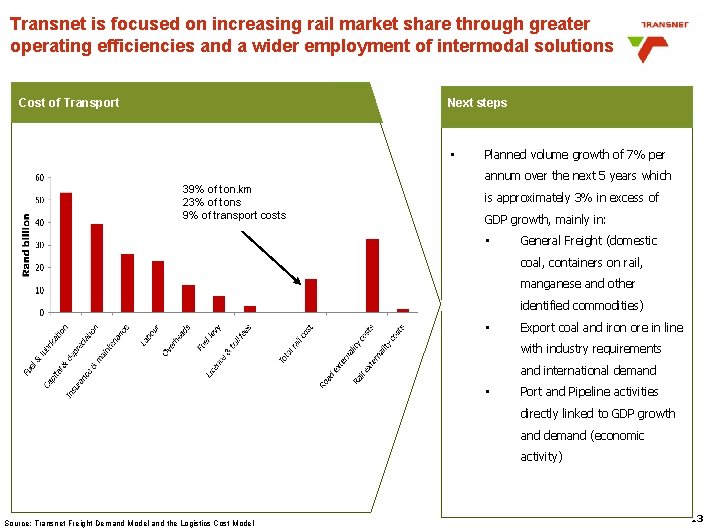
Transnet is focused on increasing rail market share through greater operating efficiencies and a wider employment of intermodal solutions Cost of Transport Next steps • 39% of ton. km 23% of tons 9% of transport costs Planned volume growth of 7% per annum over the next 5 years which is approximately 3% in excess of GDP growth, mainly in: • General Freight (domestic coal, containers on rail, manganese and other identified commodities) • Export coal and iron ore in line with industry requirements and international demand • Port and Pipeline activities directly linked to GDP growth and demand (economic activity) Source: Transnet Freight Demand Model and the Logistics Cost Model 13
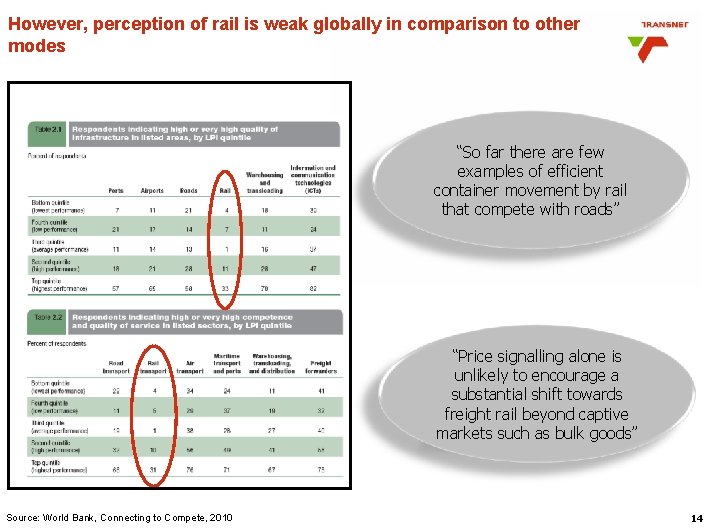
However, perception of rail is weak globally in comparison to other modes “So far there are few examples of efficient container movement by rail that compete with roads” “Price signalling alone is unlikely to encourage a substantial shift towards freight rail beyond captive markets such as bulk goods” Source: World Bank, Connecting to Compete, 2010 14
Contents Topics 1. Transnet Performance and targets 2. Cost of doing business regarding rail and freight 3. Utilising public procurement spend to reduce supply chain costs- challenges and implications 4. Opportunities and challenges presented by IPAP 2 15
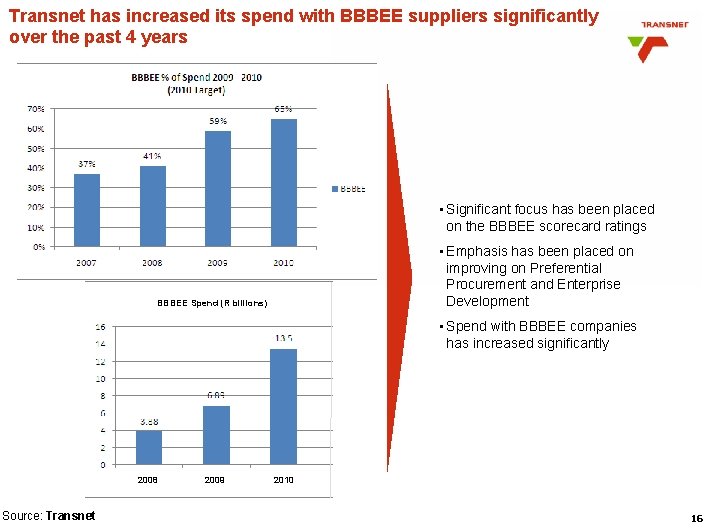
Transnet has increased its spend with BBBEE suppliers significantly over the past 4 years • Significant focus has been placed on the BBBEE scorecard ratings • Emphasis has been placed on improving on Preferential Procurement and Enterprise Development BBBEE Spend (R billions) • Spend with BBBEE companies has increased significantly 2008 Source: Transnet 2009 2010 16
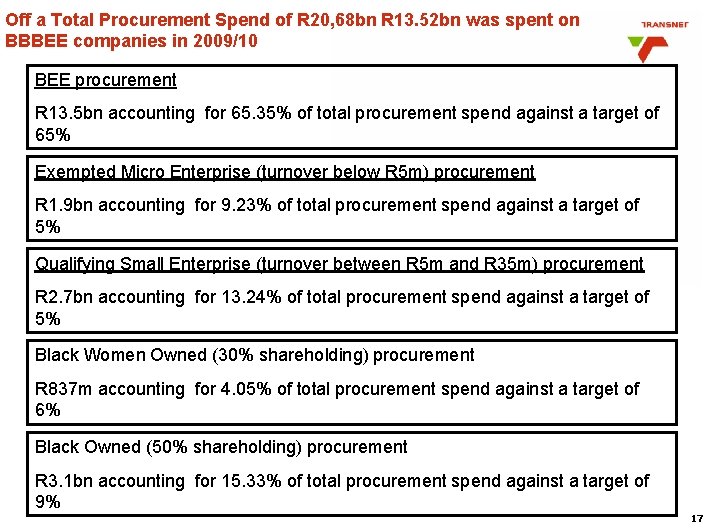
Off a Total Procurement Spend of R 20, 68 bn R 13. 52 bn was spent on BBBEE companies in 2009/10 BEE procurement R 13. 5 bn accounting for 65. 35% of total procurement spend against a target of 65% Exempted Micro Enterprise (turnover below R 5 m) procurement R 1. 9 bn accounting for 9. 23% of total procurement spend against a target of 5% Qualifying Small Enterprise (turnover between R 5 m and R 35 m) procurement R 2. 7 bn accounting for 13. 24% of total procurement spend against a target of 5% Black Women Owned (30% shareholding) procurement R 837 m accounting for 4. 05% of total procurement spend against a target of 6% Black Owned (50% shareholding) procurement R 3. 1 bn accounting for 15. 33% of total procurement spend against a target of 9% 17
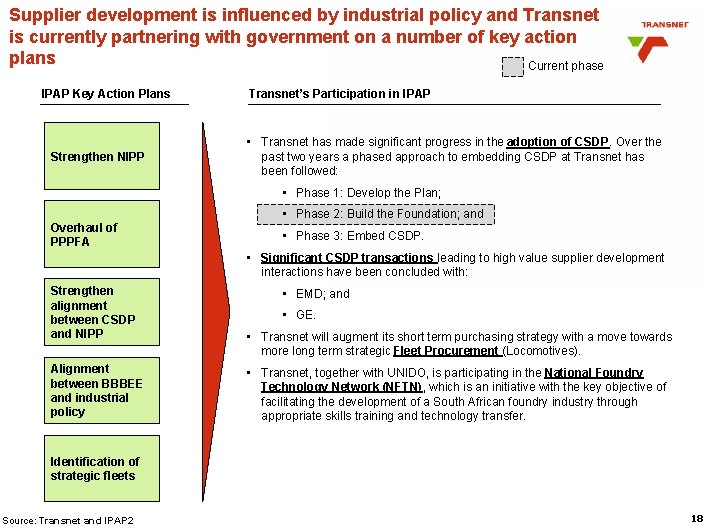
Supplier development is influenced by industrial policy and Transnet is currently partnering with government on a number of key action plans Current phase IPAP Key Action Plans Strengthen NIPP Transnet’s Participation in IPAP • Transnet has made significant progress in the adoption of CSDP. Over the past two years a phased approach to embedding CSDP at Transnet has been followed: • Phase 1: Develop the Plan; Overhaul of PPPFA • Phase 2: Build the Foundation; and • Phase 3: Embed CSDP. • Significant CSDP transactions leading to high value supplier development interactions have been concluded with: Strengthen alignment between CSDP and NIPP Alignment between BBBEE and industrial policy • EMD; and • GE. • Transnet will augment its short term purchasing strategy with a move towards more long term strategic Fleet Procurement (Locomotives). • Transnet, together with UNIDO, is participating in the National Foundry Technology Network (NFTN), which is an initiative with the key objective of facilitating the development of a South African foundry industry through appropriate skills training and technology transfer. Identification of strategic fleets Source: Transnet and IPAP 2 18
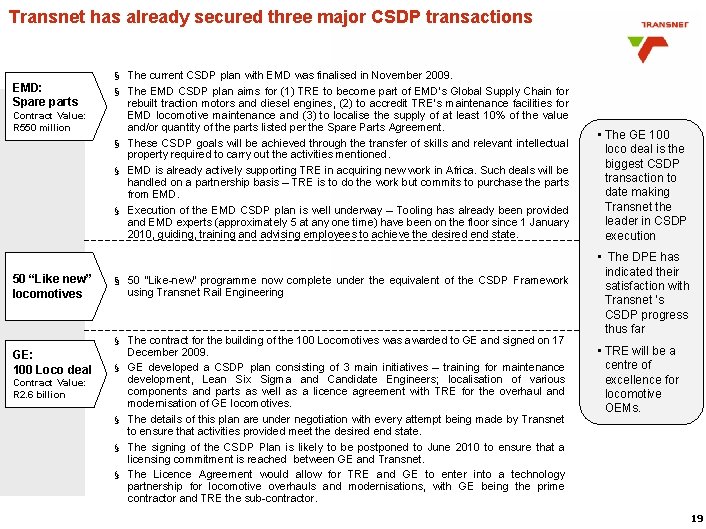
Transnet has already secured three major CSDP transactions EMD: Spare parts Contract Value: R 550 million 50 “Like new” locomotives § The current CSDP plan with EMD was finalised in November 2009. § The EMD CSDP plan aims for (1) TRE to become part of EMD’s Global Supply Chain for rebuilt traction motors and diesel engines, (2) to accredit TRE’s maintenance facilities for EMD locomotive maintenance and (3) to localise the supply of at least 10% of the value and/or quantity of the parts listed per the Spare Parts Agreement. § These CSDP goals will be achieved through the transfer of skills and relevant intellectual property required to carry out the activities mentioned. § EMD is already actively supporting TRE in acquiring new work in Africa. Such deals will be handled on a partnership basis – TRE is to do the work but commits to purchase the parts from EMD. § Execution of the EMD CSDP plan is well underway – Tooling has already been provided and EMD experts (approximately 5 at any one time) have been on the floor since 1 January 2010, guiding, training and advising employees to achieve the desired end state. § 50 “Like new” programme now complete under the equivalent of the CSDP Framework using Transnet Rail Engineering § GE: 100 Loco deal § Contract Value: R 2. 6 billion § § § The contract for the building of the 100 Locomotives was awarded to GE and signed on 17 December 2009. GE developed a CSDP plan consisting of 3 main initiatives – training for maintenance development, Lean Six Sigma and Candidate Engineers; localisation of various components and parts as well as a licence agreement with TRE for the overhaul and modernisation of GE locomotives. The details of this plan are under negotiation with every attempt being made by Transnet to ensure that activities provided meet the desired end state. The signing of the CSDP Plan is likely to be postponed to June 2010 to ensure that a licensing commitment is reached between GE and Transnet. The Licence Agreement would allow for TRE and GE to enter into a technology partnership for locomotive overhauls and modernisations, with GE being the prime contractor and TRE the sub contractor. • The GE 100 loco deal is the biggest CSDP transaction to date making Transnet the leader in CSDP execution • The DPE has indicated their satisfaction with Transnet ‘s CSDP progress thus far • TRE will be a centre of excellence for locomotive OEMs. 19
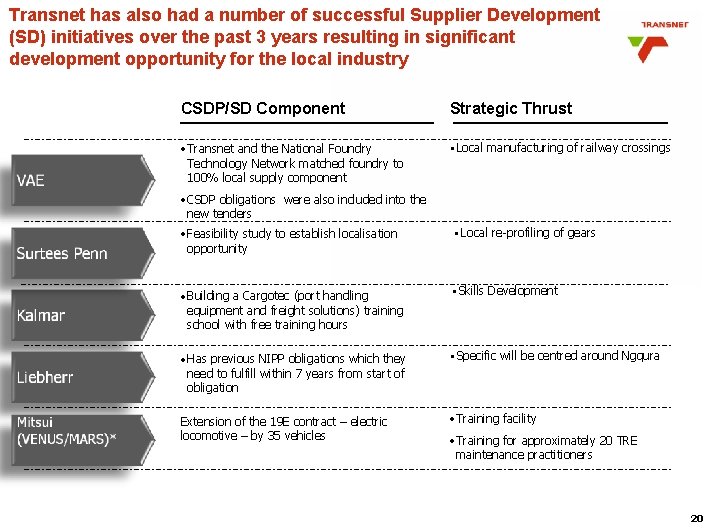
Transnet has also had a number of successful Supplier Development (SD) initiatives over the past 3 years resulting in significant development opportunity for the local industry CSDP/SD Component Strategic Thrust • Transnet and the National Foundry Technology Network matched foundry to 100% local supply component • Local manufacturing of railway crossings • CSDP obligations were also included into the new tenders • Feasibility study to establish localisation opportunity • Local re-profiling of gears • Building a Cargotec (port handling • Skills • Has previous NIPP obligations which they • Specific Extension of the 19 E contract – electric locomotive – by 35 vehicles • Training facility Development equipment and freight solutions) training school with free training hours will be centred around Ngqura need to fulfill within 7 years from start of obligation • Training for approximately 20 TRE maintenance practitioners 20
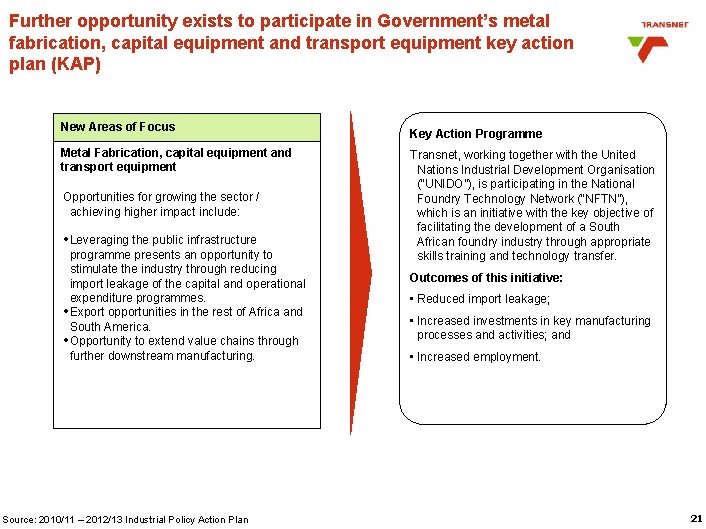
Further opportunity exists to participate in Government’s metal fabrication, capital equipment and transport equipment key action plan (KAP) New Areas of Focus Metal Fabrication, capital equipment and transport equipment Opportunities for growing the sector / achieving higher impact include: • Leveraging the public infrastructure programme presents an opportunity to stimulate the industry through reducing import leakage of the capital and operational expenditure programmes. • Export opportunities in the rest of Africa and South America. • Opportunity to extend value chains through further downstream manufacturing. Source: 2010/11 – 2012/13 Industrial Policy Action Plan Key Action Programme Transnet, working together with the United Nations Industrial Development Organisation (“UNIDO”), is participating in the National Foundry Technology Network (“NFTN”), which is an initiative with the key objective of facilitating the development of a South African foundry industry through appropriate skills training and technology transfer. Outcomes of this initiative: • Reduced import leakage; • Increased investments in key manufacturing processes and activities; and • Increased employment. 21
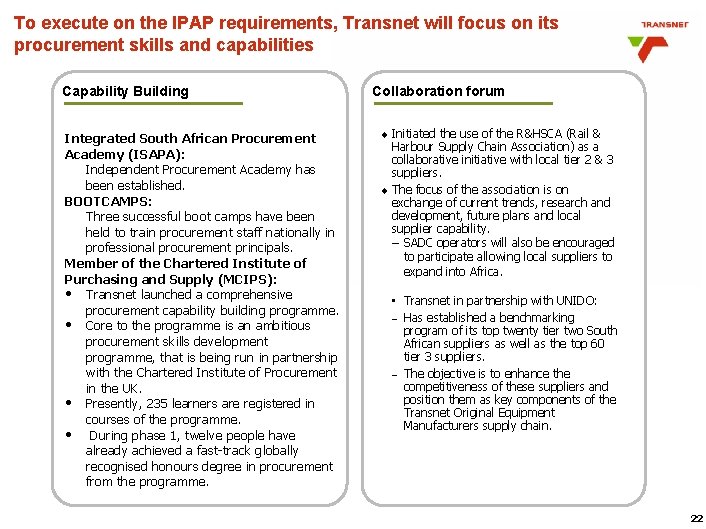
To execute on the IPAP requirements, Transnet will focus on its procurement skills and capabilities Capability Building Integrated South African Procurement Academy (ISAPA): Independent Procurement Academy has been established. BOOTCAMPS: Three successful boot camps have been held to train procurement staff nationally in professional procurement principals. Member of the Chartered Institute of Purchasing and Supply (MCIPS): • Transnet launched a comprehensive procurement capability building programme. • Core to the programme is an ambitious procurement skills development programme, that is being run in partnership with the Chartered Institute of Procurement in the UK. • Presently, 235 learners are registered in courses of the programme. • During phase 1, twelve people have already achieved a fast-track globally recognised honours degree in procurement from the programme. Collaboration forum ¨ Initiated the use of the R&HSCA (Rail & Harbour Supply Chain Association) as a collaborative initiative with local tier 2 & 3 suppliers. ¨ The focus of the association is on exchange of current trends, research and development, future plans and local supplier capability. – SADC operators will also be encouraged to participate allowing local suppliers to expand into Africa. • Transnet in partnership with UNIDO: Has established a benchmarking program of its top twenty tier two South African suppliers as well as the top 60 tier 3 suppliers. The objective is to enhance the competitiveness of these suppliers and position them as key components of the Transnet Original Equipment Manufacturers supply chain. 22
Contents Topics 1. Overview of Transnet Performance 2. Cost of doing business regarding rail and freight 3. Utilising public procurement spend to reduce supply chain costs challenges and implications 4. Opportunities and challenges presented by IPAP 2 23
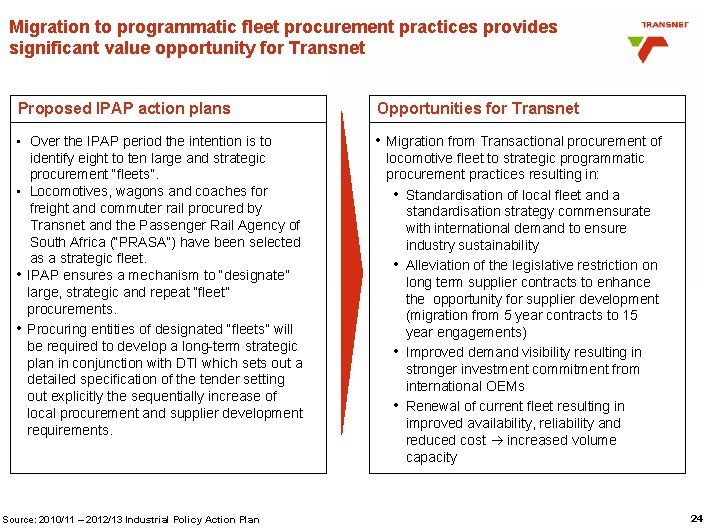
Migration to programmatic fleet procurement practices provides significant value opportunity for Transnet Proposed IPAP action plans Opportunities for Transnet • Over the IPAP period the intention is to identify eight to ten large and strategic procurement “fleets”. • Locomotives, wagons and coaches for freight and commuter rail procured by Transnet and the Passenger Rail Agency of South Africa (“PRASA”) have been selected as a strategic fleet. • IPAP ensures a mechanism to “designate” large, strategic and repeat “fleet” procurements. • Procuring entities of designated “fleets” will be required to develop a long term strategic plan in conjunction with DTI which sets out a detailed specification of the tender setting out explicitly the sequentially increase of local procurement and supplier development requirements. • Migration from Transactional procurement of Source: 2010/11 – 2012/13 Industrial Policy Action Plan locomotive fleet to strategic programmatic procurement practices resulting in: • Standardisation of local fleet and a standardisation strategy commensurate with international demand to ensure industry sustainability • Alleviation of the legislative restriction on long term supplier contracts to enhance the opportunity for supplier development (migration from 5 year contracts to 15 year engagements) • Improved demand visibility resulting in stronger investment commitment from international OEMs • Renewal of current fleet resulting in improved availability, reliability and reduced cost increased volume capacity 24
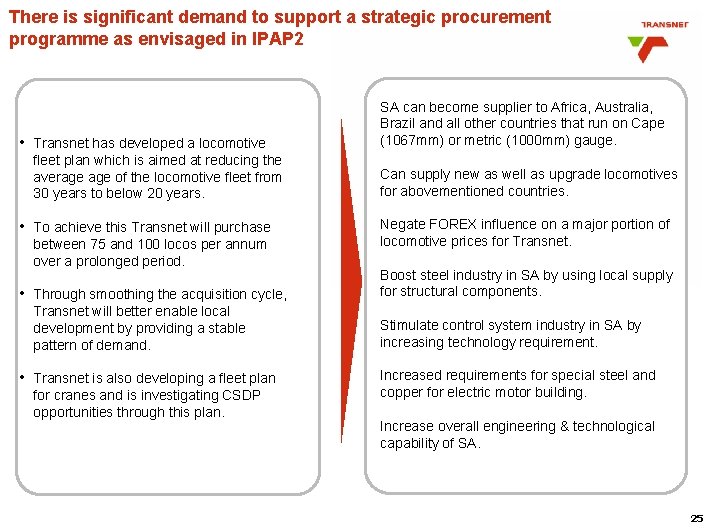
There is significant demand to support a strategic procurement programme as envisaged in IPAP 2 • Transnet has developed a locomotive fleet plan which is aimed at reducing the average of the locomotive fleet from 30 years to below 20 years. • To achieve this Transnet will purchase between 75 and 100 locos per annum over a prolonged period. • Through smoothing the acquisition cycle, Transnet will better enable local development by providing a stable pattern of demand. • Transnet is also developing a fleet plan for cranes and is investigating CSDP opportunities through this plan. SA can become supplier to Africa, Australia, Brazil and all other countries that run on Cape (1067 mm) or metric (1000 mm) gauge. Can supply new as well as upgrade locomotives for abovementioned countries. Negate FOREX influence on a major portion of locomotive prices for Transnet. Boost steel industry in SA by using local supply for structural components. Stimulate control system industry in SA by increasing technology requirement. Increased requirements for special steel and copper for electric motor building. Increase overall engineering & technological capability of SA. 25
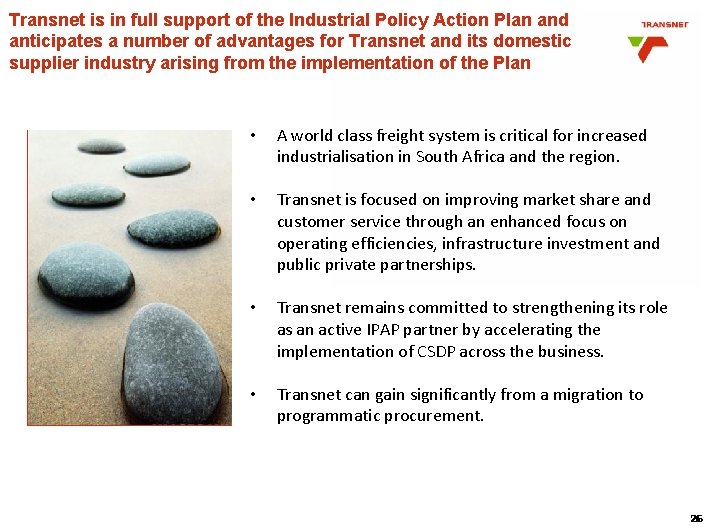
Transnet is in full support of the Industrial Policy Action Plan and anticipates a number of advantages for Transnet and its domestic supplier industry arising from the implementation of the Plan • A world class freight system is critical for increased industrialisation in South Africa and the region. • Transnet is focused on improving market share and customer service through an enhanced focus on operating efficiencies, infrastructure investment and public private partnerships. • Transnet remains committed to strengthening its role as an active IPAP partner by accelerating the implementation of CSDP across the business. • Transnet can gain significantly from a migration to programmatic procurement. 26 26
Thank You 27
Additional Information 28
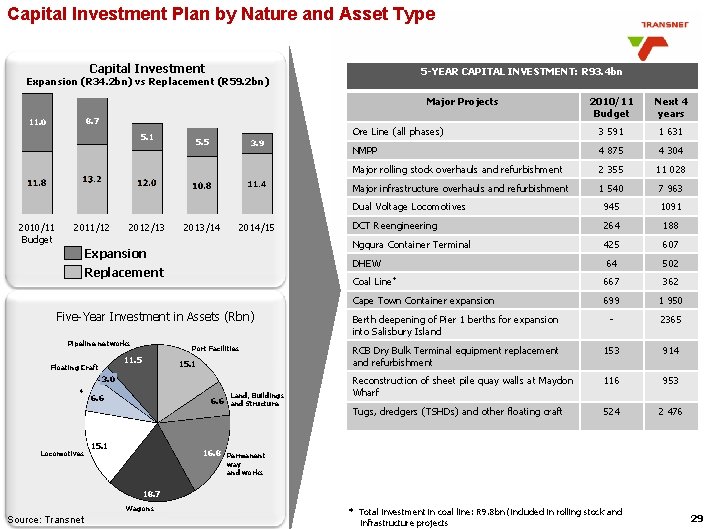
Capital Investment Plan by Nature and Asset Type Capital Investment 5 -YEAR CAPITAL INVESTMENT: R 93. 4 bn Expansion (R 34. 2 bn) vs Replacement (R 59. 2 bn) Major Projects 2010/11 Budget Next 4 years Ore Line (all phases) 3 591 1 631 NMPP 4 875 4 304 Major rolling stock overhauls and refurbishment 2 355 11 028 Major infrastructure overhauls and refurbishment 1 540 7 963 Dual Voltage Locomotives 945 1091 DCT Reengineering 264 188 Ngqura Container Terminal 425 607 DHEW 64 502 Coal Line* 667 362 Cape Town Container expansion 699 1 950 Berth deepening of Pier 1 berths for expansion into Salisbury Island - 2365 RCB Dry Bulk Terminal equipment replacement and refurbishment 153 914 Reconstruction of sheet pile quay walls at Maydon Wharf 116 953 Tugs, dredgers (TSHDs) and other floating craft 524 2 476 8. 7 11. 0 5. 1 2010/11 Budget 2011/12 2012/13 5. 5 3. 9 2013/14 2014/15 Expansion Replacement Five-Year Investment in Assets (Rbn) Pipeline networks Port Facilities 11. 5 Floating Craft 15. 1 3. 0 * Locomotives Land, Buildings 6. 6 and Structure 6. 6 15. 1 16. 8 Permanent way and works 18. 7 Wagons Source: Transnet * Total investment in coal line: R 9. 8 bn (included in rolling stock and infrastructure projects 29
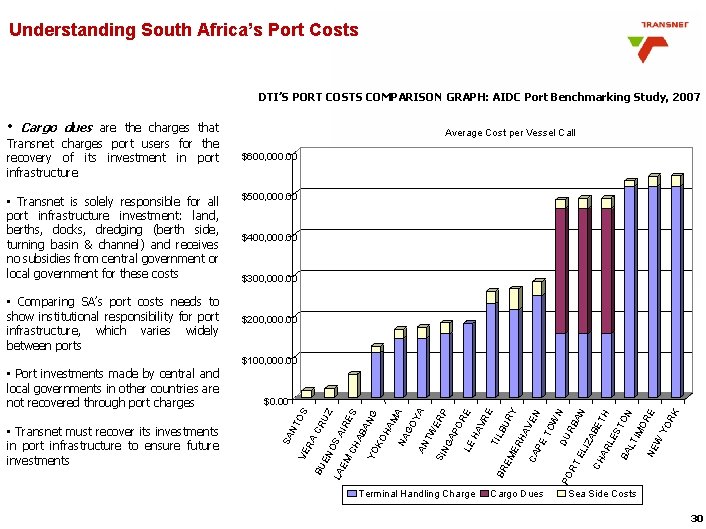
Understanding South Africa’s Port Costs DTI’S PORT COSTS COMPARISON GRAPH: AIDC Port Benchmarking Study, 2007 • Cargo dues are the charges that Transnet charges port users for the recovery of its investment in port infrastructure • Transnet is solely responsible for all port infrastructure investment: land, berths, docks, dredging (berth side, turning basin & channel) and receives no subsidies from central government or local government for these costs • Comparing SA’s port costs needs to show institutional responsibility for port infrastructure, which varies widely between ports Average Cost per Vessel Call $600, 000. 00 $500, 000. 00 $400, 000. 00 $300, 000. 00 $200, 000. 00 $100, 000. 00 YA TW ER SIN P GA PO RE LE HA VR E TIL BR BU EM RY ER HA VE CA N PE TO WN DU PO RB RT AN EL IZA BE CH TH AR LE ST ON BA LT IM OR E NE W YO RK GO AN MA NA G HA KO AN YO CH AB ES LA EM OS AIR CR BU EN RA NT VE SA • Transnet must recover its investments in port infrastructure to ensure future investments UZ $0. 00 OS • Port investments made by central and local governments in other countries are not recovered through port charges Terminal Handling Charge Cargo Dues Sea Side Costs 30
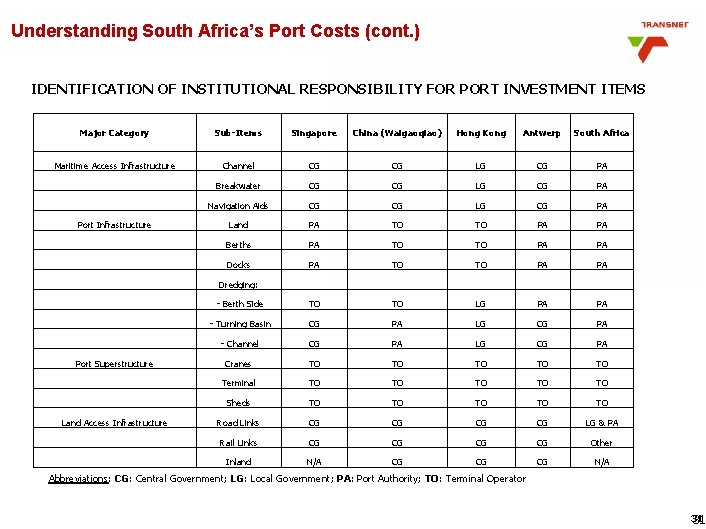
Understanding South Africa’s Port Costs (cont. ) IDENTIFICATION OF INSTITUTIONAL RESPONSIBILITY FOR PORT INVESTMENT ITEMS Major Category Sub-Items Singapore China (Waigaoqiao) Hong Kong Antwerp South Africa Maritime Access Infrastructure Channel CG CG LG CG PA Breakwater CG CG LG CG PA Navigation Aids CG CG LG CG PA Land PA TO TO PA PA Berths PA TO TO PA PA Docks PA TO TO PA PA - Berth Side TO TO LG PA PA - Turning Basin CG PA LG CG PA - Channel CG PA LG CG PA Cranes TO TO TO Terminal TO TO TO Sheds TO TO TO Road Links CG CG LG & PA Rail Links CG CG Other Inland N/A CG CG CG N/A Port Infrastructure Dredging: Port Superstructure Land Access Infrastructure Abbreviations: CG: Central Government; LG: Local Government; PA: Port Authority; TO: Terminal Operator 31 31
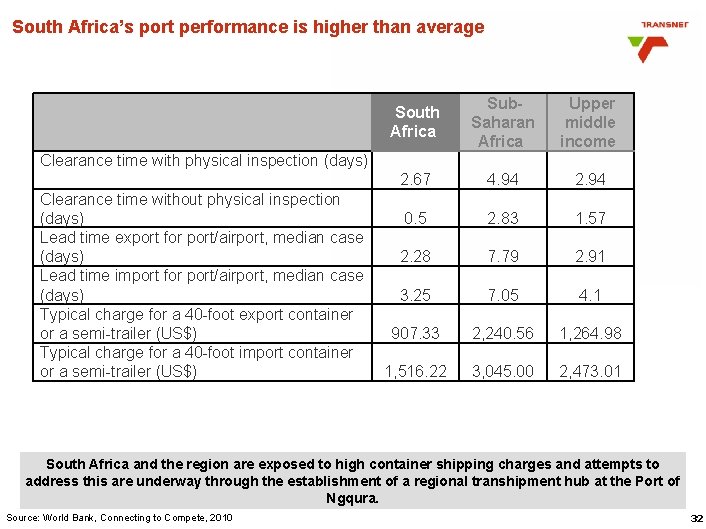
South Africa’s port performance is higher than average South Africa Sub. Saharan Africa Upper middle income 2. 67 4. 94 2. 94 0. 5 2. 83 1. 57 2. 28 7. 79 2. 91 3. 25 7. 05 4. 1 907. 33 2, 240. 56 1, 264. 98 1, 516. 22 3, 045. 00 2, 473. 01 Clearance time with physical inspection (days) Clearance time without physical inspection (days) Lead time export for port/airport, median case (days) Lead time import for port/airport, median case (days) Typical charge for a 40 foot export container or a semi trailer (US$) Typical charge for a 40 foot import container or a semi trailer (US$) South Africa and the region are exposed to high container shipping charges and attempts to address this are underway through the establishment of a regional transhipment hub at the Port of Ngqura. Source: World Bank, Connecting to Compete, 2010 32