
Confidential Not to be reproduced without written permission
Confidential Not to be reproduced without written permission from FMB Oxford Welcome Slide 1 FMB Oxford Detectors and Diagnostics Technologies – an update Steve Syme John Gordon

Confidential Not to be reproduced without written permission from FMB Oxford Contact details Slide 2 Contact details: l Business Manager, Detectors and Diagnostics l Steve. Syme@FMB-Oxford. com Website: l www. fmb-oxford. com
Confidential Not to be reproduced without written permission from FMB Oxford Capabilities and installed base Slide 3 l Capabilities and installed base l Detectors and diagnostics l Electronics l New items

Confidential Not to be reproduced without written permission from FMB Oxford Who are FMB Oxford? Slide 4 l UK Limited Company l Wholly-owned subsidiary of FMB in Berlin l >US$10 M turnover l 50 staff l Specialising in Design, Assembly, Test and Install l Operating from 2, 000 sqm factory in Oxford l BS EN ISO 9001 since 1996
Confidential Not to be reproduced without written permission from FMB Oxford Our History – 2 decades Slide 5 In the early 1990 s Oxford instruments Synchrotron Group, which had been manufacturing Superconducting Compact Synchrotrons, began to supply beamline components to many of then new 3 rd generation light sources. In January 2001 Oxford Instruments sold the Group to Danfysik A/S. In March 2002, Oxford Danfysik moved into a new factory, which had been completely refurbished specifically to suit our synchrotron beamline business. In October 2007, FMB Berlin acquired Oxford Danfysik, renaming the company to FMB Oxford. The combined business has the largest installed base and the greatest range of products of any supplier in the synchrotron community.
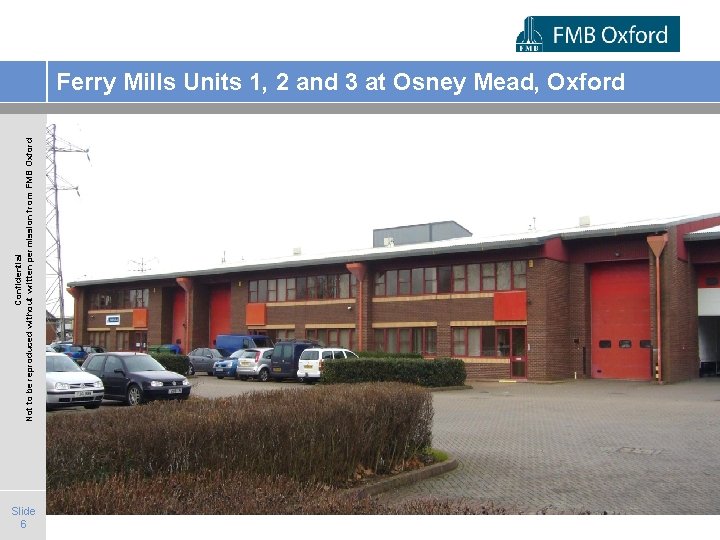
Confidential Not to be reproduced without written permission from FMB Oxford Ferry Mills Units 1, 2 and 3 at Osney Mead, Oxford Slide 6
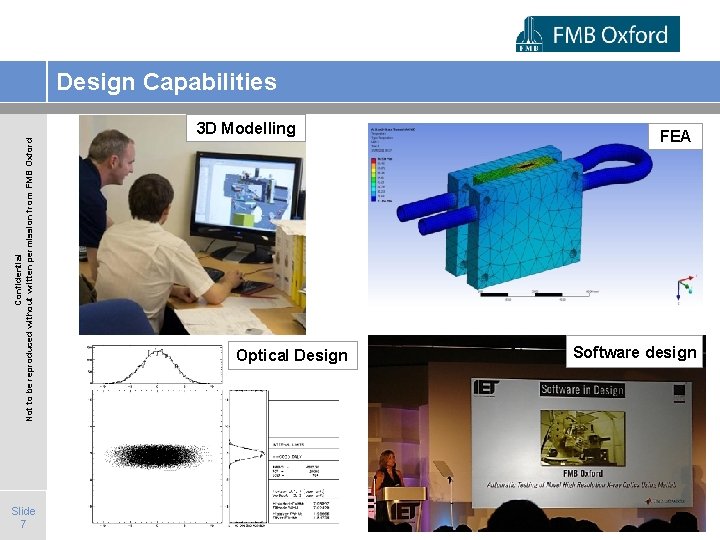
Confidential Not to be reproduced without written permission from FMB Oxford Design Capabilities 3 D Modelling Slide 7 Optical Design FEA Software design
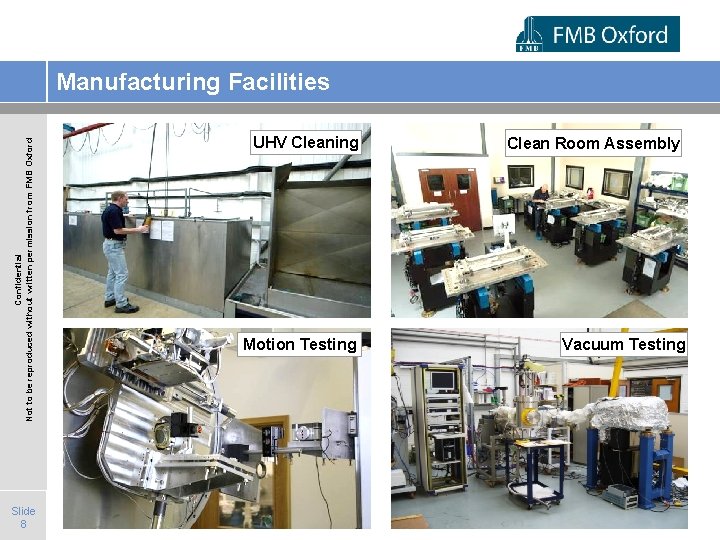
Confidential Not to be reproduced without written permission from FMB Oxford Manufacturing Facilities Slide 8 UHV Cleaning Motion Testing Clean Room Assembly Vacuum Testing
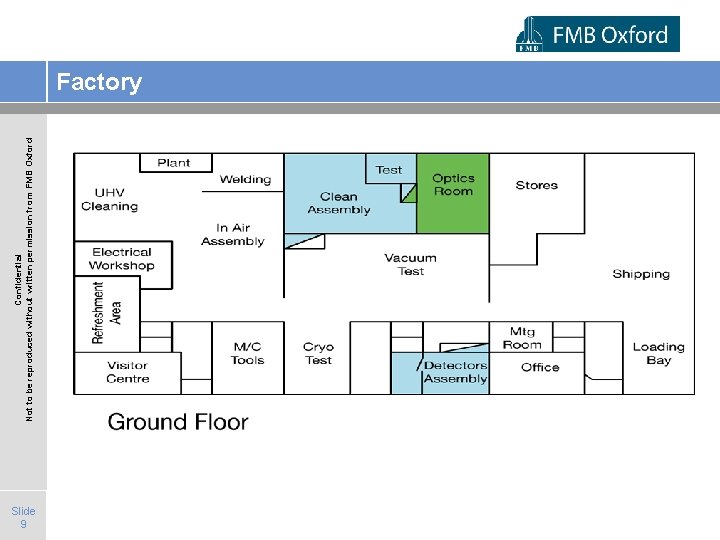
Confidential Not to be reproduced without written permission from FMB Oxford Factory Slide 9
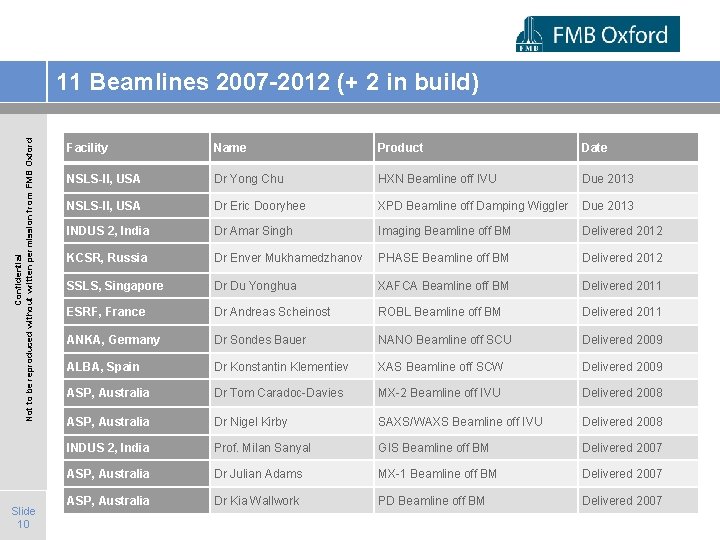
Confidential Not to be reproduced without written permission from FMB Oxford 11 Beamlines 2007 -2012 (+ 2 in build) Slide 10 Facility Name Product Date NSLS-II, USA Dr Yong Chu HXN Beamline off IVU Due 2013 NSLS-II, USA Dr Eric Dooryhee XPD Beamline off Damping Wiggler Due 2013 INDUS 2, India Dr Amar Singh Imaging Beamline off BM Delivered 2012 KCSR, Russia Dr Enver Mukhamedzhanov PHASE Beamline off BM Delivered 2012 SSLS, Singapore Dr Du Yonghua XAFCA Beamline off BM Delivered 2011 ESRF, France Dr Andreas Scheinost ROBL Beamline off BM Delivered 2011 ANKA, Germany Dr Sondes Bauer NANO Beamline off SCU Delivered 2009 ALBA, Spain Dr Konstantin Klementiev XAS Beamline off SCW Delivered 2009 ASP, Australia Dr Tom Caradoc-Davies MX-2 Beamline off IVU Delivered 2008 ASP, Australia Dr Nigel Kirby SAXS/WAXS Beamline off IVU Delivered 2008 INDUS 2, India Prof. Milan Sanyal GIS Beamline off BM Delivered 2007 ASP, Australia Dr Julian Adams MX-1 Beamline off BM Delivered 2007 ASP, Australia Dr Kia Wallwork PD Beamline off BM Delivered 2007
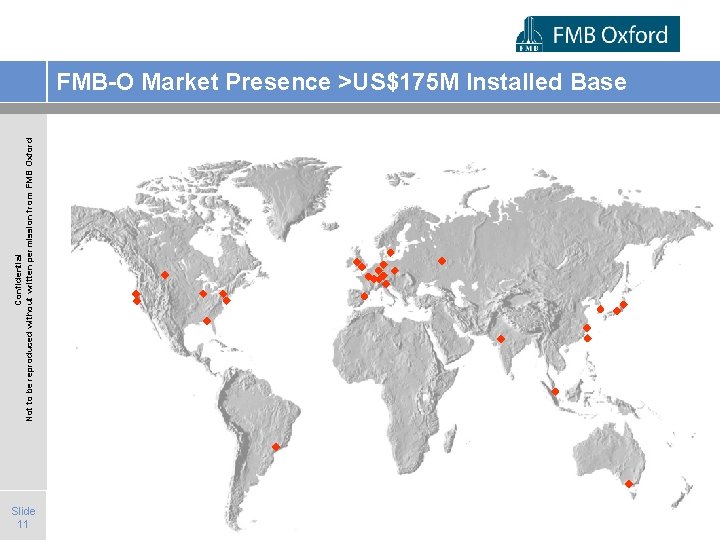
Confidential Not to be reproduced without written permission from FMB Oxford FMB-O Market Presence >US$175 M Installed Base Slide 11
Confidential Not to be reproduced without written permission from FMB Oxford Detectors and diagnostics Slide 12 l Capabilities and installed base l Detectors and diagnostics l Electronics l New items
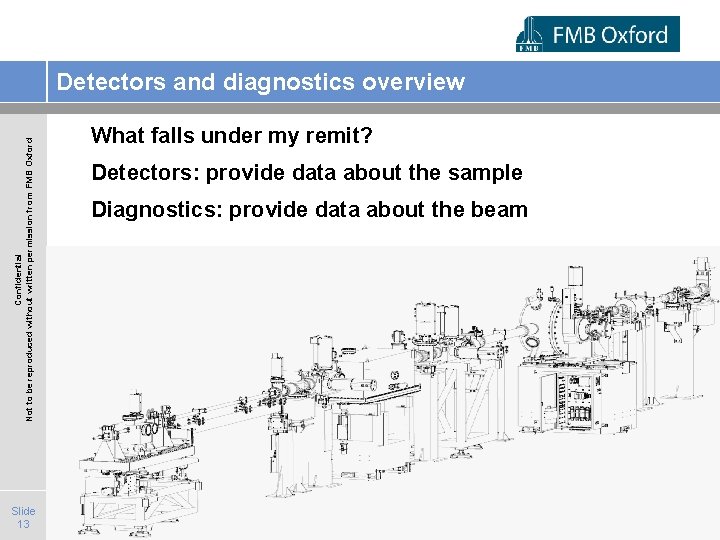
Confidential Not to be reproduced without written permission from FMB Oxford Detectors and diagnostics overview Slide 13 What falls under my remit? Detectors: provide data about the sample Diagnostics: provide data about the beam
Confidential Not to be reproduced without written permission from FMB Oxford Detectors and diagnostics range Slide 14 The FMB Oxford range can be used to measure or manipulate several experimental parameters: l Beam flux measurement l Beam energy measurement and filtering l Beam position l Beam intensity l Sample manipulation
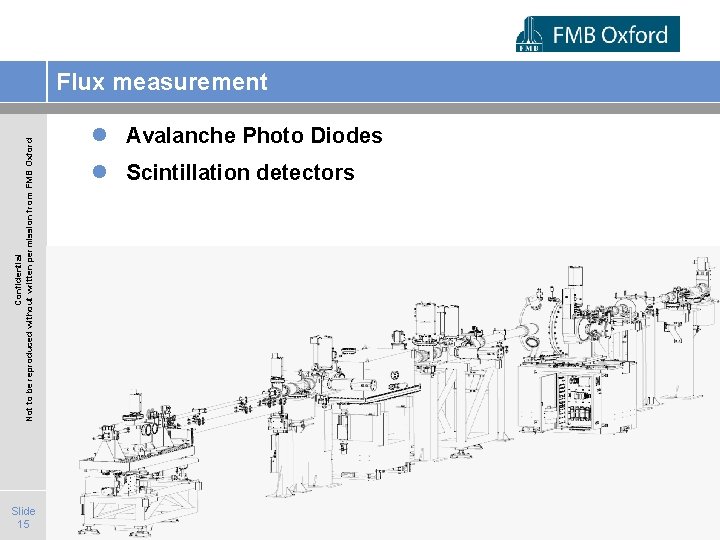
Confidential Not to be reproduced without written permission from FMB Oxford Flux measurement Slide 15 l Avalanche Photo Diodes l Scintillation detectors
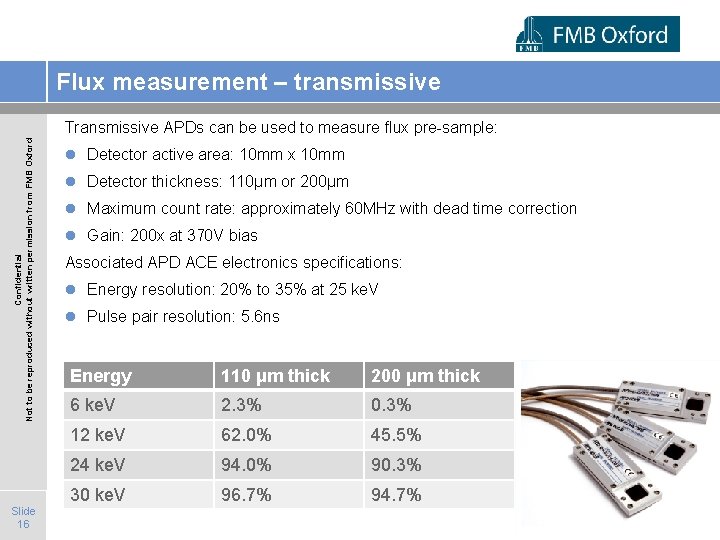
Flux measurement – transmissive Confidential Not to be reproduced without written permission from FMB Oxford Transmissive APDs can be used to measure flux pre-sample: Slide 16 l Detector active area: 10 mm x 10 mm l Detector thickness: 110μm or 200μm l Maximum count rate: approximately 60 MHz with dead time correction l Gain: 200 x at 370 V bias Associated APD ACE electronics specifications: l Energy resolution: 20% to 35% at 25 ke. V l Pulse pair resolution: 5. 6 ns Energy 110 μm thick 200 μm thick 6 ke. V 2. 3% 0. 3% 12 ke. V 62. 0% 45. 5% 24 ke. V 94. 0% 90. 3% 30 ke. V 96. 7% 94. 7%
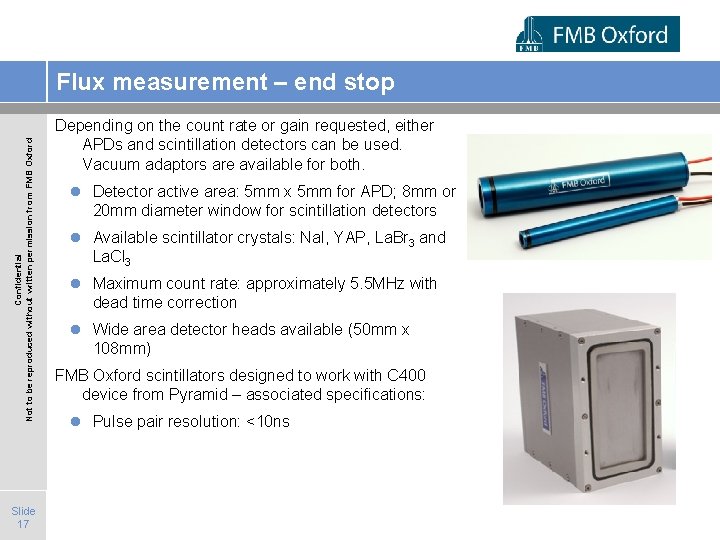
Confidential Not to be reproduced without written permission from FMB Oxford Flux measurement – end stop Slide 17 Depending on the count rate or gain requested, either APDs and scintillation detectors can be used. Vacuum adaptors are available for both. l Detector active area: 5 mm x 5 mm for APD; 8 mm or 20 mm diameter window for scintillation detectors l Available scintillator crystals: Na. I, YAP, La. Br 3 and La. Cl 3 l Maximum count rate: approximately 5. 5 MHz with dead time correction l Wide area detector heads available (50 mm x 108 mm) FMB Oxford scintillators designed to work with C 400 device from Pyramid – associated specifications: l Pulse pair resolution: <10 ns
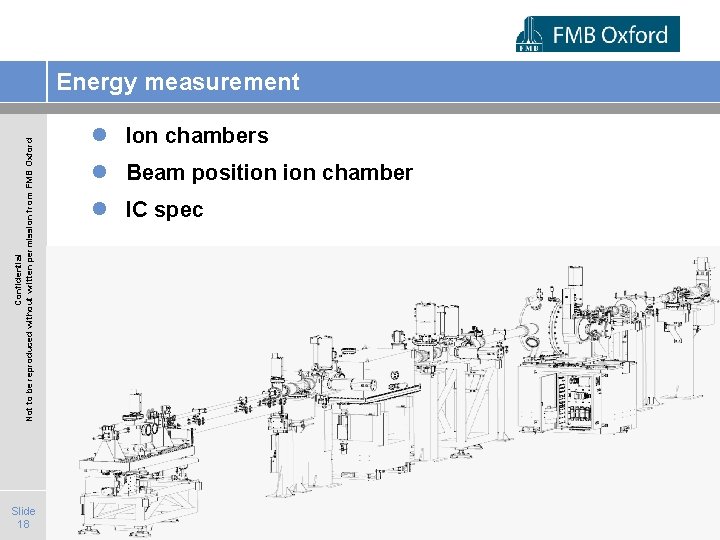
Confidential Not to be reproduced without written permission from FMB Oxford Energy measurement Slide 18 l Ion chambers l Beam position chamber l IC spec
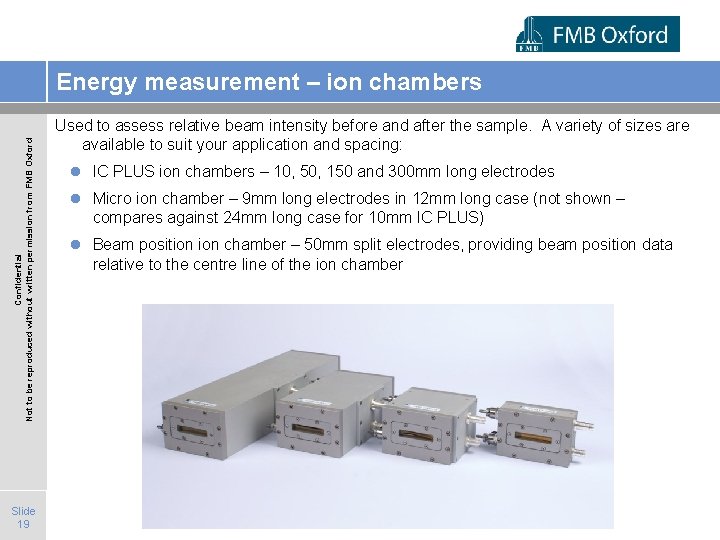
Confidential Not to be reproduced without written permission from FMB Oxford Energy measurement – ion chambers Slide 19 Used to assess relative beam intensity before and after the sample. A variety of sizes are available to suit your application and spacing: l IC PLUS ion chambers – 10, 50, 150 and 300 mm long electrodes l Micro ion chamber – 9 mm long electrodes in 12 mm long case (not shown – compares against 24 mm long case for 10 mm IC PLUS) l Beam position chamber – 50 mm split electrodes, providing beam position data relative to the centre line of the ion chamber
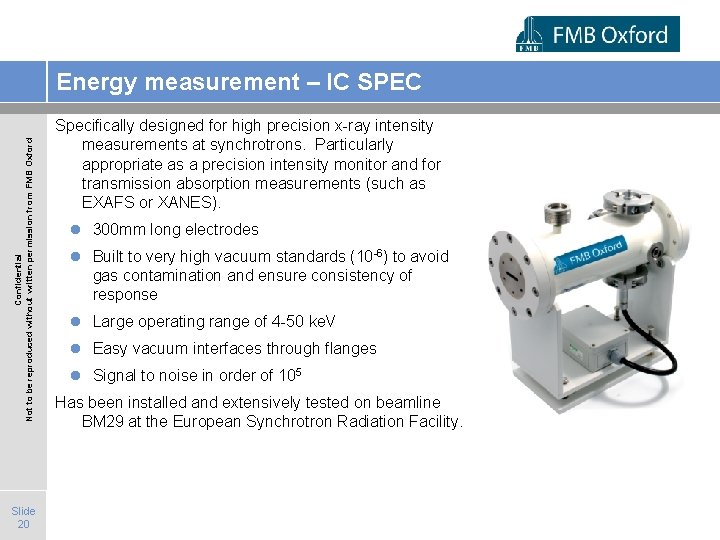
Confidential Not to be reproduced without written permission from FMB Oxford Energy measurement – IC SPEC Slide 20 Specifically designed for high precision x-ray intensity measurements at synchrotrons. Particularly appropriate as a precision intensity monitor and for transmission absorption measurements (such as EXAFS or XANES). l 300 mm long electrodes l Built to very high vacuum standards (10 -6) to avoid gas contamination and ensure consistency of response l Large operating range of 4 -50 ke. V l Easy vacuum interfaces through flanges l Signal to noise in order of 105 Has been installed and extensively tested on beamline BM 29 at the European Synchrotron Radiation Facility.
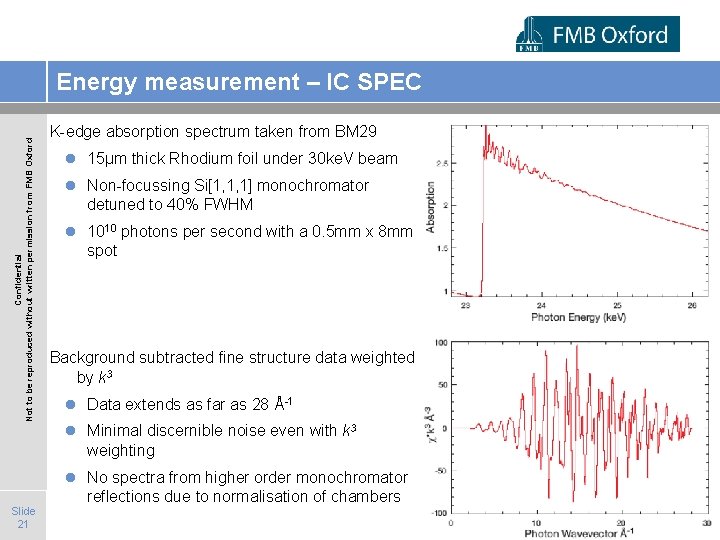
Confidential Not to be reproduced without written permission from FMB Oxford Energy measurement – IC SPEC Slide 21 K-edge absorption spectrum taken from BM 29 l 15μm thick Rhodium foil under 30 ke. V beam l Non-focussing Si[1, 1, 1] monochromator detuned to 40% FWHM l 1010 photons per second with a 0. 5 mm x 8 mm spot Background subtracted fine structure data weighted by k 3 l Data extends as far as 28 Å-1 l Minimal discernible noise even with k 3 weighting l No spectra from higher order monochromator reflections due to normalisation of chambers
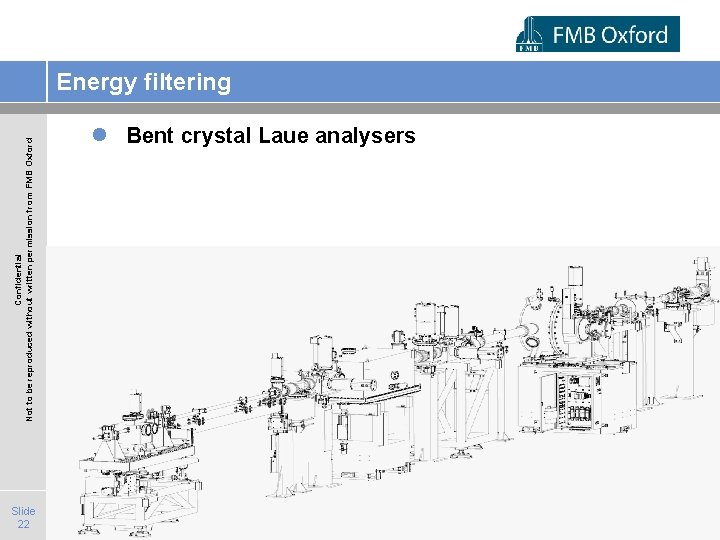
Confidential Not to be reproduced without written permission from FMB Oxford Energy filtering Slide 22 l Bent crystal Laue analysers
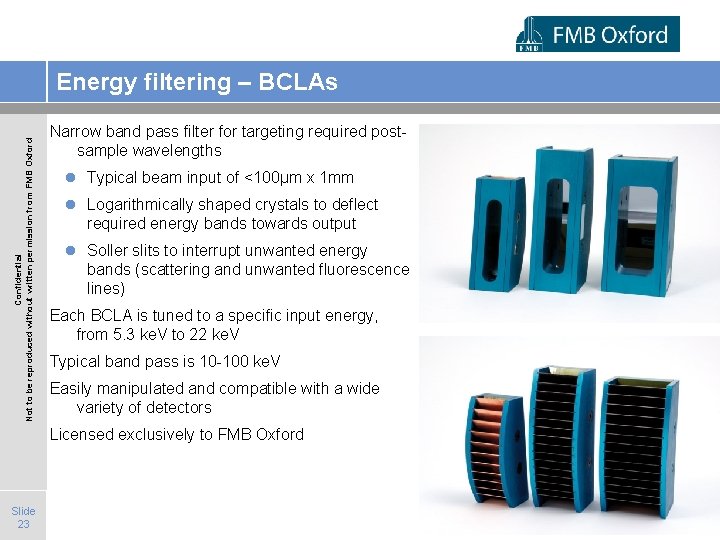
Confidential Not to be reproduced without written permission from FMB Oxford Energy filtering – BCLAs Narrow band pass filter for targeting required postsample wavelengths l Typical beam input of <100μm x 1 mm l Logarithmically shaped crystals to deflect required energy bands towards output l Soller slits to interrupt unwanted energy bands (scattering and unwanted fluorescence lines) Each BCLA is tuned to a specific input energy, from 5. 3 ke. V to 22 ke. V Typical band pass is 10 -100 ke. V Easily manipulated and compatible with a wide variety of detectors Licensed exclusively to FMB Oxford Slide 23
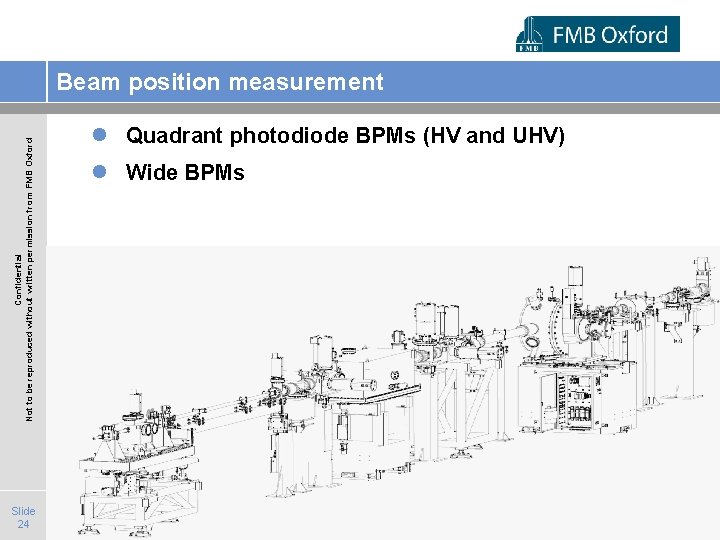
Confidential Not to be reproduced without written permission from FMB Oxford Beam position measurement Slide 24 l Quadrant photodiode BPMs (HV and UHV) l Wide BPMs
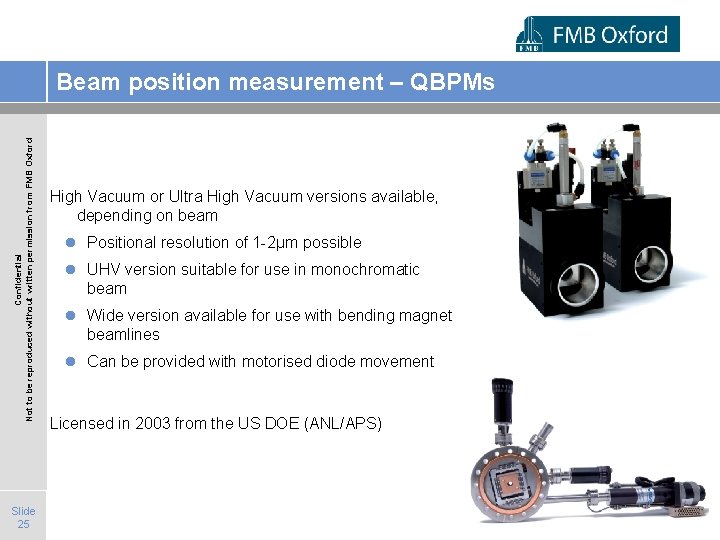
Confidential Not to be reproduced without written permission from FMB Oxford Beam position measurement – QBPMs Slide 25 High Vacuum or Ultra High Vacuum versions available, depending on beam l Positional resolution of 1 -2μm possible l UHV version suitable for use in monochromatic beam l Wide version available for use with bending magnet beamlines l Can be provided with motorised diode movement Licensed in 2003 from the US DOE (ANL/APS)
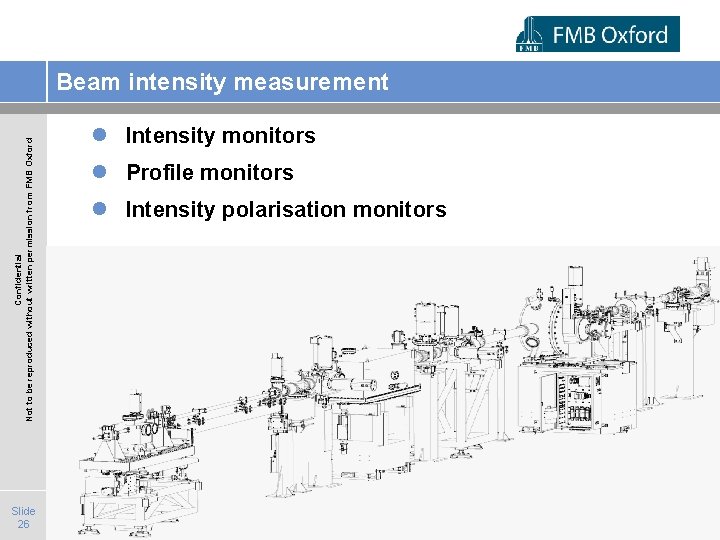
Confidential Not to be reproduced without written permission from FMB Oxford Beam intensity measurement Slide 26 l Intensity monitors l Profile monitors l Intensity polarisation monitors
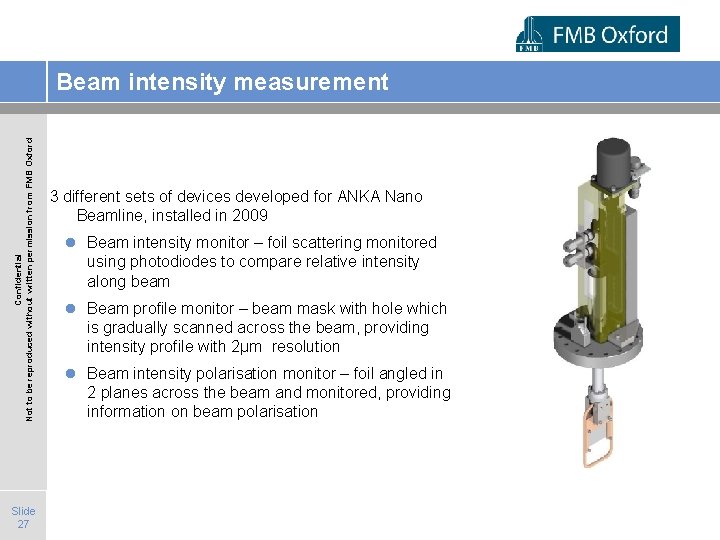
Confidential Not to be reproduced without written permission from FMB Oxford Beam intensity measurement Slide 27 3 different sets of devices developed for ANKA Nano Beamline, installed in 2009 l Beam intensity monitor – foil scattering monitored using photodiodes to compare relative intensity along beam l Beam profile monitor – beam mask with hole which is gradually scanned across the beam, providing intensity profile with 2μm resolution l Beam intensity polarisation monitor – foil angled in 2 planes across the beam and monitored, providing information on beam polarisation

Confidential Not to be reproduced without written permission from FMB Oxford Sample manipulation Slide 28 l Hot air gas blowers
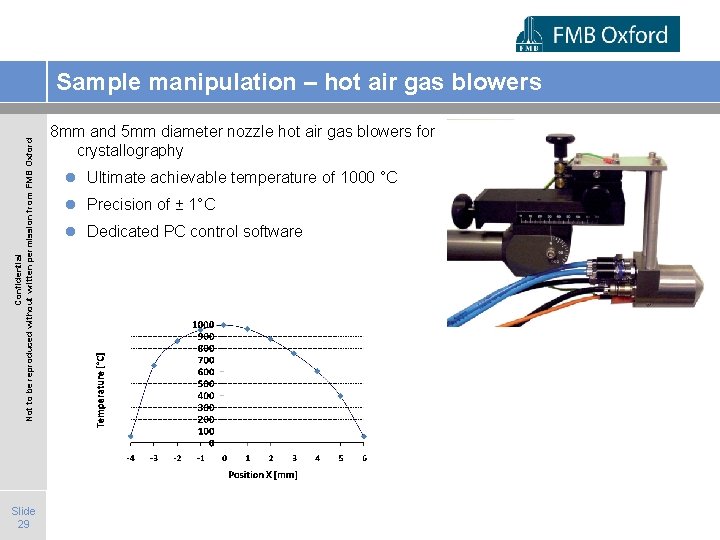
Confidential Not to be reproduced without written permission from FMB Oxford Sample manipulation – hot air gas blowers Slide 29 8 mm and 5 mm diameter nozzle hot air gas blowers for crystallography l Ultimate achievable temperature of 1000 °C l Precision of ± 1°C l Dedicated PC control software
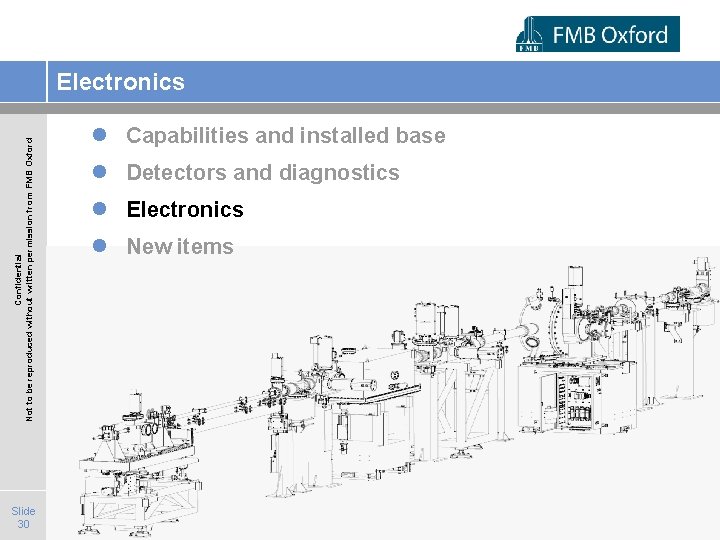
Confidential Not to be reproduced without written permission from FMB Oxford Electronics Slide 30 l Capabilities and installed base l Detectors and diagnostics l Electronics l New items
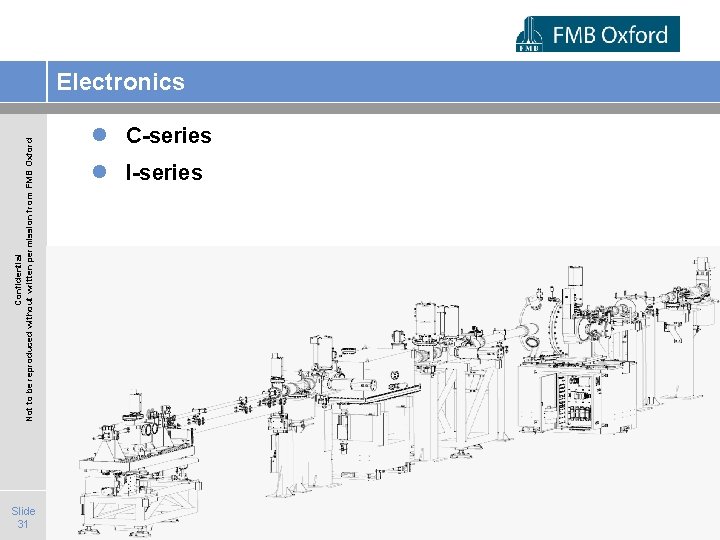
Confidential Not to be reproduced without written permission from FMB Oxford Electronics Slide 31 l C-series l I-series
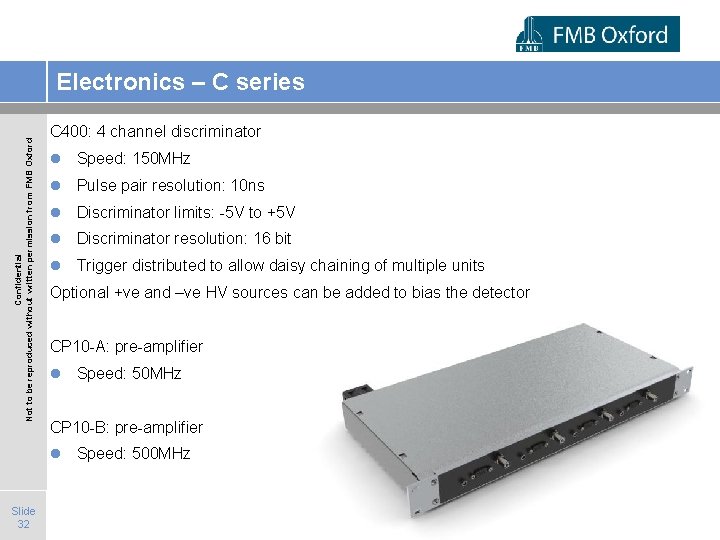
Confidential Not to be reproduced without written permission from FMB Oxford Electronics – C series C 400: 4 channel discriminator l Speed: 150 MHz l Pulse pair resolution: 10 ns l Discriminator limits: -5 V to +5 V l Discriminator resolution: 16 bit l Trigger distributed to allow daisy chaining of multiple units Optional +ve and –ve HV sources can be added to bias the detector CP 10 -A: pre-amplifier l Speed: 50 MHz CP 10 -B: pre-amplifier l Speed: 500 MHz Slide 32
Confidential Not to be reproduced without written permission from FMB Oxford Electronics – I series Slide 33 I-V integrator devices, individually optimised for performance with common equipment: IC 101 l 1 channel integrator optimised for ion chambers l Dynamic range: 1 p. A – 200μA l Optional HV sources up to +/-3 k. V can be added to provide chamber bias I 200 l 2 channel integrator optimised for DCM control l Dynamic range: 0. 1 p. A – 100μA l Optional servo feedback control can be added to provide PID input to DCM
Confidential Not to be reproduced without written permission from FMB Oxford Electronics – I series Slide 34 I 400 l 4 channel integrator optimised for blade BPMs l Dynamic range: 0. 1 p. A – 100μA l Biased inputs up to +/- 400 V I 404 l 4 channel integrator optimised for quadrant photodiode BPMs l Dynamic range: 1 p. A – 1 m. A l Quadrant position readout and output
Confidential Not to be reproduced without written permission from FMB Oxford New items Slide 35 l Capabilities and installed base l Detectors and diagnostics l Electronics l New items
Confidential Not to be reproduced without written permission from FMB Oxford New items Slide 36 l Nano. BPM l F 460 l MAC detector
Confidential Not to be reproduced without written permission from FMB Oxford Nano. BPM Slide 37 l The Nano. BPM is a transparent beam position and imaging monitor capable of nanometre resolution
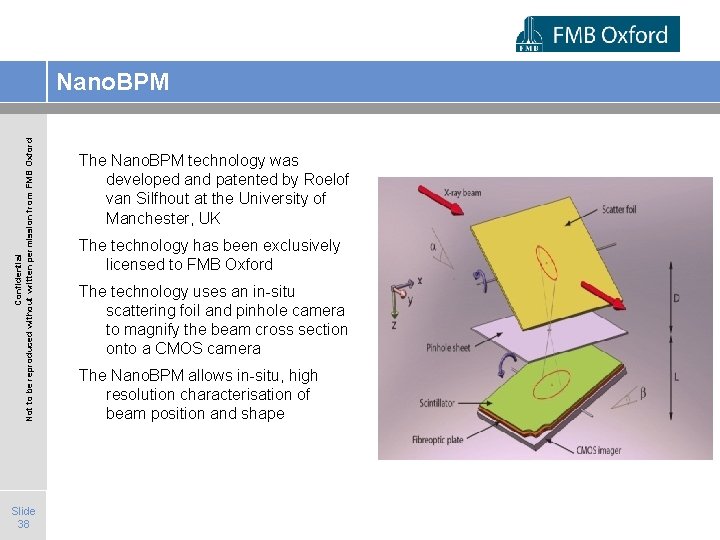
Confidential Not to be reproduced without written permission from FMB Oxford Nano. BPM Slide 38 The Nano. BPM technology was developed and patented by Roelof van Silfhout at the University of Manchester, UK The technology has been exclusively licensed to FMB Oxford The technology uses an in-situ scattering foil and pinhole camera to magnify the beam cross section onto a CMOS camera The Nano. BPM allows in-situ, high resolution characterisation of beam position and shape
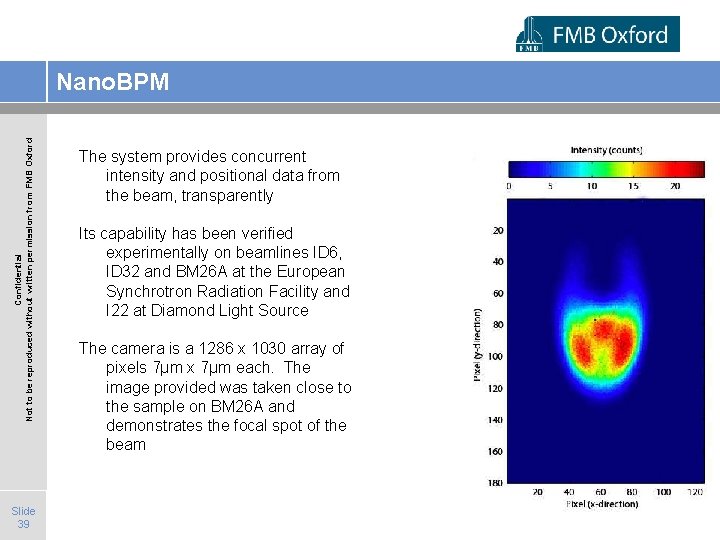
Confidential Not to be reproduced without written permission from FMB Oxford Nano. BPM Slide 39 The system provides concurrent intensity and positional data from the beam, transparently Its capability has been verified experimentally on beamlines ID 6, ID 32 and BM 26 A at the European Synchrotron Radiation Facility and I 22 at Diamond Light Source The camera is a 1286 x 1030 array of pixels 7μm x 7μm each. The image provided was taken close to the sample on BM 26 A and demonstrates the focal spot of the beam
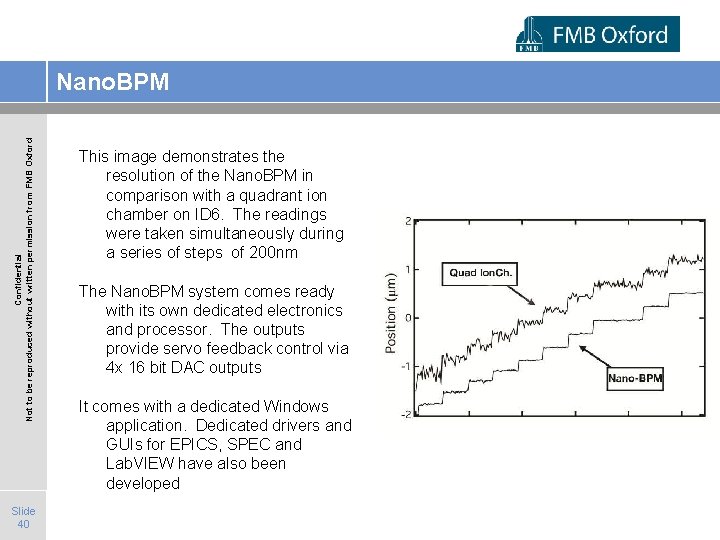
Confidential Not to be reproduced without written permission from FMB Oxford Nano. BPM Slide 40 This image demonstrates the resolution of the Nano. BPM in comparison with a quadrant ion chamber on ID 6. The readings were taken simultaneously during a series of steps of 200 nm The Nano. BPM system comes ready with its own dedicated electronics and processor. The outputs provide servo feedback control via 4 x 16 bit DAC outputs It comes with a dedicated Windows application. Dedicated drivers and GUIs for EPICS, SPEC and Lab. VIEW have also been developed
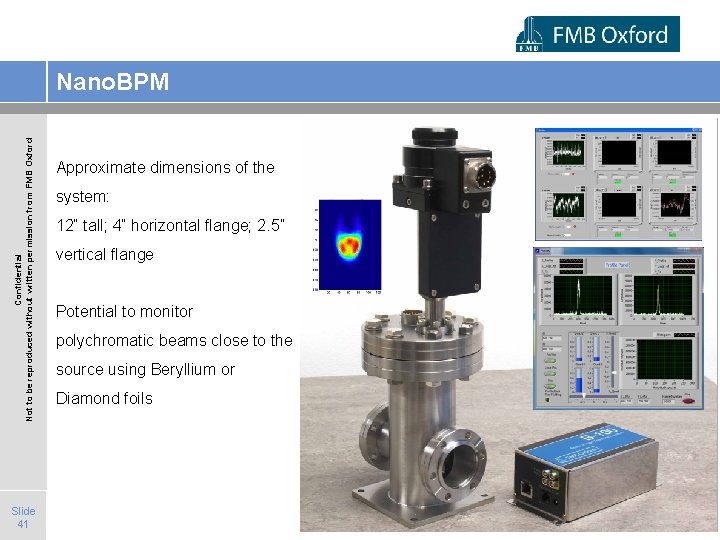
Confidential Not to be reproduced without written permission from FMB Oxford Nano. BPM Slide 41 Approximate dimensions of the system: 12” tall; 4” horizontal flange; 2. 5” vertical flange Potential to monitor polychromatic beams close to the source using Beryllium or Diamond foils
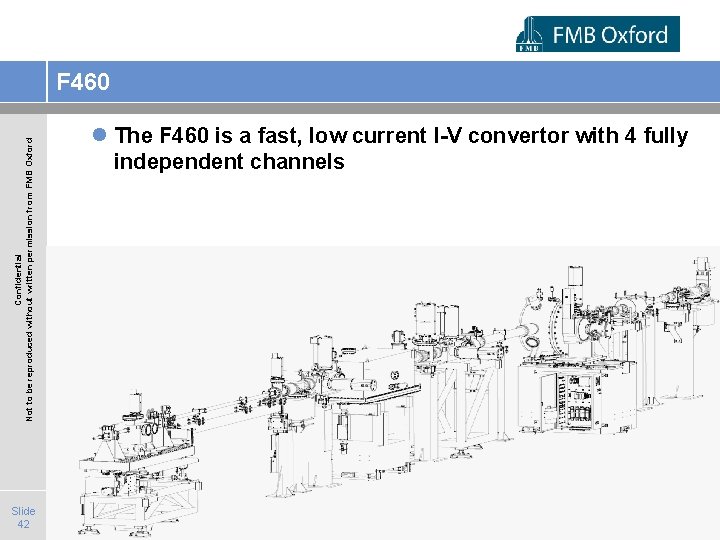
Confidential Not to be reproduced without written permission from FMB Oxford F 460 Slide 42 l The F 460 is a fast, low current I-V convertor with 4 fully independent channels
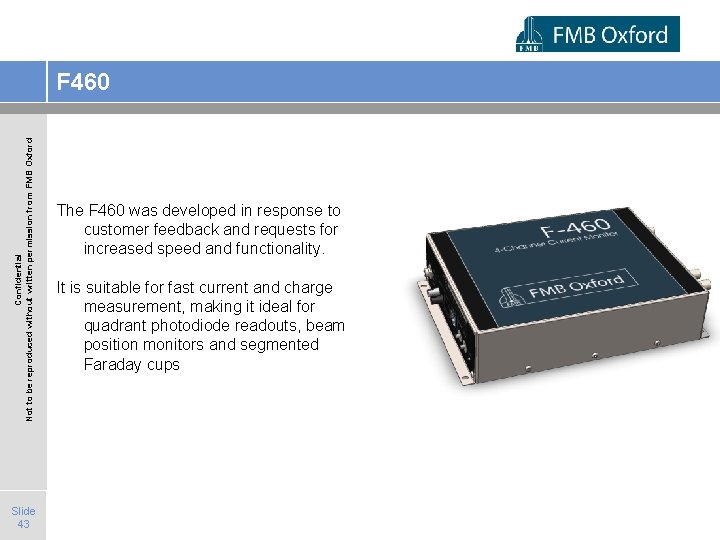
Confidential Not to be reproduced without written permission from FMB Oxford F 460 Slide 43 The F 460 was developed in response to customer feedback and requests for increased speed and functionality. It is suitable for fast current and charge measurement, making it ideal for quadrant photodiode readouts, beam position monitors and segmented Faraday cups
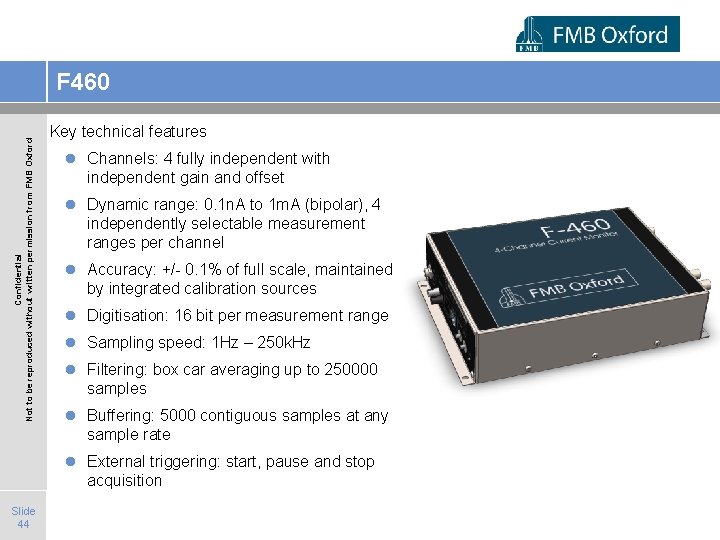
Confidential Not to be reproduced without written permission from FMB Oxford F 460 Key technical features l Channels: 4 fully independent with independent gain and offset l Dynamic range: 0. 1 n. A to 1 m. A (bipolar), 4 independently selectable measurement ranges per channel l Accuracy: +/- 0. 1% of full scale, maintained by integrated calibration sources l Digitisation: 16 bit per measurement range l Sampling speed: 1 Hz – 250 k. Hz l Filtering: box car averaging up to 250000 samples l Buffering: 5000 contiguous samples at any sample rate l External triggering: start, pause and stop acquisition Slide 44
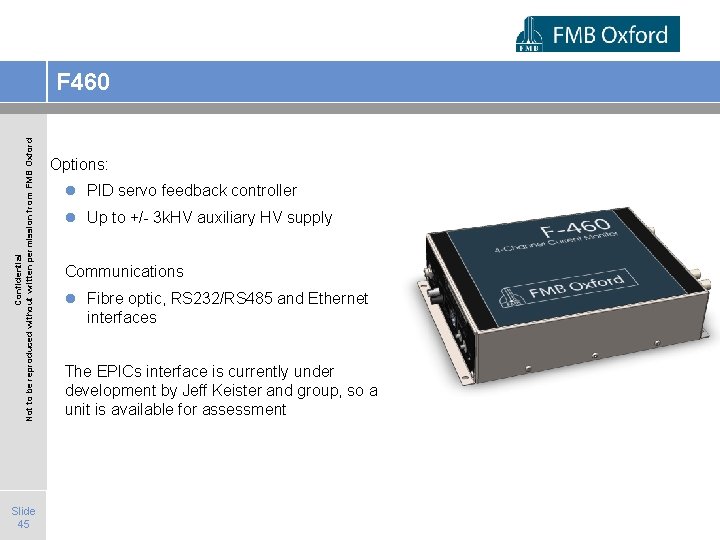
Confidential Not to be reproduced without written permission from FMB Oxford F 460 Slide 45 Options: l PID servo feedback controller l Up to +/- 3 k. HV auxiliary HV supply Communications l Fibre optic, RS 232/RS 485 and Ethernet interfaces The EPICs interface is currently under development by Jeff Keister and group, so a unit is available for assessment
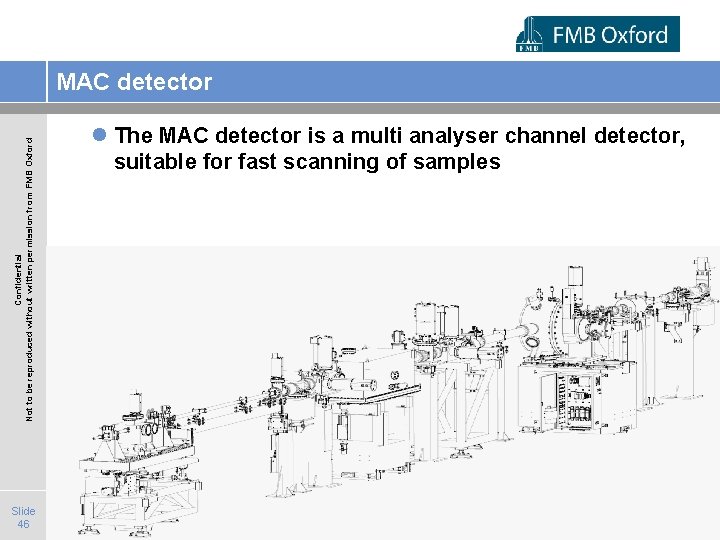
Confidential Not to be reproduced without written permission from FMB Oxford MAC detector Slide 46 l The MAC detector is a multi analyser channel detector, suitable for fast scanning of samples
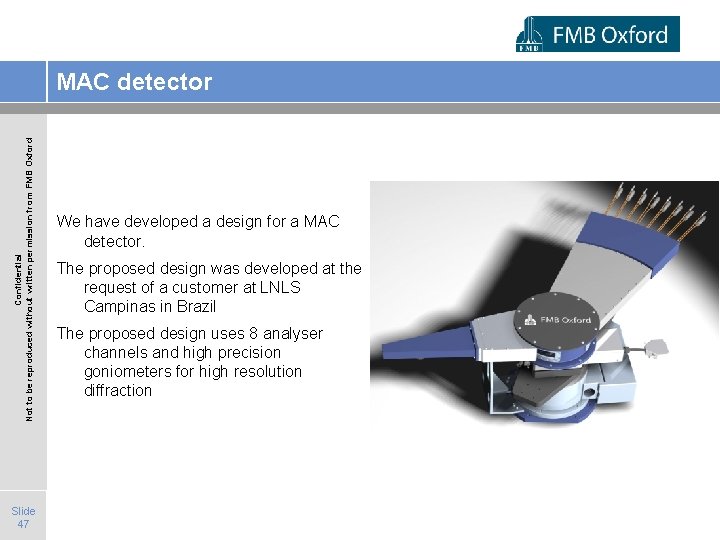
Confidential Not to be reproduced without written permission from FMB Oxford MAC detector Slide 47 We have developed a design for a MAC detector. The proposed design was developed at the request of a customer at LNLS Campinas in Brazil The proposed design uses 8 analyser channels and high precision goniometers for high resolution diffraction
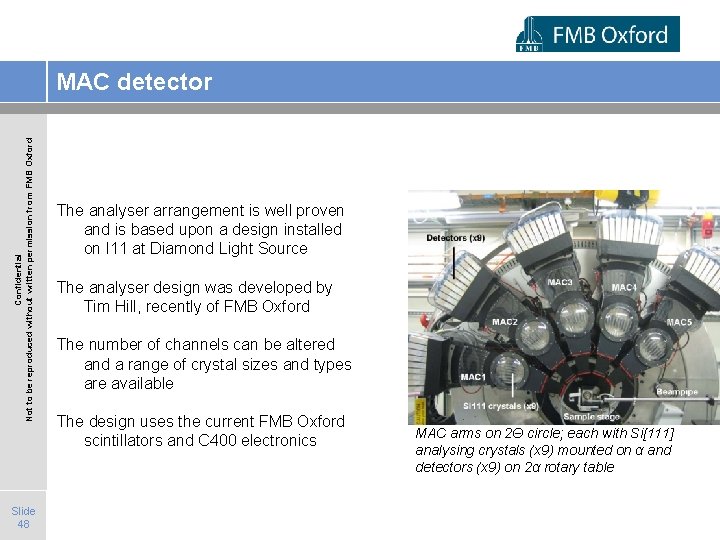
Confidential Not to be reproduced without written permission from FMB Oxford MAC detector Slide 48 The analyser arrangement is well proven and is based upon a design installed on I 11 at Diamond Light Source The analyser design was developed by Tim Hill, recently of FMB Oxford The number of channels can be altered and a range of crystal sizes and types are available The design uses the current FMB Oxford scintillators and C 400 electronics MAC arms on 2Θ circle; each with Si[111] analysing crystals (x 9) mounted on α and detectors (x 9) on 2α rotary table
Confidential Not to be reproduced without written permission from FMB Oxford Thanks! Slide 49 l Thank you for your attention l I’m here for the remainder of today and tomorrow
- Slides: 49