
Confidence Intervals Introduction A point estimate provides no
- Slides: 11
Confidence Intervals – Introduction • A point estimate provides no information about the precision and reliability of estimation. • For example, the sample mean is a point estimate of the population mean μ but because of sampling variability, it is virtually never the case that • A point estimate says nothing about how close it might be to μ. • An alternative to reporting a single sensible value for the parameter being estimated it to calculate and report an entire interval of plausible values – a confidence interval (CI). week 5 1
Confidence level • A confidence level is a measure of the degree of reliability of a confidence interval. It is denoted as 100(1 -α)%. • The most frequently used confidence levels are 90%, 95% and 99%. • A confidence level of 100(1 -α)% implies that 100(1 -α)% of all samples would include the true value of the parameter estimated. • The higher the confidence level, the more strongly we believe that the true value of the parameter being estimated lies within the interval. week 5 2
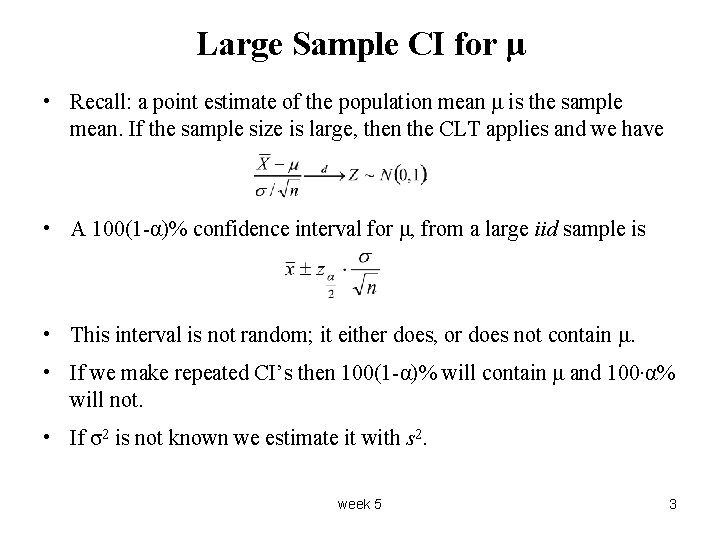
Large Sample CI for μ • Recall: a point estimate of the population mean μ is the sample mean. If the sample size is large, then the CLT applies and we have • A 100(1 -α)% confidence interval for μ, from a large iid sample is • This interval is not random; it either does, or does not contain μ. • If we make repeated CI’s then 100(1 -α)% will contain μ and 100∙α% will not. • If σ2 is not known we estimate it with s 2. week 5 3
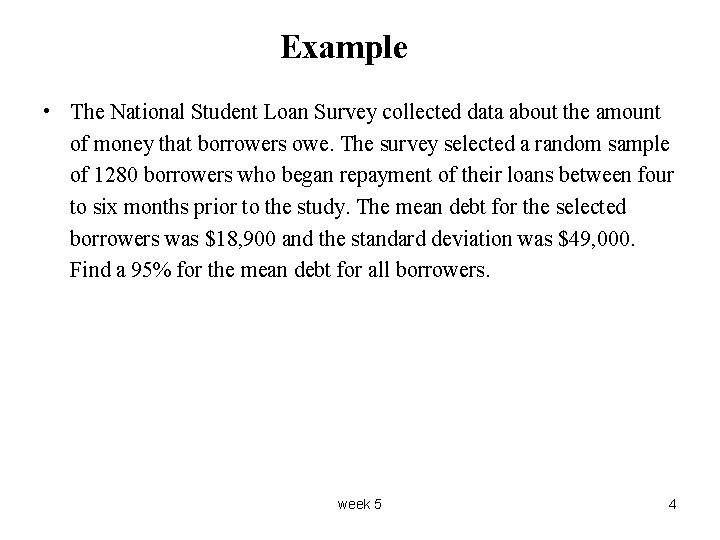
Example • The National Student Loan Survey collected data about the amount of money that borrowers owe. The survey selected a random sample of 1280 borrowers who began repayment of their loans between four to six months prior to the study. The mean debt for the selected borrowers was $18, 900 and the standard deviation was $49, 000. Find a 95% for the mean debt for all borrowers. week 5 4
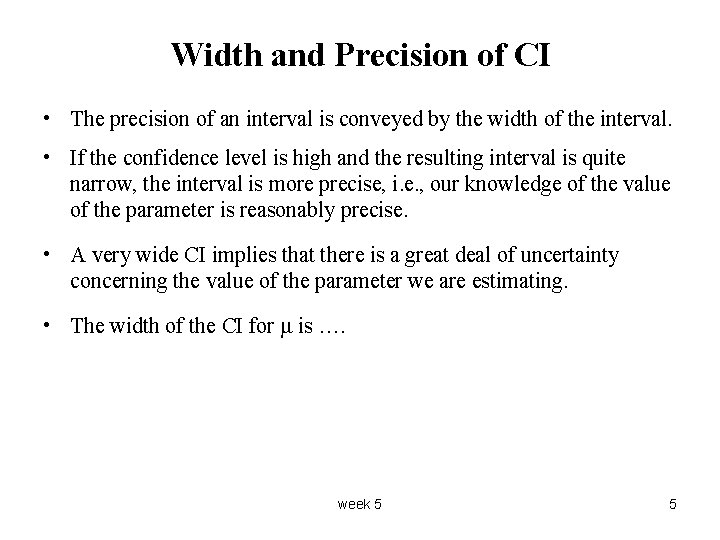
Width and Precision of CI • The precision of an interval is conveyed by the width of the interval. • If the confidence level is high and the resulting interval is quite narrow, the interval is more precise, i. e. , our knowledge of the value of the parameter is reasonably precise. • A very wide CI implies that there is a great deal of uncertainty concerning the value of the parameter we are estimating. • The width of the CI for μ is …. week 5 5
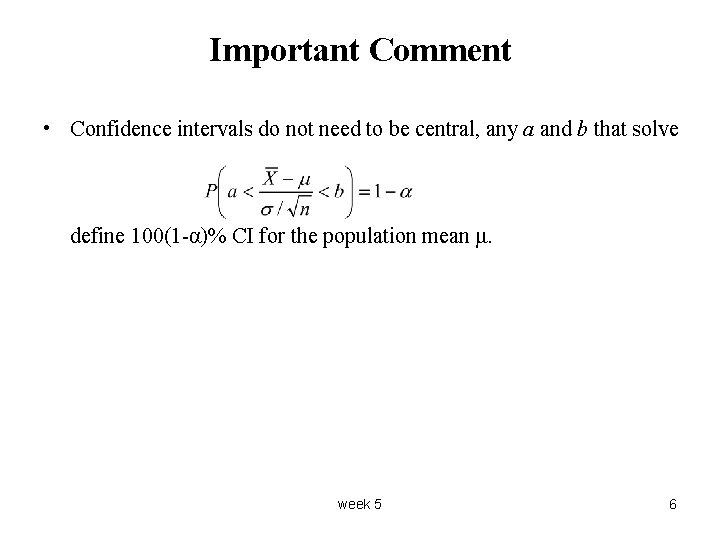
Important Comment • Confidence intervals do not need to be central, any a and b that solve define 100(1 -α)% CI for the population mean μ. week 5 6
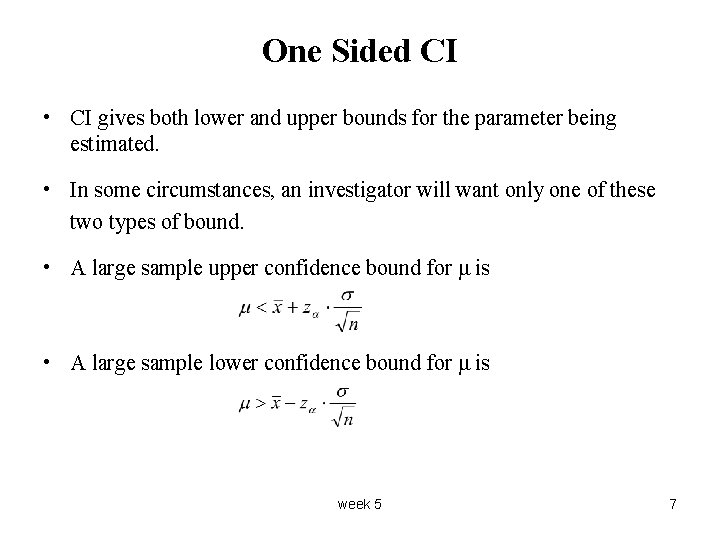
One Sided CI • CI gives both lower and upper bounds for the parameter being estimated. • In some circumstances, an investigator will want only one of these two types of bound. • A large sample upper confidence bound for μ is • A large sample lower confidence bound for μ is week 5 7
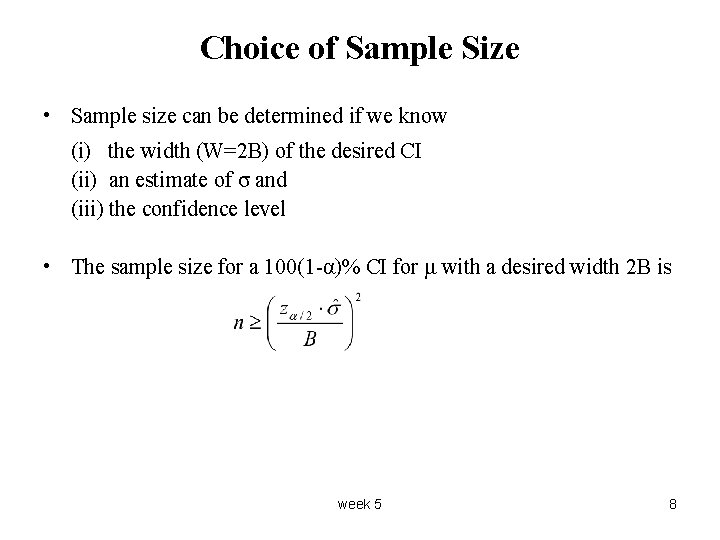
Choice of Sample Size • Sample size can be determined if we know (i) the width (W=2 B) of the desired CI (ii) an estimate of σ and (iii) the confidence level • The sample size for a 100(1 -α)% CI for μ with a desired width 2 B is week 5 8
Example • You want to rent an unfurnished one-bedroom apartment for next semester. How large a sample of one-bedroom apartments would be needed to estimate the mean µ within ±$20 with 99% confidence? week 5 9
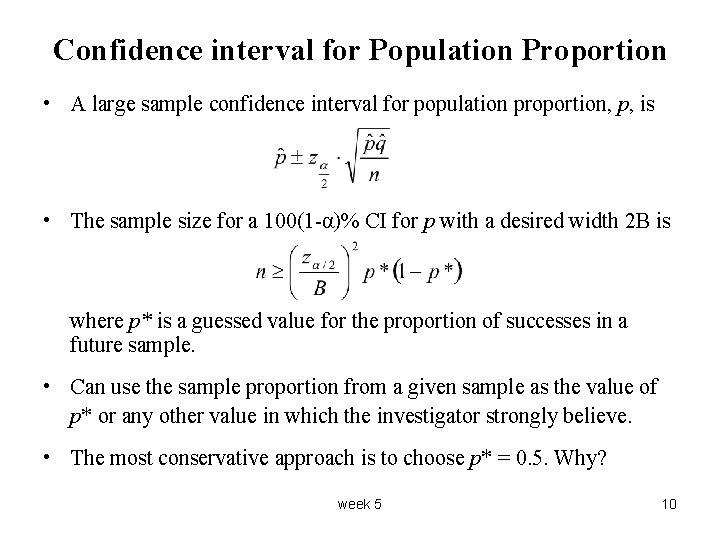
Confidence interval for Population Proportion • A large sample confidence interval for population proportion, p, is • The sample size for a 100(1 -α)% CI for p with a desired width 2 B is where p* is a guessed value for the proportion of successes in a future sample. • Can use the sample proportion from a given sample as the value of p* or any other value in which the investigator strongly believe. • The most conservative approach is to choose p* = 0. 5. Why? week 5 10
Example • In a sample of 400 computer memory chips made at Digital Devices, Inc. , 40 were found to be defective. Give a 95% confidence interval for the proportion of defective chips in the population from which the sample was taken? • What sample size is necessary if the 90% CI for the proportion of defective chips, p, is to have width of at most 0. 1? week 5 11