
Confidence Interval Estimation for a Population Proportion Lecture
- Slides: 49
Confidence Interval Estimation for a Population Proportion Lecture 31 Section 9. 4 Tue, Mar 27, 2007
Point Estimates Point estimate n The problem with point estimates is that we have no idea how close we can expect them to be to the parameter. n That is, we have no idea of how large the error may be. n
Interval Estimates Interval estimate n An interval estimate is more informative than a point estimate. n
Interval Estimates Confidence level n If the confidence level is 95%, then the interval is called a 95% confidence interval. n
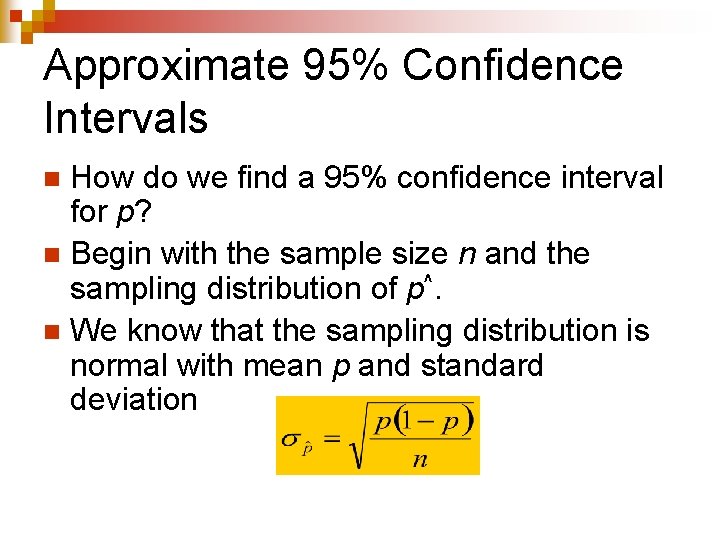
Approximate 95% Confidence Intervals How do we find a 95% confidence interval for p? n Begin with the sample size n and the sampling distribution of p^. n We know that the sampling distribution is normal with mean p and standard deviation n
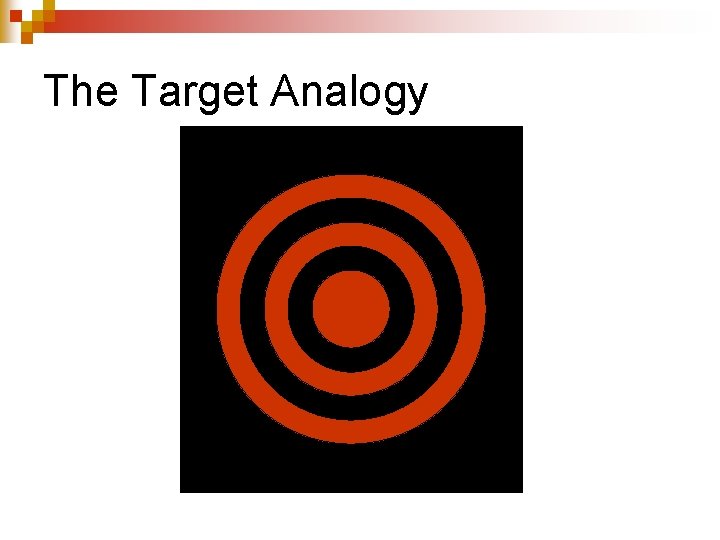
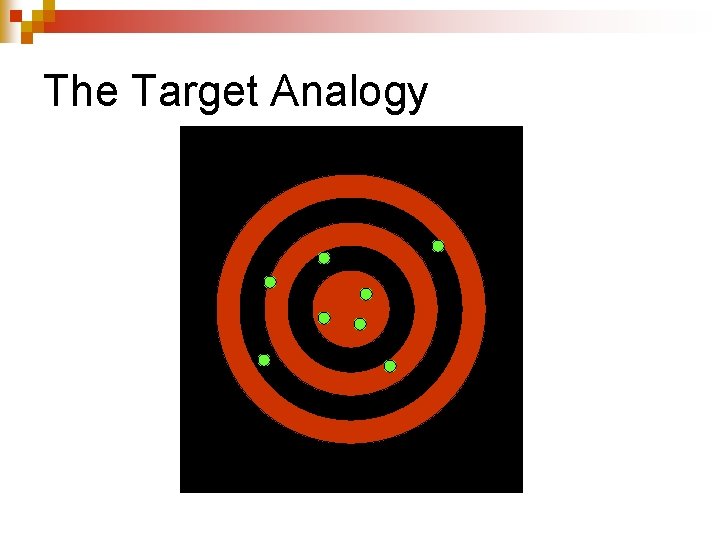
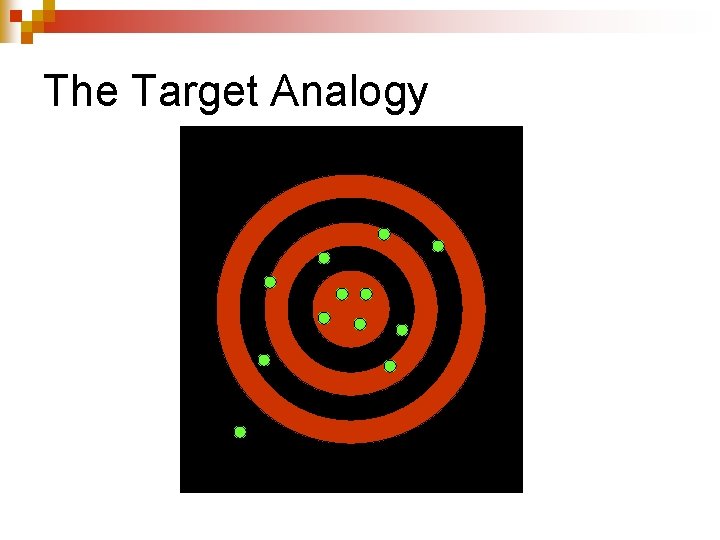
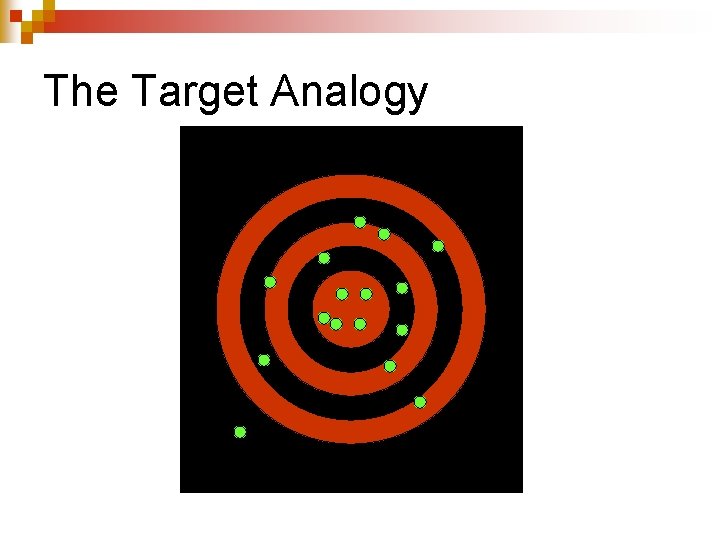
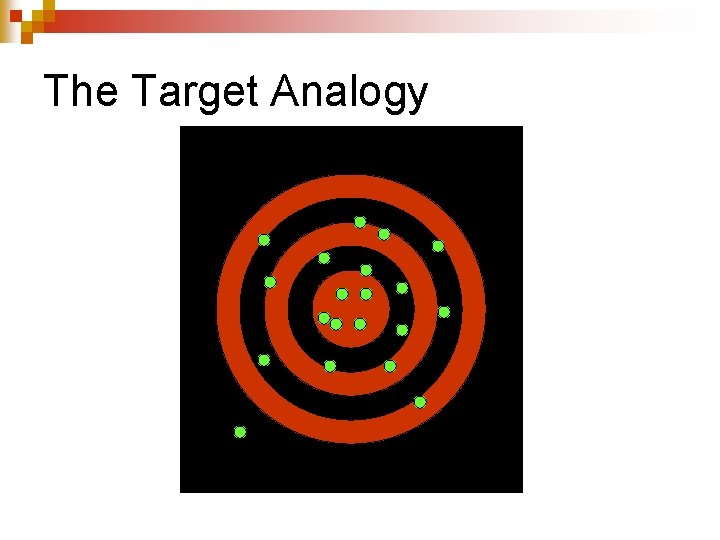
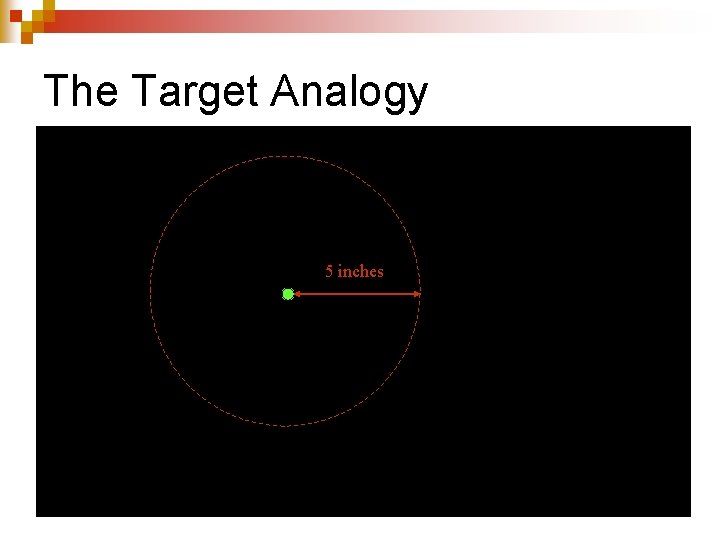
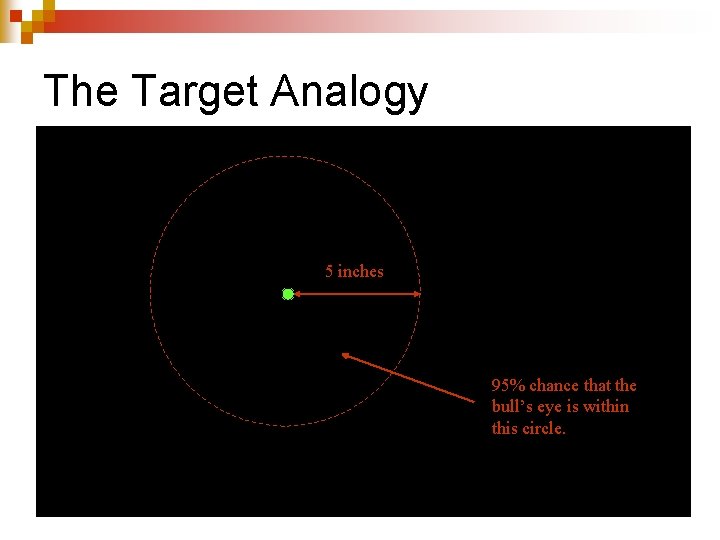
The Target Analogy Suppose a shooter hits within 5 rings (5 inches) of the bull’s eye 95% of the time. n Then each individual shot has a 95% chance of hitting within 5 inches. n
The Target Analogy
The Target Analogy
The Target Analogy
The Target Analogy
The Target Analogy
The Target Analogy
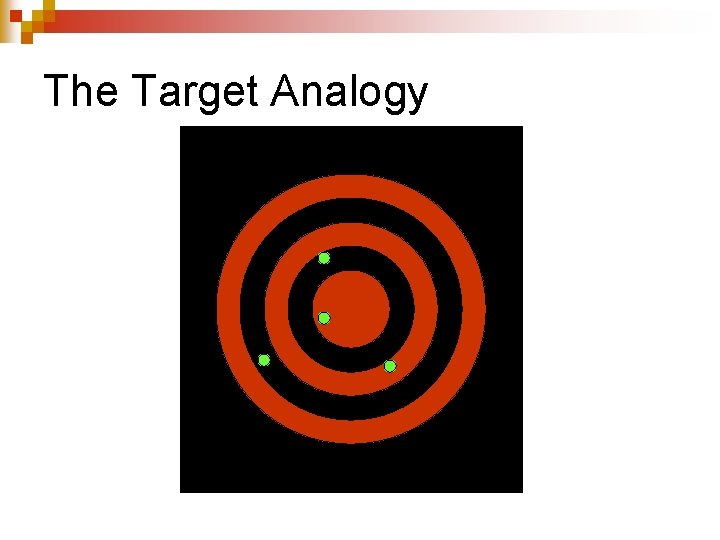
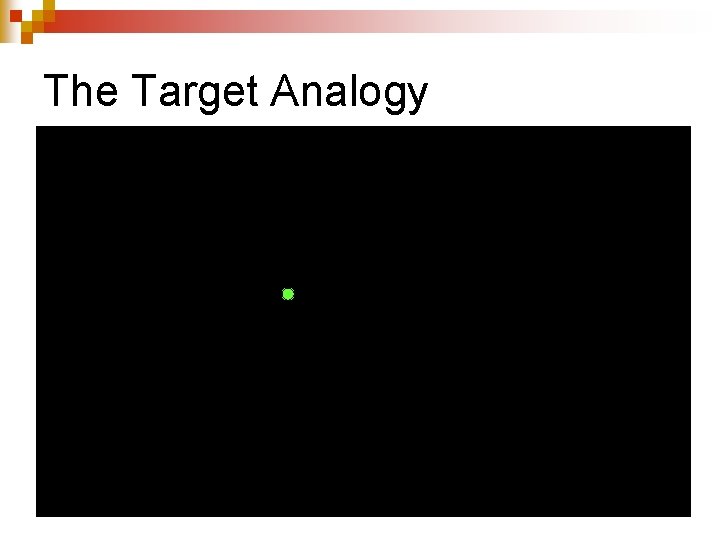
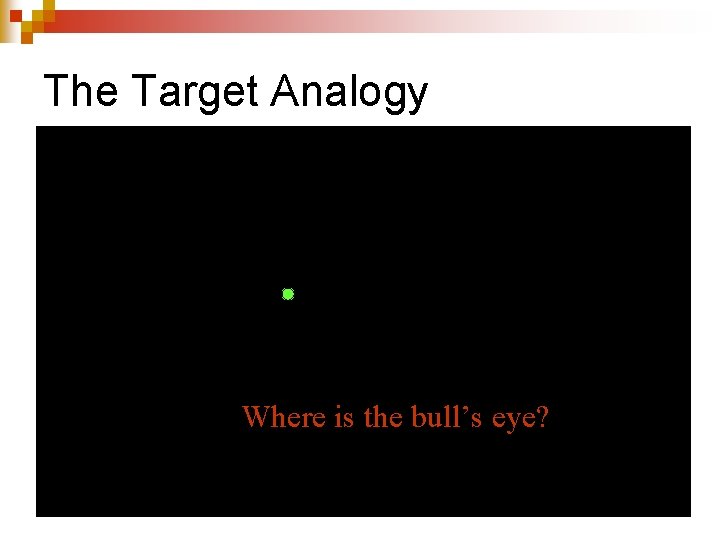
The Target Analogy Now suppose we are shown where the shot hit, but we are not shown where the bull’s eye is. n What is the probability that the bull’s eye is within 5 inches of that shot? n
The Target Analogy
The Target Analogy
The Target Analogy Where is the bull’s eye?
The Target Analogy 5 inches
The Target Analogy 5 inches 95% chance that the bull’s eye is within this circle.
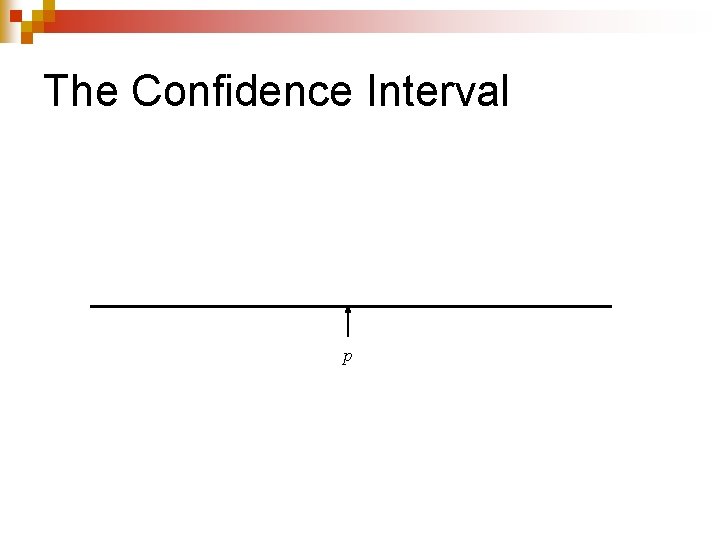
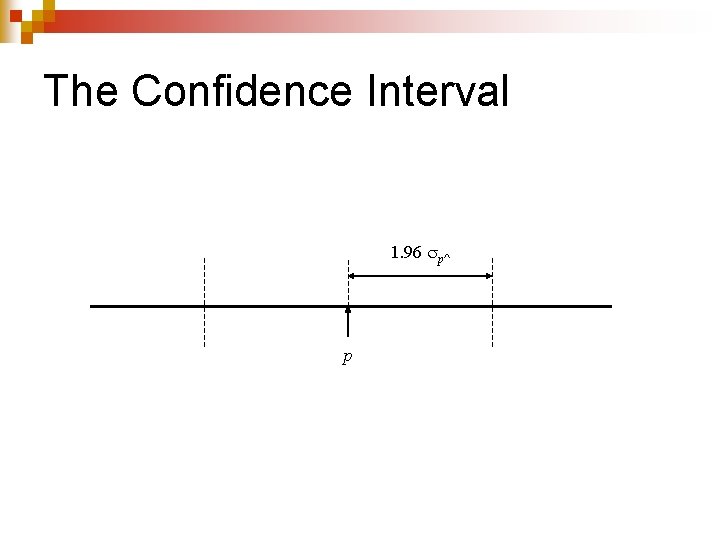
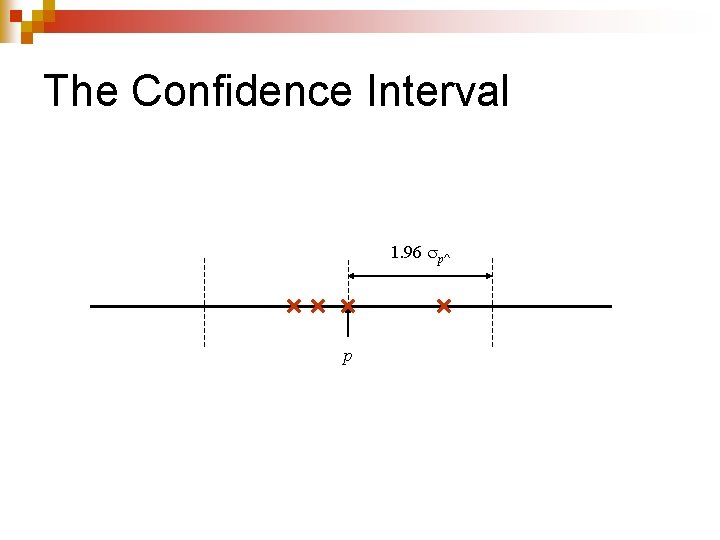
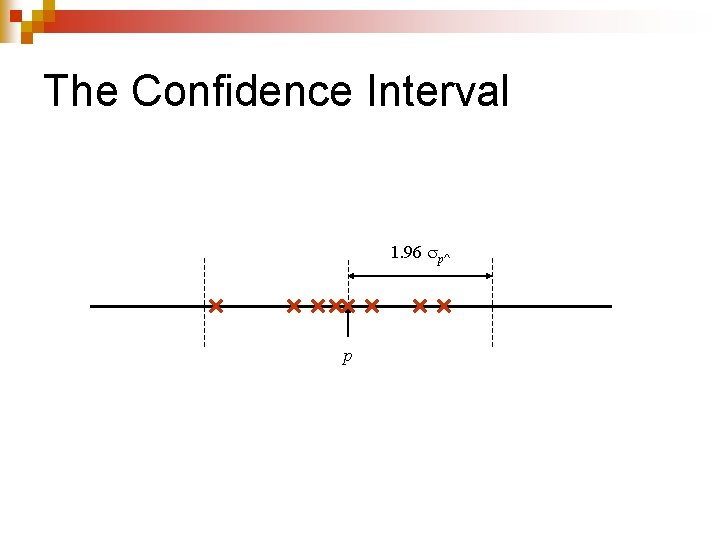
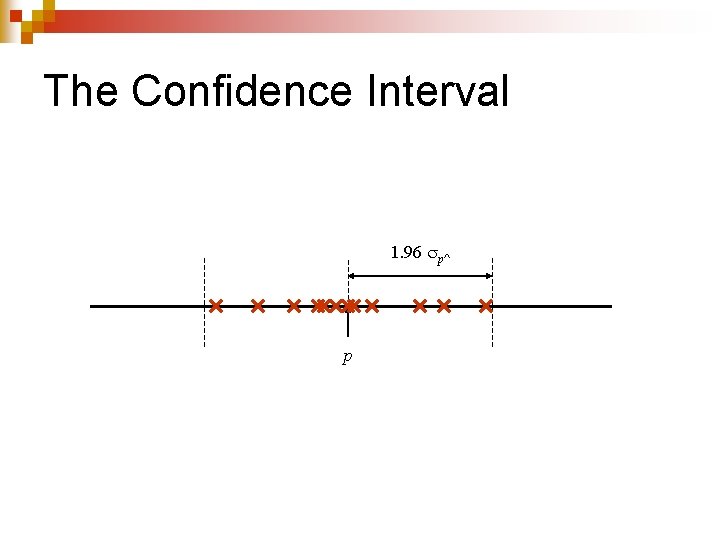
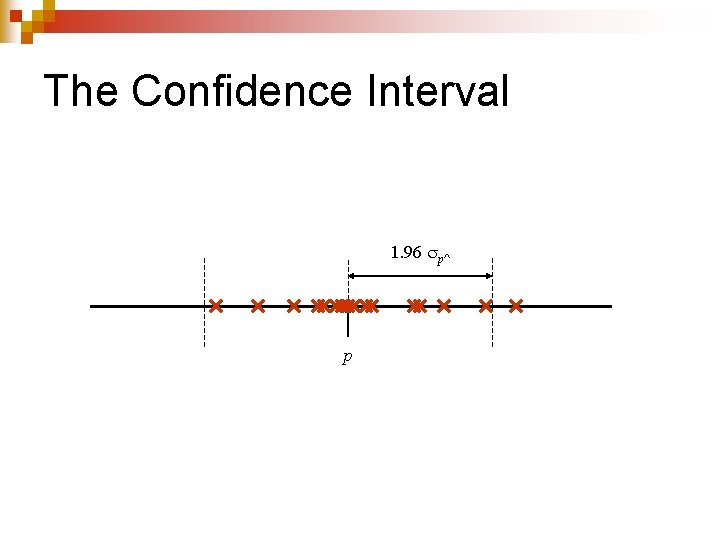
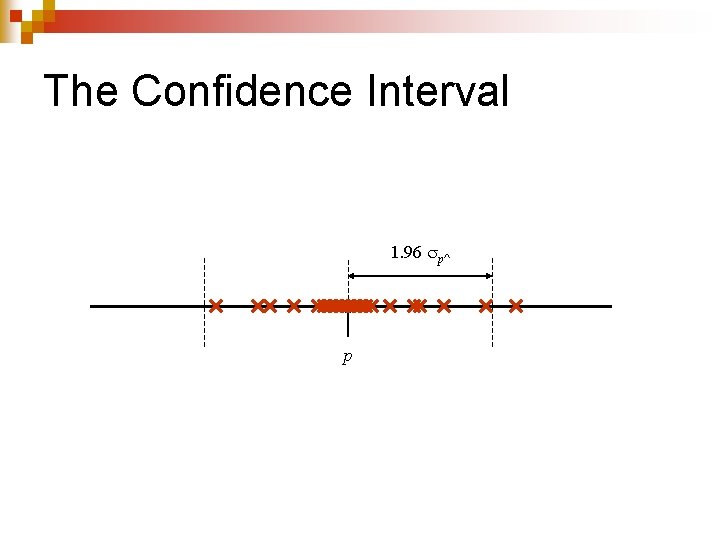
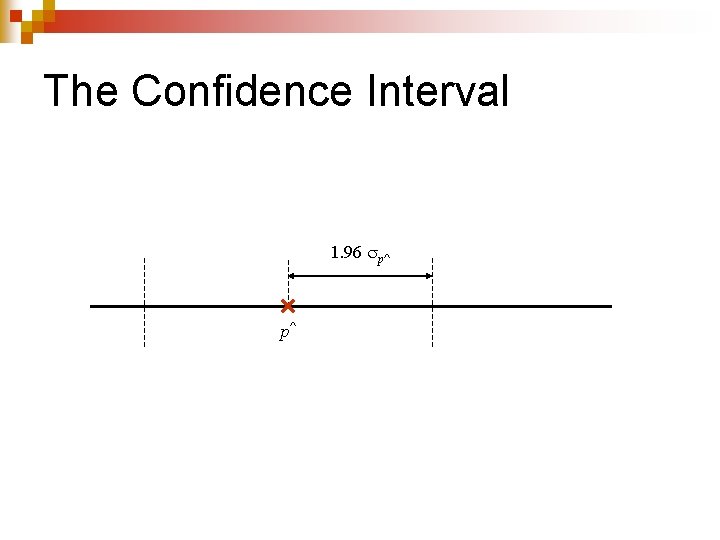
The Confidence Interval n In a similar way, 95% of the sample proportions p^ should lie within 1. 96 standard deviations ( p^) of the parameter p.
The Confidence Interval p
The Confidence Interval 1. 96 p^ p
The Confidence Interval 1. 96 p^ p
The Confidence Interval 1. 96 p^ p
The Confidence Interval 1. 96 p^ p
The Confidence Interval 1. 96 p^ p
The Confidence Interval 1. 96 p^ p
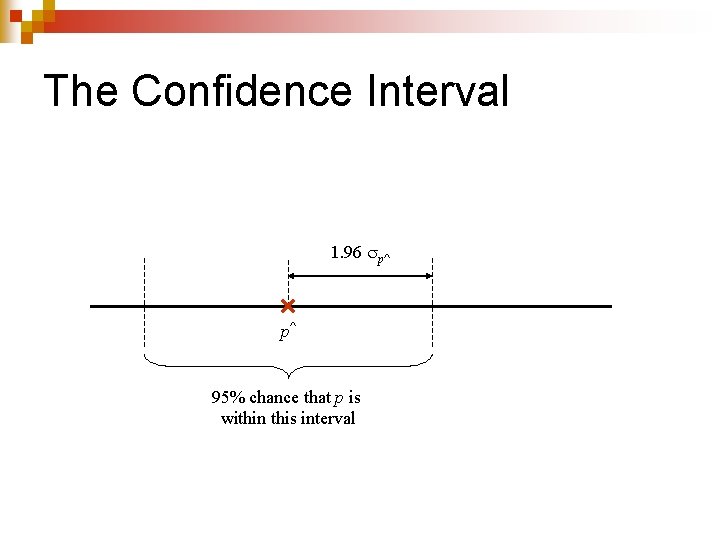
The Confidence Interval n Therefore, if we compute a single p^, then we expect that there is a 95% chance that it lies within a distance 1. 96 p^ of p.
The Confidence Interval
The Confidence Interval
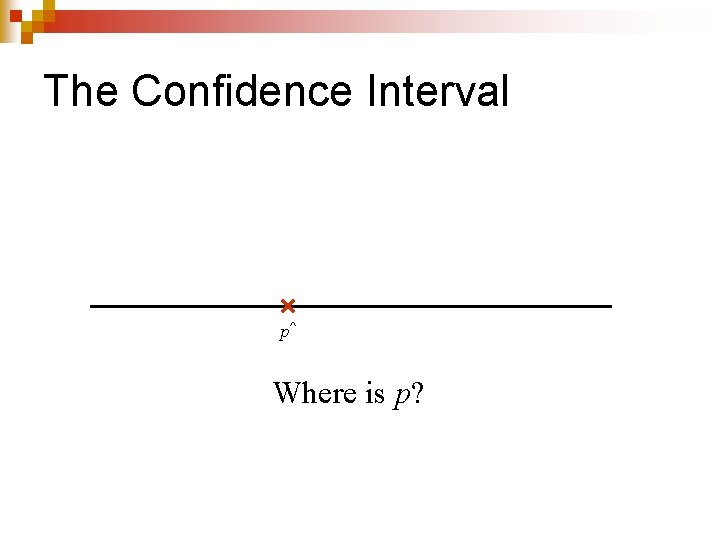
The Confidence Interval p^ Where is p?
The Confidence Interval 1. 96 p^ p^
The Confidence Interval 1. 96 p^ p^ 95% chance that p is within this interval
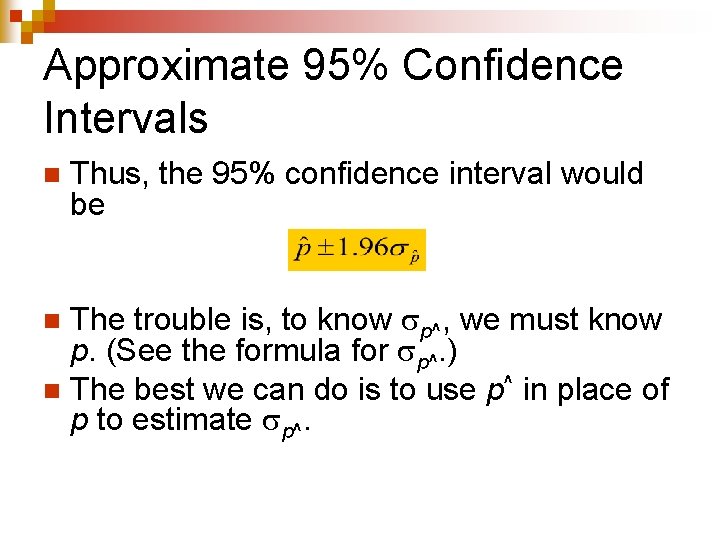
Approximate 95% Confidence Intervals n Thus, the 95% confidence interval would be The trouble is, to know p^, we must know p. (See the formula for p^. ) n The best we can do is to use p^ in place of p to estimate p^. n
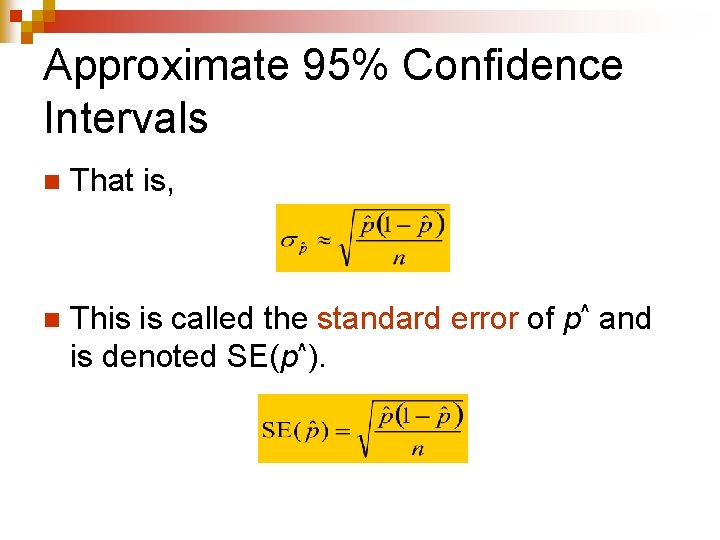
Approximate 95% Confidence Intervals n That is, n This is called the standard error of p^ and is denoted SE(p^).
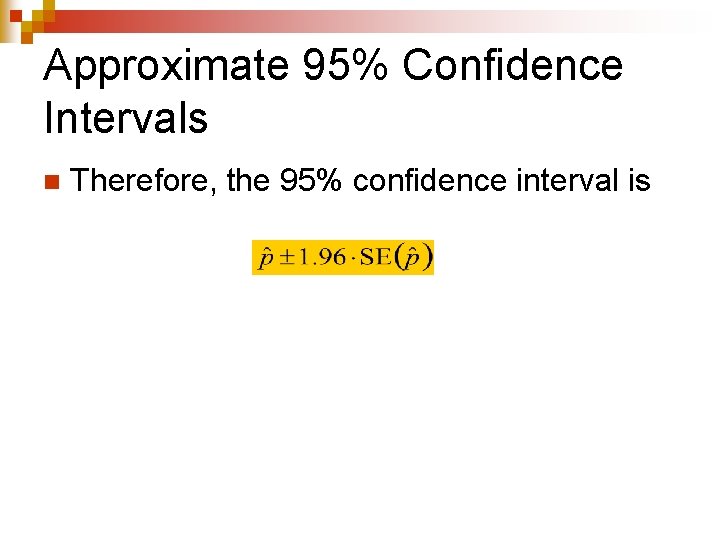
Approximate 95% Confidence Intervals n Therefore, the 95% confidence interval is
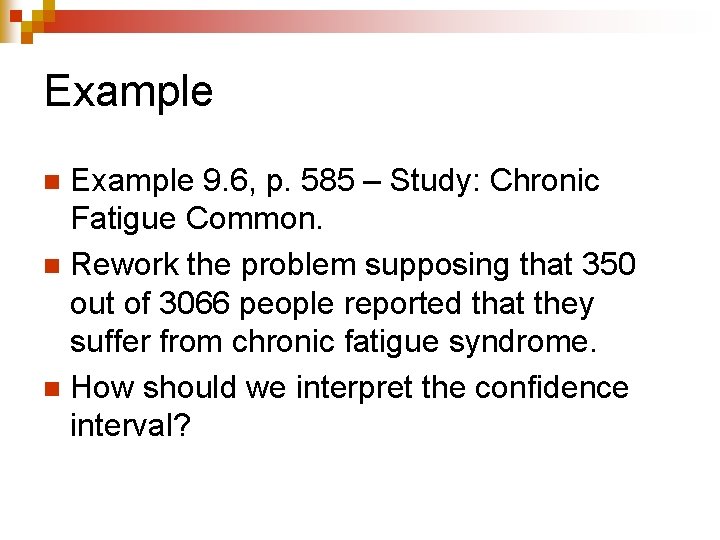
Example 9. 6, p. 585 – Study: Chronic Fatigue Common. n Rework the problem supposing that 350 out of 3066 people reported that they suffer from chronic fatigue syndrome. n How should we interpret the confidence interval? n
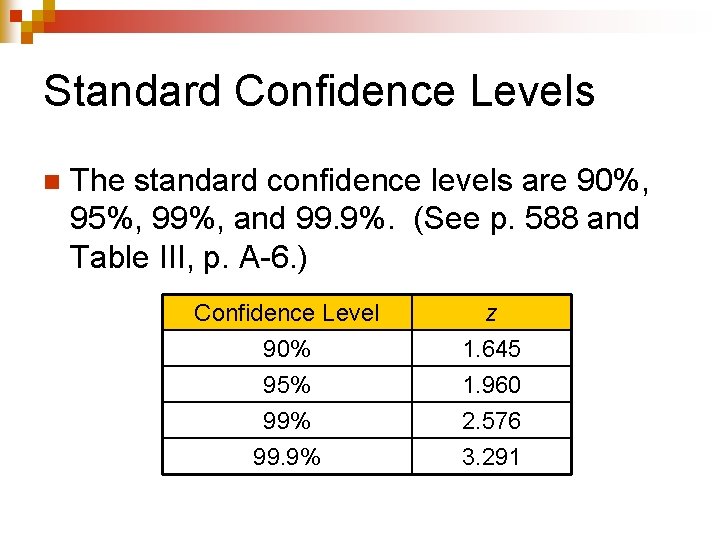
Standard Confidence Levels n The standard confidence levels are 90%, 95%, 99%, and 99. 9%. (See p. 588 and Table III, p. A-6. ) Confidence Level 90% 95% 99% z 1. 645 1. 960 2. 576 99. 9% 3. 291
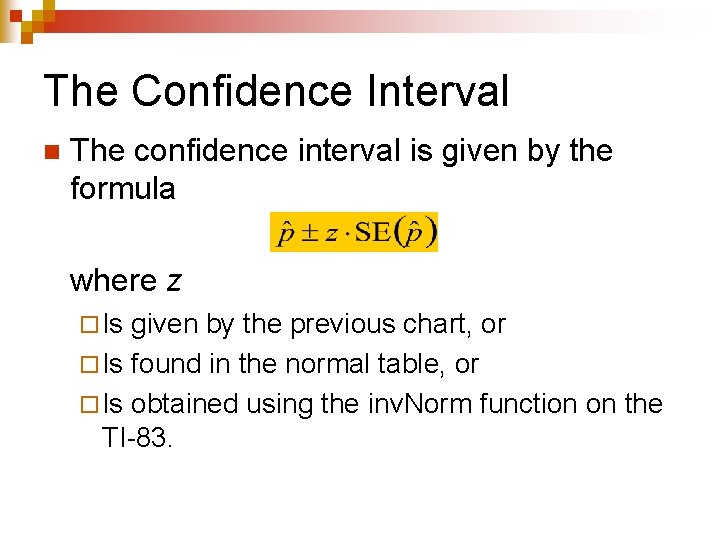
The Confidence Interval n The confidence interval is given by the formula where z ¨ Is given by the previous chart, or ¨ Is found in the normal table, or ¨ Is obtained using the inv. Norm function on the TI-83.
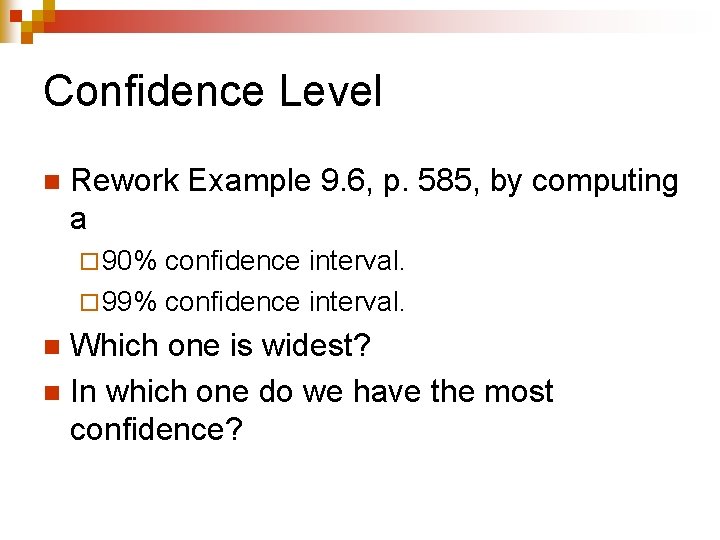
Confidence Level n Rework Example 9. 6, p. 585, by computing a ¨ 90% confidence interval. ¨ 99% confidence interval. Which one is widest? n In which one do we have the most confidence? n
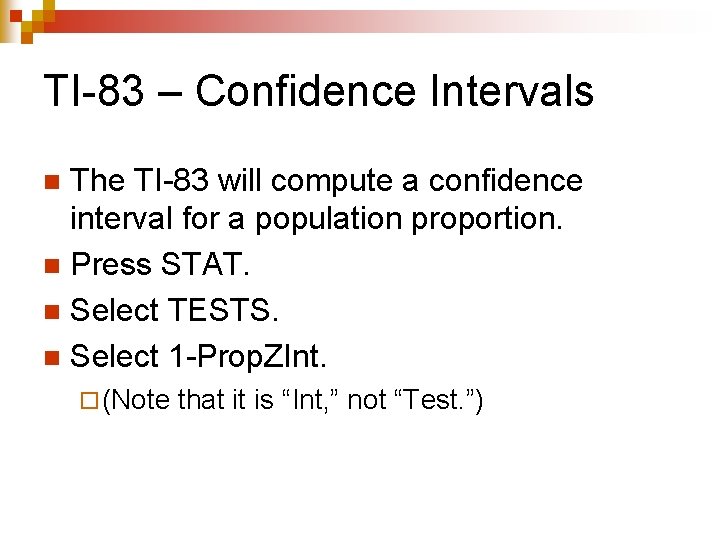
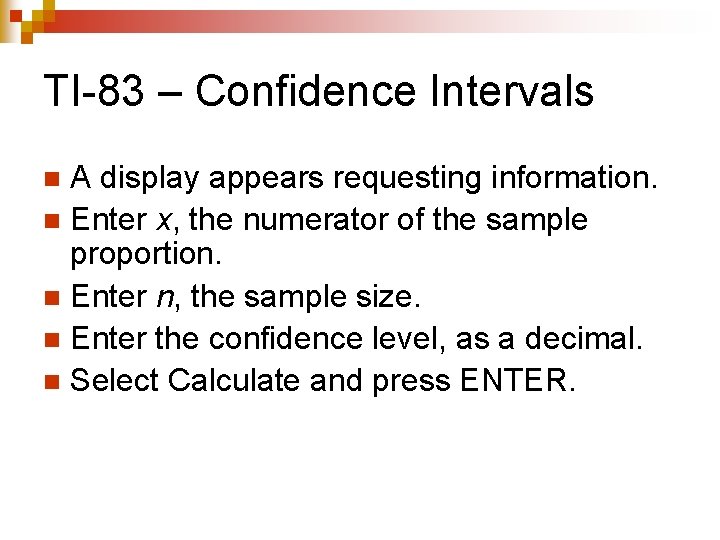
TI-83 – Confidence Intervals The TI-83 will compute a confidence interval for a population proportion. n Press STAT. n Select TESTS. n Select 1 -Prop. ZInt. n ¨ (Note that it is “Int, ” not “Test. ”)
TI-83 – Confidence Intervals A display appears requesting information. n Enter x, the numerator of the sample proportion. n Enter n, the sample size. n Enter the confidence level, as a decimal. n Select Calculate and press ENTER. n
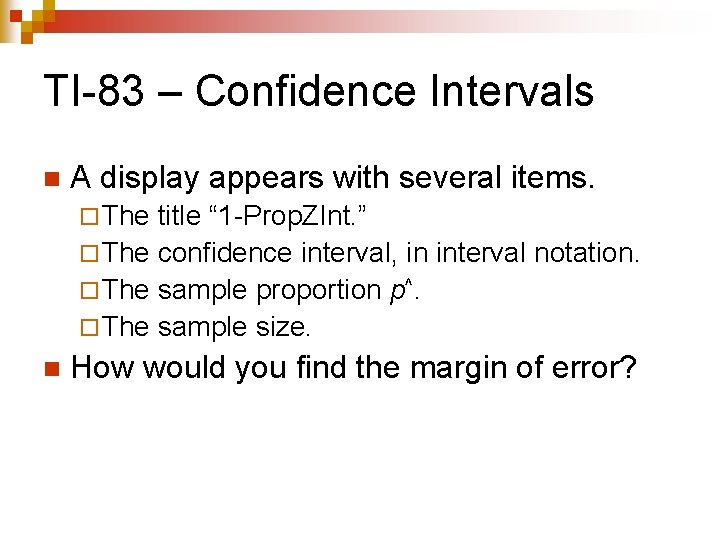
TI-83 – Confidence Intervals n A display appears with several items. ¨ The title “ 1 -Prop. ZInt. ” ¨ The confidence interval, in interval notation. ¨ The sample proportion p^. ¨ The sample size. n How would you find the margin of error?
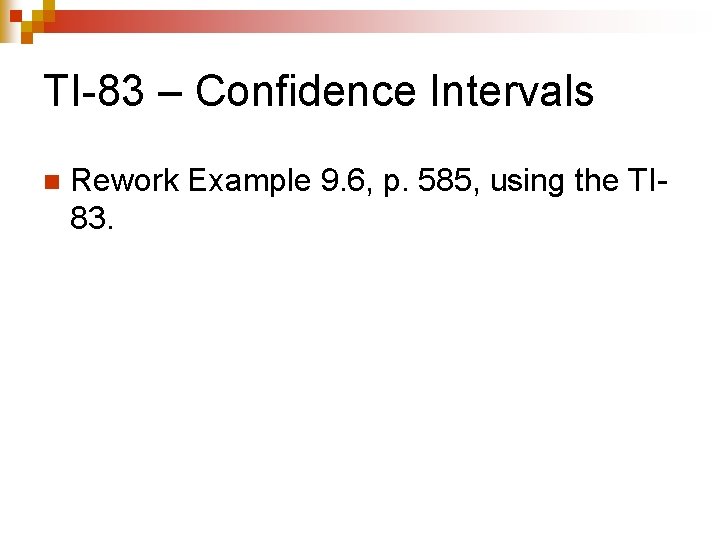
TI-83 – Confidence Intervals n Rework Example 9. 6, p. 585, using the TI 83.
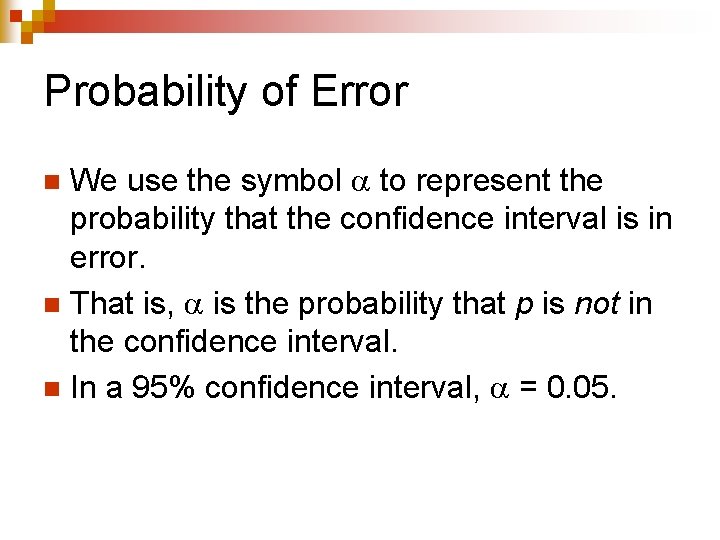
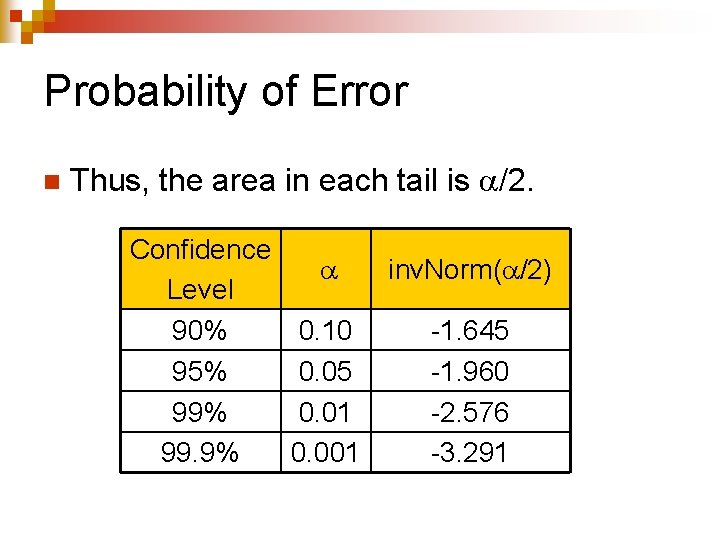
Probability of Error We use the symbol to represent the probability that the confidence interval is in error. n That is, is the probability that p is not in the confidence interval. n In a 95% confidence interval, = 0. 05. n
Probability of Error n Thus, the area in each tail is /2. Confidence Level 90% 95% 99. 9% inv. Norm( /2) 0. 10 0. 05 0. 01 0. 001 -1. 645 -1. 960 -2. 576 -3. 291
Which Confidence Interval is Best? n Which is better? ¨A large margin of error (wide interval), or ¨ A small margin of error (narrow interval). n Which is better? ¨A low level of confidence, or ¨ A high level of confidence.
Which Confidence Interval is Best? Why not get a confidence interval that has a small margin of error and has a high level of confidence associated with it? n Hey, why not a margin of error of 0 and a confidence level of 100%? n
Which Confidence Interval is Best? n Which is better? ¨A smaller sample size, or ¨ A larger sample size.
Which Confidence Interval is Best? A larger sample size is better only up to the point where its cost is not worth its benefit. n That is why we settle for a certain margin of error and a confidence level of less than 100%. n