
Conference presentation Drivers and Constraints of Conversion to

- Slides: 22
Conference presentation: “Drivers and Constraints of Conversion to Organic Farming in the Kingdom of Bhutan”. Presented by : Parladh Mahat MA Candidate, Chulalongkorn pcmmahat@gmail. com ID: 5987553320 Date: 24/01/2018
Outline of the presentation • • • Introduction Research questions Objectives of study Study area Research methodology Results & Discussion Recommendation Conclusion Reference
Introduction • Population depends on agriculture (56. 6%) (NSB, 2016). • Agriculture largely traditional in nature, small land holding (average 0. 8 hectares), low productions & inputs (Tobgay, S. O. N. A. M. (2005), ‘animal and human power’ • Practices ‘open burning’. • We use chemicals (though limited) • Want to go organic –reduce use of chemicals, improve health & income • Significance of study –Despite policy & acts, growth of OA is very gradual (total OA-13, 144 hectares (6315 wild collection, 6829 agriculture area) with 2680 producers (Willer, H. , & Lernoud, J. (2016). • Despite importance limited study in developing countries (factors differs- market/subsidies/premium price/willingness to pay) • Farmers reluctant to take up OF – pests, weeds & disease issues, market, labor shortages & others
Research questions • What is the current state of organic farming in Bhutan? • What are the main drivers and constraints in conversion to organic farming? • What are the appropriate measures to promote organic farming in Bhutan?
Objectives of the study • To explore the situation of the farming in the country and status of organic farming in Bhutan • To investigate the drivers and constraints in conversion to organic farming by the farmers of Gasa district • To provide the policy recommendation to government or relevant agency to promote organic farming in Bhutan
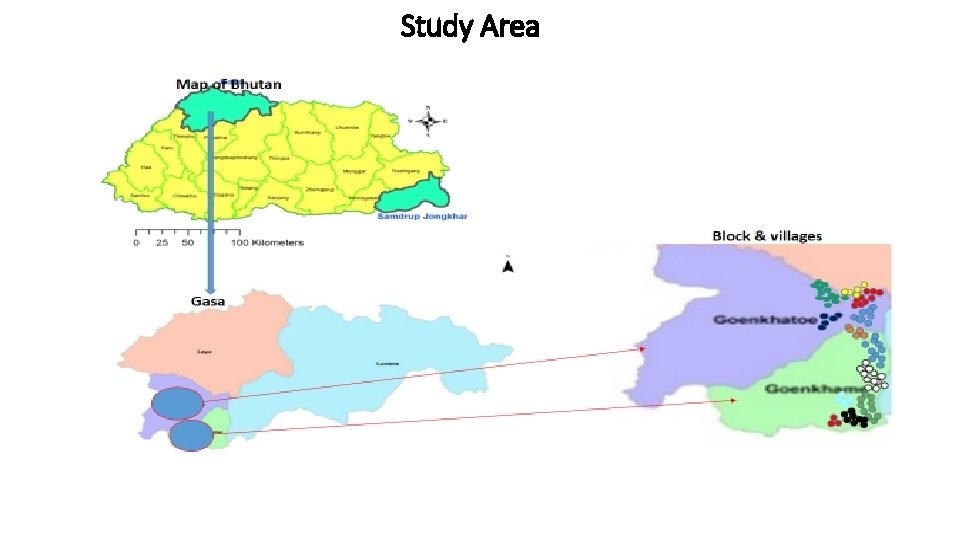
Study Area
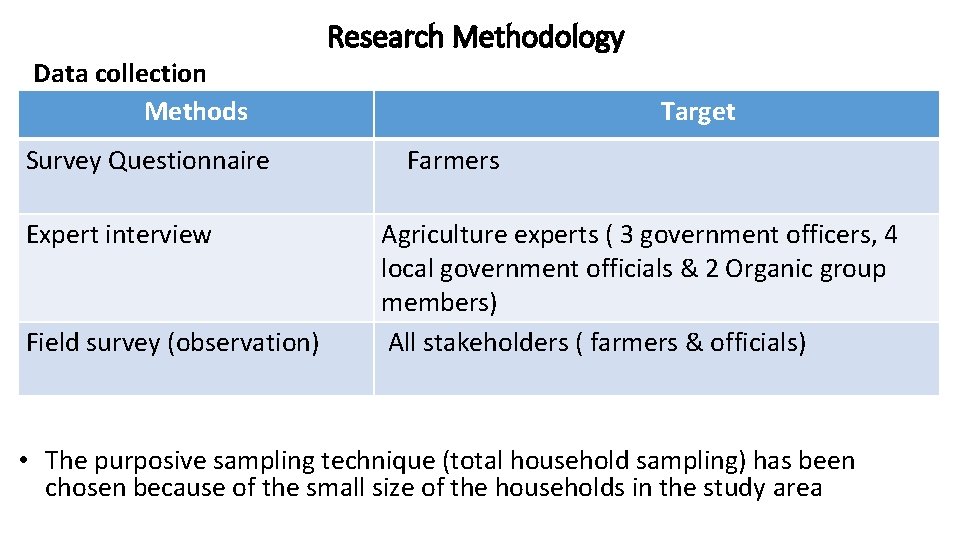
Research Methodology Data collection Methods Target Survey Questionnaire Farmers Expert interview Agriculture experts ( 3 government officers, 4 local government officials & 2 Organic group members) All stakeholders ( farmers & officials) Field survey (observation) • The purposive sampling technique (total household sampling) has been chosen because of the small size of the households in the study area
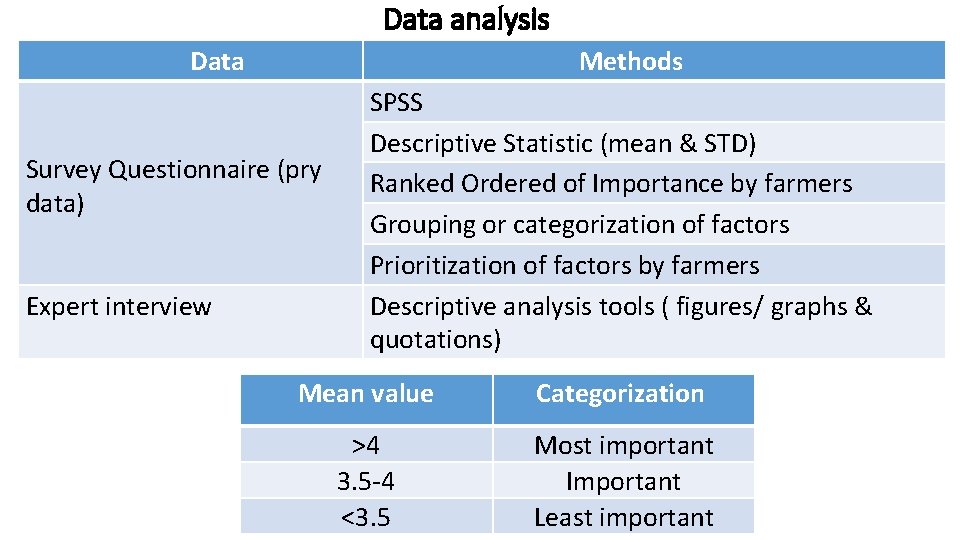
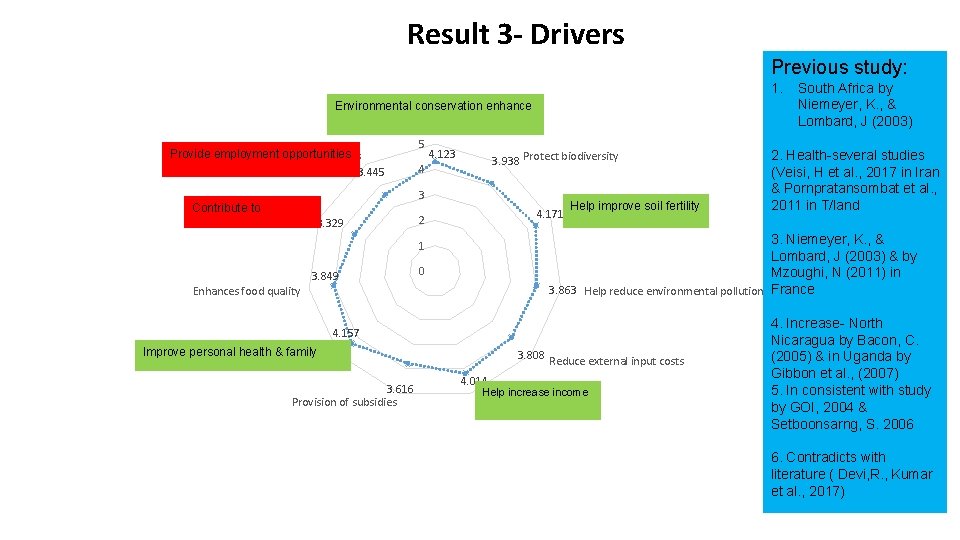
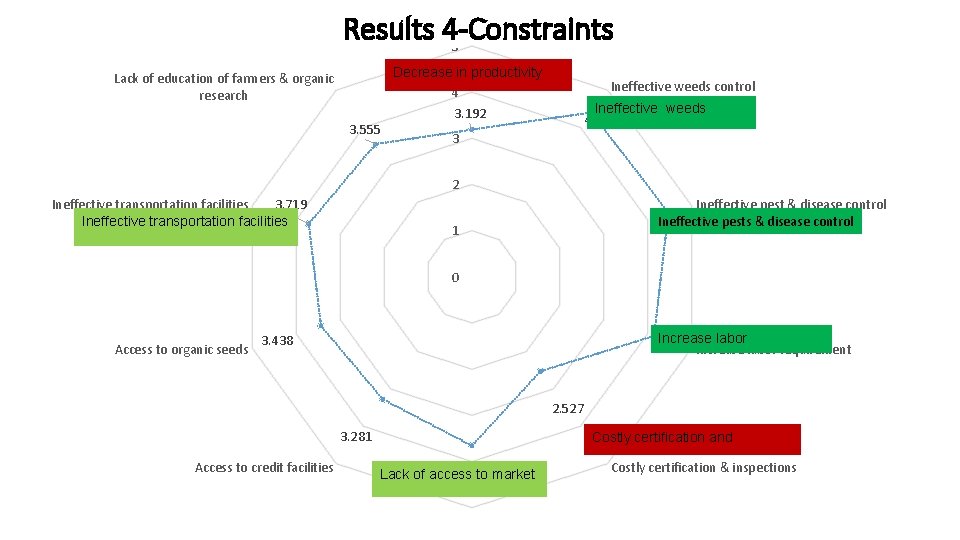
Data analysis Data Survey Questionnaire (pry data) Expert interview Methods SPSS Descriptive Statistic (mean & STD) Ranked Ordered of Importance by farmers Grouping or categorization of factors Prioritization of factors by farmers Descriptive analysis tools ( figures/ graphs & quotations) Mean value Categorization >4 3. 5 -4 <3. 5 Most important Important Least important
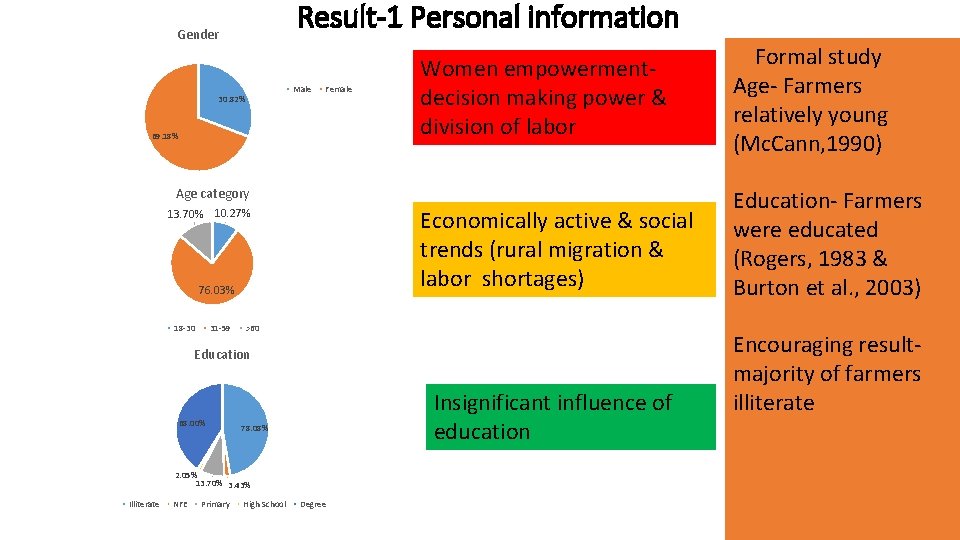
Result-1 Personal information Gender Male 30. 82% Female 69. 18% Women empowerment- decision making power & division of labor Formal study Age- Farmers relatively young (Mc. Cann, 1990) Economically active & social trends (rural migration & labor shortages) Education- Farmers were educated (Rogers, 1983 & Burton et al. , 2003) Age category 13. 70% 10. 27% 76. 03% 18 -30 31 -59 >60 Education 68. 00% Insignificant influence of education 78. 08% 2. 05% 13. 70% 3. 43% Illiterate NFE Primary High School Degree Encouraging resultmajority of farmers illiterate
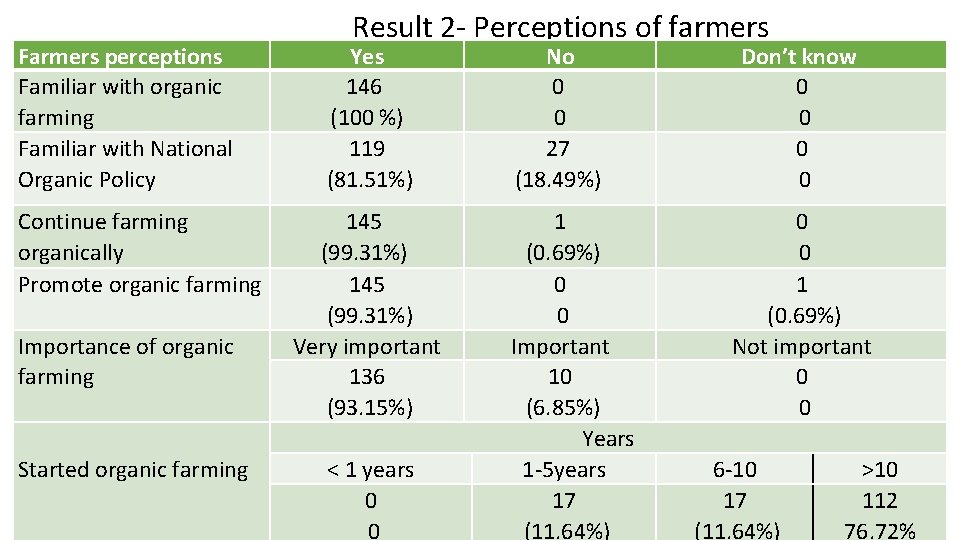
Farmers perceptions Familiar with organic farming Familiar with National Organic Policy Continue farming organically Promote organic farming Importance of organic farming Started organic farming Result 2 - Perceptions of farmers Yes 146 (100 %) 119 (81. 51%) 145 (99. 31%) Very important 136 (93. 15%) < 1 years 0 0 No 0 0 27 (18. 49%) 1 (0. 69%) 0 0 Important 10 (6. 85%) Years 1 -5 years 17 (11. 64%) Don’t know 0 0 0 1 (0. 69%) Not important 0 0 6 -10 17 (11. 64%) >10 112 76. 72%
Result 3 - Drivers Previous study: 1. Environmental conservation enhance 5 Provide employment opportunities 4. 123 Provides employment opportunities Protect biodiversity 3. 938 4 3. 445 Contribute to Contributes to education 3 3. 329 Help improve soil fertility 4. 171 Help improve soil fertility 2 Enhances food quality 0 4. 157 Improve personal health & family health 3. 616 Provision of subsidies 2. Health-several studies (Veisi, H et al. , 2017 in Iran & Pornpratansombat et al. , 2011 in T/land 3. Niemeyer, K. , & Lombard, J (2003) & by Mzoughi, N (2011) in 3. 863 Help reduce environmental pollution France 1 3. 849 South Africa by Niemeyer, K. , & Lombard, J (2003) 3. 808 Reduce external input costs 4. 014 Help increase income 4. Increase- North Nicaragua by Bacon, C. (2005) & in Uganda by Gibbon et al. , (2007) 5. In consistent with study by GOI, 2004 & Setboonsarng, S. 2006 6. Contradicts with literature ( Devi, R. , Kumar et al. , 2017)
Decrease in productivity Results 4 -Constraints 5 Decrease in productivity 4 Lack of education of farmers & organic research 3. 555 Ineffective weeds control Ineffective weeds 4. 404 3. 192 3 2 Ineffective transportation facilities 3. 719 Ineffective transportation facilities Ineffective pest & disease control Ineffective pests & disease control 4. 473 1 0 Access to organic seeds 4. 144 Increase labor requirement 3. 438 2. 527 3. 281 Access to credit facilities Costly certification and Lack of access to market 3. 657 Lack of access to market Costly certification & inspections
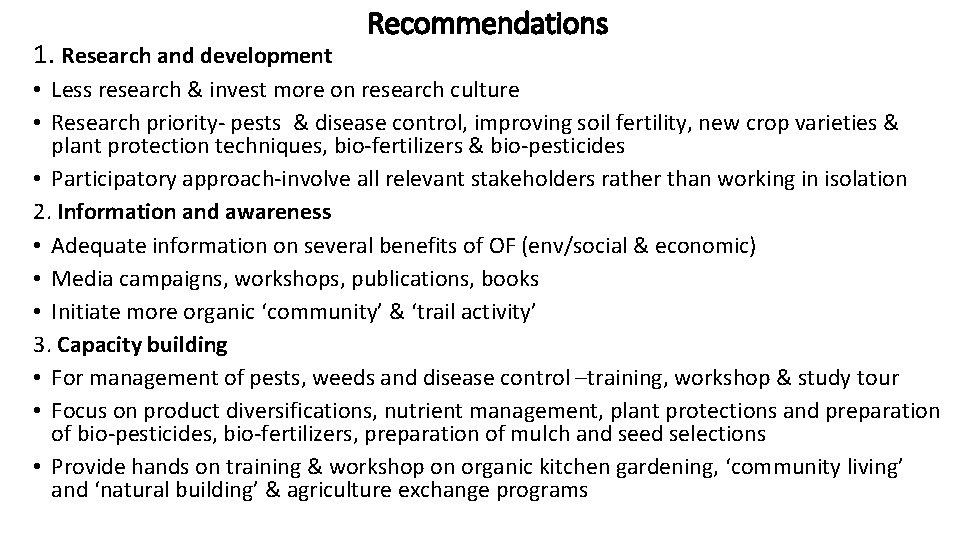
1. Research and development Recommendations • Less research & invest more on research culture • Research priority- pests & disease control, improving soil fertility, new crop varieties & plant protection techniques, bio-fertilizers & bio-pesticides • Participatory approach-involve all relevant stakeholders rather than working in isolation 2. Information and awareness • Adequate information on several benefits of OF (env/social & economic) • Media campaigns, workshops, publications, books • Initiate more organic ‘community’ & ‘trail activity’ 3. Capacity building • For management of pests, weeds and disease control –training, workshop & study tour • Focus on product diversifications, nutrient management, plant protections and preparation of bio-pesticides, bio-fertilizers, preparation of mulch and seed selections • Provide hands on training & workshop on organic kitchen gardening, ‘community living’ and ‘natural building’ & agriculture exchange programs
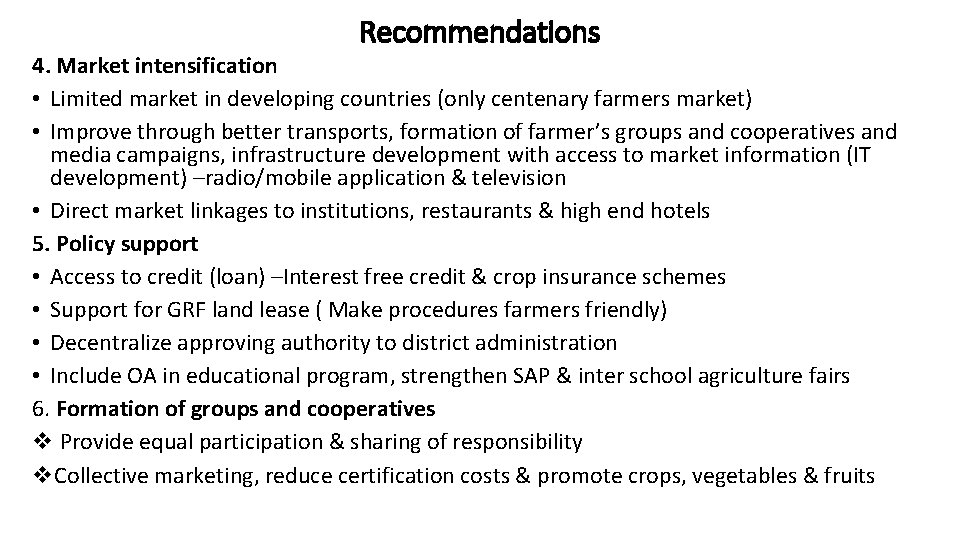
Recommendations 4. Market intensification • Limited market in developing countries (only centenary farmers market) • Improve through better transports, formation of farmer’s groups and cooperatives and media campaigns, infrastructure development with access to market information (IT development) –radio/mobile application & television • Direct market linkages to institutions, restaurants & high end hotels 5. Policy support • Access to credit (loan) –Interest free credit & crop insurance schemes • Support for GRF land lease ( Make procedures farmers friendly) • Decentralize approving authority to district administration • Include OA in educational program, strengthen SAP & inter school agriculture fairs 6. Formation of groups and cooperatives v Provide equal participation & sharing of responsibility v. Collective marketing, reduce certification costs & promote crops, vegetables & fruits
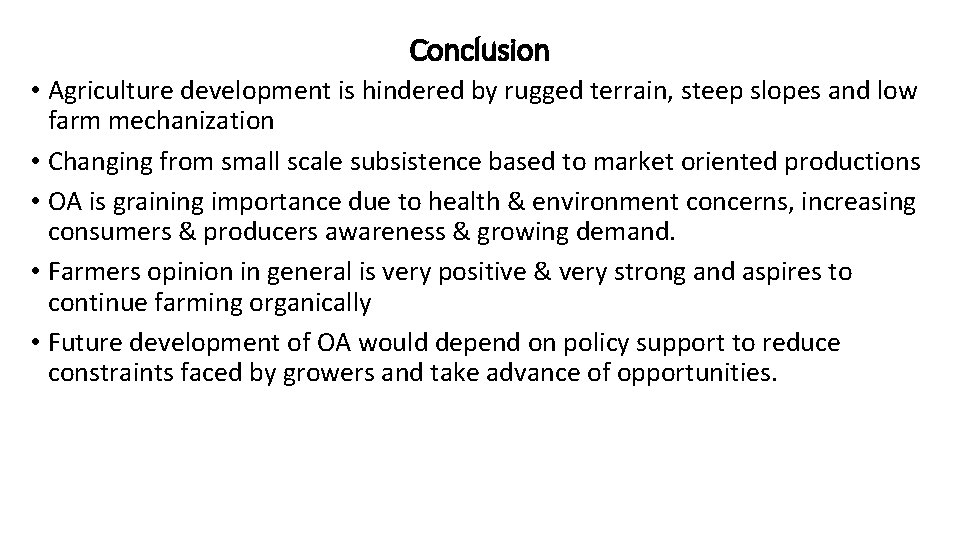
Conclusion • Agriculture development is hindered by rugged terrain, steep slopes and low farm mechanization • Changing from small scale subsistence based to market oriented productions • OA is graining importance due to health & environment concerns, increasing consumers & producers awareness & growing demand. • Farmers opinion in general is very positive & very strong and aspires to continue farming organically • Future development of OA would depend on policy support to reduce constraints faced by growers and take advance of opportunities.
THANK YOU VERY MUCH !! Q/A
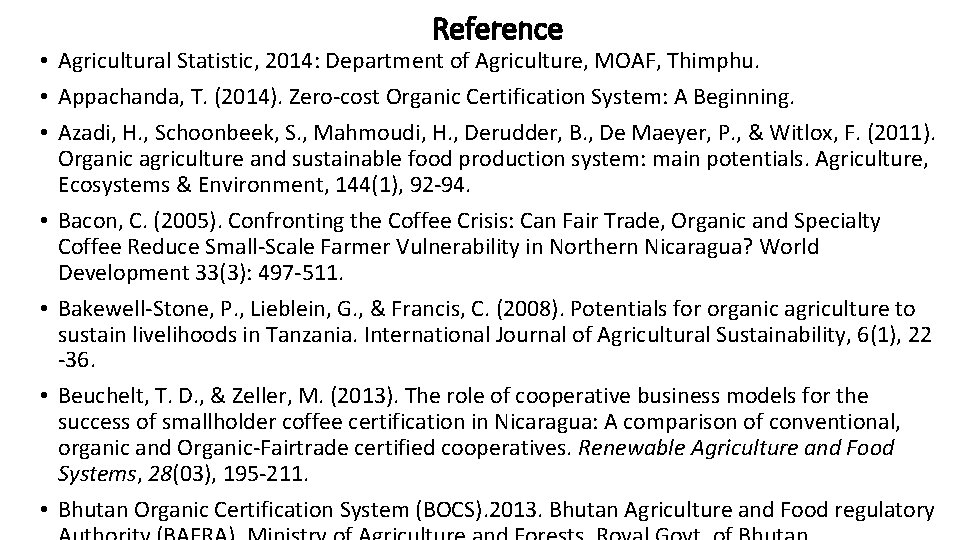
Reference • Agricultural Statistic, 2014: Department of Agriculture, MOAF, Thimphu. • Appachanda, T. (2014). Zero-cost Organic Certification System: A Beginning. • Azadi, H. , Schoonbeek, S. , Mahmoudi, H. , Derudder, B. , De Maeyer, P. , & Witlox, F. (2011). Organic agriculture and sustainable food production system: main potentials. Agriculture, Ecosystems & Environment, 144(1), 92 -94. • Bacon, C. (2005). Confronting the Coffee Crisis: Can Fair Trade, Organic and Specialty Coffee Reduce Small-Scale Farmer Vulnerability in Northern Nicaragua? World Development 33(3): 497 -511. • Bakewell-Stone, P. , Lieblein, G. , & Francis, C. (2008). Potentials for organic agriculture to sustain livelihoods in Tanzania. International Journal of Agricultural Sustainability, 6(1), 22 -36. • Beuchelt, T. D. , & Zeller, M. (2013). The role of cooperative business models for the success of smallholder coffee certification in Nicaragua: A comparison of conventional, organic and Organic-Fairtrade certified cooperatives. Renewable Agriculture and Food Systems, 28(03), 195 -211. • Bhutan Organic Certification System (BOCS). 2013. Bhutan Agriculture and Food regulatory
Reference • Bond, W. and Grundy, A. C. (2001), Non-chemical weed management in organic farming systems. Weed Research, 41: 383– 405. doi: 10. 1046/j. 13653180. 2001. 00246. x • Choden, Kunzang (2008) Chilli and Cheese: Food and Society in Bhutan. Thimphu: White Lotus Press • Connor, D. J. (2008). Organic agriculture cannot feed the world. Field Crops Research, 106(2), 187 -190. • Connor, D. J. (2013). Organically grown crops do not a cropping system make and nor can organic agriculture nearly feed the world. Field Crops Research, 144, 145 -147. • Dorji, K. D. (2008, May). Agriculture and soil fertility management in Bhutan: An overview. In Country paper presented in the meeting of Asia-Pacific Net on Integrated Plant Nutrient Management & International Workshop on Sustainable Nutrient Management: Technology & Policy. (Increase in pesticides in the country) • Das, K. (2007). Towards a smoother transition to organic farming. Economic and Political Weekly, 2243 -2245.
Reference • Devi, R. , Kumar, A. , & Deboch, B. (2007). Organic farming and sustainable development in Ethiopia. Scientific Research and Essays, 2(6), 199 -203 • Duba, S. , Ghimiray, M. , & Gurung, T. R. (2008). Promoting organic farming in Bhutan: A review of policy, implementation and constraints. Council for RNR Research of Bhutan, Ministry of Agriculture, Thimphu, Bhutan • Duram, L. A. (2000). Agents' perceptions of structure: How illinois organic farmers view political, economic, social, and ecological factors. Agriculture and Human Values, 17(1), 35 -48. Retrieved from https: //search. proquest. com/docview/214186052? accountid=15637 • FAO (2015), Country Fact Sheet on Food and Agriculture Policy Trends, FAPDA, Ghana • Ferruh Isin, Tayfun Cukur and Goksel Armagan (2007). Factors Affecting the Adoption of the Organic Dried Fig Agriculture System in Turkey. Journal of Applied Sciences, 7: 748 -754. • Gurung T (2008) Organic farming in Bhutan. In: Rennie F, Mason R (eds) Bhutan: Ways of Knowing. Information Age Publishing Inc. , USA, 205 -210 • Gibbon, P. , & Bolwig, S. (2007). The economics of certified organic farming in tropical Africa: A preliminary assessment (No. 2007: 3). DIIS working paper.
Reference • GOI (2004), Report of the Committee on Revitalization of Sugar Industry, Ministry of Food, Consumer Affairs and Publication Distribution, Government of India, New Delhi. • Gómez, M. I. , Barrett, C. B. , Buck, L. E. , De Groote, H. , Ferris, S. , Gao, H. O. , . . . & Reardon, T. (2011). Research principles for developing country food value chains. Science, 332(6034), 1154 -1155. • Giovannucci, D. (2005). Organic agriculture and poverty reduction in Asia: China and India focus • Ghazaryan, A. (2016). Collective action as a way to develop Organic Farming in Armenia. International Journal of Business and Economic Development (IJBED), 4(2) • GNHC (2013) Eleventh Five Year Plan, 2013 -2018. In: http: //www. gnhc. gov. bt/wpcontent/uploads/2011/04/Eleventh-Five-Year-Plan. pdf. • Gyeltshen, Jamba (2008) Student Handbook for Agrochemicals. Agro-chemicals and Weed Science, College of Natural Resource, Royal University of Bhutan. Retrieved from cms. cnr. edu. bt.
Reference • Hall, A. , & Mogyorody, V. (2007). Organic farming, gender, and the labor process. Rural Sociology, 72(2), 289 -316. • Jansen, K. (2000). Labour, livelihoods and the quality of life in organic agriculture in Europe. Biological agriculture & horticulture, 17(3), 247 -278. • Karma, G. M. , & Ghimiray, M. (2006). Rainfed lowland rice cultivation in Bhutan: a survey report. Bhu J RNR, 2, 93 -114. • Karki, L. , Schleenbecker, R. , & Hamm, U. (2012). Factors influencing a conversion to organic farming in Nepalese tea farms. Journal of Agriculture and Rural Development in the Tropics and Subtropics (JARTS), 112(2), 113 -123. • Kisaka-Lwayo, M. (2007, August). A discriminant analysis of factors associated with the adoption of certified organic farming by smallholder farmers in Kwazulu-Natal, South Africa. In Institution/Association: African Association of Agricultural Economists (AAAE)> 2007 Second International Conference.
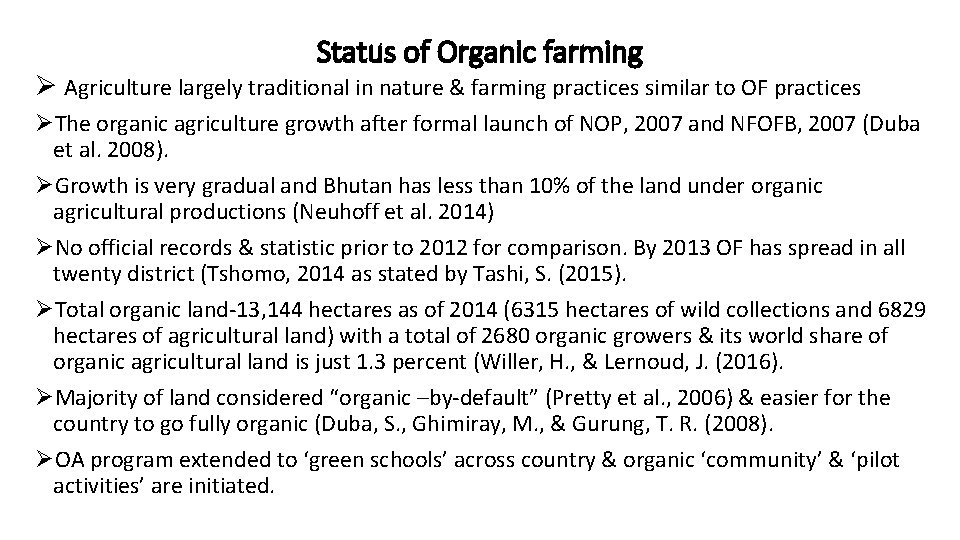
Status of Organic farming Ø Agriculture largely traditional in nature & farming practices similar to OF practices ØThe organic agriculture growth after formal launch of NOP, 2007 and NFOFB, 2007 (Duba et al. 2008). ØGrowth is very gradual and Bhutan has less than 10% of the land under organic agricultural productions (Neuhoff et al. 2014) ØNo official records & statistic prior to 2012 for comparison. By 2013 OF has spread in all twenty district (Tshomo, 2014 as stated by Tashi, S. (2015). ØTotal organic land-13, 144 hectares as of 2014 (6315 hectares of wild collections and 6829 hectares of agricultural land) with a total of 2680 organic growers & its world share of organic agricultural land is just 1. 3 percent (Willer, H. , & Lernoud, J. (2016). ØMajority of land considered “organic –by-default” (Pretty et al. , 2006) & easier for the country to go fully organic (Duba, S. , Ghimiray, M. , & Gurung, T. R. (2008). ØOA program extended to ‘green schools’ across country & organic ‘community’ & ‘pilot activities’ are initiated.