
Conference Call Etiquette Please mute your line if


- Slides: 60
Conference Call Etiquette § Please mute your line if you not speaking. § Identify yourself before you speak. § If you are on the phone and logged in via web, turn off your computer speakers. § Chat functionality will be turned on for Board members, presenters and staff. Use this to interrupt the presenters/ask questions you’d like the presenter to answer.
Pennsylvania Health Insurance Exchange Authority – Board of Directors Meeting March 19, 2020 Pennsylvania Health Insurance Exchange Authority
Preliminary Matters Pennsylvania Health Insurance Exchange Authority 3
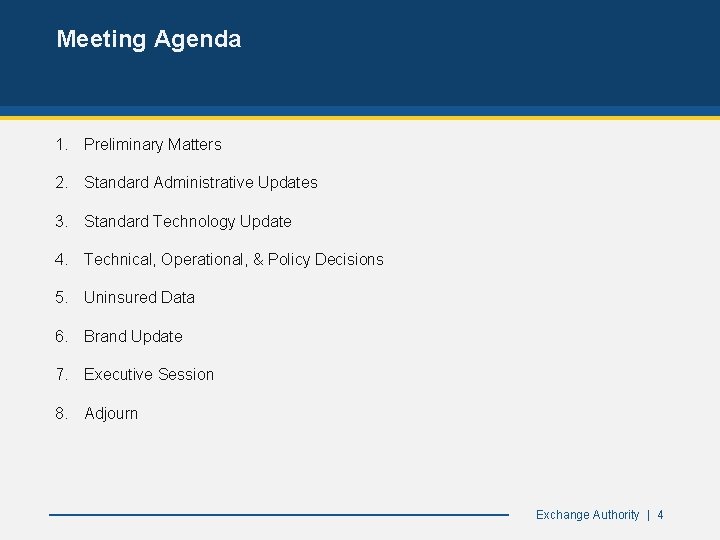
Meeting Agenda 1. Preliminary Matters 2. Standard Administrative Updates 3. Standard Technology Update 4. Technical, Operational, & Policy Decisions 5. Uninsured Data 6. Brand Update 7. Executive Session 8. Adjourn Exchange Authority | 4
Administrative Updates Pennsylvania Health Insurance Exchange Authority 5
Administrative Updates § Personnel § Stakeholder Engagement § Insurers § Advocates § Advisory Council § Brokers § State-Based Exchange partners Exchange Authority | 6
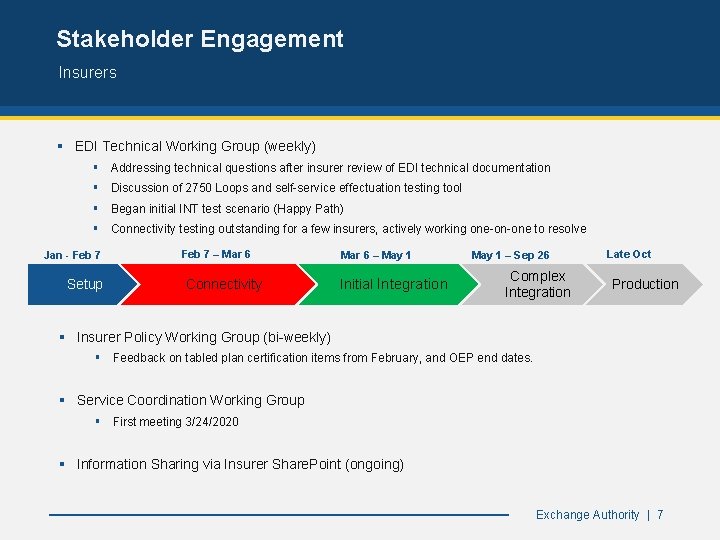
Stakeholder Engagement Insurers § EDI Technical Working Group (weekly) § Addressing technical questions after insurer review of EDI technical documentation § Discussion of 2750 Loops and self-service effectuation testing tool § Began initial INT test scenario (Happy Path) § Connectivity testing outstanding for a few insurers, actively working one-on-one to resolve Jan - Feb 7 Setup Feb 7 – Mar 6 Connectivity Mar 6 – May 1 Initial Integration May 1 – Sep 26 Complex Integration Late Oct Production § Insurer Policy Working Group (bi-weekly) § Feedback on tabled plan certification items from February, and OEP end dates. § Service Coordination Working Group § First meeting 3/24/2020 § Information Sharing via Insurer Share. Point (ongoing) Exchange Authority | 7
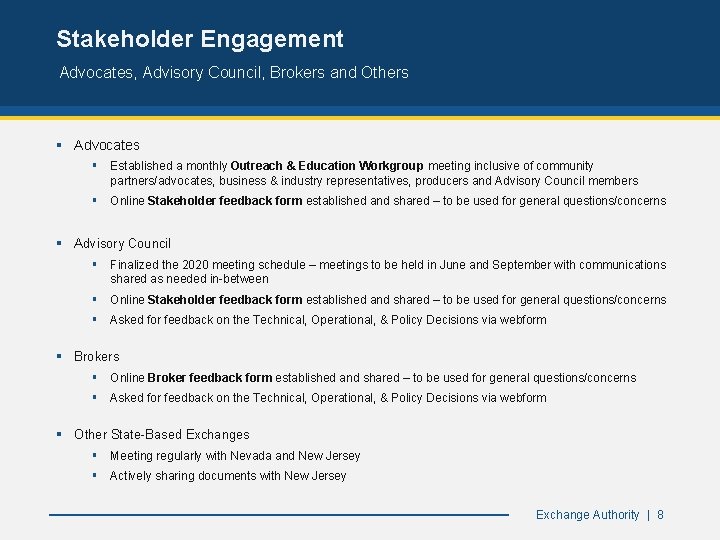
Stakeholder Engagement Advocates, Advisory Council, Brokers and Others § Advocates § Established a monthly Outreach & Education Workgroup meeting inclusive of community partners/advocates, business & industry representatives, producers and Advisory Council members § Online Stakeholder feedback form established and shared – to be used for general questions/concerns § Advisory Council § Finalized the 2020 meeting schedule – meetings to be held in June and September with communications shared as needed in-between § Online Stakeholder feedback form established and shared – to be used for general questions/concerns § Asked for feedback on the Technical, Operational, & Policy Decisions via webform § Brokers § Online Broker feedback form established and shared – to be used for general questions/concerns § Asked for feedback on the Technical, Operational, & Policy Decisions via webform § Other State-Based Exchanges § Meeting regularly with Nevada and New Jersey § Actively sharing documents with New Jersey Exchange Authority | 8
Standard Technology and Operations Update Pennsylvania Health Insurance Exchange Authority 9
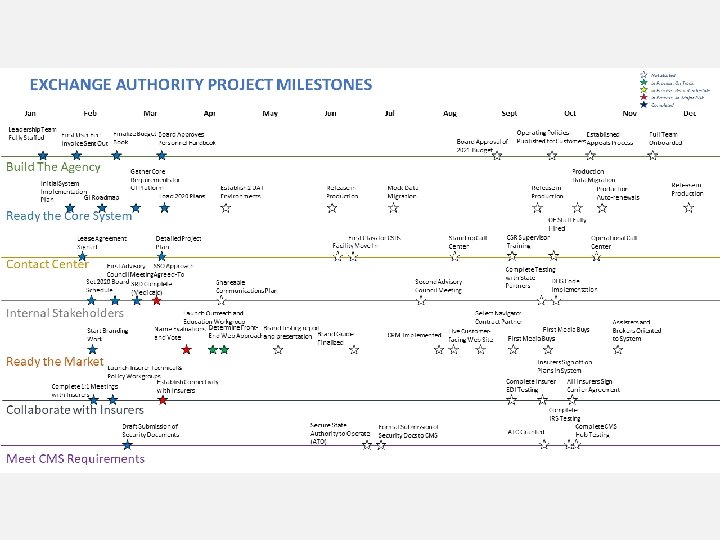
Standard Technology and Operations Update Agenda § Stars on a String Status Report § System Requirements and Design Process Update Exchange Authority | 10
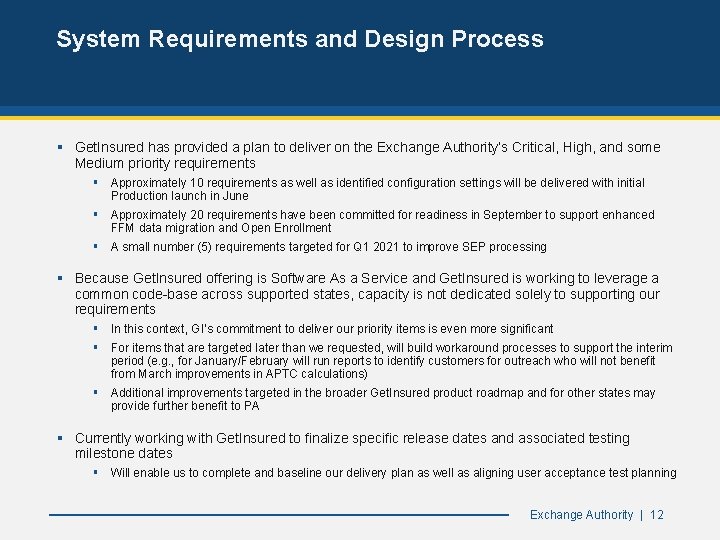
System Requirements and Design Process § Get. Insured has provided a plan to deliver on the Exchange Authority’s Critical, High, and some Medium priority requirements § Approximately 10 requirements as well as identified configuration settings will be delivered with initial Production launch in June § Approximately 20 requirements have been committed for readiness in September to support enhanced FFM data migration and Open Enrollment § A small number (5) requirements targeted for Q 1 2021 to improve SEP processing § Because Get. Insured offering is Software As a Service and Get. Insured is working to leverage a common code-base across supported states, capacity is not dedicated solely to supporting our requirements § In this context, GI’s commitment to deliver our priority items is even more significant § For items that are targeted later than we requested, will build workaround processes to support the interim period (e. g. , for January/February will run reports to identify customers for outreach who will not benefit from March improvements in APTC calculations) § Additional improvements targeted in the broader Get. Insured product roadmap and for other states may provide further benefit to PA § Currently working with Get. Insured to finalize specific release dates and associated testing milestone dates § Will enable us to complete and baseline our delivery plan as well as aligning user acceptance test planning Exchange Authority | 12
Technical, Operational, & Policy Decisions Pennsylvania Health Insurance Exchange Authority 13
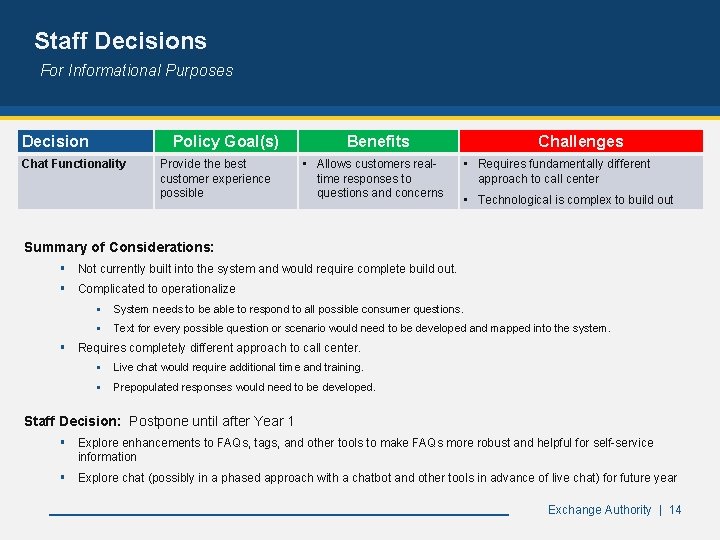
Staff Decisions For Informational Purposes Decision Policy Goal(s) Chat Functionality Provide the best customer experience possible Benefits • Allows customers realtime responses to questions and concerns Challenges • Requires fundamentally different approach to call center • Technological is complex to build out Summary of Considerations: § Not currently built into the system and would require complete build out. § Complicated to operationalize § System needs to be able to respond to all possible consumer questions. § Text for every possible question or scenario would need to be developed and mapped into the system. § Requires completely different approach to call center. § Live chat would require additional time and training. § Prepopulated responses would need to be developed. Staff Decision: Postpone until after Year 1 § Explore enhancements to FAQs, tags, and other tools to make FAQs more robust and helpful for self-service information § Explore chat (possibly in a phased approach with a chatbot and other tools in advance of live chat) for future year Exchange Authority | 14
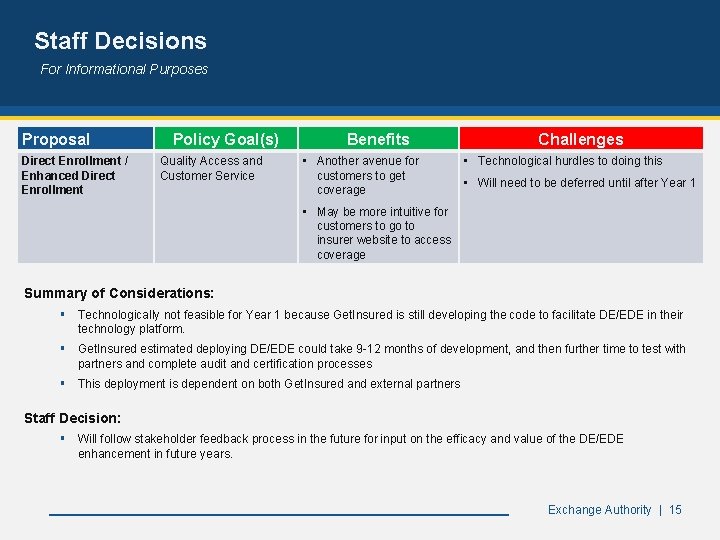
Staff Decisions For Informational Purposes Proposal Direct Enrollment / Enhanced Direct Enrollment Policy Goal(s) Quality Access and Customer Service Benefits • Another avenue for customers to get coverage Challenges • Technological hurdles to doing this • Will need to be deferred until after Year 1 • May be more intuitive for customers to go to insurer website to access coverage Summary of Considerations: § Technologically not feasible for Year 1 because Get. Insured is still developing the code to facilitate DE/EDE in their technology platform. § Get. Insured estimated deploying DE/EDE could take 9 -12 months of development, and then further time to test with partners and complete audit and certification processes § This deployment is dependent on both Get. Insured and external partners Staff Decision: § Will follow stakeholder feedback process in the future for input on the efficacy and value of the DE/EDE enhancement in future years. Exchange Authority | 15
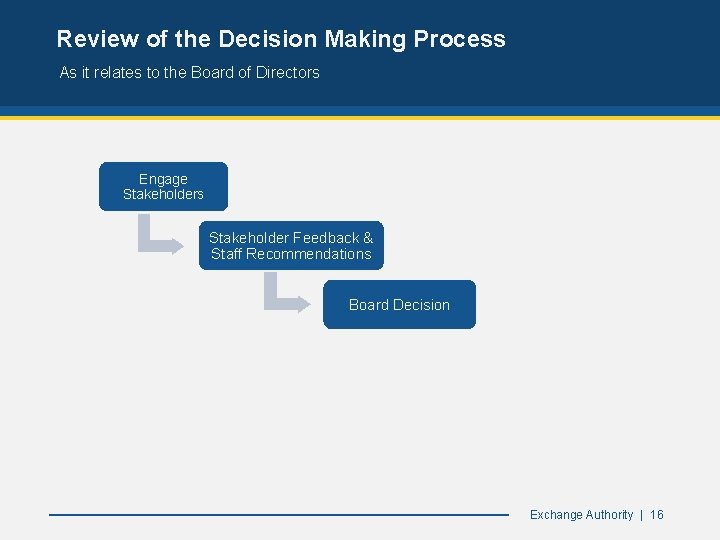
Review of the Decision Making Process As it relates to the Board of Directors Engage Stakeholders Stakeholder Feedback & Staff Recommendations Board Decision Exchange Authority | 16
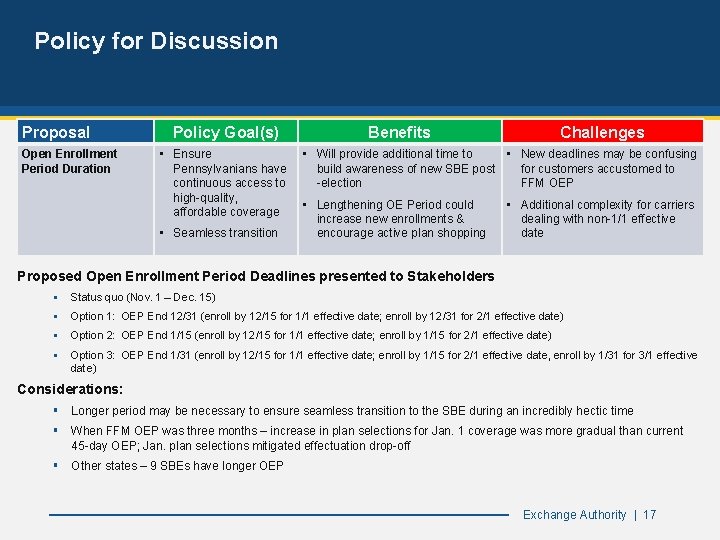
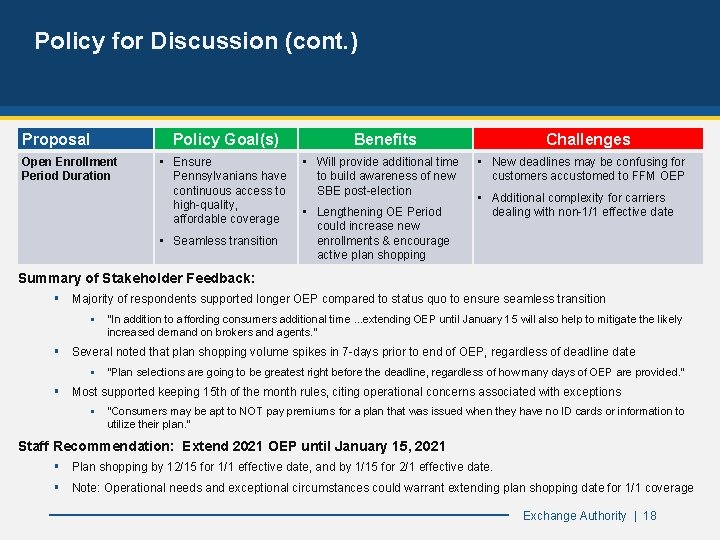
Policy for Discussion Proposal Open Enrollment Period Duration Policy Goal(s) • Ensure Pennsylvanians have continuous access to high-quality, affordable coverage • Seamless transition Benefits Challenges • Will provide additional time to • New deadlines may be confusing build awareness of new SBE post for customers accustomed to -election FFM OEP • Lengthening OE Period could increase new enrollments & encourage active plan shopping • Additional complexity for carriers dealing with non-1/1 effective date Proposed Open Enrollment Period Deadlines presented to Stakeholders § Status quo (Nov. 1 – Dec. 15) § Option 1: OEP End 12/31 (enroll by 12/15 for 1/1 effective date; enroll by 12/31 for 2/1 effective date) § Option 2: OEP End 1/15 (enroll by 12/15 for 1/1 effective date; enroll by 1/15 for 2/1 effective date) § Option 3: OEP End 1/31 (enroll by 12/15 for 1/1 effective date; enroll by 1/15 for 2/1 effective date, enroll by 1/31 for 3/1 effective date) Considerations: § Longer period may be necessary to ensure seamless transition to the SBE during an incredibly hectic time § When FFM OEP was three months – increase in plan selections for Jan. 1 coverage was more gradual than current 45 -day OEP; Jan. plan selections mitigated effectuation drop-off § Other states – 9 SBEs have longer OEP Exchange Authority | 17
Policy for Discussion (cont. ) Proposal Policy Goal(s) Open Enrollment Period Duration • Ensure Pennsylvanians have continuous access to high-quality, affordable coverage • Seamless transition Benefits • Will provide additional time to build awareness of new SBE post-election • Lengthening OE Period could increase new enrollments & encourage active plan shopping Challenges • New deadlines may be confusing for customers accustomed to FFM OEP • Additional complexity for carriers dealing with non-1/1 effective date Summary of Stakeholder Feedback: § Majority of respondents supported longer OEP compared to status quo to ensure seamless transition § "In addition to affording consumers additional time. . . extending OEP until January 15 will also help to mitigate the likely increased demand on brokers and agents. " § Several noted that plan shopping volume spikes in 7 -days prior to end of OEP, regardless of deadline date § "Plan selections are going to be greatest right before the deadline, regardless of how many days of OEP are provided. " § Most supported keeping 15 th of the month rules, citing operational concerns associated with exceptions § "Consumers may be apt to NOT pay premiums for a plan that was issued when they have no ID cards or information to utilize their plan. " Staff Recommendation: Extend 2021 OEP until January 15, 2021 § Plan shopping by 12/15 for 1/1 effective date, and by 1/15 for 2/1 effective date. § Note: Operational needs and exceptional circumstances could warrant extending plan shopping date for 1/1 coverage Exchange Authority | 18
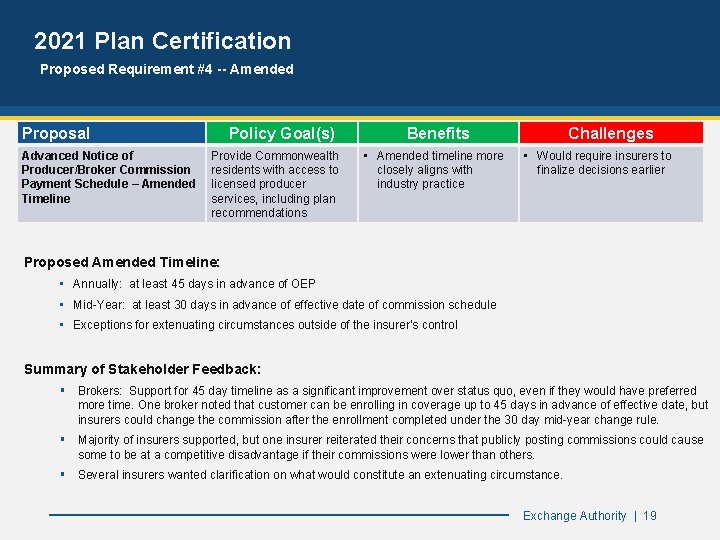
2021 Plan Certification Proposed Requirement #4 -- Amended Proposal Advanced Notice of Producer/Broker Commission Payment Schedule – Amended Timeline Policy Goal(s) Provide Commonwealth residents with access to licensed producer services, including plan recommendations Benefits • Amended timeline more closely aligns with industry practice Challenges • Would require insurers to finalize decisions earlier Proposed Amended Timeline: • Annually: at least 45 days in advance of OEP • Mid-Year: at least 30 days in advance of effective date of commission schedule • Exceptions for extenuating circumstances outside of the insurer’s control Summary of Stakeholder Feedback: § Brokers: Support for 45 day timeline as a significant improvement over status quo, even if they would have preferred more time. One broker noted that customer can be enrolling in coverage up to 45 days in advance of effective date, but insurers could change the commission after the enrollment completed under the 30 day mid-year change rule. § Majority of insurers supported, but one insurer reiterated their concerns that publicly posting commissions could cause some to be at a competitive disadvantage if their commissions were lower than others. § Several insurers wanted clarification on what would constitute an extenuating circumstance. Exchange Authority | 19
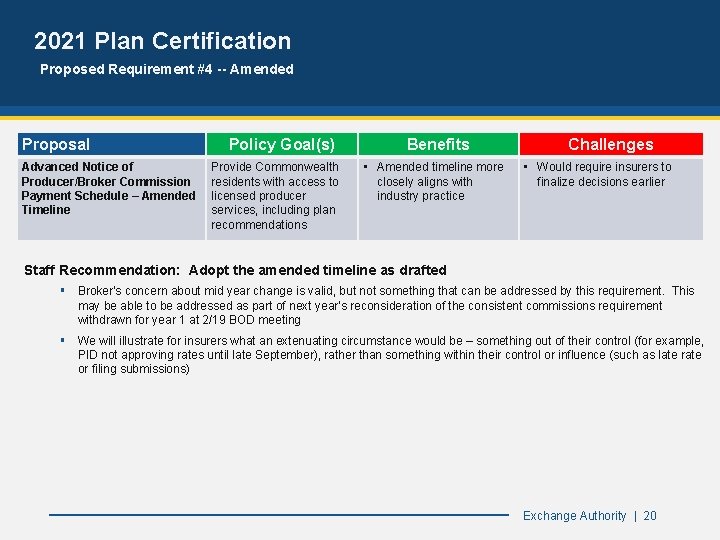
2021 Plan Certification Proposed Requirement #4 -- Amended Proposal Advanced Notice of Producer/Broker Commission Payment Schedule – Amended Timeline Policy Goal(s) Provide Commonwealth residents with access to licensed producer services, including plan recommendations Benefits • Amended timeline more closely aligns with industry practice Challenges • Would require insurers to finalize decisions earlier Staff Recommendation: Adopt the amended timeline as drafted § Broker's concern about mid year change is valid, but not something that can be addressed by this requirement. This may be able to be addressed as part of next year's reconsideration of the consistent commissions requirement withdrawn for year 1 at 2/19 BOD meeting § We will illustrate for insurers what an extenuating circumstance would be – something out of their control (for example, PID not approving rates until late September), rather than something within their control or influence (such as late rate or filing submissions) Exchange Authority | 20
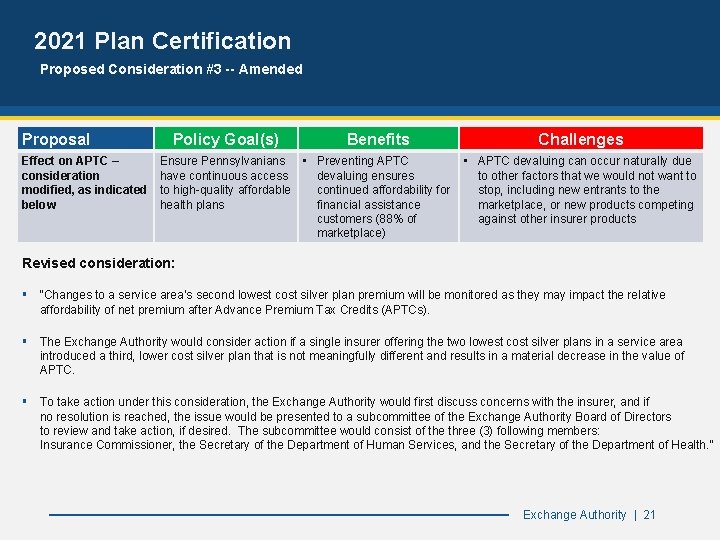
2021 Plan Certification Proposed Consideration #3 -- Amended Proposal Effect on APTC – consideration modified, as indicated below Policy Goal(s) Benefits Ensure Pennsylvanians • Preventing APTC have continuous access devaluing ensures to high-quality affordable continued affordability for health plans financial assistance customers (88% of marketplace) Challenges • APTC devaluing can occur naturally due to other factors that we would not want to stop, including new entrants to the marketplace, or new products competing against other insurer products Revised consideration: § “Changes to a service area’s second lowest cost silver plan premium will be monitored as they may impact the relative affordability of net premium after Advance Premium Tax Credits (APTCs). § The Exchange Authority would consider action if a single insurer offering the two lowest cost silver plans in a service area introduced a third, lower cost silver plan that is not meaningfully different and results in a material decrease in the value of APTC. § To take action under this consideration, the Exchange Authority would first discuss concerns with the insurer, and if no resolution is reached, the issue would be presented to a subcommittee of the Exchange Authority Board of Directors to review and take action, if desired. The subcommittee would consist of the three (3) following members: Insurance Commissioner, the Secretary of the Department of Human Services, and the Secretary of the Department of Health. ” Exchange Authority | 21
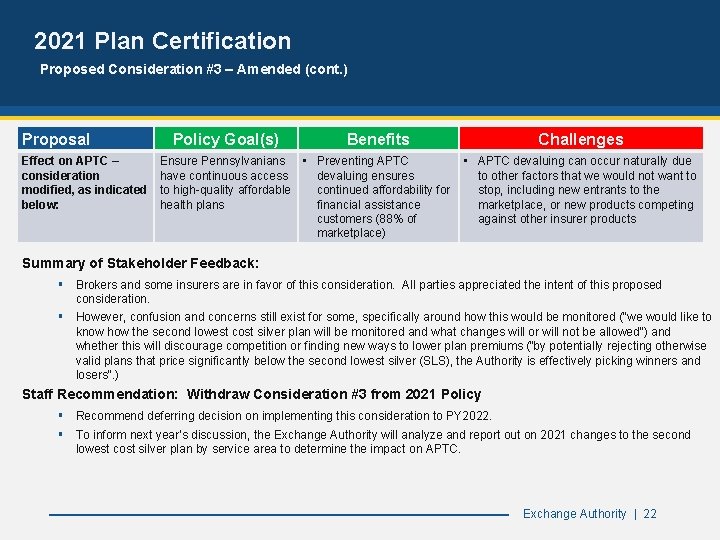
2021 Plan Certification Proposed Consideration #3 – Amended (cont. ) Proposal Effect on APTC – consideration modified, as indicated below: Policy Goal(s) Benefits Ensure Pennsylvanians • Preventing APTC have continuous access devaluing ensures to high-quality affordable continued affordability for health plans financial assistance customers (88% of marketplace) Challenges • APTC devaluing can occur naturally due to other factors that we would not want to stop, including new entrants to the marketplace, or new products competing against other insurer products Summary of Stakeholder Feedback: § Brokers and some insurers are in favor of this consideration. All parties appreciated the intent of this proposed consideration. § However, confusion and concerns still exist for some, specifically around how this would be monitored ("we would like to know how the second lowest cost silver plan will be monitored and what changes will or will not be allowed") and whether this will discourage competition or finding new ways to lower plan premiums ("by potentially rejecting otherwise valid plans that price significantly below the second lowest silver (SLS), the Authority is effectively picking winners and losers". ) Staff Recommendation: Withdraw Consideration #3 from 2021 Policy § Recommend deferring decision on implementing this consideration to PY 2022. § To inform next year’s discussion, the Exchange Authority will analyze and report out on 2021 changes to the second lowest cost silver plan by service area to determine the impact on APTC. Exchange Authority | 22
Analysis of Pennsylvania’s Uninsured Population Pennsylvania Health Insurance Exchange Authority 23
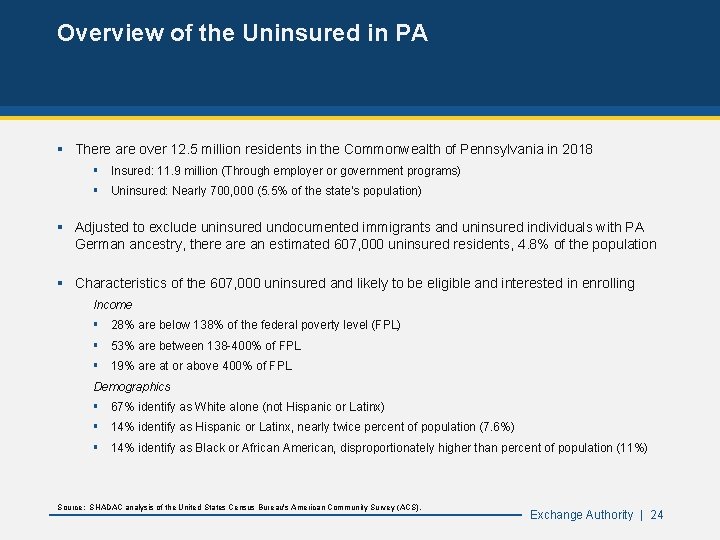
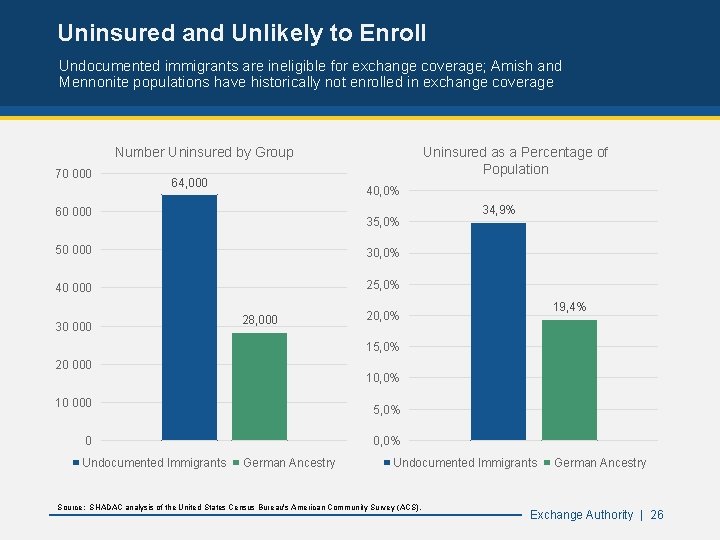
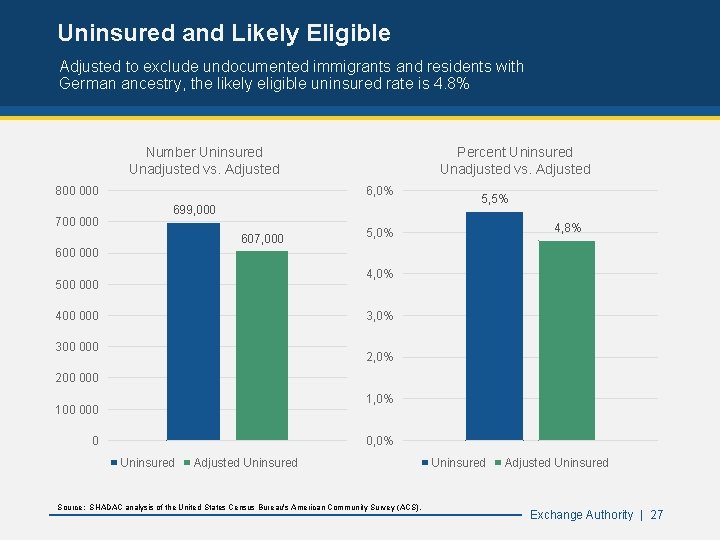
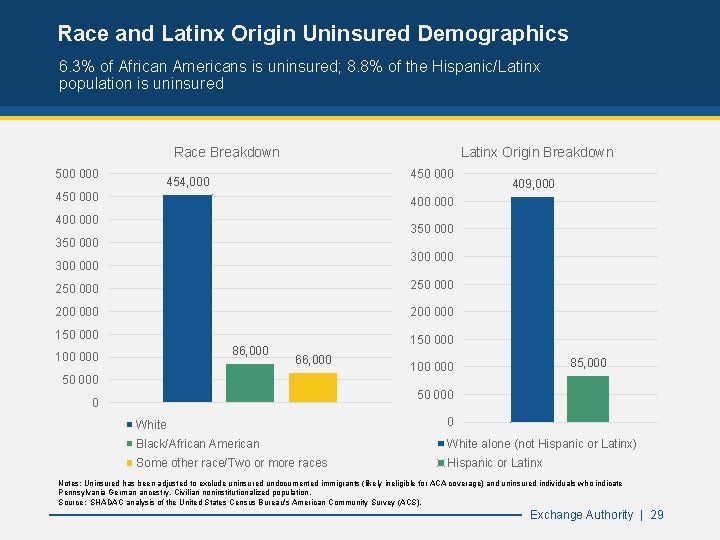
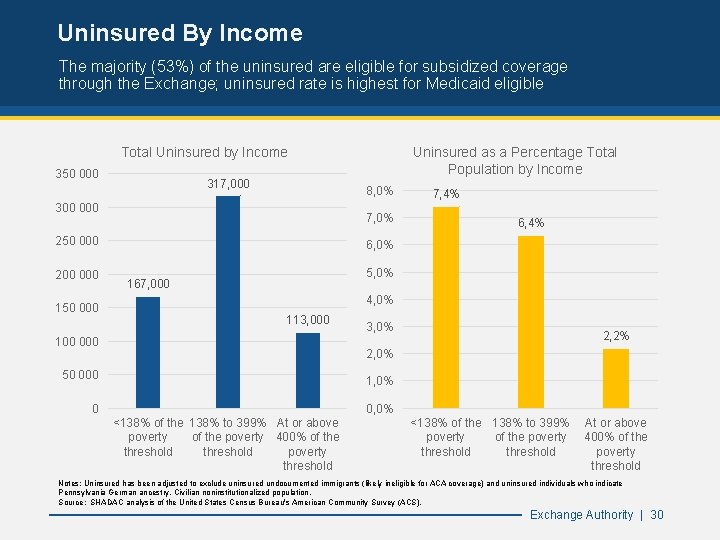
Overview of the Uninsured in PA § There are over 12. 5 million residents in the Commonwealth of Pennsylvania in 2018 § Insured: 11. 9 million (Through employer or government programs) § Uninsured: Nearly 700, 000 (5. 5% of the state’s population) § Adjusted to exclude uninsured undocumented immigrants and uninsured individuals with PA German ancestry, there an estimated 607, 000 uninsured residents, 4. 8% of the population § Characteristics of the 607, 000 uninsured and likely to be eligible and interested in enrolling Income § 28% are below 138% of the federal poverty level (FPL) § 53% are between 138 -400% of FPL § 19% are at or above 400% of FPL Demographics § 67% identify as White alone (not Hispanic or Latinx) § 14% identify as Hispanic or Latinx, nearly twice percent of population (7. 6%) § 14% identify as Black or African American, disproportionately higher than percent of population (11%) Source: SHADAC analysis of the United States Census Bureau's American Community Survey (ACS). Exchange Authority | 24
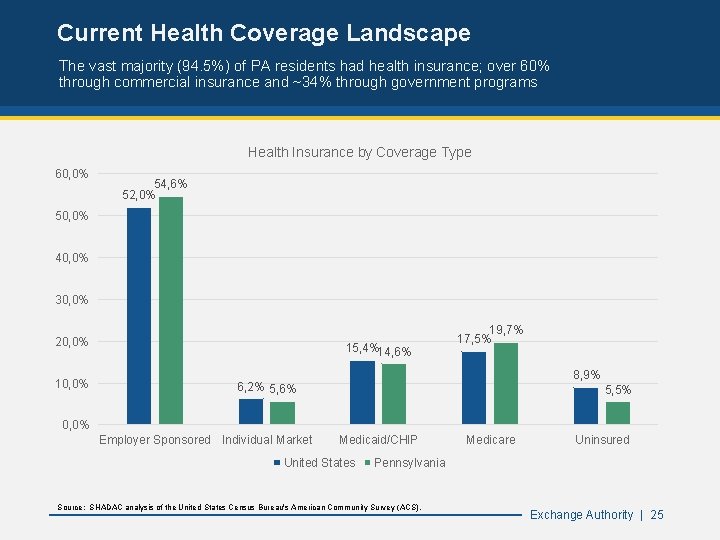
Current Health Coverage Landscape The vast majority (94. 5%) of PA residents had health insurance; over 60% through commercial insurance and ~34% through government programs Health Insurance by Coverage Type 60, 0% 54, 6% 52, 0% 50, 0% 40, 0% 30, 0% 20, 0% 15, 4%14, 6% 19, 7% 17, 5% 8, 9% 6, 2% 5, 6% 5, 5% 0, 0% Employer Sponsored Individual Market Medicaid/CHIP United States Medicare Uninsured Pennsylvania Source: SHADAC analysis of the United States Census Bureau's American Community Survey (ACS). Exchange Authority | 25
Uninsured and Unlikely to Enroll Undocumented immigrants are ineligible for exchange coverage; Amish and Mennonite populations have historically not enrolled in exchange coverage Number Uninsured by Group 70 000 64, 000 Uninsured as a Percentage of Population 40, 0% 60 000 35, 0% 50 000 30, 0% 40 000 25, 0% 30 000 28, 000 34, 9% 19, 4% 20, 0% 15, 0% 20 000 10, 0% 10 000 5, 0% 0 Undocumented Immigrants German Ancestry Undocumented Immigrants Source: SHADAC analysis of the United States Census Bureau's American Community Survey (ACS). German Ancestry Exchange Authority | 26
Uninsured and Likely Eligible Adjusted to exclude undocumented immigrants and residents with German ancestry, the likely eligible uninsured rate is 4. 8% Number Uninsured Unadjusted vs. Adjusted 800 000 700 000 Percent Uninsured Unadjusted vs. Adjusted 6, 0% 699, 000 607, 000 5, 5% 4, 8% 5, 0% 600 000 4, 0% 500 000 400 000 3, 0% 300 000 2, 0% 200 000 1, 0% 100 0 0, 0% Uninsured Adjusted Uninsured Source: SHADAC analysis of the United States Census Bureau's American Community Survey (ACS). Uninsured Adjusted Uninsured Exchange Authority | 27
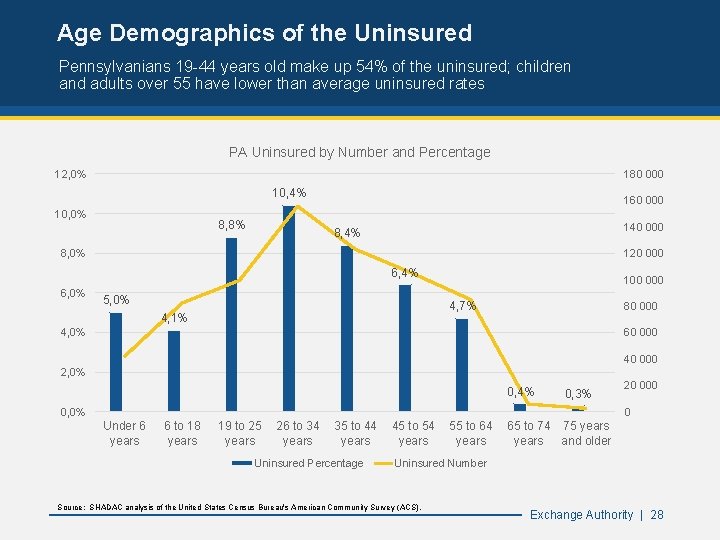
Age Demographics of the Uninsured Pennsylvanians 19 -44 years old make up 54% of the uninsured; children and adults over 55 have lower than average uninsured rates PA Uninsured by Number and Percentage 12, 0% 180 000 10, 4% 10, 0% 8, 8% 160 000 140 000 8, 4% 8, 0% 120 000 6, 4% 6, 0% 5, 0% 100 000 4, 7% 4, 1% 80 000 4, 0% 60 000 40 000 2, 0% 0, 4% 0, 3% 0, 0% 20 000 0 Under 6 years 6 to 18 years 19 to 25 years 26 to 34 years 35 to 44 years Uninsured Percentage 45 to 54 years 55 to 64 years 65 to 74 75 years and older Uninsured Number Source: SHADAC analysis of the United States Census Bureau's American Community Survey (ACS). Exchange Authority | 28
Race and Latinx Origin Uninsured Demographics 6. 3% of African Americans is uninsured; 8. 8% of the Hispanic/Latinx population is uninsured Race Breakdown 500 000 Latinx Origin Breakdown 450 000 454, 000 450 000 409, 000 400 000 350 000 300 000 250 000 200 000 150 000 86, 000 100 000 150 000 66, 000 50 000 85, 000 100 000 50 000 0 White 0 Black/African American White alone (not Hispanic or Latinx) Some other race/Two or more races Hispanic or Latinx Notes: Uninsured has been adjusted to exclude uninsured undocumented immigrants (likely ineligible for ACA coverage) and uninsured individuals who indicate Pennsylvania German ancestry. Civilian noninstitutionalized population. Source: SHADAC analysis of the United States Census Bureau's American Community Survey (ACS). Exchange Authority | 29
Uninsured By Income The majority (53%) of the uninsured are eligible for subsidized coverage through the Exchange; uninsured rate is highest for Medicaid eligible Total Uninsured by Income 350 000 317, 000 8, 0% 300 000 7, 0% 250 000 200 000 150 000 Uninsured as a Percentage Total Population by Income 7, 4% 6, 0% 5, 0% 167, 000 4, 0% 113, 000 100 000 3, 0% 2, 2% 2, 0% 50 000 1, 0% 0 <138% of the 138% to 399% At or above poverty of the poverty 400% of the threshold poverty threshold <138% of the 138% to 399% poverty of the poverty threshold At or above 400% of the poverty threshold Notes: Uninsured has been adjusted to exclude uninsured undocumented immigrants (likely ineligible for ACA coverage) and uninsured individuals who indicate Pennsylvania German ancestry. Civilian noninstitutionalized population. Source: SHADAC analysis of the United States Census Bureau's American Community Survey (ACS). Exchange Authority | 30
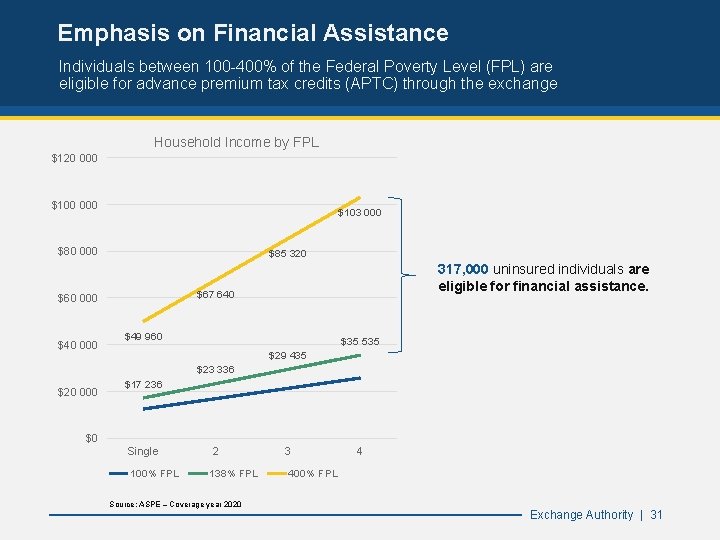
Emphasis on Financial Assistance Individuals between 100 -400% of the Federal Poverty Level (FPL) are eligible for advance premium tax credits (APTC) through the exchange Household Income by FPL $120 000 $103 000 $80 000 $85 320 $67 640 $60 000 $40 000 317, 000 uninsured individuals are eligible for financial assistance. $49 960 $35 535 $29 435 $23 336 $20 000 $0 Salary $17 236 Single 100% FPL 2 138% FPL Source: ASPE – Coverage year 2020 3 4 400% FPL Exchange Authority | 31
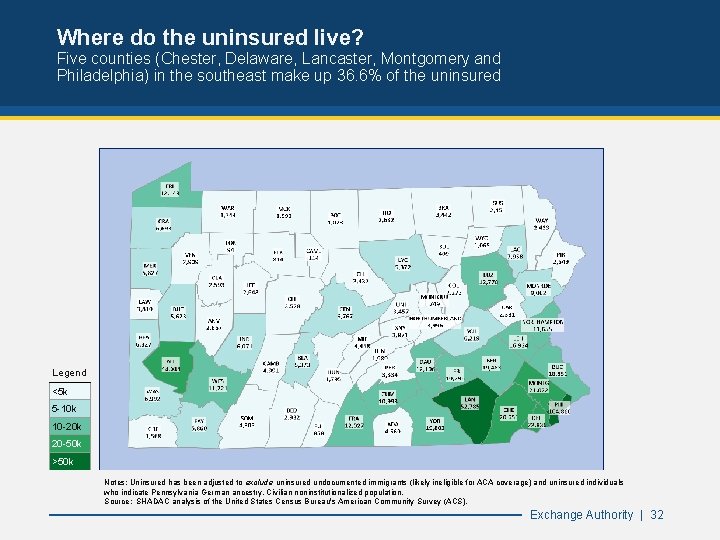
Where do the uninsured live? Five counties (Chester, Delaware, Lancaster, Montgomery and Philadelphia) in the southeast make up 36. 6% of the uninsured Legend <5 k 5 -10 k 10 -20 k 20 -50 k >50 k Notes: Uninsured has been adjusted to exclude uninsured undocumented immigrants (likely ineligible for ACA coverage) and uninsured individuals who indicate Pennsylvania German ancestry. Civilian noninstitutionalized population. Source: SHADAC analysis of the United States Census Bureau's American Community Survey (ACS). Exchange Authority | 32
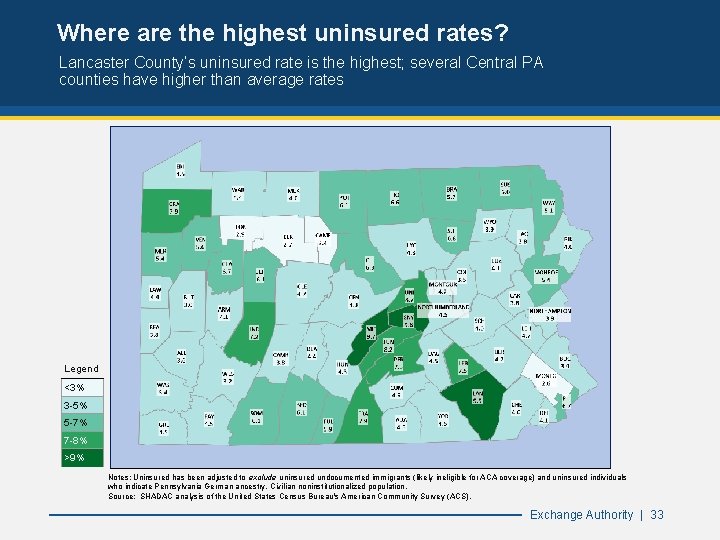
Where are the highest uninsured rates? Lancaster County’s uninsured rate is the highest; several Central PA counties have higher than average rates Legend <3% 3 -5% 5 -7% 7 -8% >9% Notes: Uninsured has been adjusted to exclude uninsured undocumented immigrants (likely ineligible for ACA coverage) and uninsured individuals who indicate Pennsylvania German ancestry. Civilian noninstitutionalized population. Source: SHADAC analysis of the United States Census Bureau's American Community Survey (ACS). Exchange Authority | 33
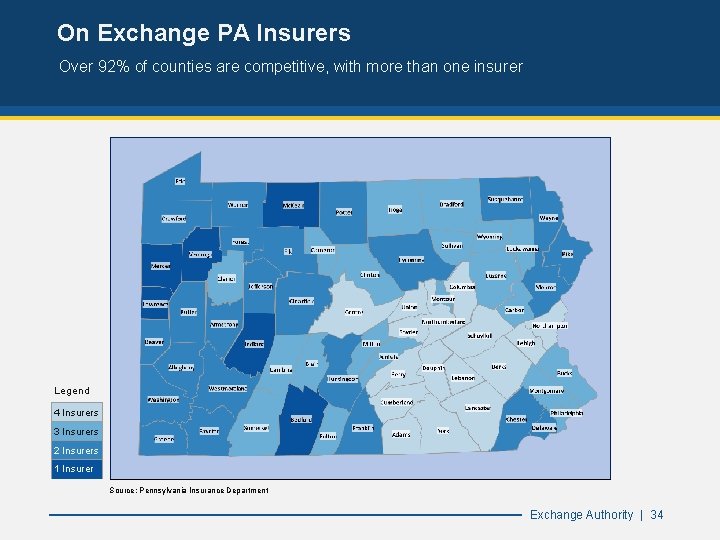
On Exchange PA Insurers Over 92% of counties are competitive, with more than one insurer Legend 4 Insurers 3 Insurers 2 Insurers 1 Insurer Source: Pennsylvania Insurance Department Exchange Authority | 34
Brand Update Pennsylvania Health Insurance Exchange Authority 35
2 Research objective research What are the potential problems our brand for PHIEA needs to solve?
research 3
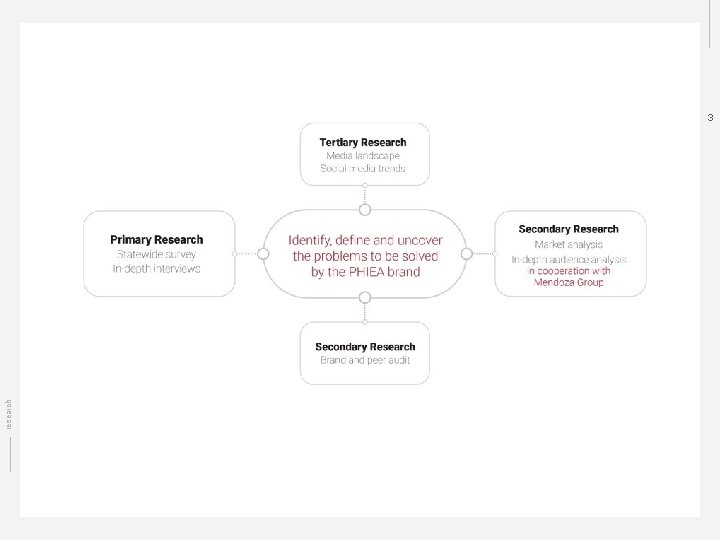
4 Research tactics research ● ● ● Market analysis In-depth audience analysis Brand peer audit Media and social landscape Statewide survey
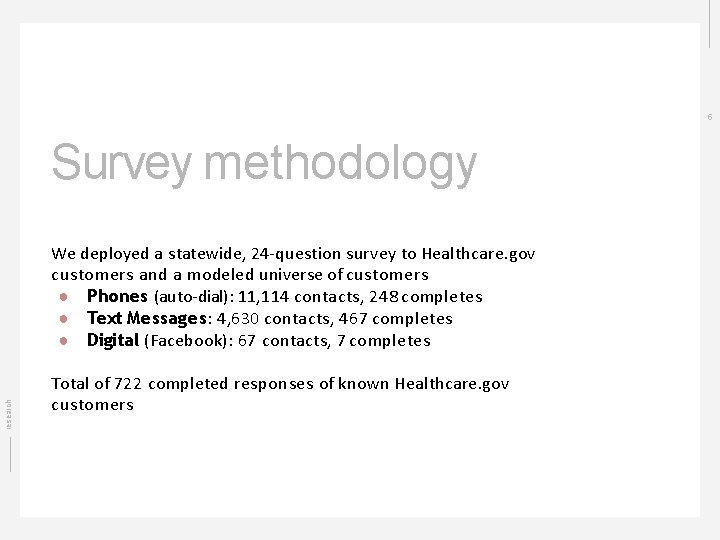
5 Survey methodology research We deployed a statewide, 24 -question survey to Healthcare. gov customers and a modeled universe of customers ● Phones (auto-dial): 11, 114 contacts, 248 completes ● Text Messages: 4, 630 contacts, 467 completes ● Digital (Facebook): 67 contacts, 7 completes Total of 722 completed responses of known Healthcare. gov customers
6 Applying research The key to effective application of primary research is to listen to the customer laterally rather than literally research While consumers know how they feel, we cannot accurately explain why. Our aim is to go beyond what customers say to deliver on their subconscious needs and wants for the PHIEA brand.
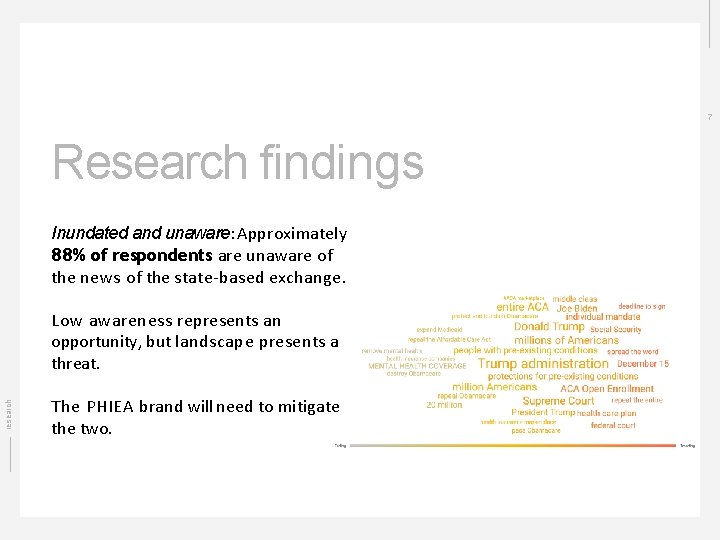
7 Research findings Inundated and unaware: Approximately 88% of respondents are unaware of the news of the state-based exchange. research Low awareness represents an opportunity, but landscape presents a threat. The PHIEA brand will need to mitigate the two.
8 Research findings research Resigned, not satisfied: Approximately 40% of respondents are unsatisfied or extremely unsatisfied with health insurance; approximately 35% are satisfied or extremely satisfied
9 Research findings research Deep skepticism, cynicism and reluctant acceptance ● Why? Lack of control, loss of power, fear around key themes of cost, quality and access ○ “In a country like the US where social mobility is low and healthcare is tied to employment luck can sometimes be the main determinant if someone ends up with large medical bills that they are unable to pay” ○ “It's all a game of chance. A bad break could leave me homeless. ”
1 0 Research findings Reason to believe: Respondents had the least confidence in state government as it relates to healthcare, ranking it last behind nonprofits, the federal government and private for-profit companies. research Past experiences with the state government leave customers with varied concerns - from customer service to cost, government interference and bureaucracy. Ultimately, customers need a reason to believe that the state system is the best option.
1 1 Research findings research In summary: ● Low direct awareness, high indirect and negative associations ● Emotional state of customer base is unsatisfied but resigned; cause of emotional state is due to lack of control, loss of power, and fear ● Low confidence in delivery mechanisms, driven by past experiences and present emotional state
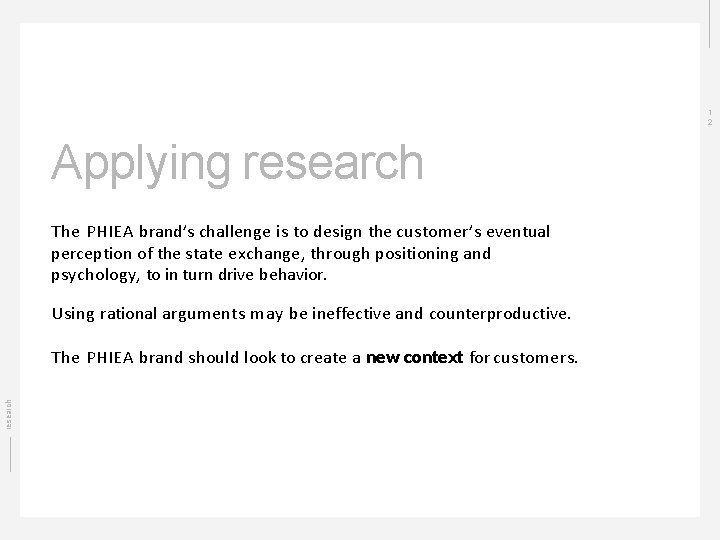
1 2 Applying research The PHIEA brand’s challenge is to design the customer’s eventual perception of the state exchange, through positioning and psychology, to in turn drive behavior. Using rational arguments may be ineffective and counterproductive. research The PHIEA brand should look to create a new context for customers.
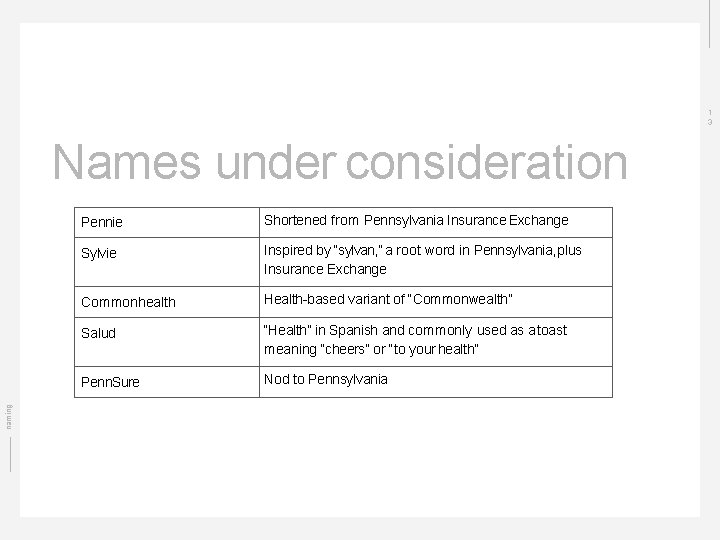
1 3 naming Names under consideration Pennie Shortened from Pennsylvania Insurance Exchange Sylvie Inspired by “sylvan, ” a root word in Pennsylvania, plus Insurance Exchange Commonhealth Health-based variant of “Commonwealth” Salud “Health” in Spanish and commonly used as a toast meaning “cheers” or “to your health” Penn. Sure Nod to Pennsylvania
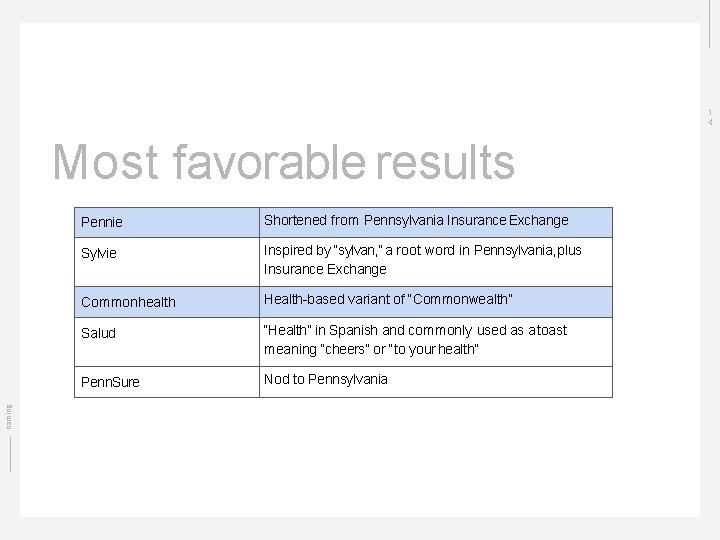
1 4 naming Most favorable results Pennie Shortened from Pennsylvania Insurance Exchange Sylvie Inspired by “sylvan, ” a root word in Pennsylvania, plus Insurance Exchange Commonhealth Health-based variant of “Commonwealth” Salud “Health” in Spanish and commonly used as a toast meaning “cheers” or “to your health” Penn. Sure Nod to Pennsylvania
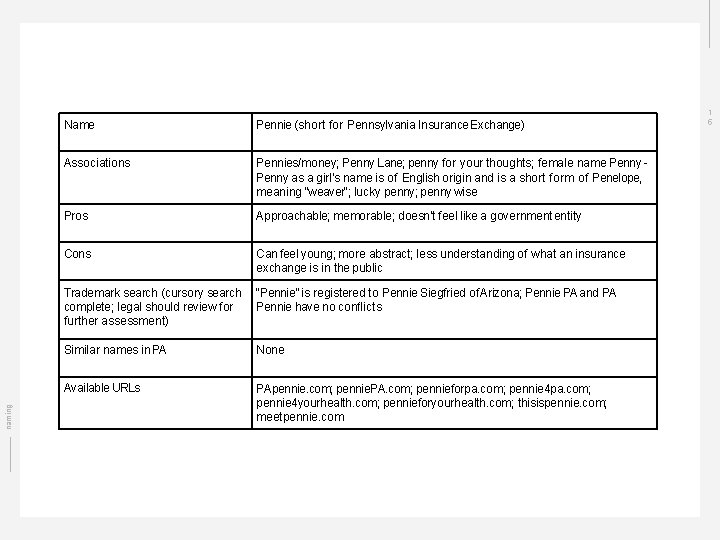
naming Name Pennie (short for Pennsylvania Insurance Exchange) Associations Pennies/money; Penny Lane; penny for your thoughts; female name Penny as a girl's name is of English origin and is a short form of Penelope, meaning "weaver"; lucky penny; penny wise Pros Approachable; memorable; doesn’t feel like a government entity Cons Can feel young; more abstract; less understanding of what an insurance exchange is in the public Trademark search (cursory search complete; legal should review for further assessment) “Pennie” is registered to Pennie Siegfried of Arizona; Pennie PA and PA Pennie have no conflicts Similar names in PA None Available URLs PApennie. com; pennie. PA. com; pennieforpa. com; pennie 4 yourhealth. com; pennieforyourhealth. com; thisispennie. com; meetpennie. com 1 5
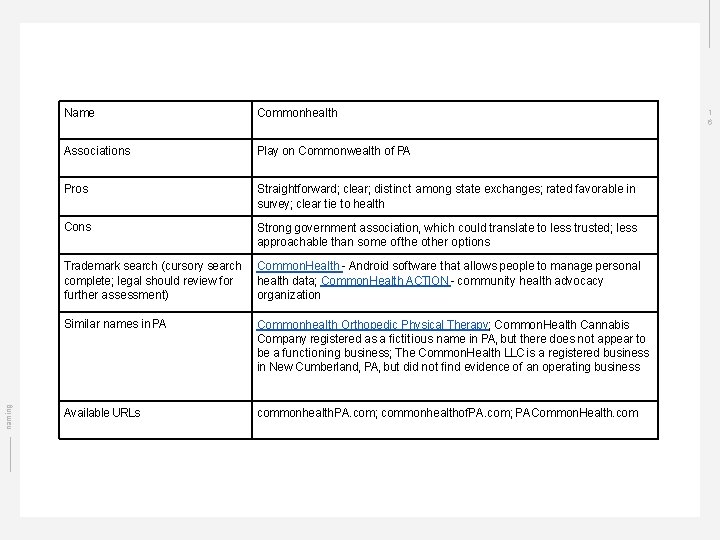
naming Name Commonhealth Associations Play on Commonwealth of PA Pros Straightforward; clear; distinct among state exchanges; rated favorable in survey; clear tie to health Cons Strong government association, which could translate to less trusted; less approachable than some of the other options Trademark search (cursory search complete; legal should review for further assessment) Common. Health - Android software that allows people to manage personal health data; Common. Health ACTION - community health advocacy organization Similar names in PA Commonhealth Orthopedic Physical Therapy; Common. Health Cannabis Company registered as a fictitious name in PA, but there does not appear to be a functioning business; The Common. Health LLC is a registered business in New Cumberland, PA, but did not find evidence of an operating business Available URLs commonhealth. PA. com; commonhealthof. PA. com; PACommon. Health. com 1 6
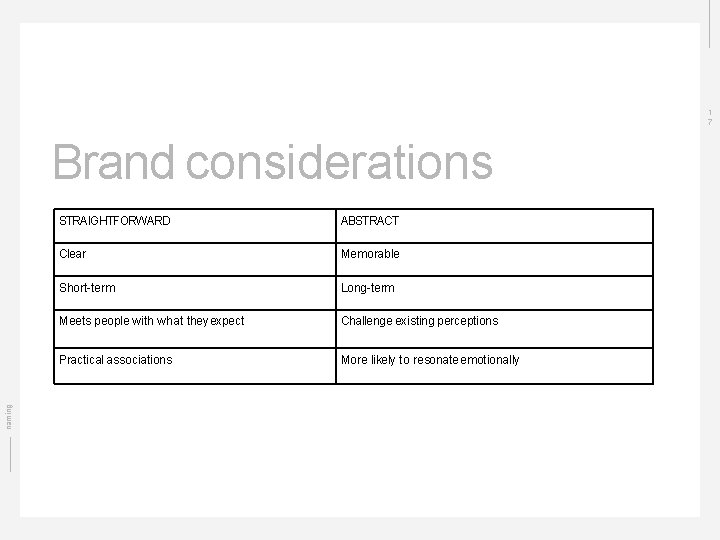
1 7 naming Brand considerations STRAIGHTFORWARD ABSTRACT Clear Memorable Short-term Long-term Meets people with what they expect Challenge existing perceptions Practical associations More likely to resonate emotionally
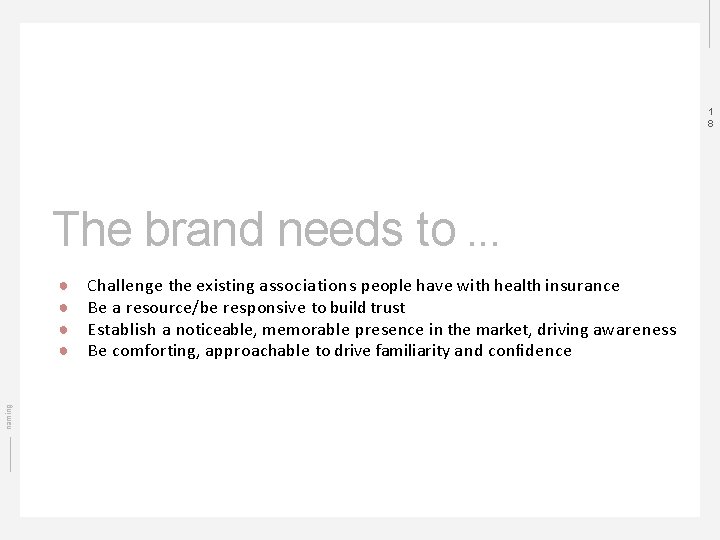
1 8 The brand needs to. . . naming ● ● Challenge the existing associations people have with health insurance Be a resource/be responsive to build trust Establish a noticeable, memorable presence in the market, driving awareness Be comforting, approachable to drive familiarity and confidence
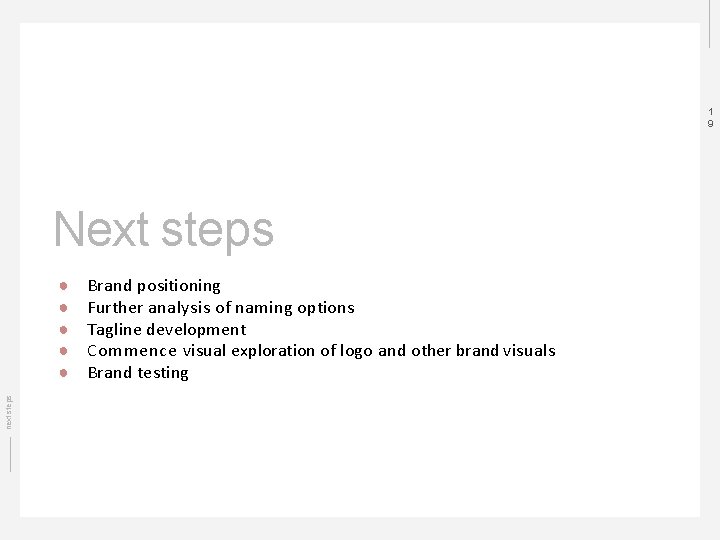
1 9 Next steps next steps ● ● ● Brand positioning Further analysis of naming options Tagline development Commence visual exploration of logo and other brand visuals Brand testing
Executive Session Pennsylvania Health Insurance Exchange Authority 54
Navigator Procurement Strategy Pennsylvania Health Insurance Exchange Authority
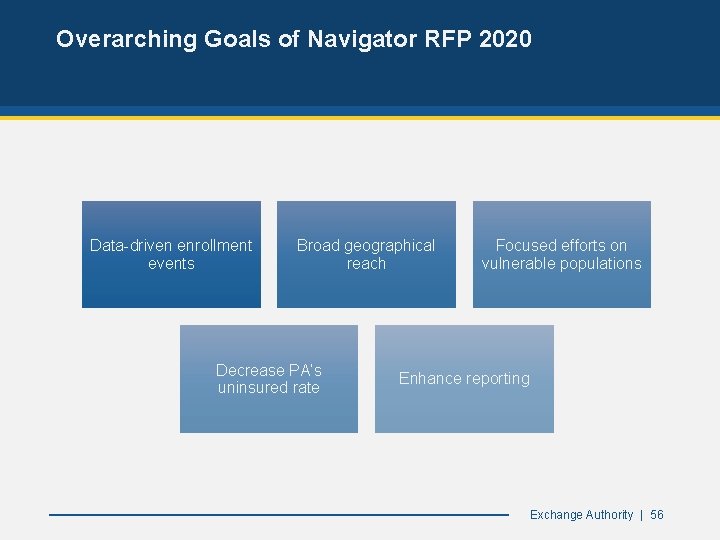
Overarching Goals of Navigator RFP 2020 Data-driven enrollment events Broad geographical reach Decrease PA’s uninsured rate Focused efforts on vulnerable populations Enhance reporting Exchange Authority | 56
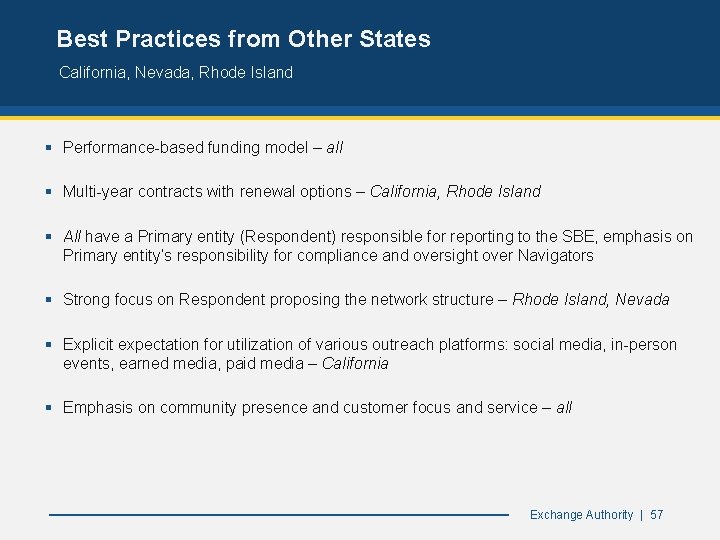
Best Practices from Other States California, Nevada, Rhode Island § Performance-based funding model – all § Multi-year contracts with renewal options – California, Rhode Island § All have a Primary entity (Respondent) responsible for reporting to the SBE, emphasis on Primary entity’s responsibility for compliance and oversight over Navigators § Strong focus on Respondent proposing the network structure – Rhode Island, Nevada § Explicit expectation for utilization of various outreach platforms: social media, in-person events, earned media, paid media – California § Emphasis on community presence and customer focus and service – all Exchange Authority | 57
Improvements incorporated in RFP 2020 Enhancements to Program structure and vendor payment approach § 2 year contract with performance incentives vs. grant opportunity § Requirement for dedicated executive contract lead, call handler lead(s), and enrollment event coordinator(s); § Enhanced Service Level Agreements for enrollment events, call handling and response times across all platforms § Three contract renewal options § Annual budget is three times the current contract size ($1. 2 m vs. $400 k current) § Strong preference for a Navigator administrator serving as the primary vendor with accountability for subcontractor performance § Specifically delineated outreach platforms and in-person event requirements § Enhanced reporting requirements: § Outreach reports – Compliance with enrollment event SLAs, trends in customer traffic; § Customer reports – Increases in enrollment, information pertinent to Medicaid match (if applicable); § Program administration report – compliance of Navigator personnel Exchange Authority | 58
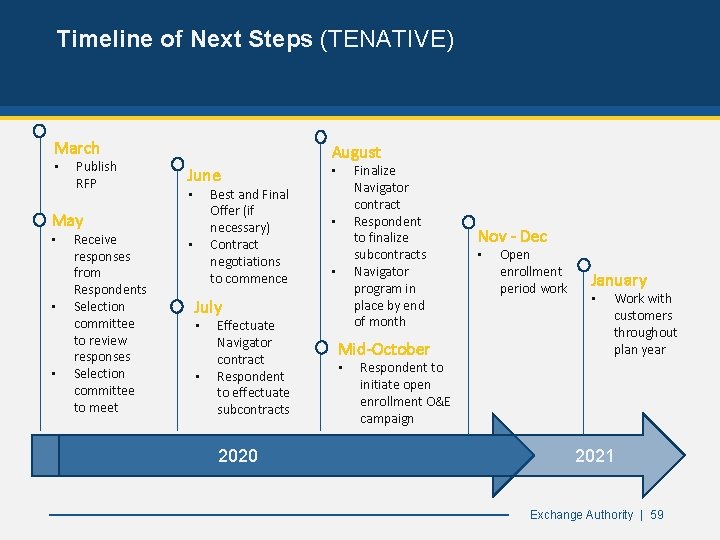
Timeline of Next Steps (TENATIVE) March • Publish RFP August June Best and Final Offer (if necessary) Contract negotiations to commence • May • • • Receive responses from Respondents Selection committee to review responses Selection committee to meet • Finalize Navigator contract Respondent to finalize subcontracts Navigator program in place by end of month • • • July • • Effectuate Navigator contract Respondent to effectuate subcontracts 2020 Mid-October • Nov - Dec • Open enrollment period work January • Work with customers throughout plan year Respondent to initiate open enrollment O&E campaign 2021 Exchange Authority | 59
Adjourn Pennsylvania Health Insurance Exchange Authority 60