
Conebeam image reconstruction by moving frames Xiaochun Yang
Cone-beam image reconstruction by moving frames Xiaochun Yang, Biovisum, Inc. Berthold K. P. Horn, MIT CSAIL
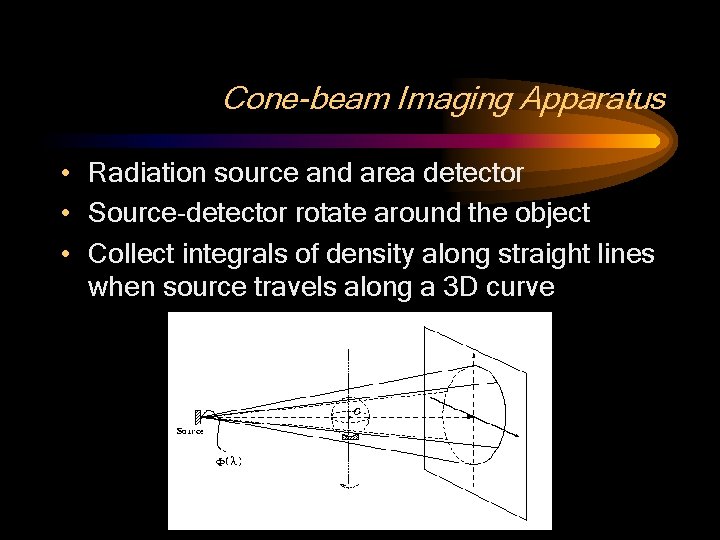
Cone-beam Imaging Apparatus • Radiation source and area detector • Source-detector rotate around the object • Collect integrals of density along straight lines when source travels along a 3 D curve
The problem • Cone-beam reconstruction: to recover a 3 D density function from its integrals along a set of lines emitting from a 3 D curve • Among the first problems in integral geometry
Difficulties • Inverse calculation deals with curved spaces • Algorithmic implementation encounters: Large dataset sophisticated geometric mapping expensive data interpolations
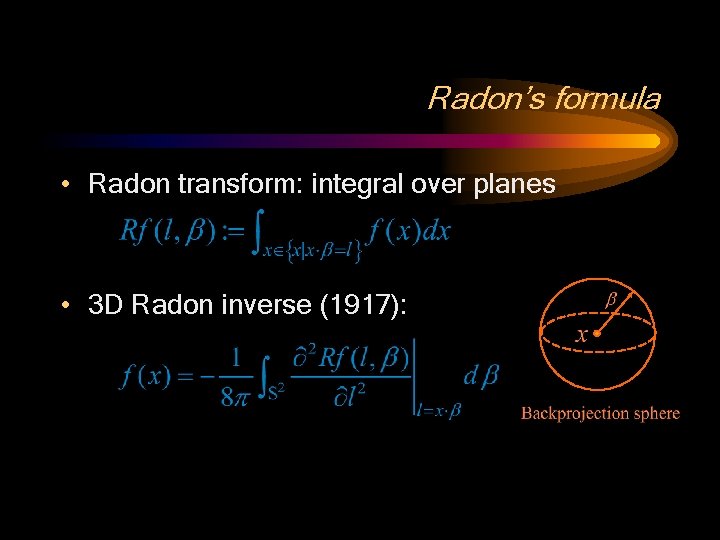
Radon’s formula • Radon transform: integral over planes • 3 D Radon inverse (1917):
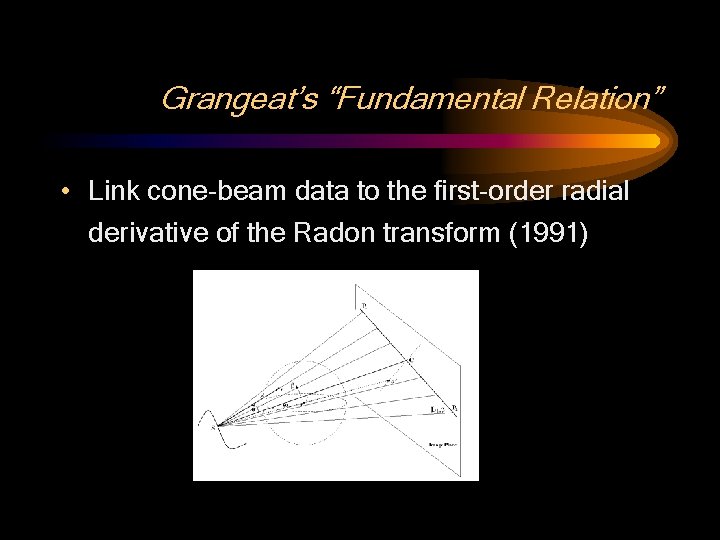
Grangeat’s “Fundamental Relation” • Link cone-beam data to the first-order radial derivative of the Radon transform (1991)
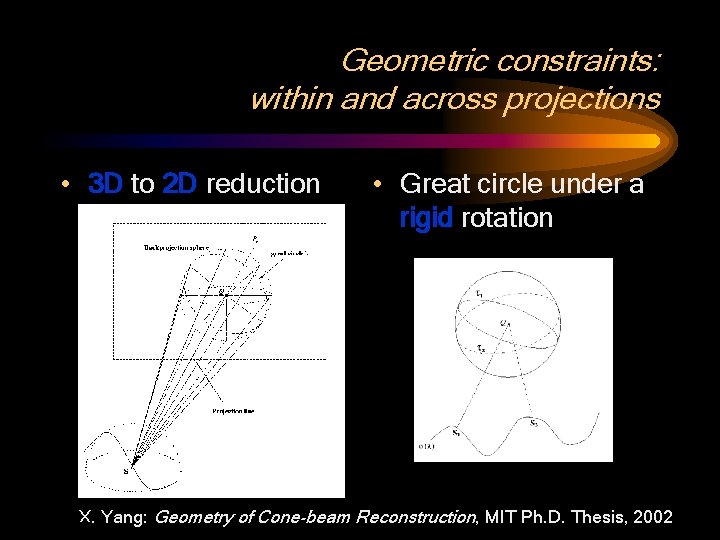
Geometric constraints: within and across projections • 3 D to 2 D reduction • Great circle under a rigid rotation X. Yang: Geometry of Cone-beam Reconstruction, MIT Ph. D. Thesis, 2002
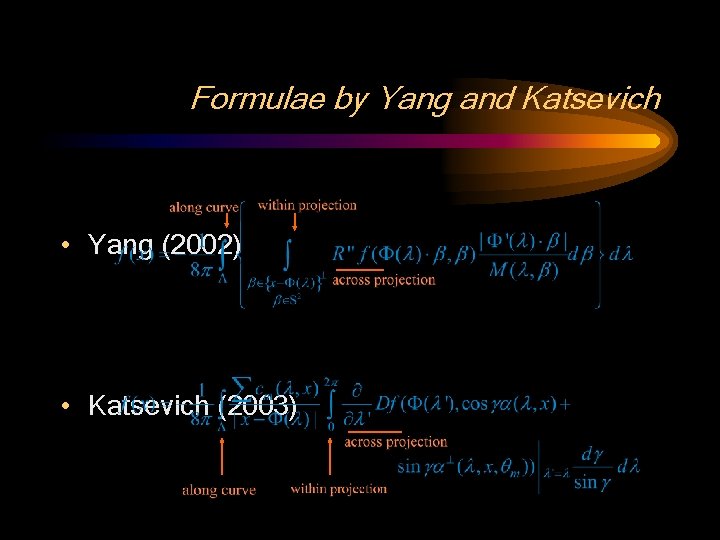
Formulae by Yang and Katsevich • Yang (2002) • Katsevich (2003)
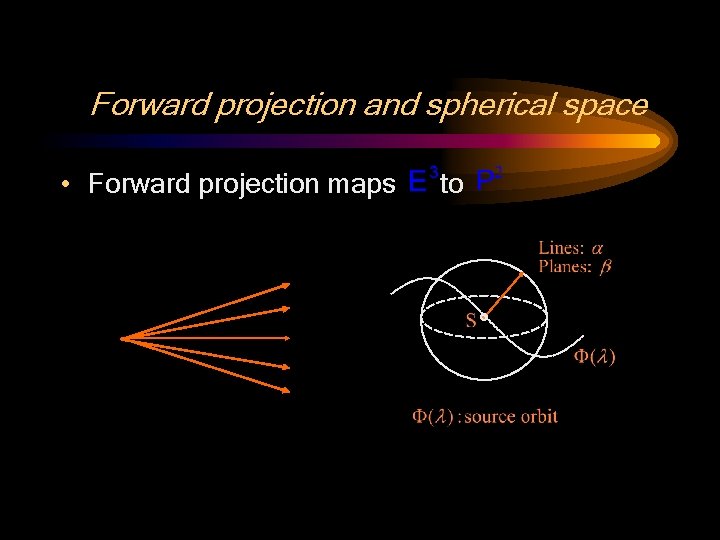
Forward projection and spherical space • Forward projection maps to
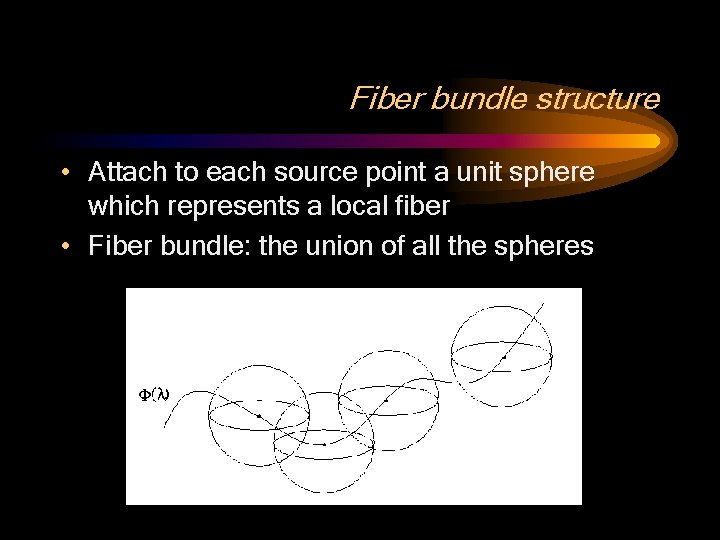
Fiber bundle structure • Attach to each source point a unit sphere which represents a local fiber • Fiber bundle: the union of all the spheres
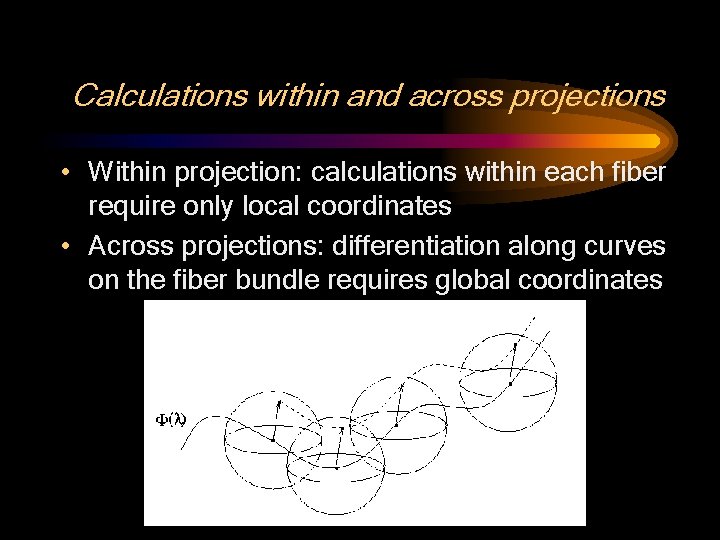
Calculations within and across projections • Within projection: calculations within each fiber require only local coordinates • Across projections: differentiation along curves on the fiber bundle requires global coordinates
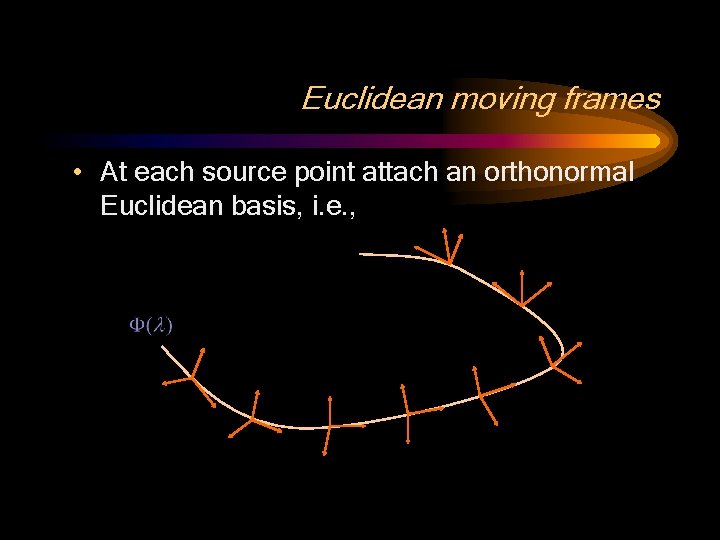
Euclidean moving frames • At each source point attach an orthonormal Euclidean basis, i. e. ,
Euclidean moving frames (Cont’d) • Allows easy exchange between local and global coordinates of points, lines and planes • Allows treating the non-Euclidean space, “locally”, as an Euclidean space equipped with Euclidean-like coordinates
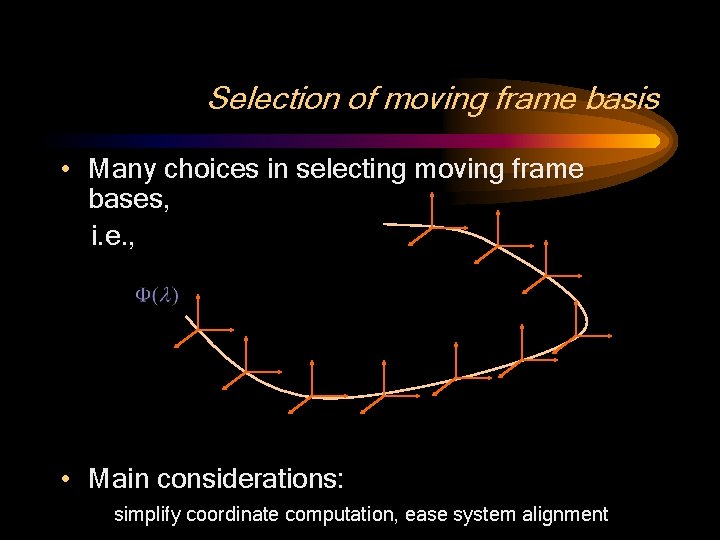
Selection of moving frame basis • Many choices in selecting moving frame bases, i. e. , • Main considerations: simplify coordinate computation, ease system alignment
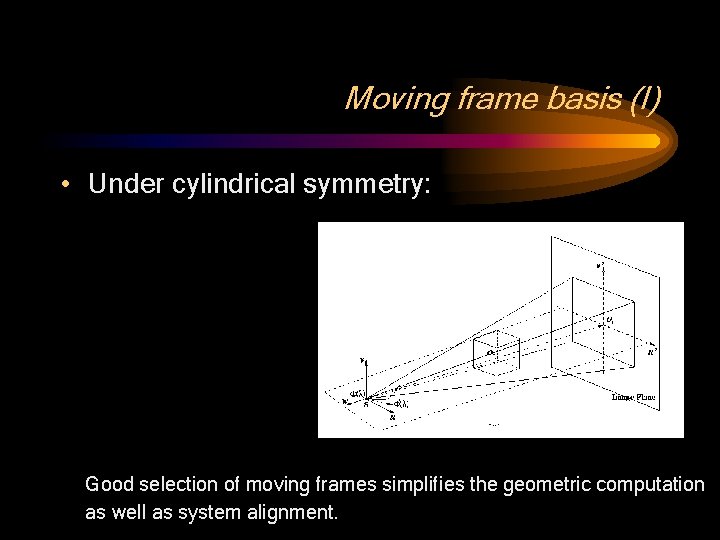
Moving frame basis (I) • Under cylindrical symmetry: Good selection of moving frames simplifies the geometric computation as well as system alignment.
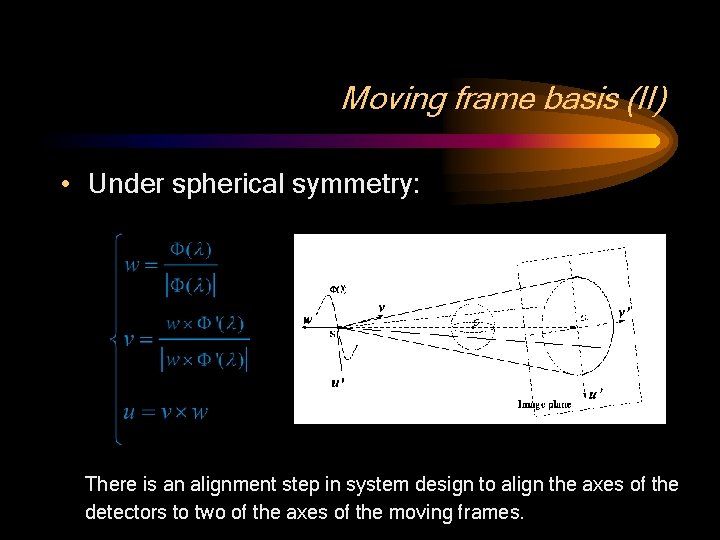
Moving frame basis (II) • Under spherical symmetry: There is an alignment step in system design to align the axes of the detectors to two of the axes of the moving frames.
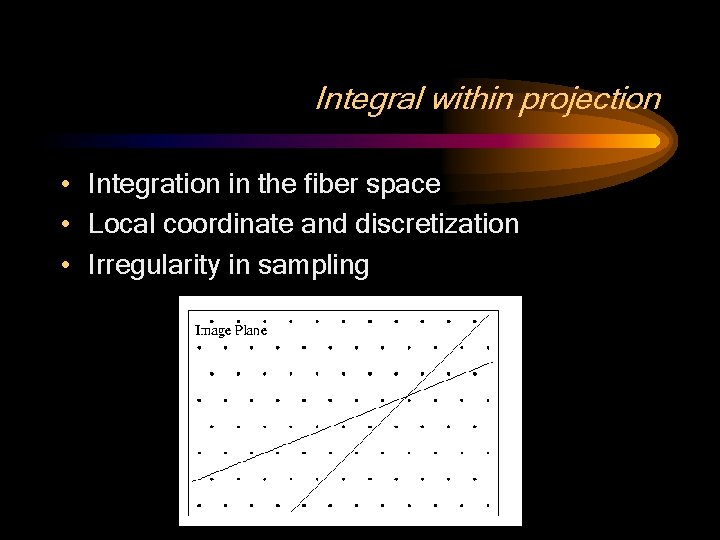
Integral within projection • Integration in the fiber space • Local coordinate and discretization • Irregularity in sampling
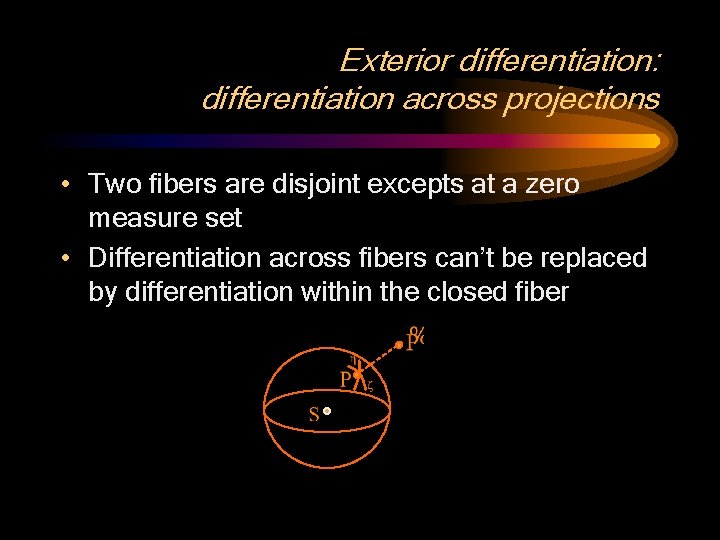
Exterior differentiation: differentiation across projections • Two fibers are disjoint excepts at a zero measure set • Differentiation across fibers can’t be replaced by differentiation within the closed fiber
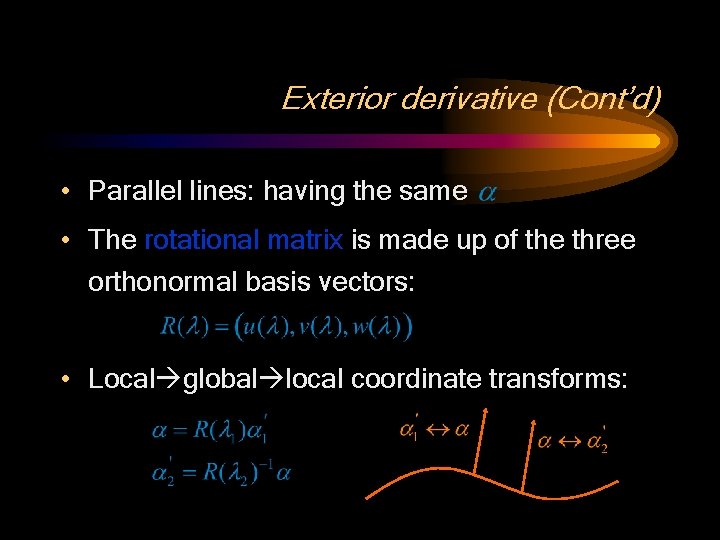
Exterior derivative (Cont’d) • Parallel lines: having the same • The rotational matrix is made up of the three orthonormal basis vectors: • Local global local coordinate transforms:
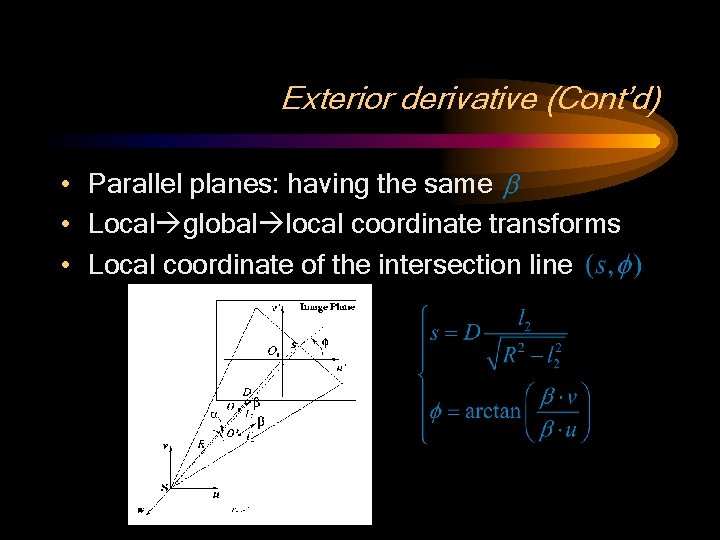
Exterior derivative (Cont’d) • Parallel planes: having the same • Local global local coordinate transforms • Local coordinate of the intersection line
Summary • New geometric representations • A new “method of moving frames” applied to conebeam reconstruction (a new computational framework) • 3 D discretization of the curved transform space, applicable to all cone-beam geometries • Methods to compute the exterior derivatives • Further study on sampling/interpolation schemes to improve algorithm efficiency
- Slides: 21