
Conductor stability Modelling and experiments Arjan Verweij Gerard
Conductor stability: Modelling and experiments Arjan Verweij Gerard Willering AT/MCS-SC
Scope Targets: Ø Better understand stability and quench phenomena in LHC conductors and other Rutherford cables. Ø Optimise future superconductors for enhanced stability. Ø Correlate (if possible) cable stability (using small heaters) and magnet stability & training Means: Ø Modelling using CUDI Ø Quench/Stability experiments on cables in FRESCA (B-163) Ø Side experiments and calculations on important parameters
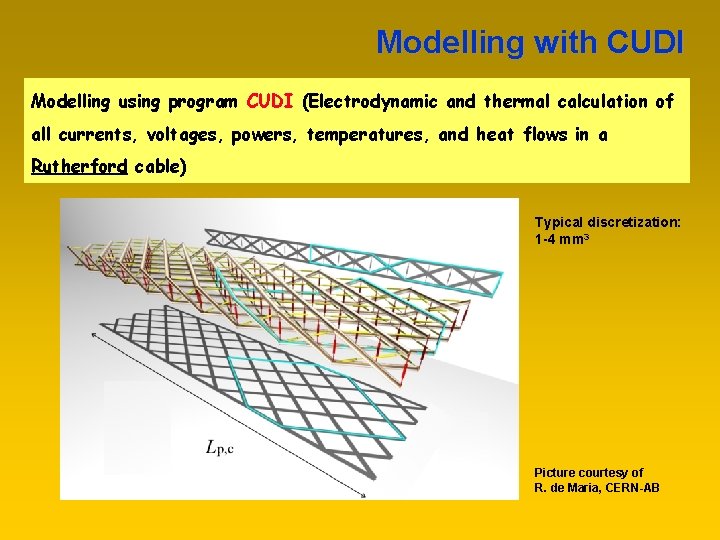
Modelling with CUDI Modelling using program CUDI (Electrodynamic and thermal calculation of all currents, voltages, powers, temperatures, and heat flows in a Rutherford cable) Typical discretization: 1 -4 mm 3 Picture courtesy of R. de Maria, CERN-AB
Modelling with CUDI Possibilities: Ø Any type of Nb-Ti or Nb 3 Sn Rutherford cable with insulation Ø Any type of conductor characteristics: IC(B, T), Cu/SC-ratio, RRR(T), k(T), Cp(B, T) Ø Any type of heat pulse profile: volume distribution, amplitude, time distribution Ø Any operating condition: current, field, temperature Ø Uniform and non-uniform strand currents Restrictions: Ø Calculation of a single cable (no inter-turn effects) Ø Static helium in the cable voids
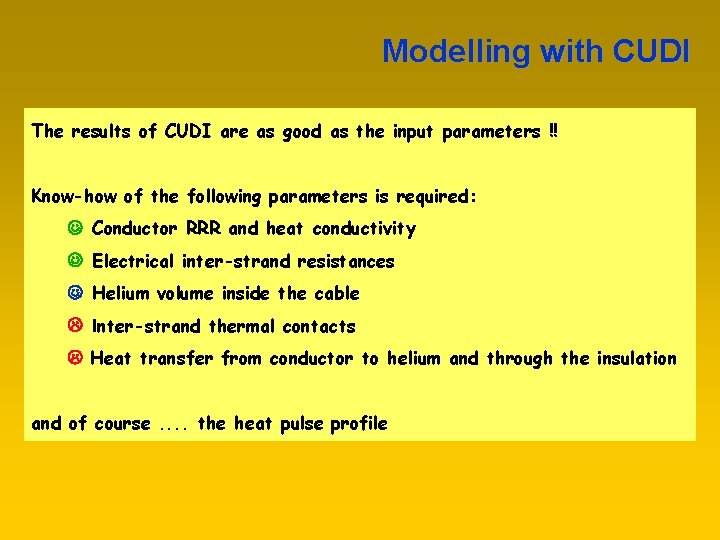
Modelling with CUDI The results of CUDI are as good as the input parameters !! Know-how of the following parameters is required: Conductor RRR and heat conductivity Electrical inter-strand resistances Helium volume inside the cable Inter-strand thermal contacts Heat transfer from conductor to helium and through the insulation and of course. . the heat pulse profile
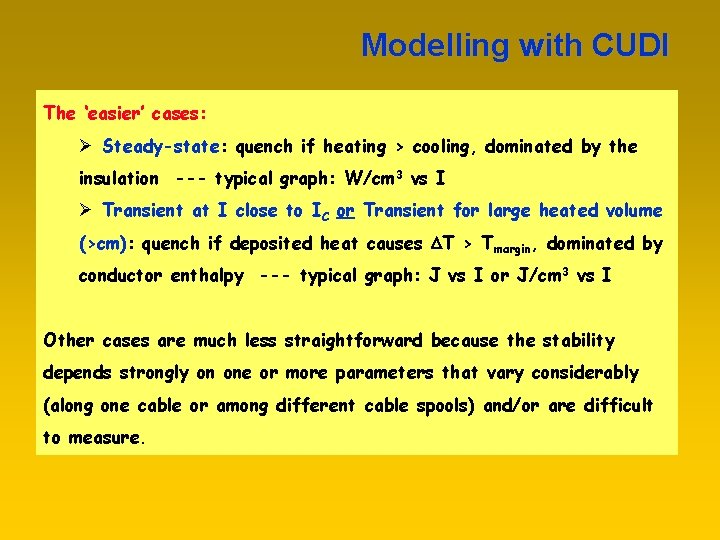
Modelling with CUDI The ‘easier’ cases: Ø Steady-state: quench if heating > cooling, dominated by the insulation --- typical graph: W/cm 3 vs I Ø Transient at I close to IC or Transient for large heated volume (>cm): quench if deposited heat causes DT > Tmargin, dominated by conductor enthalpy --- typical graph: J vs I or J/cm 3 vs I Other cases are much less straightforward because the stability depends strongly on one or more parameters that vary considerably (along one cable or among different cable spools) and/or are difficult to measure.
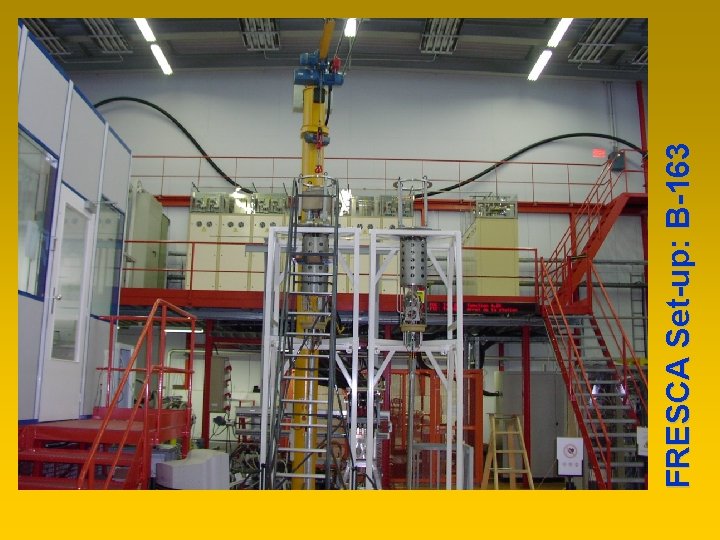
FRESCA Set-up: B-163

Stability tests in FRESCA Avantages of testing on cables (as compared to entire coils): • I and B can be decoupled. • Better accessibility for instrumentation (sensors, voltage taps etc). • Easier application of a known heat pulse, with given volume and duration. • Higher test rate (fast quench recovery). Major difficulties: • Preparing samples which are representative to a cable in a magnet. • Applying heat without too much altering the local cooling conditions.
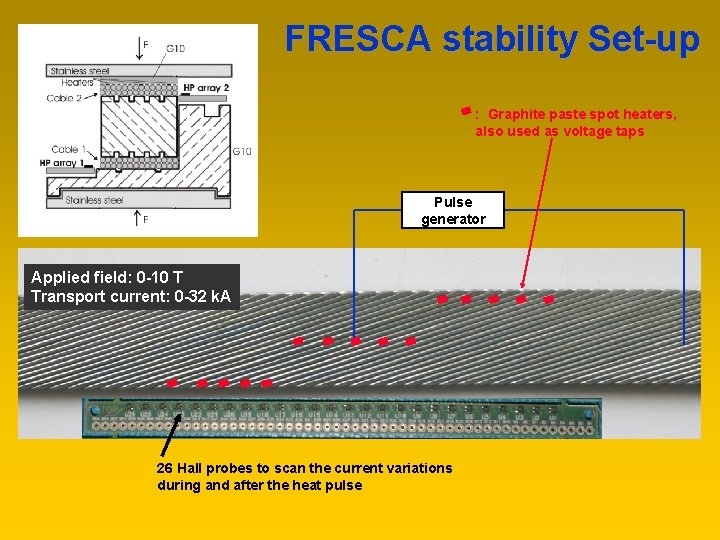
FRESCA stability Set-up : Graphite paste spot heaters, also used as voltage taps Pulse generator Applied field: 0 -10 T Transport current: 0 -32 k. A 26 Hall probes to scan the current variations during and after the heat pulse
Stability tests About 10 tests have been performed on LHC type 01 and 02 cables: o Variations using different heaters o Different positioning of the heaters (centre, thin edge, thick edge) o Cables having different heat treatment (Ra and Rc) o Cables with and without stainless steel core Quench Energy is measured for different B, T, I, and pulse duration. Continuation of the tests is foreseen for the next year, focussing especially on the helium volume, heat transfer to helium, and interstrand thermal resistance.
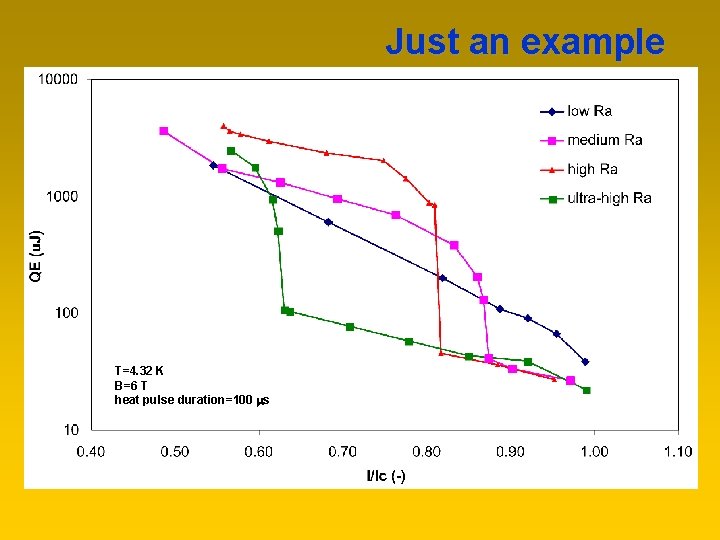
Just an example T=4. 32 K B=6 T heat pulse duration=100 ms
Side experiments & Calculations 1. Inter-strand thermal contact. First tests performed at Twente University in 2006. Probably more to follow. 2. Heat flow to helium, especially in transient case, for conditions very similar to the cable stability experiments. 3. Helium volume in the voids and Flow of helium inside the cable.
Conclusion An in-depth study on the stability of Rutherford cables against external heat pulses is on-going, by means of simulations with CUDI and experiments in FRESCA. Experimental results of 2005 -2006 are very intriguing, and will be used to validate CUDI. More measurements and a few side experiments are needed to obtain better “predictive power”, and to optimize future cable designs for enhanced stability. Open questions: Can we correlate cable stability (using small heaters) with magnet stability & training? Can we better define the maximum allowed heat deposition to avoid quenches in the LHC? - steady state: small volume [W] and large volume [W/mm 3] - transient: small volume [J] and large volume [J/mm 3]
- Slides: 13