
Conductor on Round Core CORC cables for power
Conductor on Round Core (CORC) cables for power transmission and high-field magnets Danko van der Laan Advanced Conductor Technologies LLC, Boulder, Colorado & University of Colorado / NIST, Boulder, Colorado MAP HTS Magnet Workshop, Fermilab, May 31 st 2012
Outline 1. Introduction of Advanced Conductor Technologies and the HTS magnet cable program at the University of Colorado. 2. Overview of CORC cable design. 3. Power transmission cables for Air Force applications. 4. Cable tests at 4. 2 K and 20 T. 5. Current distribution in CORC cable. 6. Next steps. 7. Summary.
Advanced Conductor Technologies Spin-off from the University of Colorado and NIST: Advanced Conductor Technologies focuses on the commercialization of high-temperature superconducting Conductor on Round Core (CORC) cables for high-density power transmission and high-field magnets. Current projects: 1. “REBCO coated conductor cables for fusion magnets” - Phase I STTR from DOE-Fusion - Subcontractor MIT (Joe Minervini, Leslie Bromberg, Makoto Takayasu) 2. “High-temperature superconducting SMES for airborne applications” - Phase I STTR from the Air Force (AFRL) - Subcontractor Ohio State University (Mike Sumption, Milan Majoros, Ted Collings) 3. “Superconducting Cable Connections” - Phase I SBIR from the Navy - Subcontractor Center for Advanced Power Systems (Sastry Pamidi)
Magnet cable program at University of Colorado “RE-Ba 2 Cu 3 O 7 -d coated conductor cables for high-energy physics applications” New program at the University of Colorado aims to develop HTS CORC cables for high-energy physics magnets. Program funded through CU, but physically still located at NIST. - Funded for 3 years by DOE-HEP to the University of Colorado. Goals: - The main goal is to raise the engineering current density of CORC cables to a level needed for future HEP magnets: 200 A/mm 2 Je at 20 T would be a good start. - Provide the electromechanical testing infrastructure needed to develop HTS conductors for HEP applications.
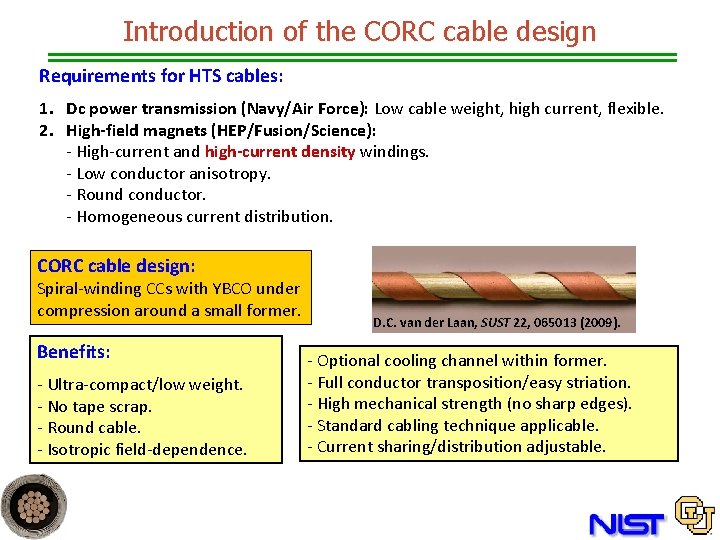
Introduction of the CORC cable design Requirements for HTS cables: 1. Dc power transmission (Navy/Air Force): Low cable weight, high current, flexible. 2. High-field magnets (HEP/Fusion/Science): - High-current and high-current density windings. - Low conductor anisotropy. - Round conductor. - Homogeneous current distribution. CORC cable design: Spiral-winding CCs with YBCO under compression around a small former. Benefits: - Ultra-compact/low weight. - No tape scrap. - Round cable. - Isotropic field-dependence. D. C. van der Laan, SUST 22, 065013 (2009). - Optional cooling channel within former. - Full conductor transposition/easy striation. - High mechanical strength (no sharp edges). - Standard cabling technique applicable. - Current sharing/distribution adjustable.
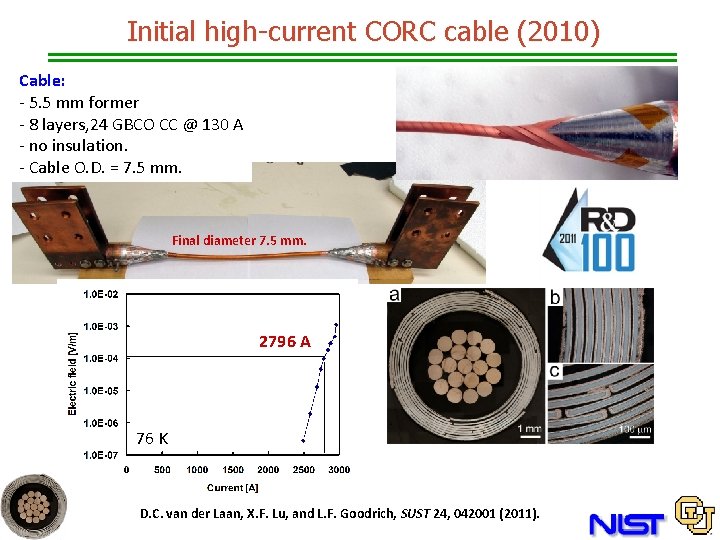
Initial high-current CORC cable (2010) Cable: - 5. 5 mm former - 8 layers, 24 GBCO CC @ 130 A - no insulation. - Cable O. D. = 7. 5 mm. Final diameter 7. 5 mm. 2796 A 76 K D. C. van der Laan, X. F. Lu, and L. F. Goodrich, SUST 24, 042001 (2011).
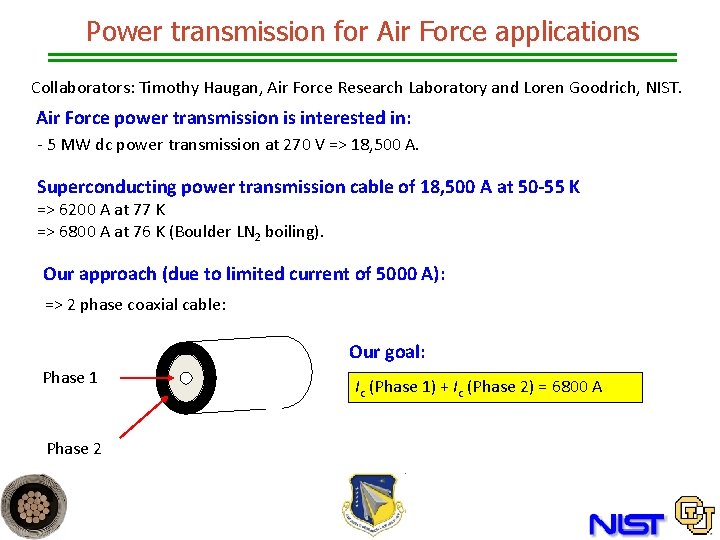
Power transmission for Air Force applications Collaborators: Timothy Haugan, Air Force Research Laboratory and Loren Goodrich, NIST. Air Force power transmission is interested in: - 5 MW dc power transmission at 270 V => 18, 500 A. Superconducting power transmission cable of 18, 500 A at 50 -55 K => 6200 A at 77 K => 6800 A at 76 K (Boulder LN 2 boiling). Our approach (due to limited current of 5000 A): => 2 phase coaxial cable: Our goal: Phase 1 Phase 2 Ic (Phase 1) + Ic (Phase 2) = 6800 A
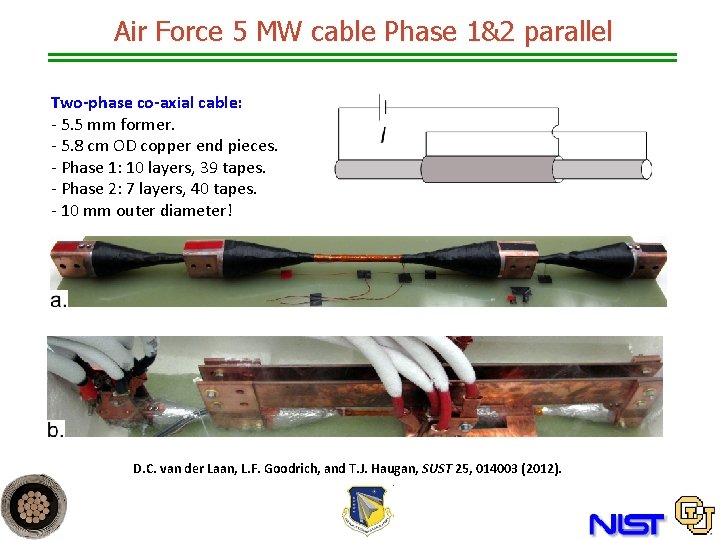
Air Force 5 MW cable Phase 1&2 parallel Two-phase co-axial cable: - 5. 5 mm former. - 5. 8 cm OD copper end pieces. - Phase 1: 10 layers, 39 tapes. - Phase 2: 7 layers, 40 tapes. - 10 mm outer diameter! D. C. van der Laan, L. F. Goodrich, and T. J. Haugan, SUST 25, 014003 (2012).
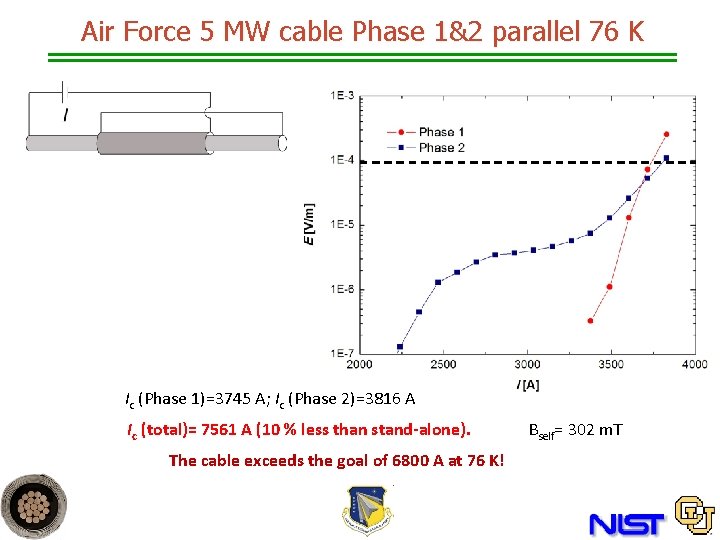
Air Force 5 MW cable Phase 1&2 parallel 76 K Ic (Phase 1)=3745 A; Ic (Phase 2)=3816 A Ic (total)= 7561 A (10 % less than stand-alone). The cable exceeds the goal of 6800 A at 76 K! Bself= 302 m. T
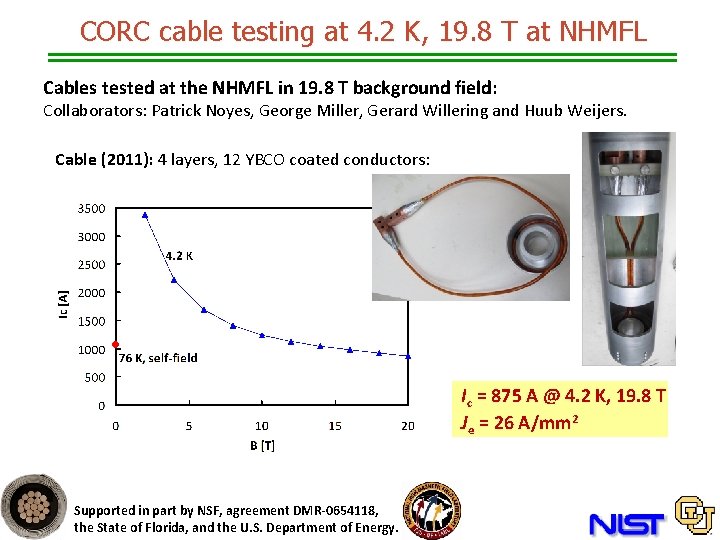
CORC cable testing at 4. 2 K, 19. 8 T at NHMFL Cables tested at the NHMFL in 19. 8 T background field: Collaborators: Patrick Noyes, George Miller, Gerard Willering and Huub Weijers. Cable (2011): 4 layers, 12 YBCO coated conductors: Ic = 875 A @ 4. 2 K, 19. 8 T Je = 26 A/mm 2 Supported in part by NSF, agreement DMR-0654118, the State of Florida, and the U. S. Department of Energy.
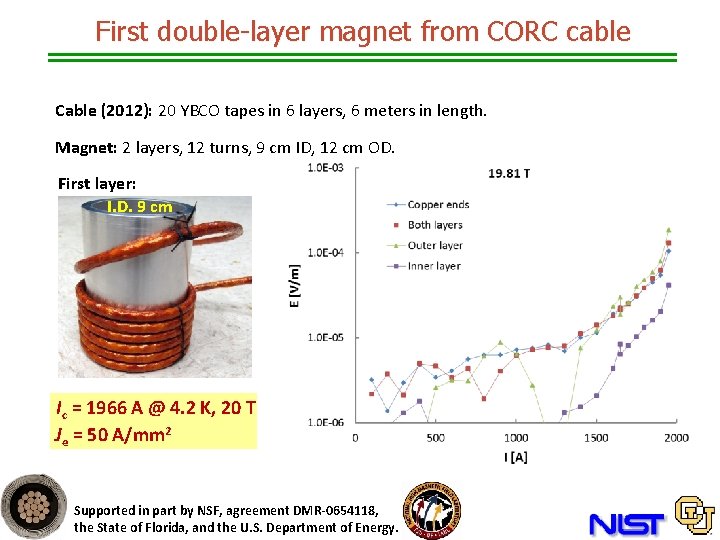
First double-layer magnet from CORC cable Cable (2012): 20 YBCO tapes in 6 layers, 6 meters in length. Magnet: 2 layers, 12 turns, 9 cm ID, 12 cm OD. First layer: I. D. 9 cm Ic = 1966 A @ 4. 2 K, 20 T Je = 50 A/mm 2 Supported in part by NSF, agreement DMR-0654118, the State of Florida, and the U. S. Department of Energy.
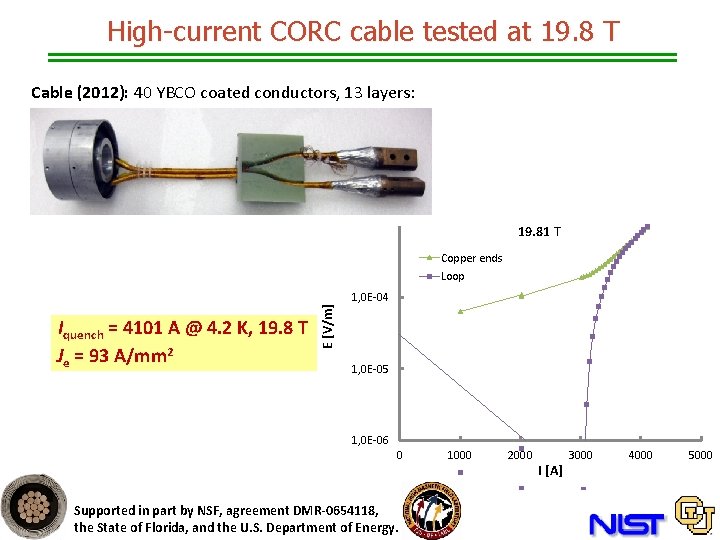
High-current CORC cable tested at 19. 8 T Iquench = 4101 A @ 4. 2 K, 19. 8 T Je = 93 A/mm 2 E [V/m] Cable (2012): 40 YBCO coated conductors, 13 layers: I [A] Supported in part by NSF, agreement DMR-0654118, the State of Florida, and the U. S. Department of Energy.
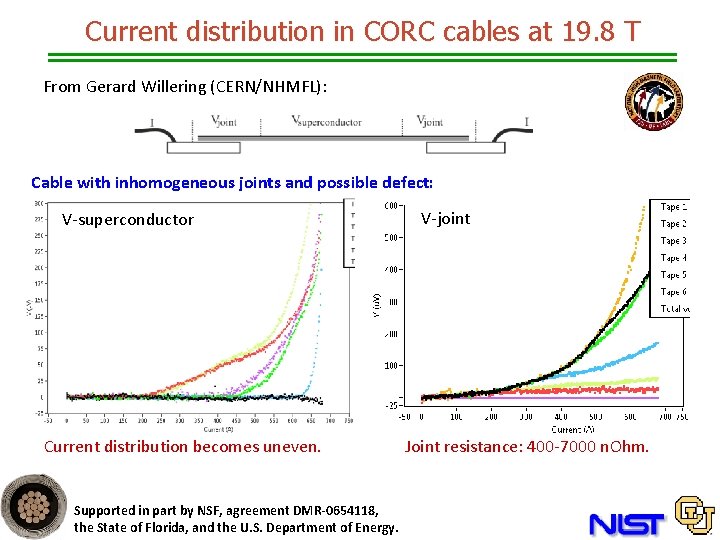
Current distribution in CORC cables at 19. 8 T From Gerard Willering (CERN/NHMFL): Cable with inhomogeneous joints and possible defect: V-superconductor Current distribution becomes uneven. Supported in part by NSF, agreement DMR-0654118, the State of Florida, and the U. S. Department of Energy. V-joint Joint resistance: 400 -7000 n. Ohm.
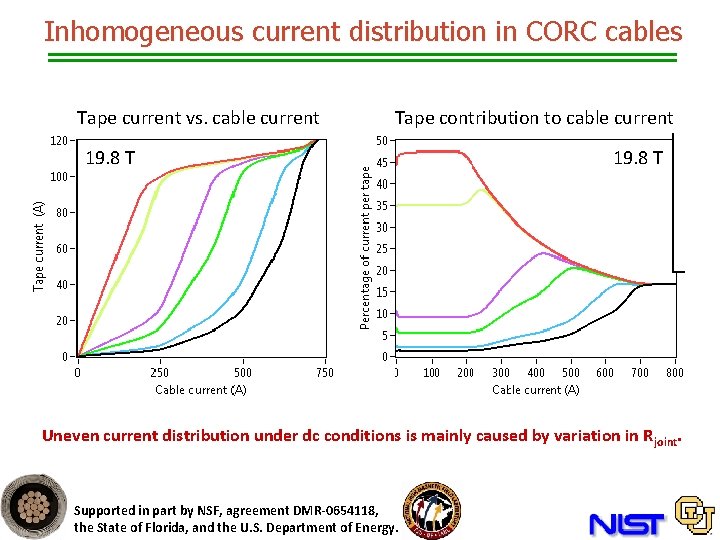
Inhomogeneous current distribution in CORC cables Tape current vs. cable current Tape contribution to cable current 19. 8 T Uneven current distribution under dc conditions is mainly caused by variation in R joint. Supported in part by NSF, agreement DMR-0654118, the State of Florida, and the U. S. Department of Energy.
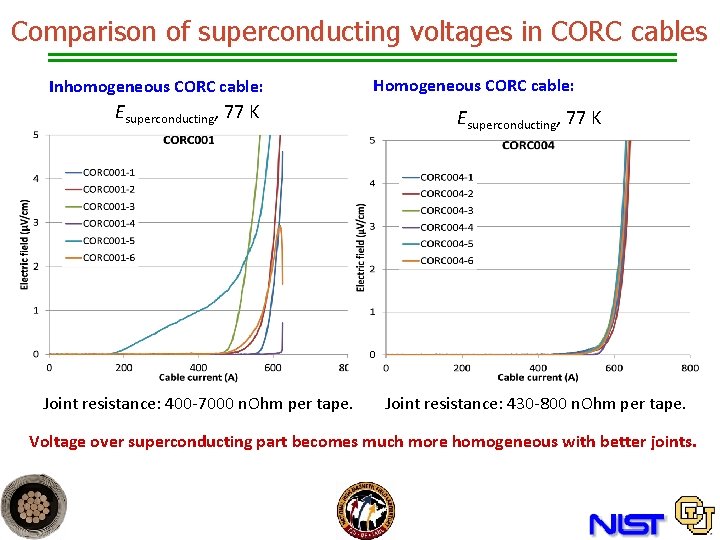
Comparison of superconducting voltages in CORC cables Inhomogeneous CORC cable: Esuperconducting, 77 K Joint resistance: 400 -7000 n. Ohm per tape. Homogeneous CORC cable: Esuperconducting, 77 K Joint resistance: 430 -800 n. Ohm per tape. Voltage over superconducting part becomes much more homogeneous with better joints.
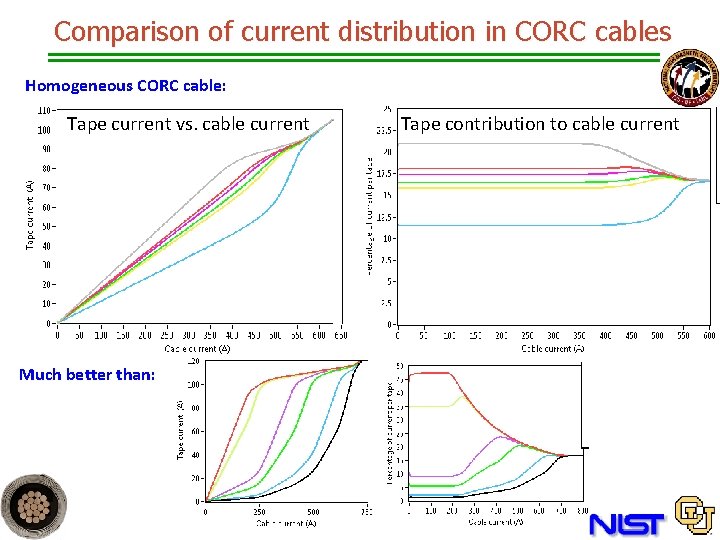
Comparison of current distribution in CORC cables Homogeneous CORC cable: Tape current vs. cable current Much better than: Tape contribution to cable current
What’s next: - Higher in-field cable Je: 200 A/mm 2 at 20 T will be a good start. - Introduction of technical formers (SS-316, Cu, brass, titanium, hollow, etc. ). - Improving current distribution: Static (mainly driven by resistance, local damage, etc. ) Dynamic (k. A/s, where layer inductance starts to matter). - Introduction of practical cable terminations. - Studying the effect of tape splices on cable performance. - Magnetization measurements (including striated conductors? ).
Summary Current status of CORC cables: - Possibility of helically winding YBCO coated conductors around very small formers. - Very-high current DC transmission cables are possible: 2800 A in 7. 5 mm diameter 7561 A in 10 mm diameter - First successful cable tests performed at 4. 2 K in fields up to 20 T: 93 A/mm 2 reached. - First magnet wound from an HTS cable tested at 20 T. - Performed initial studies of current distribution in CORC cables.
- Slides: 18