
Conductivity Lecture Conductivity n A measure of how


- Slides: 28
Conductivity Lecture
Conductivity n A measure of how well a solution conducts electricity n Water with absolutely no impurities (does not exist) n Conducts n electricity very poorly Impurities in water increase conductivity n So, when measure conductivity of water can estimate the degree of impurities
Conductivity The current is carried by dissolved ions n The ability of an ion to carry current is a function of: n Ions charge (more charge, more current) n Ions mass or size (larger ions, conduct less) n
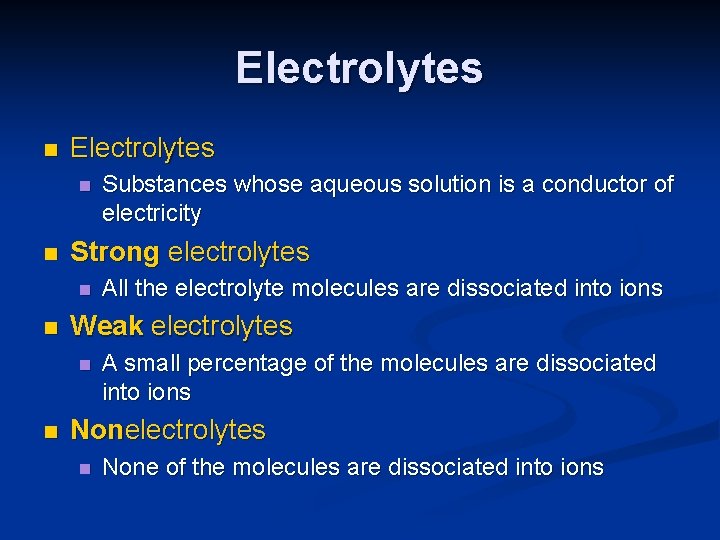
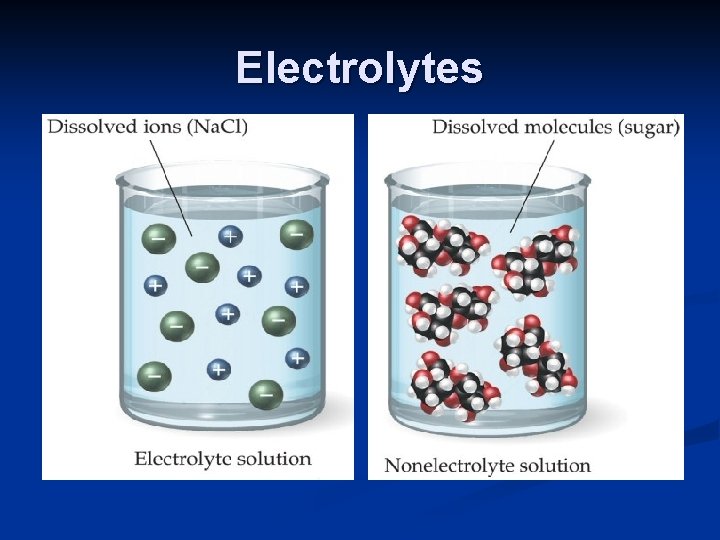
Electrolytes n n Strong electrolytes n n All the electrolyte molecules are dissociated into ions Weak electrolytes n n Substances whose aqueous solution is a conductor of electricity A small percentage of the molecules are dissociated into ions Nonelectrolytes n None of the molecules are dissociated into ions
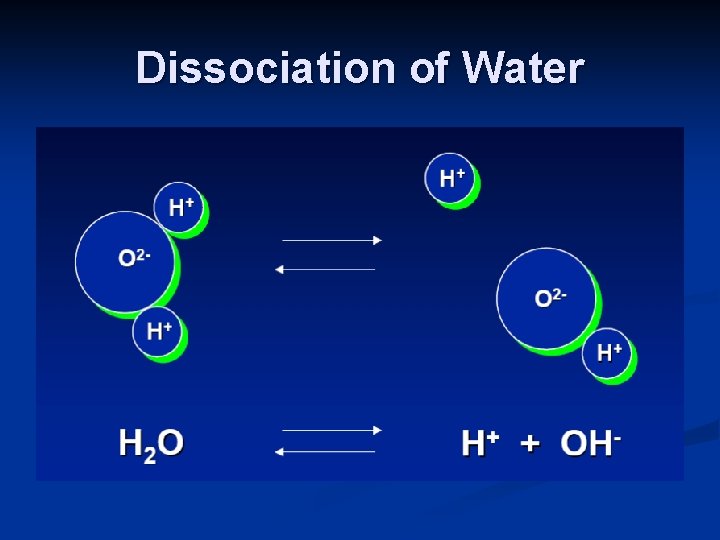
Dissociation of Water
Electrolytes
Strength of Solutions n Conductivity of various solutions n n http: //www. chem. iastate. edu/group/Greenbow e/sections/projectfolder/flashfiles/electro. Chem /conductivity. html Conductivity of a solution is proportional to its ion concentration n Since charge on ions in solution facilities the conductance of electrical current
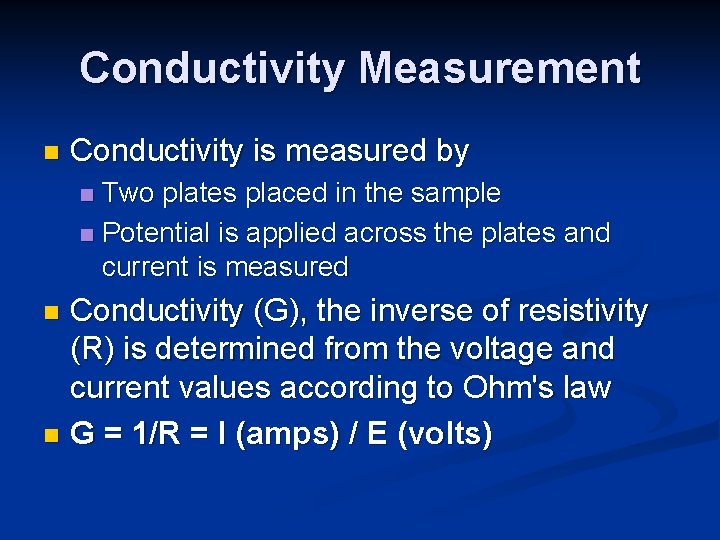
Conductivity Measurement n Conductivity is measured by Two plates placed in the sample n Potential is applied across the plates and current is measured n Conductivity (G), the inverse of resistivity (R) is determined from the voltage and current values according to Ohm's law n G = 1/R = I (amps) / E (volts) n
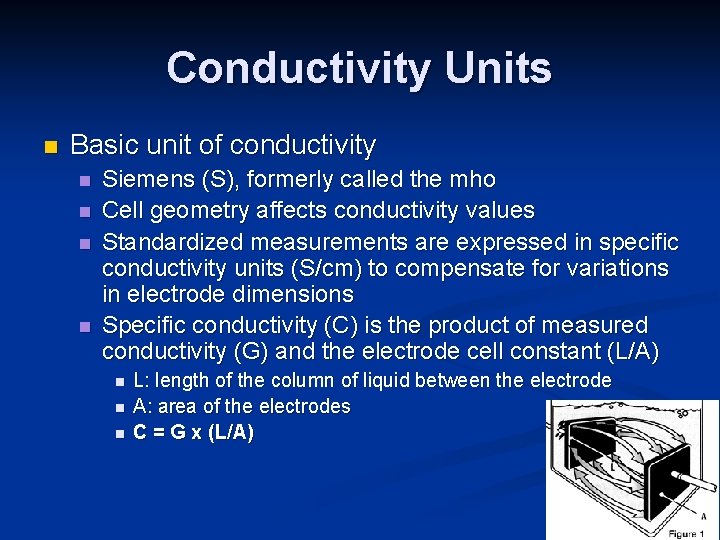
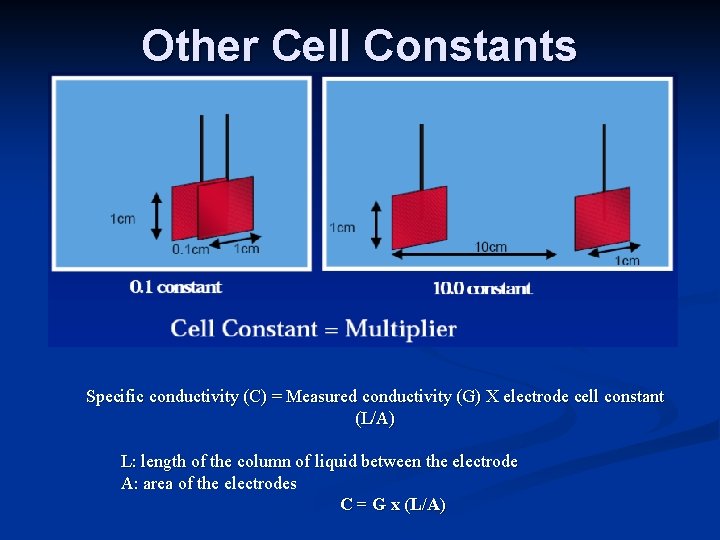
Conductivity Units n Basic unit of conductivity n n Siemens (S), formerly called the mho Cell geometry affects conductivity values Standardized measurements are expressed in specific conductivity units (S/cm) to compensate for variations in electrode dimensions Specific conductivity (C) is the product of measured conductivity (G) and the electrode cell constant (L/A) n n n L: length of the column of liquid between the electrode A: area of the electrodes C = G x (L/A)
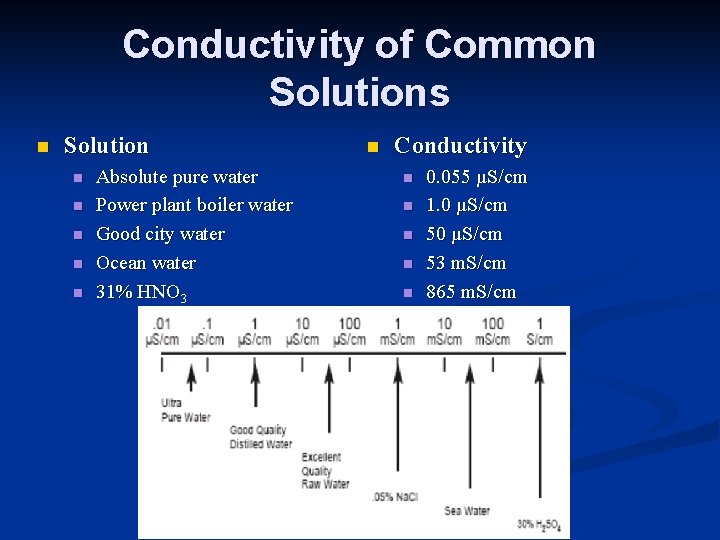
Conductivity of Common Solutions n Solution n n Absolute pure water Power plant boiler water Good city water Ocean water 31% HNO 3 n Conductivity n n n 0. 055 µS/cm 1. 0 µS/cm 53 m. S/cm 865 m. S/cm
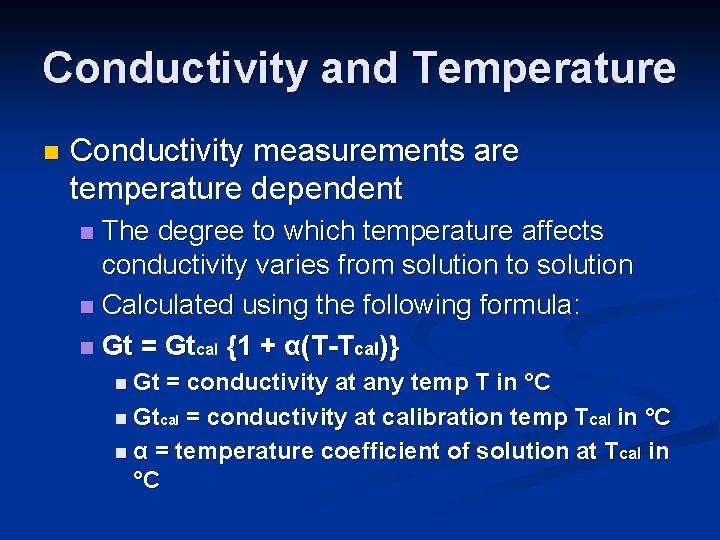
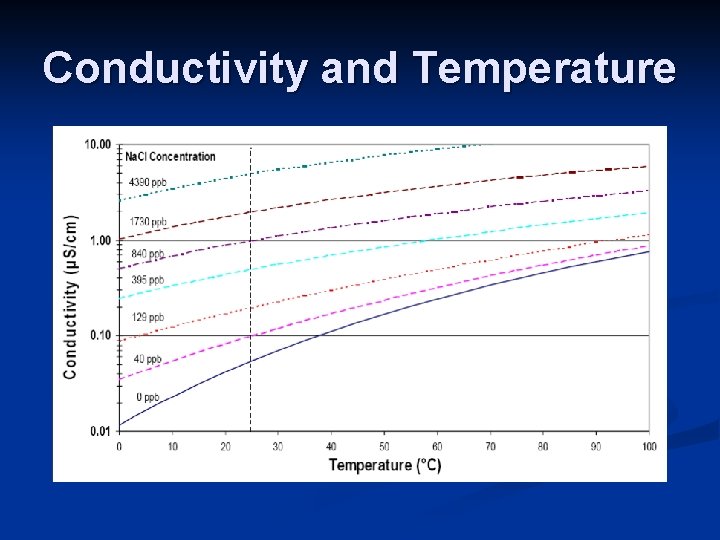
Conductivity and Temperature n Conductivity measurements are temperature dependent The degree to which temperature affects conductivity varies from solution to solution n Calculated using the following formula: n Gt = Gtcal {1 + α(T-Tcal)} n n Gt = conductivity at any temp T in °C n Gtcal = conductivity at calibration temp Tcal in °C n α = temperature coefficient of solution at Tcal in °C
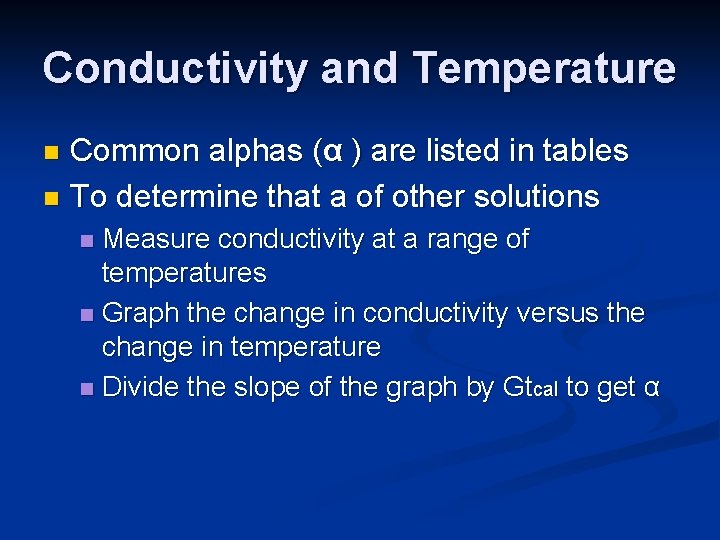
Conductivity and Temperature Common alphas (α ) are listed in tables n To determine that a of other solutions n Measure conductivity at a range of temperatures n Graph the change in conductivity versus the change in temperature n Divide the slope of the graph by Gtcal to get α n
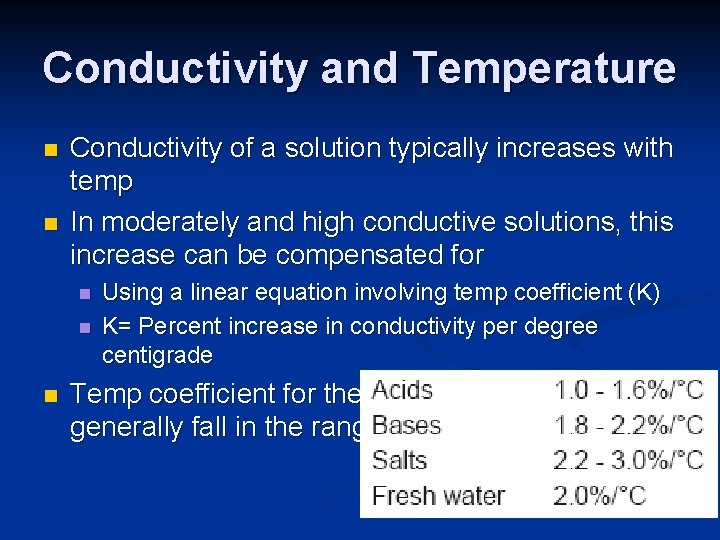
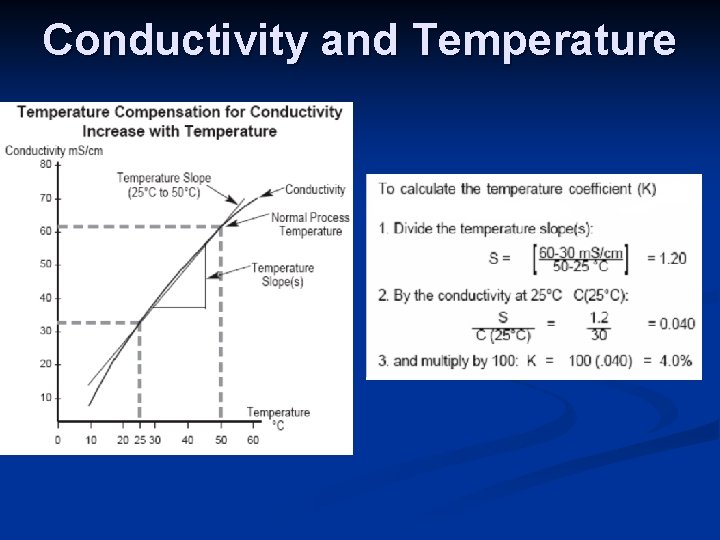
Conductivity and Temperature n n Conductivity of a solution typically increases with temp In moderately and high conductive solutions, this increase can be compensated for n n n Using a linear equation involving temp coefficient (K) K= Percent increase in conductivity per degree centigrade Temp coefficient for the following electrolytes generally fall in the ranges below
Conductivity and Temperature
Conductivity and Temperature
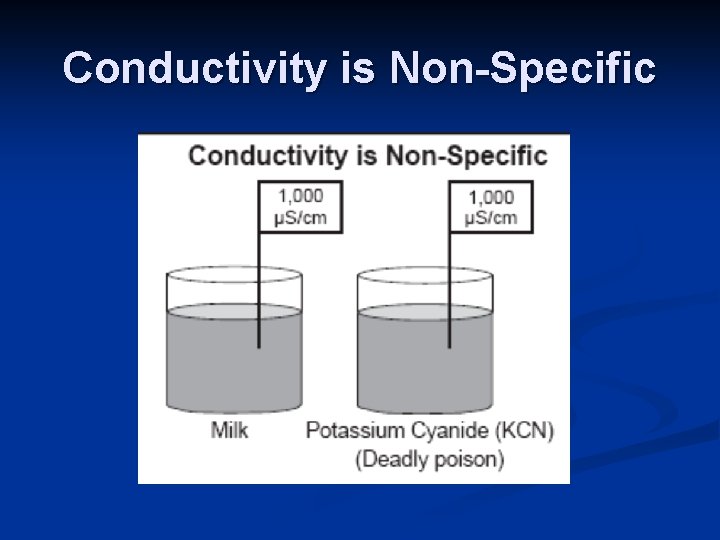
Conductivity is Non-Specific
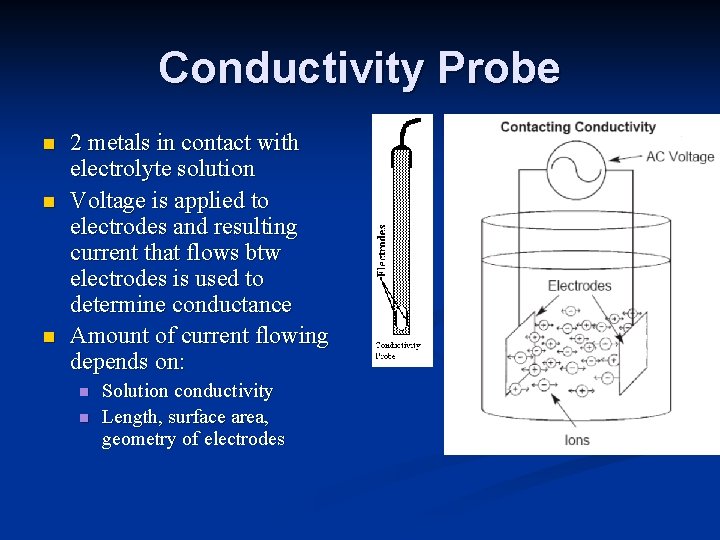
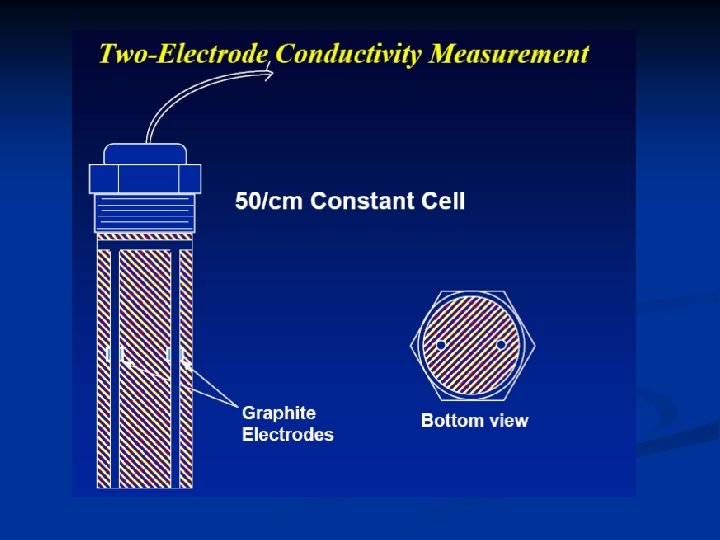
Conductivity Probe n n n 2 metals in contact with electrolyte solution Voltage is applied to electrodes and resulting current that flows btw electrodes is used to determine conductance Amount of current flowing depends on: n n Solution conductivity Length, surface area, geometry of electrodes
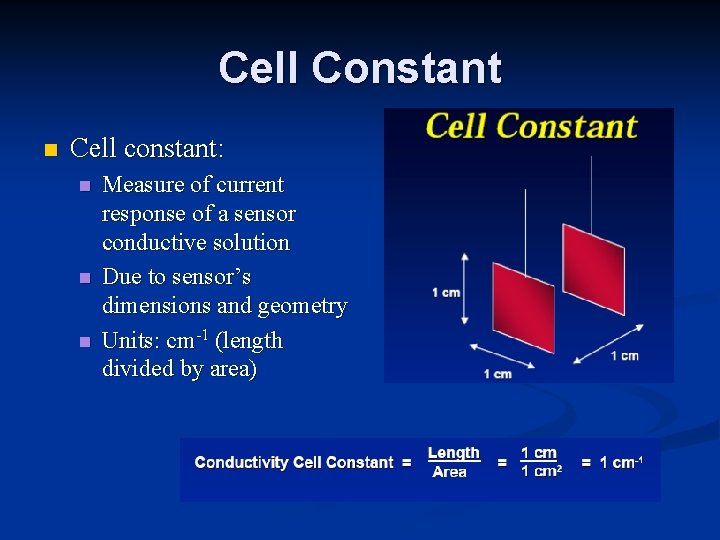
Conductivity Probe n n n Apply an AC Voltage to Two Electrodes of Exact Dimensions Acids, Bases and Salts (Na. Cl) Dissolve in Solution and Act as Current Carriers Current Flow is Directly Proportional to the Total Dissolved Solids in Solution Physical Dimensions of a Conductivity Electrode are Referred to as the Cell Constant is Length/Area Relationship n n n Distance Between Plates = 1. 0 cm Area of Each Plate = 1. 0 cm x 1. 0 cm Cell Constant = 1. 0 cm-1
Cell Constant n Cell constant: n n n Measure of current response of a sensor conductive solution Due to sensor’s dimensions and geometry Units: cm-1 (length divided by area)
Other Cell Constants Specific conductivity (C) = Measured conductivity (G) X electrode cell constant (L/A) L: length of the column of liquid between the electrode A: area of the electrodes C = G x (L/A)
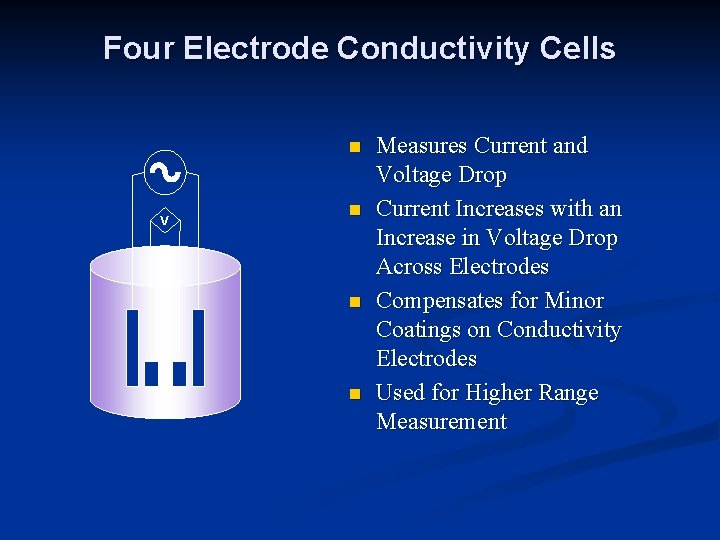
Four Electrode Conductivity Cells n V n n n Measures Current and Voltage Drop Current Increases with an Increase in Voltage Drop Across Electrodes Compensates for Minor Coatings on Conductivity Electrodes Used for Higher Range Measurement
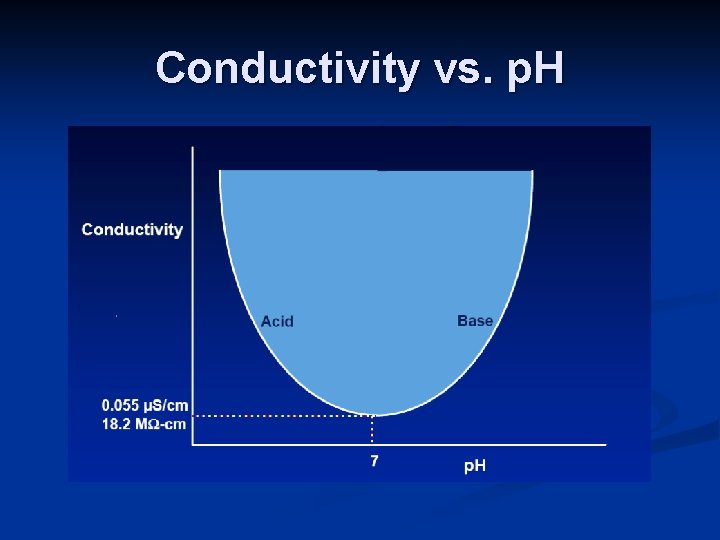
Conductivity vs. p. H
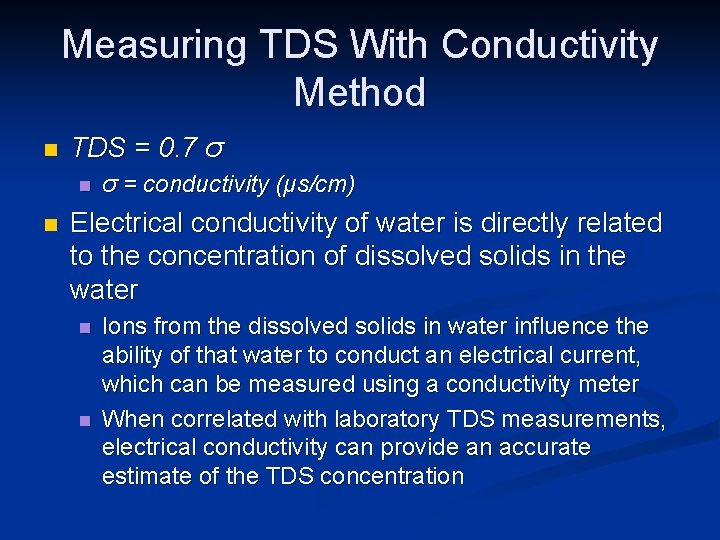
Measuring TDS With Conductivity Method n TDS = 0. 7 σ n n σ = conductivity (μs/cm) Electrical conductivity of water is directly related to the concentration of dissolved solids in the water n n Ions from the dissolved solids in water influence the ability of that water to conduct an electrical current, which can be measured using a conductivity meter When correlated with laboratory TDS measurements, electrical conductivity can provide an accurate estimate of the TDS concentration
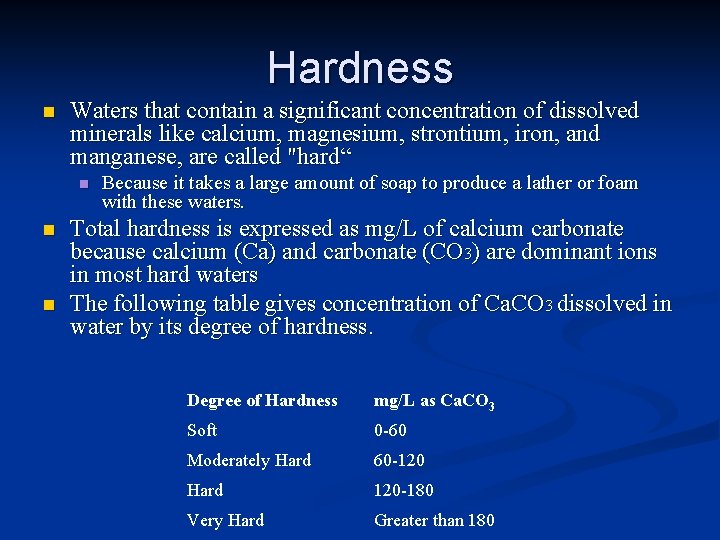
Hardness n Waters that contain a significant concentration of dissolved minerals like calcium, magnesium, strontium, iron, and manganese, are called "hard“ n n n Because it takes a large amount of soap to produce a lather or foam with these waters. Total hardness is expressed as mg/L of calcium carbonate because calcium (Ca) and carbonate (CO 3) are dominant ions in most hard waters The following table gives concentration of Ca. CO 3 dissolved in water by its degree of hardness. Degree of Hardness mg/L as Ca. CO 3 Soft 0 -60 Moderately Hard 60 -120 Hard 120 -180 Very Hard Greater than 180
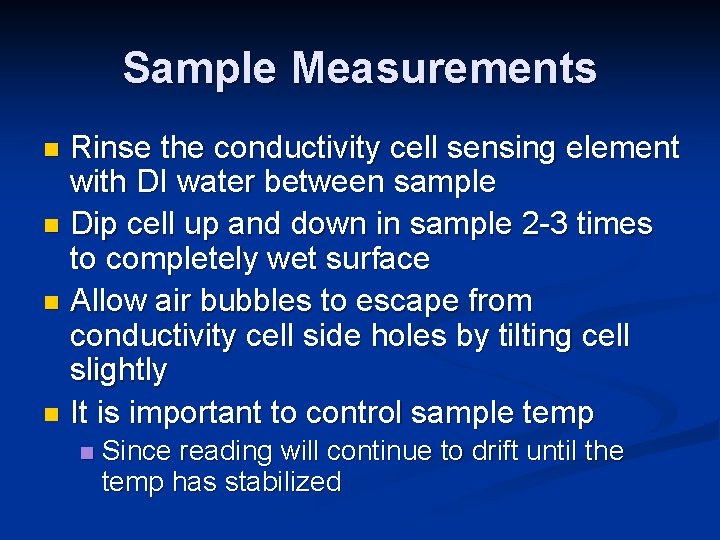
Sample Measurements Rinse the conductivity cell sensing element with DI water between sample n Dip cell up and down in sample 2 -3 times to completely wet surface n Allow air bubbles to escape from conductivity cell side holes by tilting cell slightly n It is important to control sample temp n n Since reading will continue to drift until the temp has stabilized
Storage 1. Best to store conductivity probe so that electrodes are immersed in DI water n 2. Can also store dry n Before use: n Probe should be soaked in DI water for 5 -10 minutes n To assure complete wetting of the electrodes n
Cleaning 1. For most applications, a hot solution of water with mild lab detergent can be used for cleaning n 2. Dilute 1% nitric acid may be used followed by DI water rinsing n