
CONDUCTION THROUGH A CYLINDRICAL WALL Heat and Mass

- Slides: 5
CONDUCTION THROUGH A CYLINDRICAL WALL Heat and Mass Transfer (DTE - 122) Dr. J. Badshah University Professor – cum - Chief Scientist Dairy Engineering Department Sanjay Gandhi Institute of Dairy Technology, Jagdeopath, Patna (Bihar Animal Sciences University, Patna)
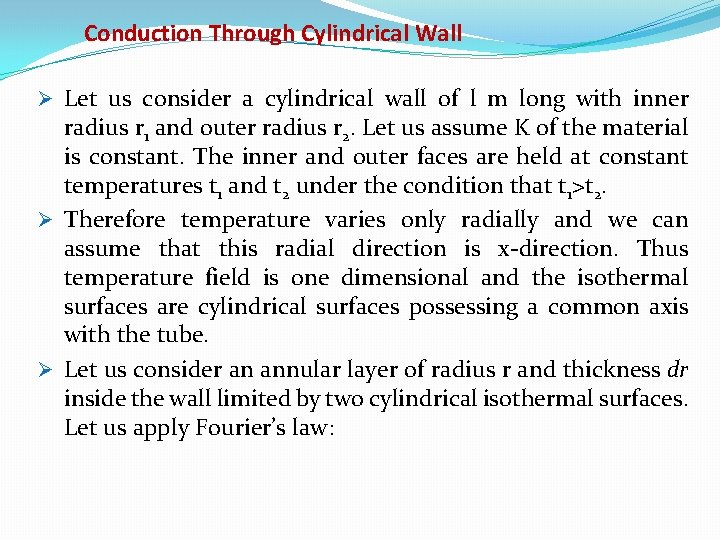
Conduction Through Cylindrical Wall Ø Let us consider a cylindrical wall of l m long with inner radius r 1 and outer radius r 2. Let us assume K of the material is constant. The inner and outer faces are held at constant temperatures t 1 and t 2 under the condition that t 1>t 2. Ø Therefore temperature varies only radially and we can assume that this radial direction is x-direction. Thus temperature field is one dimensional and the isothermal surfaces are cylindrical surfaces possessing a common axis with the tube. Ø Let us consider an annular layer of radius r and thickness dr inside the wall limited by two cylindrical isothermal surfaces. Let us apply Fourier’s law:
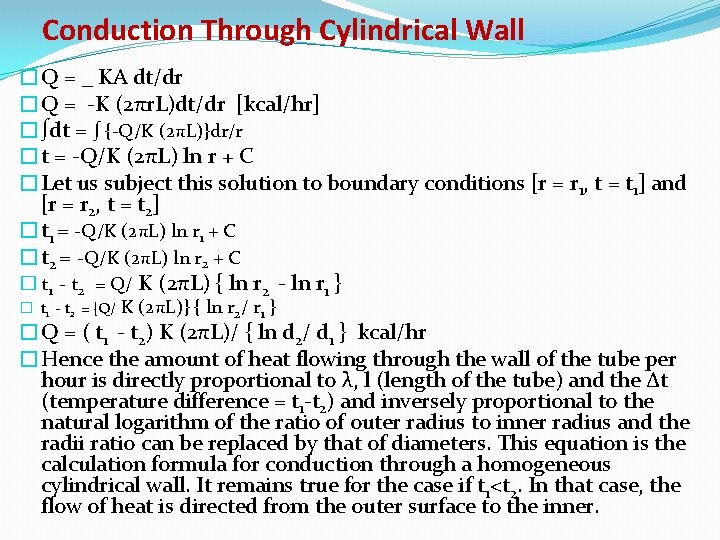
Conduction Through Cylindrical Wall �Q = _ KA dt/dr �Q = -K (2πr. L)dt/dr [kcal/hr] �∫dt = ∫ {-Q/K (2πL)}dr/r �t = -Q/K (2πL) ln r + C �Let us subject this solution to boundary conditions [r = r 1, t = t 1] and [r = r 2, t = t 2] �t 1 = -Q/K (2πL) ln r 1 + C �t 2 = -Q/K (2πL) ln r 2 + C � t 1 - t 2 = Q/ K (2πL) { ln r 2 - ln r 1 } � t 1 - t 2 = {Q/ K (2πL)} { ln r 2/ r 1 } �Q = ( t 1 - t 2) K (2πL)/ { ln d 2/ d 1 } kcal/hr �Hence the amount of heat flowing through the wall of the tube per hour is directly proportional to λ, l (length of the tube) and the ∆t (temperature difference = t 1 -t 2) and inversely proportional to the natural logarithm of the ratio of outer radius to inner radius and the radii ratio can be replaced by that of diameters. This equation is the calculation formula for conduction through a homogeneous cylindrical wall. It remains true for the case if t 1<t 2. In that case, the flow of heat is directed from the outer surface to the inner.
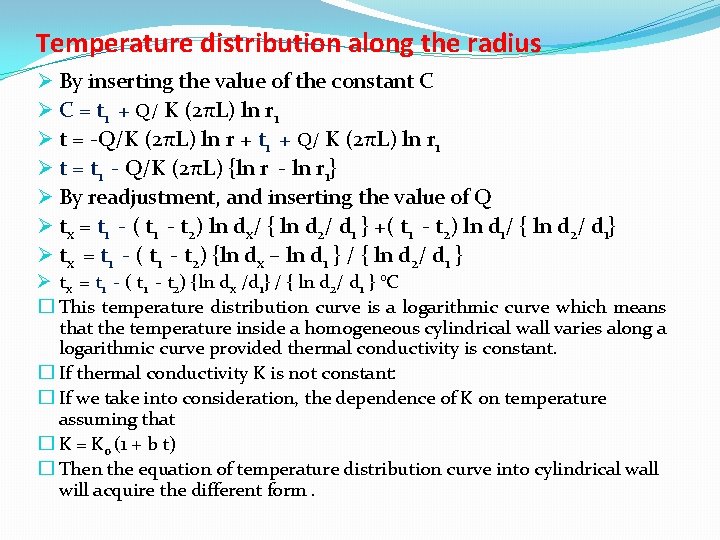
Temperature distribution along the radius Ø By inserting the value of the constant C Ø C = t 1 + Q/ K (2πL) ln r 1 Ø t = -Q/K (2πL) ln r + t 1 + Q/ K (2πL) ln r 1 Ø t = t 1 - Q/K (2πL) {ln r - ln r 1} Ø By readjustment, and inserting the value of Q Ø tx = t 1 - ( t 1 - t 2) ln dx/ { ln d 2/ d 1 } +( t 1 - t 2) ln d 1/ { ln d 2/ d 1} Ø tx = t 1 - ( t 1 - t 2) {ln dx – ln d 1 } / { ln d 2/ d 1 } Ø tx = t 1 - ( t 1 - t 2) {ln dx /d 1} / { ln d 2/ d 1 } °C � This temperature distribution curve is a logarithmic curve which means that the temperature inside a homogeneous cylindrical wall varies along a logarithmic curve provided thermal conductivity is constant. � If thermal conductivity K is not constant: � If we take into consideration, the dependence of K on temperature assuming that � K = K 0 (1 + b t) � Then the equation of temperature distribution curve into cylindrical wall will acquire the different form.