
CONDUCTION THROUGH A COMPOSITE SPHERES and Numericals Heat

- Slides: 10
CONDUCTION THROUGH A COMPOSITE SPHERES and Numericals Heat and Mass Transfer (DTE - 122) Dr. J. Badshah University Professor – cum - Chief Scientist Dairy Engineering Department Sanjay Gandhi Institute of Dairy Technology, Jagdeopath, Patna (Bihar Animal Sciences University, Patna)
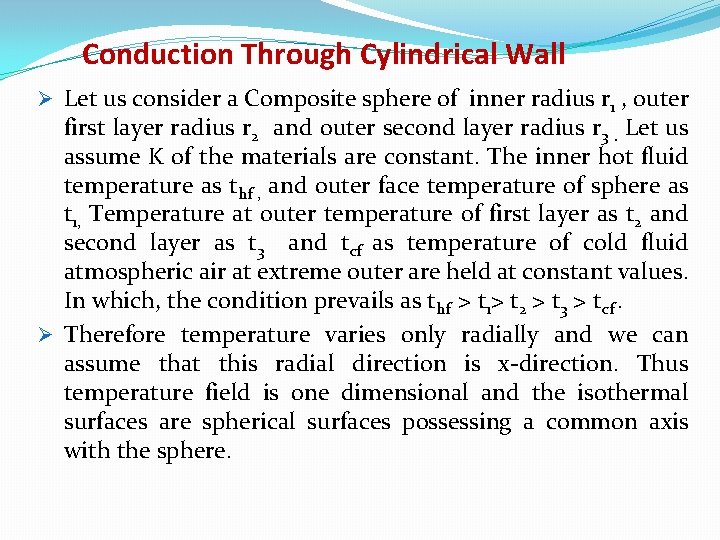
Conduction Through Cylindrical Wall Ø Let us consider a Composite sphere of inner radius r 1 , outer first layer radius r 2 and outer second layer radius r 3. Let us assume K of the materials are constant. The inner hot fluid temperature as thf , and outer face temperature of sphere as t 1, Temperature at outer temperature of first layer as t 2 and second layer as t 3 and tcf as temperature of cold fluid atmospheric air at extreme outer are held at constant values. In which, the condition prevails as thf > t 1> t 2 > t 3 > tcf. Ø Therefore temperature varies only radially and we can assume that this radial direction is x-direction. Thus temperature field is one dimensional and the isothermal surfaces are spherical surfaces possessing a common axis with the sphere.
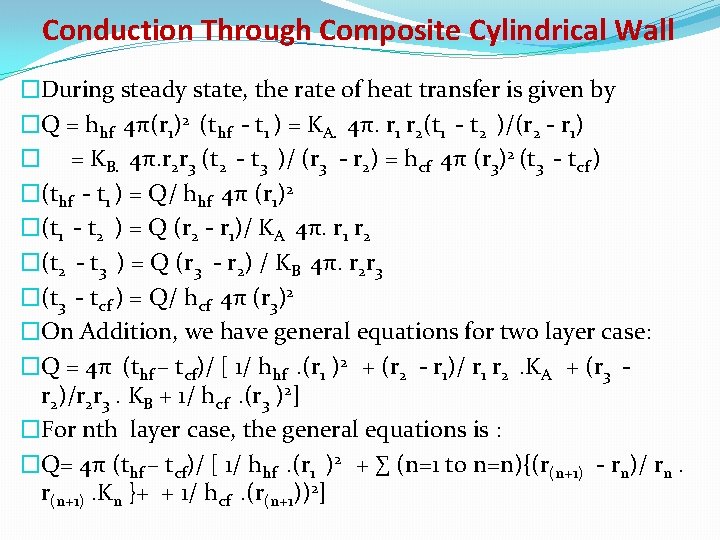
Conduction Through Composite Cylindrical Wall �During steady state, the rate of heat transfer is given by �Q = hhf 4π(r 1)2 (thf - t 1 ) = KA. 4π. r 1 r 2(t 1 - t 2 )/(r 2 - r 1) � = KB. 4π. r 2 r 3 (t 2 - t 3 )/ (r 3 - r 2) = hcf 4π (r 3)2 (t 3 - tcf ) �(thf - t 1 ) = Q/ hhf 4π (r 1)2 �(t 1 - t 2 ) = Q (r 2 - r 1)/ KA 4π. r 1 r 2 �(t 2 - t 3 ) = Q (r 3 - r 2) / KB 4π. r 2 r 3 �(t 3 - tcf ) = Q/ hcf 4π (r 3)2 �On Addition, we have general equations for two layer case: �Q = 4π (thf – tcf)/ [ 1/ hhf . (r 1 )2 + (r 2 - r 1)/ r 1 r 2 . KA + (r 3 - r 2)/r 2 r 3. KB + 1/ hcf . (r 3 )2] �For nth layer case, the general equations is : �Q= 4π (thf – tcf)/ [ 1/ hhf . (r 1 )2 + ∑ (n=1 to n=n){(r(n+1) - rn)/ rn. r(n+1). Kn }+ + 1/ hcf . (r(n+1))2]
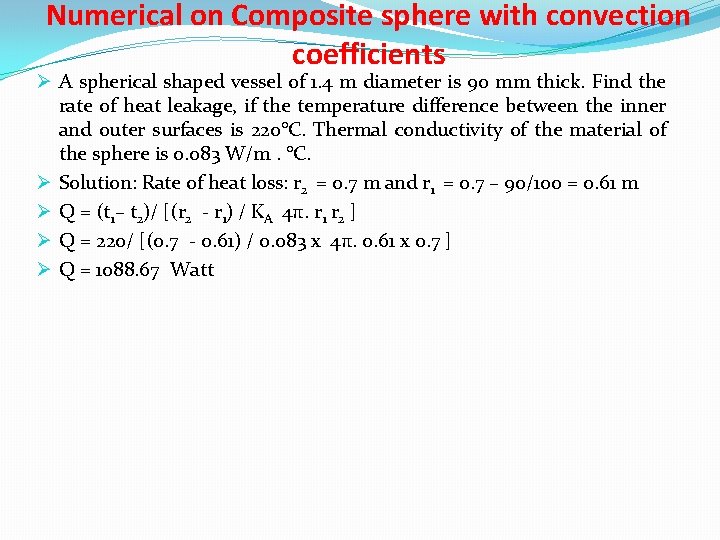
Numerical on Composite sphere with convection coefficients Ø A spherical shaped vessel of 1. 4 m diameter is 90 mm thick. Find the rate of heat leakage, if the temperature difference between the inner and outer surfaces is 220°C. Thermal conductivity of the material of the sphere is 0. 083 W/m. °C. Ø Solution: Rate of heat loss: r 2 = 0. 7 m and r 1 = 0. 7 – 90/100 = 0. 61 m Ø Q = (t 1– t 2)/ [(r 2 - r 1) / KA 4π. r 1 r 2 ] Ø Q = 220/ [(0. 7 - 0. 61) / 0. 083 x 4π. 0. 61 x 0. 7 ] Ø Q = 1088. 67 Watt
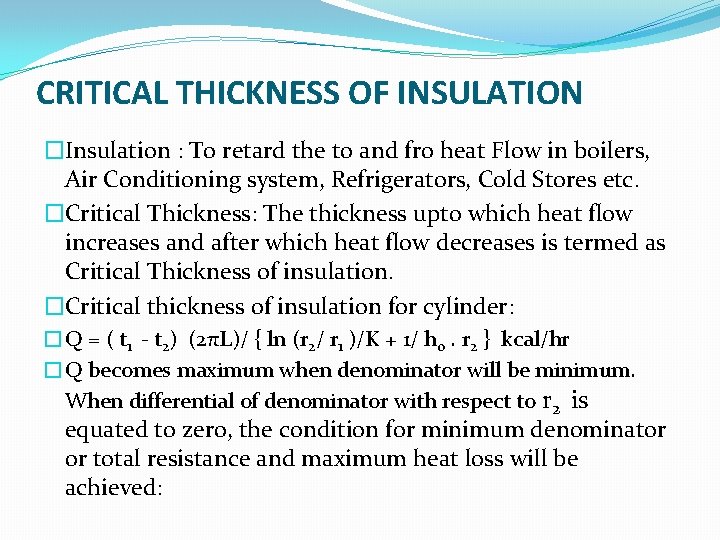
CRITICAL THICKNESS OF INSULATION �Insulation : To retard the to and fro heat Flow in boilers, Air Conditioning system, Refrigerators, Cold Stores etc. �Critical Thickness: The thickness upto which heat flow increases and after which heat flow decreases is termed as Critical Thickness of insulation. �Critical thickness of insulation for cylinder: �Q = ( t 1 - t 2) (2πL)/ { ln (r 2/ r 1 )/K + 1/ ho. r 2 } kcal/hr �Q becomes maximum when denominator will be minimum. When differential of denominator with respect to r 2 is equated to zero, the condition for minimum denominator or total resistance and maximum heat loss will be achieved:
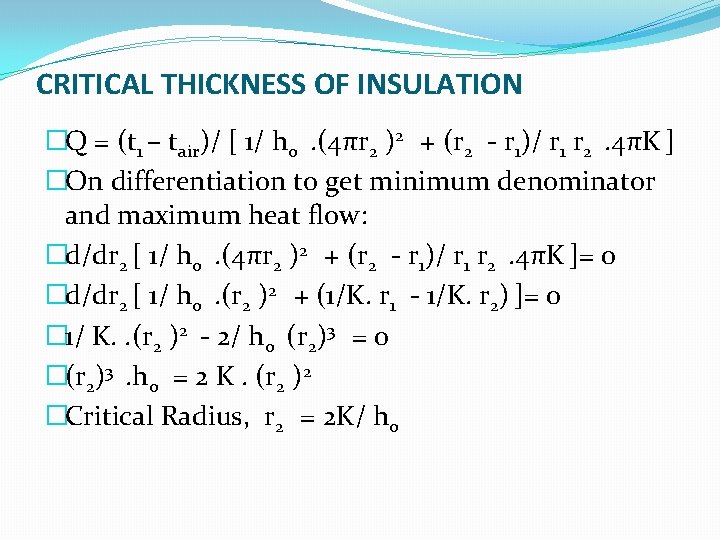
CRITICAL THICKNESS OF INSULATION �Q = (t 1 – tair)/ [ 1/ ho . (4πr 2 )2 + (r 2 - r 1)/ r 1 r 2 . 4πK ] �On differentiation to get minimum denominator and maximum heat flow: �d/dr 2 [ 1/ ho . (4πr 2 )2 + (r 2 - r 1)/ r 1 r 2 . 4πK ]= 0 �d/dr 2 [ 1/ ho . (r 2 )2 + (1/K. r 1 - 1/K. r 2) ]= 0 � 1/ K. . (r 2 )2 - 2/ ho (r 2)3 = 0 �(r 2)3 . ho = 2 K. (r 2 )2 �Critical Radius, r 2 = 2 K/ ho
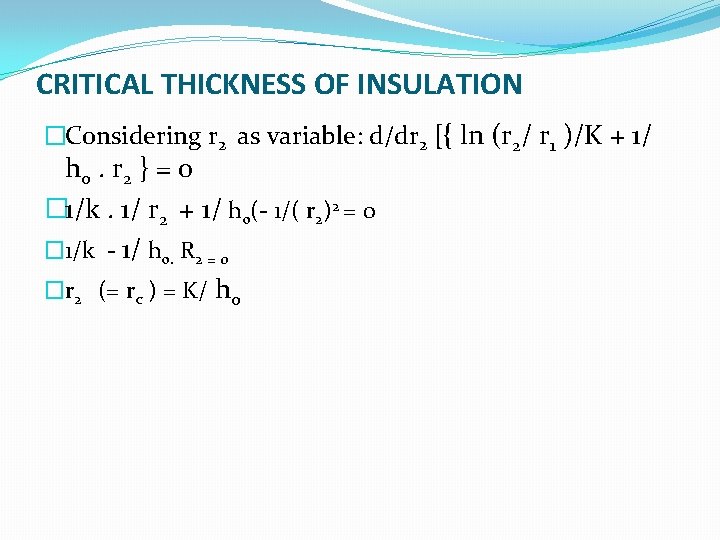
CRITICAL THICKNESS OF INSULATION �Considering r 2 as variable: d/dr 2 [{ ln (r 2/ r 1 )/K + 1/ ho. r 2 } = 0 � 1/k. 1/ r 2 + 1/ ho(- 1/( r 2)2 = 0 � 1/k - 1/ ho. R 2 = 0 �r 2 (= rc ) = K/ ho
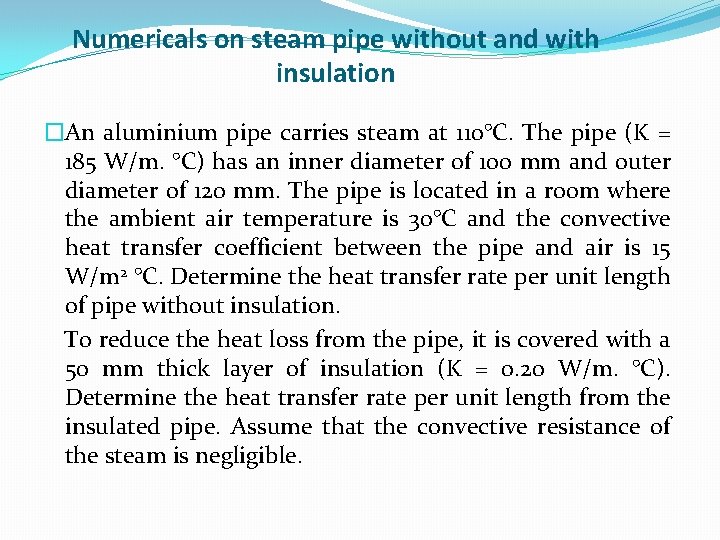
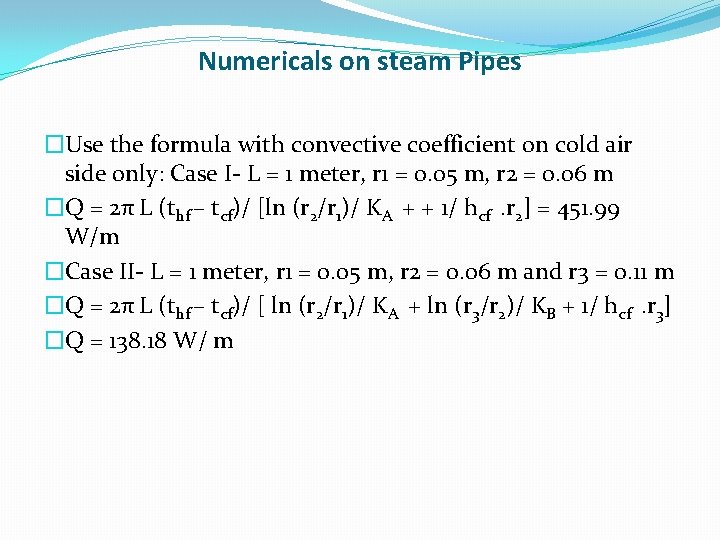
Numericals on steam pipe without and with insulation �An aluminium pipe carries steam at 110°C. The pipe (K = 185 W/m. °C) has an inner diameter of 100 mm and outer diameter of 120 mm. The pipe is located in a room where the ambient air temperature is 30°C and the convective heat transfer coefficient between the pipe and air is 15 W/m 2 °C. Determine the heat transfer rate per unit length of pipe without insulation. To reduce the heat loss from the pipe, it is covered with a 50 mm thick layer of insulation (K = 0. 20 W/m. °C). Determine the heat transfer rate per unit length from the insulated pipe. Assume that the convective resistance of the steam is negligible.
Numericals on steam Pipes �Use the formula with convective coefficient on cold air side only: Case I- L = 1 meter, r 1 = 0. 05 m, r 2 = 0. 06 m �Q = 2π L (thf – tcf)/ [ln (r 2/r 1)/ KA + + 1/ hcf . r 2] = 451. 99 W/m �Case II- L = 1 meter, r 1 = 0. 05 m, r 2 = 0. 06 m and r 3 = 0. 11 m �Q = 2π L (thf – tcf)/ [ ln (r 2/r 1)/ KA + ln (r 3/r 2)/ KB + 1/ hcf . r 3] �Q = 138. 18 W/ m