
Conducting Focus Groups Why Do Focus Groups Effective

- Slides: 36
Conducting Focus Groups
Why Do Focus Groups? • Effective – can eliminate guess work regarding what customers and potential customers think and want • Inexpensive • Open lines of communication and provide a direct link with current and potential patrons • Evaluate program offerings – measure how well objectives are being met • Offer suggestions for improvement
Benefits of Focus Groups • Customers provide a wealth of information – personal experience, observation, conversations with other customers, and experience at other locations • Indicates degree of consumer interest/enthusiasm for new or existing programs • Can quickly identify problems, suggest solutions and monitor marketing efforts • Provides fresh approaches to problems – participants not biased by past organizational actions • Flexible and allow for creativity • Fast – put together quickly and at most 1 and ½ hours for each group (40 participants per day)
Drawbacks of Focus Groups • Small sample sizes – not projectable to population • Easily biased by discussion leader – Recommend someone outside of the program area moderate – contact MARKETING OFFICE • Easily biased by very vocal participants – Requires experience and tight control by moderator
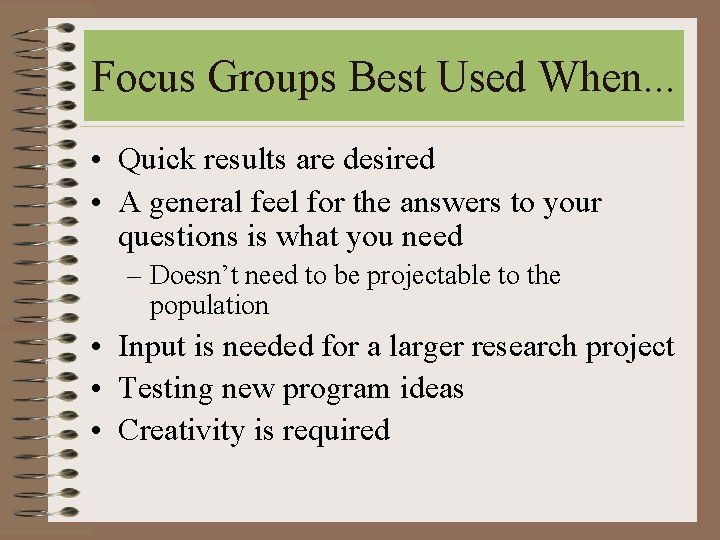
Focus Groups Best Used When. . . • Quick results are desired • A general feel for the answers to your questions is what you need – Doesn’t need to be projectable to the population • Input is needed for a larger research project • Testing new program ideas • Creativity is required
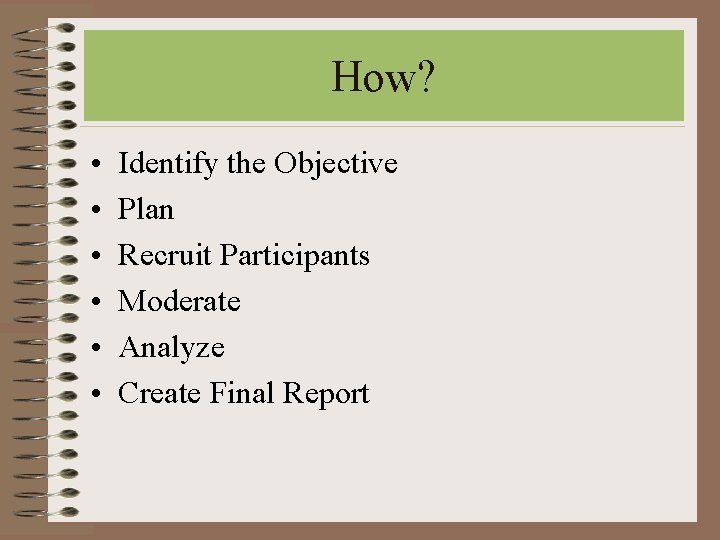
How? • • • Identify the Objective Plan Recruit Participants Moderate Analyze Create Final Report
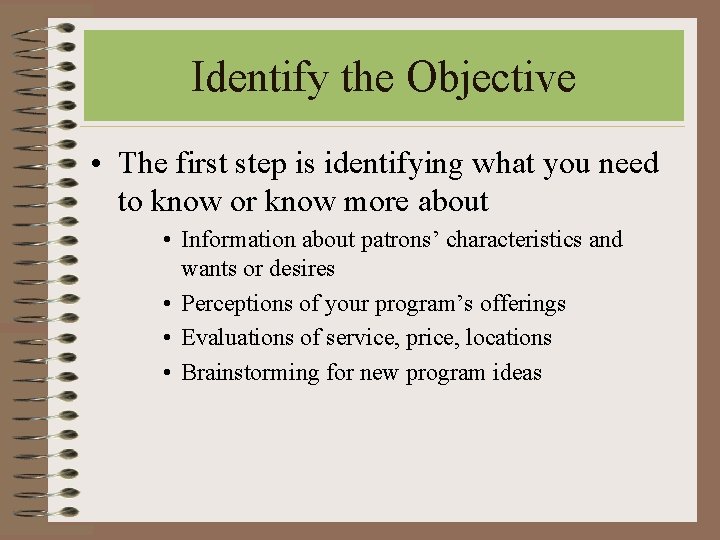
Identify the Objective • The first step is identifying what you need to know or know more about • Information about patrons’ characteristics and wants or desires • Perceptions of your program’s offerings • Evaluations of service, price, locations • Brainstorming for new program ideas
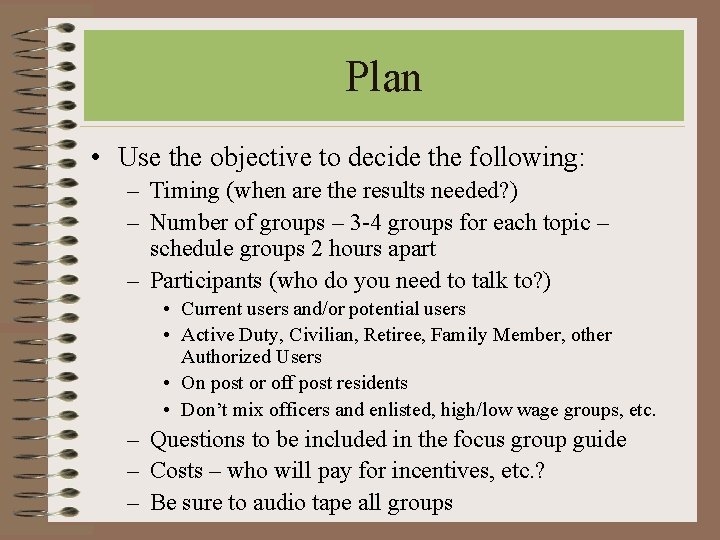
Plan • Use the objective to decide the following: – Timing (when are the results needed? ) – Number of groups – 3 -4 groups for each topic – schedule groups 2 hours apart – Participants (who do you need to talk to? ) • Current users and/or potential users • Active Duty, Civilian, Retiree, Family Member, other Authorized Users • On post or off post residents • Don’t mix officers and enlisted, high/low wage groups, etc. – Questions to be included in the focus group guide – Costs – who will pay for incentives, etc. ? – Be sure to audio tape all groups
Recruit Participants • Ideally, there should be 8 -10 participants in each group, so recruit 12 -14 • Recruit as randomly as possible from each target group • No MWR employees should participate or observe • Participation must be voluntary and an incentive should be used – Coupons for MWR activities • Participants should be told groups will last 1 to 1 and ½ hours
Recruit Participants (continued) – Contact the marketing office for assistance in getting participants – Advertise in the newspaper or bulletin – Randomly select program users (every 5 th one in the door) to participate – Have marketing put a request in their e-mail publication (if your installation has one) – Advertise on the post web site
Moderate • Moderation is the major influence on the outcome of the groups. Moderators must be: – Objective – Knowledgeable on subject matter – Informed about group dynamics/consumer behavior
Moderation Tips • • • Practice ‘listening’, not talking Be flexible Facilitate, don’t participate Practice memory techniques Think ‘globally’ – keep the big picture in mind
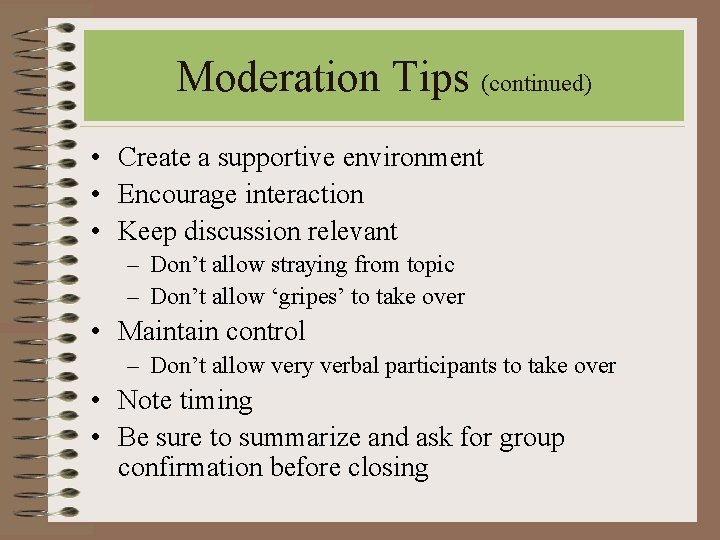
Moderation Tips (continued) • Create a supportive environment • Encourage interaction • Keep discussion relevant – Don’t allow straying from topic – Don’t allow ‘gripes’ to take over • Maintain control – Don’t allow very verbal participants to take over • Note timing • Be sure to summarize and ask for group confirmation before closing
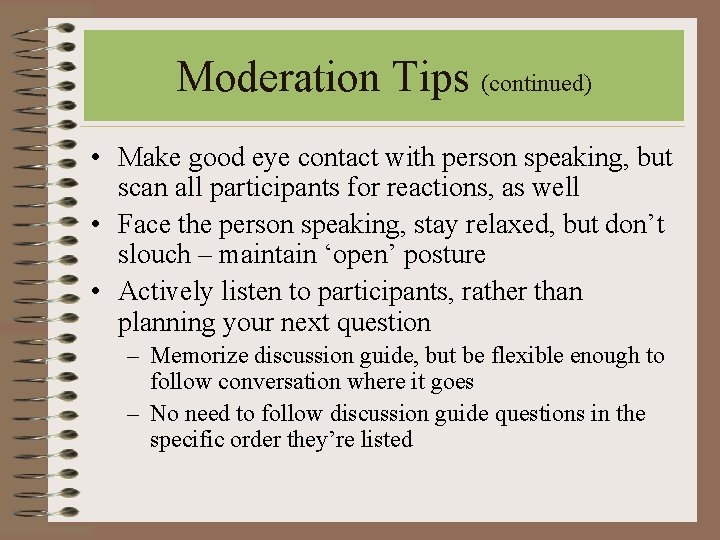
Moderation Tips (continued) • Make good eye contact with person speaking, but scan all participants for reactions, as well • Face the person speaking, stay relaxed, but don’t slouch – maintain ‘open’ posture • Actively listen to participants, rather than planning your next question – Memorize discussion guide, but be flexible enough to follow conversation where it goes – No need to follow discussion guide questions in the specific order they’re listed
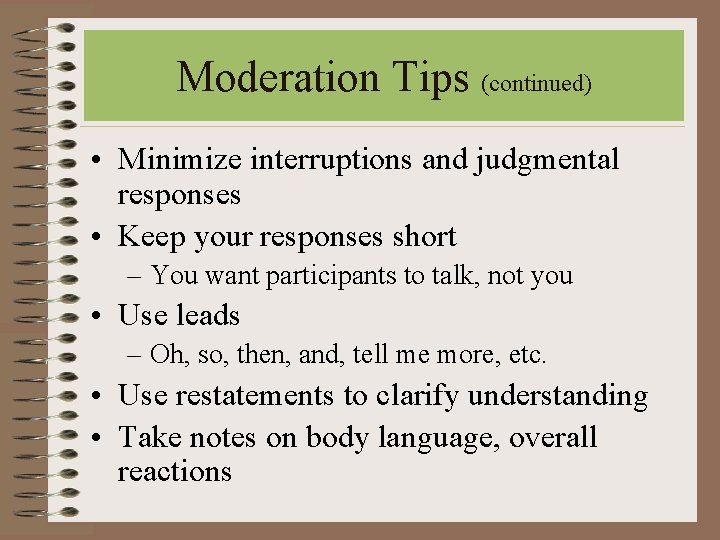
Moderation Tips (continued) • Minimize interruptions and judgmental responses • Keep your responses short – You want participants to talk, not you • Use leads – Oh, so, then, and, tell me more, etc. • Use restatements to clarify understanding • Take notes on body language, overall reactions
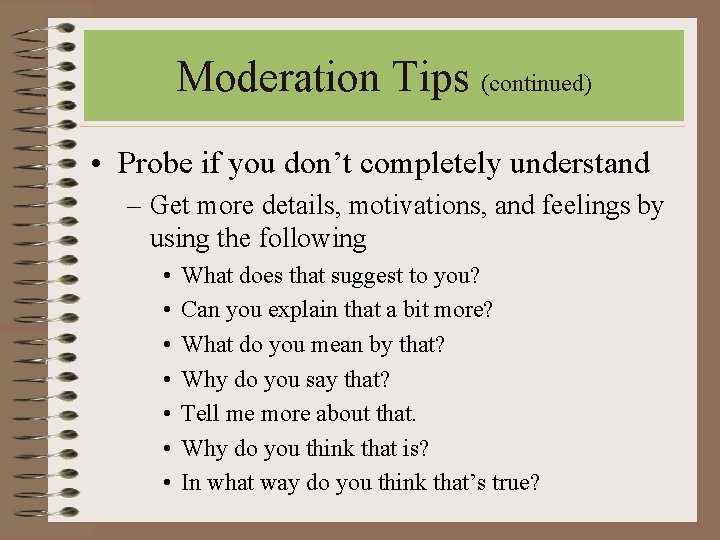
Moderation Tips (continued) • Probe if you don’t completely understand – Get more details, motivations, and feelings by using the following • • What does that suggest to you? Can you explain that a bit more? What do you mean by that? Why do you say that? Tell me more about that. Why do you think that is? In what way do you think that’s true?
Moderation Tips (continued) • Don’t ask leading questions – Don’t you think that… – Don’t you agree that… – I really think…. . don’t you agree? – Most people say…. don’t you think that’s true? • Handle dominant respondents – – Avoid eye contact, turn body away, use hand gestures, address other participants by name
Logistics • Participants should be seated around a circular or rectangular table that comfortably seats 12 – If rectangular, place moderator at the head of the table • Place cards should be used with first names • Soft drinks/water/coffee and/or snacks should be made available to participants • All focus group discussions should be audio taped for purposes of reporting and direct quotation • Begin by asking each participant to introduce themselves - icebreaker
Discussion Guide • Use a funnel approach – Start with most general topics • Leisure time activities • General opinion of installation/location – Move to specific objectives • • Program image Usage Quality of service Pricing Promotion Hours Suggested improvements • SAMPLE HANDOUT PROVIDED
Analyze • Transcribe tape recordings from each group – word for word • Be sure to protect participants’ privacy • Include your notes taken during each session as well as observations about body language, etc. • Every session is different, each analysis will be too • Look for similarities and reinforcements from group to group
Analyze (continued) • • Identify key issues Prioritize key issues Select which issues to address Make recommendations – Justified by the research
Final Report • Be succinct • Write a management summary including the research dates, number of groups, description of participants, locations, and objectives of the research • Use actual quotations and reinforcement in the body of the report to support your insights • Scan and examine notes and quotes to identify patterns, irregularities, or relationships
Final Report (continued) • Summarize with conclusions and recommendations for action relating specifics to the objectives • Remember, results cannot be generalized to the entire population due to small sample sizes
Get Close to Your Customers • Focus on the benefits of Outdoor Recreation in promotion – – – Having fun Having access to things you can’t get access to anywhere else Saving money (by not having to buy your own equipment) Socializing opportunities Personal satisfaction (learning a new skill or hobby) • Get involved in the orientation process at your installation – Brief units, newcomers’ briefings, BOSS members, students, etc. • Build on customer word of mouth – For every user that brings a non-user in, they get a free hour of rental time, etc. • Identify potential cross marketing efforts for programs – child/youth, trainees/student units, etc.
Get Close to Your Customers (continued) • Take the facilities to the people – use high traffic areas such as the P/X or commissary to conduct demonstrations, display new equipment, and highlight photos of recent trips/tours/events. • Form a customer advisory committee for idea generation and promotional tactics. • Utilize e-mail and/or Internet to publicize upcoming events…consider creating an ODR e-zine for customers to subscribe to. • Review hours or operation periodically to meet the needs of your customers. Consider varying hours to be open later one or two evenings a week and longer on weekends.
Tidbits • Do you receive Tidbits? – A monthly e-mail publication that includes research on families, child and youth; food, beverage and entertainment; leisure, hobbies and skill development; internet/computers; sports and fitness; and travel/tourism
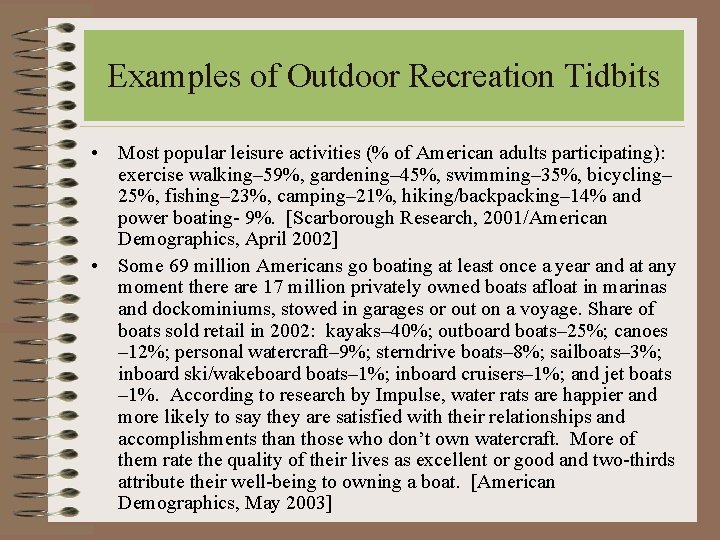
Examples of Outdoor Recreation Tidbits • Most popular leisure activities (% of American adults participating): exercise walking– 59%, gardening– 45%, swimming– 35%, bicycling– 25%, fishing– 23%, camping– 21%, hiking/backpacking– 14% and power boating- 9%. [Scarborough Research, 2001/American Demographics, April 2002] • Some 69 million Americans go boating at least once a year and at any moment there are 17 million privately owned boats afloat in marinas and dockominiums, stowed in garages or out on a voyage. Share of boats sold retail in 2002: kayaks– 40%; outboard boats– 25%; canoes – 12%; personal watercraft– 9%; sterndrive boats– 8%; sailboats– 3%; inboard ski/wakeboard boats– 1%; inboard cruisers– 1%; and jet boats – 1%. According to research by Impulse, water rats are happier and more likely to say they are satisfied with their relationships and accomplishments than those who don’t own watercraft. More of them rate the quality of their lives as excellent or good and two-thirds attribute their well-being to owning a boat. [American Demographics, May 2003]
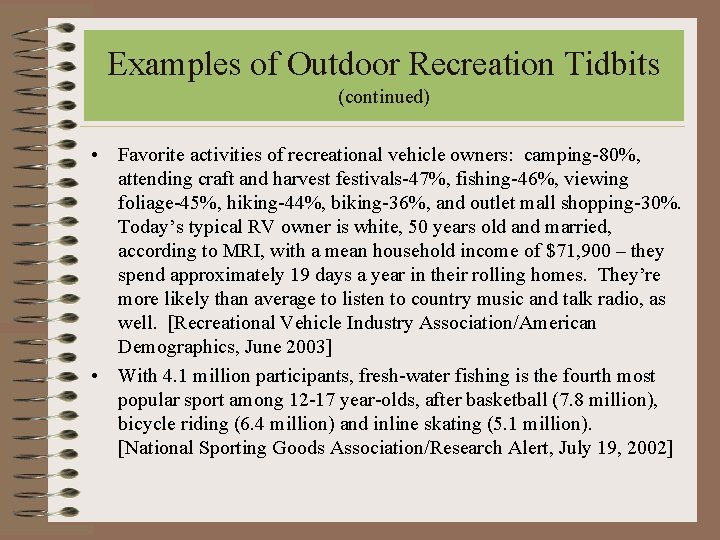
Examples of Outdoor Recreation Tidbits (continued) • Favorite activities of recreational vehicle owners: camping-80%, attending craft and harvest festivals-47%, fishing-46%, viewing foliage-45%, hiking-44%, biking-36%, and outlet mall shopping-30%. Today’s typical RV owner is white, 50 years old and married, according to MRI, with a mean household income of $71, 900 – they spend approximately 19 days a year in their rolling homes. They’re more likely than average to listen to country music and talk radio, as well. [Recreational Vehicle Industry Association/American Demographics, June 2003] • With 4. 1 million participants, fresh-water fishing is the fourth most popular sport among 12 -17 year-olds, after basketball (7. 8 million), bicycle riding (6. 4 million) and inline skating (5. 1 million). [National Sporting Goods Association/Research Alert, July 19, 2002]
Leisure Needs Survey (LNS) • 2003 LNS – Focuses on leisure activity participation and perceived quality of MWR programs and facilities, and program and facility user profiles. – Feeds into 5 -year program planning process and Installation Status Report (ISR) 3.
LNS (continued) • Currently postponed, pending removal of the Army Research Institute’s moratorium on all Army-wide surveying • Once moratorium is lifted, 6 -8 months for survey process, analysis and report production • Survey will be offered in hard copy and via the web • Final draft is available here today, if you’d like to see it
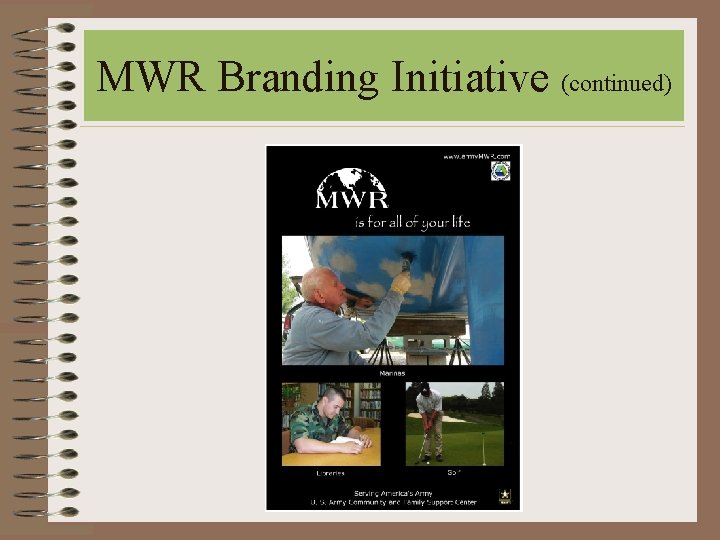
MWR Branding Initiative • In 2001, the Chief of Staff of the Army directed CFSC to undertake proactive efforts to communicate the value of MWR to all Army components and the American public. • Advertising campaign featured three distinctly different MWR programs per advertisement, illustrating a new slogan, “MWR is for all of your life” and was disseminated through selected installation newspapers, Army Times, the Pentagram, Government Executive Magazine (print and online), TROA, and Stars and Stripes (European and Far East).
MWR Branding Initiative (continued)
MWR Branding Initiative (continued) • The Hill and Knowlton Communications Agency was contracted to develop a cohesive, unified brand identity for Army MWR to enhance awareness, increase MWR program and service usage, and drive strong support for MWR as a key benefit of Army service. • A pilot program and draft strategic communications plan was developed to test messages, communications channels and tools in the field. The pilot program kicked off in October 2002 at Picatinny Arsenal, New Jersey; Fort Drum, New York; and Fort Leonard Wood, Missouri with pre- and post- focus groups, marketing and program manager training, and Garrison Commander and Director of Community Activities briefings.
MWR Branding Initiative (continued) • Pilot results were incorporated into the Strategic Communications Plan which is now being coordinated through CFSC. Once our Commanding General approves, the document will be presented at the Working Group in August and the Executive Committee Meeting in September. Following that, it will move to implementation at the Region and installation levels. • Implementation will include new visual standards for the logo along with engagement tactics for all levels of MWR associates: customers, providers, hosts and patrons.
Questions