
CONDUCTING A SCAN OF ALCOHOL SIGNAGE CLASS A





- Slides: 48
CONDUCTING A SCAN OF ALCOHOL SIGNAGE @ CLASS A RETAILERS Organize & conduct a scan of alcohol advertising at off-premises retailers Wisconsin Alcohol Policy Project September 15, 2016
Conducting a scan of alcohol signage @ Class A retailers 4 Why advertising scans matter 47 Acknowledgements 8 Information & Planning 23 27 34 Conducting the Survey Sharing the Results Examples & Resources Cataloging the alcohol advertising at off-premises outlets (convenience stores, gas stations, grocery stores, liquor stores) enables a group to identify locations that fail to comply with local sign codes & then seek enforcement. | 2
Why advertising scans matter
Why alcohol advertising matters “The fact that young people were more likely to drink more over time in environments with more alcohol advertising suggests that it is exposure to alcohol advertising that contributes to the drinking, rather than the reverse. ” David Jernigan, Ph. D. January 2006, Journal of Pediatrics & Adolescent Medicine. Advertising is one of the 4 A’s -- factors that can alter the community alcohol environment. They are described on page 45. Youth exposure to alcohol advertising is a factor in when youth begin drinking and how much they drink. While just one factor in the community alcohol environment, signage is a factor that many communities regulate locally. It has been a decade since the first peer-reviewed studies indicated that the age at which youth first consume alcohol (alcohol initiation) and how much alcohol they consume is linked to alcohol advertising exposure. By cataloging this factor contributing to underage drinking & determining if it is in violation of local ordinances, you: Research also shows that modest increases in youth exposure to alcohol advertising has an impact on youth, suggesting that limiting or even reducing youth exposure would be beneficial. 1) Increase community awareness of the role alcohol advertising plays in underage drinking 2) Take action to reduce youth exposure to alcohol advertising using existing public policy. Snyder LB, Milici F, Slater M, Sun H, Strizhakova Y. Effects of Alcohol Advertising Exposure on Drinking Among Youth. Arch Pediatr Adolesc Med. 2006; 160(1): 18 -24. doi: 10. 1001/archpedi. 160. 1. 18. | 4 Craig S. Ross, Emily Maple, Michael Siegel, William De. Jong, Timothy S. Naimi, Alisa A. Padon, Dina L. G. Borzekowski, David H. Jernigan The Relationship Between Population-Level Exposure to Alcohol Advertising on Television and Brand-Specific Consumption Among Underage Youth in the U Alcohol and Alcoholism May 2015, 50 (3) 358 -364; DOI: 10. 1093/alcalc/agv 016
Reduce youth exposure to alcohol advertising: Local control makes it possible Municipalities can’t: Ban all alcohol advertising in the community. Municipalities can: Consider local policies, sign codes & the zoning requirements in your community. For example: Are exterior business signs regulated? Create local sign ordinances that address the placement of signs or the portion of window that may be covered. Are commercial signs in windows Place limitations and license requirements on exterior signs. regulated? Control all advertising on public property such as recreational centers, parks & public transportation. regulated? Are temporary banners & commercial flags regulated? Are free-standing moveable signs Are temporary signs regulated? Are billboards or advertising painted on the side of a building regulated? The first step is a survey of locally regulated advertising. | 5
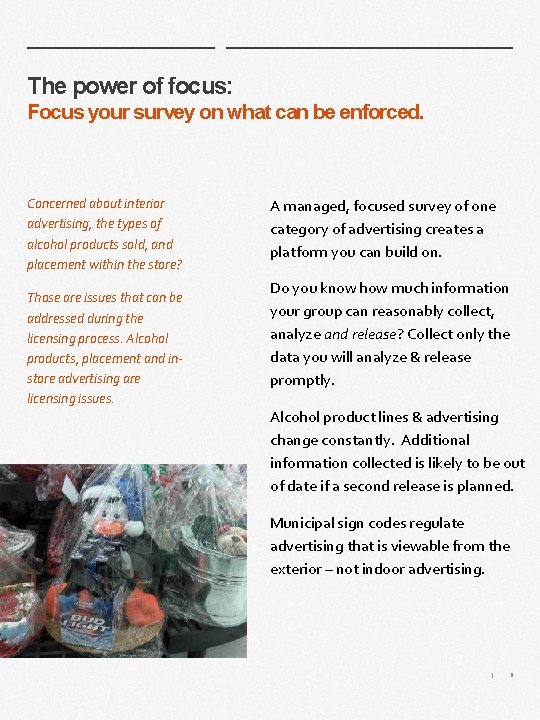
The power of focus: Focus your survey on what can be enforced. Concerned about interior advertising, the types of alcohol products sold, and placement within the store? Those are issues that can be addressed during the licensing process. Alcohol products, placement and instore advertising are licensing issues. A managed, focused survey of one category of advertising creates a platform you can build on. Do you know how much information your group can reasonably collect, analyze and release? Collect only the data you will analyze & release promptly. Alcohol product lines & advertising change constantly. Additional information collected is likely to be out of date if a second release is planned. Municipal sign codes regulate advertising that is viewable from the exterior – not indoor advertising. | 6
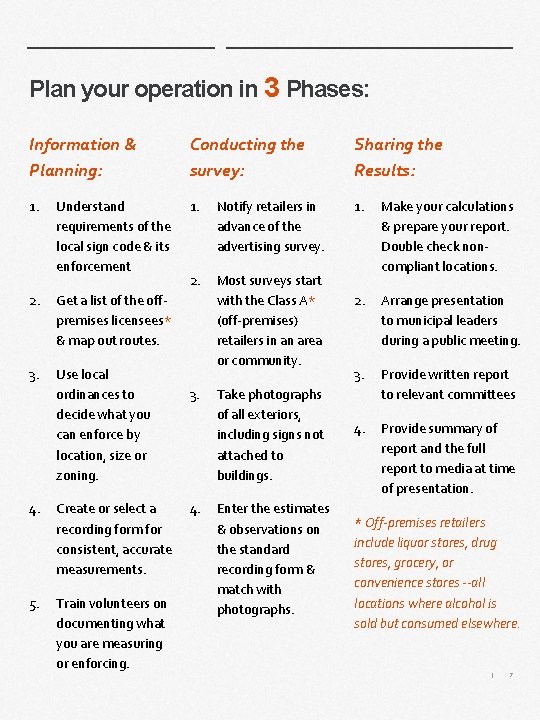
Plan your operation in 3 Phases: Information & Planning: Conducting the survey: Sharing the Results: 1. Notify retailers in advance of the advertising survey. 1. 2. Most surveys start with the Class A* (off-premises) retailers in an area or community. Make your calculations & prepare your report. Double check noncompliant locations. 2. Arrange presentation to municipal leaders during a public meeting. 3. Provide written report to relevant committees 4. Provide summary of report and the full report to media at time of presentation. Understand requirements of the local sign code & its enforcement 2. Get a list of the offpremises licensees* & map out routes. 3. Use local ordinances to decide what you can enforce by location, size or zoning. 4. Create or select a recording form for consistent, accurate measurements. 5. Train volunteers on documenting what you are measuring or enforcing. 3. 4. Take photographs of all exteriors, including signs not attached to buildings. Enter the estimates & observations on the standard recording form & match with photographs. * Off-premises retailers include liquor stores, drug stores, grocery, or convenience stores --all locations where alcohol is sold but consumed elsewhere. | 7
Information & Planning
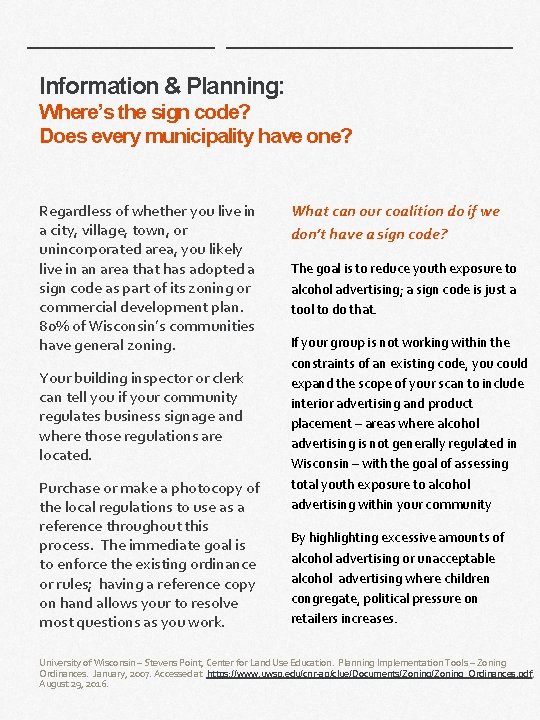
Information & Planning: Where’s the sign code? Does every municipality have one? Regardless of whether you live in a city, village, town, or unincorporated area, you likely live in an area that has adopted a sign code as part of its zoning or commercial development plan. 80% of Wisconsin’s communities have general zoning. Your building inspector or clerk can tell you if your community regulates business signage and where those regulations are located. Purchase or make a photocopy of the local regulations to use as a reference throughout this process. The immediate goal is to enforce the existing ordinance or rules; having a reference copy on hand allows your to resolve most questions as you work. What can our coalition do if we don’t have a sign code? The goal is to reduce youth exposure to alcohol advertising; a sign code is just a tool to do that. If your group is not working within the constraints of an existing code, you could expand the scope of your scan to include interior advertising and product placement – areas where alcohol advertising is not generally regulated in Wisconsin – with the goal of assessing total youth exposure to alcohol advertising within your community By highlighting excessive amounts of alcohol advertising or unacceptable alcohol advertising where children congregate, political pressure on retailers increases. University of Wisconsin – Stevens Point, Center for Land Use Education. Planning Implementation Tools – Zoning Ordinances. January, 2007. Accessed at https: //www. uwsp. edu/cnr-ap/clue/Documents/Zoning_Ordinances. pdf, | 9 August 29, 2016.
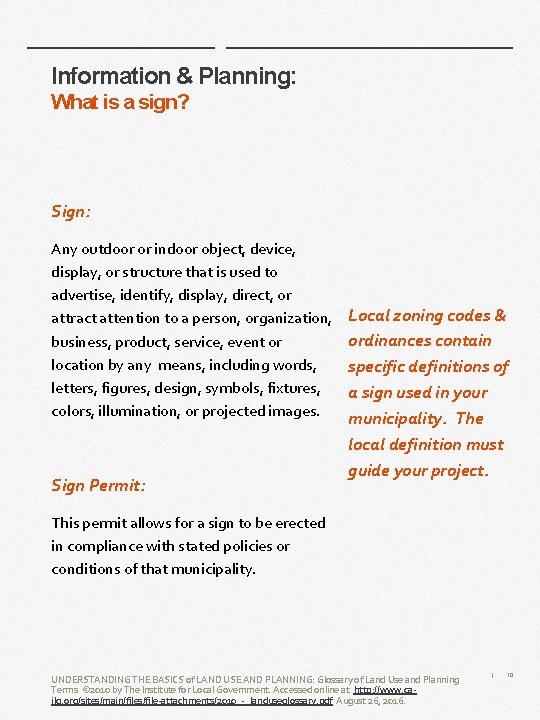
Information & Planning: What is a sign? Sign: Any outdoor or indoor object, device, display, or structure that is used to advertise, identify, display, direct, or attract attention to a person, organization, business, product, service, event or location by any means, including words, letters, figures, design, symbols, fixtures, colors, illumination, or projected images. Sign Permit: Local zoning codes & ordinances contain specific definitions of a sign used in your municipality. The local definition must guide your project. This permit allows for a sign to be erected in compliance with stated policies or conditions of that municipality. UNDERSTANDING THE BASICS of LAND USE AND PLANNING: Glossary of Land Use and Planning Terms © 2010 by The Institute for Local Government. Accessed online at http: //www. cailg. org/sites/main/files/file-attachments/2010_-_landuseglossary. pdf August 26, 2016. | 10
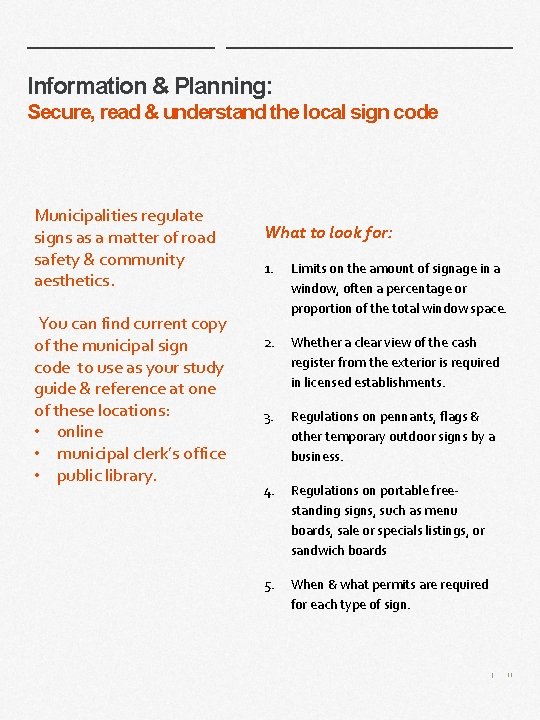
Information & Planning: Secure, read & understand the local sign code Municipalities regulate signs as a matter of road safety & community aesthetics. You can find current copy of the municipal sign code to use as your study guide & reference at one of these locations: • online • municipal clerk’s office • public library. What to look for: 1. Limits on the amount of signage in a window, often a percentage or proportion of the total window space. 2. Whether a clear view of the cash register from the exterior is required in licensed establishments. 3. Regulations on pennants, flags & other temporary outdoor signs by a business. 4. Regulations on portable freestanding signs, such as menu boards, sale or specials listings, or sandwich boards 5. When & what permits are required for each type of sign. | 11
Information & Planning: Many communities limit the proportion of a window that can be covered by advertising signs. Example: City of Eau Claire Some municipalities require locations selling alcohol to maintain a clear “line of sight” to the cash register or check-out. Local law enforcement will know the local requirement. “Such signs shall be permitted except in the residential and C -1 A zoning districts for each ground floor business establishment. The total area of such signs plus any permanent window signs shall not exceed a maximum of 40 percent of the window area to which such signs are attached. ” Example: City of Fond du Lac “Signs affixed to or painted on the interior of a window surface shall not exceed more than 25% of the window area. ” | 12
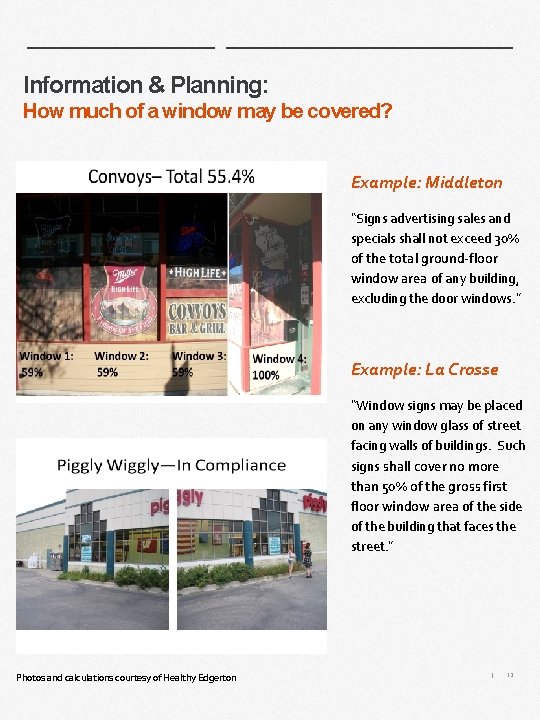
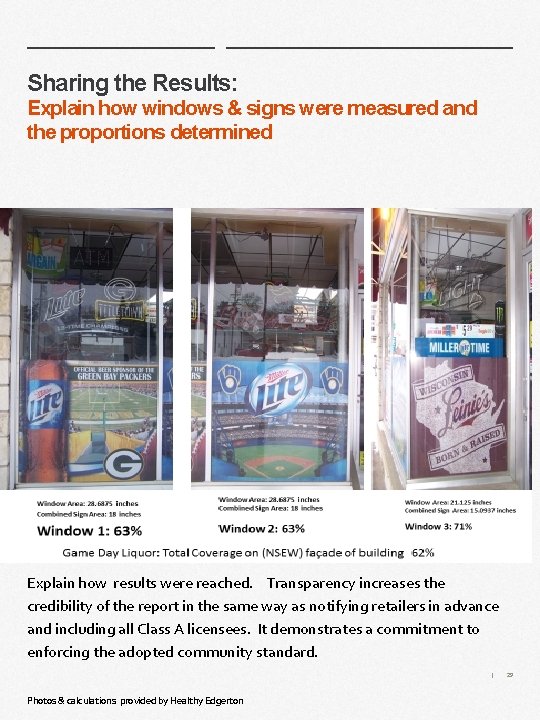
Information & Planning: How much of a window may be covered? Example: Middleton “Signs advertising sales and specials shall not exceed 30% of the total ground-floor window area of any building, excluding the door windows. ” Example: La Crosse “Window signs may be placed on any window glass of street facing walls of buildings. Such signs shall cover no more than 50% of the gross first floor window area of the side of the building that faces the street. ” Photos and calculations courtesy of Healthy Edgerton | 13
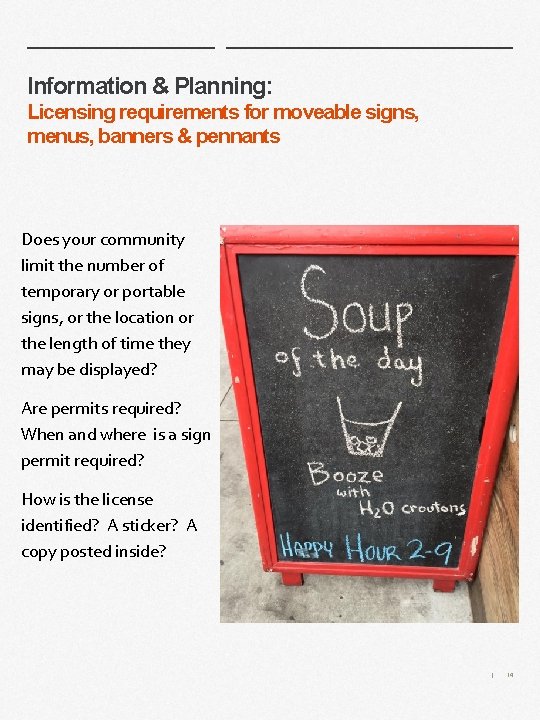
Information & Planning: Licensing requirements for moveable signs, menus, banners & pennants Does your community limit the number of temporary or portable signs, or the location or the length of time they may be displayed? Are permits required? When and where is a sign permit required? How is the license identified? A sticker? A copy posted inside? | 14
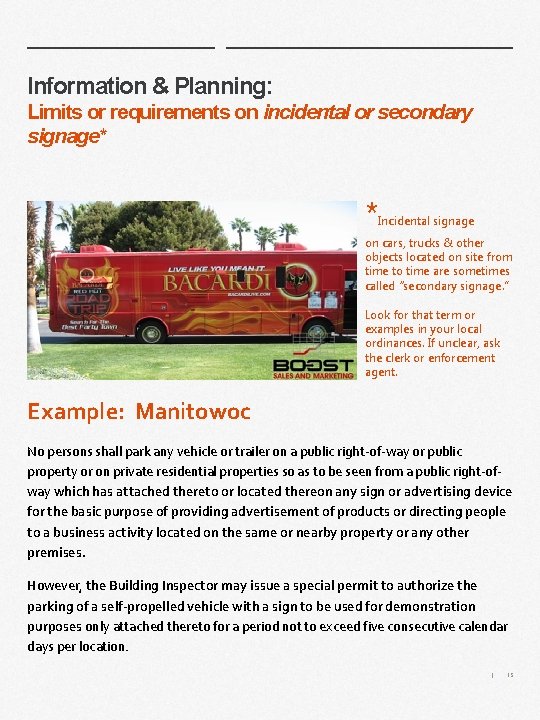
Information & Planning: Limits or requirements on incidental or secondary signage* * Incidental signage on cars, trucks & other objects located on site from time to time are sometimes called “secondary signage. ” Look for that term or examples in your local ordinances. If unclear, ask the clerk or enforcement agent. Example: Manitowoc No persons shall park any vehicle or trailer on a public right-of-way or public property or on private residential properties so as to be seen from a public right-ofway which has attached thereto or located thereon any sign or advertising device for the basic purpose of providing advertisement of products or directing people to a business activity located on the same or nearby property or any other premises. However, the Building Inspector may issue a special permit to authorize the parking of a self-propelled vehicle with a sign to be used for demonstration purposes only attached thereto for a period not to exceed five consecutive calendar days per location. | 15
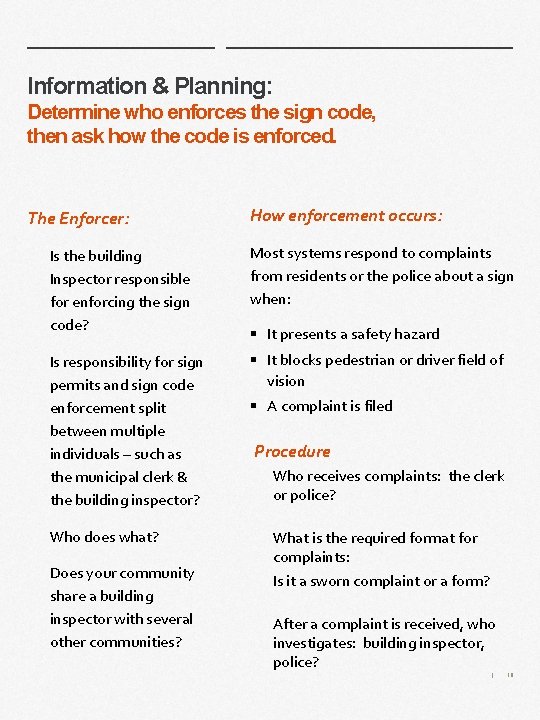
Information & Planning: Determine who enforces the sign code, then ask how the code is enforced. The Enforcer: How enforcement occurs: Is the building Inspector responsible for enforcing the sign code? Most systems respond to complaints from residents or the police about a sign when: Is responsibility for sign permits and sign code enforcement split between multiple individuals – such as the municipal clerk & the building inspector? § It blocks pedestrian or driver field of vision Who does what? Does your community share a building inspector with several other communities? § It presents a safety hazard § A complaint is filed Procedure Who receives complaints: the clerk or police? What is the required format for complaints: Is it a sworn complaint or a form? After a complaint is received, who investigates: building inspector, police? | 16
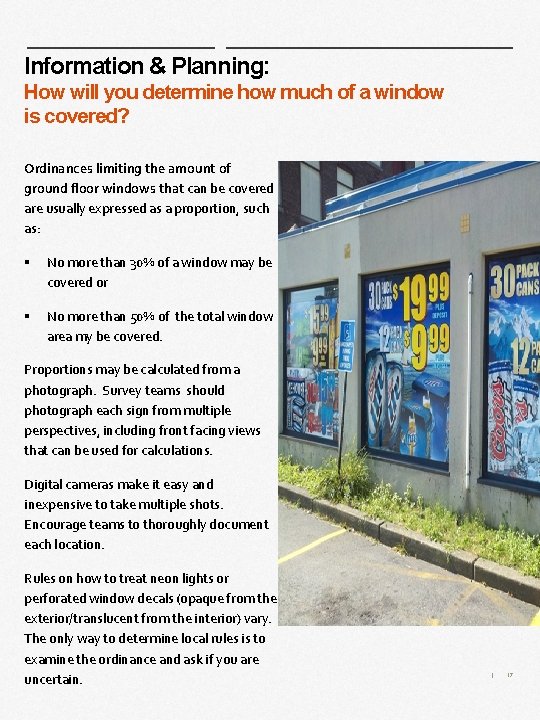
Information & Planning: How will you determine how much of a window is covered? Ordinances limiting the amount of ground floor windows that can be covered are usually expressed as a proportion, such as: § No more than 30% of a window may be covered or § No more than 50% of the total window area my be covered. Proportions may be calculated from a photograph. Survey teams should photograph each sign from multiple perspectives, including front facing views that can be used for calculations. Digital cameras make it easy and inexpensive to take multiple shots. Encourage teams to thoroughly document each location. Rules on how to treat neon lights or perforated window decals (opaque from the exterior/translucent from the interior) vary. The only way to determine local rules is to examine the ordinance and ask if you are uncertain. | 17
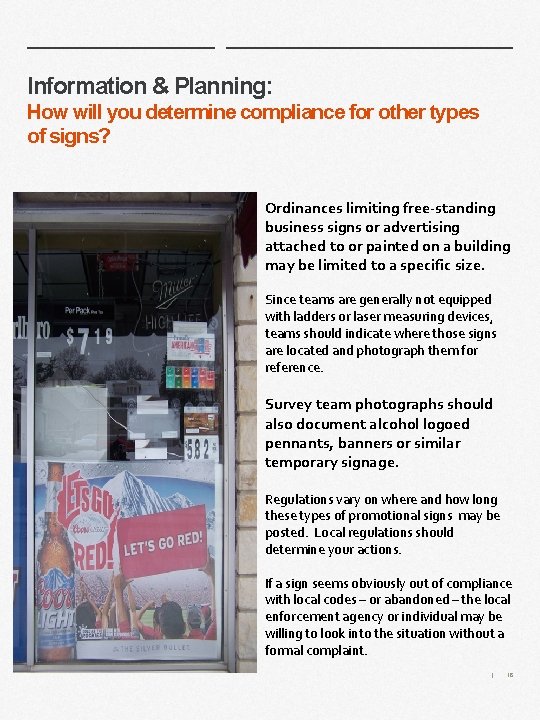
Information & Planning: How will you determine compliance for other types of signs? Ordinances limiting free-standing business signs or advertising attached to or painted on a building may be limited to a specific size. Since teams are generally not equipped with ladders or laser measuring devices, teams should indicate where those signs are located and photograph them for reference. Survey team photographs should also document alcohol logoed pennants, banners or similar temporary signage. Regulations vary on where and how long these types of promotional signs may be posted. Local regulations should determine your actions. If a sign seems obviously out of compliance with local codes – or abandoned – the local enforcement agency or individual may be willing to look into the situation without a formal complaint. | 18
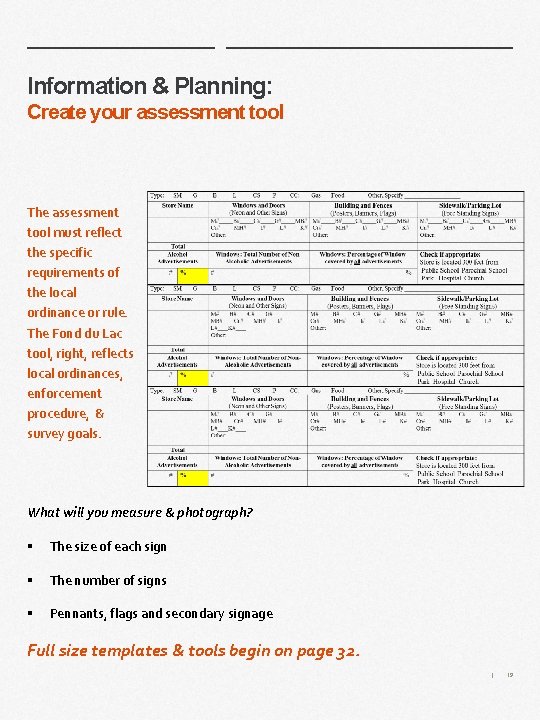
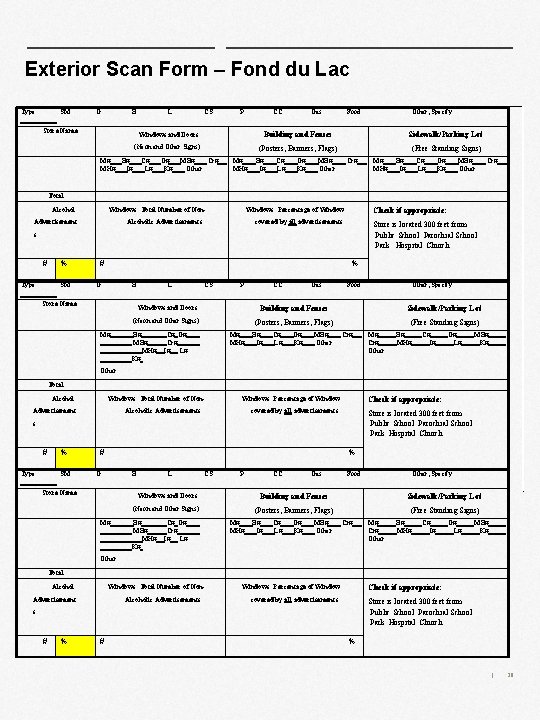
Information & Planning: Create your assessment tool The assessment tool must reflect the specific requirements of the local ordinance or rule. The Fond du Lac tool, right, reflects local ordinances, enforcement procedure, & survey goals. What will you measure & photograph? § The size of each sign § The number of signs § Pennants, flags and secondary signage Full size templates & tools begin on page 32. | 19
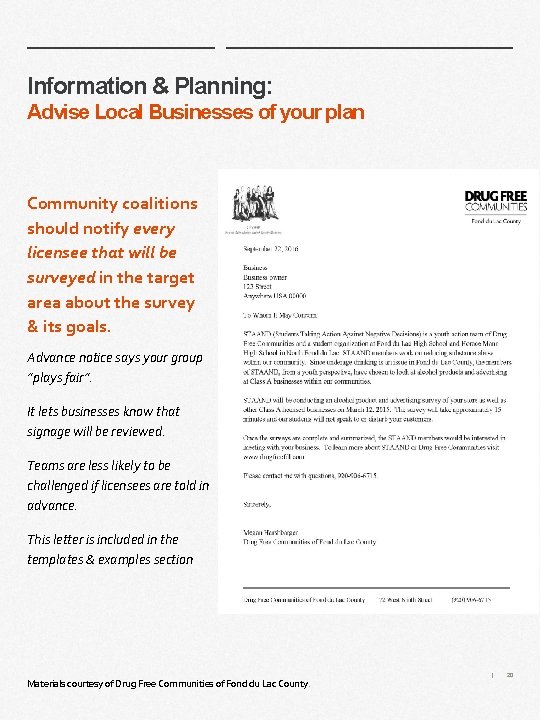
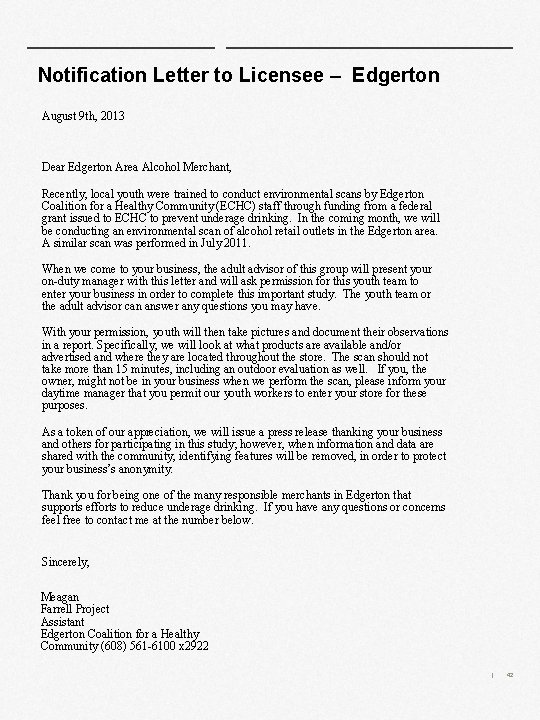
Information & Planning: Advise Local Businesses of your plan Community coalitions should notify every licensee that will be surveyed in the target area about the survey & its goals. Advance notice says your group ”plays fair”. It lets businesses know that signage will be reviewed. Teams are less likely to be challenged if licensees are told in advance. This letter is included in the templates & examples section Materials courtesy of Drug Free Communities of Fond du Lac County. | 20
Information & Planning: Recruit & train volunteers Adult volunteers can: All volunteers can: q Supervise youth. Plan on one adult driver for every 2 -3 youth. q Prepare letters to retailers. q Train youth. q Calculate window proportions from photos. q Provide transportation. q Take photographs. q Supervise & confirm photographs, notes and estimates. q Help present results. q Monitor later compliance of those found non-compliant. q Make calculations & determine compliance. q Arrange presentation and be available as a resource or spokesperson. q File complaints with community. A complaint often requires a resident over age 18. Based on the assessment tool created by the Fond du Lac Safe & Drug Free Community Coalition. | 21
Information & Planning: Prepare the Volunteers Training Topics: Using a new skill or knowledge promptly after training helps participants retain the information. If the training is more than a week before the survey, consider surveying one retailer that day to cement the lesson. 1. Explain the purpose of the survey & role of each team member. Youth should receive permission slips to take home. Youth without parental permission should not participate. 2. Discuss what you are measuring and how you will document it. Explain note taking & the photographs required in detail. 3. Provide examples of all forms and how they should be completed. Consider using images of locations that would be in violation and talk through how it would be noted. 4. Explain how the survey will be compiled into a report and who will receive it. Look for volunteers for public presentation. 5. Provide the timeline for all activities. Volunteer recruitment is best when specific dates or a time frame is provided. 6. If technology will be used, explain how to use it & practice its use. | 22
Conducting the Survey
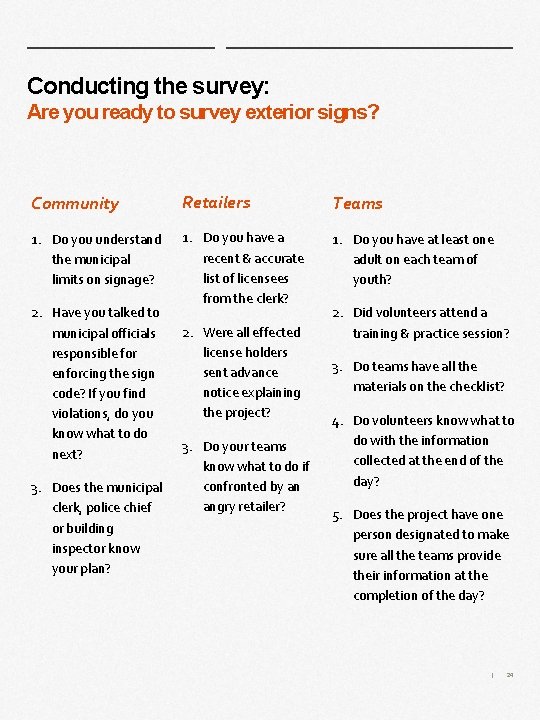
Conducting the survey: Are you ready to survey exterior signs? Community Retailers Teams 1. Do you understand the municipal limits on signage? 1. Do you have a recent & accurate list of licensees from the clerk? 1. Do you have at least one adult on each team of youth? 2. Have you talked to municipal officials responsible for enforcing the sign code? If you find violations, do you know what to do next? 3. Does the municipal clerk, police chief or building inspector know your plan? 2. Were all effected license holders sent advance notice explaining the project? 3. Do your teams know what to do if confronted by an angry retailer? 2. Did volunteers attend a training & practice session? 3. Do teams have all the materials on the checklist? 4. Do volunteers know what to do with the information collected at the end of the day? 5. Does the project have one person designated to make sure all the teams provide their information at the completion of the day? | 24
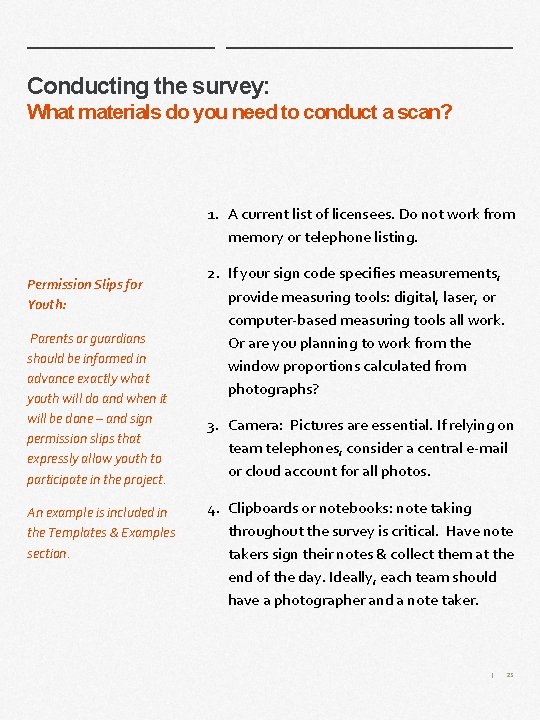
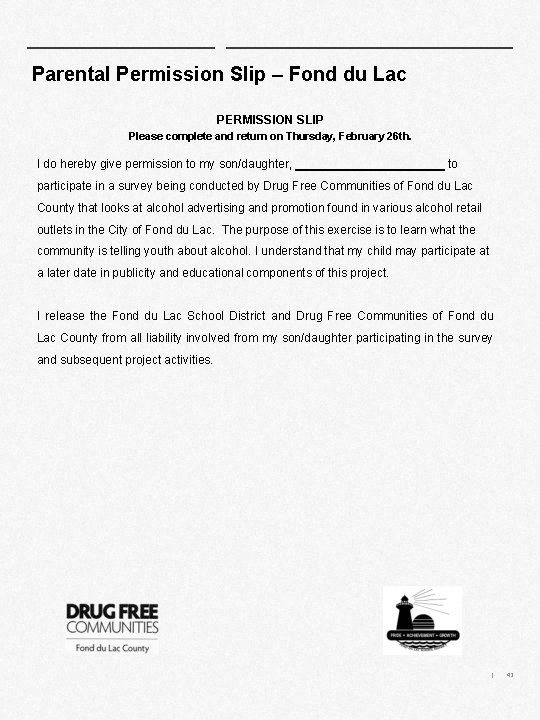
Conducting the survey: What materials do you need to conduct a scan? 1. A current list of licensees. Do not work from memory or telephone listing. Permission Slips for Youth: Parents or guardians should be informed in advance exactly what youth will do and when it will be done – and sign permission slips that expressly allow youth to participate in the project. An example is included in the Templates & Examples section. 2. If your sign code specifies measurements, provide measuring tools: digital, laser, or computer-based measuring tools all work. Or are you planning to work from the window proportions calculated from photographs? 3. Camera: Pictures are essential. If relying on team telephones, consider a central e-mail or cloud account for all photos. 4. Clipboards or notebooks: note taking throughout the survey is critical. Have note takers sign their notes & collect them at the end of the day. Ideally, each team should have a photographer and a note taker. | 25
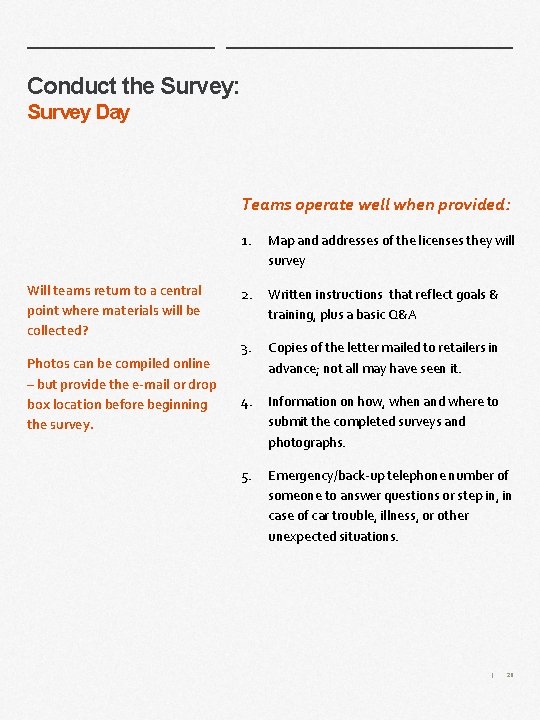
Conduct the Survey: Survey Day Teams operate well when provided: Will teams return to a central point where materials will be collected? Photos can be compiled online – but provide the e-mail or drop box location before beginning the survey. 1. Map and addresses of the licenses they will survey 2. Written instructions that reflect goals & training, plus a basic Q&A 3. Copies of the letter mailed to retailers in advance; not all may have seen it. 4. Information on how, when and where to submit the completed surveys and photographs. 5. Emergency/back-up telephone number of someone to answer questions or step in, in case of car trouble, illness, or other unexpected situations. | 26
Sharing the Results:
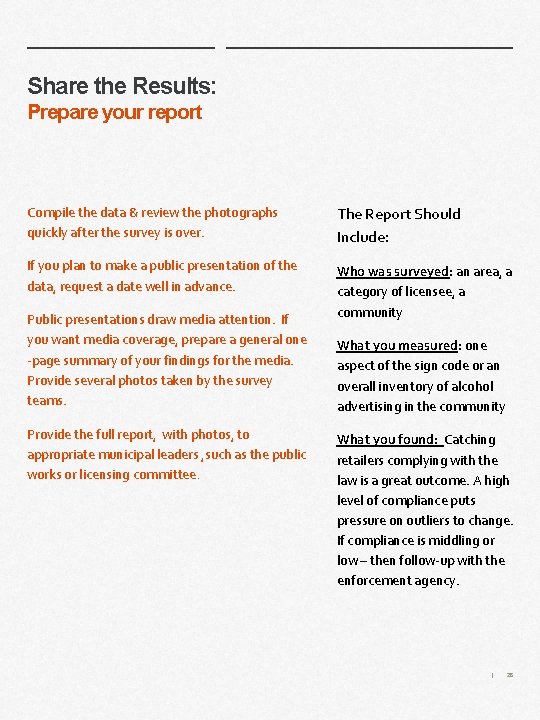
Share the Results: Prepare your report Compile the data & review the photographs quickly after the survey is over. The Report Should Include: If you plan to make a public presentation of the data, request a date well in advance. Who was surveyed: an area, a category of licensee, a community Public presentations draw media attention. If you want media coverage, prepare a general one -page summary of your findings for the media. Provide several photos taken by the survey teams. Provide the full report, with photos, to appropriate municipal leaders , such as the public works or licensing committee. What you measured: one aspect of the sign code or an overall inventory of alcohol advertising in the community What you found: Catching retailers complying with the law is a great outcome. A high level of compliance puts pressure on outliers to change. If compliance is middling or low – then follow-up with the enforcement agency. | 28
Sharing the Results: Explain how windows & signs were measured and the proportions determined Explain how results were reached. Transparency increases the credibility of the report in the same way as notifying retailers in advance and including all Class A licensees. It demonstrates a commitment to enforcing the adopted community standard. | Photos & calculations provided by Healthy Edgerton 29
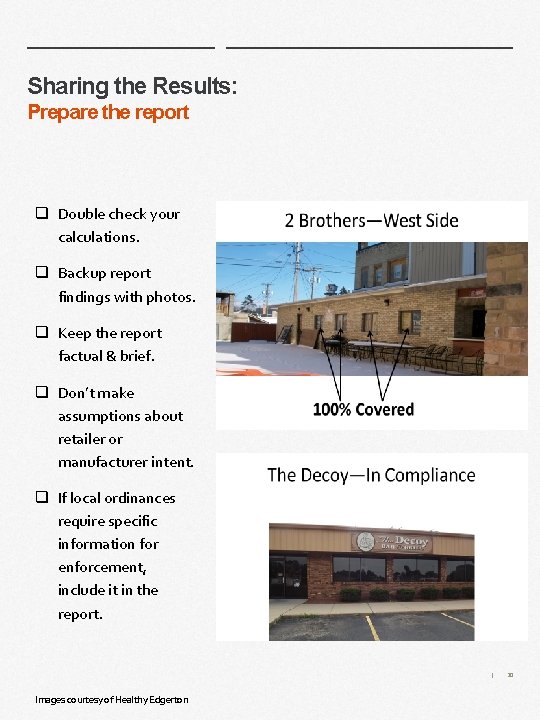
Sharing the Results: Prepare the report q Double check your calculations. q Backup report findings with photos. q Keep the report factual & brief. q Don’t make assumptions about retailer or manufacturer intent. q If local ordinances require specific information for enforcement, include it in the report. | Images courtesy of Healthy Edgerton 30
Share the Results: Organize a presentation to local media & elected officials Media: Local Elected Leaders: Pick your release date. Secure a date on alder/trustees calendar well in advance. Give copies of the report to relevant community officials (building inspector, planning staff) shortly before release – especially if you find non-compliance. No blindsiding! Brief volunteers and have them prepared for interviews on the project after the meeting. Put your personal contact information on any reports or materials. Nameless accusations are generally ineffective. If a complaint is required – file one. Provide a summary of your project to the local paper in addition to the same report provided to council. Don’t give the report to the media in advance. Elected officials first, then the media. | 31
Share the Results: Follow up on the findings Noncompliant Retailers: 1. Ask enforcement agency to follow-up with retailer within 30 days. * Compliant Retailers: 2. Always state your timeframe for action. . 1. Thank retailers for obeying the sign code. 3. When a resident complaint is required, file it promptly. 2. Remind retailers youth exposure to alcohol advertising is a factor in underage drinking. 3. Ask retailers to keep alcohollogoed advertising to a minimum. Compliance takes time. A March-April 2011 scan in Fond du Lac did not result in noncompliance action until August 29. Full compliance was achieved by September 15. * Fond du Lac encouraged youth to observe every part of the enforcement process with the cooperation of city officials. | 32
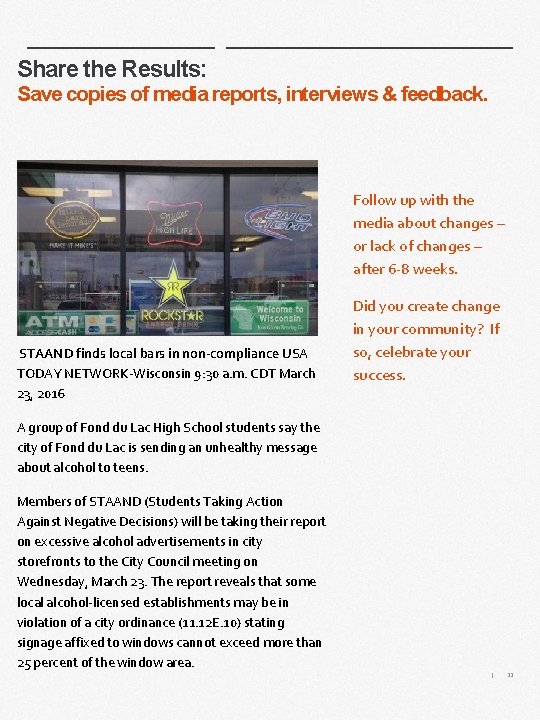
Share the Results: Save copies of media reports, interviews & feedback. Follow up with the media about changes – or lack of changes – after 6 -8 weeks. STAAND finds local bars in non-compliance USA TODAY NETWORK-Wisconsin 9: 30 a. m. CDT March 23, 2016 Did you create change in your community? If so, celebrate your success. A group of Fond du Lac High School students say the city of Fond du Lac is sending an unhealthy message about alcohol to teens. Members of STAAND (Students Taking Action Against Negative Decisions) will be taking their report on excessive alcohol advertisements in city storefronts to the City Council meeting on Wednesday, March 23. The report reveals that some local alcohol-licensed establishments may be in violation of a city ordinance (11. 12 E. 10) stating signage affixed to windows cannot exceed more than 25 percent of the window area. | 33
Examples & Resources
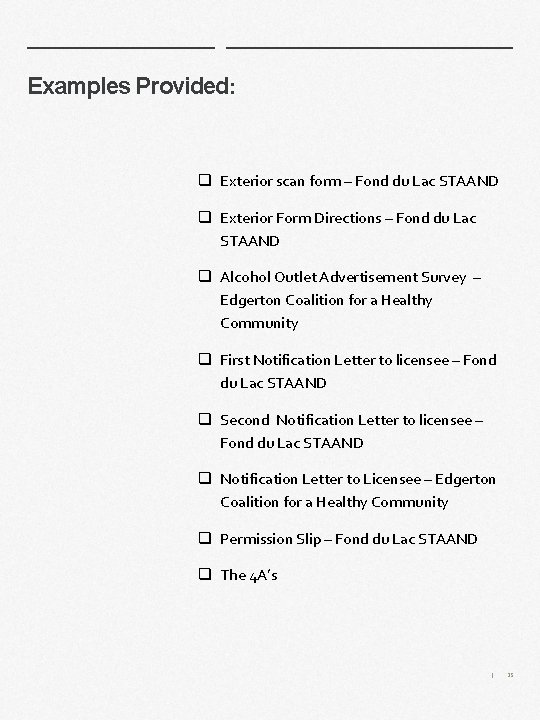
Examples Provided: q Exterior scan form – Fond du Lac STAAND q Exterior Form Directions – Fond du Lac STAAND q Alcohol Outlet Advertisement Survey – Edgerton Coalition for a Healthy Community q First Notification Letter to licensee – Fond du Lac STAAND q Second Notification Letter to licensee – Fond du Lac STAAND q Notification Letter to Licensee – Edgerton Coalition for a Healthy Community q Permission Slip – Fond du Lac STAAND q The 4 A’s | 35
Exterior Scan Form – Fond du Lac SM Type: G B Store Name L CS P Gas CC: Windows and Doors Building and Fences (Neon and Other Signs) (Posters, Banners, Flags) M# B# MH# I# C# L# G# K# MB# Cr# Other: M# MH# B# I# C# L# G# K# Food Other, Specify Sidewalk/Parking Lot (Free Standing Signs) MB# Other: Cr# M# MH# B# I# C# L# G# K# MB# Other: Cr# Total Alcohol Windows: Total Number of Non- Advertisement Windows: Percentage of Window Alcoholic Advertisements Check if appropriate: covered by all advertisements Store is located 300 feet from Public School Parochial School Park Hospital Church s # % SM Type: # % G B Store Name L CS P Windows and Doors B# MH# K# Food Other, Specify Building and Fences (Neon and Other Signs) M# Gas CC: Sidewalk/Parking Lot (Posters, Banners, Flags) C# G# Cr# I# L# M# MH# B# I# C# L# G# K# MB# Other: (Free Standing Signs) Cr# M# Cr# Other: B# MH# C# I# G# L# MB# K# Other: Total Alcohol Windows: Total Number of Non- Advertisement Windows: Percentage of Window Alcoholic Advertisements Check if appropriate: covered by all advertisements Store is located 300 feet from Public School Parochial School Park Hospital Church s # % SM Type: # % G B Store Name L CS P Windows and Doors B# MH# K# C# G# Cr# I# L# Food Other, Specify Building and Fences (Neon and Other Signs) M# Gas CC: Sidewalk/Parking Lot (Posters, Banners, Flags) M# MH# B# I# C# L# G# K# MB# Other: (Free Standing Signs) Cr# M# Cr# Other: B# MH# C# I# G# L# MB# K# Other: Total Alcohol Windows: Total Number of Non- Advertisement Alcoholic Advertisements Windows: Percentage of Window Check if appropriate: covered by all advertisements Store is located 300 feet from Public School Parochial School Park Hospital Church s # % | 36
| 37
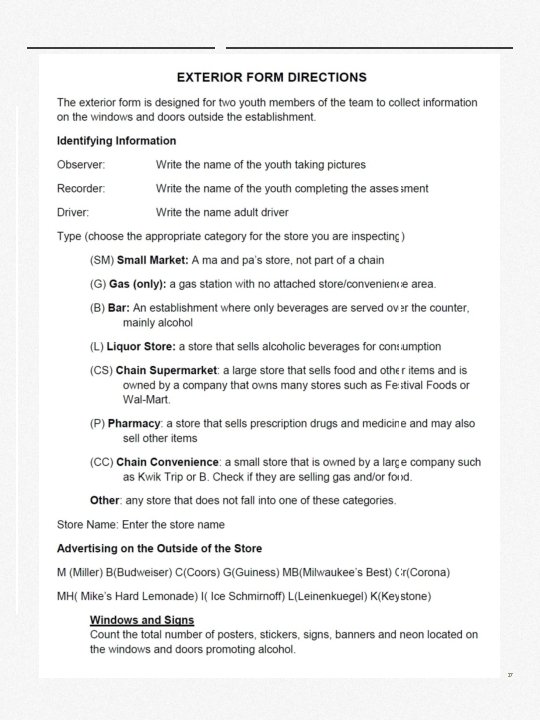
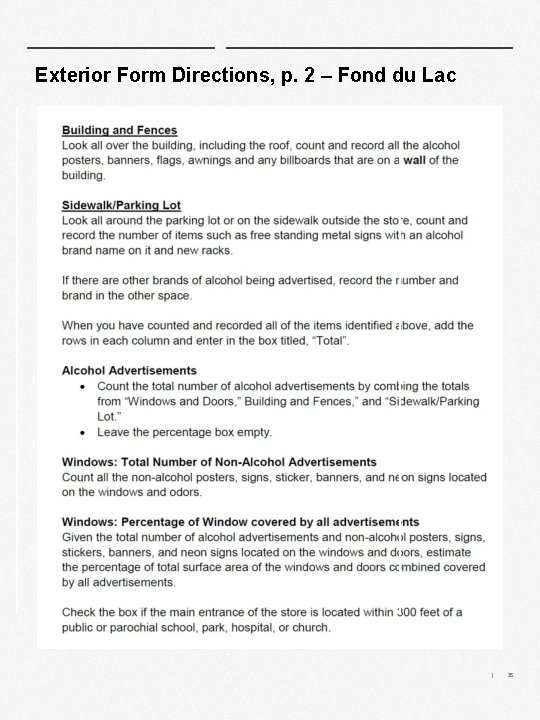
Exterior Form Directions, p. 2 – Fond du Lac | 38
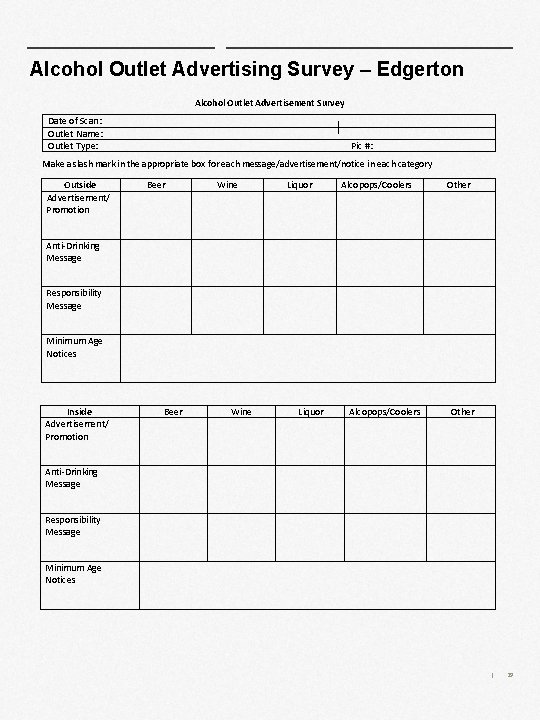
Alcohol Outlet Advertising Survey – Edgerton Alcohol Outlet Advertisement Survey Date of Scan: Outlet Name: Outlet Type: Pic #: Make a slash mark in the appropriate box for each message/advertisement/notice in each category Outside Advertisement/ Promotion Beer Wine Liquor Alcopops/Coolers Other Anti-Drinking Message Responsibility Message Minimum Age Notices Inside Advertisement/ Promotion Beer Wine Liquor Alcopops/Coolers Other Anti-Drinking Message Responsibility Message Minimum Age Notices | 39
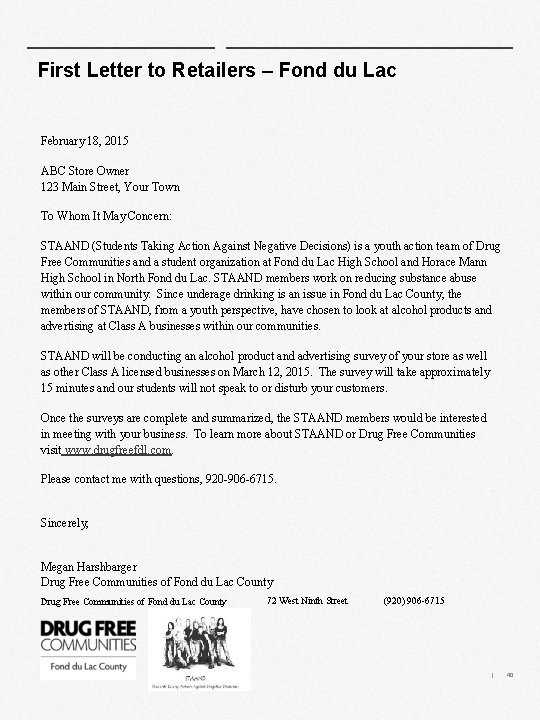
First Letter to Retailers – Fond du Lac February 18, 2015 ABC Store Owner 123 Main Street, Your Town To Whom It May Concern: STAAND (Students Taking Action Against Negative Decisions) is a youth action team of Drug Free Communities and a student organization at Fond du Lac High School and Horace Mann High School in North Fond du Lac. STAAND members work on reducing substance abuse within our community. Since underage drinking is an issue in Fond du Lac County, the members of STAAND, from a youth perspective, have chosen to look at alcohol products and advertising at Class A businesses within our communities. STAAND will be conducting an alcohol product and advertising survey of your store as well as other Class A licensed businesses on March 12, 2015. The survey will take approximately 15 minutes and our students will not speak to or disturb your customers. Once the surveys are complete and summarized, the STAAND members would be interested in meeting with your business. To learn more about STAAND or Drug Free Communities visit www. drugfreefdl. com. Please contact me with questions, 920 -906 -6715. Sincerely, Megan Harshbarger Drug Free Communities of Fond du Lac County 72 West Ninth Street (920) 906 -6715 | 40
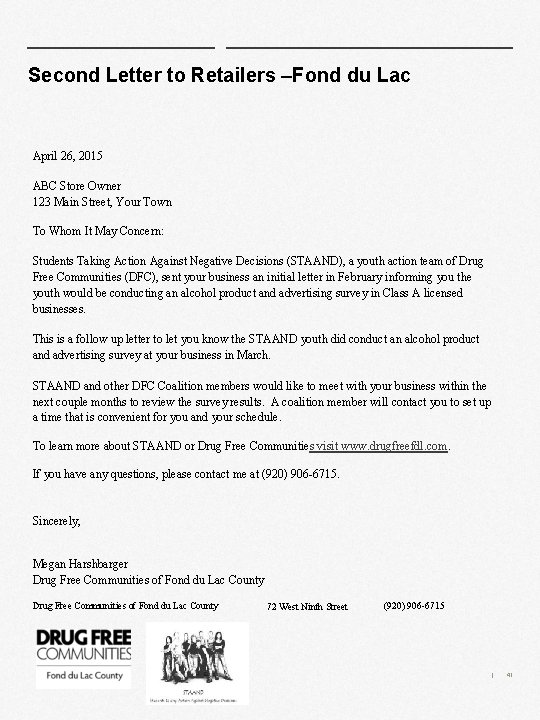
Second Letter to Retailers –Fond du Lac April 26, 2015 ABC Store Owner 123 Main Street, Your Town To Whom It May Concern: Students Taking Action Against Negative Decisions (STAAND), a youth action team of Drug Free Communities (DFC), sent your business an initial letter in February informing you the youth would be conducting an alcohol product and advertising survey in Class A licensed businesses. This is a follow up letter to let you know the STAAND youth did conduct an alcohol product and advertising survey at your business in March. STAAND and other DFC Coalition members would like to meet with your business within the next couple months to review the survey results. A coalition member will contact you to set up a time that is convenient for you and your schedule. To learn more about STAAND or Drug Free Communities visit www. drugfreefdl. com. If you have any questions, please contact me at (920) 906 -6715. Sincerely, Megan Harshbarger Drug Free Communities of Fond du Lac County 72 West Ninth Street (920) 906 -6715 | 41
Notification Letter to Licensee – Edgerton August 9 th, 2013 Dear Edgerton Area Alcohol Merchant, Recently, local youth were trained to conduct environmental scans by Edgerton Coalition for a Healthy Community (ECHC) staff through funding from a federal grant issued to ECHC to prevent underage drinking. In the coming month, we will be conducting an environmental scan of alcohol retail outlets in the Edgerton area. A similar scan was performed in July 2011. When we come to your business, the adult advisor of this group will present your on-duty manager with this letter and will ask permission for this youth team to enter your business in order to complete this important study. The youth team or the adult advisor can answer any questions you may have. With your permission, youth will then take pictures and document their observations in a report. Specifically, we will look at what products are available and/or advertised and where they are located throughout the store. The scan should not take more than 15 minutes, including an outdoor evaluation as well. If you, the owner, might not be in your business when we perform the scan, please inform your daytime manager that you permit our youth workers to enter your store for these purposes. As a token of our appreciation, we will issue a press release thanking your business and others for participating in this study; however, when information and data are shared with the community, identifying features will be removed, in order to protect your business’s anonymity. Thank you for being one of the many responsible merchants in Edgerton that supports efforts to reduce underage drinking. If you have any questions or concerns feel free to contact me at the number below. Sincerely, Meagan Farrell Project Assistant Edgerton Coalition for a Healthy Community (608) 561 -6100 x 2922 | 42
Parental Permission Slip – Fond du Lac PERMISSION SLIP Please complete and return on Thursday, February 26 th. I do hereby give permission to my son/daughter, to participate in a survey being conducted by Drug Free Communities of Fond du Lac County that looks at alcohol advertising and promotion found in various alcohol retail outlets in the City of Fond du Lac. The purpose of this exercise is to learn what the community is telling youth about alcohol. I understand that my child may participate at a later date in publicity and educational components of this project. I release the Fond du Lac School District and Drug Free Communities of Fond du Lac County from all liability involved from my son/daughter participating in the survey and subsequent project activities. | 43
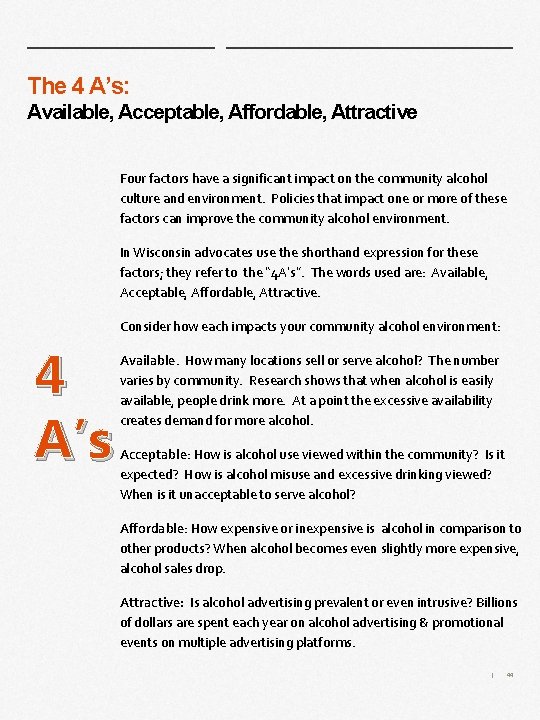
The 4 A’s: Available, Acceptable, Affordable, Attractive Four factors have a significant impact on the community alcohol culture and environment. Policies that impact one or more of these factors can improve the community alcohol environment. In Wisconsin advocates use the shorthand expression for these factors; they refer to the “ 4 A’s”. The words used are: Available, Acceptable, Affordable, Attractive. Consider how each impacts your community alcohol environment: 4 A’s Available. How many locations sell or serve alcohol? The number varies by community. Research shows that when alcohol is easily available, people drink more. At a point the excessive availability creates demand for more alcohol. Acceptable: How is alcohol use viewed within the community? Is it expected? How is alcohol misuse and excessive drinking viewed? When is it unacceptable to serve alcohol? Affordable: How expensive or inexpensive is alcohol in comparison to other products? When alcohol becomes even slightly more expensive, alcohol sales drop. Attractive: Is alcohol advertising prevalent or even intrusive? Billions of dollars are spent each year on alcohol advertising & promotional events on multiple advertising platforms. | 44
Resources: CADCA: Preventing alcohol, tobacco and other drug abuse Since 1992, the Community Anti-Drug Coalitions of America has demonstrated that when all sectors of a community come together, social change happens. CADCA is the premier membership organization representing those working to make their communities safe, healthy and drug-free. They have members in every U. S. state and territory and work in 18 countries around the world. www. cadca. org Learn more about the impact of alcohol advertising on youth: Center on Alcohol Marketing & Youth measures youth exposure to alcohol marketing in a wide range of different media outlets including T. V. , radio, online and published advertising. Using the tools developed by the advertising industry, it estimates youth exposure to alcohol advertising. www. camy. org Alcohol Justice: This California based nonprofit group monitors the alcohol industry. It has operated campaigns to eliminate alcohol advertising from mass transit, highlight the limits of selfregulation and, raise awareness of “Pink Washing. ” www. alcoholjustice. org Learn more about resources in Wisconsin to prevent & reduce underage drinking: Alliance for Wisconsin Youth: An organization representing over 100 community coalitions working locally to prevent alcohol and drug use among Wisconsin youth. The Alliance’s Regional Resource Centers provide training to member coalitions and opportunities for regional coordination. Organize or join a local coalition to prevent and reduce local alcohol and drug use among youth. www. allwisyouth. org | 45
Resources: The Wisconsin Alcohol Policy Project Visit the Wisconsin Alcohol Policy Project website, https: //law. wisc. edu/wapp/, for additional information on evidence-based polices & practices that prevent and reduce excessive alcohol consumption, including: § Licensing Alcohol Outlets § Alcohol Age Compliance Checks § Social Host Ordinance § Alcohol Control at Festivals & Outdoor Events § Sober Server Ordinances § Ordinances that prevent or reduce excessive drinking Contact Julia Sherman, Coordinator: Julia. Sherman@wisc. edu 608 -262 -0370 | 46
Acknowledgements
Thank you to the groups that generously shared their experience & materials. Students Taking Action Against Negative Decisions of Drug Free Communities of Fond du Lac County: Megan Harshbarger, CSI Project Coordinator, and Ellen Sorensen, Grant Coordinator Healthy Edgerton, Meagan Farrell, Coordinator The Wisconsin Alcohol Policy Project is a project of the University of Wisconsin Law School through funding from the Wisconsin Department of Health Services. Community Health Improvement in Action, a project of the Wisconsin Association of Local Health Departments & Boards, Sara Jesse, Project Manager. The coalitions, public health agencies and community leaders who shared their experiences and ideas with the Wisconsin Alcohol Policy Project. | 48