
Conducting a Risk Assessment Learning Outcomes To understand
- Slides: 12
Conducting a Risk Assessment Learning Outcomes • To understand the difference between a risk, a hazard and a control measure • To identify hazards in a laboratory setting • To recognise any potential risks that could arise from those identified hazards • To identify the control measure that needs to be put in place to prevent the hazard from occurring
What is a Risk Assessment? Before carrying out any practical investigation a risk assessment must be performed. This should involve looking at the materials, equipment and any chemicals you are planning to use and identifying any possible dangers that these may cause and what action can be taken to minimise these dangers. The three categories that we focus on when carrying out a risk assessment are ‘Hazards’, ‘Risks’ and ‘Control Measures’.
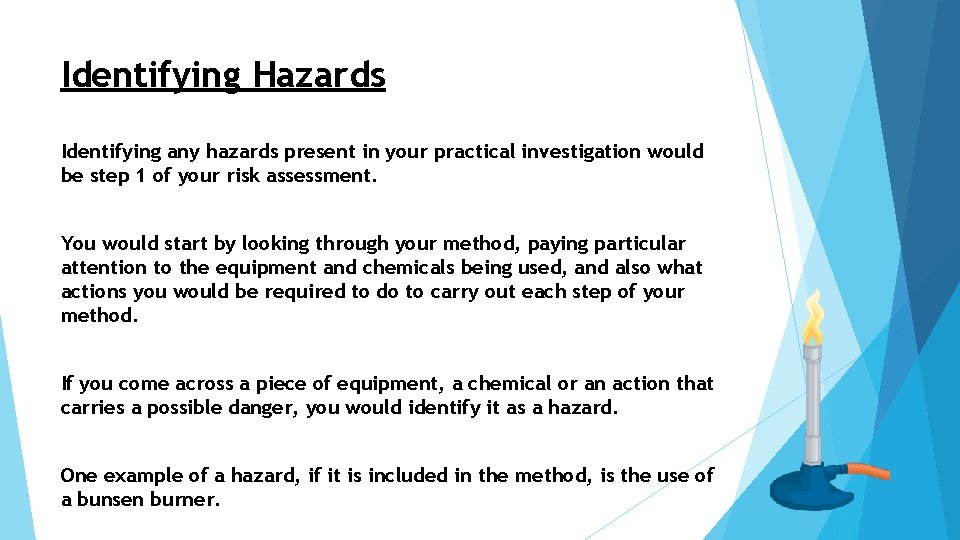
Identifying Hazards Identifying any hazards present in your practical investigation would be step 1 of your risk assessment. You would start by looking through your method, paying particular attention to the equipment and chemicals being used, and also what actions you would be required to do to carry out each step of your method. If you come across a piece of equipment, a chemical or an action that carries a possible danger, you would identify it as a hazard. One example of a hazard, if it is included in the method, is the use of a bunsen burner.
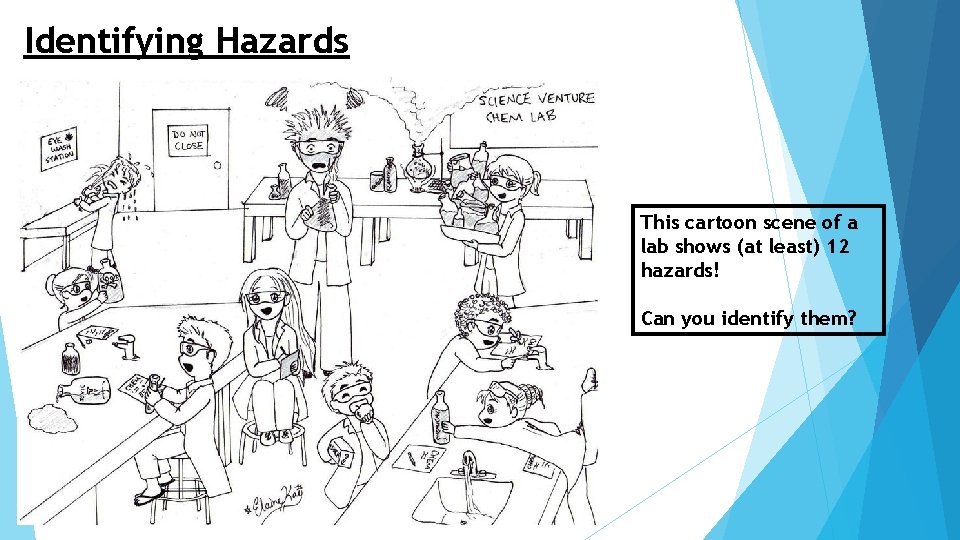
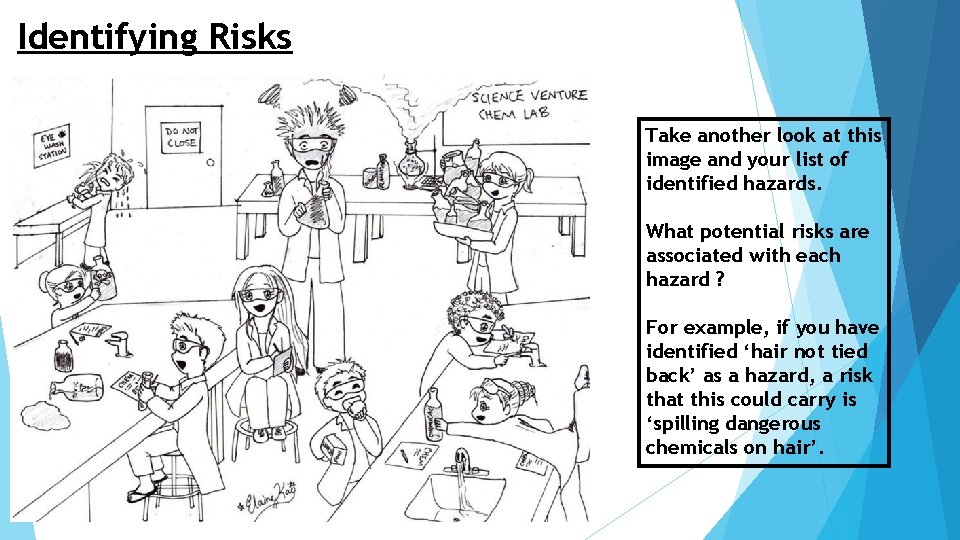
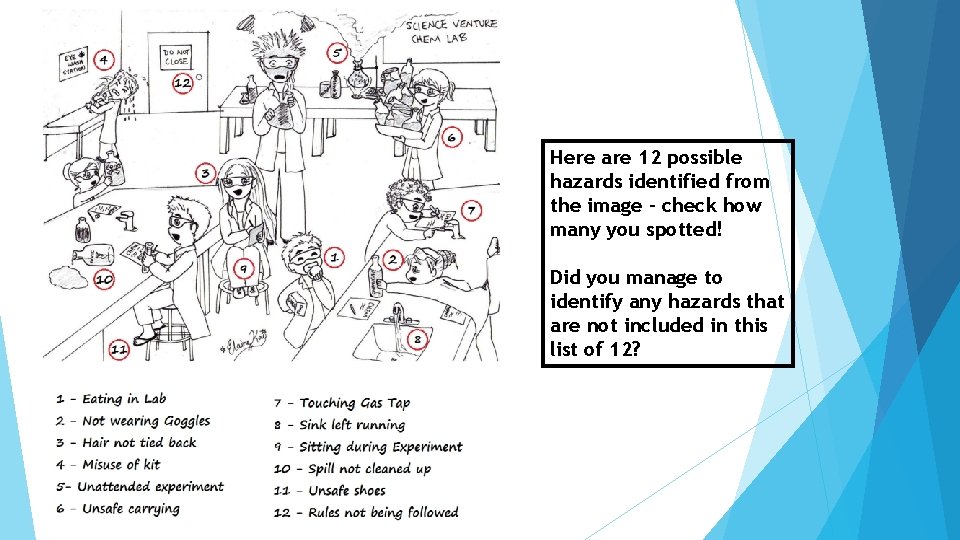
Identifying Hazards This cartoon scene of a lab shows (at least) 12 hazards! Can you identify them?
Identifying Risks The next step in our risk assessment is to take a look at the possible outcomes of the hazards we identified in step 1. Each identified hazard will have a risk directly associated with it, for example if we named a bunsen burner as a hazard the potential risk could be burning ourselves. It is essential that every identified hazard in our investigation has a corresponding risk.
Identifying Risks Take another look at this image and your list of identified hazards. What potential risks are associated with each hazard ? For example, if you have identified ‘hair not tied back’ as a hazard, a risk that this could carry is ‘spilling dangerous chemicals on hair’.
Identifying Control Measures The third and final step in our risk assessment is deciding on the procedures that need to be followed in order for each risk to be minimal or non existent. We call these procedures control measures. Each identified risk from step 2 of our risk assessment will have its own control measure. Using the example of a bunsen burner as a hazard, and burning ourselves is a risk of using the bunsen burner, what control measures should we have in place in order to minimise the risk? One possible control measure could be not to put your hand in the flame!
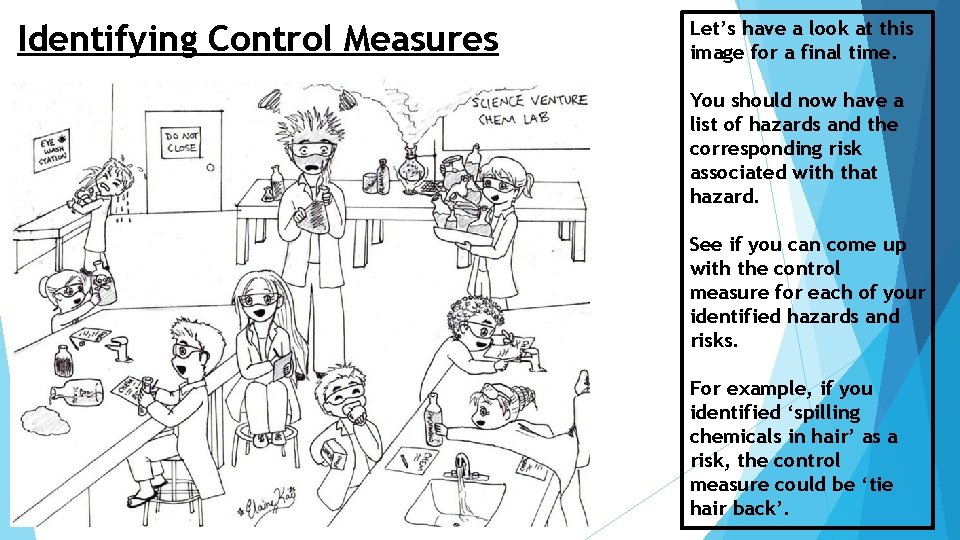
Identifying Control Measures Let’s have a look at this image for a final time. You should now have a list of hazards and the corresponding risk associated with that hazard. See if you can come up with the control measure for each of your identified hazards and risks. For example, if you identified ‘spilling chemicals in hair’ as a risk, the control measure could be ‘tie hair back’.
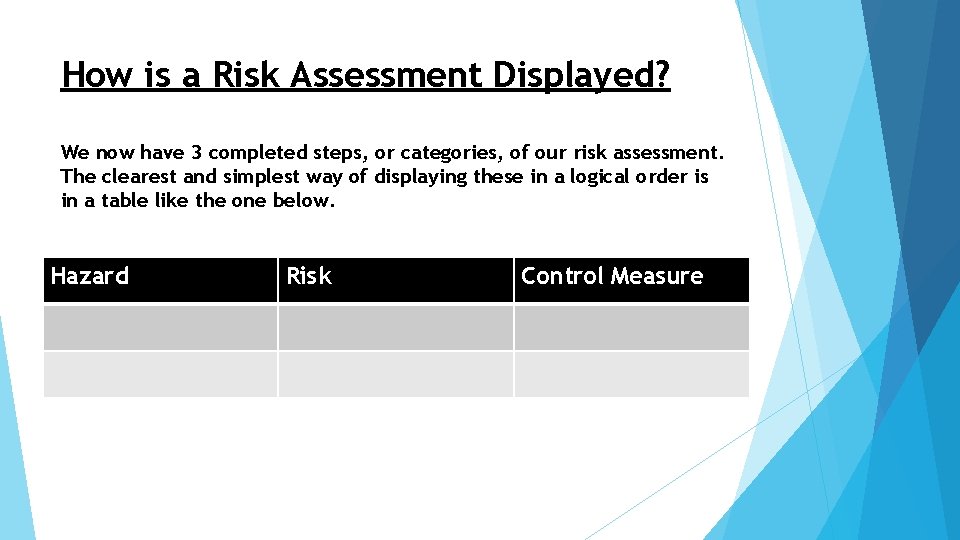
How is a Risk Assessment Displayed? We now have 3 completed steps, or categories, of our risk assessment. The clearest and simplest way of displaying these in a logical order is in a table like the one below. Hazard Risk Control Measure
Task – Identifying Hazards, Risks and Control Measures in a Practical Investigation It is now time to look at a practical investigation and use the new skills that we have learned today. Click on the link below and observe the practical investigation being demonstrated. Don’t worry about theory or why the investigation is being carried out, all you need to pay attention to are the equipment and chemicals being used and what the demonstrator is doing. Your task is to identify 3 hazards, the risks they carry and what control measures should be in place to either prevent or minimise the risks. Use the table on the previous page for help setting your answers out. https: //www. youtube. com/watch? v=q. IOMlw. Boe_4
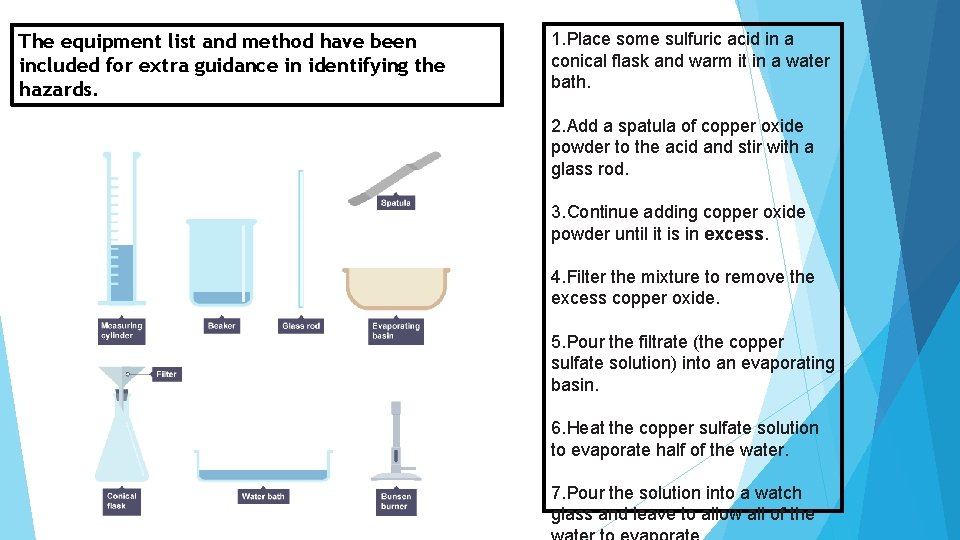
The equipment list and method have been included for extra guidance in identifying the hazards. 1. Place some sulfuric acid in a conical flask and warm it in a water bath. 2. Add a spatula of copper oxide powder to the acid and stir with a glass rod. 3. Continue adding copper oxide powder until it is in excess. 4. Filter the mixture to remove the excess copper oxide. 5. Pour the filtrate (the copper sulfate solution) into an evaporating basin. 6. Heat the copper sulfate solution to evaporate half of the water. 7. Pour the solution into a watch glass and leave to allow all of the
Here are 12 possible hazards identified from the image – check how many you spotted! Did you manage to identify any hazards that are not included in this list of 12?