
Conducting a Comprehensive Needs Assessment for the Title








- Slides: 43
Conducting a Comprehensive Needs Assessment for the Title I, Part A, Schoolwide Plan Title I University September 2014 Kristi Bond 1
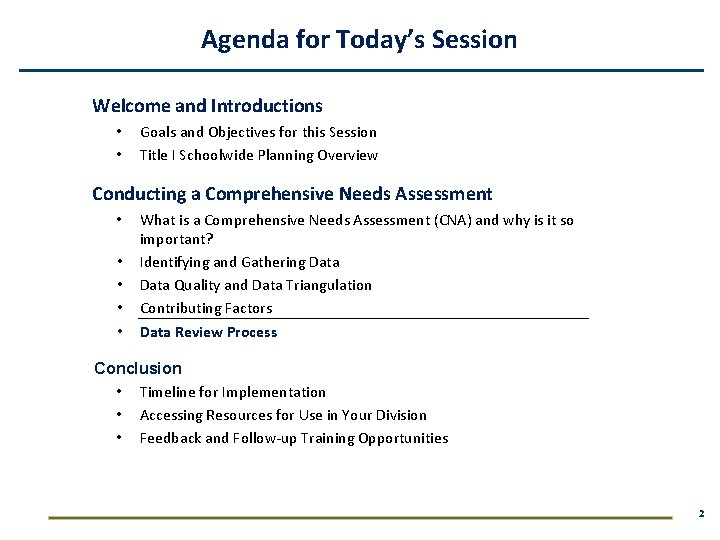
Agenda for Today’s Session Welcome and Introductions • • Goals and Objectives for this Session Title I Schoolwide Planning Overview Conducting a Comprehensive Needs Assessment • • • What is a Comprehensive Needs Assessment (CNA) and why is it so important? Identifying and Gathering Data Quality and Data Triangulation Contributing Factors Data Review Process Conclusion • Timeline for Implementation • Accessing Resources for Use in Your Division • Feedback and Follow-up Training Opportunities 2
Session Goals/Objectives �Gain an understanding of what a CNA is and why it’s a crucial first step for school improvement planning �Become equipped to facilitate a deep and meaningful CNA in your school through: � a process of data triangulation to identify areas of strength and challenge; and � discovery of root causes (contributing factors) impacting student outcomes �Become prepared to conduct a CNA process in your school/division by walking through the steps involved 3
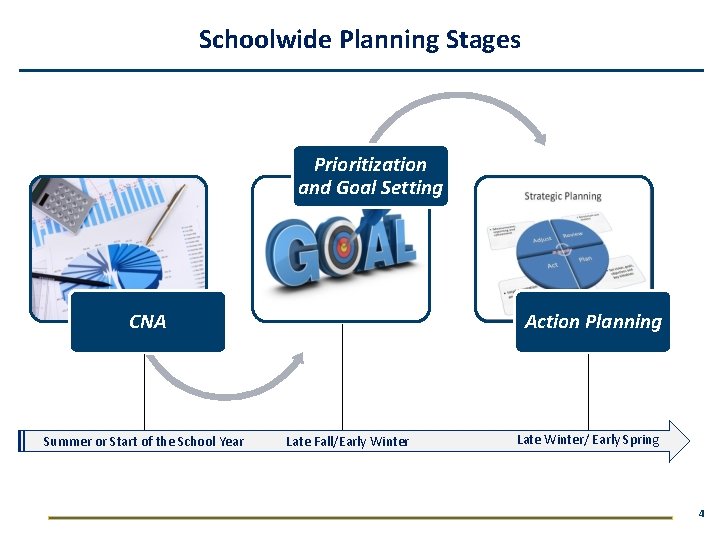
Schoolwide Planning Stages Prioritization and Goal Setting CNA Summer or Start of the School Year Action Planning Late Fall/Early Winter Late Winter/ Early Spring 4
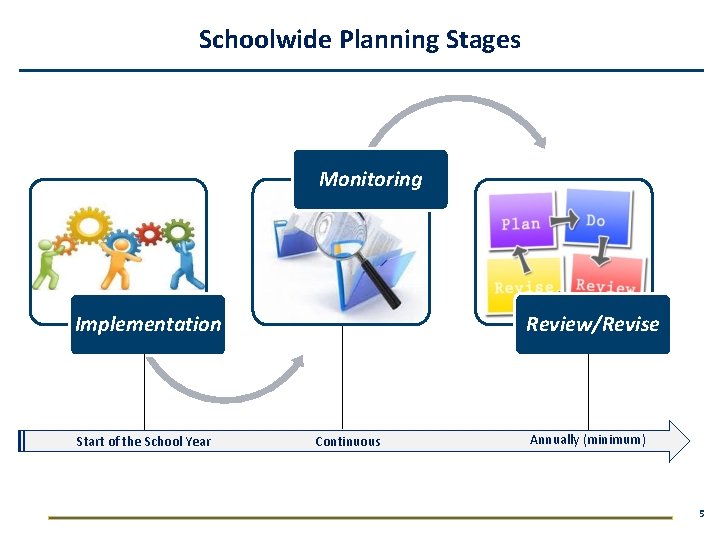
Schoolwide Planning Stages Monitoring Implementation Start of the School Year Review/Revise Continuous Annually (minimum) 5
Schoolwide Plan – 10 Components Schoolwide Plan 1. Comprehensive Needs Assessment 2. Schoolwide Reform Strategies 3. Highly Qualified Teachers 4. High Quality Professional Development 5. Strategies to Attract High Quality Teachers 6. Parental Involvement 7. Transition Plans – Preschool to Kindergarten 8. Teacher Participation in Assessment Decisions 9. Timely Additional Assistance 10. Coordination of Services and Programs 6
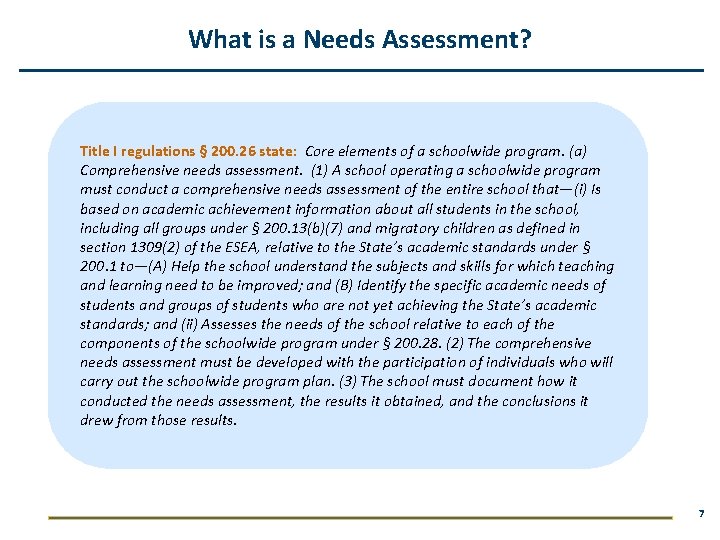
What is a Needs Assessment? Title I regulations § 200. 26 state: Core elements of a schoolwide program. (a) Comprehensive needs assessment. (1) A school operating a schoolwide program must conduct a comprehensive needs assessment of the entire school that—(i) Is based on academic achievement information about all students in the school, including all groups under § 200. 13(b)(7) and migratory children as defined in section 1309(2) of the ESEA, relative to the State’s academic standards under § 200. 1 to—(A) Help the school understand the subjects and skills for which teaching and learning need to be improved; and (B) Identify the specific academic needs of students and groups of students who are not yet achieving the State’s academic standards; and (ii) Assesses the needs of the school relative to each of the components of the schoolwide program under § 200. 28. (2) The comprehensive needs assessment must be developed with the participation of individuals who will carry out the schoolwide program plan. (3) The school must document how it conducted the needs assessment, the results it obtained, and the conclusions it drew from those results. 7
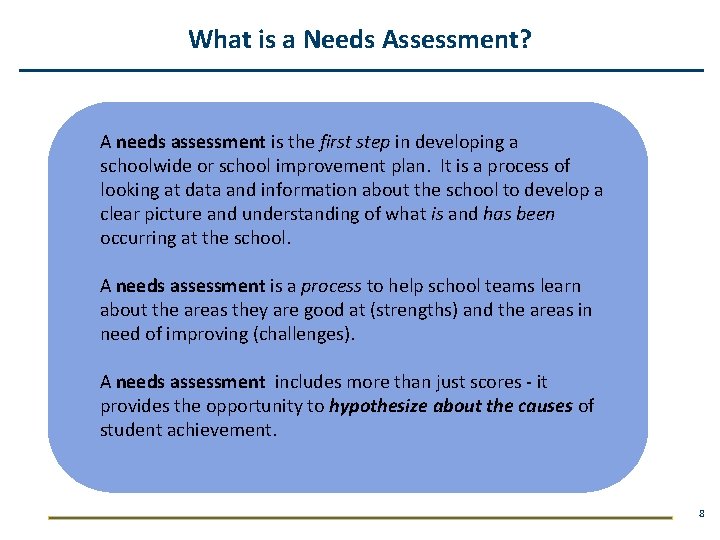
What is a Needs Assessment? A needs assessment is the first step in developing a schoolwide or school improvement plan. It is a process of looking at data and information about the school to develop a clear picture and understanding of what is and has been occurring at the school. A needs assessment is a process to help school teams learn about the areas they are good at (strengths) and the areas in need of improving (challenges). A needs assessment includes more than just scores - it provides the opportunity to hypothesize about the causes of student achievement. 8
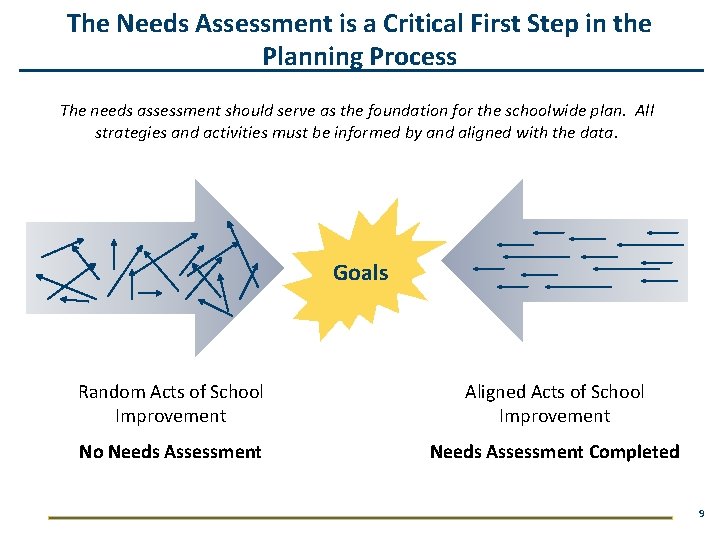
The Needs Assessment is a Critical First Step in the Planning Process The needs assessment should serve as the foundation for the schoolwide plan. All strategies and activities must be informed by and aligned with the data. Goals Random Acts of School Improvement Aligned Acts of School Improvement No Needs Assessment Completed 9
The Needs Assessment Narrows our Focus Inquiry process produces a strong beam of thought directed to illuminate a focused area of student need and adult practice. 10
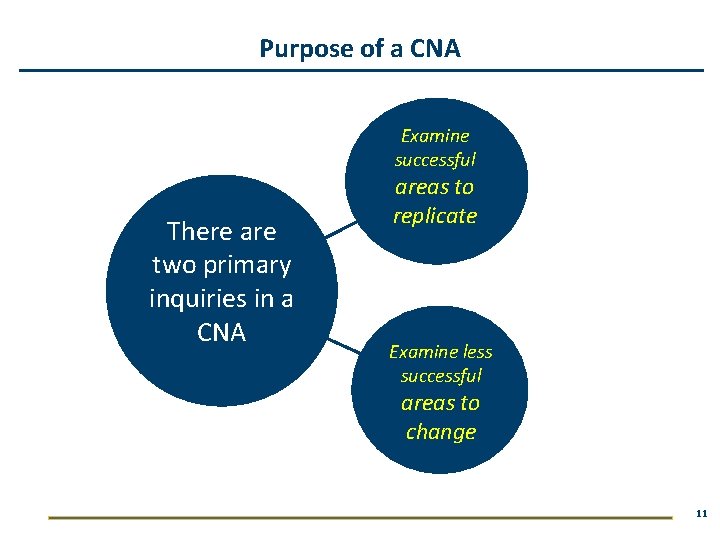
Purpose of a CNA Examine successful There are two primary inquiries in a CNA areas to replicate Examine less successful areas to change 11
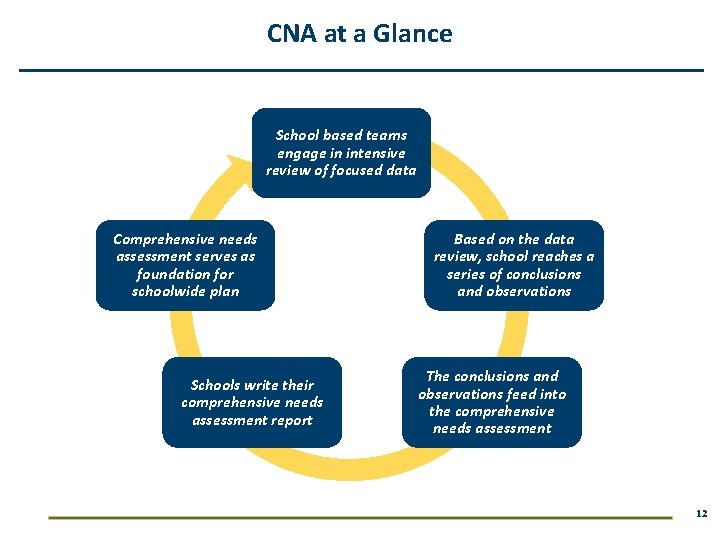
CNA at a Glance School based teams engage in intensive review of focused data Comprehensive needs assessment serves as foundation for schoolwide plan Schools write their comprehensive needs assessment report Based on the data review, school reaches a series of conclusions and observations The conclusions and observations feed into the comprehensive needs assessment 12
CNA Process • Identify Data Sources & Gather Necessary Data Points • Data Review by Subcommittees • Identify & Articulate Patterns/Trends in Key Data Points • School Planning Team Review of Findings . • Write the CNA Report: Foundation to the SWP 13
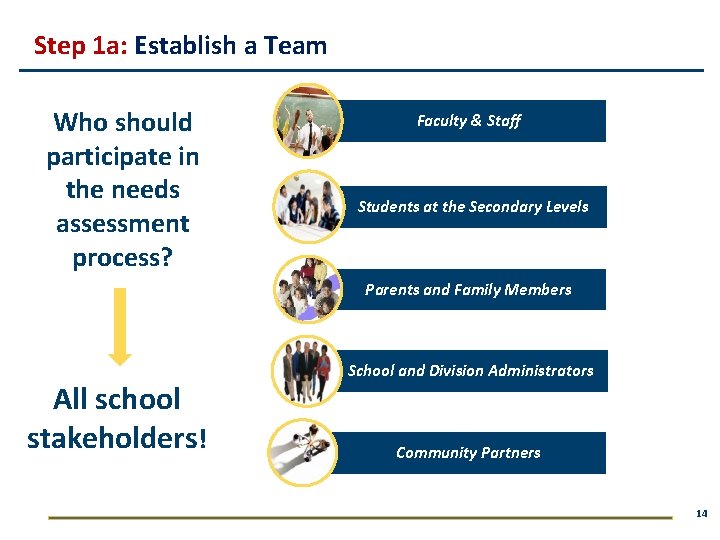
Step 1 a: Establish a Team Who should participate in the needs assessment process? Faculty & Staff Students at the Secondary Levels Parents and Family Members All school stakeholders! School and Division Administrators Community Partners 14
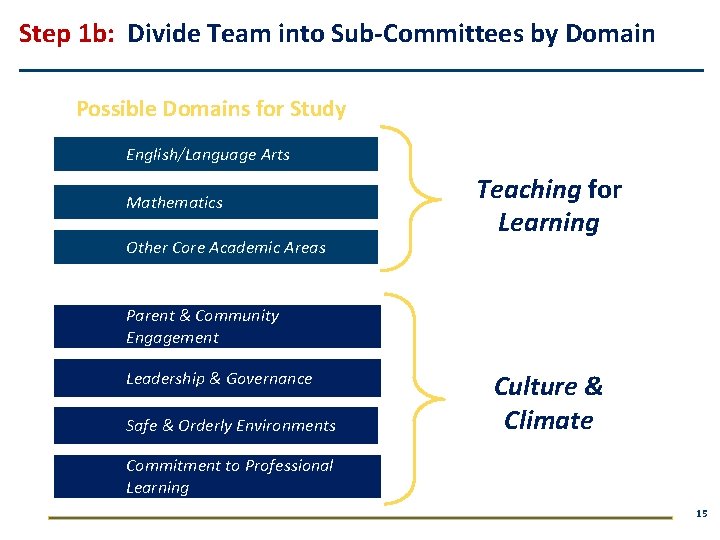
Step 1 b: Divide Team into Sub-Committees by Domain Possible Domains for Study English/Language Arts Mathematics Other Core Academic Areas Teaching for Learning Parent & Community Engagement Leadership & Governance Safe & Orderly Environments Culture & Climate Commitment to Professional Learning 15
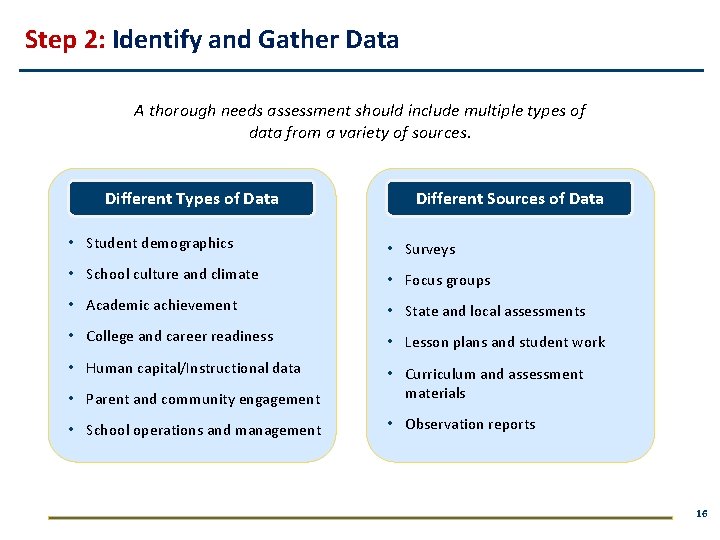
Step 2: Identify and Gather Data A thorough needs assessment should include multiple types of data from a variety of sources. Different Types of Data Different Sources of Data • Student demographics • Surveys • School culture and climate • Focus groups • Academic achievement • State and local assessments • College and career readiness • Lesson plans and student work • Human capital/Instructional data • Parent and community engagement • Curriculum and assessment materials • School operations and management • Observation reports 16
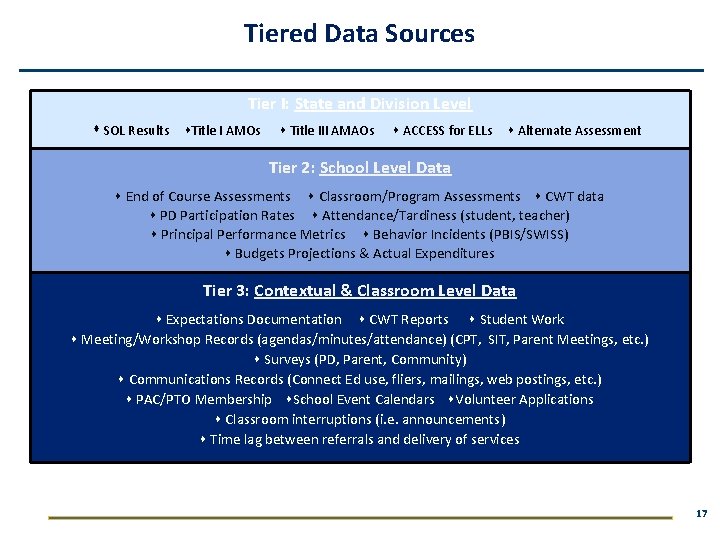
Tiered Data Sources Tier I: State and Division Level SOL Results Title I AMOs Title III AMAOs ACCESS for ELLs Alternate Assessment Tier 2: School Level Data. End of Course Assessments Classroom/Program Assessments CWT data PD Participation Rates Attendance/Tardiness (student, teacher) Principal Performance Metrics Behavior Incidents (PBIS/SWISS) Budgets Projections & Actual Expenditures Tier 3: Contextual & Classroom Level Data. Expectations Documentation CWT Reports Student Work Meeting/Workshop Records (agendas/minutes/attendance) (CPT, SIT, Parent Meetings, etc. ) Surveys (PD, Parent, Community) Communications Records (Connect Ed use, fliers, mailings, web postings, etc. ) PAC/PTO Membership School Event Calendars Volunteer Applications Classroom interruptions (i. e. announcements) Time lag between referrals and delivery of services 17
When determining which sources of data to use, think about the following questions: Ø Are the data sets relevant to the area under study? Ø Do the data points selected give you differing perspectives or lenses through which you can answer key questions? Ø How does each of the data points (sources of data) help you answer key questions? 18
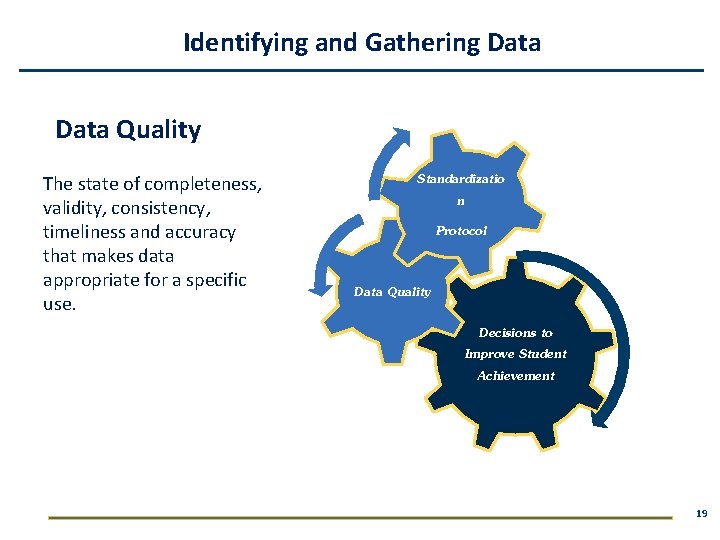
Identifying and Gathering Data Quality The state of completeness, validity, consistency, timeliness and accuracy that makes data appropriate for a specific use. Standardizatio n Protocol Data Quality Decisions to Improve Student Achievement 19
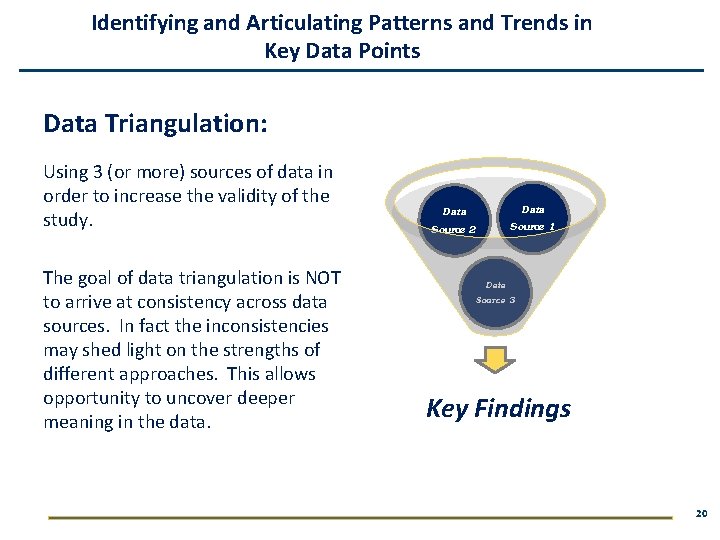
Identifying and Articulating Patterns and Trends in Key Data Points Data Triangulation: Using 3 (or more) sources of data in order to increase the validity of the study. The goal of data triangulation is NOT to arrive at consistency across data sources. In fact the inconsistencies may shed light on the strengths of different approaches. This allows opportunity to uncover deeper meaning in the data. Data Source 2 Data Source 1 Data Source 3 Key Findings 20
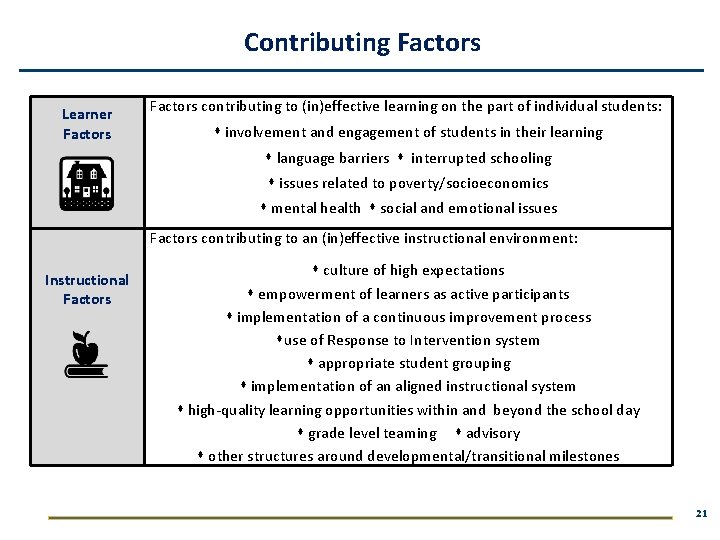
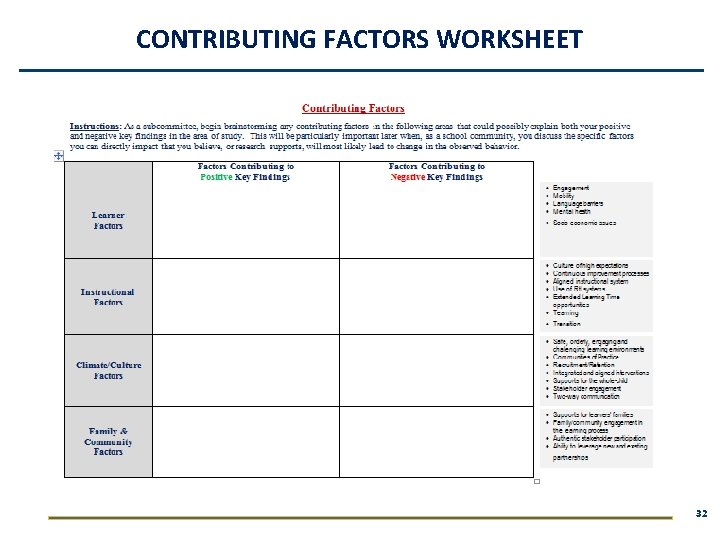
Contributing Factors Learner Factors contributing to (in)effective learning on the part of individual students: involvement and engagement of students in their learning language barriers interrupted schooling issues related to poverty/socioeconomics mental health social and emotional issues Factors contributing to an (in)effective instructional environment: Instructional Factors culture of high expectations empowerment of learners as active participants implementation of a continuous improvement process use of Response to Intervention system appropriate student grouping implementation of an aligned instructional system high-quality learning opportunities within and beyond the school day grade level teaming advisory other structures around developmental/transitional milestones 21
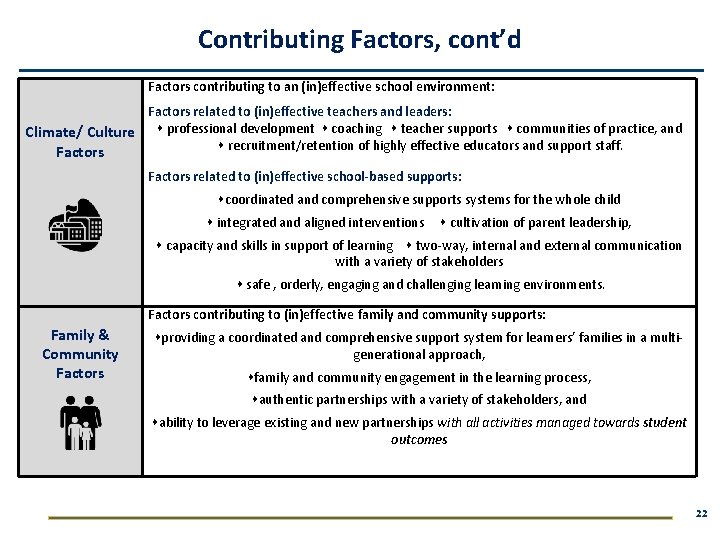
Contributing Factors, cont’d Factors contributing to an (in)effective school environment: Factors related to (in)effective teachers and leaders: Climate/ Culture professional development coaching teacher supports communities of practice, and recruitment/retention of highly effective educators and support staff. Factors related to (in)effective school-based supports: coordinated and comprehensive supports systems for the whole child integrated and aligned interventions cultivation of parent leadership, capacity and skills in support of learning two-way, internal and external communication with a variety of stakeholders safe , orderly, engaging and challenging learning environments. Factors contributing to (in)effective family and community supports: Family & Community Factors providing a coordinated and comprehensive support system for learners’ families in a multigenerational approach, family and community engagement in the learning process, authentic partnerships with a variety of stakeholders, and ability to leverage existing and new partnerships with all activities managed towards student outcomes 22
Tip for success The purpose of the needs assessment is to determine what is happening in the school that is impacting learning and hypothesize on what the root causes might be. During your data review process – avoid the temptation to blame/finger point and the temptation to move into goal setting or problem solving. 23
Check Point 24
Check Point • Step 1 – Establish a team; Divide team into subcommittees • Step 2 – Identify and gather data – Types and Sources of Data – Data Quality – Data Triangulation • Contributing Factors 25
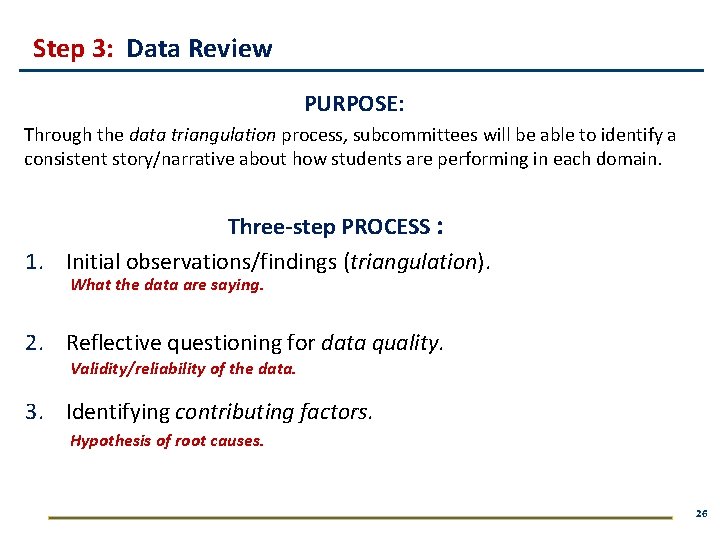
Step 3: Data Review PURPOSE: Through the data triangulation process, subcommittees will be able to identify a consistent story/narrative about how students are performing in each domain. Three-step PROCESS : 1. Initial observations/findings (triangulation). What the data are saying. 2. Reflective questioning for data quality. Validity/reliability of the data. 3. Identifying contributing factors. Hypothesis of root causes. 26
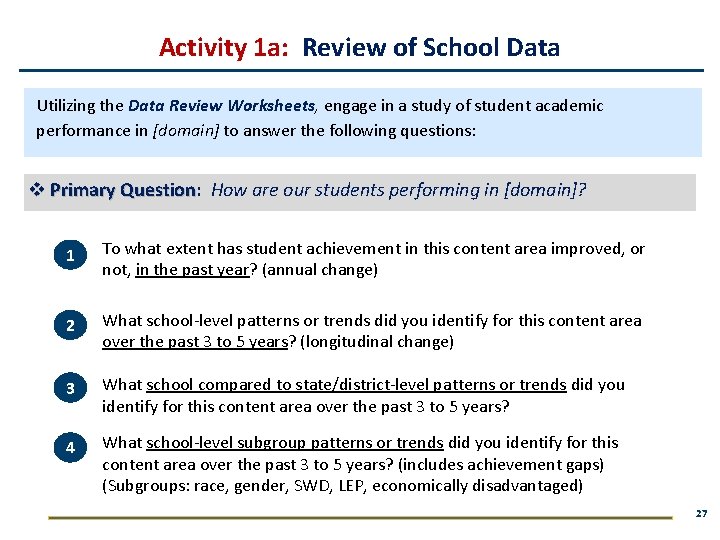
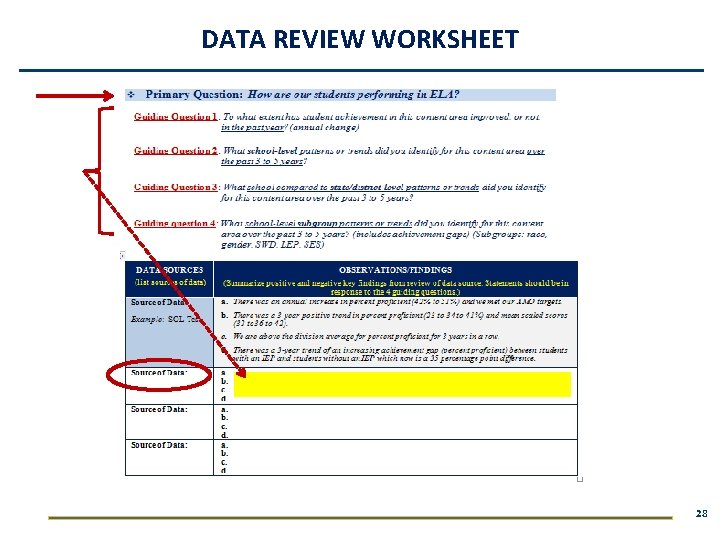
Activity 1 a: Review of School Data Utilizing the Data Review Worksheets, engage in a study of student academic performance in [domain] to answer the following questions: v Primary Question: Question How are our students performing in [domain]? 1 To what extent has student achievement in this content area improved, or not, in the past year? (annual change) 2 What school-level patterns or trends did you identify for this content area over the past 3 to 5 years? (longitudinal change) 3 What school compared to state/district-level patterns or trends did you identify for this content area over the past 3 to 5 years? 4 What school-level subgroup patterns or trends did you identify for this content area over the past 3 to 5 years? (includes achievement gaps) (Subgroups: race, gender, SWD, LEP, economically disadvantaged) 27
DATA REVIEW WORKSHEET 28
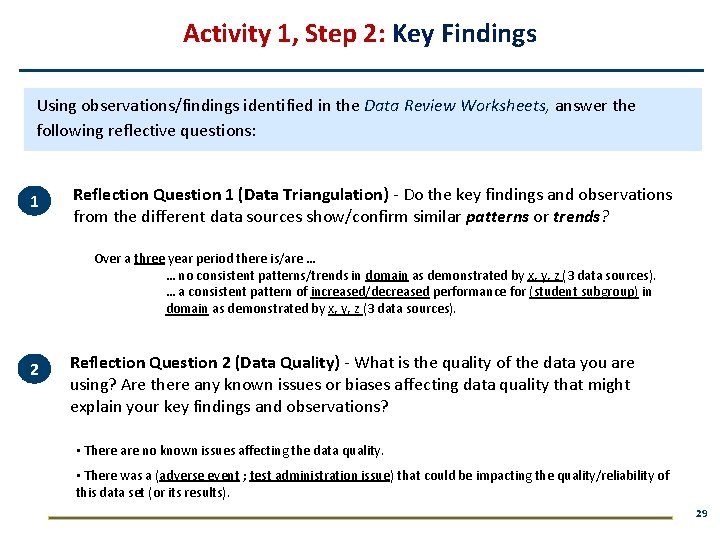
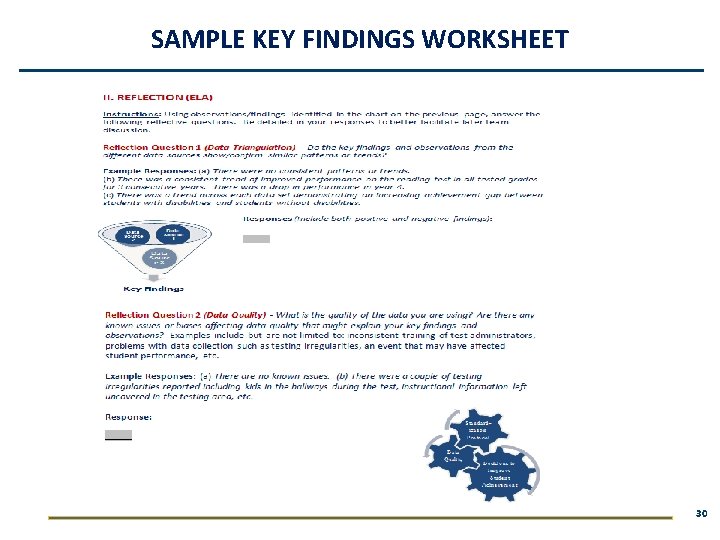
Activity 1, Step 2: Key Findings Using observations/findings identified in the Data Review Worksheets, answer the following reflective questions: 1 Reflection Question 1 (Data Triangulation) - Do the key findings and observations from the different data sources show/confirm similar patterns or trends? Over a three year period there is/are … … no consistent patterns/trends in domain as demonstrated by x, y, z (3 data sources). … a consistent pattern of increased/decreased performance for (student subgroup) in domain as demonstrated by x, y, z (3 data sources). 2 Reflection Question 2 (Data Quality) - What is the quality of the data you are using? Are there any known issues or biases affecting data quality that might explain your key findings and observations? • There are no known issues affecting the data quality. • There was a (adverse event ; test administration issue) that could be impacting the quality/reliability of this data set (or its results). 29
SAMPLE KEY FINDINGS WORKSHEET 30
Activity 2: Contributing Factors Review the key findings and observations for your school from the Data Review Worksheet. Provide a response the question: What factors or root cases could explain these strengths and challenges? Utilize the Contributing Factors worksheet provided to capture your thoughts for each of the contributing factors areas (learner factors, instructional factors, climate/culture factors, family/community factors). 31
CONTRIBUTING FACTORS WORKSHEET 32
Step 4: Team Review of Findings PURPOSE: Root cause discovery Through team consensus building, finalize key findings & observations derived from the data for each domain. Ø This is the final step in the CNA process, before writing the report. PROCESS : 1. 2. Reassemble the full team. Subcommittee members share-out domain specific key findings and contributing factors from the data review worksheet. 3. Explain positive and negative key findings. 4. Write summary statements on specific factors contributing to the key findings and observations. 33
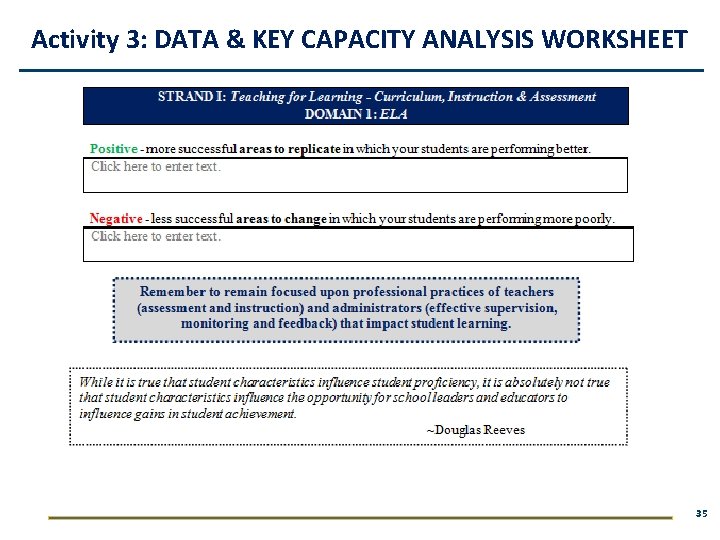
Activity 3: Data & Key Capacity Analysis Worksheet Utilize the Data & Key Capacity Analysis worksheet provided to summarize key findings and contributing factors affecting student performance in the area of study. 1 Share the positive and negative key findings and observations from the Data Review Worksheet: • The data indicate. . . 2 Discuss the factors raised by the subcommittee to explain the positive and negative key finds: • We believe the factors impacting these results to be… 3 Write summarizing statements on the specific factors contributing to the key findings and observations for your school. 34
Activity 3: DATA & KEY CAPACITY ANALYSIS WORKSHEET 35
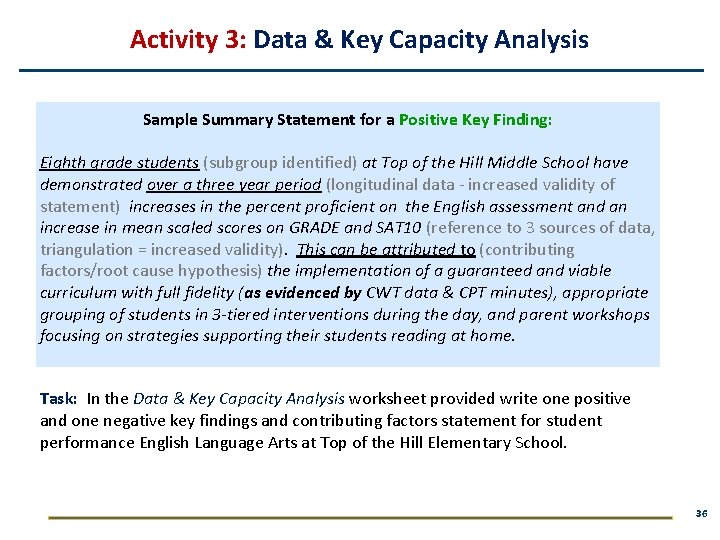
Activity 3: Data & Key Capacity Analysis Sample Summary Statement for a Positive Key Finding: Eighth grade students (subgroup identified) at Top of the Hill Middle School have demonstrated over a three year period (longitudinal data - increased validity of statement) increases in the percent proficient on the English assessment and an increase in mean scaled scores on GRADE and SAT 10 (reference to 3 sources of data, triangulation = increased validity). This can be attributed to (contributing factors/root cause hypothesis) the implementation of a guaranteed and viable curriculum with full fidelity (as evidenced by CWT data & CPT minutes), appropriate grouping of students in 3 -tiered interventions during the day, and parent workshops focusing on strategies supporting their students reading at home. Task: In the Data & Key Capacity Analysis worksheet provided write one positive and one negative key findings and contributing factors statement for student performance English Language Arts at Top of the Hill Elementary School. 36
Pulling it all Together 37
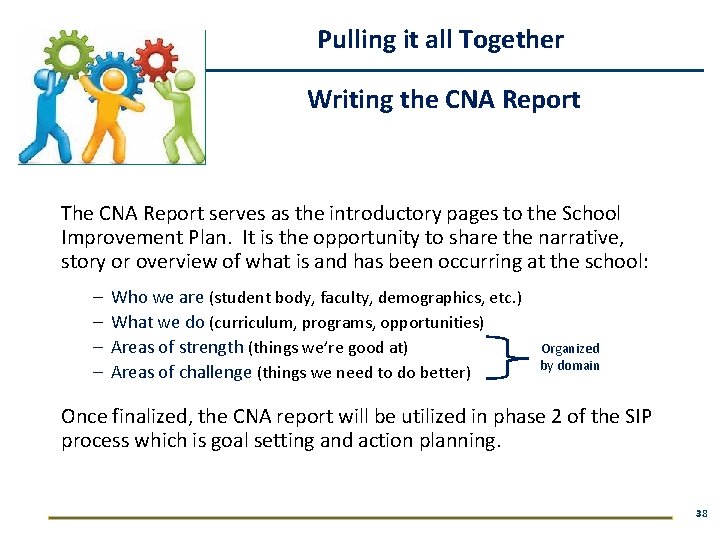
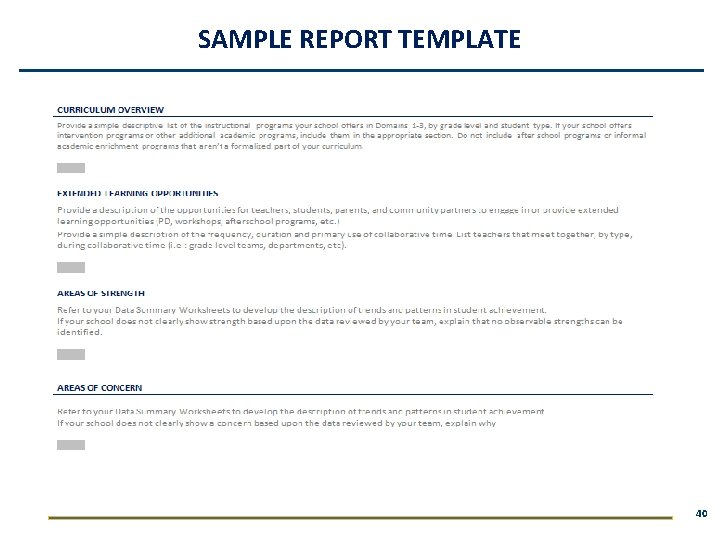
Pulling it all Together Writing the CNA Report The CNA Report serves as the introductory pages to the School Improvement Plan. It is the opportunity to share the narrative, story or overview of what is and has been occurring at the school: – – Who we are (student body, faculty, demographics, etc. ) What we do (curriculum, programs, opportunities) Areas of strength (things we’re good at) Areas of challenge (things we need to do better) Organized by domain Once finalized, the CNA report will be utilized in phase 2 of the SIP process which is goal setting and action planning. 38
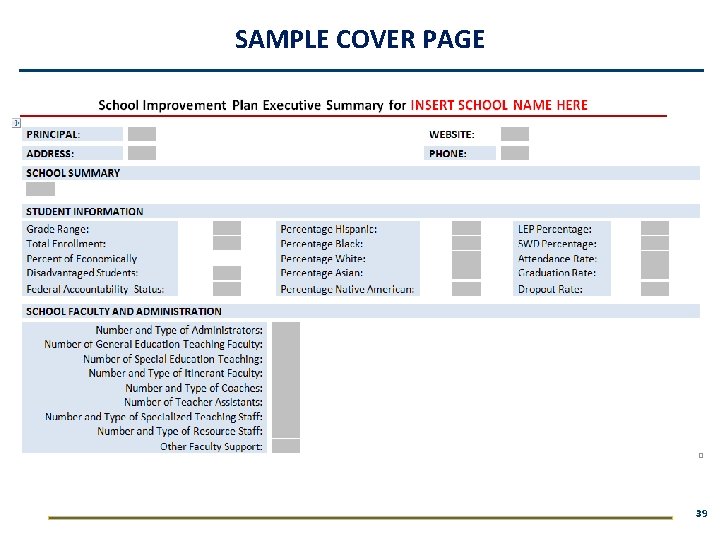
SAMPLE COVER PAGE 39
SAMPLE REPORT TEMPLATE 40
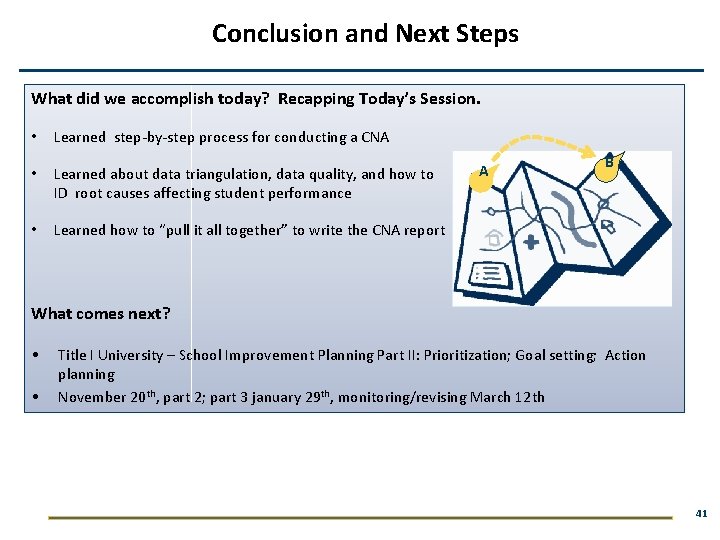
Conclusion and Next Steps What did we accomplish today? Recapping Today’s Session. • Learned step-by-step process for conducting a CNA • Learned about data triangulation, data quality, and how to ID root causes affecting student performance • Learned how to “pull it all together” to write the CNA report A B What comes next? • • Title I University – School Improvement Planning Part II: Prioritization; Goal setting; Action planning November 20 th, part 2; part 3 january 29 th, monitoring/revising March 12 th 41
Q & A Opportunity 42
Contact info Kristi Bond, Title I/III Specialist Virginia Department of Education Office of Program Administration & Accountability E-mail: kristi. bond@doe. virginia. gov Tel: 804 -371 -2682 VDOE Website http: //www. doe. virginia. gov/ Title I Web Page for CNA and SIP Resources http: //www. doe. virginia. gov/federal_programs/esea/title 1/part_a/index. shtml 43