
conducted what became known as shuttle diplomacy served
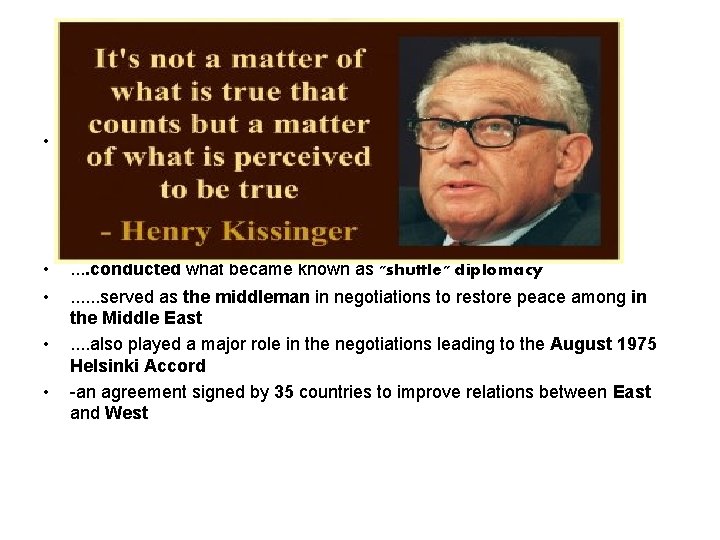
• • • . . conducted what became known as "shuttle" diplomacy. . . served as the middleman in negotiations to restore peace among in the Middle East. . also played a major role in the negotiations leading to the August 1975 Helsinki Accord -an agreement signed by 35 countries to improve relations between East and West
Mediated Diplomacy • • When? – political circumstances Direct- communication –neg. aspects Why? – a mediator - Pluses Task? - goals of their mission How? - particular steps taken-Agenda Who? - Staff Mixed success
When? • with tense international situations • initial direct negotiations prove tense • direct communication - unlikely reduces tensions - conterproductive • the UN S. C. is called upon to mediate a resolution to a conflict
• • in the early stages of a dispute. . . unwilling to budge on the issue negotiations - at an impasse in intractable conflicts
Prerequisites for successful m. • a thorough and complete analysis – aspects of a conflict • issues at stake, context and dynamics • conducted at an optimal or ripe moment
Direct communication • the simple repetition of demands • no exchange of views and producing no compromise • gives support to the perception of the conflict's intractability • seeing each other - causes a setback • to paint one's own side in a favorable light
Why? 3 rd Party • an impartial –neutral- actor • a reliable means of communication • less susceptible to the grandstanding of face-to-face or media-based communication • prestige, knowledge
Mediator´s task • to disengage opposing armies • 1. to move the conflict forward • 2. to break the deadlock over the possible settlement of dispute • to provide an impetus for the parties to give the process a chance • to promote a lasting truce between the belligerents
• to develope the trust and a certain level of mutual understanding • to avert the (Falklands )crisis • to find ways out of stalemates • to promote implementation modalities and agreements • separates the ceasefire from long-range problems
• to broker end to hostilities • to help the parties to the conlitct to find solutions to resolve their conflict • to affect it, change it, resolve it, modify or influence it • to reduce violence and achieve a peaceful outcome
• to bring about peace
Process is over • face-to-face and even a routine of communications can be started • a mediator departs the arena of the conflict
How • serves as an intermediary or mediator between the two parties • serves as a go-between • serves as a relay for questions and answers • carries proposals and counterproposals back and forth • engages in a process as a third party
• conveys information back and forth between the parties • flies back and forth between capitals • looks for creative approaches to find ways out of stalemate • uses a new effective debating tactics • applies hands-on approach to the Middle East
• provides suggestions for moving the conflict toward resolution and does so in private • acts in private • involves personal and emotional elements
• conducts preventive diplomacy • acts as a peacemaker
Who? • Mediator • Go-between • Middle man
mixed success • Kissinger was instrumental in brokering an end to hostilities between Israel, Egypt and Syria • separated the ceasefire from long-range problems and minimized Russian involvement in the process
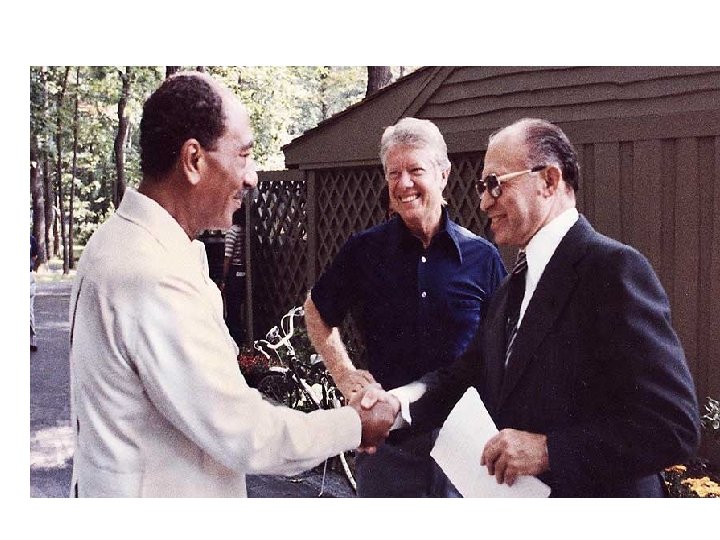
Carter • . . . was little chance of a viable settlement • Carter eventually prevailed through his non-stop shuttle diplomacy U. S. • Secretary of State Alexander Haig failed to avert the Falklands crisis
Secretary of State J. Baker The bilateral talks between Israel and Jordan led directly to the historic 1994 peace agreement the Oslo Accords between Israel and the Palestinian Authority.
A brief survey of examples -mixed success • U. S. Secretary of State Alexander Haig • Richard Holbrooke • Russian Foreign Minister Chernomyrdin • U. S. special envoy Dennis Ross and U. S. Secretary of State Colin Powell • Defense Secretary Donald Rumsfeld. India and Pakistan
- Slides: 22