
Conditions for special parallelograms Warm Up 1 Find
- Slides: 33
Conditions for special parallelograms
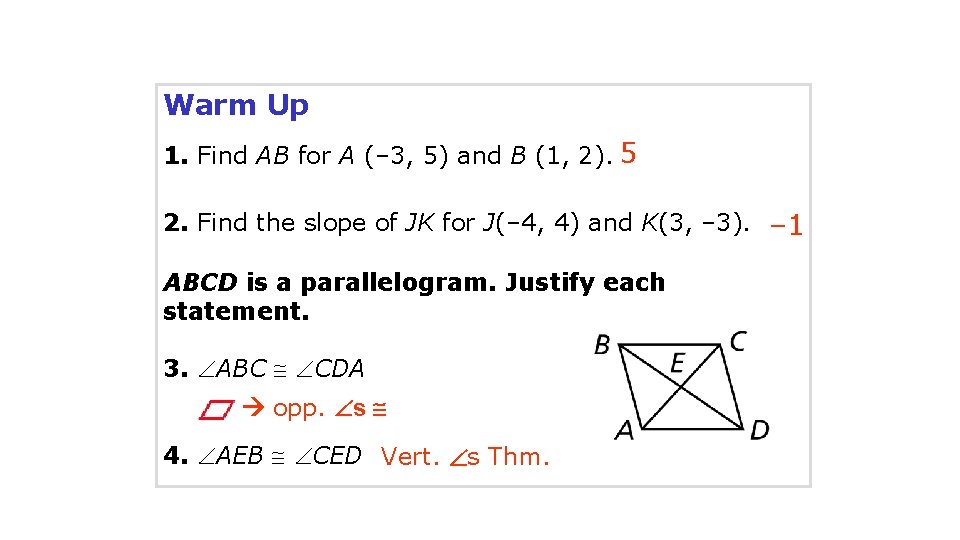
Warm Up 1. Find AB for A (– 3, 5) and B (1, 2). 5 2. Find the slope of JK for J(– 4, 4) and K(3, – 3). – 1 ABCD is a parallelogram. Justify each statement. 3. ABC CDA opp. s 4. AEB CED Vert. s Thm.
Objective Prove that a given quadrilateral is a rectangle, rhombus, or square.
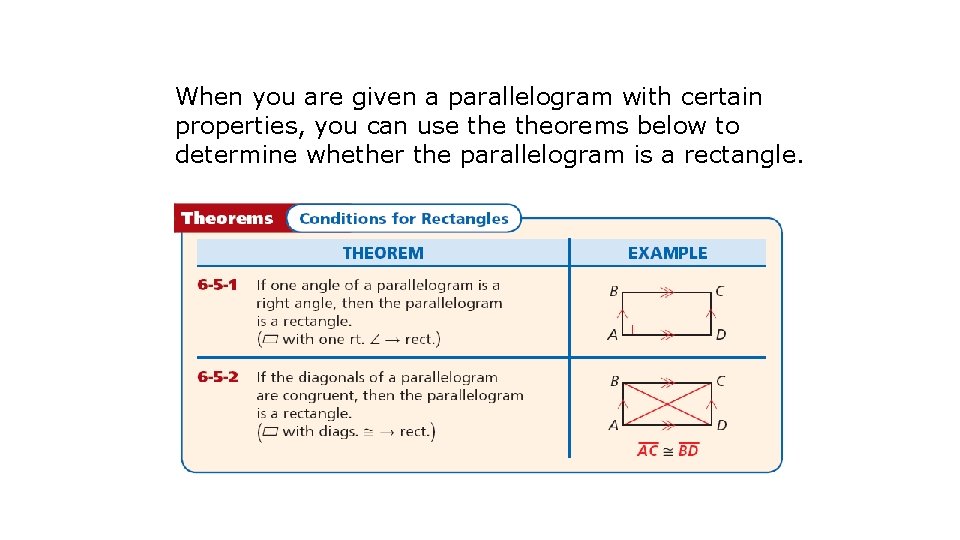
When you are given a parallelogram with certain properties, you can use theorems below to determine whether the parallelogram is a rectangle.
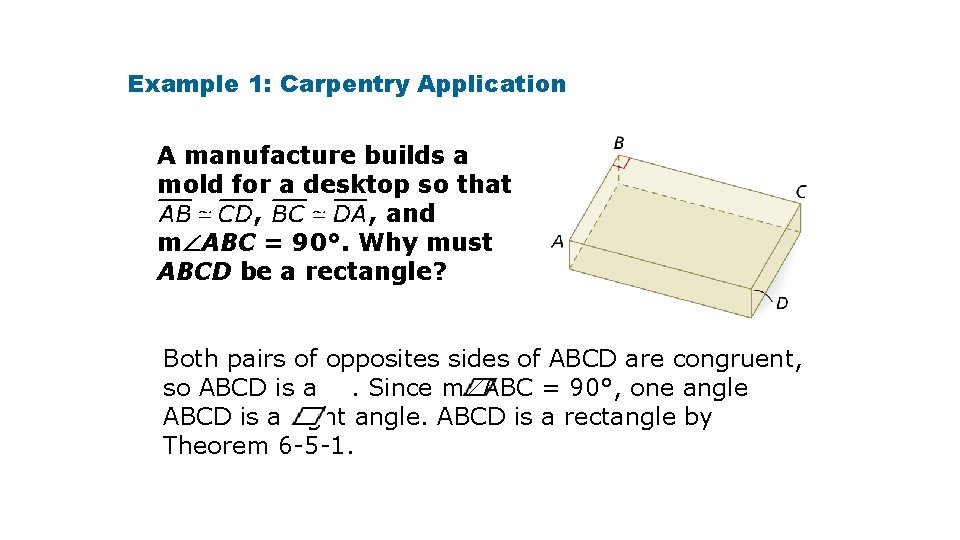
Example 1: Carpentry Application A manufacture builds a mold for a desktop so that , , and m ABC = 90°. Why must ABCD be a rectangle? Both pairs of opposites sides of ABCD are congruent, so ABCD is a. Since m ABC = 90°, one angle ABCD is a right angle. ABCD is a rectangle by Theorem 6 -5 -1.
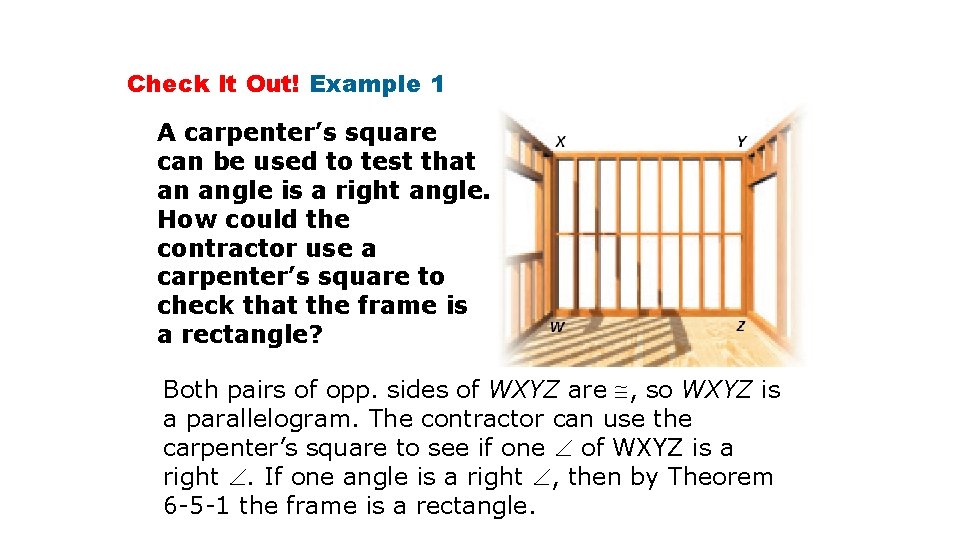
Check It Out! Example 1 A carpenter’s square can be used to test that an angle is a right angle. How could the contractor use a carpenter’s square to check that the frame is a rectangle? Both pairs of opp. sides of WXYZ are , so WXYZ is a parallelogram. The contractor can use the carpenter’s square to see if one of WXYZ is a right . If one angle is a right , then by Theorem 6 -5 -1 the frame is a rectangle.
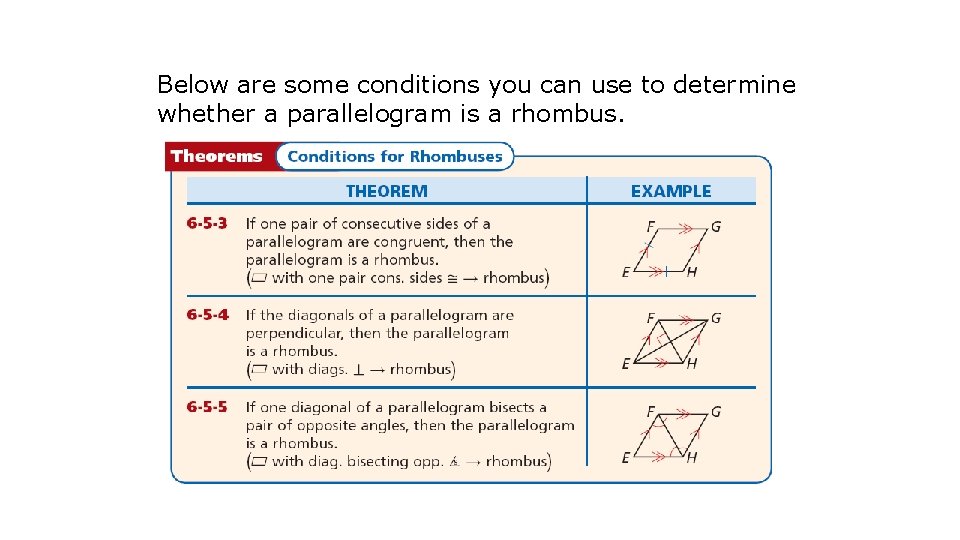
Below are some conditions you can use to determine whether a parallelogram is a rhombus.
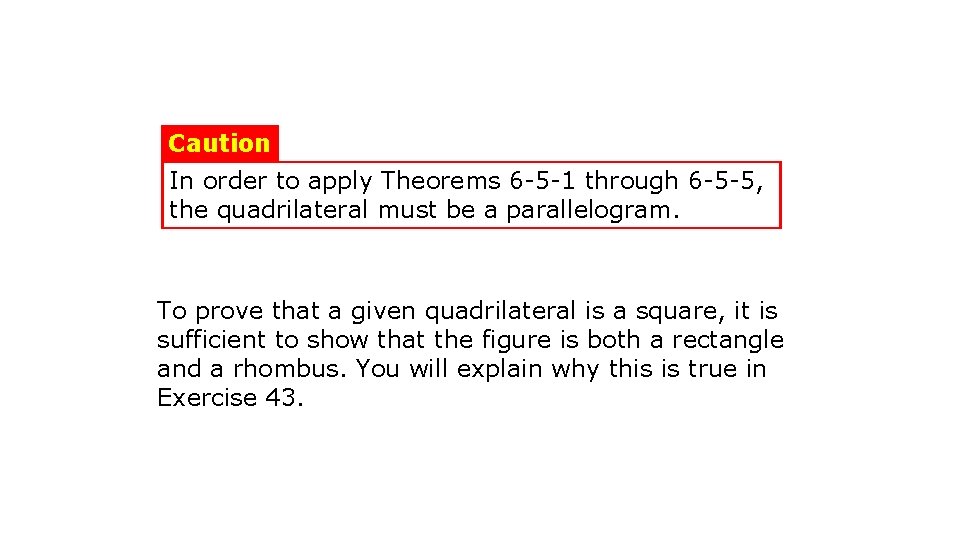
Caution In order to apply Theorems 6 -5 -1 through 6 -5 -5, the quadrilateral must be a parallelogram. To prove that a given quadrilateral is a square, it is sufficient to show that the figure is both a rectangle and a rhombus. You will explain why this is true in Exercise 43.
Remember! You can also prove that a given quadrilateral is a rectangle, rhombus, or square by using the definitions of the special quadrilaterals.
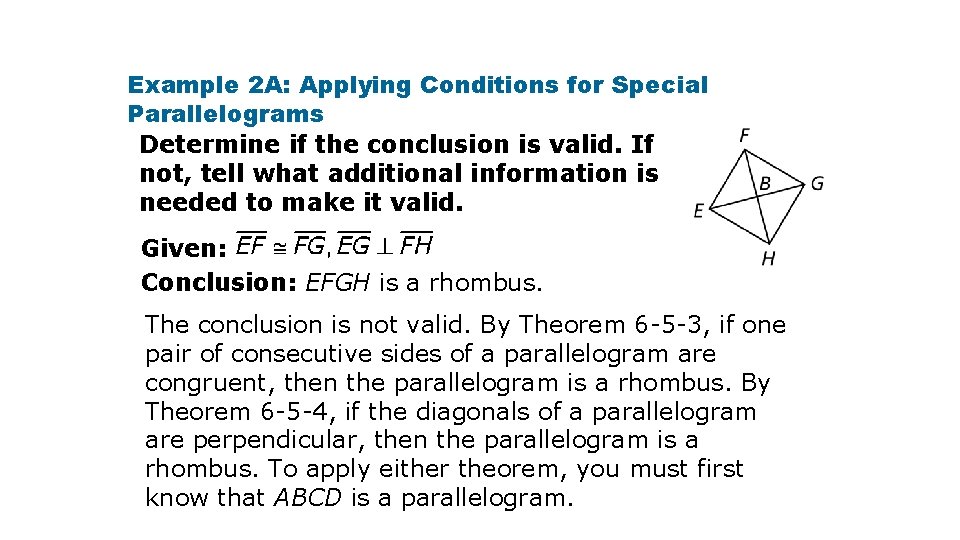
Example 2 A: Applying Conditions for Special Parallelograms Determine if the conclusion is valid. If not, tell what additional information is needed to make it valid. Given: Conclusion: EFGH is a rhombus. The conclusion is not valid. By Theorem 6 -5 -3, if one pair of consecutive sides of a parallelogram are congruent, then the parallelogram is a rhombus. By Theorem 6 -5 -4, if the diagonals of a parallelogram are perpendicular, then the parallelogram is a rhombus. To apply either theorem, you must first know that ABCD is a parallelogram.
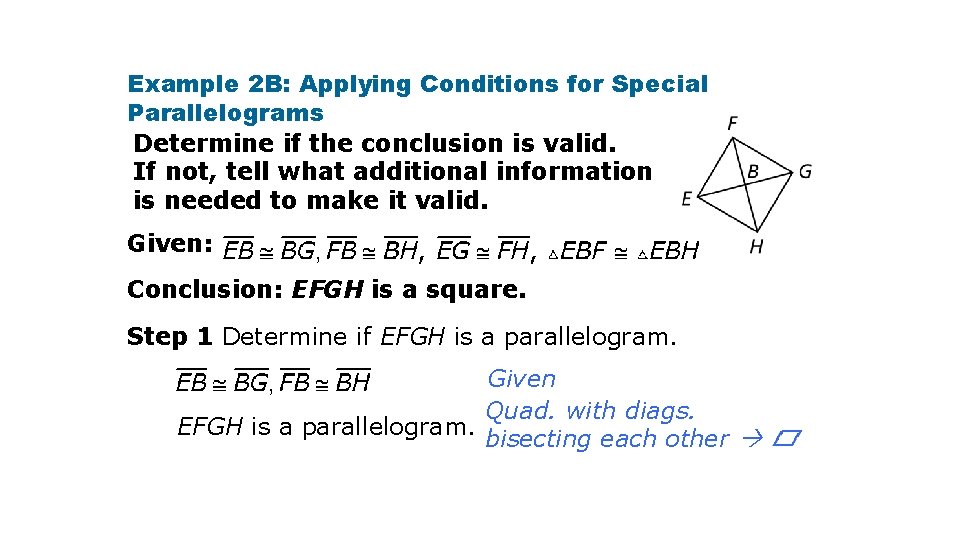
Example 2 B: Applying Conditions for Special Parallelograms Determine if the conclusion is valid. If not, tell what additional information is needed to make it valid. Given: Conclusion: EFGH is a square. Step 1 Determine if EFGH is a parallelogram. Given Quad. with diags. EFGH is a parallelogram. bisecting each other
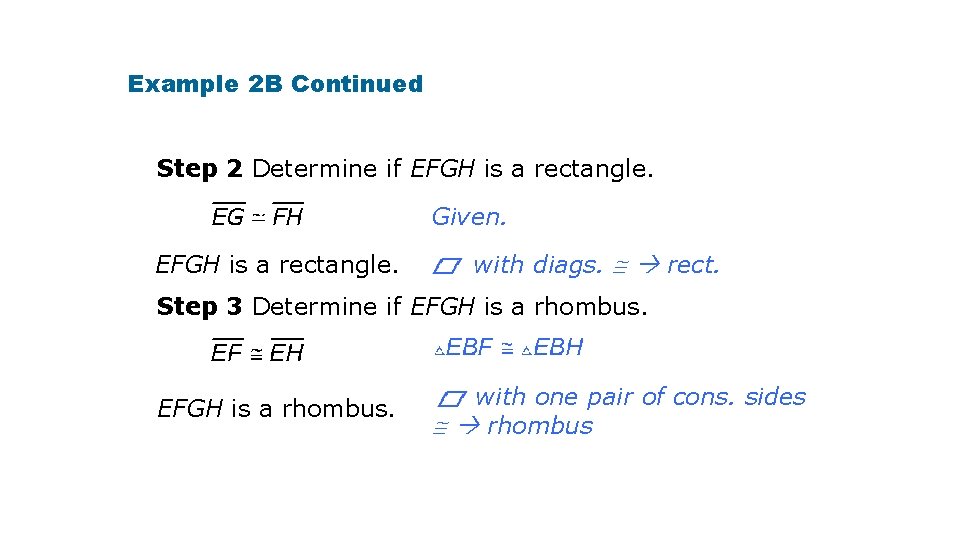
Example 2 B Continued Step 2 Determine if EFGH is a rectangle. Given. EFGH is a rectangle. with diags. rect. Step 3 Determine if EFGH is a rhombus. with one pair of cons. sides rhombus
Example 2 B Continued Step 4 Determine is EFGH is a square. Since EFGH is a rectangle and a rhombus, it has four right angles and four congruent sides. So EFGH is a square by definition. The conclusion is valid.
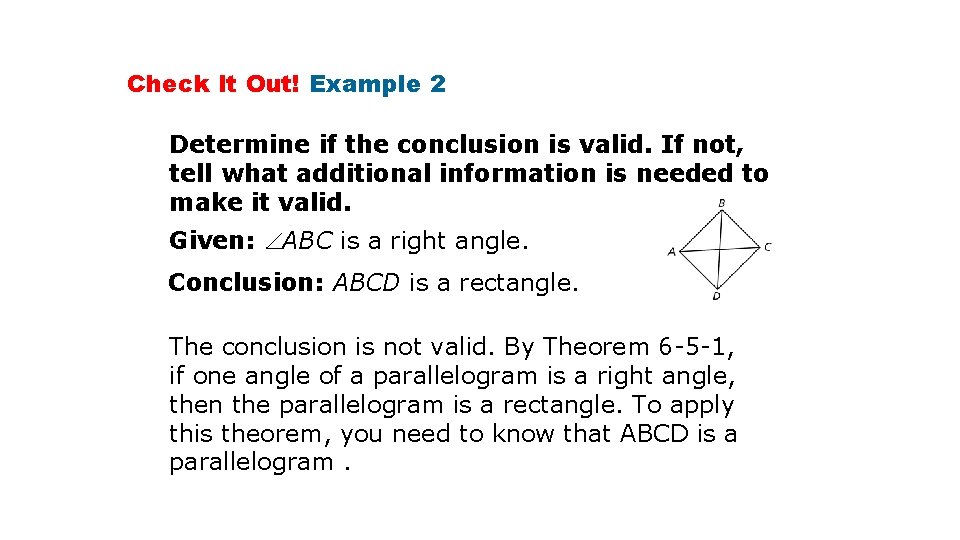
Check It Out! Example 2 Determine if the conclusion is valid. If not, tell what additional information is needed to make it valid. Given: ABC is a right angle. Conclusion: ABCD is a rectangle. The conclusion is not valid. By Theorem 6 -5 -1, if one angle of a parallelogram is a right angle, then the parallelogram is a rectangle. To apply this theorem, you need to know that ABCD is a parallelogram.
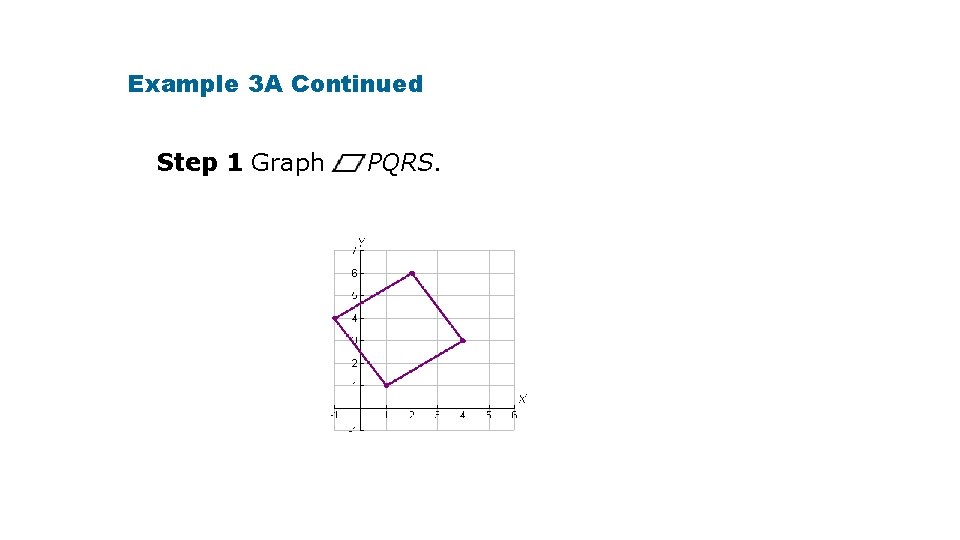
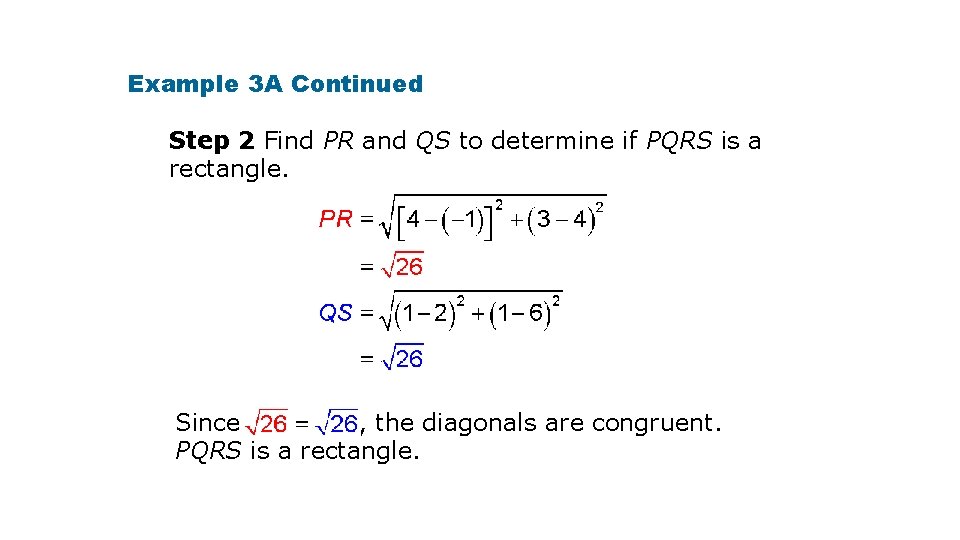
Example 3 A: Identifying Special Parallelograms in the Coordinate Plane Use the diagonals to determine whether a parallelogram with the given vertices is a rectangle, rhombus, or square. Give all the names that apply. P(– 1, 4), Q(2, 6), R(4, 3), S(1, 1)
Example 3 A Continued Step 1 Graph PQRS.
Example 3 A Continued Step 2 Find PR and QS to determine if PQRS is a rectangle. Since , the diagonals are congruent. PQRS is a rectangle.
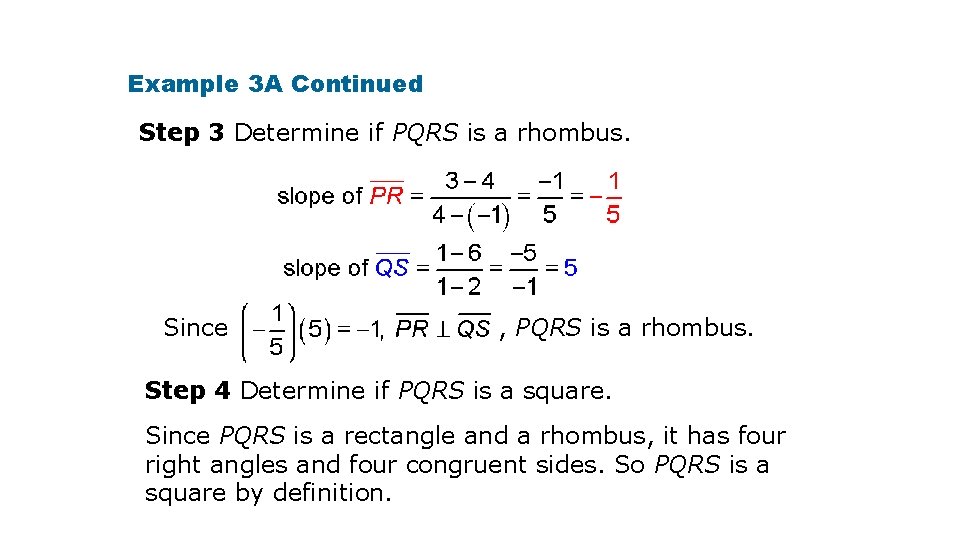
Example 3 A Continued Step 3 Determine if PQRS is a rhombus. Since , PQRS is a rhombus. Step 4 Determine if PQRS is a square. Since PQRS is a rectangle and a rhombus, it has four right angles and four congruent sides. So PQRS is a square by definition.
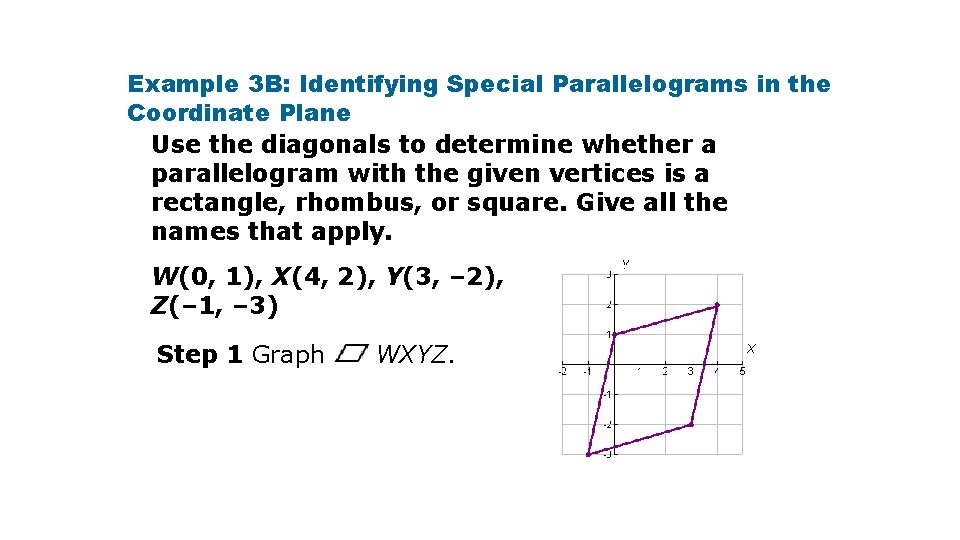
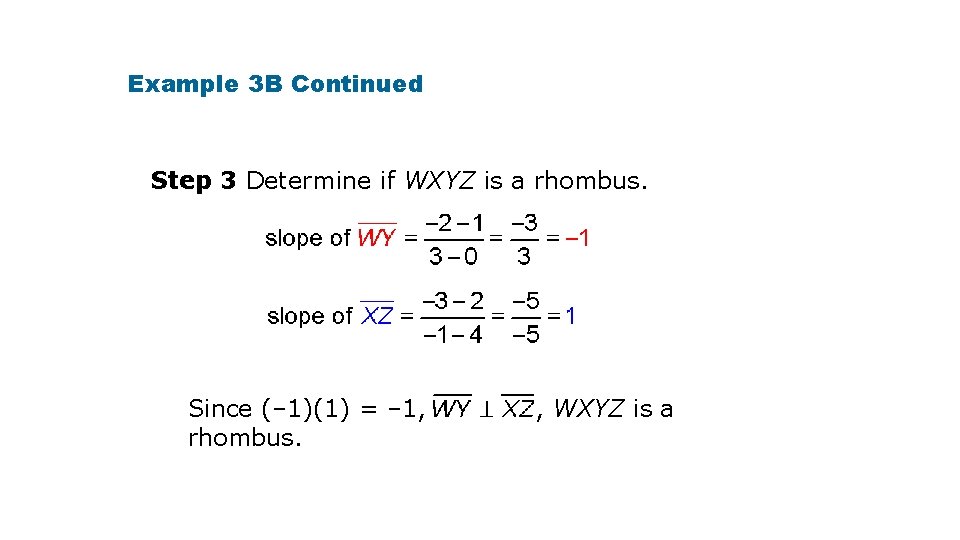
Example 3 B: Identifying Special Parallelograms in the Coordinate Plane Use the diagonals to determine whether a parallelogram with the given vertices is a rectangle, rhombus, or square. Give all the names that apply. W(0, 1), X(4, 2), Y(3, – 2), Z(– 1, – 3) Step 1 Graph WXYZ.
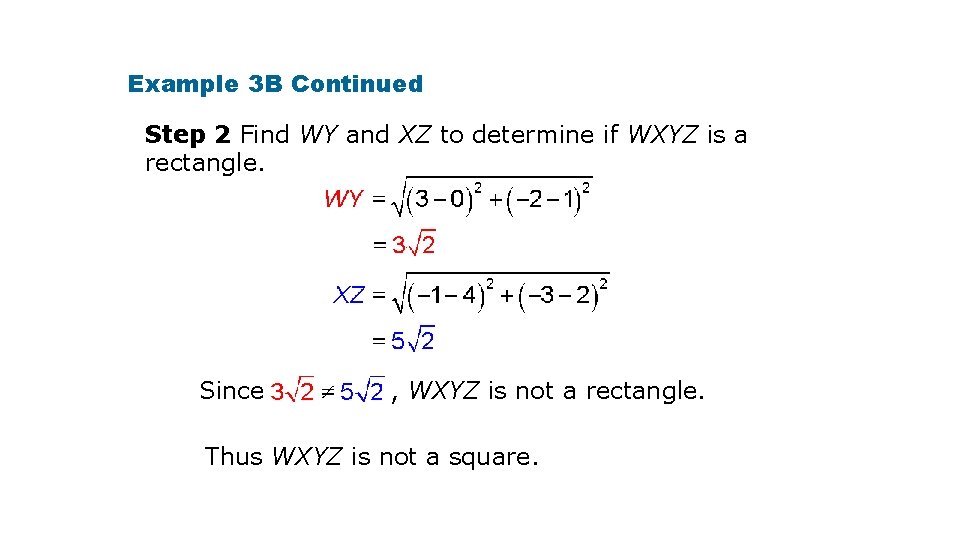
Example 3 B Continued Step 2 Find WY and XZ to determine if WXYZ is a rectangle. Since , WXYZ is not a rectangle. Thus WXYZ is not a square.
Example 3 B Continued Step 3 Determine if WXYZ is a rhombus. Since (– 1)(1) = – 1, rhombus. , WXYZ is a
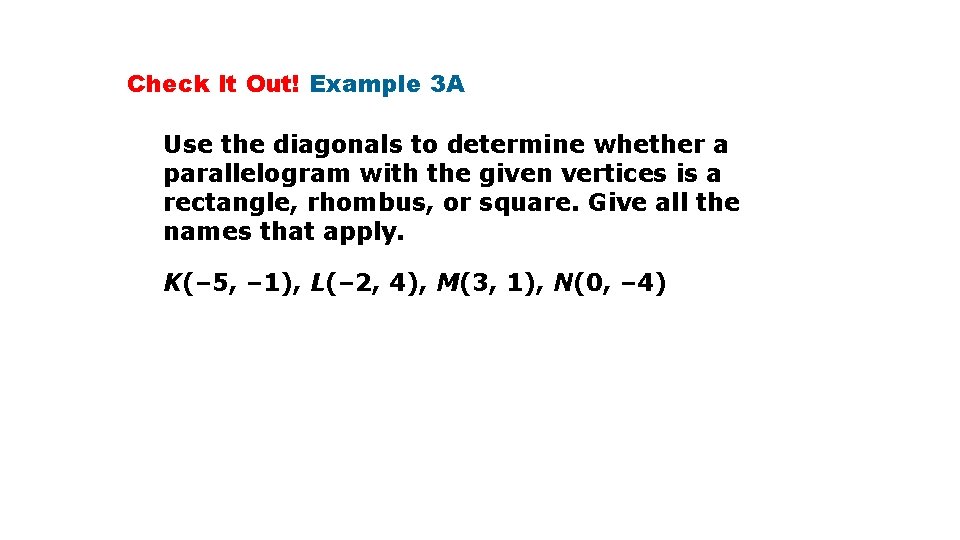
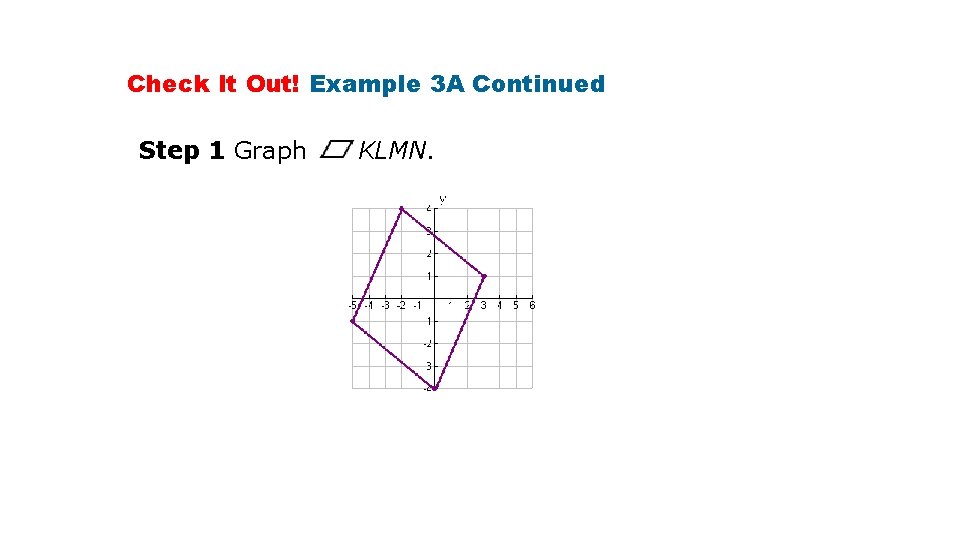
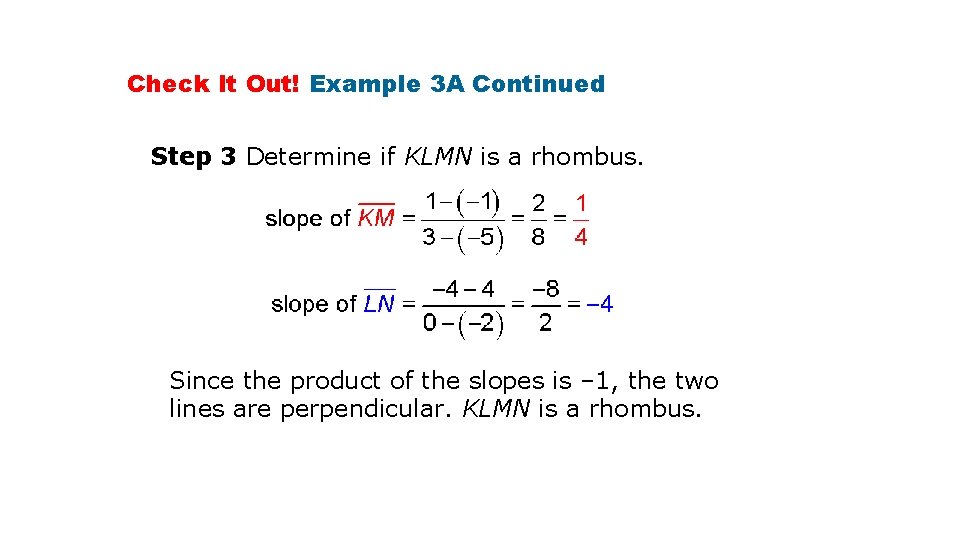
Check It Out! Example 3 A Use the diagonals to determine whether a parallelogram with the given vertices is a rectangle, rhombus, or square. Give all the names that apply. K(– 5, – 1), L(– 2, 4), M(3, 1), N(0, – 4)
Check It Out! Example 3 A Continued Step 1 Graph KLMN.
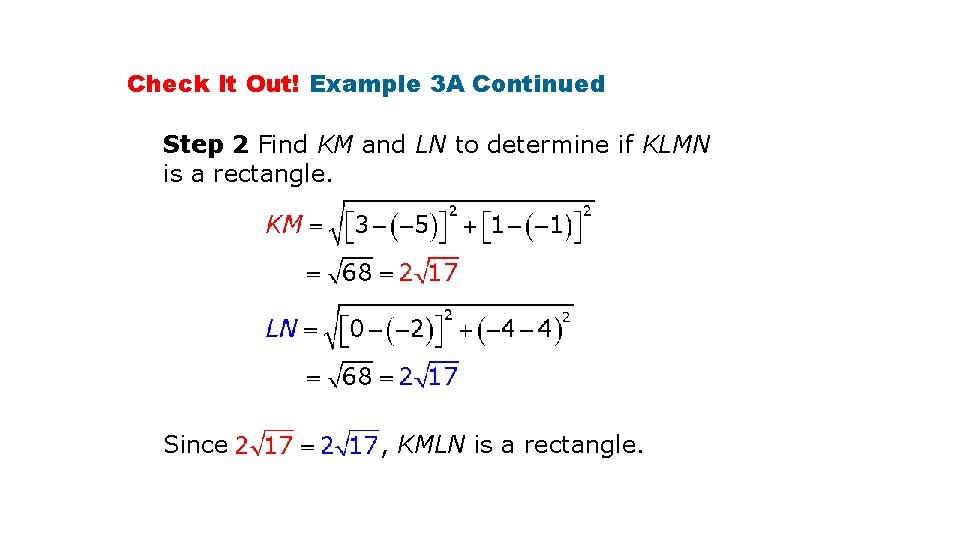
Check It Out! Example 3 A Continued Step 2 Find KM and LN to determine if KLMN is a rectangle. Since , KMLN is a rectangle.
Check It Out! Example 3 A Continued Step 3 Determine if KLMN is a rhombus. Since the product of the slopes is – 1, the two lines are perpendicular. KLMN is a rhombus.
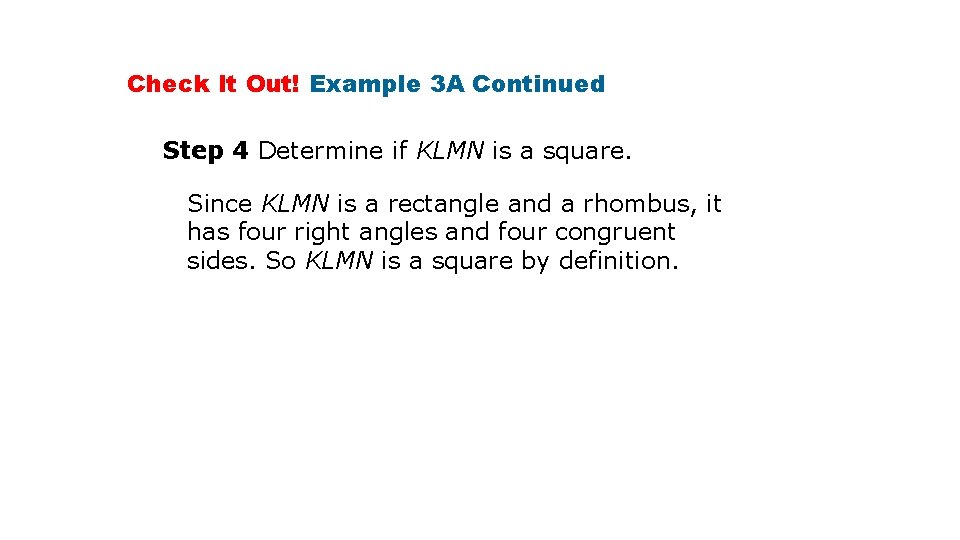
Check It Out! Example 3 A Continued Step 4 Determine if KLMN is a square. Since KLMN is a rectangle and a rhombus, it has four right angles and four congruent sides. So KLMN is a square by definition.
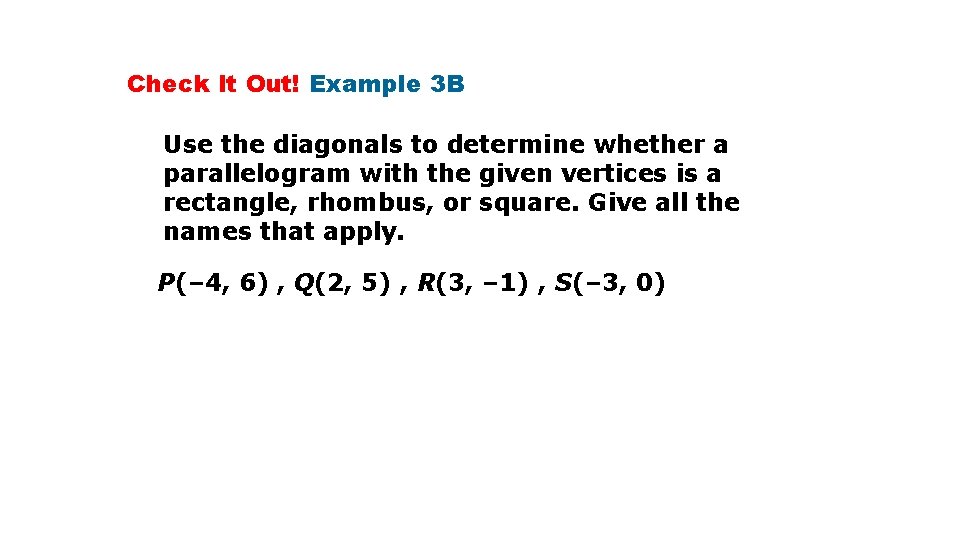
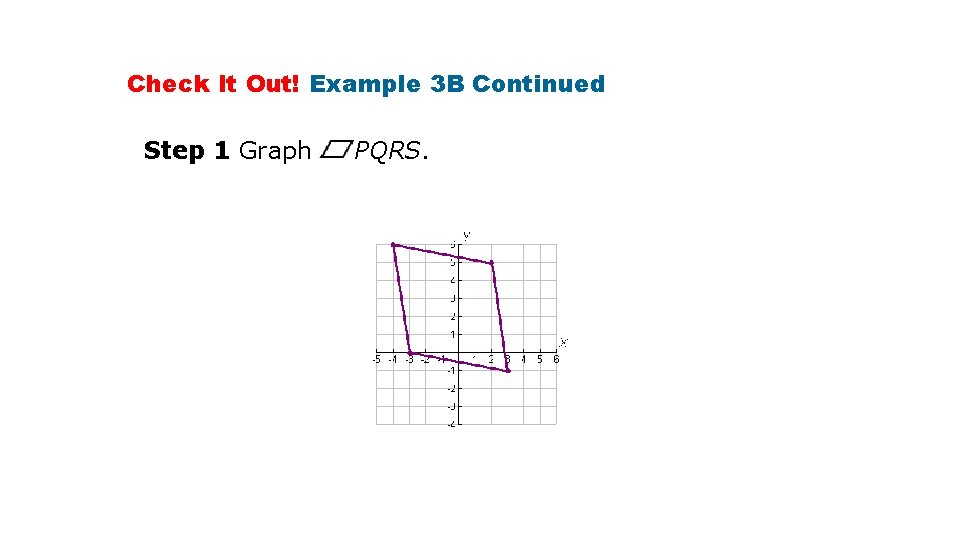
Check It Out! Example 3 B Use the diagonals to determine whether a parallelogram with the given vertices is a rectangle, rhombus, or square. Give all the names that apply. P(– 4, 6) , Q(2, 5) , R(3, – 1) , S(– 3, 0)
Check It Out! Example 3 B Continued Step 1 Graph PQRS.
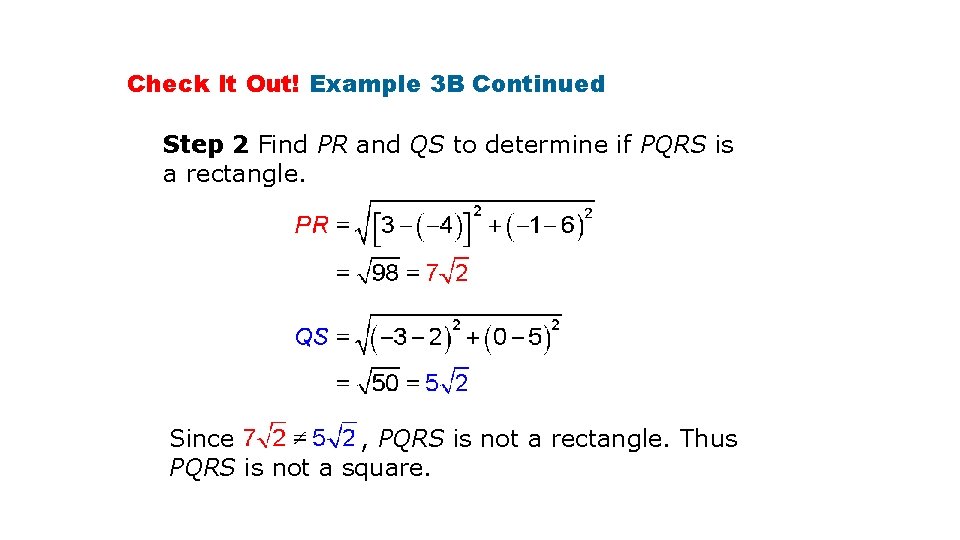
Check It Out! Example 3 B Continued Step 2 Find PR and QS to determine if PQRS is a rectangle. Since , PQRS is not a rectangle. Thus PQRS is not a square.
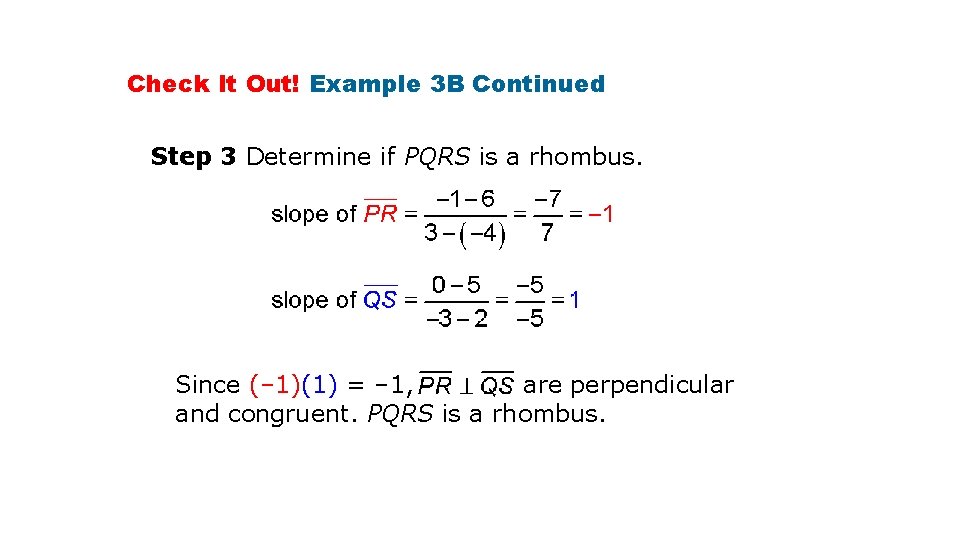
Check It Out! Example 3 B Continued Step 3 Determine if PQRS is a rhombus. Since (– 1)(1) = – 1, are perpendicular and congruent. PQRS is a rhombus.
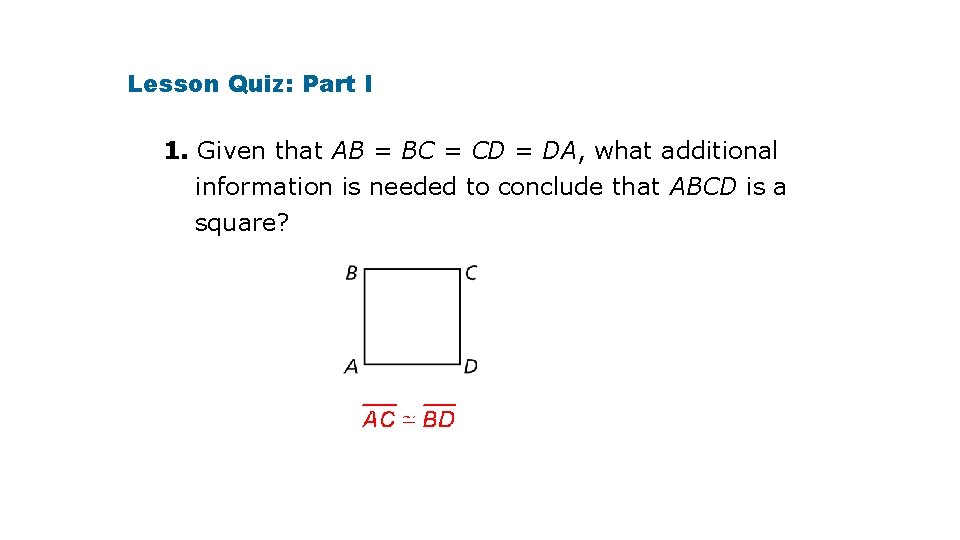
Lesson Quiz: Part I 1. Given that AB = BC = CD = DA, what additional information is needed to conclude that ABCD is a square?
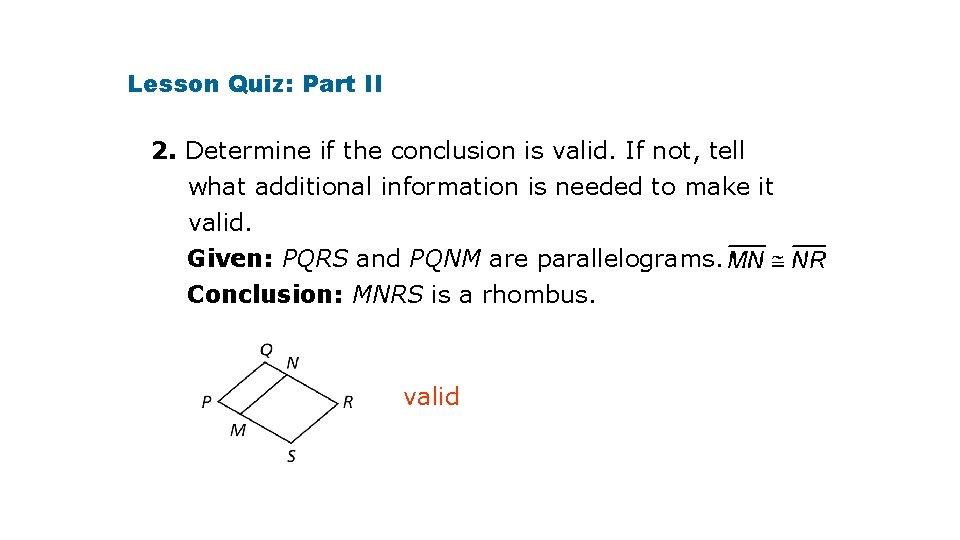
Lesson Quiz: Part II 2. Determine if the conclusion is valid. If not, tell what additional information is needed to make it valid. Given: PQRS and PQNM are parallelograms. Conclusion: MNRS is a rhombus. valid
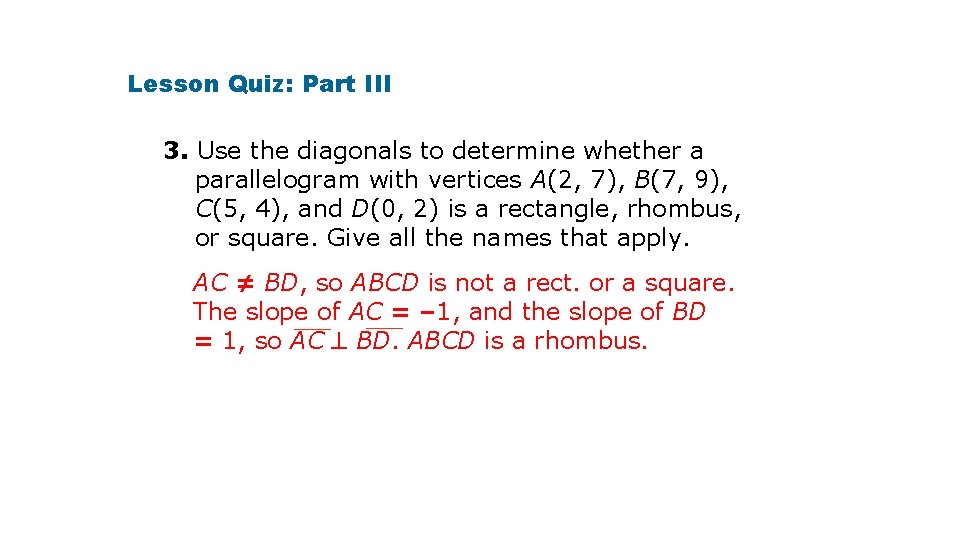
Lesson Quiz: Part III 3. Use the diagonals to determine whether a parallelogram with vertices A(2, 7), B(7, 9), C(5, 4), and D(0, 2) is a rectangle, rhombus, or square. Give all the names that apply. AC ≠ BD, so ABCD is not a rect. or a square. The slope of AC = – 1, and the slope of BD = 1, so AC BD. ABCD is a rhombus.