
Conditions and Loops in C Programming By Rutu
“Conditions and Loops in C Programming ” By- Rutu Ataliya Lecture C Slide 1 of 64
Road Map v. Introduction of Program Looping v. Relational Operators v. Looping Types v. Entry Controlled Loop v. Exit Controlled Loop v. Steps of Loop Processing v. Types of Loops v. For Loop v. While Loop v. Do While Loop v. Practice Examples v. Comparison v. Summary Lecture C Slide 2 of 64
Introduction of Program Looping § One of the fundamental properties of a programming language is the ability to repetitively execute a sequence of statements which is called decision making and looping. § Programs should be able to make decisions based on the condition provided and then repeat a specific chunk of code or statement again and again. § In looping a sequence of statements are executed until some conditions for termination of loop are satisfied. Lecture C Slide 3 of 64
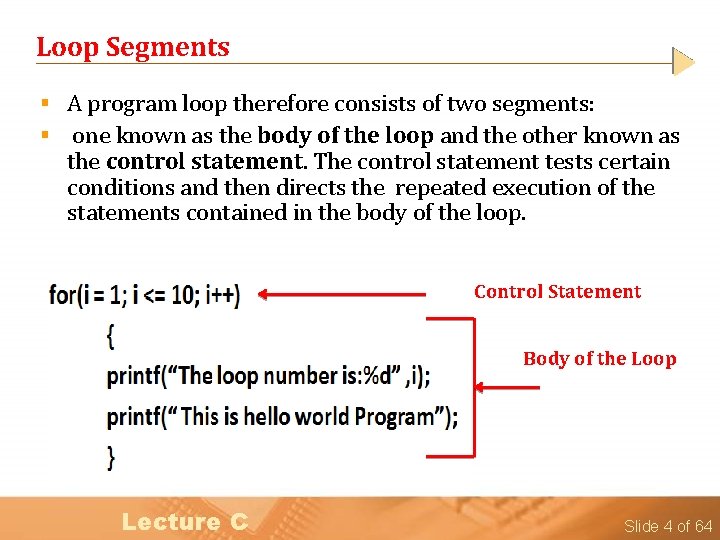
Loop Segments § A program loop therefore consists of two segments: § one known as the body of the loop and the other known as the control statement. The control statement tests certain conditions and then directs the repeated execution of the statements contained in the body of the loop. Control Statement Body of the Loop Lecture C Slide 4 of 64
Looping Types § Depending on the position of the control statement in the loop, a loop control structure may be classified either as 1. The entry controlled loop 2. The exit controlled loop. § Based on the nature of the control variables and the kind of value assigned to, the loops may be classified into two general categories 1. The counter controlled loop 3. The sentinel controlled loop Lecture C Slide 5 of 64

Entry Controlled Loop § The types of loop where the test condition is stated before the body of the loop, are known as the entry controlled loop. So in the case of an entry controlled loop, the condition is tested before the execution of the loop. § If the test condition is true, then the loop gets the execution, otherwise not. For example, the for loop is an entry controlled loop. In the given figure, the structure of an entry controlled loop is shown. Lecture C Slide 6 of 64
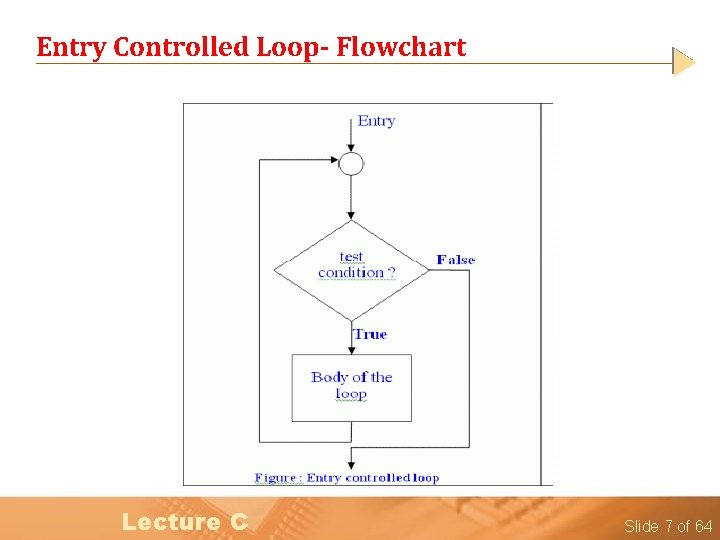
Entry Controlled Loop- Flowchart Lecture C Slide 7 of 64
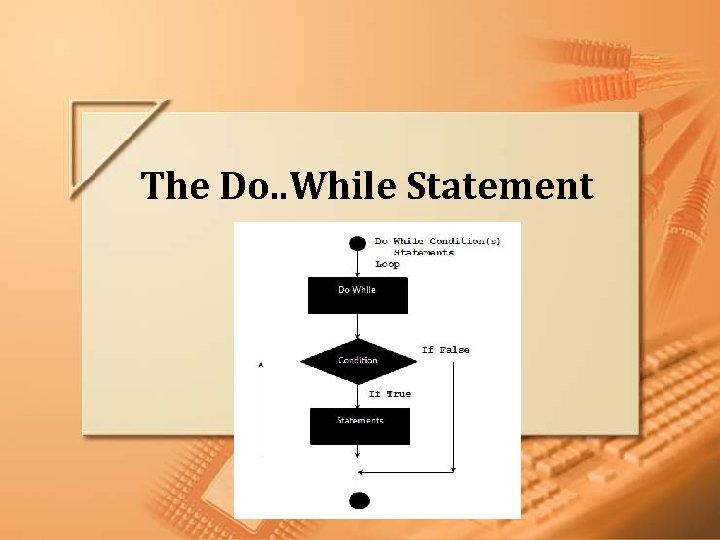
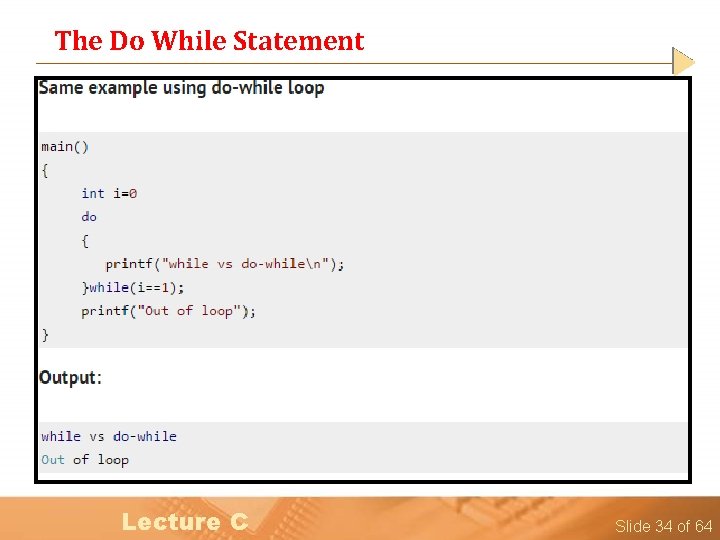
Exit Controlled Loop § The types of loop where the test condition is stated at the end of the body of the loop, are know as the exit controlled loops. So, in the case of the exit controlled loops, the body of the loop gets execution without testing the given condition for the first time. Then the condition is tested. § If it comes true, then the loop gets another execution and continues till the result of the test condition is not false. § In case of exit controlled loop the body of the loop is executed unconditionally for the first time without testing the condition. § For example, the do statement or the do. . while loop is an exit controlled loop. The structure of an exit controlled loop is given in the given figure. Lecture C Slide 8 of 64

Exit Controlled Loop- Flowchart Lecture C Slide 9 of 64
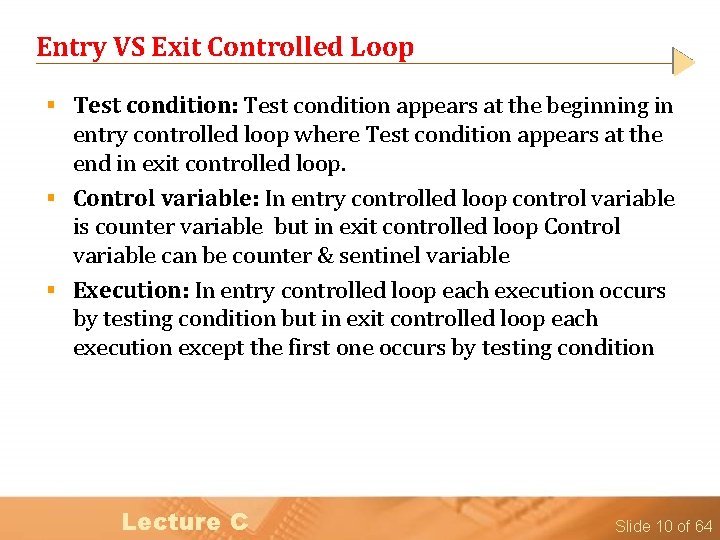
Entry VS Exit Controlled Loop § Test condition: Test condition appears at the beginning in entry controlled loop where Test condition appears at the end in exit controlled loop. § Control variable: In entry controlled loop control variable is counter variable but in exit controlled loop Control variable can be counter & sentinel variable § Execution: In entry controlled loop each execution occurs by testing condition but in exit controlled loop each execution except the first one occurs by testing condition Lecture C Slide 10 of 64
Steps of Looping a Process § A looping process, in general, would include the following four steps. The given steps may come at any order depending on the type of the loop. Setting and initialization of a condition variable. 2. Execution of the statements of the loop. 3. Test for a specified value of the condition variable for execution of the loop. 4. Incrementing or updating the condition variable. 1. Lecture C Slide 11 of 64

Types of Loop § The C language supports three types of looping statement: The for statement 2. The do while statement 3. The while do statement 1. Lecture C Slide 12 of 64
The For Loop Lecture C Slide 13 of 64

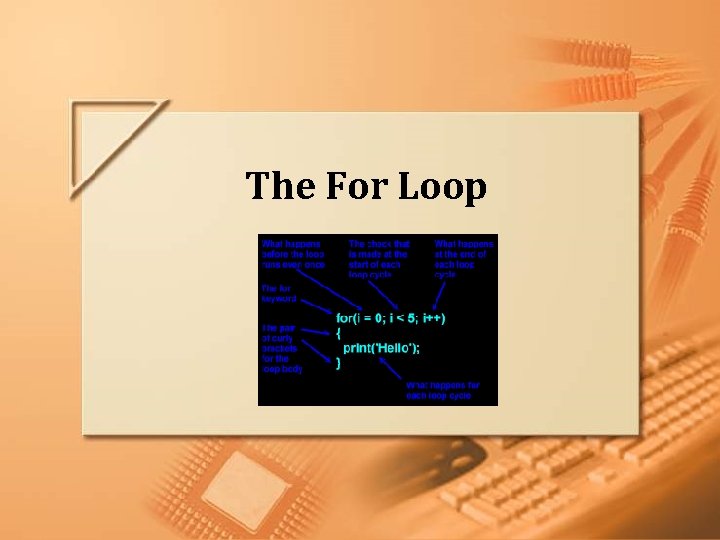
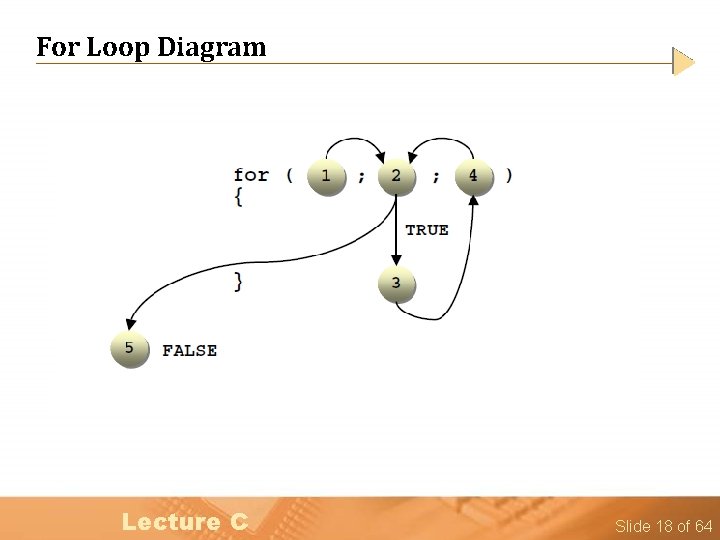
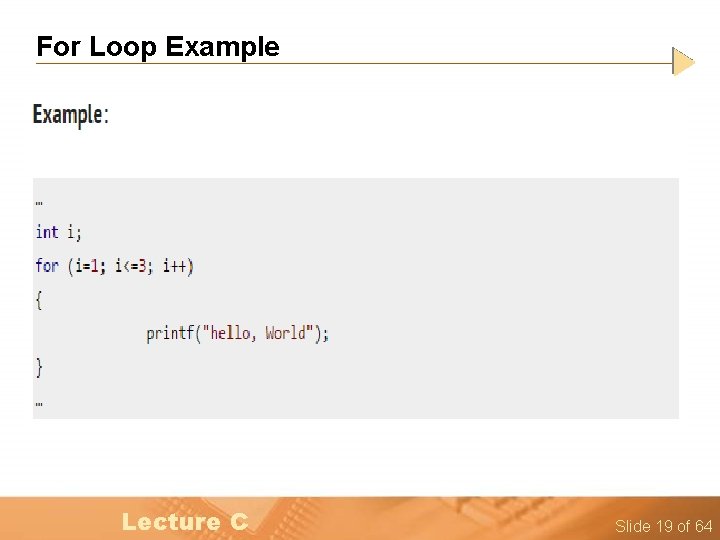
The for Statement § The for loop is an entry controlled loop. It has the following structure: for(initialization; test-condition; increment/decrement) { body of the loop; } Lecture C Slide 14 of 64
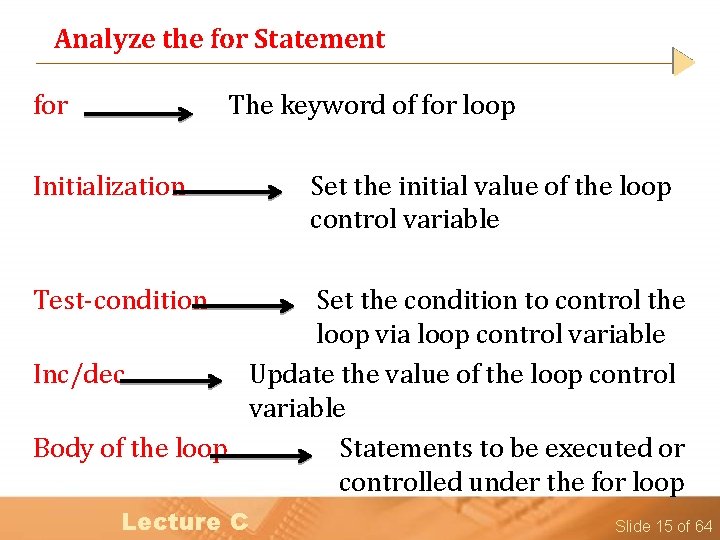
Analyze the for Statement for The keyword of for loop Initialization Set the initial value of the loop control variable Test-condition Set the condition to control the loop via loop control variable Inc/dec Update the value of the loop control variable Body of the loop Statements to be executed or controlled under the for loop Lecture C Slide 15 of 64

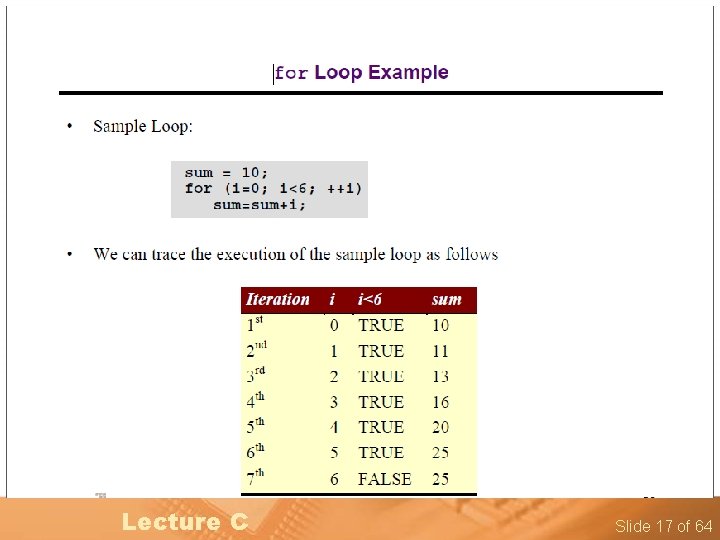
Analyze the for Statement § When the body of the loop is executed, the control is transferred back to the for statement after evaluating the last statement such as increment/decrement and the new value of the control variable is again tested to see whether it satisfies the loop condition or not Lecture C Slide 16 of 64
Lecture C Slide 17 of 64
For Loop Diagram Lecture C Slide 18 of 64
For Loop Example Lecture C Slide 19 of 64

For Loop Example Lecture C Slide 20 of 64
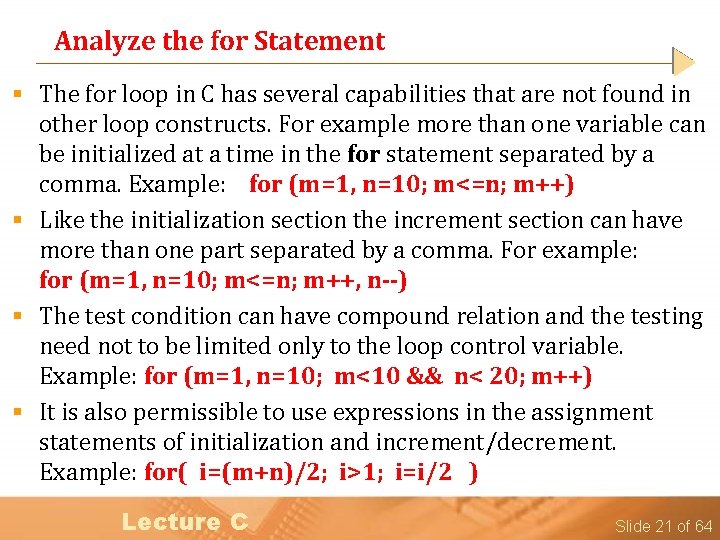
Analyze the for Statement § The for loop in C has several capabilities that are not found in other loop constructs. For example more than one variable can be initialized at a time in the for statement separated by a comma. Example: for (m=1, n=10; m<=n; m++) § Like the initialization section the increment section can have more than one part separated by a comma. For example: for (m=1, n=10; m<=n; m++, n--) § The test condition can have compound relation and the testing need not to be limited only to the loop control variable. Example: for (m=1, n=10; m<10 && n< 20; m++) § It is also permissible to use expressions in the assignment statements of initialization and increment/decrement. Example: for( i=(m+n)/2; i>1; i=i/2 ) Lecture C Slide 21 of 64
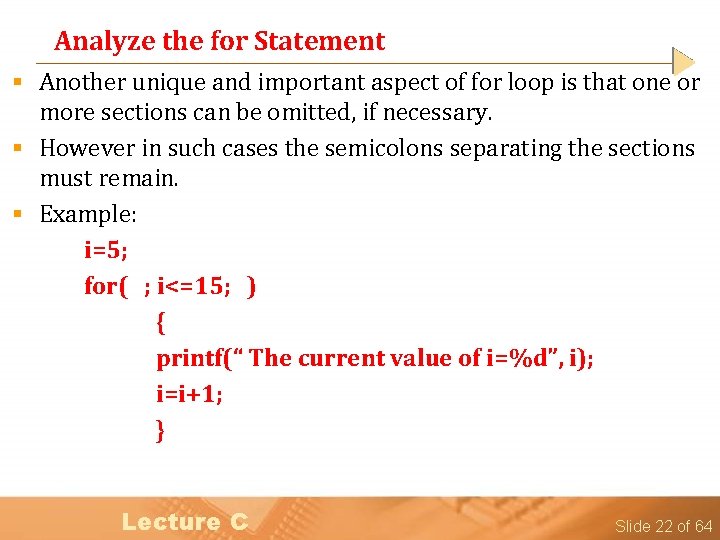
Analyze the for Statement § Another unique and important aspect of for loop is that one or more sections can be omitted, if necessary. § However in such cases the semicolons separating the sections must remain. § Example: i=5; for( ; i<=15; ) { printf(“ The current value of i=%d”, i); i=i+1; } Lecture C Slide 22 of 64
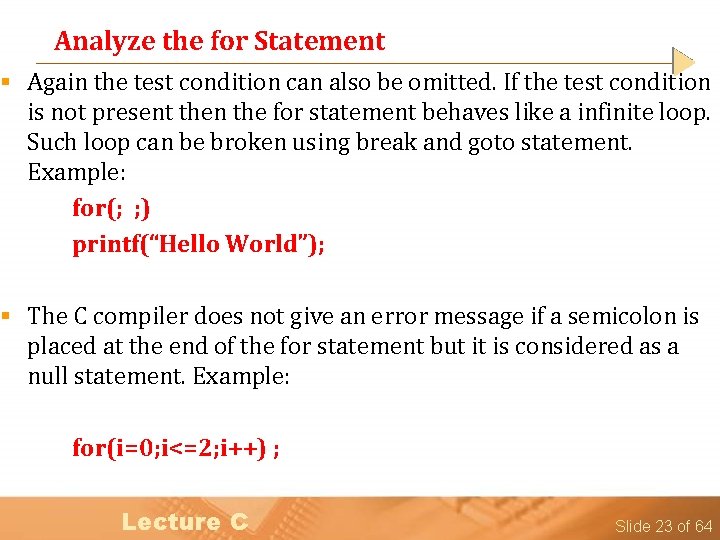
Analyze the for Statement § Again the test condition can also be omitted. If the test condition is not present then the for statement behaves like a infinite loop. Such loop can be broken using break and goto statement. Example: for(; ; ) printf(“Hello World”); § The C compiler does not give an error message if a semicolon is placed at the end of the for statement but it is considered as a null statement. Example: for(i=0; i<=2; i++) ; Lecture C Slide 23 of 64
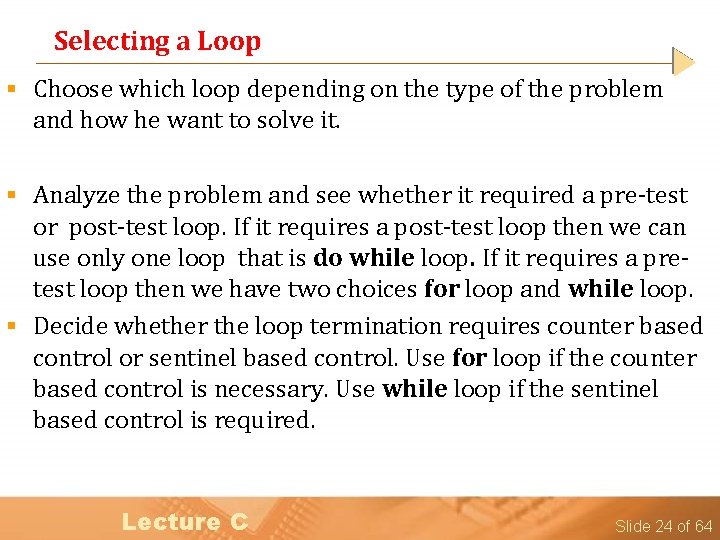
Selecting a Loop § Choose which loop depending on the type of the problem and how he want to solve it. § Analyze the problem and see whether it required a pre-test or post-test loop. If it requires a post-test loop then we can use only one loop that is do while loop. If it requires a pretest loop then we have two choices for loop and while loop. § Decide whether the loop termination requires counter based control or sentinel based control. Use for loop if the counter based control is necessary. Use while loop if the sentinel based control is required. Lecture C Slide 24 of 64
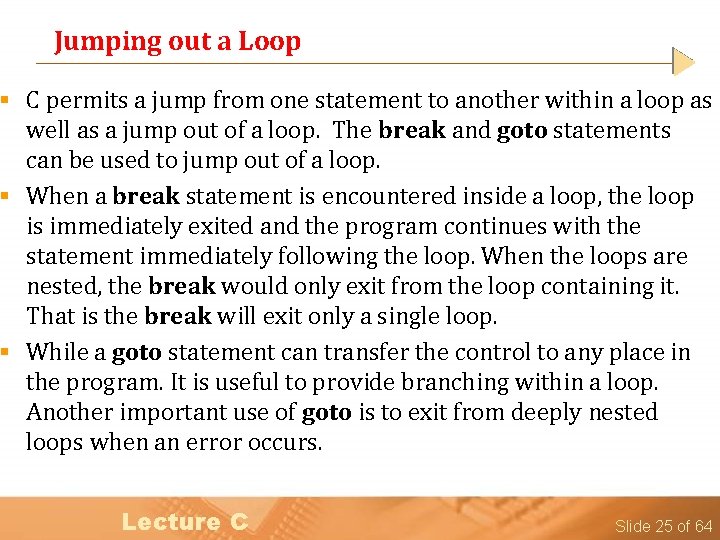
Jumping out a Loop § C permits a jump from one statement to another within a loop as well as a jump out of a loop. The break and goto statements can be used to jump out of a loop. § When a break statement is encountered inside a loop, the loop is immediately exited and the program continues with the statement immediately following the loop. When the loops are nested, the break would only exit from the loop containing it. That is the break will exit only a single loop. § While a goto statement can transfer the control to any place in the program. It is useful to provide branching within a loop. Another important use of goto is to exit from deeply nested loops when an error occurs. Lecture C Slide 25 of 64
The while Statement Lecture C Slide 26 of 64

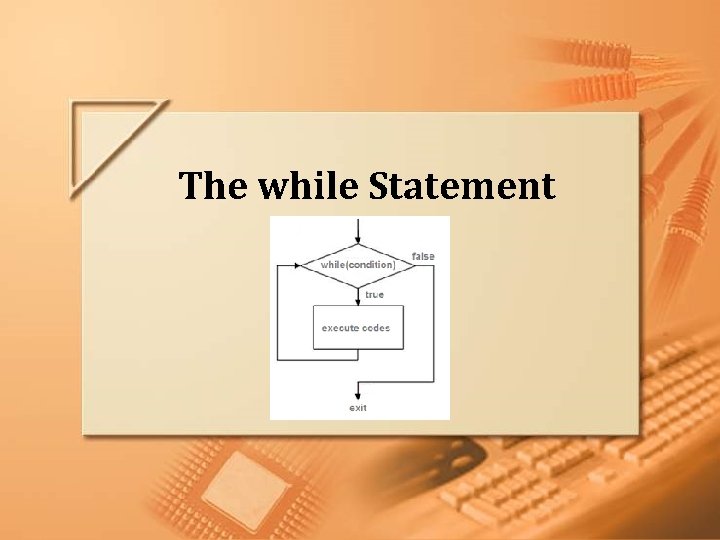
The While Statement § The simplest of all the looping structures is the while statement. The basic format of the while statement is : while (test-condition) { body of the loop; } Lecture C Slide 27 of 64
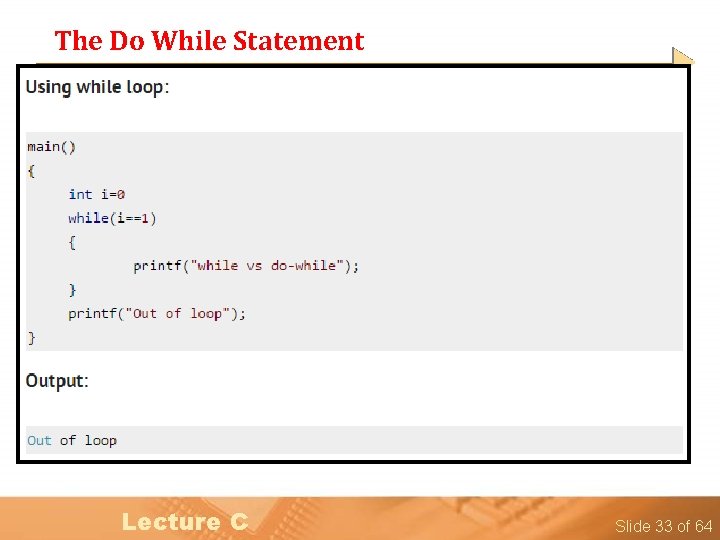
The While Statement § The while is an entry controlled loop statement. • If the condition is true, the statement is executed; then the condition is evaluated again • The statement is executed over and over until the condition becomes false • If the condition of a while statement is false initially, the statement is never executed. Therefore, we say that a while statement executes zero or more times § Important thing to notice that if the test condition is false then the controlled statements are not executed not even once unlike the do while loop. Lecture C Slide 28 of 64
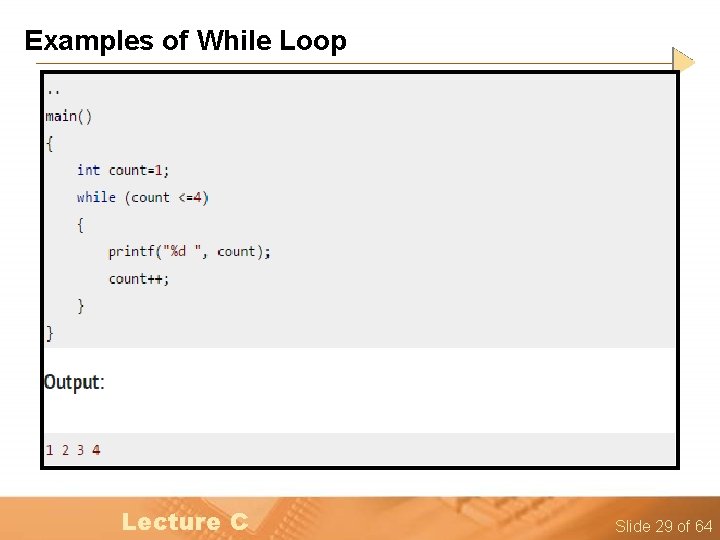
Examples of While Loop Lecture C Slide 29 of 64

Guess the Output? ? ? main() { int var=1; while (var <=2) { printf("%d ", var); } } Lecture C Slide 30 of 64
The Do. . While Statement Lecture C Slide 31 of 64
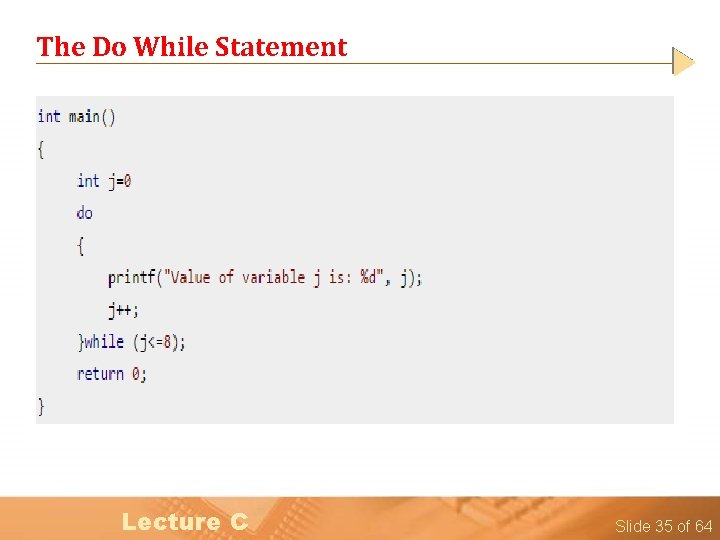
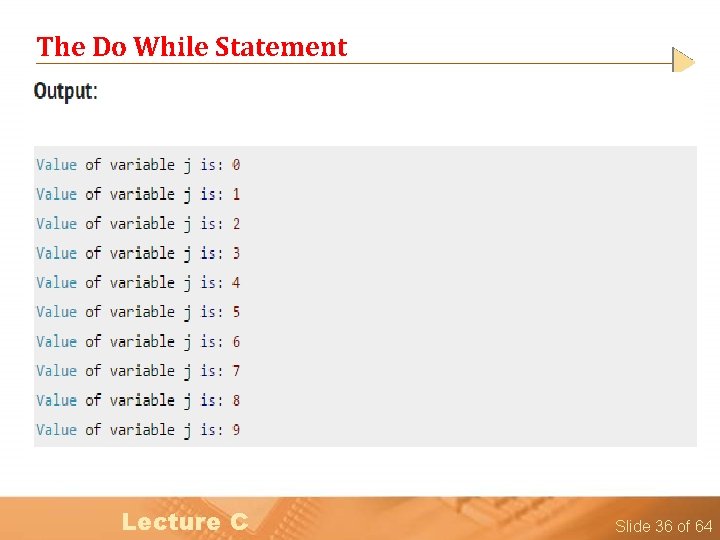
The Do While Statement § On some occasions it might be necessary to execute the body of the loop before the test is performed. Such situations can be handled by using do while loop. It has the structure: do { body of the loop; } while(test condition) Lecture C Slide 32 of 64
The Do While Statement Lecture C Slide 33 of 64
The Do While Statement Lecture C Slide 34 of 64
The Do While Statement Lecture C Slide 35 of 64
The Do While Statement Lecture C Slide 36 of 64
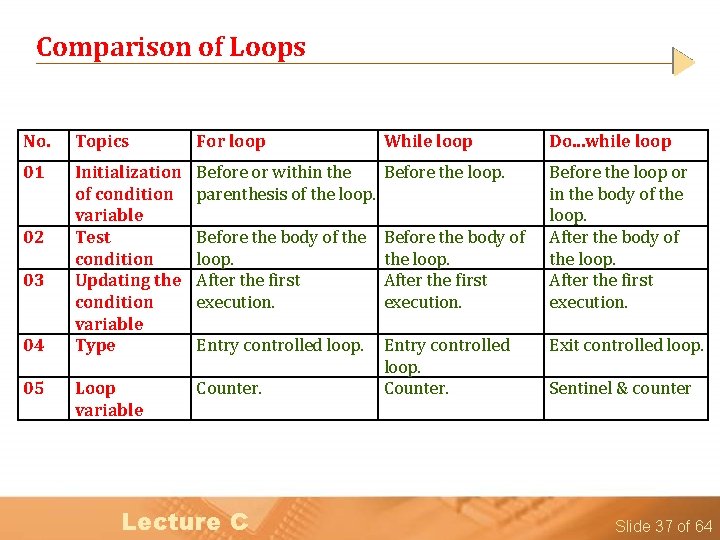
Comparison of Loops No. Topics For loop 01 Initialization of condition variable Test condition Updating the condition variable Type Before or within the Before the loop. parenthesis of the loop. Loop variable Counter. 02 03 04 05 While loop Before the body of the loop. After the first execution. Entry controlled loop. Counter. Lecture C Do. . . while loop Before the loop or in the body of the loop. After the first execution. Exit controlled loop. Sentinel & counter Slide 37 of 64
Questions? Lecture C Slide 38 of 64
References § The C Programming Language (9780131103627): Brian W. Kernighan, Dennis M. Ritchie § C Programming: A Modern Approach, 2 nd Edition By K. N. King § Absolute Beginner’s Guide To C, 2 nd Edition By Greg Perry Lecture C Slide 39 of 64
- Slides: 39