
Conditioning and Distribution of Compressed Air Chapter 16
Conditioning and Distribution of Compressed Air Chapter 16 Fluid Power Hydraulics and Pneumatics Kroger Pneumatics 1
Learning Objectives n n n Compare the various methods used to remove dirt from ambient air entering the compressor and in the final filtering of air distributed to the workstations. Benefits of controlling the temperature of compressed air and the methods used to remove excess heat. Problems caused by excess moisture in the compressed air of a pneumatic system. Identify the source of moisture in a pneumatic system and various methods used to remove liquid water from a system. Describe the functions of the pneumatic system receiver and identify construction features of typical designs. Atlas Copco Kroger Pneumatics 2
Learning Objectives n n n Considering factors for establishing the size and location of a receiver for a pneumatic system. Compare the design and operation of pneumatic pressure-regulator valves. Compare the various types of pipe, tubing, and hose used in pneumatic systems. Identify and explain the factors that should be used when selecting a conductor for use in a pneumatic system. Explain the design and construction of the various airdistribution systems. Describe the purpose, construction, and operation of the components used for the final preparation of compressed air at a pneumatic system workstation. Kroger Pneumatics 3
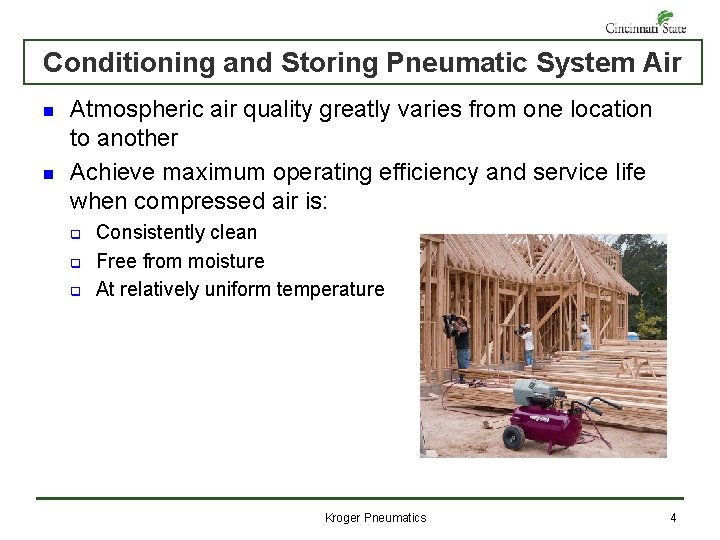
Conditioning and Storing Pneumatic System Air n n Atmospheric air quality greatly varies from one location to another Achieve maximum operating efficiency and service life when compressed air is: q q q Consistently clean Free from moisture At relatively uniform temperature Kroger Pneumatics 4
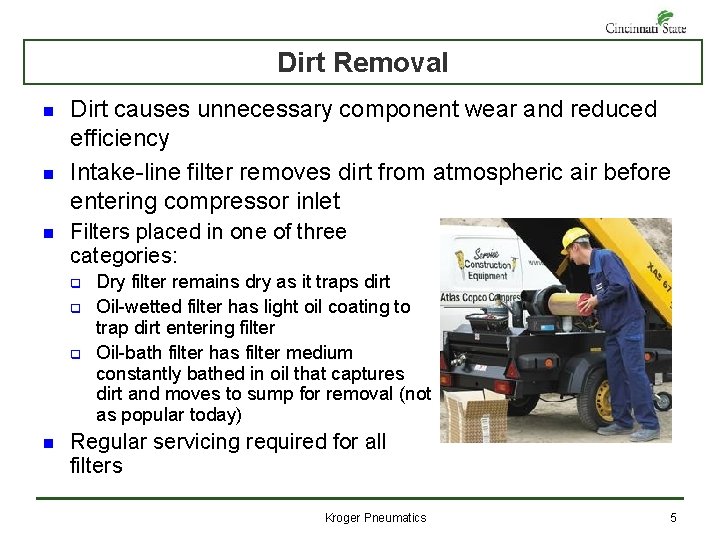
Dirt Removal n n n Dirt causes unnecessary component wear and reduced efficiency Intake-line filter removes dirt from atmospheric air before entering compressor inlet Filters placed in one of three categories: q q q n Dry filter remains dry as it traps dirt Oil-wetted filter has light oil coating to trap dirt entering filter Oil-bath filter has filter medium constantly bathed in oil that captures dirt and moves to sump for removal (not as popular today) Regular servicing required for all filters Kroger Pneumatics 5
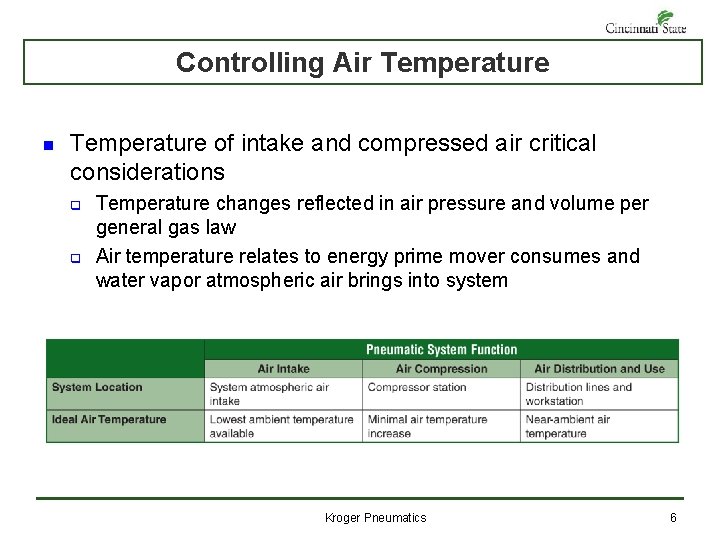
Controlling Air Temperature n Temperature of intake and compressed air critical considerations q q Temperature changes reflected in air pressure and volume per general gas law Air temperature relates to energy prime mover consumes and water vapor atmospheric air brings into system Kroger Pneumatics 6
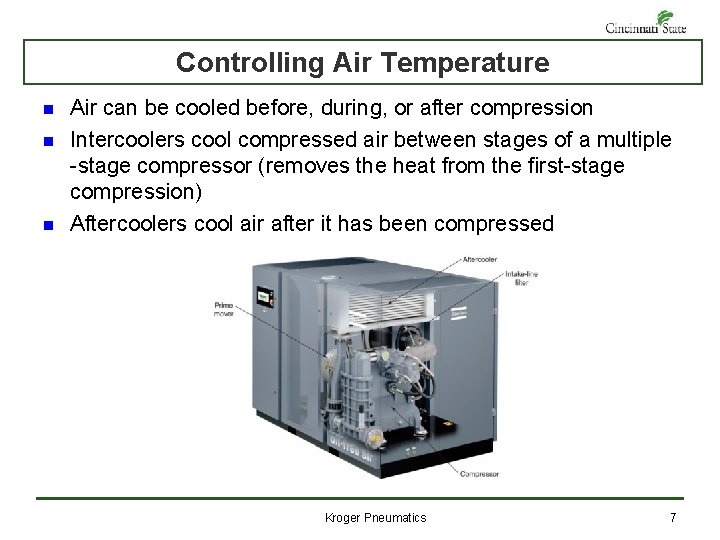
Controlling Air Temperature n n n Air can be cooled before, during, or after compression Intercoolers cool compressed air between stages of a multiple -stage compressor (removes the heat from the first-stage compression) Aftercoolers cool air after it has been compressed Kroger Pneumatics 7

Controlling Moisture in Compressed Air n Water vapor in air commonly referred to as humidity q q n n Amount of water vapor air retains depends on air temperature and volume Free air at 70°F can hold 1. 14 pounds of water vapor per 1, 000 cubic feet at saturation point q n Important and constant factor to consider Becomes an issue if vapor condenses into liquid water Equal to approximately one pint of liquid water Change in water vapor content with compression difficult to predict q Typically, cooling air moves through system, saturation or dew point is reached, and liquid water forms Kroger Pneumatics 8
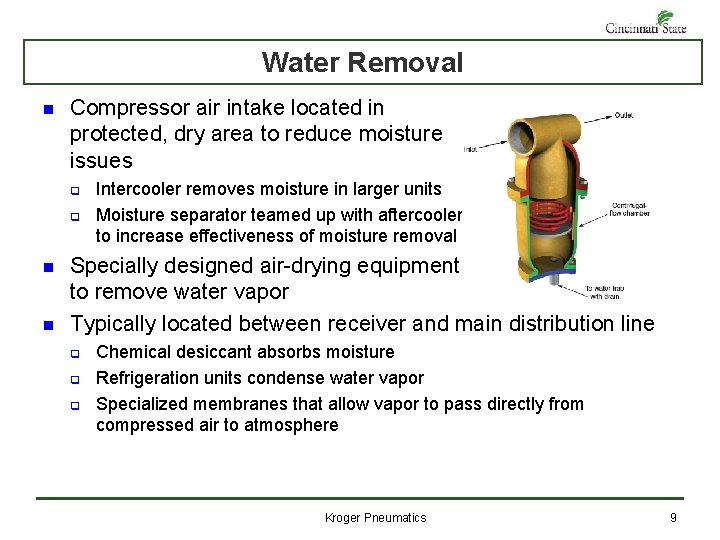
Water Removal n Compressor air intake located in protected, dry area to reduce moisture issues q q n n Intercooler removes moisture in larger units Moisture separator teamed up with aftercooler to increase effectiveness of moisture removal Specially designed air-drying equipment to remove water vapor Typically located between receiver and main distribution line q q q Chemical desiccant absorbs moisture Refrigeration units condense water vapor Specialized membranes that allow vapor to pass directly from compressed air to atmosphere Kroger Pneumatics 9
Compressed Air Storage n n Compressed air stored in specialized tank called a receiver Other functions of a receiver: q q n Dampens air pulsations resulting from compressor operation Removes water vapor from system air Volume of the tank reduces frequency of compressor cycling in capacity-control systems using start-stop or inlet valve unloading Kroger Pneumatics 10
Receiver Design and Construction n n Typically cylindrical with domed ends Withstand pressures used in consumer and industrial systems Often constructed of inlet and outlet ports, fittings to allow various component connections, hole for cleaning, and internal baffle Accessory component location depends on system size and complexity Caution q q Take care to follow certain codes Large volume of highly compressed air can present serious safety issues Kroger Pneumatics 11
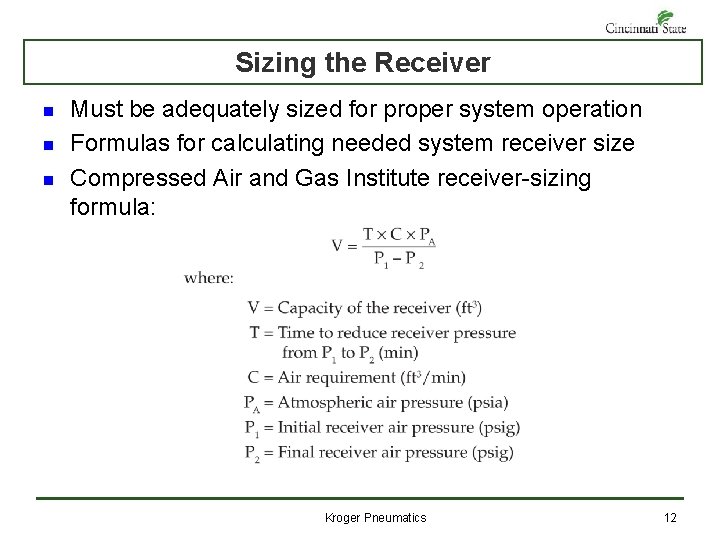
Sizing the Receiver n n n Must be adequately sized for proper system operation Formulas for calculating needed system receiver size Compressed Air and Gas Institute receiver-sizing formula: Kroger Pneumatics 12
Air-Distribution System n Carries high-pressure, conditioned air from receiver to workstations q n Must be done with minimal pressure drop Variety of designs to ensure air: q q q Remains pressurized Delivered at required volume Free from moisture and other contaminants Kroger Pneumatics 13
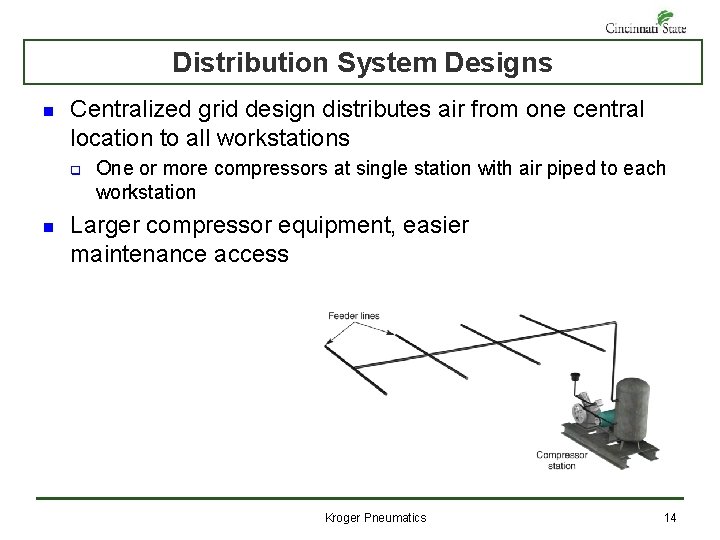
Distribution System Designs n Centralized grid design distributes air from one central location to all workstations q n One or more compressors at single station with air piped to each workstation Larger compressor equipment, easier maintenance access Kroger Pneumatics 14
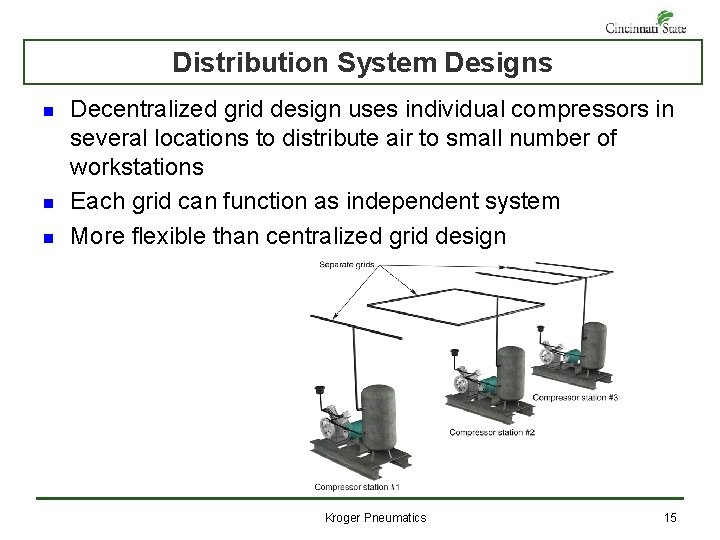
Distribution System Designs n n n Decentralized grid design uses individual compressors in several locations to distribute air to small number of workstations Each grid can function as independent system More flexible than centralized grid design Kroger Pneumatics 15
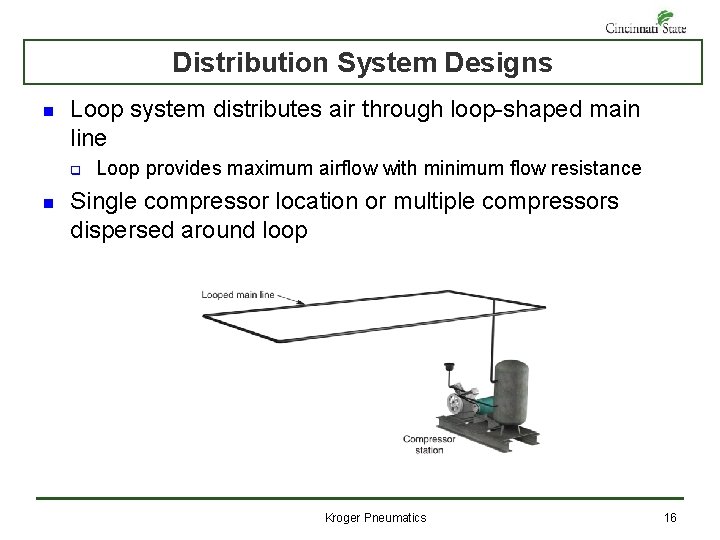
Distribution System Designs n Loop system distributes air through loop-shaped main line q n Loop provides maximum airflow with minimum flow resistance Single compressor location or multiple compressors dispersed around loop Kroger Pneumatics 16
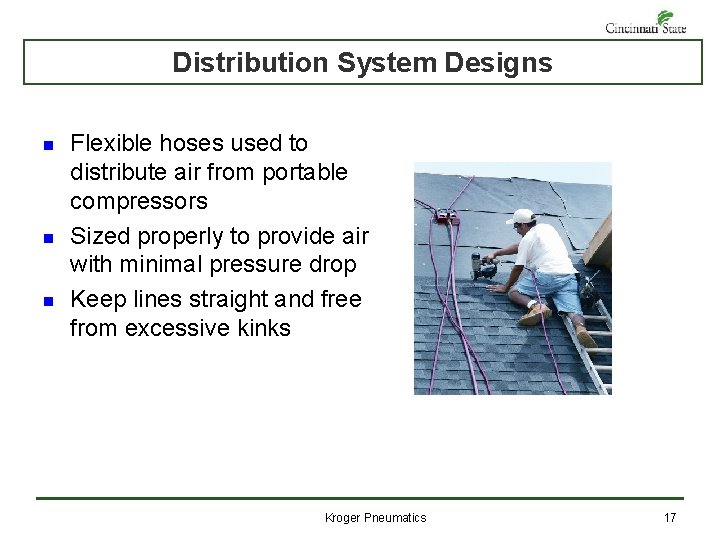
Distribution System Designs n n n Flexible hoses used to distribute air from portable compressors Sized properly to provide air with minimal pressure drop Keep lines straight and free from excessive kinks Kroger Pneumatics 17
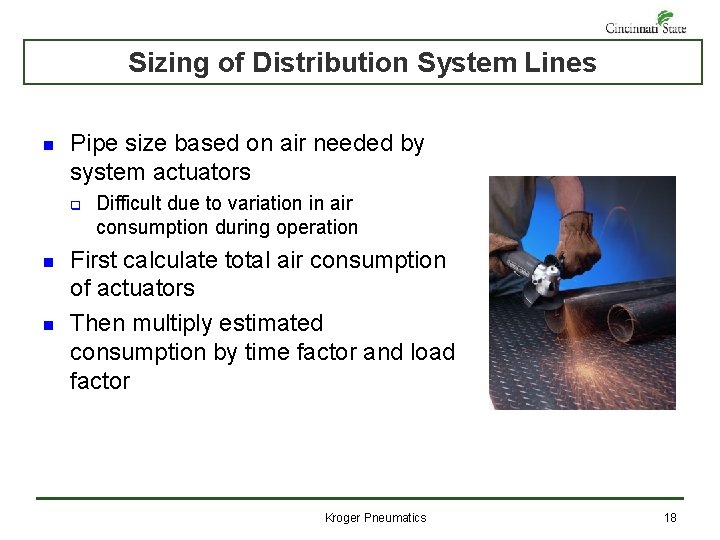
Sizing of Distribution System Lines n Pipe size based on air needed by system actuators q n n Difficult due to variation in air consumption during operation First calculate total air consumption of actuators Then multiply estimated consumption by time factor and load factor Kroger Pneumatics 18
Other Distribution System Considerations n Consider liquid water formation and excessive pressure drop n Install pipe with slope of 1″ per 10′ of line q n Drop lines lead to water traps where water is removed Auxiliary-air receiver can supply extra compressed air q Cost effective and accommodate unexpected resizing or relocation of workstations Kroger Pneumatics 19
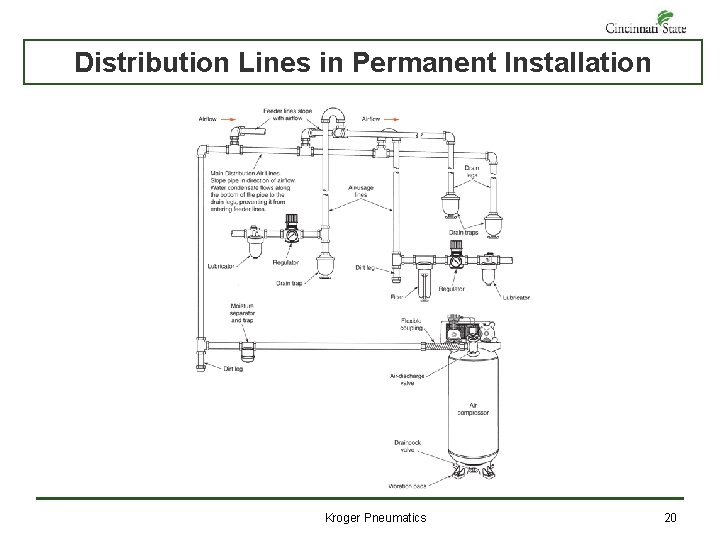
Distribution Lines in Permanent Installation Kroger Pneumatics 20
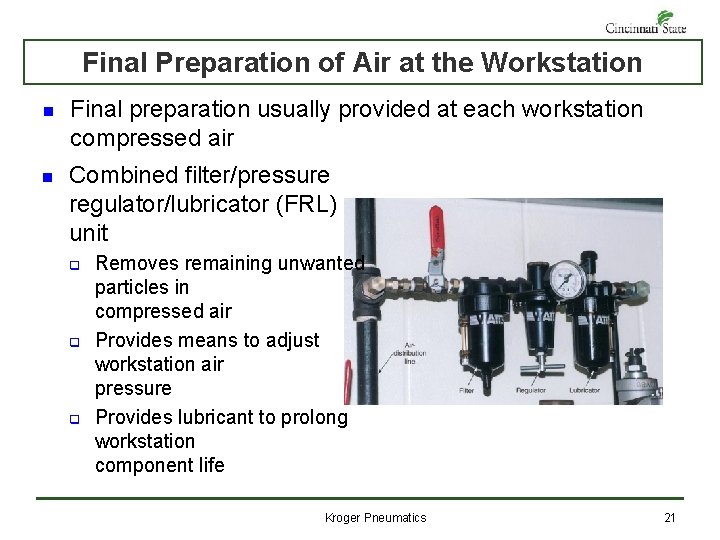
Final Preparation of Air at the Workstation n Final preparation usually provided at each workstation compressed air n Combined filter/pressure regulator/lubricator (FRL) unit q q q Removes remaining unwanted particles in compressed air Provides means to adjust workstation air pressure Provides lubricant to prolong workstation component life Kroger Pneumatics 21
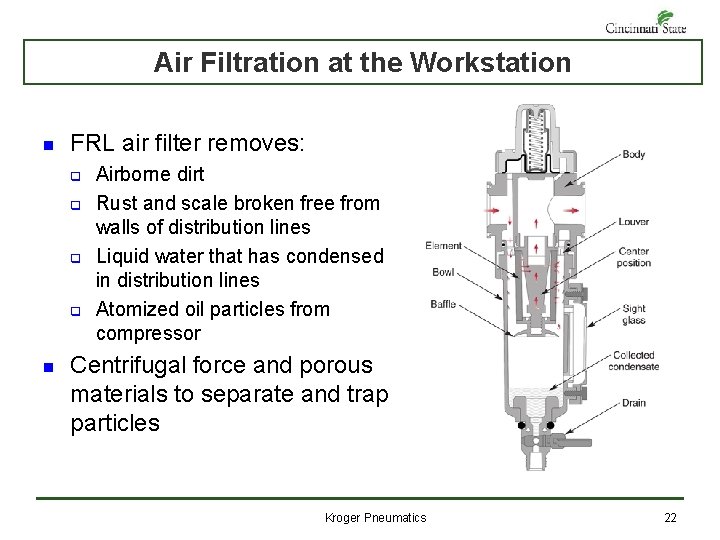
Air Filtration at the Workstation n FRL air filter removes: q q n Airborne dirt Rust and scale broken free from walls of distribution lines Liquid water that has condensed in distribution lines Atomized oil particles from compressor Centrifugal force and porous materials to separate and trap particles Kroger Pneumatics 22
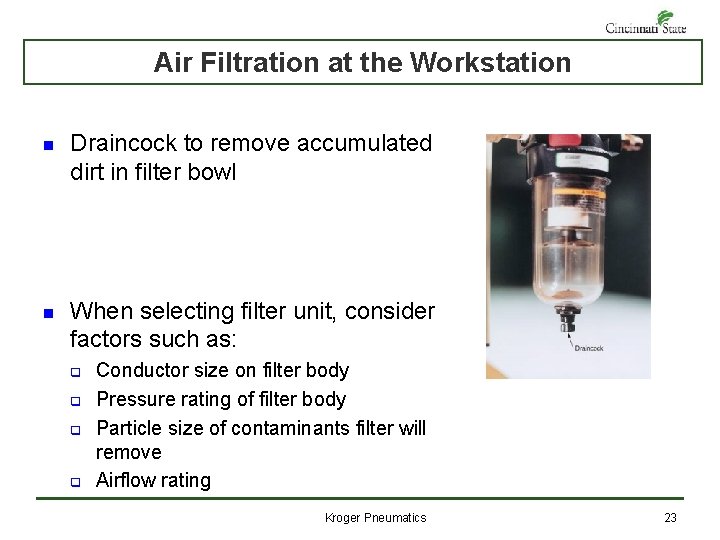
Air Filtration at the Workstation n Draincock to remove accumulated dirt in filter bowl n When selecting filter unit, consider factors such as: q q Conductor size on filter body Pressure rating of filter body Particle size of contaminants filter will remove Airflow rating Kroger Pneumatics 23
Pressure Regulation at the Workstation n Pressure regulator maintains uniform workstation air pressure q Promotes consistent actuator operation for tools and circuits n Maintain desired station output pressure as long as pressure in distribution system does not drop below selected pressure n Several designs discussed over the next few slides. Kroger Pneumatics 24
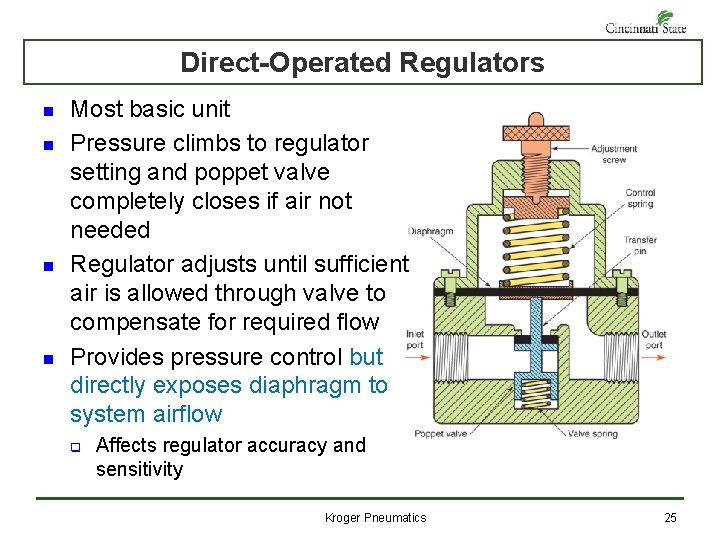
Direct-Operated Regulators n n Most basic unit Pressure climbs to regulator setting and poppet valve completely closes if air not needed Regulator adjusts until sufficient air is allowed through valve to compensate for required flow Provides pressure control but directly exposes diaphragm to system airflow q Affects regulator accuracy and sensitivity Kroger Pneumatics 25
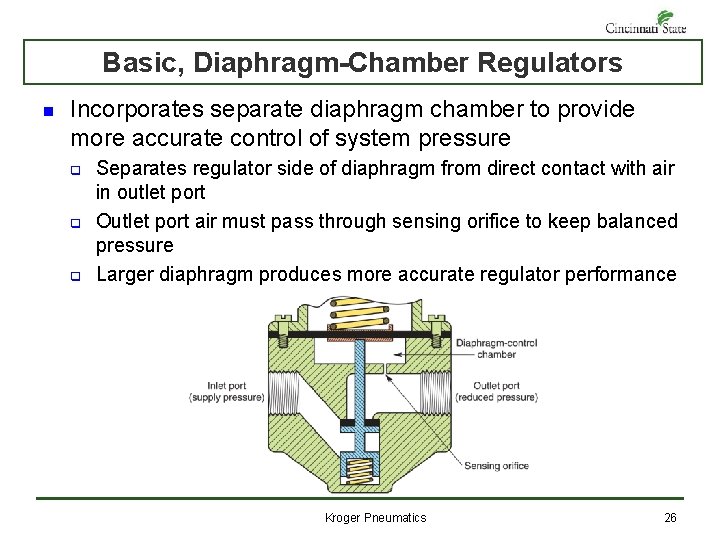
Basic, Diaphragm-Chamber Regulators n Incorporates separate diaphragm chamber to provide more accurate control of system pressure q q q Separates regulator side of diaphragm from direct contact with air in outlet port Outlet port air must pass through sensing orifice to keep balanced pressure Larger diaphragm produces more accurate regulator performance Kroger Pneumatics 26
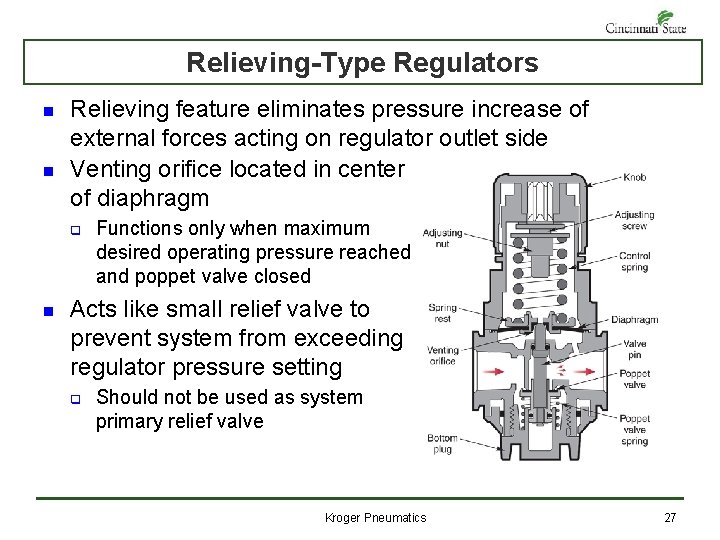
Relieving-Type Regulators n n Relieving feature eliminates pressure increase of external forces acting on regulator outlet side Venting orifice located in center of diaphragm q n Functions only when maximum desired operating pressure reached and poppet valve closed Acts like small relief valve to prevent system from exceeding regulator pressure setting q Should not be used as system primary relief valve Kroger Pneumatics 27
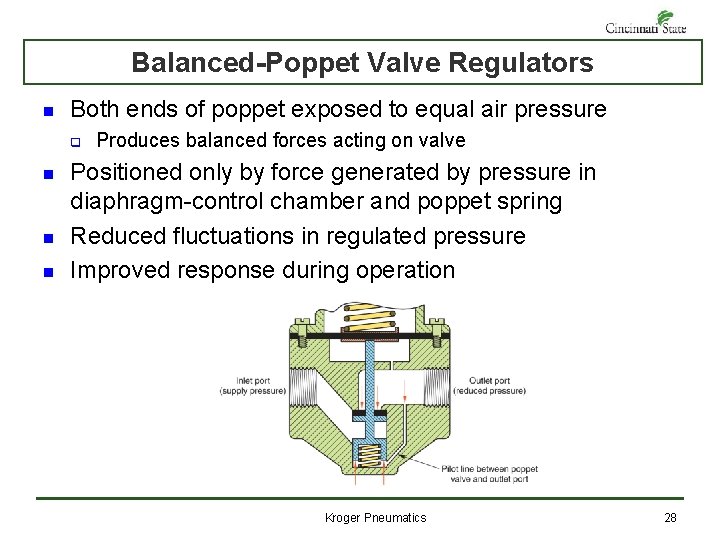
Balanced-Poppet Valve Regulators n Both ends of poppet exposed to equal air pressure q n n n Produces balanced forces acting on valve Positioned only by force generated by pressure in diaphragm-control chamber and poppet spring Reduced fluctuations in regulated pressure Improved response during operation Kroger Pneumatics 28
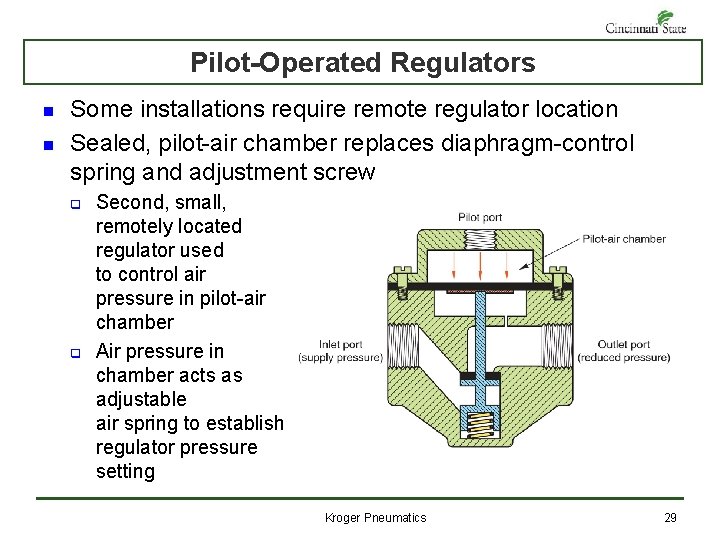
Pilot-Operated Regulators n n Some installations require remote regulator location Sealed, pilot-air chamber replaces diaphragm-control spring and adjustment screw q q Second, small, remotely located regulator used to control air pressure in pilot-air chamber Air pressure in chamber acts as adjustable air spring to establish regulator pressure setting Kroger Pneumatics 29
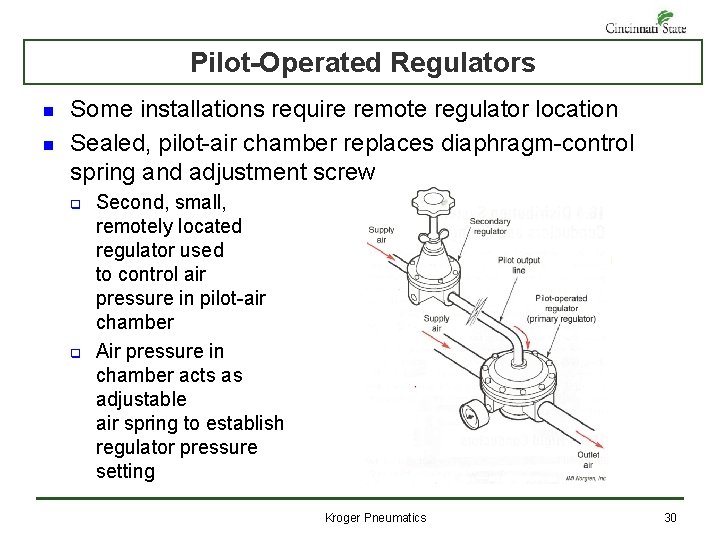
Pilot-Operated Regulators n n Some installations require remote regulator location Sealed, pilot-air chamber replaces diaphragm-control spring and adjustment screw q q Second, small, remotely located regulator used to control air pressure in pilot-air chamber Air pressure in chamber acts as adjustable air spring to establish regulator pressure setting Kroger Pneumatics 30
Regulator Selection n Factors to consider when selecting system regulator: q q n Regulator style depending on system size and performance demands Pressure range of unit Airflow range of unit Conductor connection size Manufacturer information and specification sheets supply details Kroger Pneumatics 31
Air Line Lubrication at the Workstation n Lubricator provides oil needed to improve performance and component service life n Atomizes oil and mixes it with compressed air q q Not enough oil can cause rapid component wear Too much oil is wasteful and can contaminate work areas Kroger Pneumatics 32
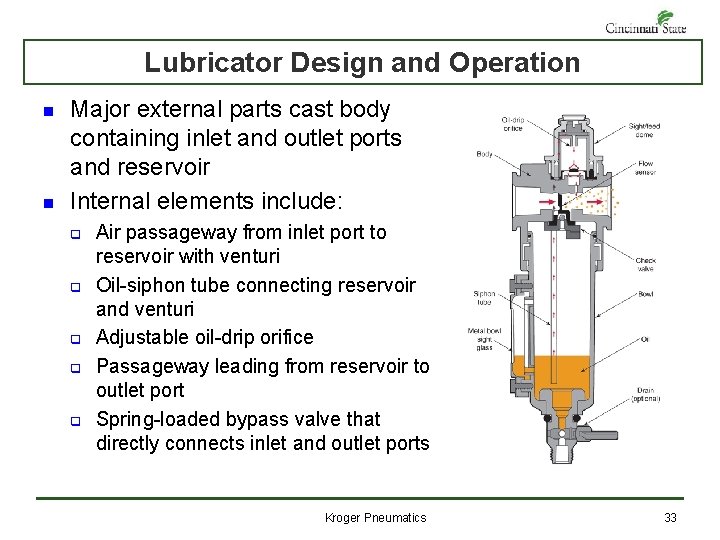
Lubricator Design and Operation n n Major external parts cast body containing inlet and outlet ports and reservoir Internal elements include: q q q Air passageway from inlet port to reservoir with venturi Oil-siphon tube connecting reservoir and venturi Adjustable oil-drip orifice Passageway leading from reservoir to outlet port Spring-loaded bypass valve that directly connects inlet and outlet ports Kroger Pneumatics 33
Lubricator Design and Operation n Rapidly moving system air passing through lubricator breaks up droplets of oil to form mist q n n Mist transported through workstation lines to system components Oil amount added to air controlled by adjusting oil-drip orifice size Lubricator Selection q Factors to consider when selecting system lubricator: n n n q Conductor connection size Oil reservoir capacity System pressure drop created by volume of air needed to pass through unit to operate workstation components Manufacturer information and specification sheets supply details Kroger Pneumatics 34
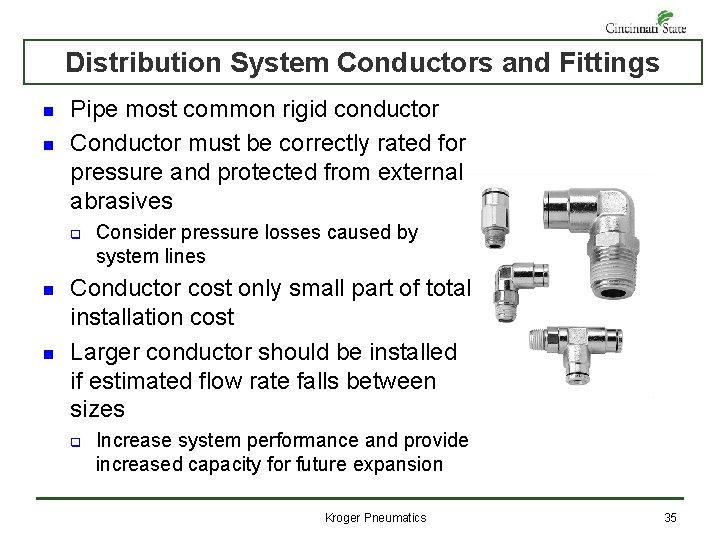
Distribution System Conductors and Fittings n n Pipe most common rigid conductor Conductor must be correctly rated for pressure and protected from external abrasives q n n Consider pressure losses caused by system lines Conductor cost only small part of total installation cost Larger conductor should be installed if estimated flow rate falls between sizes q Increase system performance and provide increased capacity for future expansion Kroger Pneumatics 35
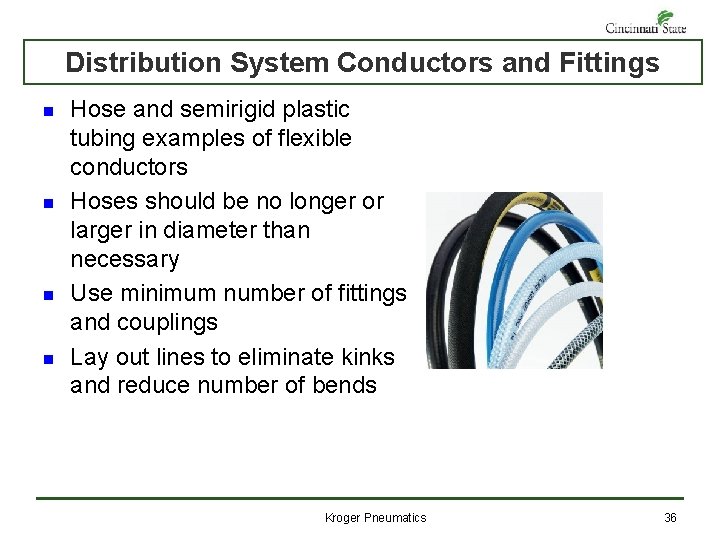
Distribution System Conductors and Fittings n n Hose and semirigid plastic tubing examples of flexible conductors Hoses should be no longer or larger in diameter than necessary Use minimum number of fittings and couplings Lay out lines to eliminate kinks and reduce number of bends Kroger Pneumatics 36
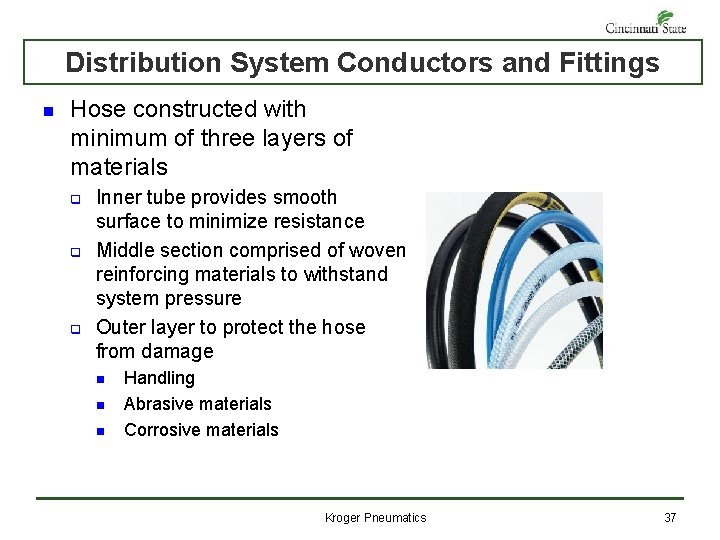
Distribution System Conductors and Fittings n Hose constructed with minimum of three layers of materials q q q Inner tube provides smooth surface to minimize resistance Middle section comprised of woven reinforcing materials to withstand system pressure Outer layer to protect the hose from damage n n n Handling Abrasive materials Corrosive materials Kroger Pneumatics 37
- Slides: 37