
CONDITIONED EMOTIONAL REACTIONS Watson Rayner 1920 OVER ALL













- Slides: 28
CONDITIONED EMOTIONAL REACTIONS Watson & Rayner, 1920
OVER ALL AIM To demonstrate that the principles of classical conditioning can be used to explain how humans acquire phobic behaviours and to show that a fear response can be created within a young child to a stimulus which does not naturally produce this response.
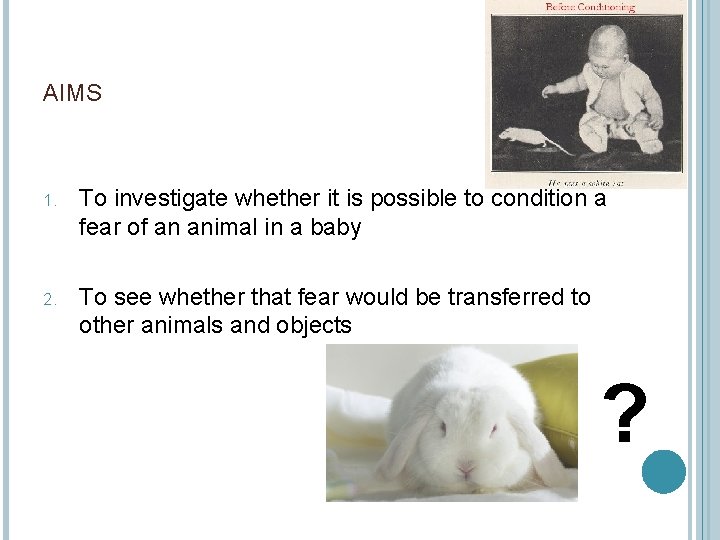
AIMS 1. To investigate whether it is possible to condition a fear of an animal in a baby 2. To see whether that fear would be transferred to other animals and objects ?
AIMS 3. To investigate the effect of time on such conditioned emotional responses 4. If the responses do not extinguish themselves, then to investigate what laboratory methods can be devised for their removal ?
PARTICIPANT Little Albert aged 9 months - 1 year 21 days Mother a wet nurse at the Harriet Lane Home for Invalid Children This was where Albert had been raised Albert ‘normal’ Stolid and unemotional
“No one had ever seen him in a state of fear or rage. ” “The infant practically never cried. ”
“We felt we could do him relatively little harm by carrying out experiments such as those outlined below. . . ”
PROCEDURE Method Single case study conducted under laboratory conditions Using observational techniques to record data
PROCEDURE Although only carried out on one participant (a healthy, 9 month old male infant called ‘Albert B’ or little Albert) this is an example of a laboratory experiment. The procedure involved 3 phases: pre conditioning testing, conditioning trials and a post conditioning test.
PROCEDURE Approx 9 months Little Albert was shown a series of stimuli � White rat � Rabbit Neutral stimuli � Dog � Monkey � Masks � Cotton wool � Burning newspapers At NO time did Little Albert show any fear
PROCEDURE Unconditioned stimulus 8 months & 26 days 1. A steel bar was struck with a sharp blow behind Albert’s head Albert showed ‘startled reaction’ 2. 3. The steel bar was struck again Albert again showed a ‘startled reaction & his lips puckered and trembled The steel bar was struck for the third time Unconditioned Albert started crying response
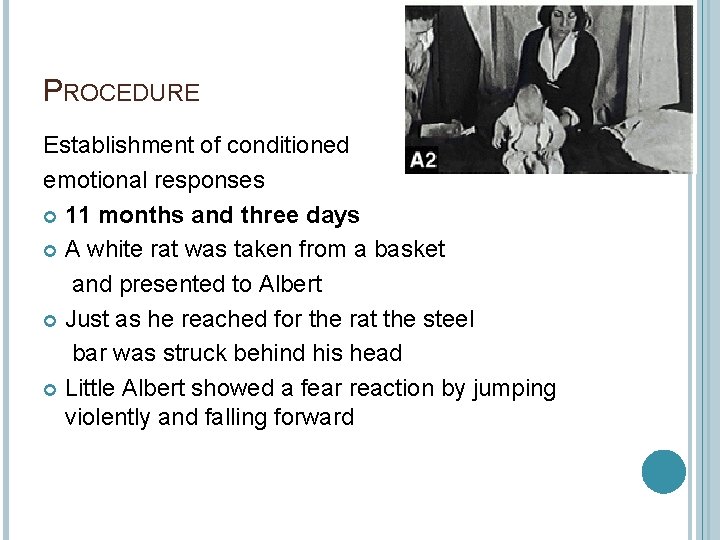
PROCEDURE Establishment of conditioned emotional responses 11 months and three days A white rat was taken from a basket and presented to Albert Just as he reached for the rat the steel bar was struck behind his head Little Albert showed a fear reaction by jumping violently and falling forward
PROCEDURE 11 months 10 days 1. The rat was presented without the steel bar and Albert was hesitant to touch the animal This shows the procedure that was performed the previous week had some effect. . . Then the experimental procedure began again. . . 2. The rat and steel bar were presented together Little Albert ‘started’ and fell over
PROCEDURE 3. Joint stimulation again. Albert fell over again and turn away from the rat 4. Joint stimulation – same reaction 5. Rat presented alone – Albert whimpers and withdraws his body 6. Joint stimulation. Albert fell over again and started to whimper 7. Joint stimulation. Albert started violently and cried!
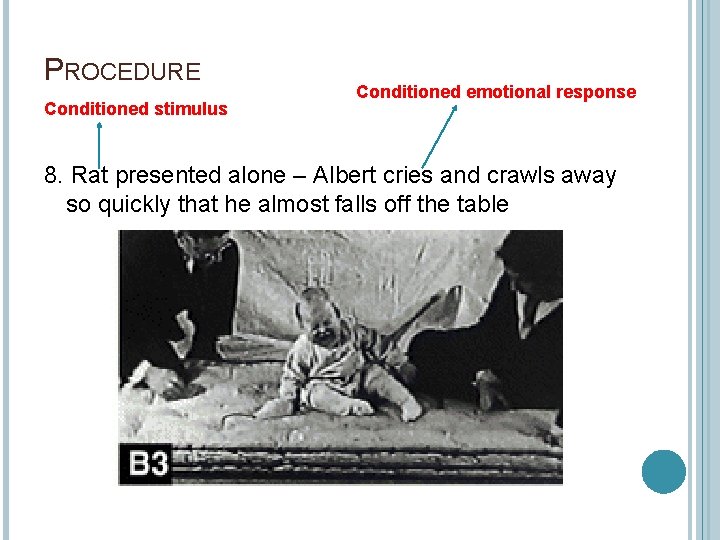
PROCEDURE Conditioned stimulus Conditioned emotional response 8. Rat presented alone – Albert cries and crawls away so quickly that he almost falls off the table
It takes seven joint stimulation trials in all to make Little Albert cry and establish the fear response!
PROCEDURE TESTING AIM 2 – WILL ALBERT'S FEAR RESPONSE GENERALISE TO OTHER OBJECTS? 11 months 15 days 1. Albert is shown the rat again and shows a fear response 2. Albert is then shown a rabbit. He show a fear response by whimpering then bursting into tears and buried his head in the mattress then crawled off crying
PROCEDURE Little Albert shows a similar fear response to: Fur coat Cotton wool Santa mask A dog
PROCEDURE TESTING AIM 3 – THE EFFECT OF TIME ON CONDITIONED EMOTIONAL RESPONSES No further conditioning experimentation was conducted on Little Albert for 31 days One Year 21 days Little Albert was presented with � The Santa mask � The Fur Coat � The Rat � The Dog He showed a fear response to all of them
“These experiments seem to show conclusively that directly conditioned emotional responses as well as those conditioned by transfer, persist”
“Our view is that these responses in the home environment are likely to persist indefinitely” http: //www. youtube. com/watch? v=9 h. Bfn. XA Cs. OI
AFTER THE STUDY……. . What happened to Little Albert? Watson wanted to desensitize him to see if a conditioned stimulus could be removed, but knew from the beginning of the study that there would not be time. Albert left the hospital on the day these last tests were made, and no desensitizing ever took place, hence the opportunity of developing an experimental technique for removing the Conditioned Emotional Response was then discontinued. "Albert B. " was a pseudonym for Douglas Merritte. The boy died on May 10, 1925 of hydrocephalus.
EVALUATION Validity This research lacks ecological validity, so the findings cannot be generalised to other settings outside the laboratory situation as the method used created an unnatural situation which may not reflect learning in everyday life. However, this artificiality did increase the experimental validity of the study due to the strict controls, e. g. Albert had no prior learning due to his age that could have influenced the fear response to rats.
EVALUATION Reliability The study is high in reliability as the use of standardised procedures allows for high control over all extraneous variables, this means that it is possible to replicate the study and check that the results are consistent.
EVALUATION Generalisability However, as this was a study of one young child the findings cannot be generalised to others. Albert had been reared in a hospital environment from birth and he was unusual as he had never been seen to show fear or rage by staff. Therefore Little Albert may have responded differently in this experiment to how other young children may have, these findings will therefore be unique to him.
EVALUATION Application to everyday life This research has demonstrated that phobias can be learnt through the process of classical conditioning. Therefore, if we can understand how phobias do develop we can incorporate this into treatment of this form of behaviour through the use of systematic desensitisation.
EVALUATION Ethical issues There are ethical concerns with this study as Albert was conditioned to fear numerous white furry stimuli. His mother removed him from the experiment before the researchers were able to remove this fear. This goes against the present day guideline of protection which govern psychological research. However, you could argue that the benefits to others through the development of therapy outweigh the costs to Albert.
EXTRA – CREDIBILITY ISSUE A recent (2012) research paper suggests that Merritte had hydrocephalus from birth. The article also included assessments of the boy in the "Albert B. " film by a clinical psychologist and a pediatric neurologist indicating that his responses were indicative of a neurologically compromised child. If true, this would undermine Watson & Rayner's claim that "Albert B. " was a "normal" and "healthy" baby and possibly call into question the credibility of a highly influential study.