
Conditionals and Biconditionals PHIL 012 03262001 Outline Announcements
Conditionals and Biconditionals PHIL 012 03/26/2001
Outline • Announcements – Exams will be handed back Wednesday – Next exam April 11 • 4. 1 The Material Conditional → • 4. 2 The Biconditional: ↔
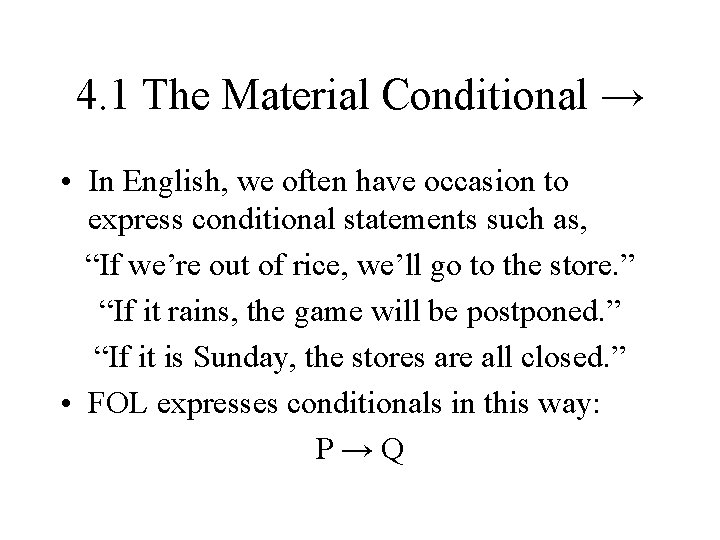
4. 1 The Material Conditional → • In English, we often have occasion to express conditional statements such as, “If we’re out of rice, we’ll go to the store. ” “If it rains, the game will be postponed. ” “If it is Sunday, the stores are all closed. ” • FOL expresses conditionals in this way: P→Q

The Material Conditional → • The Material Conditional (P→Q) consists of two terms, P and Q. • The first term, P, is called the antecedent. • The second term, Q, is called the consequent. • The definition of → says that for P→Q to be true, the consequent must be true whenever the antecedent is true.
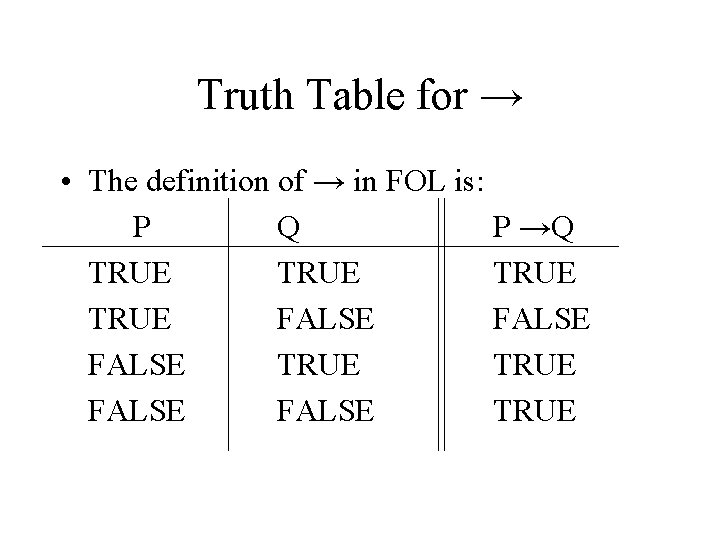
Truth Table for → • The definition of → in FOL is: P Q P →Q TRUE FALSE TRUE FALSE TRUE
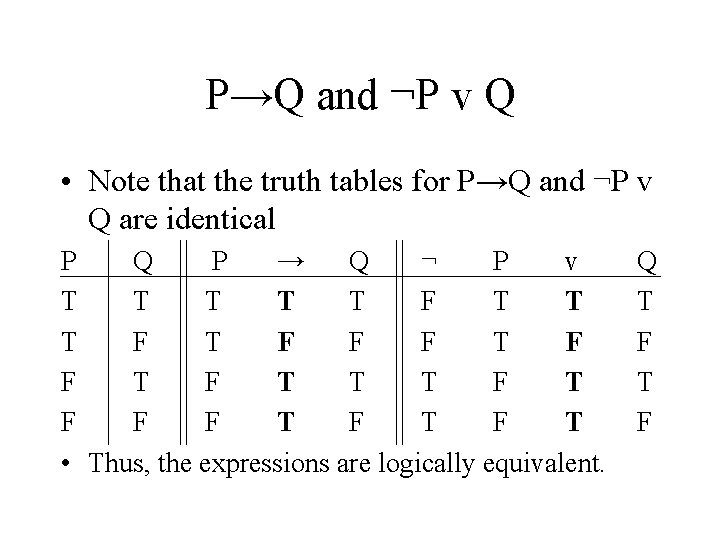
P→Q and ¬P v Q • Note that the truth tables for P→Q and ¬P v Q are identical P Q P → Q ¬ P v T T T F F F T F T T T F F F T F T • Thus, the expressions are logically equivalent. Q T F
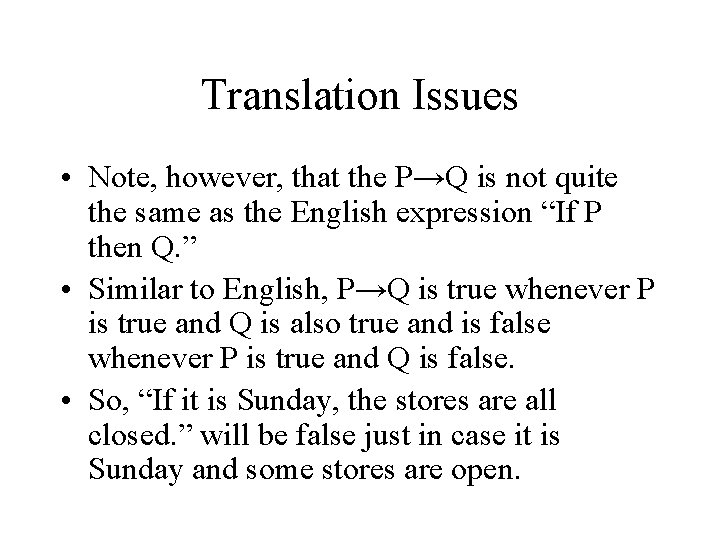
Translation Issues • Note, however, that the P→Q is not quite the same as the English expression “If P then Q. ” • Similar to English, P→Q is true whenever P is true and Q is also true and is false whenever P is true and Q is false. • So, “If it is Sunday, the stores are all closed. ” will be false just in case it is Sunday and some stores are open.
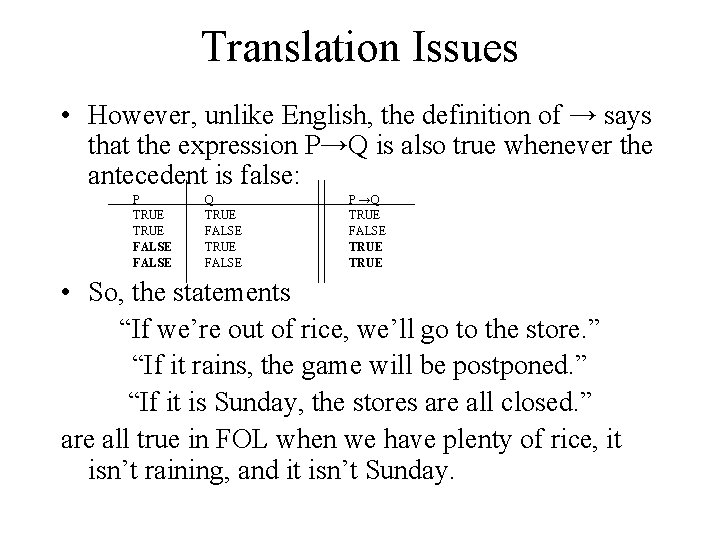
Translation Issues • However, unlike English, the definition of → says that the expression P→Q is also true whenever the antecedent is false: P TRUE FALSE Q TRUE FALSE P →Q TRUE FALSE TRUE • So, the statements “If we’re out of rice, we’ll go to the store. ” “If it rains, the game will be postponed. ” “If it is Sunday, the stores are all closed. ” are all true in FOL when we have plenty of rice, it isn’t raining, and it isn’t Sunday.
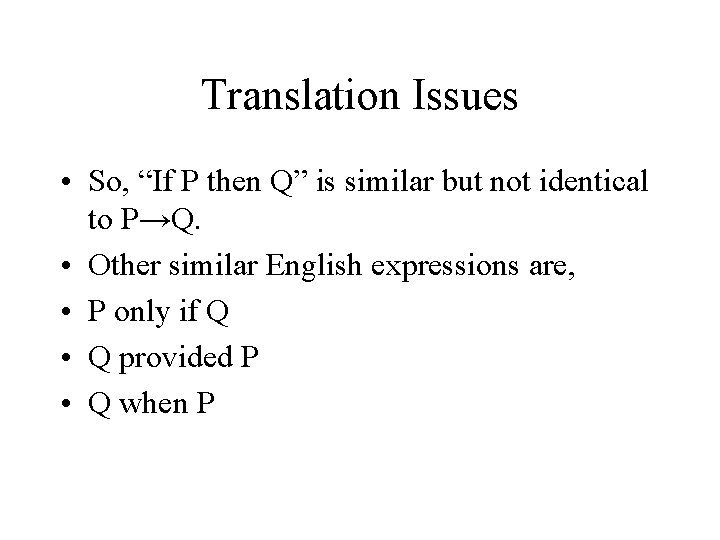
Translation Issues • So, “If P then Q” is similar but not identical to P→Q. • Other similar English expressions are, • P only if Q • Q provided P • Q when P
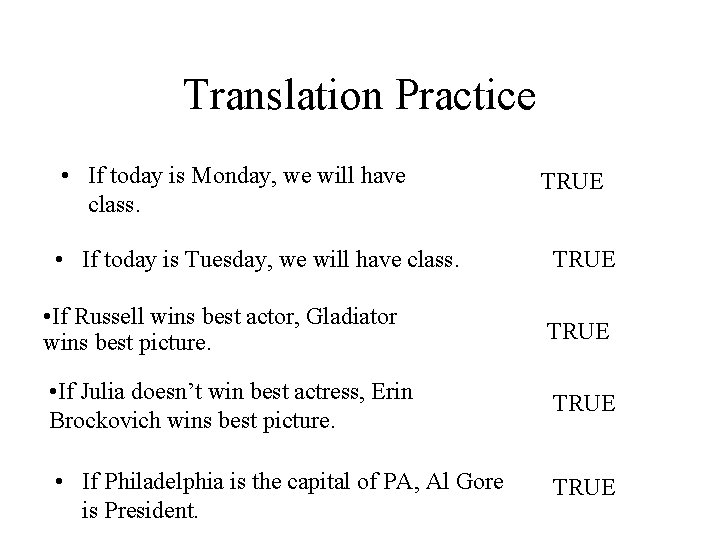
Translation Practice • If today is Monday, we will have class. • If today is Tuesday, we will have class. TRUE • If Russell wins best actor, Gladiator wins best picture. TRUE • If Julia doesn’t win best actress, Erin Brockovich wins best picture. TRUE • If Philadelphia is the capital of PA, Al Gore is President. TRUE
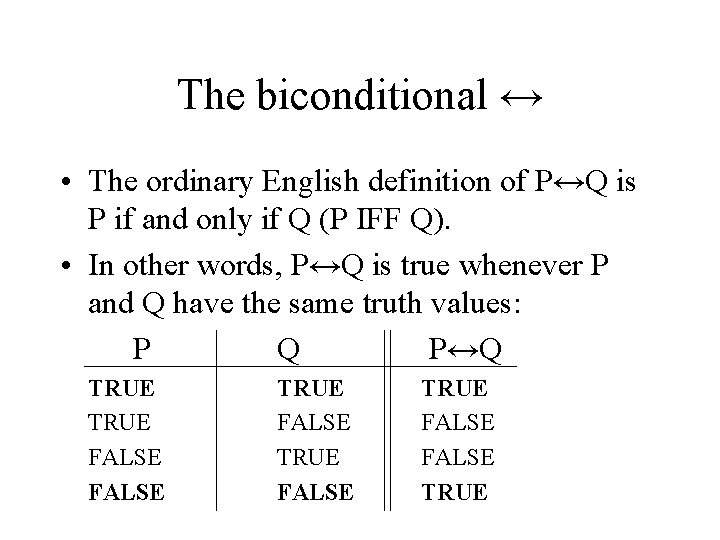
The biconditional ↔ • The ordinary English definition of P↔Q is P if and only if Q (P IFF Q). • In other words, P↔Q is true whenever P and Q have the same truth values: P Q P↔Q TRUE FALSE TRUE FALSE TRUE
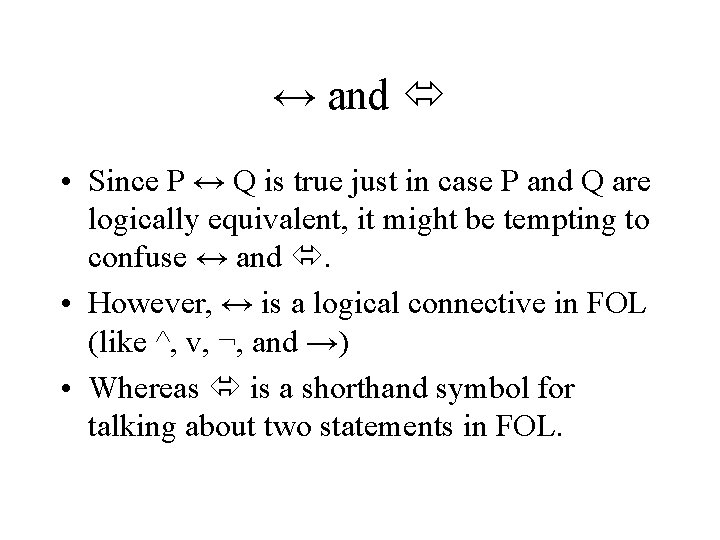
↔ and • Since P ↔ Q is true just in case P and Q are logically equivalent, it might be tempting to confuse ↔ and . • However, ↔ is a logical connective in FOL (like ^, v, ¬, and →) • Whereas is a shorthand symbol for talking about two statements in FOL.
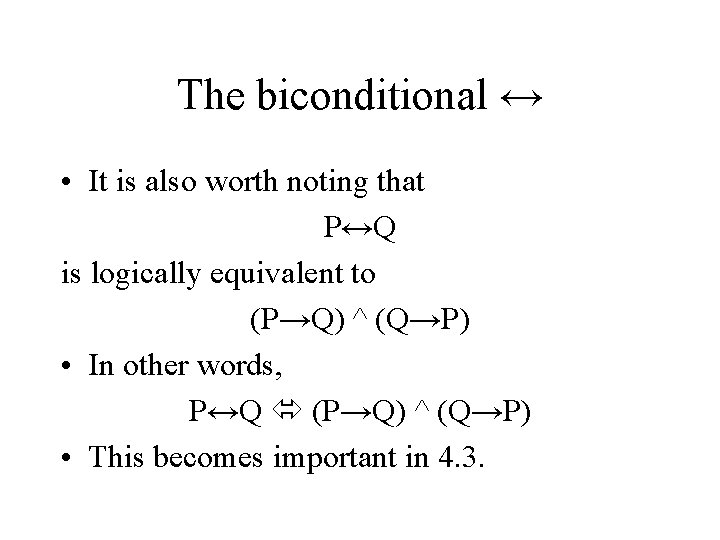
The biconditional ↔ • It is also worth noting that P↔Q is logically equivalent to (P→Q) ^ (Q→P) • In other words, P↔Q (P→Q) ^ (Q→P) • This becomes important in 4. 3.
Questions
Assignment • For Monday, do Ch 4: probs 1 -22 (except 17 and 21). • For Wednesday, read 4. 3.
- Slides: 15