
Conditional Statements Counterexamples Truth tables Warm Up Determine
Conditional Statements Counterexamples Truth tables
Warm Up Determine if each statement is true or false. 1. The measure of an obtuse angle is less than 90°. 2. All F perfect-square numbers are positive. T 3. Every prime number is odd. 4. Any three points are coplanar. F T
Objectives Identify, write, and analyze the truth value of conditional statements. Write the inverse, converse, and contrapositive of a conditional statement.
Vocabulary conditional statement hypothesis conclusion truth value negation converse inverse contrapostive logically equivalent statements
In the pursuit of justice Lawyers may act as legal advisers to or advocates for their clients. The details of the job depend on the lawyer’s specialization. But no matter their role, all lawyers must interpret the law and apply it to their client’s situations. To interpret the law in specific situations, lawyers must be skillful in logical thinking and reasoning.
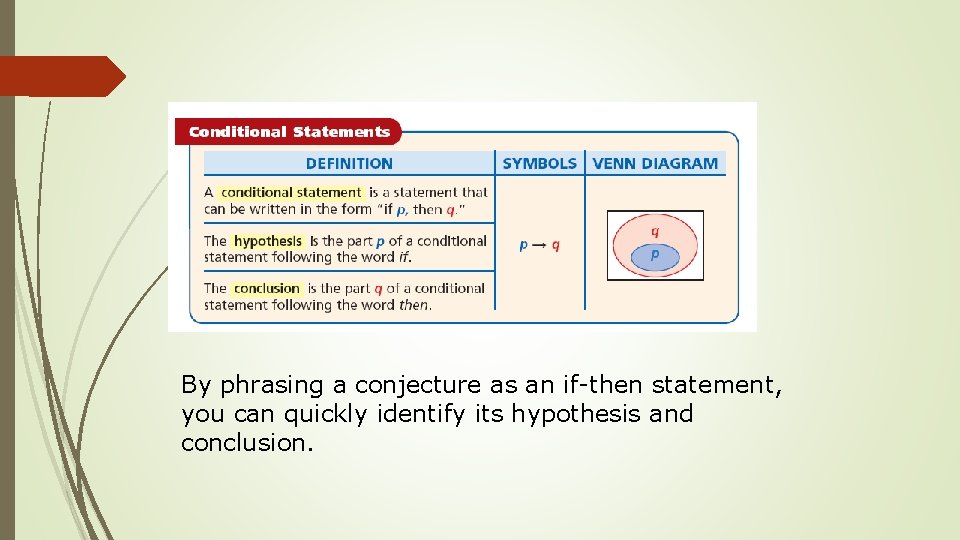
By phrasing a conjecture as an if-then statement, you can quickly identify its hypothesis and conclusion.
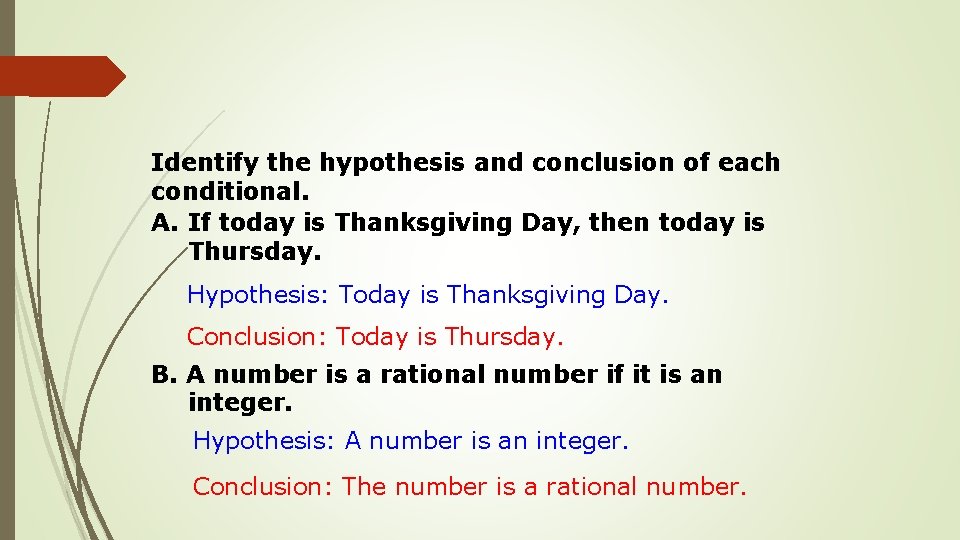
Identify the hypothesis and conclusion of each conditional. A. If today is Thanksgiving Day, then today is Thursday. Hypothesis: Today is Thanksgiving Day. Conclusion: Today is Thursday. B. A number is a rational number if it is an integer. Hypothesis: A number is an integer. Conclusion: The number is a rational number.
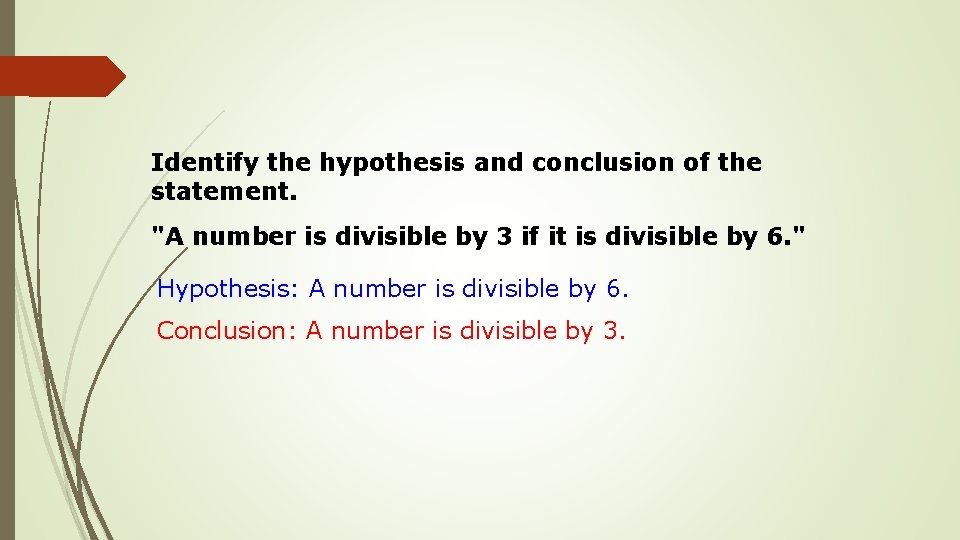
Identify the hypothesis and conclusion of the statement. "A number is divisible by 3 if it is divisible by 6. " Hypothesis: A number is divisible by 6. Conclusion: A number is divisible by 3.
If two lines intersect, then they intersect in exactly one point. Hypothesis: Two line intersect. Conclusion: They intersect in exactly one point. If two planes intersect, then they intersect in exactly one line. Hypothesis: Two planes intersect. Conclusion: They intersect in exactly one line.
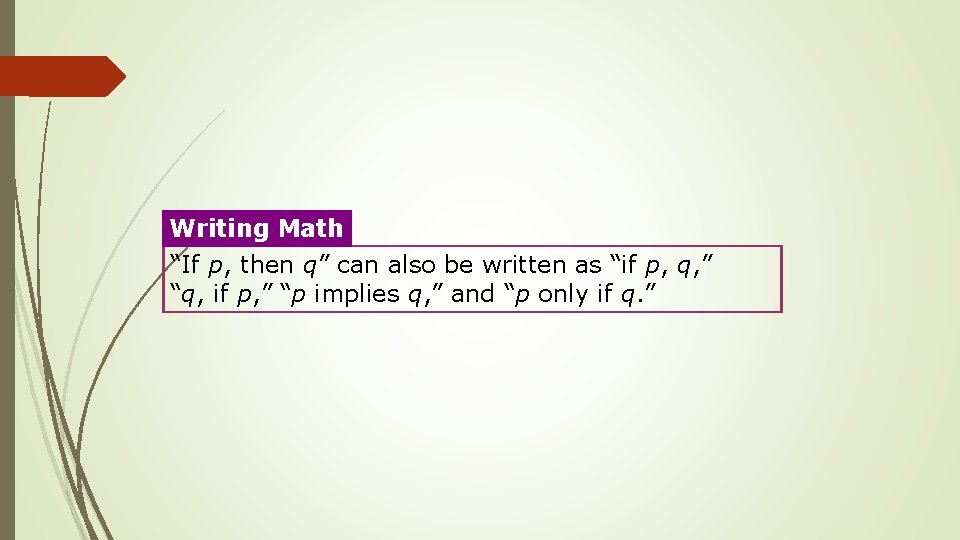
Writing Math “If p, then q” can also be written as “if p, q, ” “q, if p, ” “p implies q, ” and “p only if q. ”
Many sentences without the words if and then can be written as conditionals. To do so, identify the sentence’s hypothesis and conclusion by figuring out which part of the statement depends on the other.

Write a conditional statement from the following. An obtuse triangle has exactly one obtuse angle. Identify the hypothesis and the conclusion. If a triangle is obtuse, then it has exactly one obtuse angle.
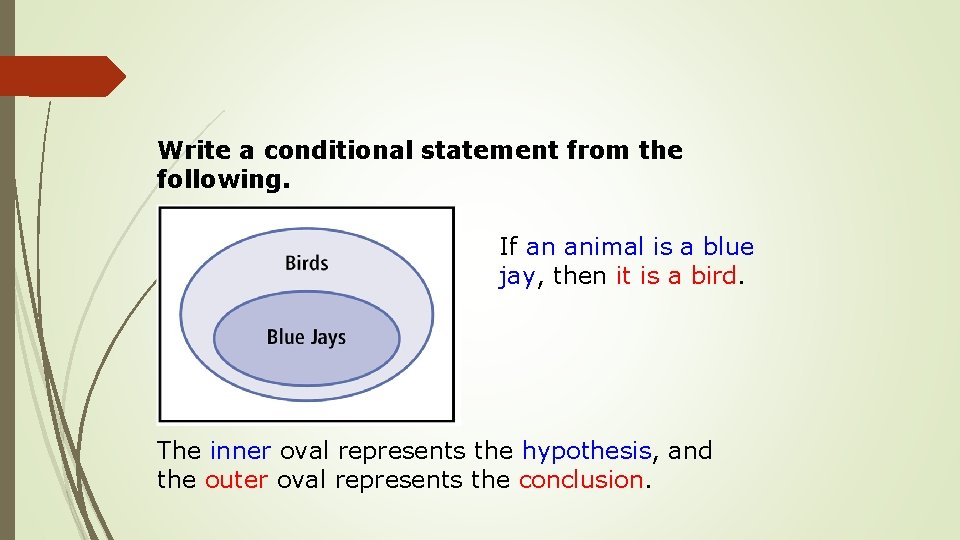
Write a conditional statement from the following. If an animal is a blue jay, then it is a bird. The inner oval represents the hypothesis, and the outer oval represents the conclusion.
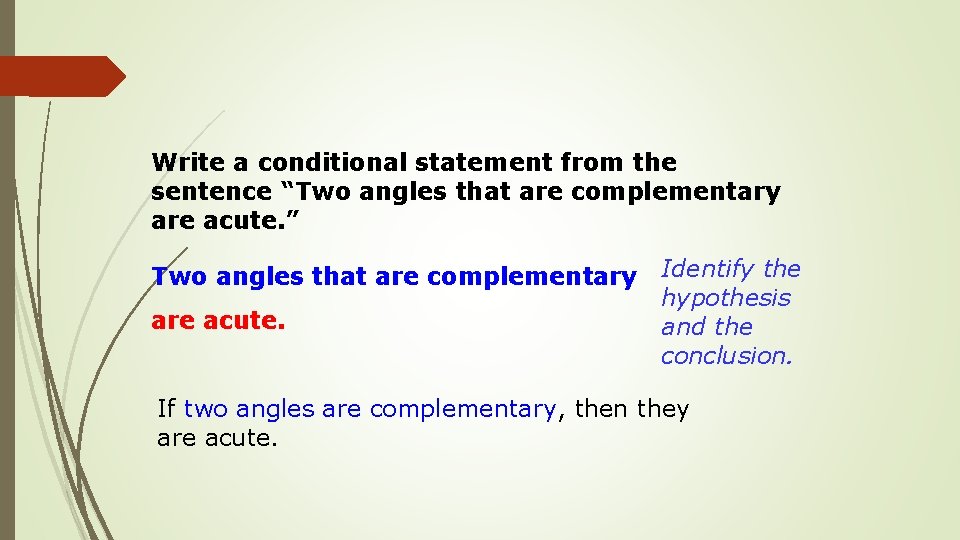
Write a conditional statement from the sentence “Two angles that are complementary are acute. ” Two angles that are complementary are acute. Identify the hypothesis and the conclusion. If two angles are complementary, then they are acute.
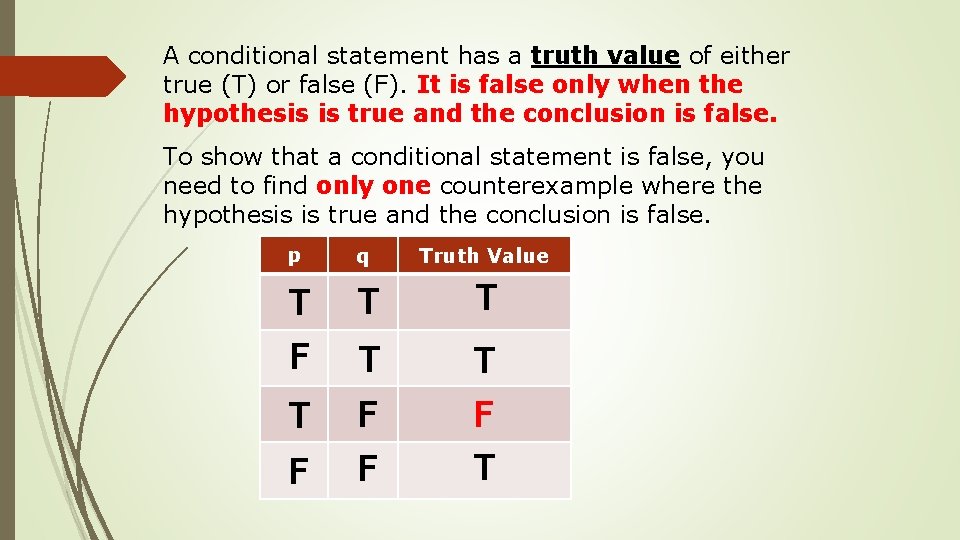
A conditional statement has a truth value of either true (T) or false (F). It is false only when the hypothesis is true and the conclusion is false. To show that a conditional statement is false, you need to find only one counterexample where the hypothesis is true and the conclusion is false. p q Truth Value T F T T T F F T
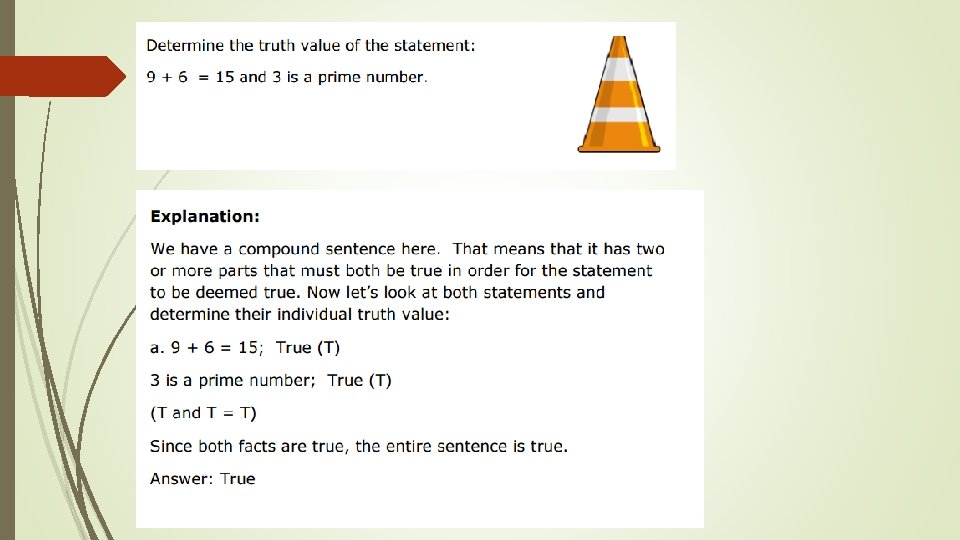
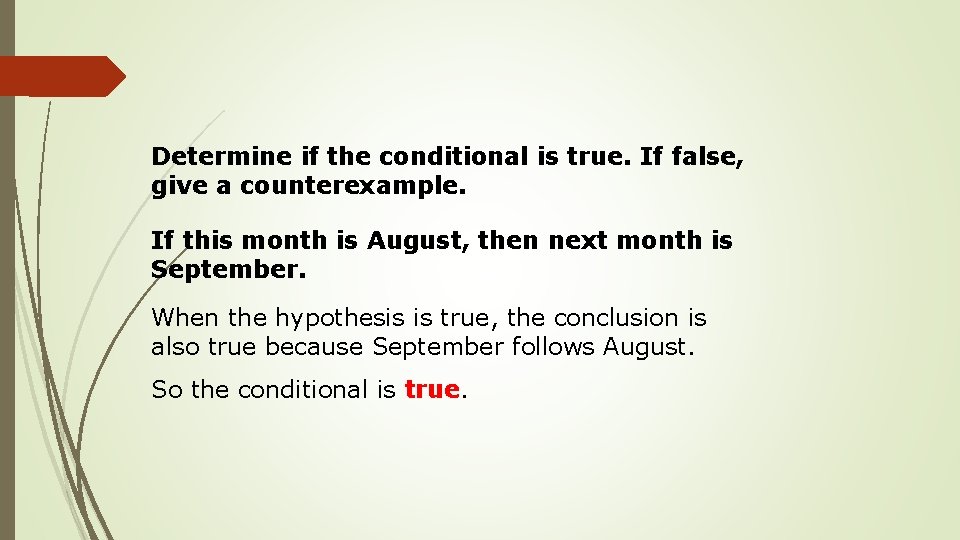
Determine if the conditional is true. If false, give a counterexample. If this month is August, then next month is September. When the hypothesis is true, the conclusion is also true because September follows August. So the conditional is true.
Determine if the conditional is true. If false, give a counterexample. If two angles are acute, then they are congruent. You can have acute angles with measures of 80° and 30°. In this case, the hypothesis is true, but the conclusion is false. Since you can find a counterexample, the conditional is false.
Determine if the conditional is true. If false, give a counterexample. If an even number greater than 2 is prime, then 5 + 4 = 8. An even number greater than 2 will never be prime, so the hypothesis is false. 5 + 4 is not equal to 8, so the conclusion is false. However, the conditional is true because the hypothesis is false.
Determine if the conditional “If a number is odd, then it is divisible by 3” is true. If false, give a counterexample. An example of an odd number is 7. It is not divisible by 3. In this case, the hypothesis is true, but the conclusion is false. Since you can find a counterexample, the conditional is false.
Remember! If the hypothesis is false, the conditional statement is true, regardless of the truth value of the conclusion.
The negation of statement p is “not p, ” written as ~p. The negation of a true statement is false, and the negation of a false statement is true.
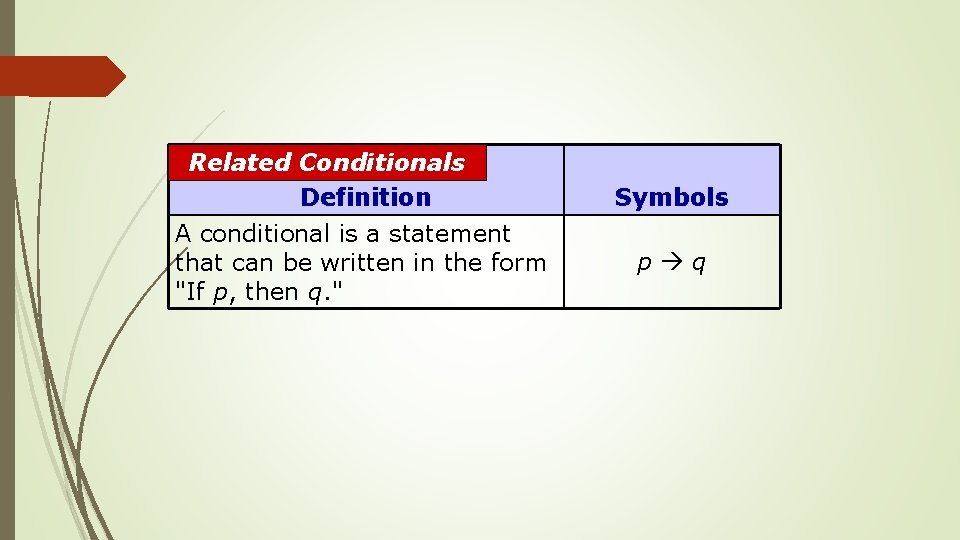
Related Conditionals Definition A conditional is a statement that can be written in the form "If p, then q. " Symbols p q
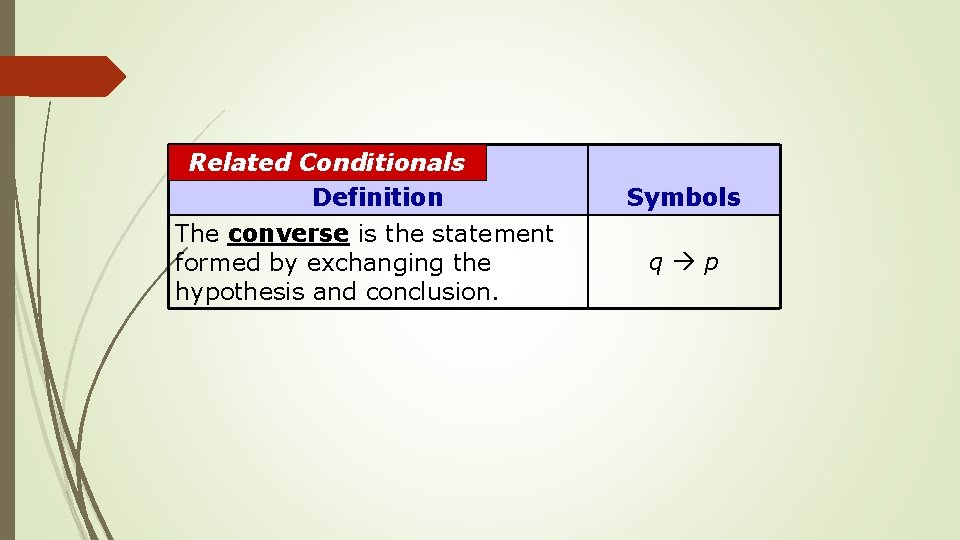
Related Conditionals Definition The converse is the statement formed by exchanging the hypothesis and conclusion. Symbols q p
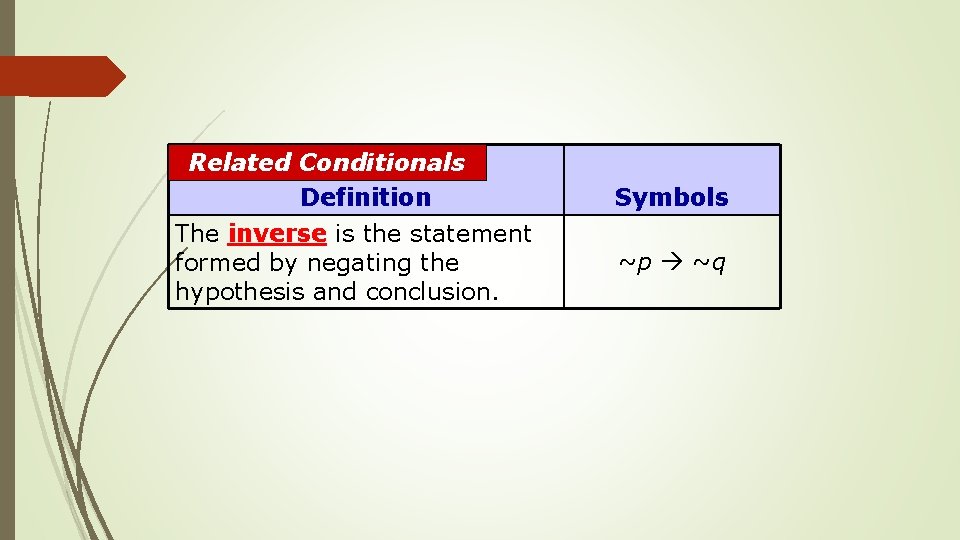
Related Conditionals Definition The inverse is the statement formed by negating the hypothesis and conclusion. Symbols ~p ~q
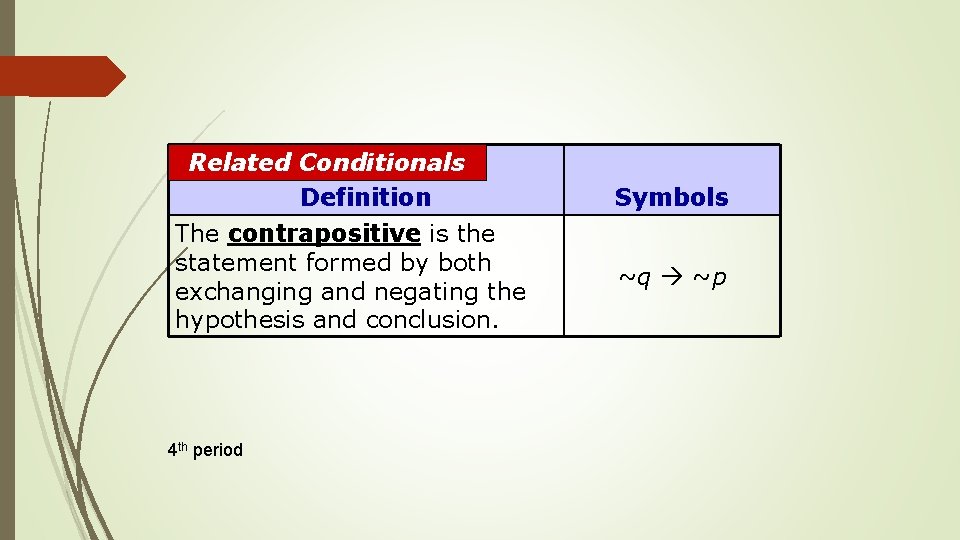
Related Conditionals Definition The contrapositive is the statement formed by both exchanging and negating the hypothesis and conclusion. 4 th period Symbols ~q ~p
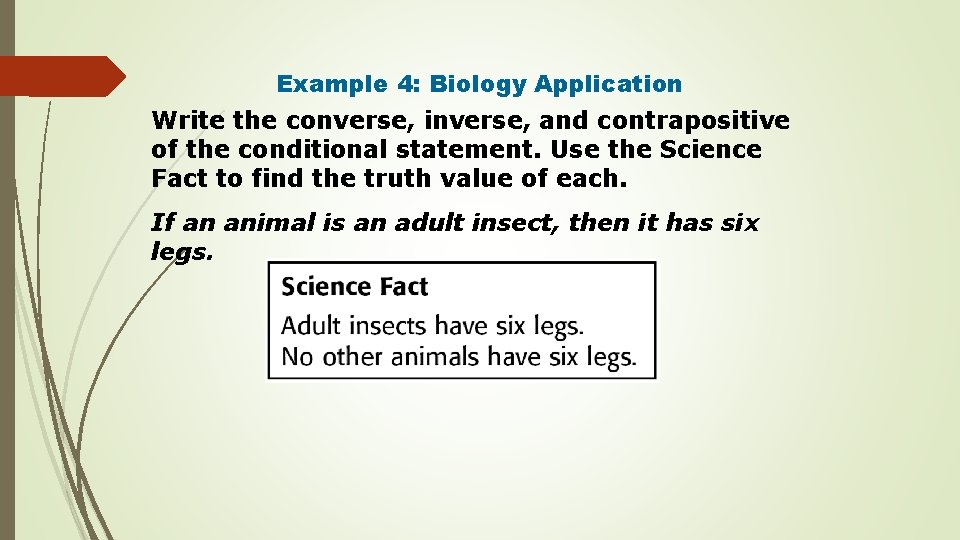
Example 4: Biology Application Write the converse, inverse, and contrapositive of the conditional statement. Use the Science Fact to find the truth value of each. If an animal is an adult insect, then it has six legs.
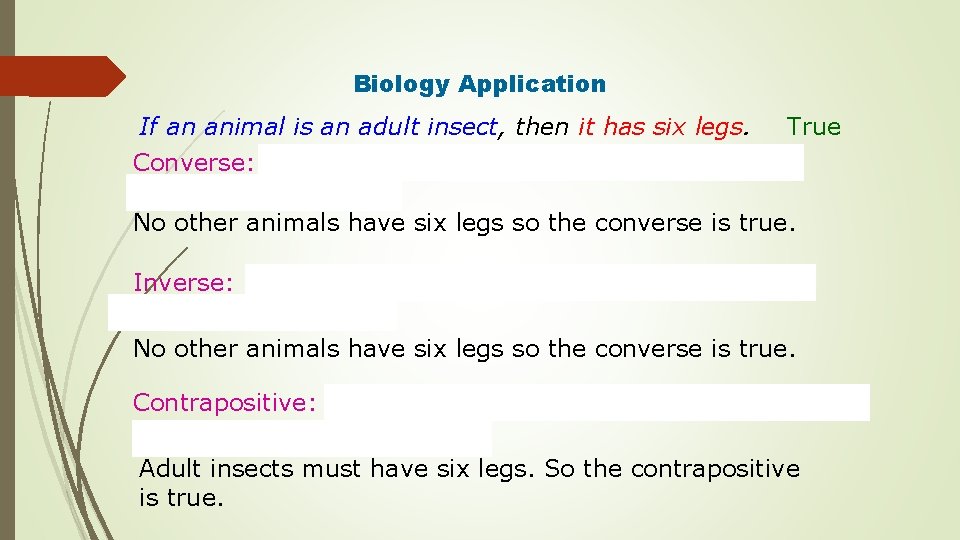
Biology Application If an animal is an adult insect, then it has six legs. True Converse: If an animal has six legs, then it is an adult insect. No other animals have six legs so the converse is true. Inverse: If an animal is not an adult insect, then it does not have six legs. No other animals have six legs so the converse is true. Contrapositive: If an animal does not have six legs, then it is not an adult insect. Adult insects must have six legs. So the contrapositive is true.
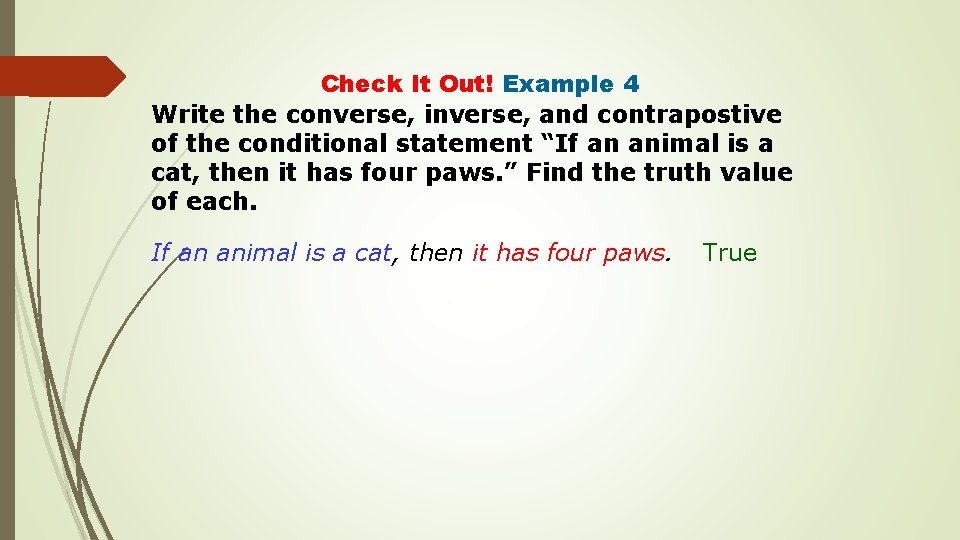
Check It Out! Example 4 Write the converse, inverse, and contrapostive of the conditional statement “If an animal is a cat, then it has four paws. ” Find the truth value of each. If an animal is a cat, then it has four paws. True
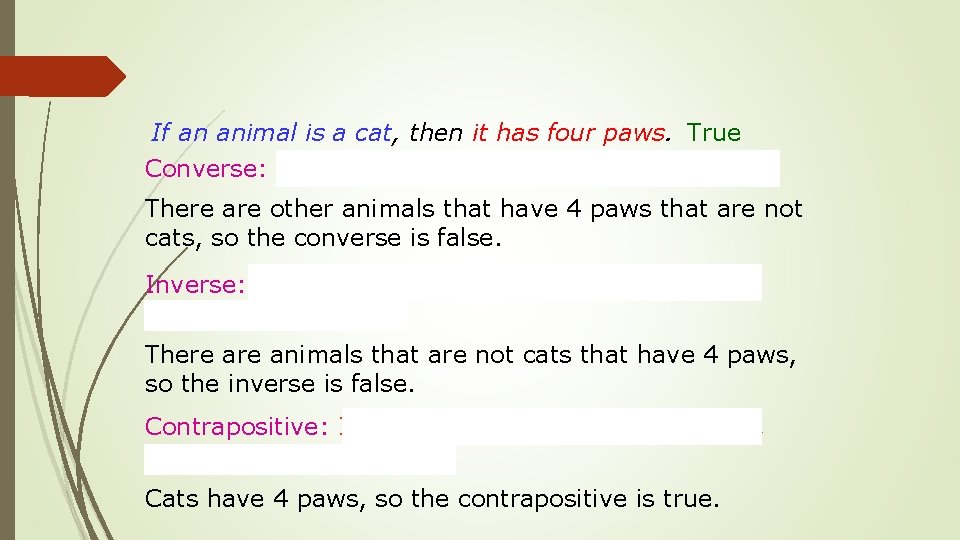
If an animal is a cat, then it has four paws. True Converse: If an animal has 4 paws, then it is a cat. There are other animals that have 4 paws that are not cats, so the converse is false. Inverse: If an animal is not a cat, then it does not have 4 paws. There animals that are not cats that have 4 paws, so the inverse is false. Contrapositive: If an animal does not have 4 paws, then it is not a cat; True. Cats have 4 paws, so the contrapositive is true.
Related conditional statements that have the same truth value are called logically equivalent statements. A conditional and its contrapositive are logically equivalent, and so are the converse and inverse.
Helpful Hint The logical equivalence of a conditional and its contrapositive is known as the Law of Contrapositive.
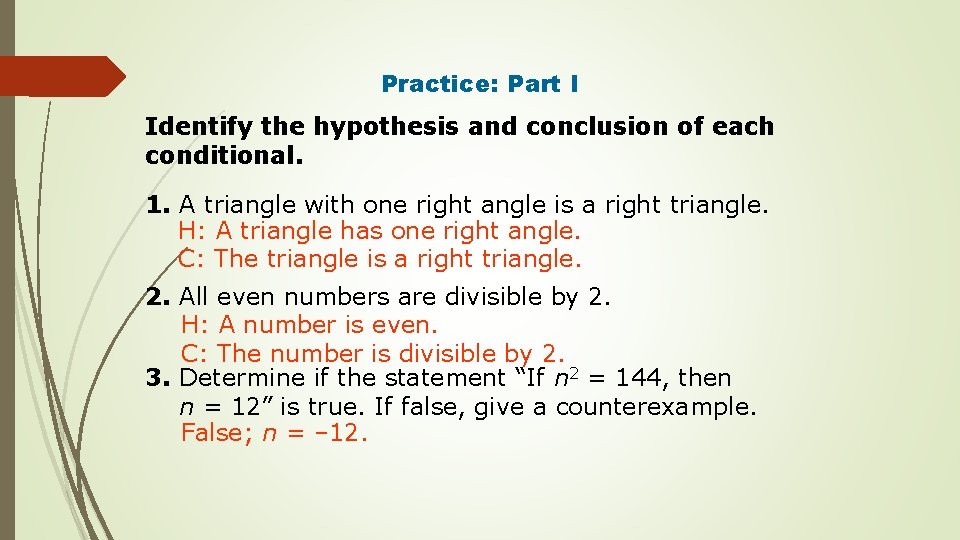
Practice: Part I Identify the hypothesis and conclusion of each conditional. 1. A triangle with one right angle is a right triangle. H: A triangle has one right angle. C: The triangle is a right triangle. 2. All even numbers are divisible by 2. H: A number is even. C: The number is divisible by 2. 3. Determine if the statement “If n 2 = 144, then n = 12” is true. If false, give a counterexample. False; n = – 12.
Practice: Part II Identify the hypothesis and conclusion of each conditional. 4. Write the converse, inverse, and contrapositive of the conditional statement “If Maria’s birthday is February 29, then she was born in a leap year. ” Find the truth value of each. Converse: If Maria was born in a leap year, then her birthday is February 29; False. Inverse: If Maria’s birthday is not February 29, then she was not born in a leap year; False. Contrapositive: If Maria was not born in a leap year, then her birthday is not February 29; True.
- Slides: 34