
Conditional Reasoning The Dual Source Model of Conditional




- Slides: 31
Conditional Reasoning: The Dual Source Model of Conditional Reasoning versus Minimizing the Kullback-Leibler Divergence Henrik Singmann Sieghard Beller Karl Christoph Klauer
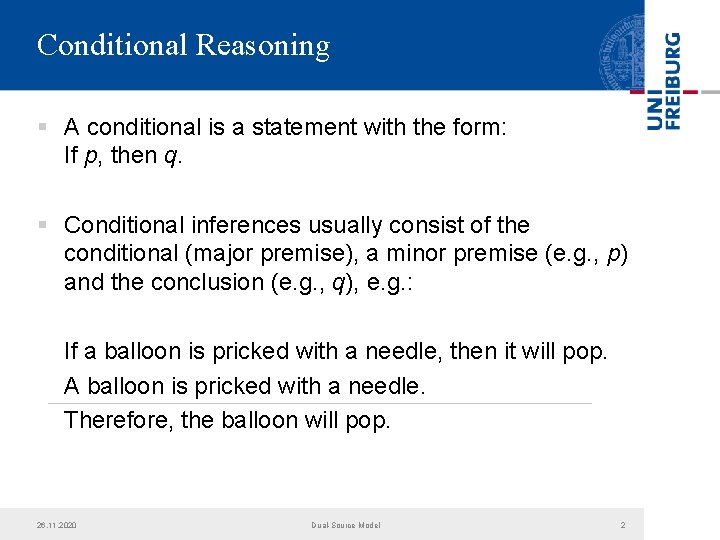
Conditional Reasoning § A conditional is a statement with the form: If p, then q. § Conditional inferences usually consist of the conditional (major premise), a minor premise (e. g. , p) and the conclusion (e. g. , q), e. g. : If a balloon is pricked with a needle, then it will pop. A balloon is pricked with a needle. Therefore, the balloon will pop. 26. 11. 2020 Dual-Source Model 2
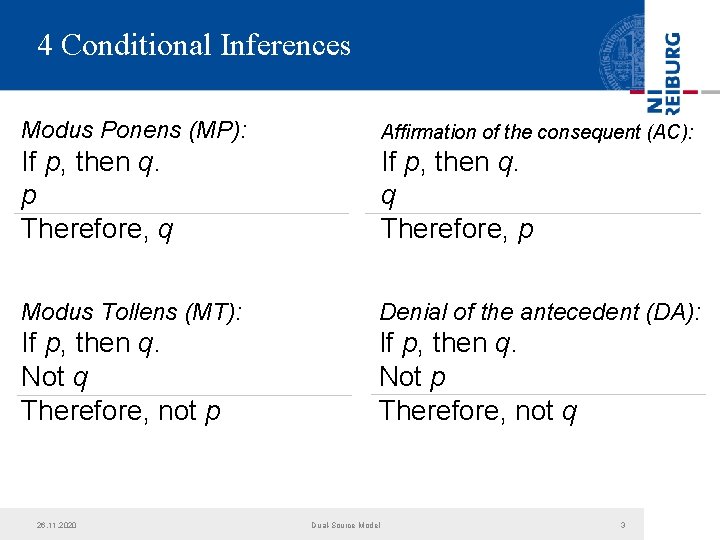
4 Conditional Inferences Modus Ponens (MP): Affirmation of the consequent (AC): If p, then q. p Therefore, q If p, then q. q Therefore, p Modus Tollens (MT): Denial of the antecedent (DA): If p, then q. Not q Therefore, not p If p, then q. Not p Therefore, not q 26. 11. 2020 Dual-Source Model 3
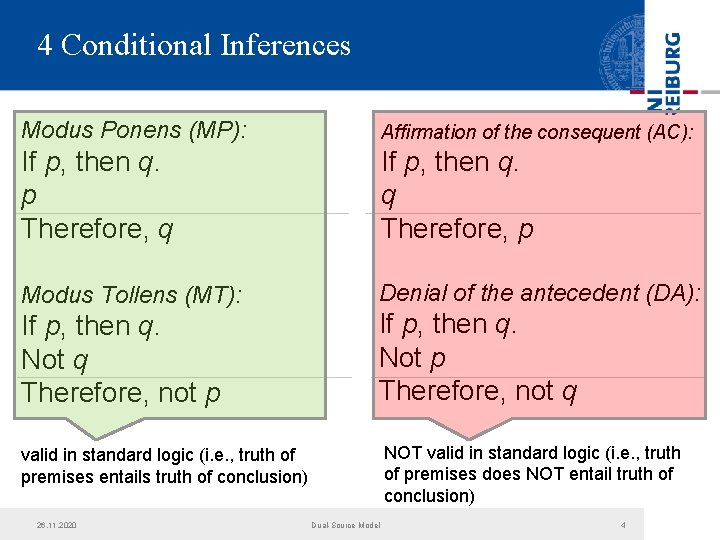
4 Conditional Inferences Modus Ponens (MP): Affirmation of the consequent (AC): If p, then q. p Therefore, q If p, then q. q Therefore, p Modus Tollens (MT): Denial of the antecedent (DA): If p, then q. Not q Therefore, not p If p, then q. Not p Therefore, not q NOT valid in standard logic (i. e. , truth of premises does NOT entail truth of conclusion) valid in standard logic (i. e. , truth of premises entails truth of conclusion) 26. 11. 2020 Dual-Source Model 4
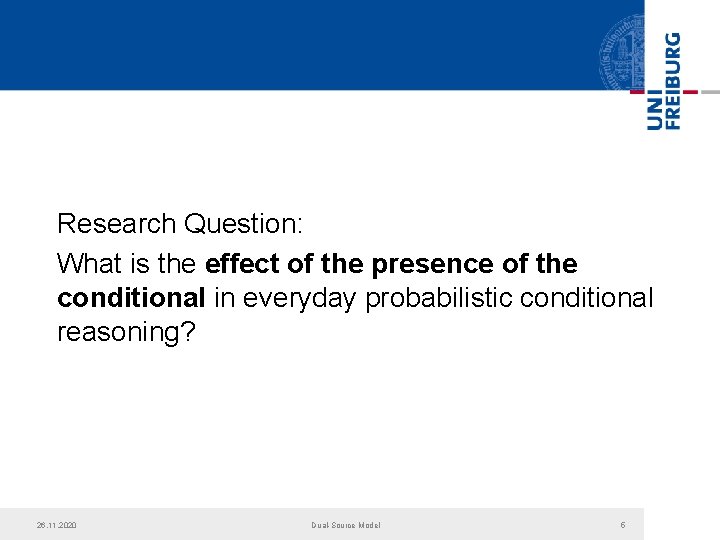
Research Question: What is the effect of the presence of the conditional in everyday probabilistic conditional reasoning? 26. 11. 2020 Dual-Source Model 5
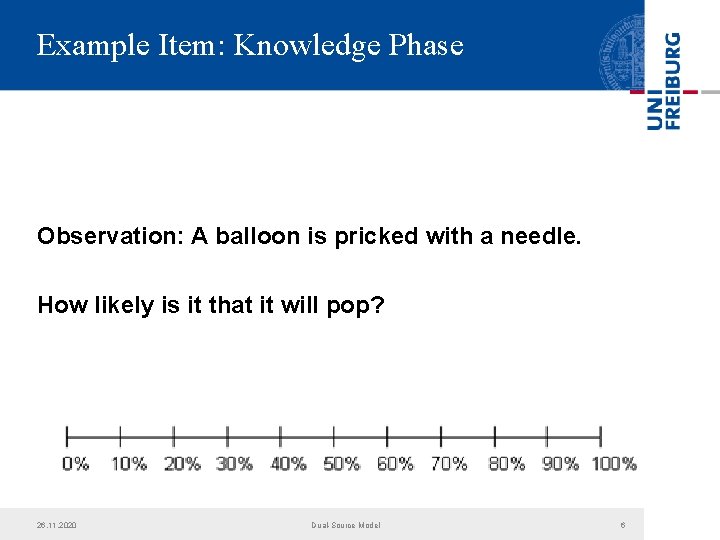
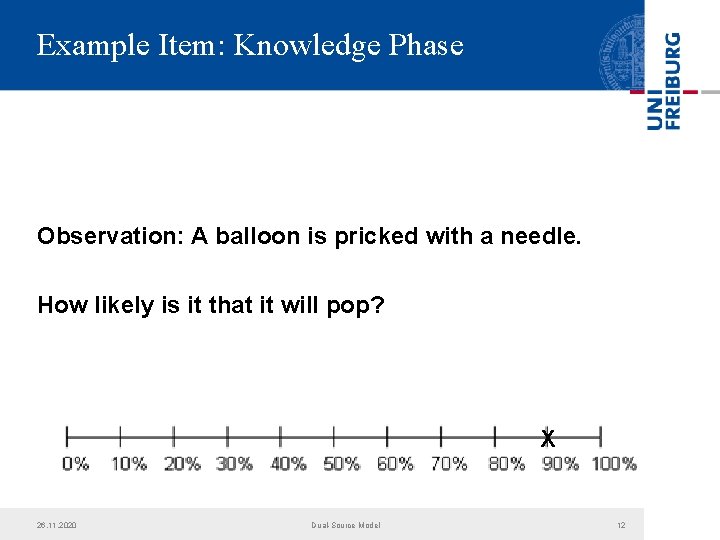
Example Item: Knowledge Phase Observation: A balloon is pricked with a needle. How likely is it that it will pop? 26. 11. 2020 Dual-Source Model 6
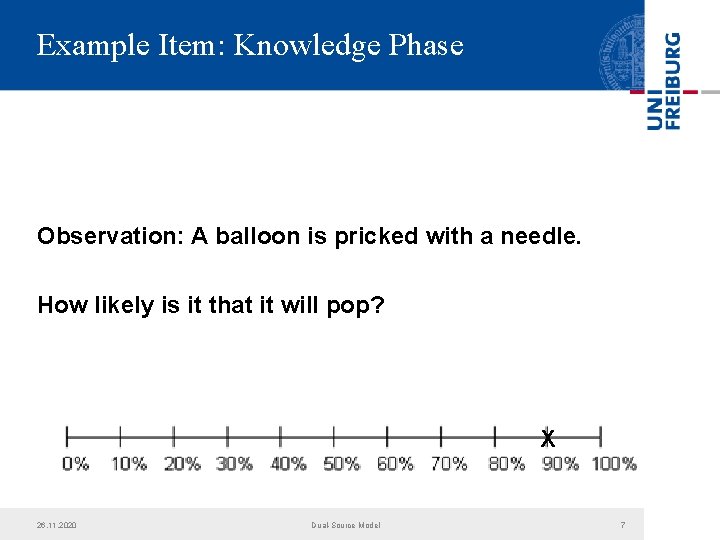
Example Item: Knowledge Phase Observation: A balloon is pricked with a needle. How likely is it that it will pop? X 26. 11. 2020 Dual-Source Model 7
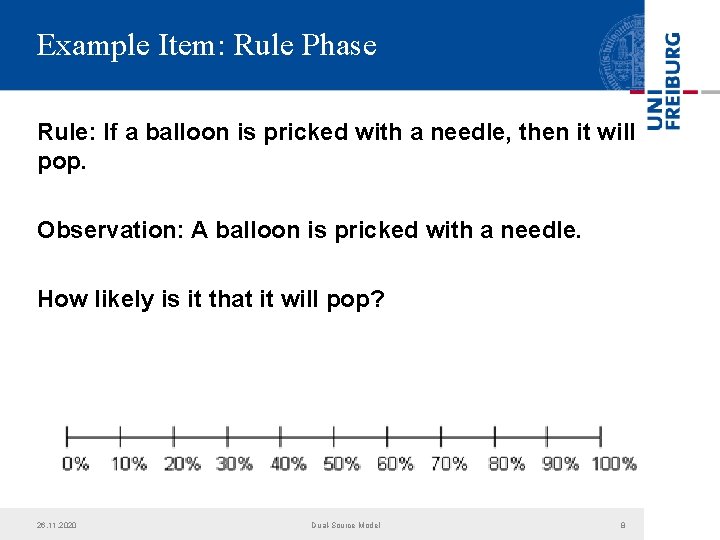
Example Item: Rule Phase Rule: If a balloon is pricked with a needle, then it will pop. Observation: A balloon is pricked with a needle. How likely is it that it will pop? 26. 11. 2020 Dual-Source Model 8
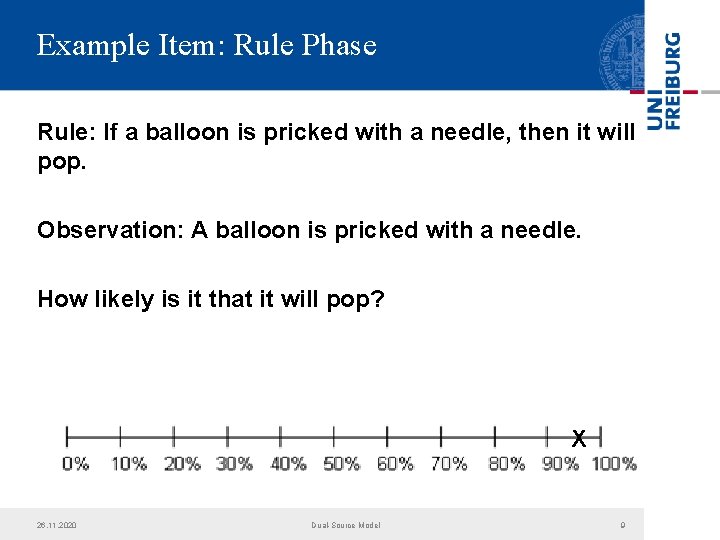
Example Item: Rule Phase Rule: If a balloon is pricked with a needle, then it will pop. Observation: A balloon is pricked with a needle. How likely is it that it will pop? X 26. 11. 2020 Dual-Source Model 9
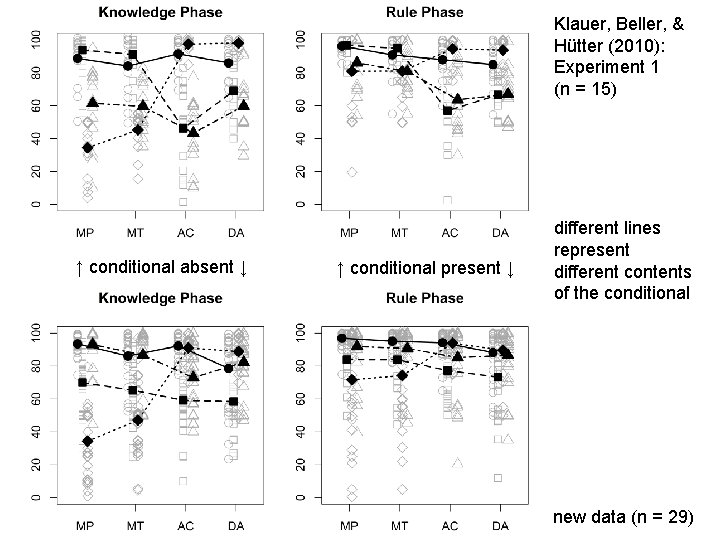
Klauer, Beller, & Hütter (2010): Experiment 1 (n = 15) ↑ conditional absent ↓ 26. 11. 2020 ↑ conditional present ↓ Dual-Source Model different lines represent different contents of the conditional new data (n = 29) 10
Klauer, Beller, & Hütter (2010): Experiment 1 (n = 15) different lines The presence of the rule increases participants'represent estimates absent ↑ conditional present ↓ of the↑ conditional probability of↓ the conclusion. different contents of theand conditional Especially so for the formally valid inferences MP MT. 26. 11. 2020 Dual-Source Model new data (n = 29) 11
Example Item: Knowledge Phase Observation: A balloon is pricked with a needle. How likely is it that it will pop? X 26. 11. 2020 Dual-Source Model 12
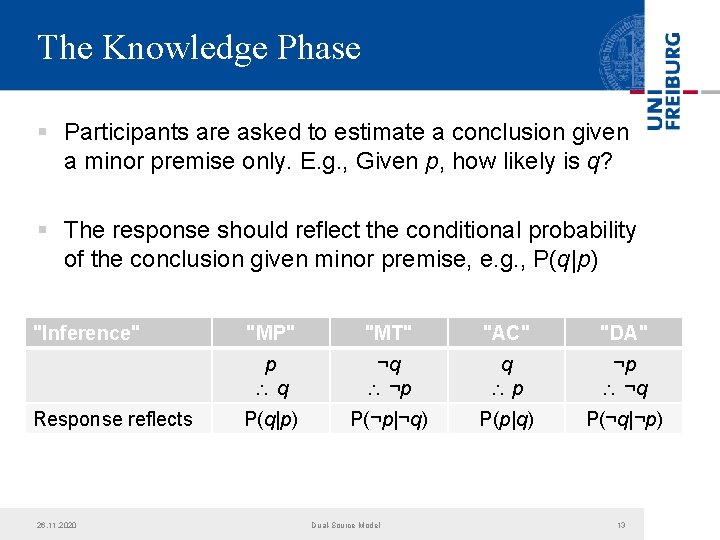
The Knowledge Phase § Participants are asked to estimate a conclusion given a minor premise only. E. g. , Given p, how likely is q? § The response should reflect the conditional probability of the conclusion given minor premise, e. g. , P(q|p) "Inference" Response reflects 26. 11. 2020 "MP" "MT" "AC" "DA" p q ¬q ¬p q p ¬p ¬q P(q|p) P(¬p|¬q) P(p|q) P(¬q|¬p) Dual-Source Model 13
Formalizing the Knowledge Phase § We have the joint probability distribution over P(p), P(q), and their negations in the knowledge phase per content: § q ¬q p P(p q) P(p ¬q) ¬p P(¬p q) P(¬p ¬q) § From this we can obtain the conditional probabilities, e. g. : P(MP) = P(q|p) = P(p q) / P(q) § We need at least three independent parameters (e. g. , P(p), P(q), and P(¬q|p), Oaksford, Chater, & Larkin, 2000) to describe the joint probability distribution. 26. 11. 2020 Dual-Source Model 14
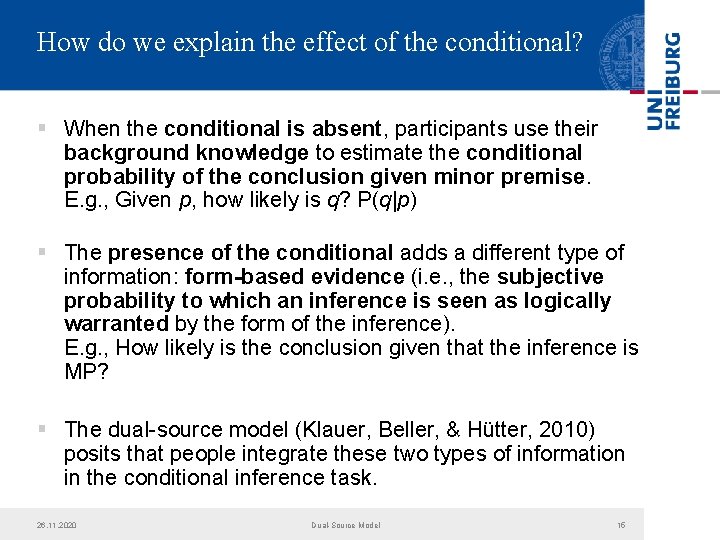
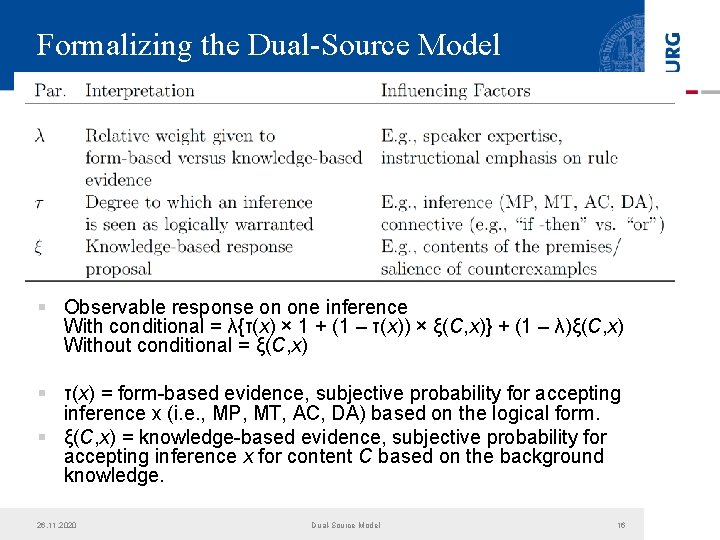
How do we explain the effect of the conditional? § When the conditional is absent, participants use their background knowledge to estimate the conditional probability of the conclusion given minor premise. E. g. , Given p, how likely is q? P(q|p) § The presence of the conditional adds a different type of information: form-based evidence (i. e. , the subjective probability to which an inference is seen as logically warranted by the form of the inference). E. g. , How likely is the conclusion given that the inference is MP? § The dual-source model (Klauer, Beller, & Hütter, 2010) posits that people integrate these two types of information in the conditional inference task. 26. 11. 2020 Dual-Source Model 15
Formalizing the Dual-Source Model § Observable response on one inference With conditional = λ{τ(x) × 1 + (1 – τ(x)) × ξ(C, x)} + (1 – λ)ξ(C, x) Without conditional = ξ(C, x) § τ(x) = form-based evidence, subjective probability for accepting inference x (i. e. , MP, MT, AC, DA) based on the logical form. § ξ(C, x) = knowledge-based evidence, subjective probability for accepting inference x for content C based on the background knowledge. 26. 11. 2020 Dual-Source Model 16
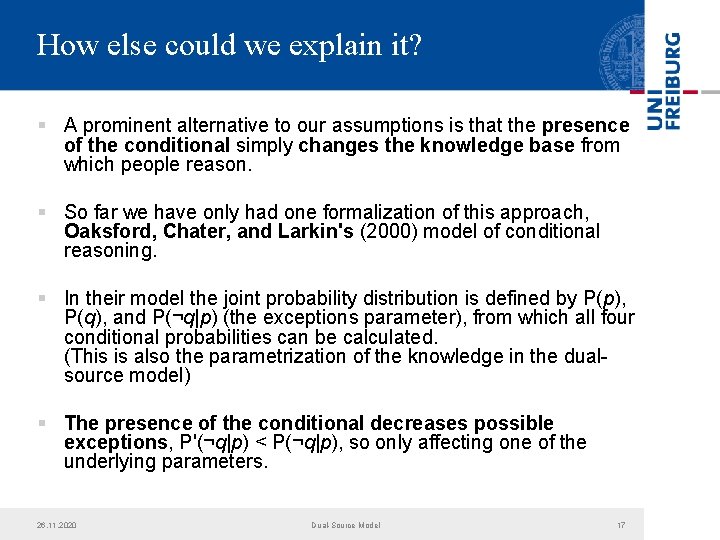
How else could we explain it? § A prominent alternative to our assumptions is that the presence of the conditional simply changes the knowledge base from which people reason. § So far we have only had one formalization of this approach, Oaksford, Chater, and Larkin's (2000) model of conditional reasoning. § In their model the joint probability distribution is defined by P(p), P(q), and P(¬q|p) (the exceptions parameter), from which all four conditional probabilities can be calculated. (This is also the parametrization of the knowledge in the dualsource model) § The presence of the conditional decreases possible exceptions, P'(¬q|p) < P(¬q|p), so only affecting one of the underlying parameters. 26. 11. 2020 Dual-Source Model 17
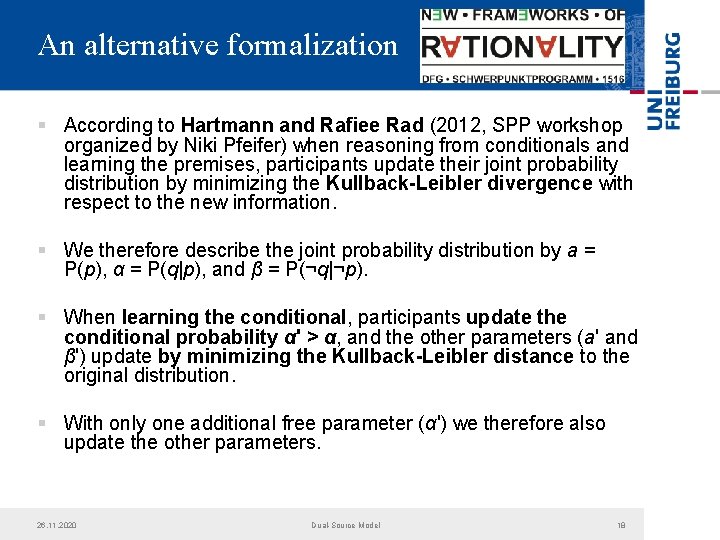
An alternative formalization § According to Hartmann and Rafiee Rad (2012, SPP workshop organized by Niki Pfeifer) when reasoning from conditionals and learning the premises, participants update their joint probability distribution by minimizing the Kullback-Leibler divergence with respect to the new information. § We therefore describe the joint probability distribution by a = P(p), α = P(q|p), and β = P(¬q|¬p). § When learning the conditional, participants update the conditional probability α' > α, and the other parameters (a' and β') update by minimizing the Kullback-Leibler distance to the original distribution. § With only one additional free parameter (α') we therefore also update the other parameters. 26. 11. 2020 Dual-Source Model 18
Empirical Question: Which of the three models provides the best account to the empricial data? 26. 11. 2020 Dual-Source Model 19
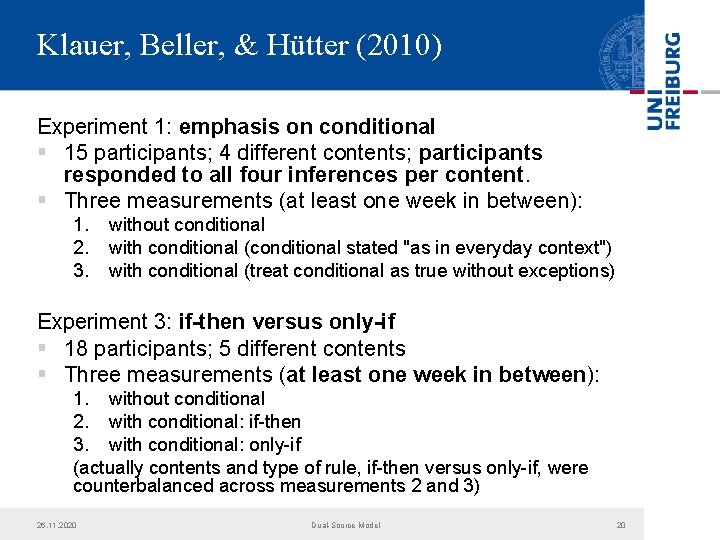
Klauer, Beller, & Hütter (2010) Experiment 1: emphasis on conditional § 15 participants; 4 different contents; participants responded to all four inferences per content. § Three measurements (at least one week in between): 1. 2. 3. without conditional with conditional (conditional stated "as in everyday context") with conditional (treat conditional as true without exceptions) Experiment 3: if-then versus only-if § 18 participants; 5 different contents § Three measurements (at least one week in between): 1. without conditional 2. with conditional: if-then 3. with conditional: only-if (actually contents and type of rule, if-then versus only-if, were counterbalanced across measurements 2 and 3) 26. 11. 2020 Dual-Source Model 20
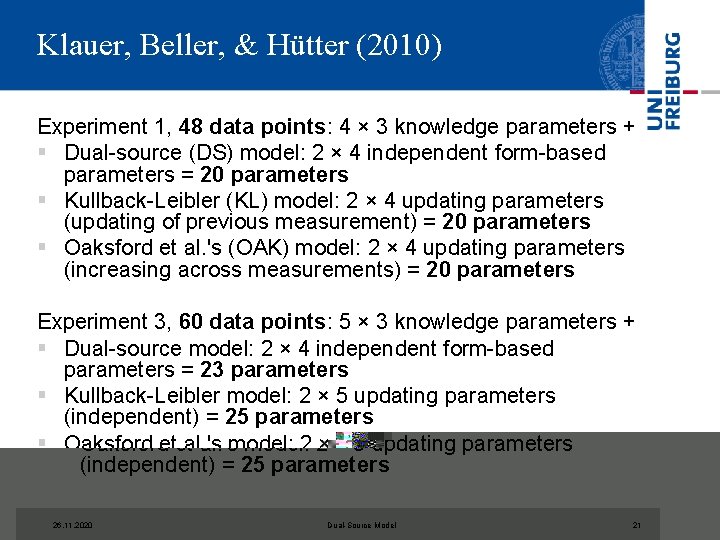
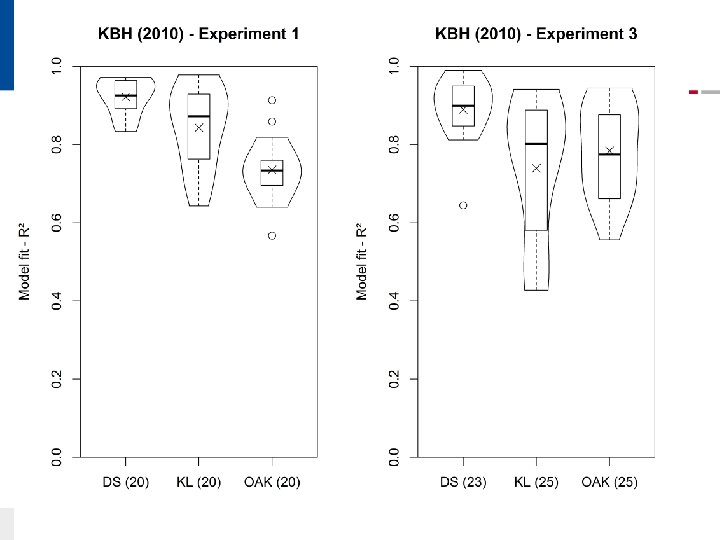
Klauer, Beller, & Hütter (2010) Experiment 1, 48 data points: 4 × 3 knowledge parameters + § Dual-source (DS) model: 2 × 4 independent form-based parameters = 20 parameters § Kullback-Leibler (KL) model: 2 × 4 updating parameters (updating of previous measurement) = 20 parameters § Oaksford et al. 's (OAK) model: 2 × 4 updating parameters (increasing across measurements) = 20 parameters Experiment 3, 60 data points: 5 × 3 knowledge parameters + § Dual-source model: 2 × 4 independent form-based parameters = 23 parameters § Kullback-Leibler model: 2 × 5 updating parameters (independent) = 25 parameters § Oaksford et al. 's model: 2 × 5 updating parameters (independent) = 25 parameters 26. 11. 2020 Dual-Source Model 21
26. 11. 2020 Dual-Source Model 22
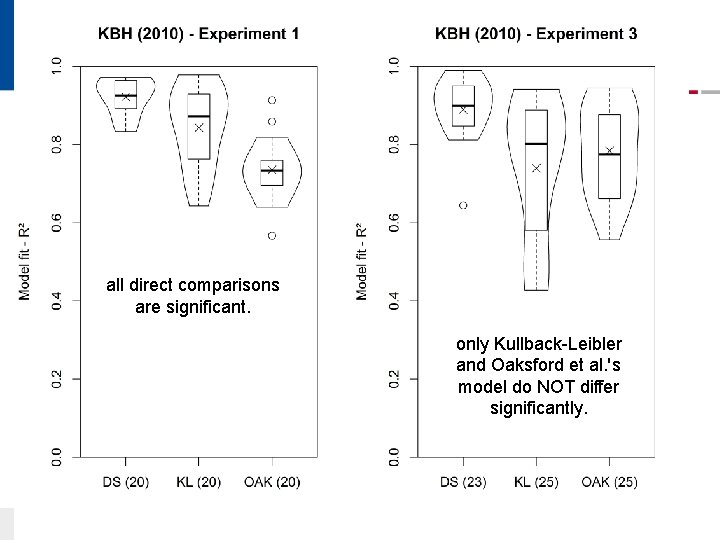
all direct comparisons are significant. only Kullback-Leibler and Oaksford et al. 's model do NOT differ significantly. 26. 11. 2020 Dual-Source Model 23
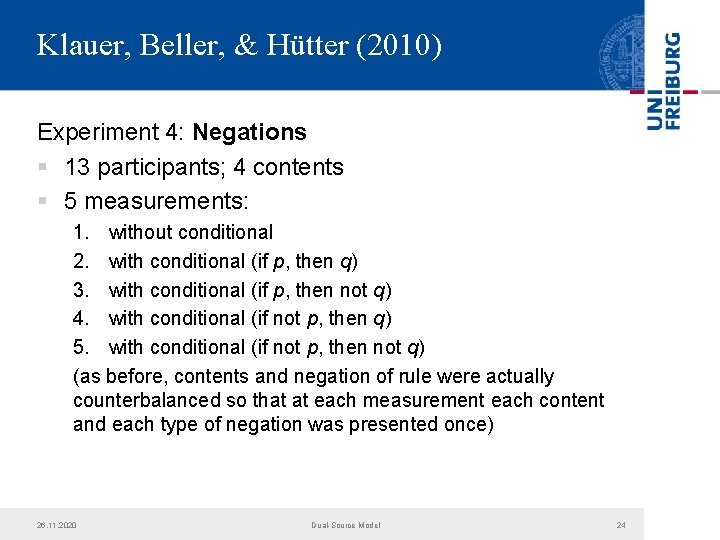
Klauer, Beller, & Hütter (2010) Experiment 4: Negations § 13 participants; 4 contents § 5 measurements: 1. without conditional 2. with conditional (if p, then q) 3. with conditional (if p, then not q) 4. with conditional (if not p, then q) 5. with conditional (if not p, then not q) (as before, contents and negation of rule were actually counterbalanced so that at each measurement each content and each type of negation was presented once) 26. 11. 2020 Dual-Source Model 24
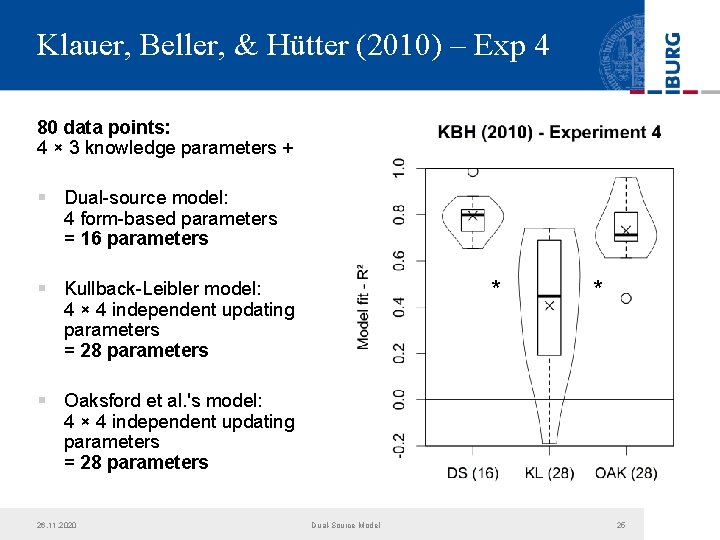
Klauer, Beller, & Hütter (2010) – Exp 4 80 data points: 4 × 3 knowledge parameters + § Dual-source model: 4 form-based parameters = 16 parameters * § Kullback-Leibler model: 4 × 4 independent updating parameters = 28 parameters * § Oaksford et al. 's model: 4 × 4 independent updating parameters = 28 parameters 26. 11. 2020 Dual-Source Model 25
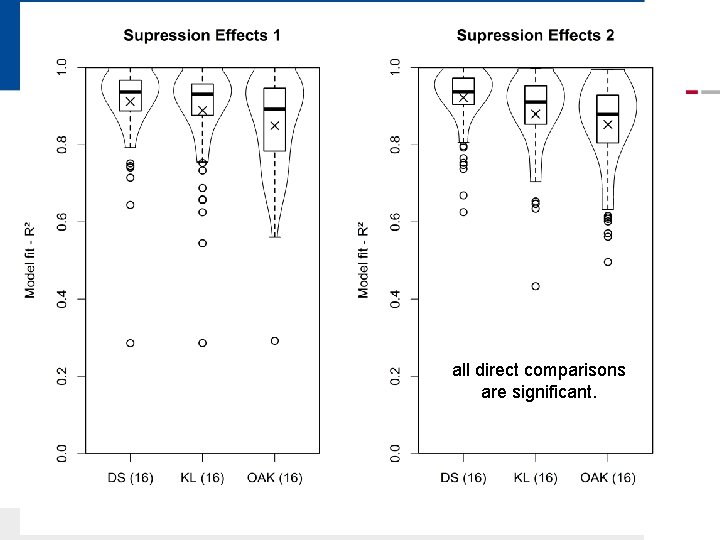
Supression Effects Supression effects (data presented last year): § 77 (dataset 1) and 91 (dataset 2) participants; 4 contents § 3 between-subjects conditions: - Baseline (same as before) - Disablers (additional premises undermining the sufficiency of p for q) - Alternatives (additional premises undermining the necessity of p for q) § 2 measurements: - without conditional (but with additional premises) - with conditional (and with additional premises) § All models have 4 × 3 knowledge parameters plus 4 formbased or updating parameters = 16 parameters for 32 data points 26. 11. 2020 Dual-Source Model 26
Supression Effects all direct comparisons are significant. 26. 11. 2020 Dual-Source Model 27
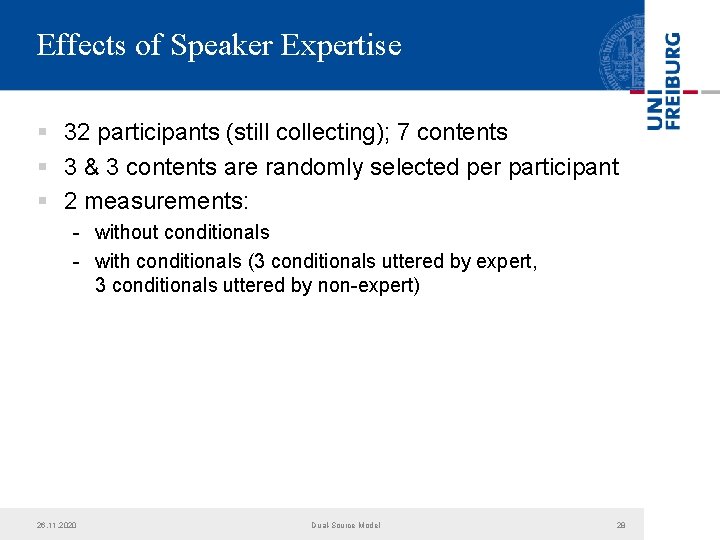
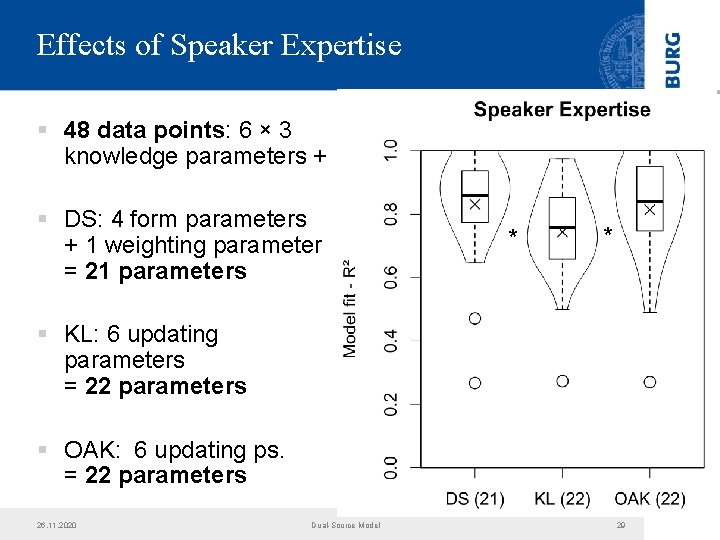
Effects of Speaker Expertise § 32 participants (still collecting); 7 contents § 3 & 3 contents are randomly selected per participant § 2 measurements: - without conditionals - with conditionals (3 conditionals uttered by expert, 3 conditionals uttered by non-expert) 26. 11. 2020 Dual-Source Model 28
Effects of Speaker Expertise § 48 data points: 6 × 3 knowledge parameters + § DS: 4 form parameters + 1 weighting parameter = 21 parameters * * § KL: 6 updating parameters = 22 parameters § OAK: 6 updating ps. = 22 parameters 26. 11. 2020 Dual-Source Model 29
Summary Results § The dual-source model provides the overall best account for 6 datasets. For the two cases where it shares the first place (with Oaksford et al. 's model), it has less parameters. § The dual-source model provides the best account for 144 of 246 data sets (59%). § The Kullback-Leibler model (4 times second place, 53 best accounts) and Oaksford et al. 's model (2 times first place, one time second, 49 best account) share the second place. § This is strong evidence for our interpretation of the effect of the conditional. It seems to provide formal information that can not easily be accounted for by changes in participants' knowledge base. 26. 11. 2020 Dual-Source Model 30
Beyond Model Fit § The parameters of the dual-source model offer an insight into different underlying cognitive processes, e. g. , a dissociation of different suppression effects (disablers decrease the weighting parameters, whereas alternatives decrease the knowledge base for AC and DA). § The dual-source model can be easily extended to other types of connectives such as e. g. , or, as it is not strictly tied to conditional reasoning. 26. 11. 2020 Dual-Source Model 31