
Conditional Random Fields For Speech and Language Processing
![Initial Results (Morris & Fosler-Lussier, Model Params Phone 06) Accuracy Tandem [1] (phones) 20,](https://slidetodoc.com/presentation_image_h/2e25de3e2e325f9368762548ed06b0fa/image-39.jpg "Initial Results (Morris & Fosler-Lussier, Model Params Phone 06) Accuracy Tandem [1] (phones) 20,")
![Current Work - Crandem Systems Model Baseline Tandem MLP [phone classes] Crandem MLP [phone](https://slidetodoc.com/presentation_image_h/2e25de3e2e325f9368762548ed06b0fa/image-47.jpg "Current Work - Crandem Systems Model Baseline Tandem MLP [phone classes] Crandem MLP [phone")
- Slides: 54
Conditional Random Fields For Speech and Language Processing Jeremy Morris 10/27/2008 1
Outline n n Background Maximum Entropy models and CRFs CRF Example SLa. Te experiments with CRFs 2
Background n Conditional Random Fields (CRFs) q q q Discriminative probabilistic sequence model Used successfully in various domains such as part of speech tagging and named entity recognition Directly defines a posterior probability of a label sequence Y given an input observation sequence X - P(Y|X) 3
Background – Discriminative n Directly model the association between the Models observed features and labels for those features q q n e. g. neural networks, maximum entropy models Attempt to model boundaries between competing classes Probabilistic discriminative models q q Give conditional probabilities instead of hard class decisions Find the class y that maximizes P(y|x) for observed features x 4
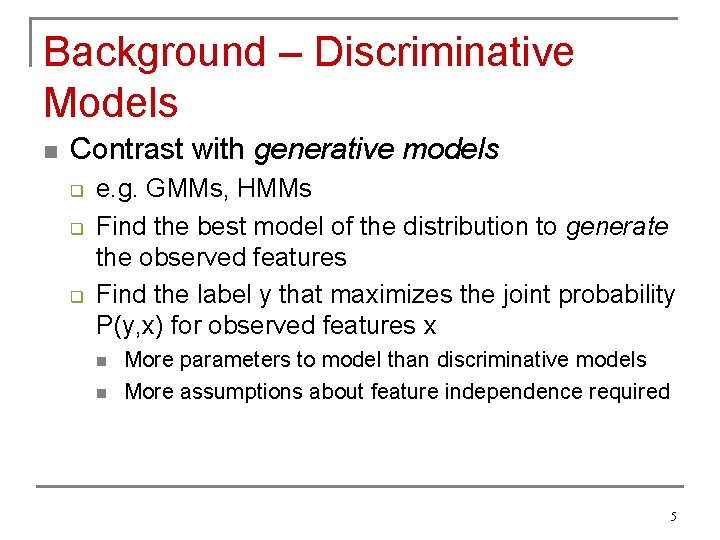
Background – Discriminative Models n Contrast with generative models q q q e. g. GMMs, HMMs Find the best model of the distribution to generate the observed features Find the label y that maximizes the joint probability P(y, x) for observed features x n n More parameters to model than discriminative models More assumptions about feature independence required 5
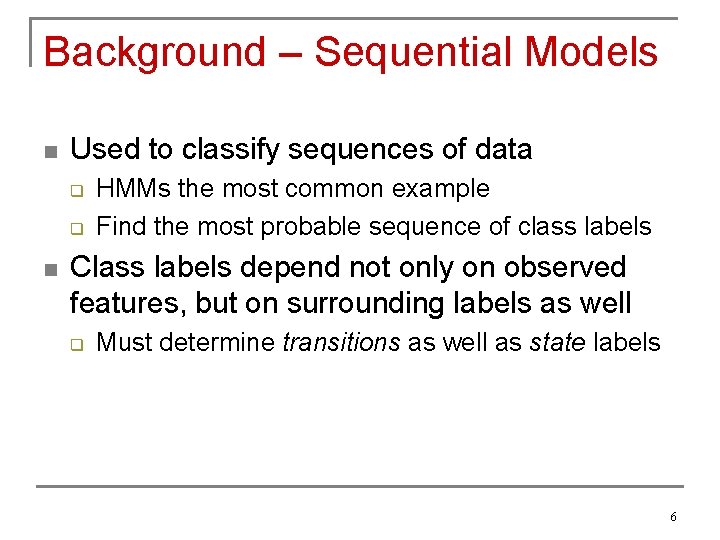
Background – Sequential Models n Used to classify sequences of data q q n HMMs the most common example Find the most probable sequence of class labels Class labels depend not only on observed features, but on surrounding labels as well q Must determine transitions as well as state labels 6
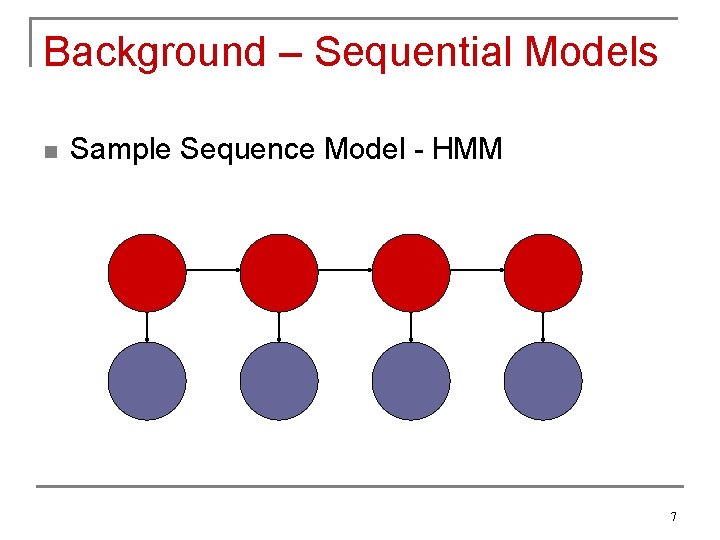
Background – Sequential Models n Sample Sequence Model - HMM 7
Conditional Random Fields n A probabilistic, discriminative classification model for sequences q Based on the idea of Maximum Entropy Models (Logistic Regression models) expanded to sequences 8
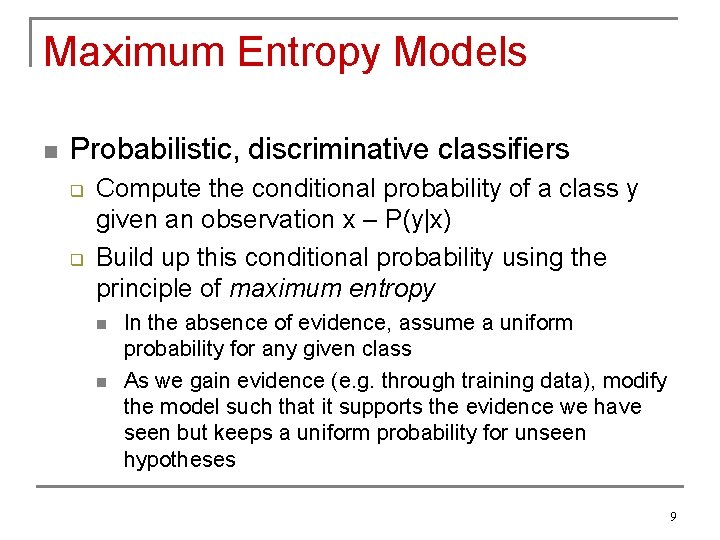
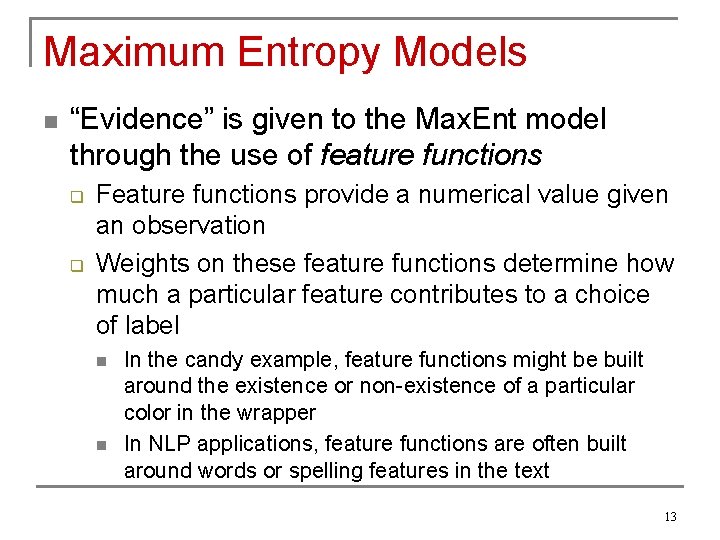
Maximum Entropy Models n Probabilistic, discriminative classifiers q q Compute the conditional probability of a class y given an observation x – P(y|x) Build up this conditional probability using the principle of maximum entropy n n In the absence of evidence, assume a uniform probability for any given class As we gain evidence (e. g. through training data), modify the model such that it supports the evidence we have seen but keeps a uniform probability for unseen hypotheses 9
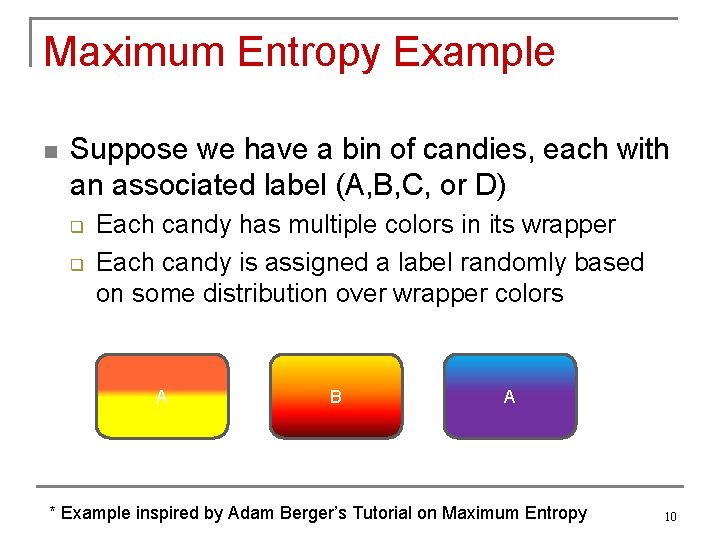
Maximum Entropy Example n Suppose we have a bin of candies, each with an associated label (A, B, C, or D) q q Each candy has multiple colors in its wrapper Each candy is assigned a label randomly based on some distribution over wrapper colors A B A * Example inspired by Adam Berger’s Tutorial on Maximum Entropy 10
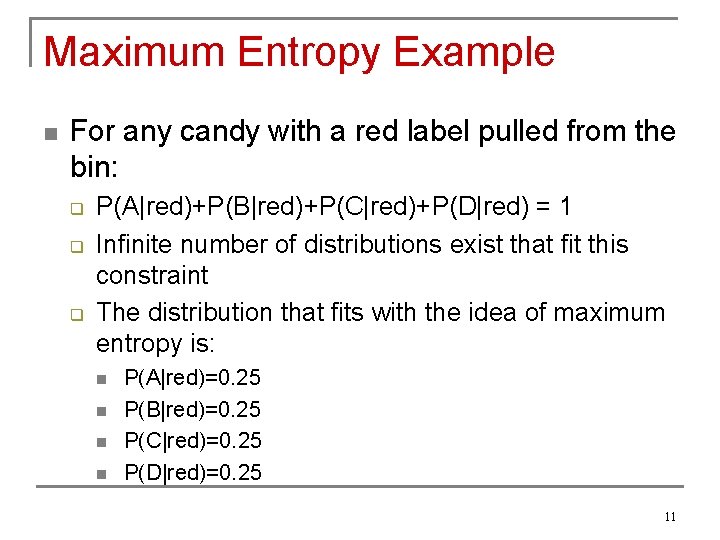
Maximum Entropy Example n For any candy with a red label pulled from the bin: q q q P(A|red)+P(B|red)+P(C|red)+P(D|red) = 1 Infinite number of distributions exist that fit this constraint The distribution that fits with the idea of maximum entropy is: n n P(A|red)=0. 25 P(B|red)=0. 25 P(C|red)=0. 25 P(D|red)=0. 25 11
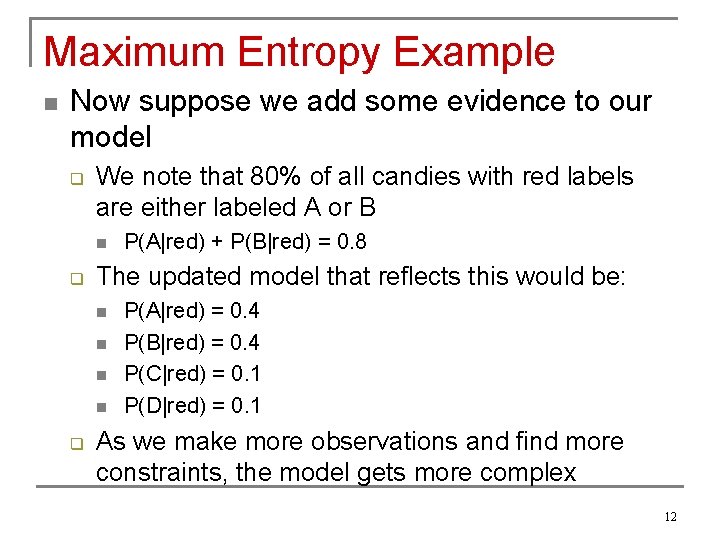
Maximum Entropy Example n Now suppose we add some evidence to our model q We note that 80% of all candies with red labels are either labeled A or B n q The updated model that reflects this would be: n n q P(A|red) + P(B|red) = 0. 8 P(A|red) = 0. 4 P(B|red) = 0. 4 P(C|red) = 0. 1 P(D|red) = 0. 1 As we make more observations and find more constraints, the model gets more complex 12
Maximum Entropy Models n “Evidence” is given to the Max. Ent model through the use of feature functions q q Feature functions provide a numerical value given an observation Weights on these feature functions determine how much a particular feature contributes to a choice of label n n In the candy example, feature functions might be built around the existence or non-existence of a particular color in the wrapper In NLP applications, feature functions are often built around words or spelling features in the text 13
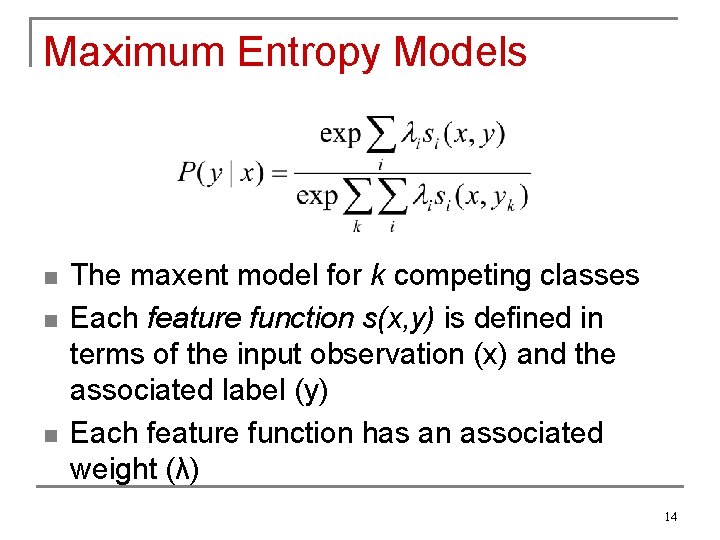
Maximum Entropy Models n n n The maxent model for k competing classes Each feature function s(x, y) is defined in terms of the input observation (x) and the associated label (y) Each feature function has an associated weight (λ) 14
Maximum Entropy – Feature Funcs. n Feature functions for a maxent model associate a label and an observation q q For the candy example, feature functions might be based on labels and wrapper colors In an NLP application, feature functions might be based on labels (e. g. POS tags) and words in the text 15
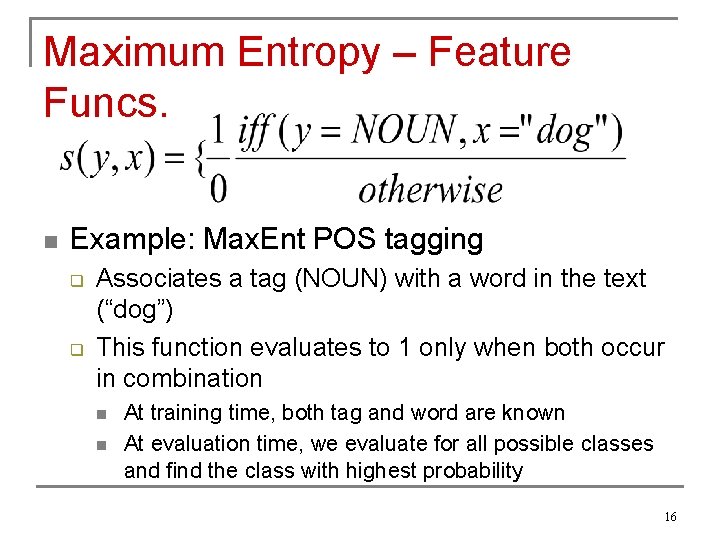
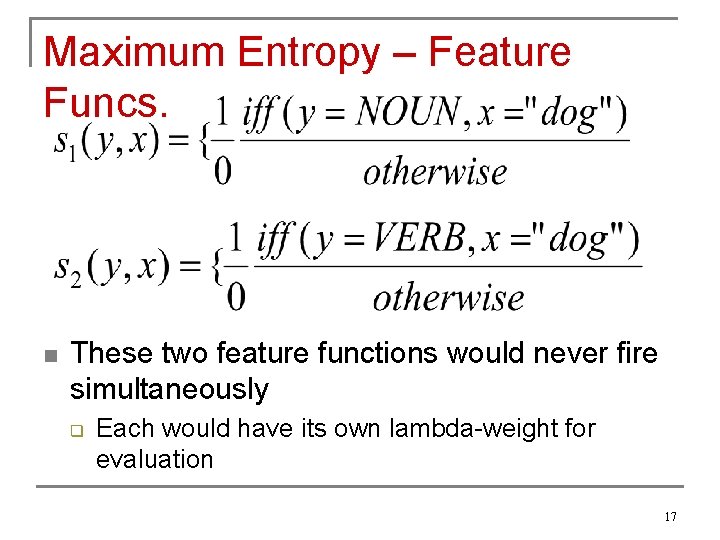
Maximum Entropy – Feature Funcs. n Example: Max. Ent POS tagging q q Associates a tag (NOUN) with a word in the text (“dog”) This function evaluates to 1 only when both occur in combination n n At training time, both tag and word are known At evaluation time, we evaluate for all possible classes and find the class with highest probability 16
Maximum Entropy – Feature Funcs. n These two feature functions would never fire simultaneously q Each would have its own lambda-weight for evaluation 17
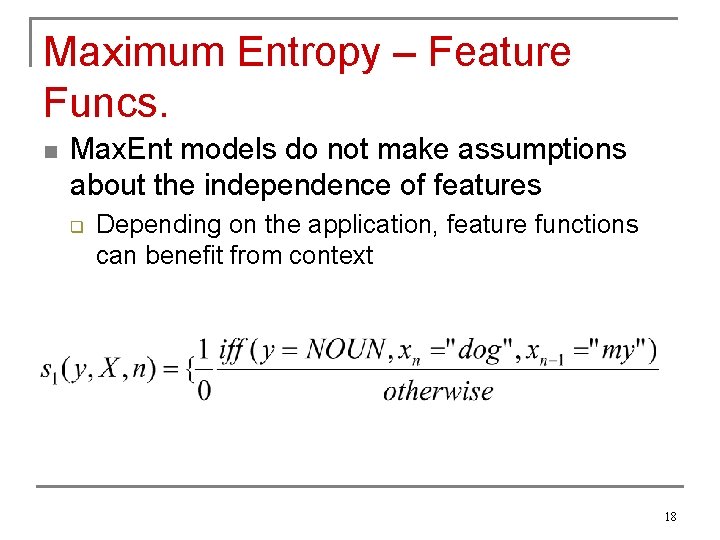
Maximum Entropy – Feature Funcs. n Max. Ent models do not make assumptions about the independence of features q Depending on the application, feature functions can benefit from context 18
Maximum Entropy – Feature Funcs. n Other feature functions possible beyond simple word/tag association q q n Does the word have a particular prefix? Does the word have a particular suffix? Is the word capitalized? Does the word contain punctuation? Ability to integrate many complex but sparse observations is a strength of maxent models. 19
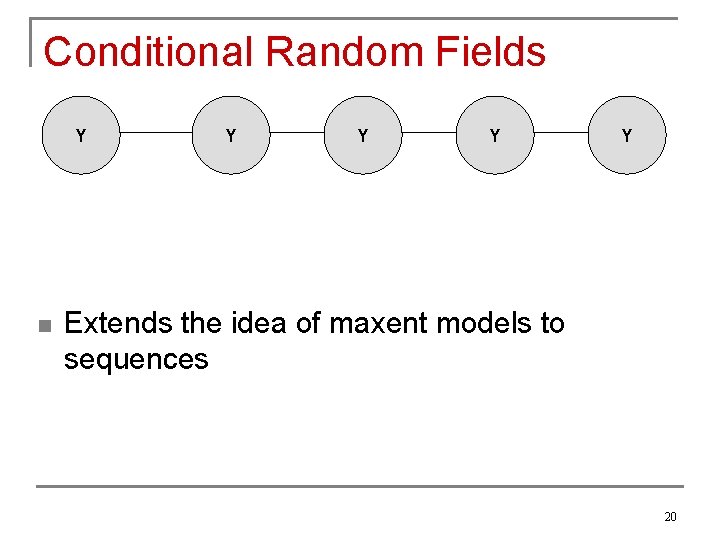
Conditional Random Fields Y n Y Y Extends the idea of maxent models to sequences 20
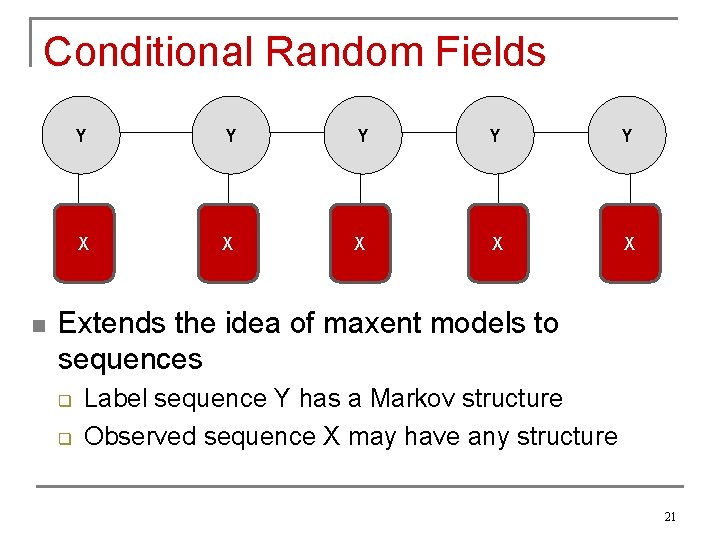
Conditional Random Fields n Y Y Y X X X Extends the idea of maxent models to sequences q q Label sequence Y has a Markov structure Observed sequence X may have any structure 21
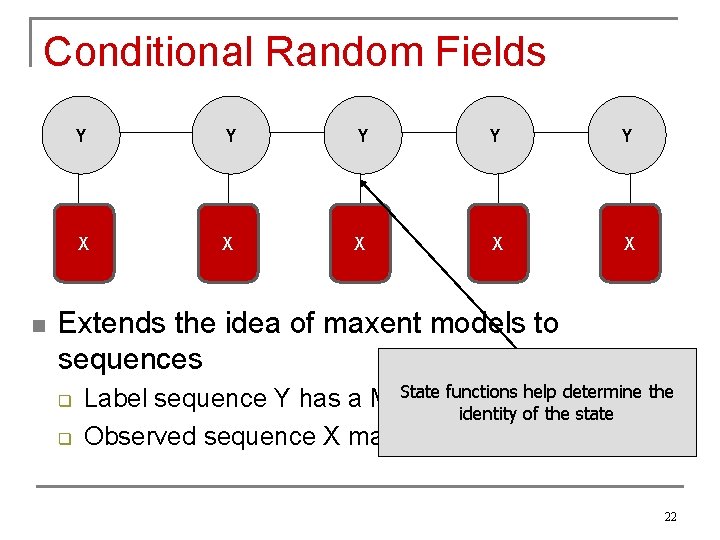
Conditional Random Fields n Y Y Y X X X Extends the idea of maxent models to sequences q q State functions help determine the Label sequence Y has a Markov structure identity of the state Observed sequence X may have any structure 22
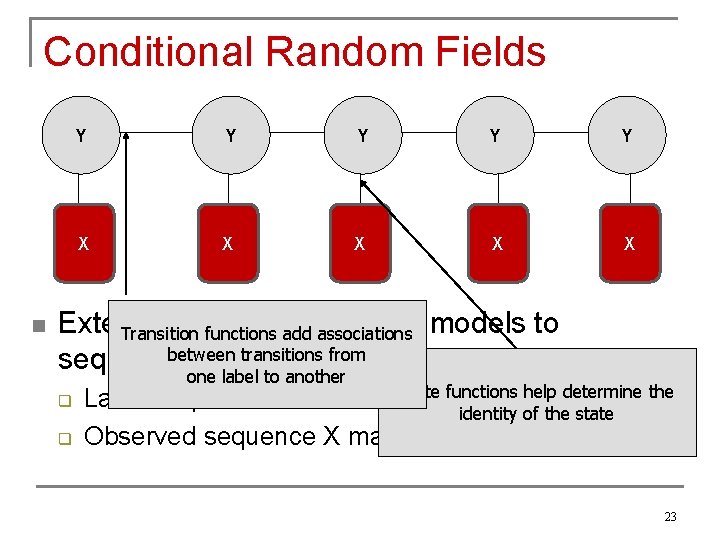
Conditional Random Fields n Y Y Y X X X Extends thefunctions idea add of associations maxent models to Transition between transitions from sequences one label to another q q State functions help determine the Label sequence Y has a Markov structure identity of the state Observed sequence X may have any structure 23
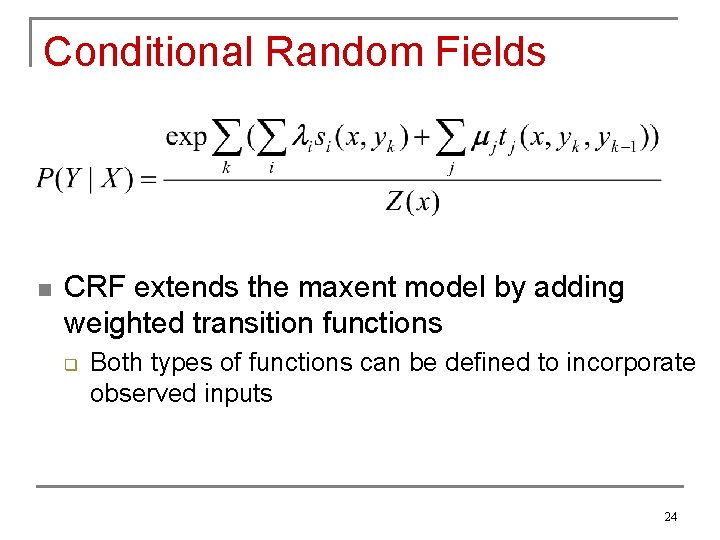
Conditional Random Fields n CRF extends the maxent model by adding weighted transition functions q Both types of functions can be defined to incorporate observed inputs 24
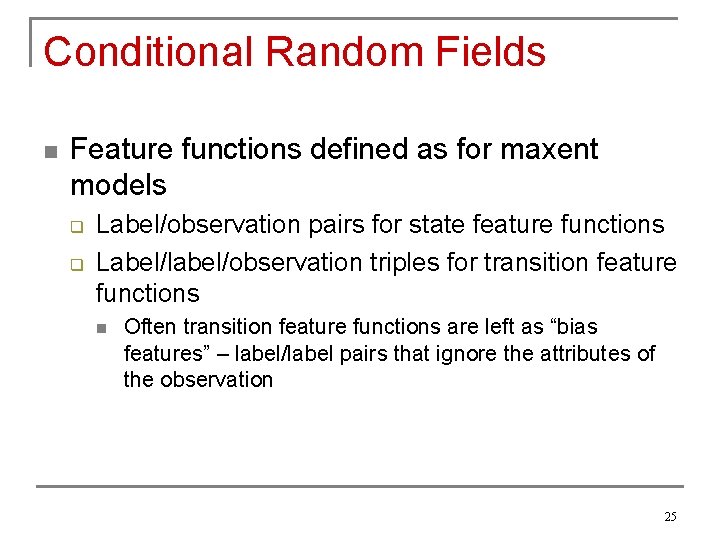
Conditional Random Fields n Feature functions defined as for maxent models q q Label/observation pairs for state feature functions Label/label/observation triples for transition feature functions n Often transition feature functions are left as “bias features” – label/label pairs that ignore the attributes of the observation 25
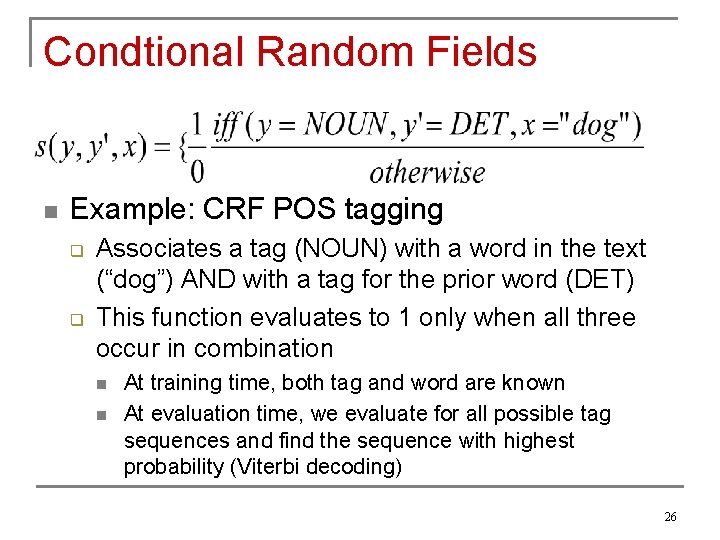
Condtional Random Fields n Example: CRF POS tagging q q Associates a tag (NOUN) with a word in the text (“dog”) AND with a tag for the prior word (DET) This function evaluates to 1 only when all three occur in combination n n At training time, both tag and word are known At evaluation time, we evaluate for all possible tag sequences and find the sequence with highest probability (Viterbi decoding) 26
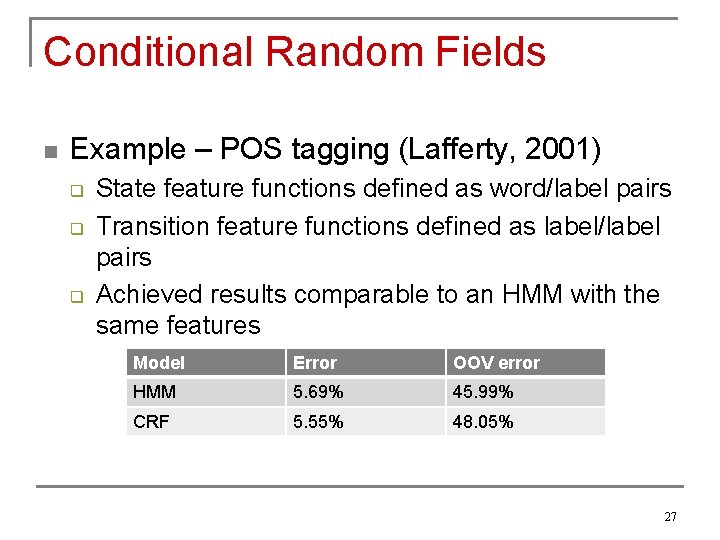
Conditional Random Fields n Example – POS tagging (Lafferty, 2001) q q q State feature functions defined as word/label pairs Transition feature functions defined as label/label pairs Achieved results comparable to an HMM with the same features Model Error OOV error HMM 5. 69% 45. 99% CRF 5. 55% 48. 05% 27
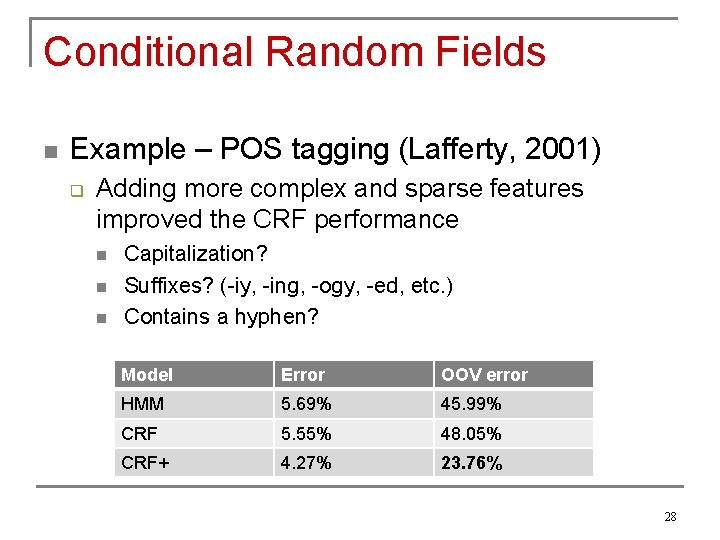
Conditional Random Fields n Example – POS tagging (Lafferty, 2001) q Adding more complex and sparse features improved the CRF performance n n n Capitalization? Suffixes? (-iy, -ing, -ogy, -ed, etc. ) Contains a hyphen? Model Error OOV error HMM 5. 69% 45. 99% CRF 5. 55% 48. 05% CRF+ 4. 27% 23. 76% 28
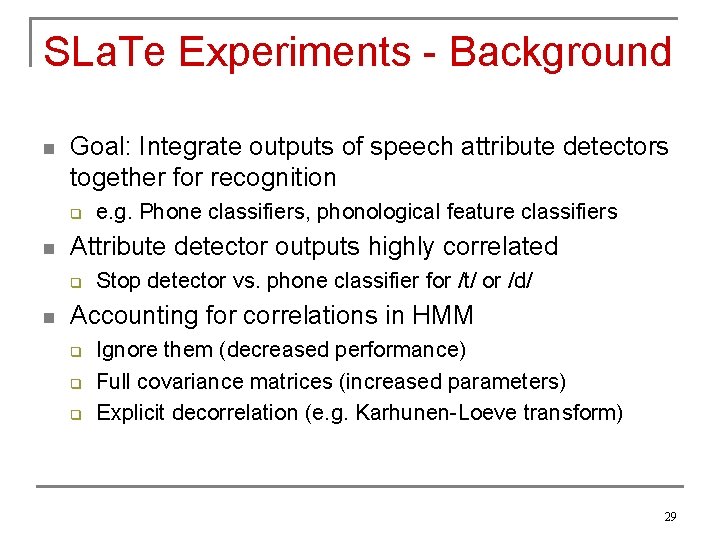
SLa. Te Experiments - Background n Goal: Integrate outputs of speech attribute detectors together for recognition q n Attribute detector outputs highly correlated q n e. g. Phone classifiers, phonological feature classifiers Stop detector vs. phone classifier for /t/ or /d/ Accounting for correlations in HMM q q q Ignore them (decreased performance) Full covariance matrices (increased parameters) Explicit decorrelation (e. g. Karhunen-Loeve transform) 29
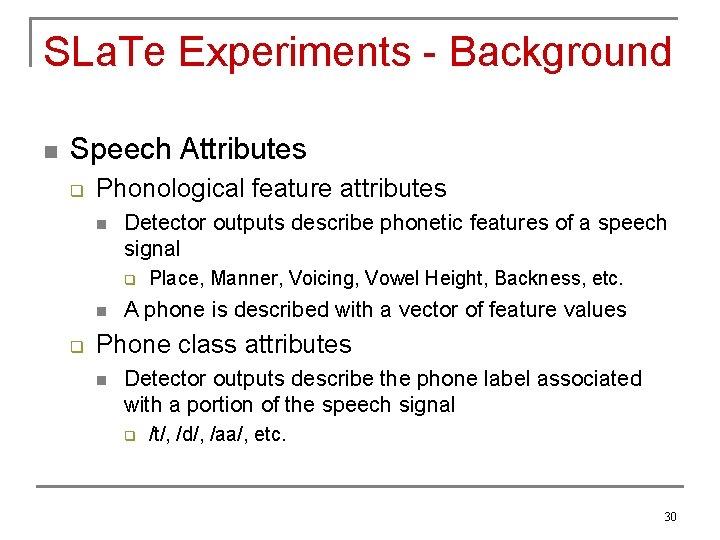
SLa. Te Experiments - Background n Speech Attributes q Phonological feature attributes n Detector outputs describe phonetic features of a speech signal q n q Place, Manner, Voicing, Vowel Height, Backness, etc. A phone is described with a vector of feature values Phone class attributes n Detector outputs describe the phone label associated with a portion of the speech signal q /t/, /d/, /aa/, etc. 30
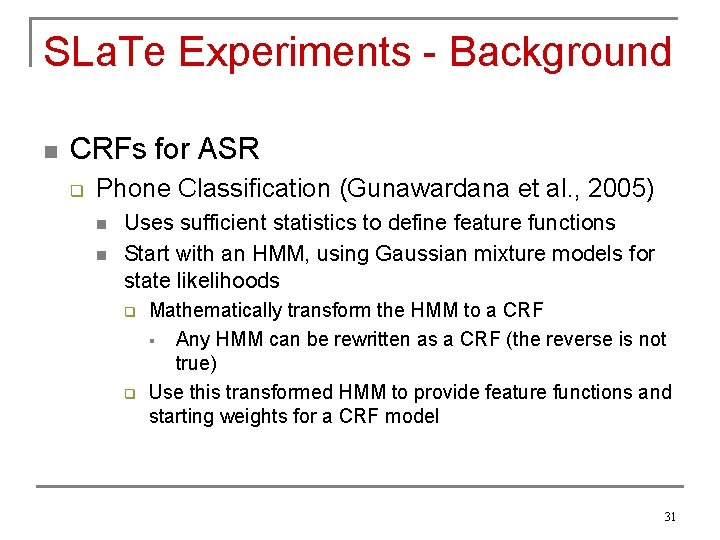
SLa. Te Experiments - Background n CRFs for ASR q Phone Classification (Gunawardana et al. , 2005) n n Uses sufficient statistics to define feature functions Start with an HMM, using Gaussian mixture models for state likelihoods q q Mathematically transform the HMM to a CRF § Any HMM can be rewritten as a CRF (the reverse is not true) Use this transformed HMM to provide feature functions and starting weights for a CRF model 31
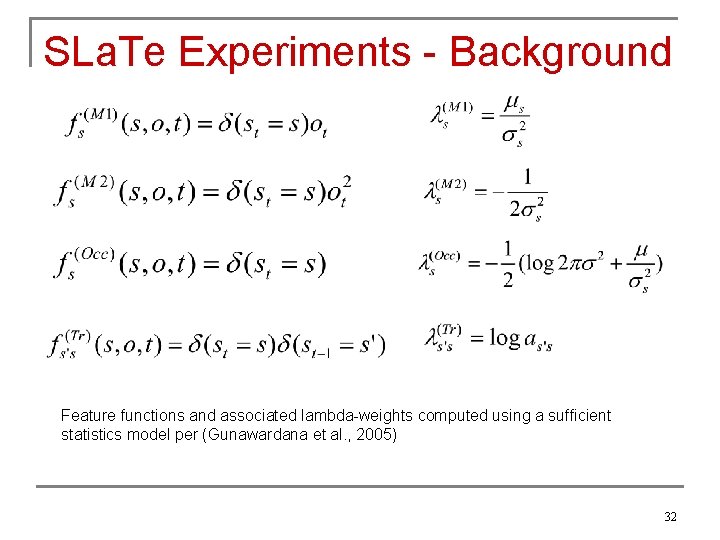
SLa. Te Experiments - Background Feature functions and associated lambda-weights computed using a sufficient statistics model per (Gunawardana et al. , 2005) 32
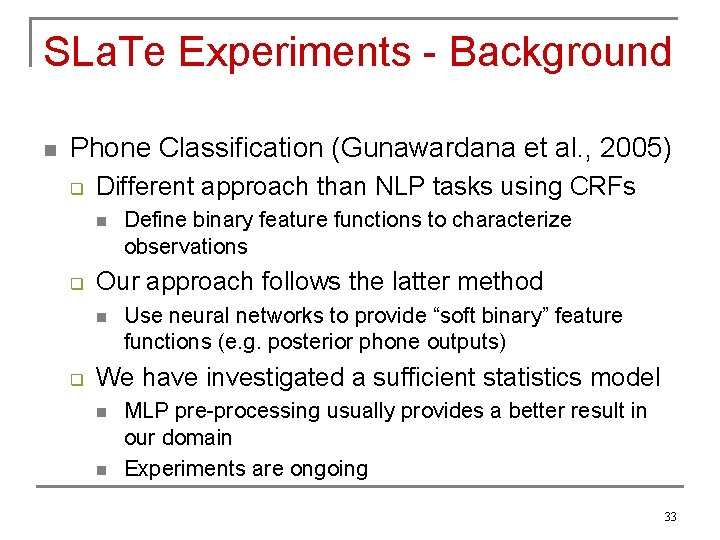
SLa. Te Experiments - Background n Phone Classification (Gunawardana et al. , 2005) q Different approach than NLP tasks using CRFs n q Our approach follows the latter method n q Define binary feature functions to characterize observations Use neural networks to provide “soft binary” feature functions (e. g. posterior phone outputs) We have investigated a sufficient statistics model n n MLP pre-processing usually provides a better result in our domain Experiments are ongoing 33
SLa. Te Experiments n Implemented CRF models on data from phonetic attribute detectors q q n Performed phone recognition Compared results to Tandem/HMM system on same data Experimental Data q TIMIT corpus of read speech 34
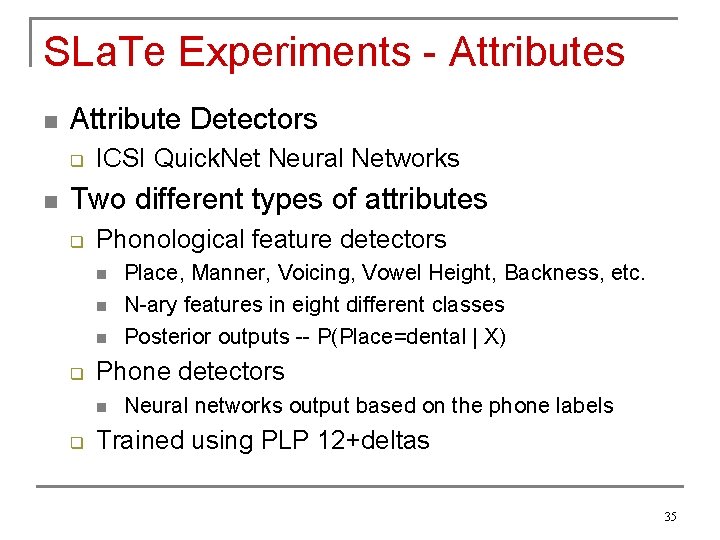
SLa. Te Experiments - Attributes n Attribute Detectors q n ICSI Quick. Net Neural Networks Two different types of attributes q Phonological feature detectors n n n q Phone detectors n q Place, Manner, Voicing, Vowel Height, Backness, etc. N-ary features in eight different classes Posterior outputs -- P(Place=dental | X) Neural networks output based on the phone labels Trained using PLP 12+deltas 35
SLa. Te Experiments - Setup n CRF code q q Built on the Java CRF toolkit from Sourceforge http: //crf. sourceforge. net Performs maximum log-likelihood training Uses Limited Memory BGFS algorithm to perform minimization of the log-likelihood gradient 36
Experimental Setup n Feature functions built using the neural net output q q q Each attribute/label combination gives one feature function Phone class: s/t/, /t/ or s/t/, /s/ Feature class: s/t/, stop or s/t/, dental 37
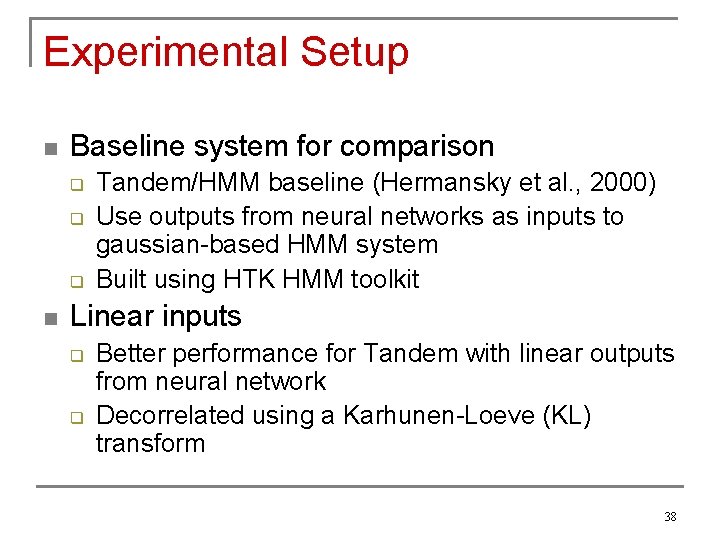
Experimental Setup n Baseline system for comparison q q q n Tandem/HMM baseline (Hermansky et al. , 2000) Use outputs from neural networks as inputs to gaussian-based HMM system Built using HTK HMM toolkit Linear inputs q q Better performance for Tandem with linear outputs from neural network Decorrelated using a Karhunen-Loeve (KL) transform 38
Initial Results (Morris & Fosler-Lussier, Model Params Phone 06) Accuracy Tandem [1] (phones) 20, 000+ 60. 82% Tandem [3] (phones) 4 mix 420, 000+ 68. 07%* CRF [1] (phones) 5280 67. 32%* Tandem [1] (feas) 14, 000+ 61. 85% Tandem [3] (feas) 4 mix 360, 000+ 68. 30%* CRF [1] (feas) 4464 65. 45%* Tandem [1] (phones/feas) 34, 000+ 61. 72% Tandem [3] (phones/feas) 4 mix 774, 000+ 68. 46% CRF (phones/feas) 7392 68. 43%* * Significantly (p<0. 05) better than comparable Tandem monophone system * Significantly (p<0. 05) better than comparable CRF monophone system 39
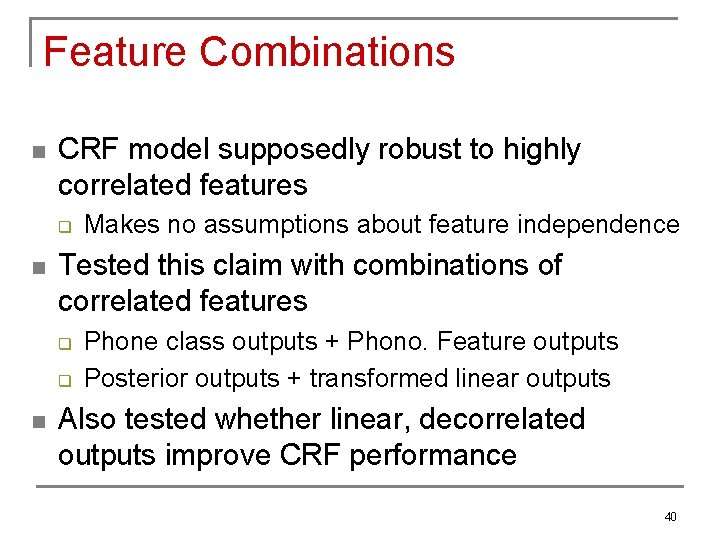
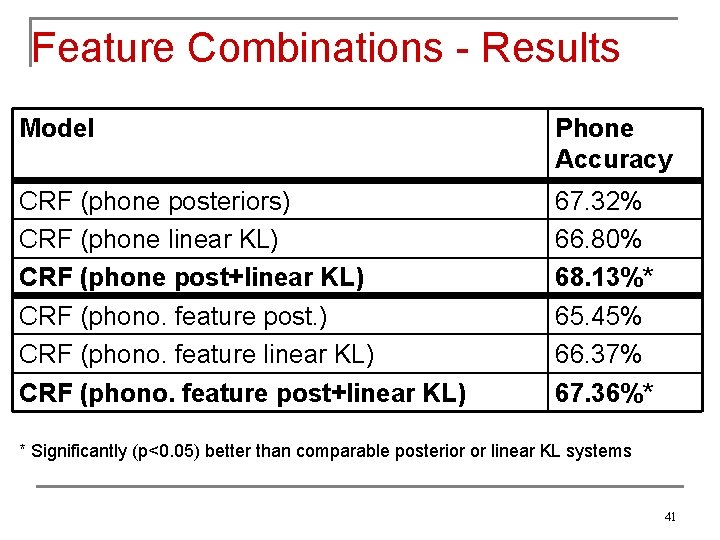
Feature Combinations n CRF model supposedly robust to highly correlated features q n Tested this claim with combinations of correlated features q q n Makes no assumptions about feature independence Phone class outputs + Phono. Feature outputs Posterior outputs + transformed linear outputs Also tested whether linear, decorrelated outputs improve CRF performance 40
Feature Combinations - Results Model Phone Accuracy CRF (phone posteriors) CRF (phone linear KL) CRF (phone post+linear KL) CRF (phono. feature post. ) CRF (phono. feature linear KL) CRF (phono. feature post+linear KL) 67. 32% 66. 80% 68. 13%* 65. 45% 66. 37% 67. 36%* * Significantly (p<0. 05) better than comparable posterior or linear KL systems 41
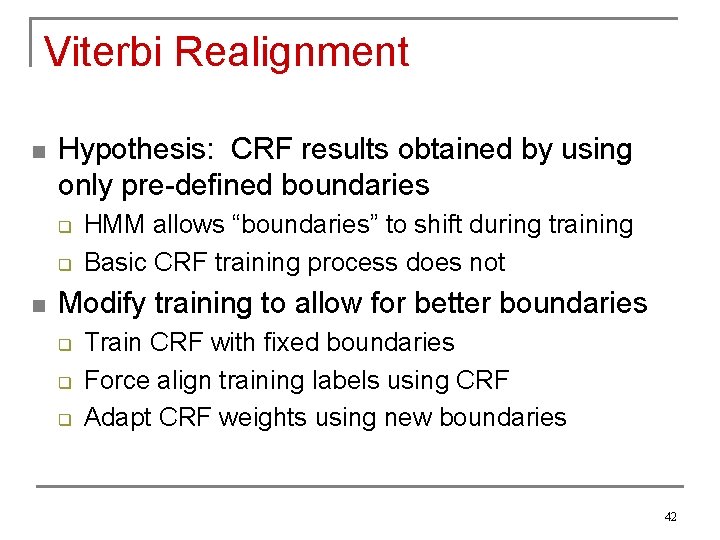
Viterbi Realignment n Hypothesis: CRF results obtained by using only pre-defined boundaries q q n HMM allows “boundaries” to shift during training Basic CRF training process does not Modify training to allow for better boundaries q q q Train CRF with fixed boundaries Force align training labels using CRF Adapt CRF weights using new boundaries 42
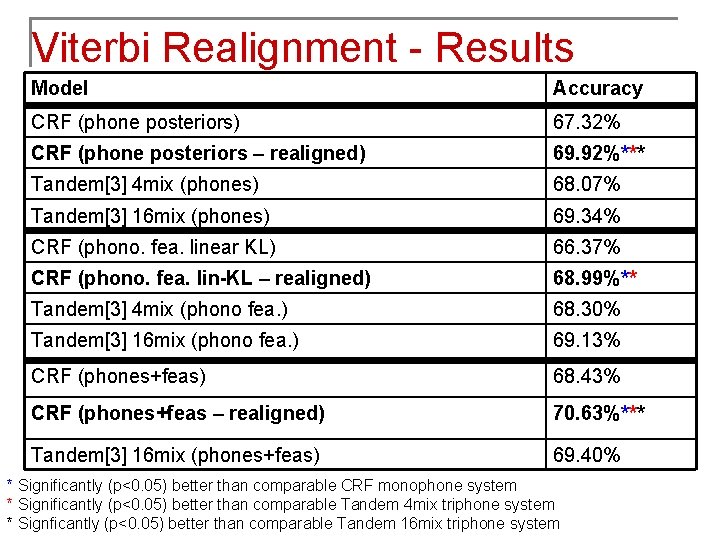
Viterbi Realignment - Results Model Accuracy CRF (phone posteriors) 67. 32% CRF (phone posteriors – realigned) 69. 92%*** Tandem[3] 4 mix (phones) 68. 07% Tandem[3] 16 mix (phones) 69. 34% CRF (phono. fea. linear KL) 66. 37% CRF (phono. fea. lin-KL – realigned) 68. 99%** Tandem[3] 4 mix (phono fea. ) 68. 30% Tandem[3] 16 mix (phono fea. ) 69. 13% CRF (phones+feas) 68. 43% CRF (phones+feas – realigned) 70. 63%*** Tandem[3] 16 mix (phones+feas) 69. 40% * Significantly (p<0. 05) better than comparable CRF monophone system * Significantly (p<0. 05) better than comparable Tandem 4 mix triphone system * Signficantly (p<0. 05) better than comparable Tandem 16 mix triphone system 43
Conclusions n Using correlated features in the CRF model did not degrade performance q n Extra features improved performance for the CRF model across the board Viterbi realignment training significantly improved CRF results q Improvement did not occur when best HMMaligned transcript was used for training 44
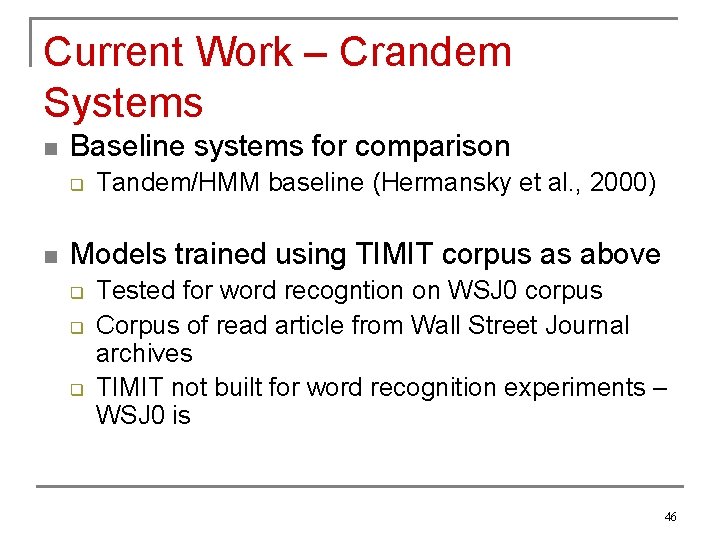
Current Work - Crandem Systems n Idea – use the CRF model to generate features for an HMM q q q Similar to the Tandem HMM systems, replacing the neural network outputs with CRF outputs Use forward-backward algorithm to compute posterior probabilities for each frame of input data Preliminary phone-recognition experiments show promise n Preliminary attempts to incorporate CRF features at the word level are less promising 45
Current Work – Crandem Systems n Baseline systems for comparison q n Tandem/HMM baseline (Hermansky et al. , 2000) Models trained using TIMIT corpus as above q q q Tested for word recogntion on WSJ 0 corpus Corpus of read article from Wall Street Journal archives TIMIT not built for word recognition experiments – WSJ 0 is 46
Current Work - Crandem Systems Model Baseline Tandem MLP [phone classes] Crandem MLP [phone classes] Baseline Tandem MLP [phone + phono] Crandem MLP [phone + phono] Word Accuracy 90. 30% 90. 95% 91. 26% 91. 31% 47
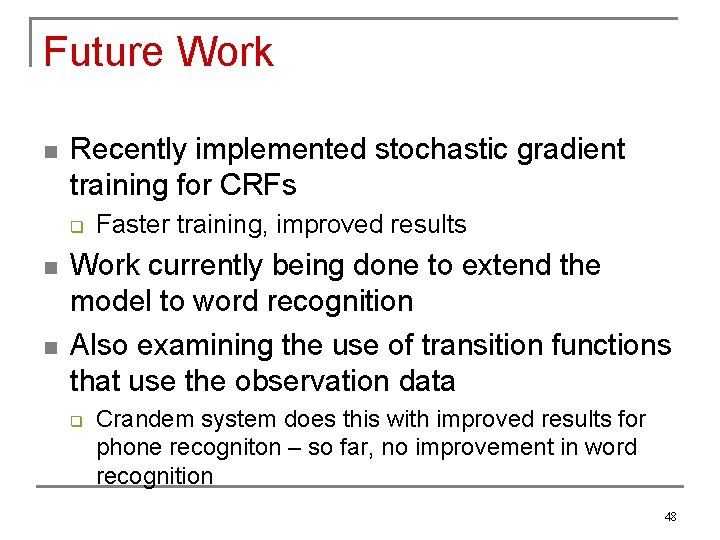
Future Work n Recently implemented stochastic gradient training for CRFs q n n Faster training, improved results Work currently being done to extend the model to word recognition Also examining the use of transition functions that use the observation data q Crandem system does this with improved results for phone recogniton – so far, no improvement in word recognition 48
References n n J. Lafferty et al, “Conditional Random Fields: Probabilistic models for segmenting and labeling sequence data”, Proc. ICML, 2001 A. Berger, “A Brief Max. Ent Tutorial”, http: //www. cs. cmu. eu/afs/cs/user/aberger/www/html/tutor ial/tutorial. html R. Rosenfeld, “Adaptive statistical language modeling: a maximum entropy approach”, Ph. D thesis, CMU, 1994 A. Gunawardana et al, “Hidden Conditional Random Fields for phone classification”, Proc. Interspeech, 2005 49
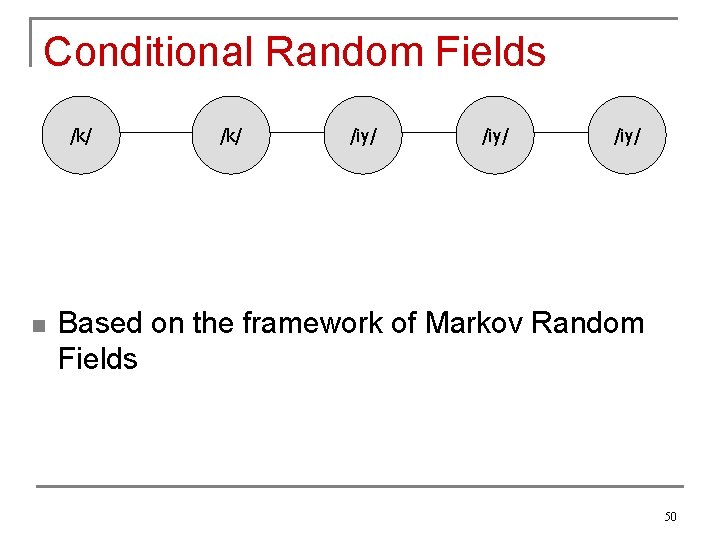
Conditional Random Fields /k/ n /k/ /iy/ Based on the framework of Markov Random Fields 50
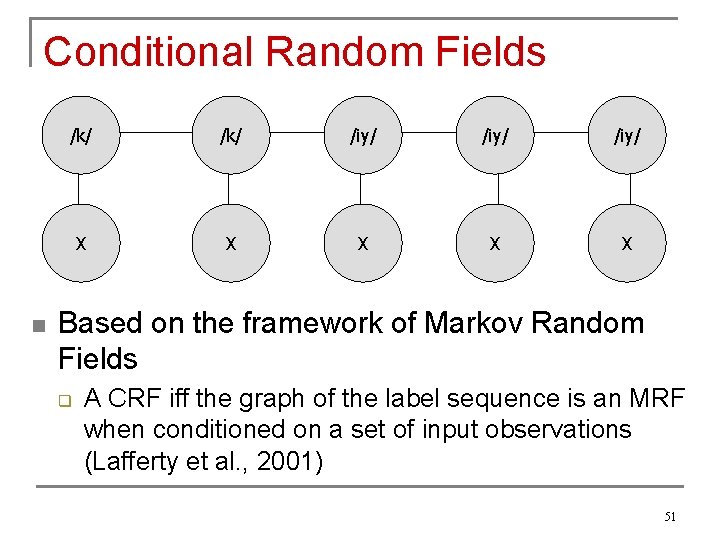
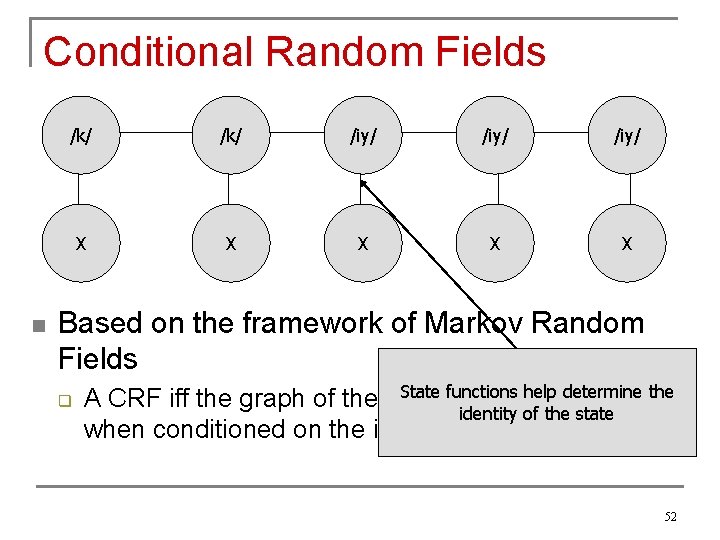
Conditional Random Fields n /k/ /iy/ X X X Based on the framework of Markov Random Fields q A CRF iff the graph of the label sequence is an MRF when conditioned on a set of input observations (Lafferty et al. , 2001) 51
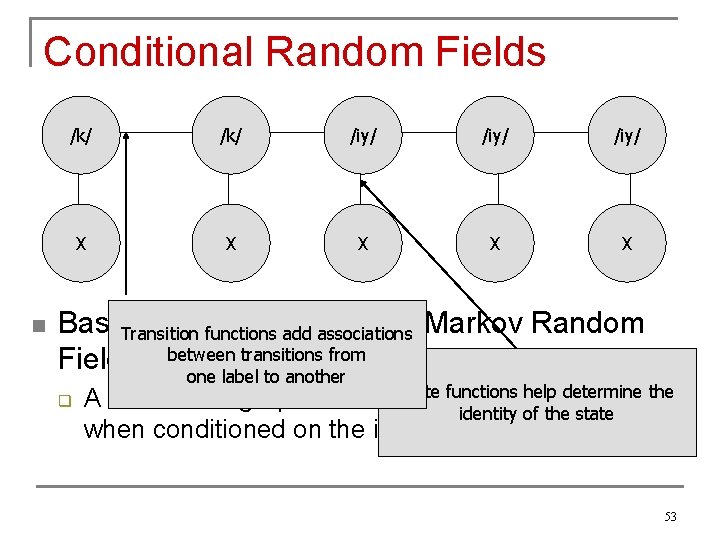
Conditional Random Fields n /k/ /iy/ X X X Based on the framework of Markov Random Fields q State functions help determine the A CRF iff the graph of the label sequence is an MRF identity of the state when conditioned on the input observations 52
Conditional Random Fields n /k/ /iy/ X X X Based on the framework of Markov Random Transition functions add associations transitions from Fields between one label to another q State functions help determine the A CRF iff the graph of the label sequence is an MRF identity of the state when conditioned on the input observations 53
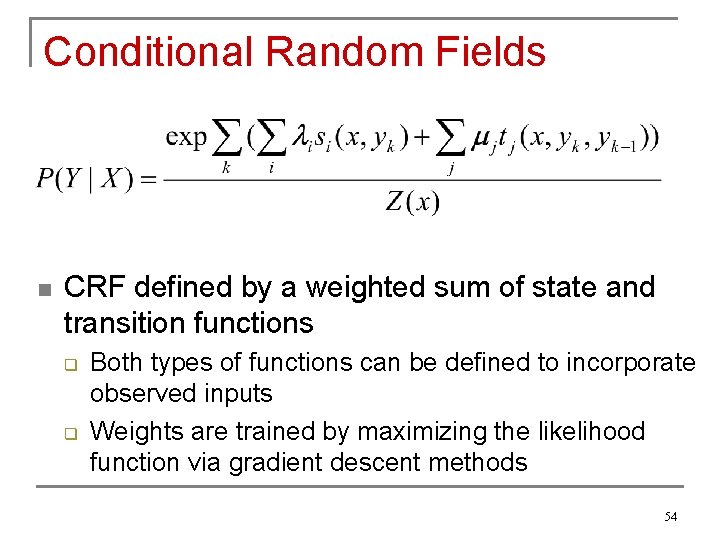
Conditional Random Fields n CRF defined by a weighted sum of state and transition functions q q Both types of functions can be defined to incorporate observed inputs Weights are trained by maximizing the likelihood function via gradient descent methods 54